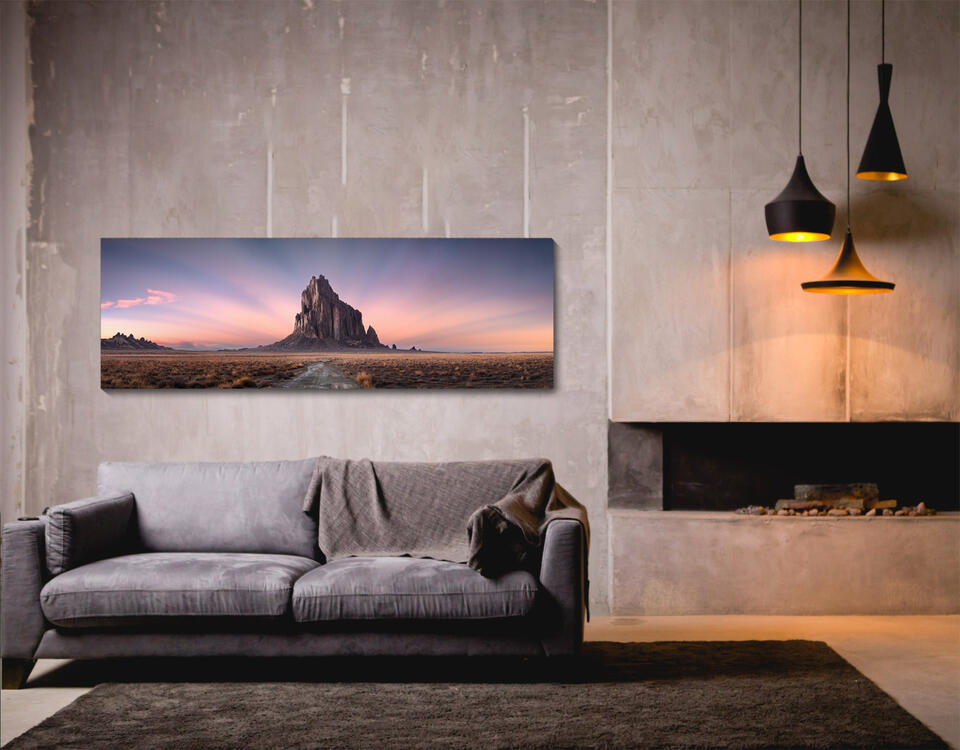
Why Scale Matters: The Psychology of Large Format Landscape Photography
There is a difference between looking at a landscape and being inside one. Most people have felt this distinction without being able to name it. You stand at the edge of the Grand Canyon and something happens that no photograph on a phone screen has ever produced. The world stops. The context around you disappears. You are no longer a person observing a scene. You are a person absorbed by one.
This is not simply a matter of size. It is a matter of psychology. And understanding it changes everything about how you choose the art you bring into your home.
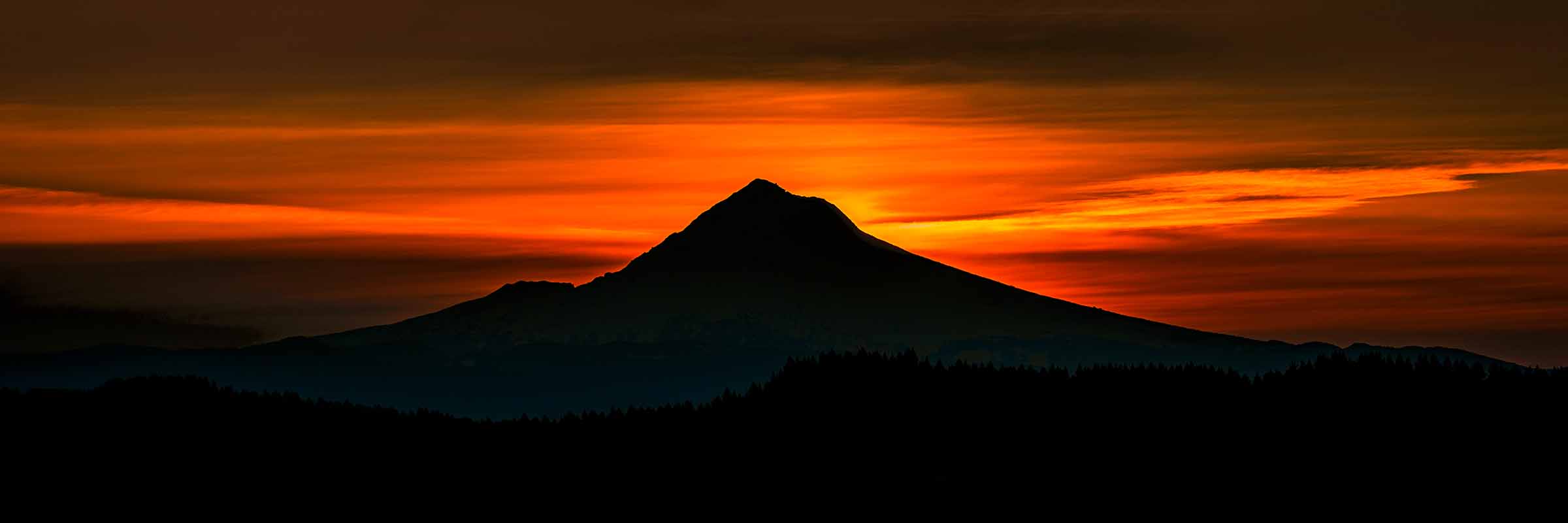
View Available Prints of Hood in Shadow
Mount Hood holds its form against a sky still burning with the last of the light. Stripped to silhouette, the mountain becomes less a place than a presence, the kind of shape the mind settles on when everything else has gone quiet.
The Moment Scale Becomes Personal
I have stood at the rim of the Grand Canyon more than once, and the experience never becomes ordinary. Looking over the edge, the mind does not simply register depth and distance. It begins to contemplate time. How long did the Colorado River work at this stone to carve what stands before me? How many centuries passed between the first cut and the canyon I am standing above now? I find myself thinking about the first people who crossed this landscape and stumbled upon this view without warning, with no photographs to prepare them, no context for what they were seeing. How did that feel? What did it do to them?
Every one of those thoughts is a movement away from myself and toward something vastly larger. My problems, my decisions, my daily concerns, none of them survive contact with that kind of scale. They do not disappear, but they shrink to their actual proportions. And in that shrinking there is something that feels remarkably like relief.
I had a similar experience standing at the Valley View lookout in Yosemite, surrounded by trees and mountains and the full sweep of the valley below, recognizing landscapes I had seen in photographs for years but had never experienced in person. What struck me most was thinking about the first person to arrive at that view. No roads, no visitor center, no interpretive signs. Just a human being encountering something that exceeded every scale of reference they had ever known. That encounter must have been overwhelming in the most complete and clarifying sense of the word.
These experiences are what I am trying to give people when I create large format landscape work. Not a record of a place, but a threshold into a psychological state that most of us rarely access in daily life.

View Available Prints of Mountain of Riches
The Superstition Mountains rise from the Sonoran floor while a single saguaro holds the foreground at human height. That lone column gives the eye a measure, and against it the cliff face above reads as immense. Scale here is not stated. It is constructed, the near and the far set in deliberate relation so the mountain looms rather than merely appears.
What Happens When Scale Exceeds the Visual Field
When a large-scale nature photograph exceeds the viewer's normal field of vision, something fundamental shifts. You are no longer looking at an image. You are entering an environment.
Environmental psychology, aesthetic philosophy, and phenomenology converge on this point. Vastness has long been associated with what thinkers from Edmund Burke to Immanuel Kant described as the Sublime, the aesthetic category reserved for experiences that exceed the mind's capacity to fully contain them. When the edges of an image disappear from your peripheral vision, the brain struggles to cognitively frame what it is seeing. This perceptual limit triggers what contemporary researchers call the small self effect, a temporary feeling of personal diminishment that is experienced not as threat but as relief. When you feel small before something genuinely vast, your individual concerns feel proportionally less central. The mental noise quiets. Perspective arrives without effort.
As the frame recedes from awareness entirely, something deeper occurs. Without clear visual boundaries, the brain begins to process the scene less as an object and more as a surrounding space. This perceptual engulfment produces a sense of presence and absorption similar to mild flow states, in which self-conscious awareness softens and the boundary between viewer and image begins to dissolve. You are no longer standing in a room looking at a wall. You are standing somewhere else entirely.
Attention restoration theory adds another dimension to this. Large-scale nature imagery provides what the Kaplans described as extent, the quality of an environment being large and coherent enough to fully occupy the mind. When a landscape print fills your visual field, it does not leave attentional room for competing thoughts. The directed attention system is gently relieved of duty. Soft fascination takes over. The mind wanders through the image rather than through its own anxieties.
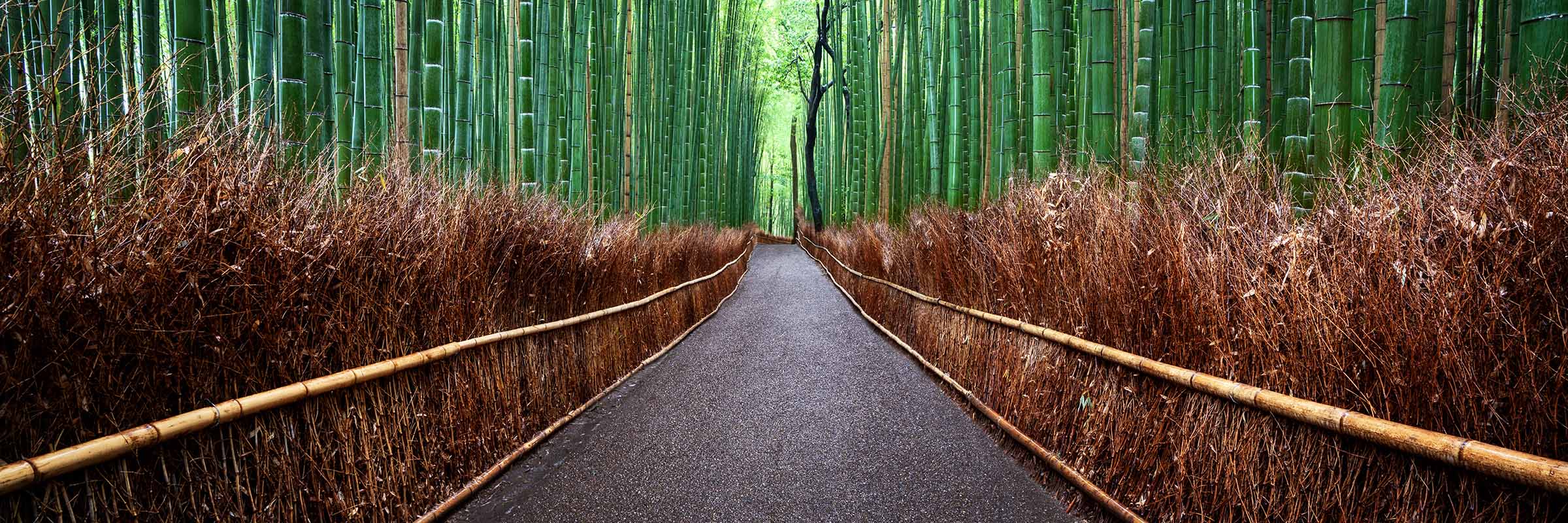
In Arashiyama, the grove closes gently around the path, and something in you begins to slow. I photographed this corridor early in the morning before the crowds arrived, when the light was soft, the path was empty, and the bamboo rose on both sides in quiet symmetry.
View Available Prints of Still Passage
Scale and the Prospect Refuge Response
Prospect refuge theory offers a final layer to understanding why large format landscape photography produces such a distinctive psychological experience. A vast horizon in an image suggests openness and possibility, activating the deep evolutionary response to landscapes that offer visibility and opportunity. Simultaneously, the physical safety of your own room provides refuge. This pairing of expansive visual prospect with physical security can generate a simultaneous feeling of exhilaration and calm that is difficult to produce through any other means.
What begins as awe gradually transitions into embodied stillness. The image moves you, and then it settles you. Research aligned with the biophilia hypothesis adds that exposure to natural forms and fractal patterns is associated with physiological calming, including reduced stress reactivity and increased relaxation. Taken together, standing before a large nature photograph may begin with a moment of awe and gradually transition into the cognitive quiet and reduced mental fatigue that attention restoration theory describes.
The emotional journey from perceptual expansion to psychological rest is not incidental. It is the point.
When the Panorama Requires the Wall
Not all scale is vertical. Some of the most psychologically immersive landscape images operate through horizontal sweep, the panoramic format that places the viewer at the center of a scene that extends beyond the edges of awareness in both directions simultaneously.
Badlands Burn was made in the South Dakota Badlands as a storm broke over the distant grassland and a single shaft of light opened in the clouds. The panoramic format of this image is essential to its psychological effect. The eroded ridges fill the lower register of the frame at eye level when printed large, drawing the viewer down into the foreground while the prairie and the storm recede toward a horizon that sits far beyond arm's reach. This is an image that does not simply show a landscape. It places you inside one.
A panoramic landscape printed small becomes a postcard. The same image printed at sixty inches or more becomes an environment. The composition is designed for the latter. The viewer's peripheral vision is engaged on both sides simultaneously, which is the specific perceptual condition that initiates the engulfment response. Without that scale, the image is merely observed. With it, the image is inhabited.
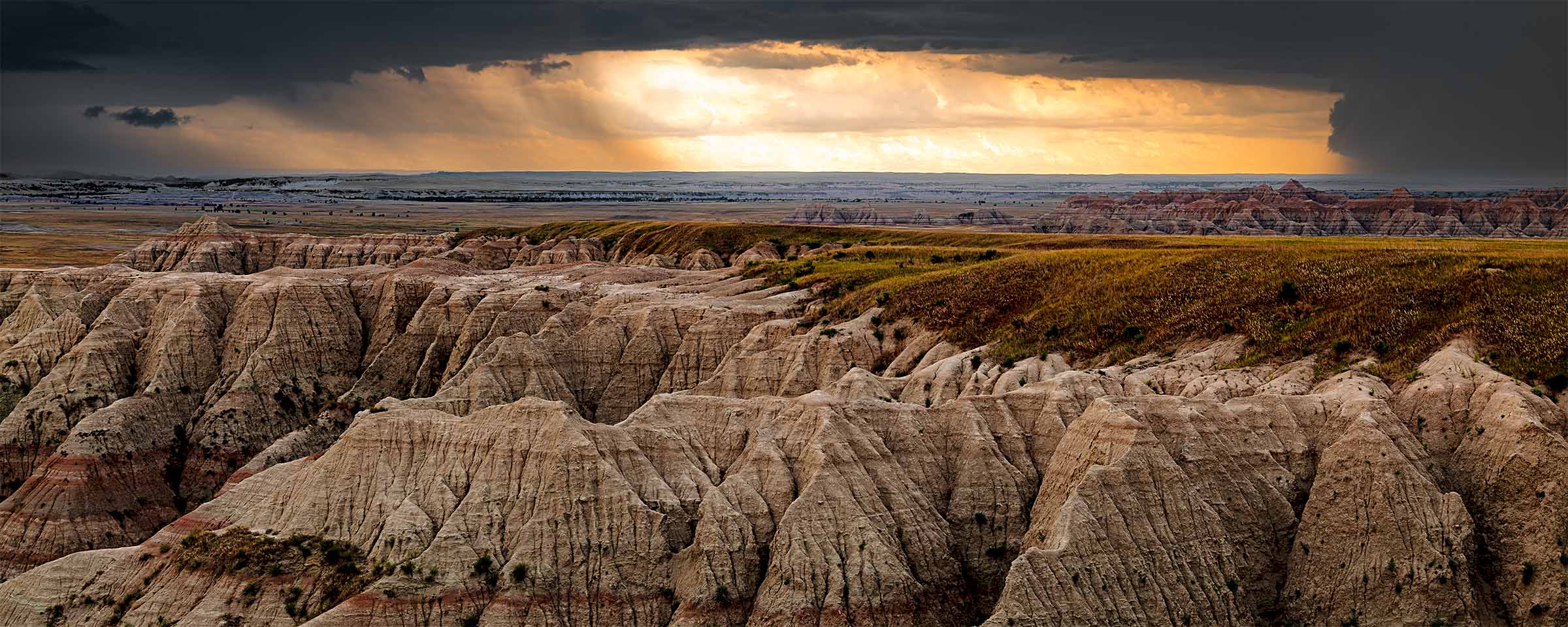
View Available Prints of Badlands Burn
The storm pulled the light into a single opening above the grassland, and for a moment the whole expanse of the Badlands seemed lit from within. The eroded ridges in the foreground give the eye somewhere to begin before the land falls away toward a horizon that never quite resolves.
What Color Removes and What It Leaves Behind
There is a specific and revealing experiment available to any collector who wants to understand what scale is really doing in a landscape image. Look at a black and white print of a vast landscape and notice what remains when color is taken away. What you are left with is purely form, spatial relationship, and light. If the scale experience survives that reduction, the image has genuine psychological depth. If it does not, the color was doing most of the work.
The Serpent's Watch was made from the North Rim of the Grand Canyon, looking down the full depth of Toroweap Overlook as the Colorado River catches the light far below. The choice to render this image in black and white was deliberate. Color would direct the eye immediately to the river and flatten everything else into backdrop. Without it, the entire spatial structure of the canyon asserts itself. The stratified walls, the receding haze through five miles of atmosphere, the implied thousand-foot drop beneath the foreground ledge, all of it reads at once because nothing competes for attention. The scale experience is not softened by warmth or drama. It is simply present, quietly and completely.
Printed large, this image does not invite you to admire the canyon. It places you at the edge of it. That is not the same thing.
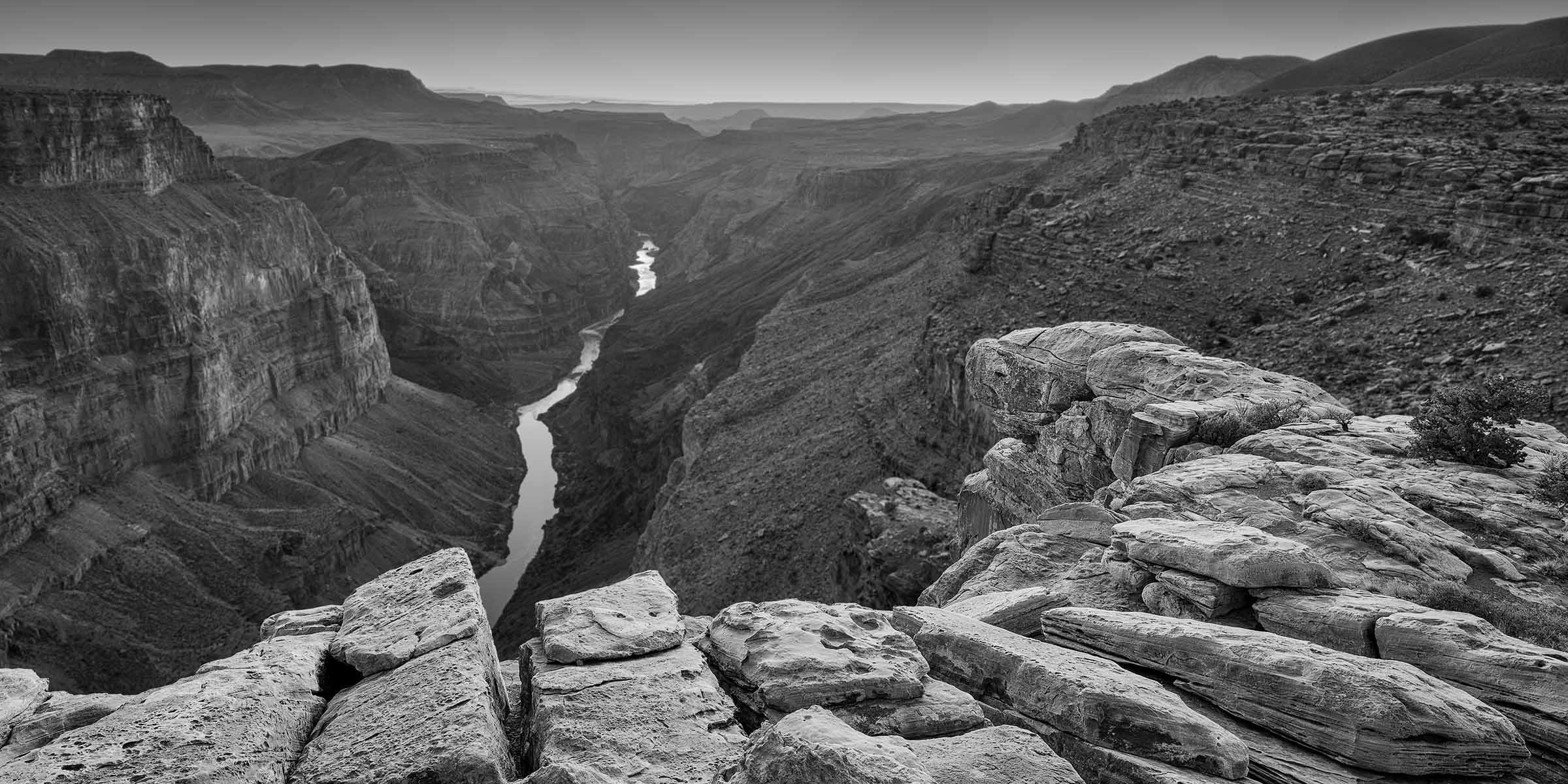
It was not placed here. It was revealed.
At the edge of Toroweap Point, wind and water shaped the sandstone over millions of years into forms that feel almost beyond explanation. On the right side of the overlook, one formation carries the unmistakable profile of a serpent’s head, raised and still, watching over the canyon below.
View Available Prints of The Serpent's Watch
The Scale We Forget to Consider
Most conversations about scale in landscape photography focus on the horizontal plane, the width of a panorama, the depth of a canyon, the sweep of a mountain range. But there is another dimension of scale that is perhaps the most humbling of all, and that is the vertical scale of the cosmos itself.
Mother Earth, Father Sky adds the dimension that no purely terrestrial image can address. The sandstone buttes of Monument Valley stand on the desert floor as the Milky Way arches across the full width of the sky above them. The buttes are the product of tens of millions of years of erosion, and yet beneath the galactic arch they read as recent, almost momentary. The image holds two clocks at once, the geological time written into the stone and the cosmic time written into light that has traveled from stars across distances the mind cannot hold. Printed large, it does not simply show stars. It places the viewer at the precise point where the terrestrial and the cosmic meet, which may be the most complete scale experience a single image can offer.
When the arc of the Milky Way fills your peripheral vision and the buttes at the base of the frame anchor the eye at something near human reference, the scale of the image becomes the scale of everything. That is not a metaphor. It is a perceptual fact.

View Available Prints of Mother Earth, Father Sky
The Milky Way arched across the full width of the sky above Monument Valley, and the buttes that have stood for ages suddenly seemed young beneath it. In that alignment of stone and starlight, two scales of time met in a single frame.
Scale That Surrounds Rather Than Recedes
Everything described so far depends on vastness, on a landscape opening outward until its edges leave your field of view. But immersion has a second form, and it works in the opposite direction. Some images surround the viewer not by receding but by closing in.
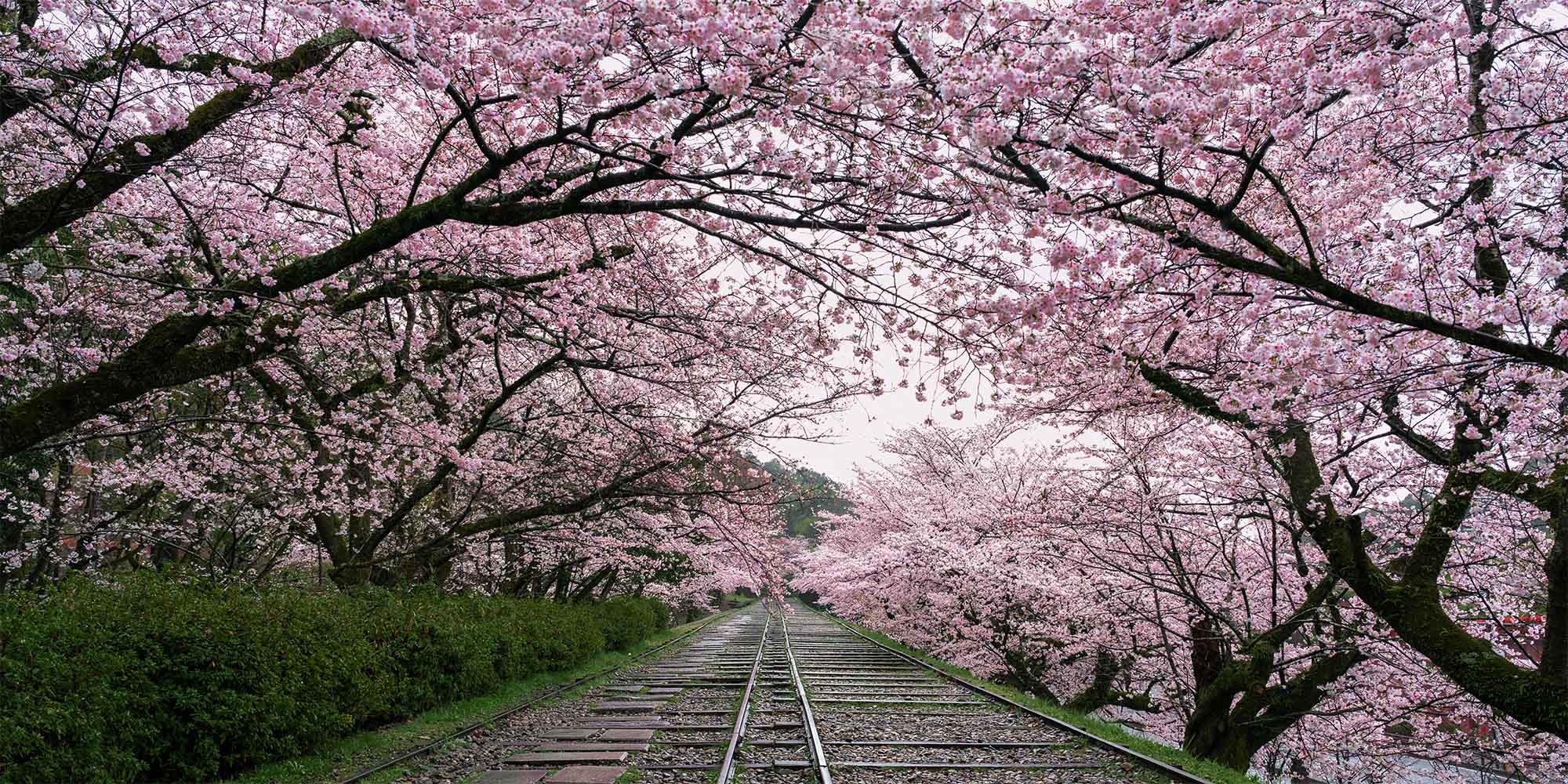
Fleeting was made beneath a corridor of cherry trees in full bloom, the canopy arching overhead until the path ahead nearly disappears into it. There is no distant horizon here and no sense of the infinite. The scale is intimate rather than expansive. Yet printed large, the effect is unmistakably immersive. The branches reach past the edges of the frame, and the viewer is placed inside the tunnel rather than before it. Where a vast landscape produces awe by making you small, an enveloping one produces calm by holding you close.
Both rely on the same principle. At sufficient scale, the image stops being something you look at and becomes something you are within. Vastness and enclosure are simply two routes to the same psychological destination, and a thoughtfully composed space can use either.
View Available Prints of Fleeting
The blossoms closed overhead until the tracks seemed to run straight into the canopy. Where a wide horizon opens the mind outward, this corridor draws it inward, a quieter kind of immersion that surrounds rather than expands.
Scale as a Design Decision
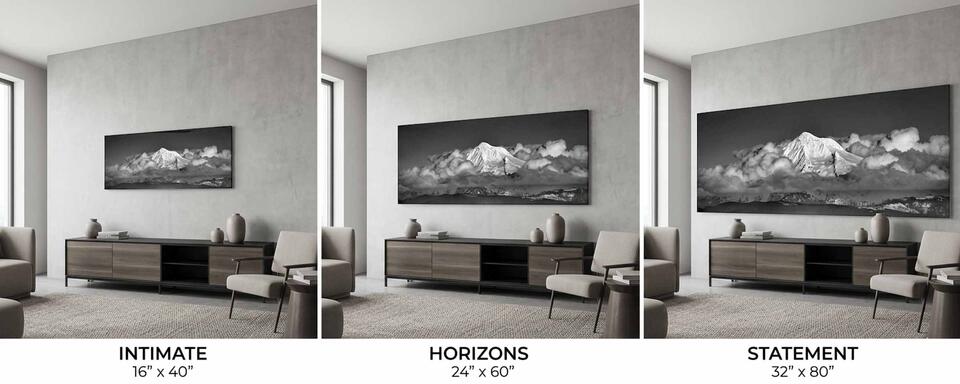
Choosing the scale at which to print and display a landscape photograph is not a decorative decision. It is a psychological one. The same image at twelve inches and at sixty inches are not the same psychological object. One can be observed. The other can be inhabited.
For collectors who are thinking carefully about what they want their spaces to do, this distinction matters enormously. A large format landscape print positioned as the focal point of a primary living or working space does not simply fill a wall. It changes the psychological character of the room. It introduces the experience of vastness into an environment where vastness is otherwise absent. It gives the eye somewhere to go that is genuinely expansive, which is a rare and valuable thing in the built environments most of us inhabit.
The research on this is consistent. Spaces that offer visual depth and natural complexity produce measurably lower stress responses than spaces without them. People in rooms with large scale nature imagery report greater ease, reduced cognitive fatigue, and a stronger sense of psychological presence. These are not subtle effects. They are the difference between a space that depletes you and one that restores you.
Scale is not about filling a wall. It is about what happens to a person when the wall disappears.
Living With Scale
A large format print is not simply a bigger version of a small one. It is a different psychological object, an image you do not so much look at as stand within. If a particular image in this collection has stayed with you, the question worth asking is not whether it is beautiful, but how large it would need to be to place you inside it.
I invite you to spend time with the full collection, where each piece can be seen at the scale and presentation it was made for. And if you are considering a specific space, a wall meant to open a room outward, or a place where you want vastness to enter, I am always glad to think it through with you. A complimentary digital mockup will let you see a chosen image at scale within your own space before you decide. There is no urgency in any of this. A print you intend to live inside for years is worth choosing slowly, and on purpose.
Featured Fine Art Prints for Why Scale Matters
Steve Austin is a psychology professor, behavioral neuroscientist, and fine art landscape photographer. His limited edition landscape prints are available through Steve Austin Fine Art Photography at steveaustinphotography.com. Complimentary digital mockups are available for those who would like to visualize a piece within their own space.