
About Steve Austin - Psychology Professor & Artist
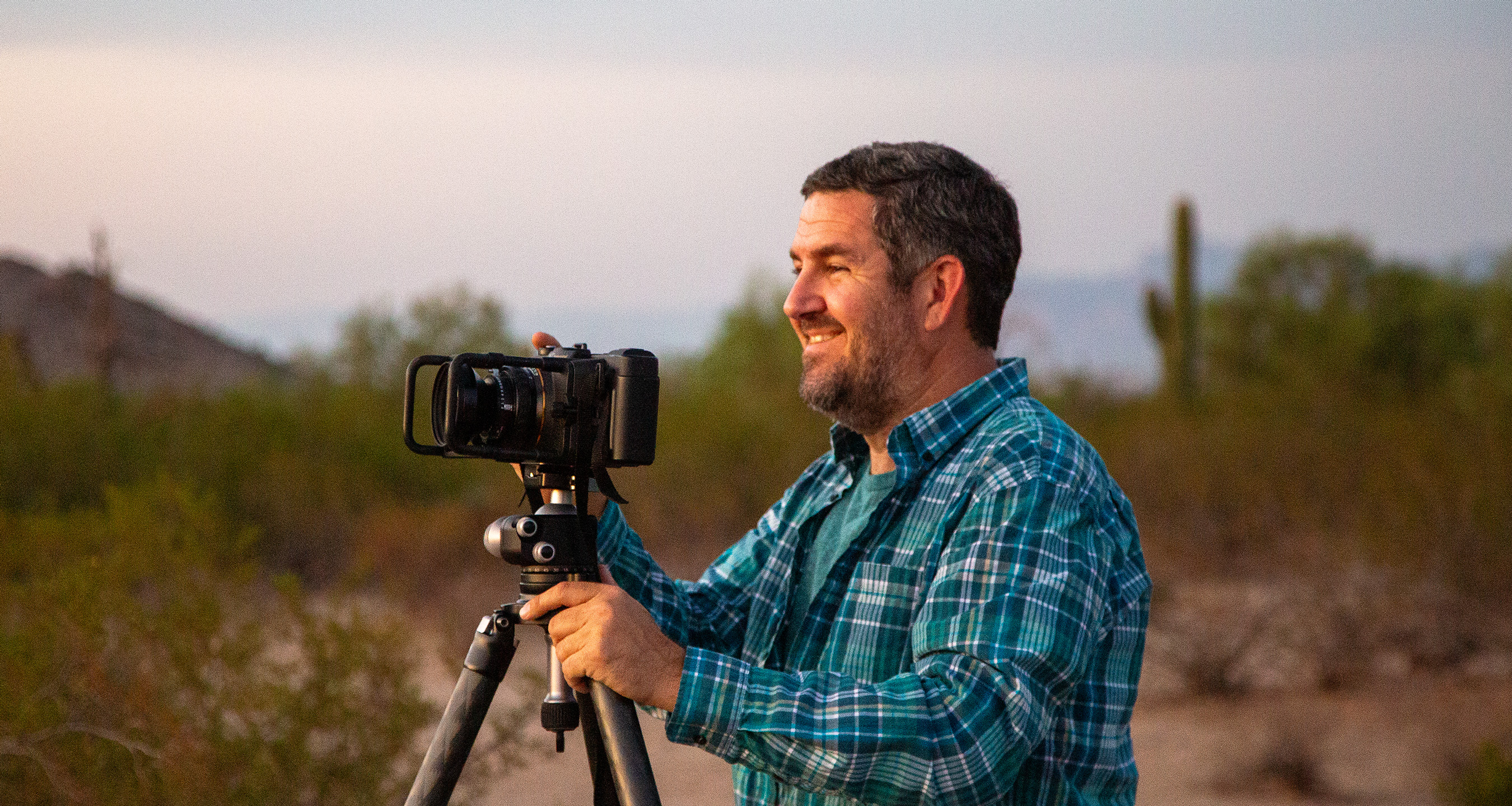
Most landscape photographers are drawn to nature because of how it looks. Steve Austin is drawn to it because of what it does.
Austin is a psychology faculty member and behavioral neuroscientist based in Arizona, where he was born and raised on a steady diet of Arizona Highways magazine and the kind of landscape that makes a person understand instinctively that certain places do something to you that others do not. That early intuition, that nature has a measurable effect on the human mind, became the organizing question of his academic career.
Steve Austin · Psychology Faculty, Behavioral Neuroscientist, Fine Art Photographer
Master of Arts, Psychology (Behavioral Neuroscience), Arizona State University, 2006. Thesis: Parametric Studies of Electrically Evoked Rotation and Dopamine Overflow.
Bachelor of Science, Psychology, minor in Philosophy, Arizona State University, 2002
Doctoral candidate, Educational Leadership, Northern Arizona University
Faculty, Psychology, GateWay Community College, Phoenix, since 2010. Arts, Humanities, Behavioral and Social Sciences.
Faculty Associate, Psychology, Arizona State University Polytechnic, since 2019. Human Cognition and Statistics.
American Psychological Association · Professional Photographers of America
His teaching is grounded in the same principles that govern his photographic practice: that deliberate, intentional engagement with the natural world produces measurable improvements in cognitive performance, emotional regulation, and psychological wellbeing.
His published research began in behavioral neuroscience, examining dopamine systems and adrenergic receptor behavior, work that appeared in the Journal of Biological Chemistry and was presented at Society for Neuroscience conferences. His current work has moved toward the questions this collection exists to answer. In 2025 he received funding for a collaborative project with an R1 University, Exploring the Intersections of Ecopsychology and Mental Health, examining how nature-based interventions grounded in ecopsychology improve mental health and wellbeing among diverse student populations. In 2019 he delivered a public lecture titled Biophilia: Connecting with Nature and Avoiding Death by Technology, and completed a funded study on eye tracking and emotional arousal, measuring sustained attention in learning environments.
The connection between that research and his photography did not arrive all at once. It developed over two decades in psychology and a decade behind the camera, the academic work proceeding in one direction and the photography in another, until the moment he recognized that the two were asking the same question from different angles. What does nature do to a person, and how do you bring that experience to people who cannot access it directly? That recognition changed everything about how he approached the camera.
This is not a photography practice inspired by research. It is a photography practice built from it.
Every image in this collection begins with a question that has nothing to do with composition or light, though both matter enormously. The first question is always psychological. What will this image do to the person who lives with it? What kind of attention does it invite? What does it ask of the nervous system, and what does it give back?
Attention restoration theory holds that certain visual environments allow the mind to shift from the effortful, directed attention that daily life demands into a softer, more effortless mode of engagement that gradually restores cognitive and emotional resources. The research identifies specific visual qualities that support this shift, among them a sense of depth and openness, the presence of water, soft and diffused light, organic rather than geometric form, and a quality of coherence that allows the eye to move through a scene without friction or demand.
These are not aesthetic preferences. They are documented psychological mechanisms. And they are the criteria against which every image in this collection is evaluated before it is offered.
This means that a visually striking image may not make the collection if it activates rather than restores. It means that a quieter, more interior image may be among the most valuable pieces here precisely because of what it asks of you, which is very little, and what it returns, which is considerably more. It means that the selection of subject, the quality of light pursued, the time of day chosen, and the emotional atmosphere of each photograph are not artistic whims. They are informed decisions grounded in an understanding of how the human mind responds to visual experience.
When you acquire a work from this collection you are not acquiring a beautiful photograph. You are acquiring the applied output of two decades of practice in psychology and a decade behind the camera, converged toward a single intention. To return to yourself.
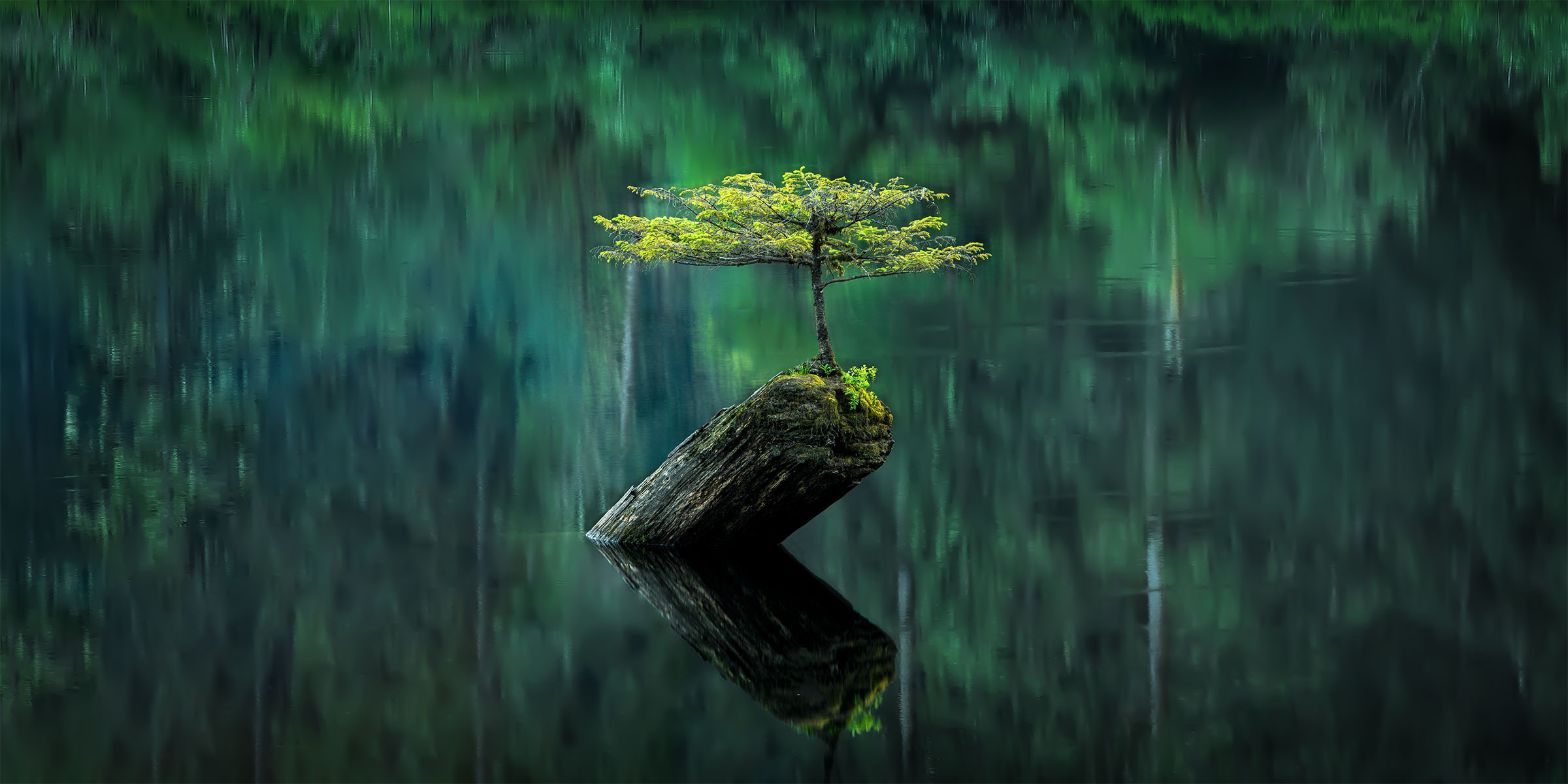
Quiet Persistence
How These Photographs Are Made
Every photograph in this collection begins with a real place Austin stood in and photographed. The landscapes, water, light, and weather in each image are drawn from the natural world, not invented.
Like most landscape photographers, he processes his work, adjusting exposure, color, and contrast to convey what it felt like to be there. Some images combine several exposures made from the same position, to hold detail in both a bright sky and a dark foreground. Occasionally he combines elements from more than one of his own photographs, such as a sky, and when he does, it is noted on that photograph's page.
He uses some AI-assisted tools in editing, such as noise reduction and, occasionally, generative tools to remove small distractions. AI is never used to create a scene, a landscape, or any significant element within one. Everything that gives a photograph its character comes from his own photographs of real places.
The purpose of this work is to connect people with the natural world, and that connection depends on the world being real.
The Evidence Behind the Work
The question collectors most often carry into this decision, even if they do not always ask it directly, is whether the work will actually do what it claims to do. Whether the investment is justified not just aesthetically but in terms of what it will bring to their daily life and environment.
It is a fair question and it deserves a direct answer.
The research supporting nature based visual intervention is not fringe science or wellness marketing. It is a substantial and peer reviewed body of work developed over decades by environmental psychologists, neuroscientists, and public health researchers across some of the world's leading institutions. Roger Ulrich's study of surgical recovery, published in Science in 1984, found that patients with a window view of trees recovered faster and required less pain medication than those facing a brick wall. Rachel and Stephen Kaplan developed attention restoration theory at the University of Michigan, and the framework continues to be refined, most recently around the roles of soft fascination and mental bandwidth. Alongside it sits a growing literature on biophilia, the innate human affinity for natural environments that shapes our psychological responses whether we are aware of it or not.
References
Basu, A., Duvall, J., & Kaplan, R. (2019). Attention restoration theory: Exploring the role of soft fascination and mental bandwidth. Environment and Behavior, 51(9–10), 1055–1081.
Kaplan, R., & Kaplan, S. (1989). The experience of nature: A psychological perspective. Cambridge University Press.
Ulrich, R. S. (1984). View through a window may influence recovery from surgery. Science, 224(4647), 420–421.
Ulrich, R. S. (1993). Biophilia, biophobia, and natural landscapes. In S. R. Kellert & E. O. Wilson (Eds.), The biophilia hypothesis (pp. 73–137). Island Press.
Beauty is necessary but it is not sufficient.
Steve Austin did not discover this research and decide to become a photographer. He was already both a researcher and a photographer when he recognized that the two practices were pointing toward the same place. That convergence is what makes this collection different from fine art landscape photography that is simply beautiful, and there is no shortage of that. The work here is held to a higher and more specific standard, one that asks not only whether an image is visually compelling but whether it is psychologically effective.
Every limited edition archival print offered here has passed that standard. It has been evaluated not just for its visual qualities but for its capacity to engage attention gently, reduce mental noise, and return the viewer to a state of greater calm and clarity.
The images are beautiful. But that is almost beside the point. What matters is what they do. And what they do is the result of everything described on this page, brought together in a single, considered, limited edition print, made to last a lifetime and designed to improve every day of it.
Steve Austin's commitment to nature and mental health extends beyond this collection through Natural Phocus, a separate initiative dedicated to making the restorative benefits of nature accessible to everyone, in classrooms, healthcare facilities, and workplaces. naturalphocus.com
Browse The Collection
Curated Collections, grouped by psychological atmosphere
Editions, scale and acquisition
Writing on light, attention and place
Start a conversation