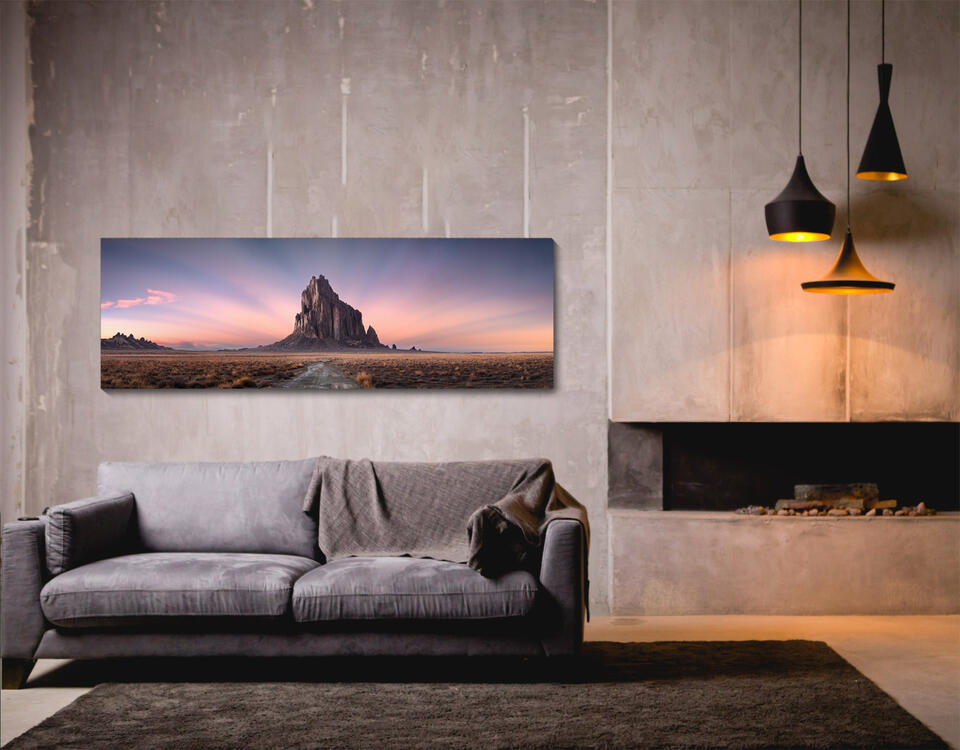
Designing Calm Spaces With Nature Wall Art | Steve Austin Photography
Calming Art and the Hidden Cost of Visual Noise
Walk into the average modern interior and pay attention to what your eyes do. They move. Constantly. From the television to the cluttered surface, from the busy pattern on the rug to the stack of items waiting to be dealt with, from the notification light blinking on a device to the window where movement outside catches attention without invitation. The eye does not rest. It searches. And beneath that searching, largely beneath conscious awareness, the cognitive system is working.
This is visual noise. And it is depleting you.
Most people do not connect the restlessness they feel in certain rooms to the visual environment of those rooms. They attribute it to stress, to tiredness, to the accumulated weight of a demanding day. All of those things may be true. But the visual field in which you spend your hours is not a neutral backdrop. It is an active participant in your psychological state, and when it is chaotic, cluttered, or incoherent, it contributes measurably to the cognitive fatigue you carry.
This is why restorative interior design has begun to move beyond aesthetics toward something closer to environmental psychology, and why calming wall art is increasingly treated as a functional element of a room rather than a decorative afterthought. The right nature photography for the home does not simply fill a wall. It gives the eye a place to settle.
Understanding this changes how you think about the spaces you design, inhabit, and choose to live in, and it reframes fine art landscape photography for calming spaces as a deliberate intervention in how you feel and recover.
.
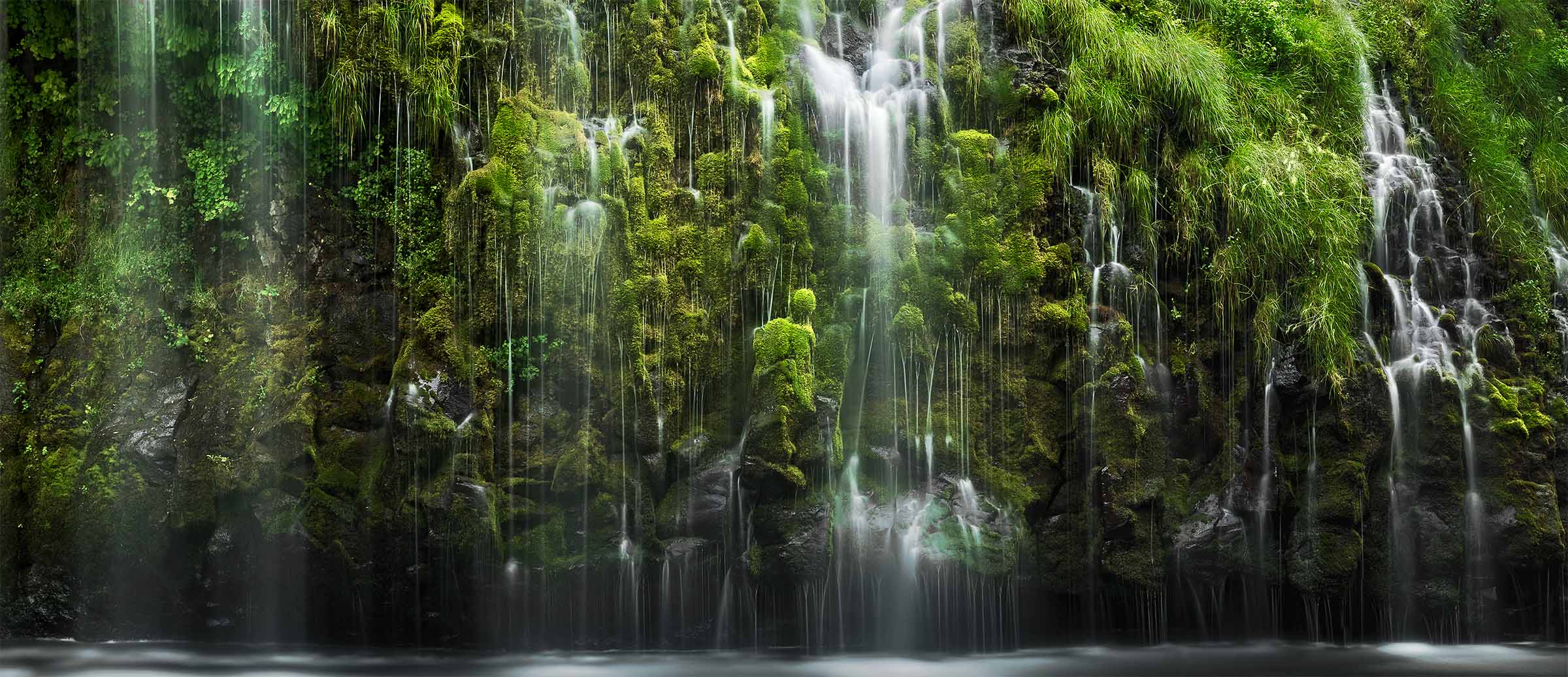
A wall of moss and water, lush and alive from edge to edge, with dozens of quiet streams finding their way downward through the green. Nothing here competes for attention in the way a busy room does. Everything moves in the same direction, gently, without urgency. The eye does not search. It simply follows.
View Available Prints of The Quiet Thinker
.
.
How Visual Noise Affects the Brain
A visual environment becomes depleting when it forces the brain to keep working without pause. High contrast, rapid transitions, cluttered arrangements, and ambiguous depth cues all require the prefrontal cortex to stay continuously engaged, sorting, inhibiting, and prioritizing stimuli with no chance to rest. Over time that sustained demand becomes mental fatigue. The room never lets attention recover, because it holds the cognitive system in a low but constant state of vigilance.
There is a quieter layer to this as well. Visual chaos, dense information, and sharp artificial geometry produce micro-signals of unpredictability that rarely reach conscious awareness but can still nudge the autonomic nervous system toward sympathetic dominance. You may not call the room threatening. You simply feel restless in it, distracted, mentally noisy, without quite knowing why. Attention is being captured rather than invited. That difference is the whole point.
.
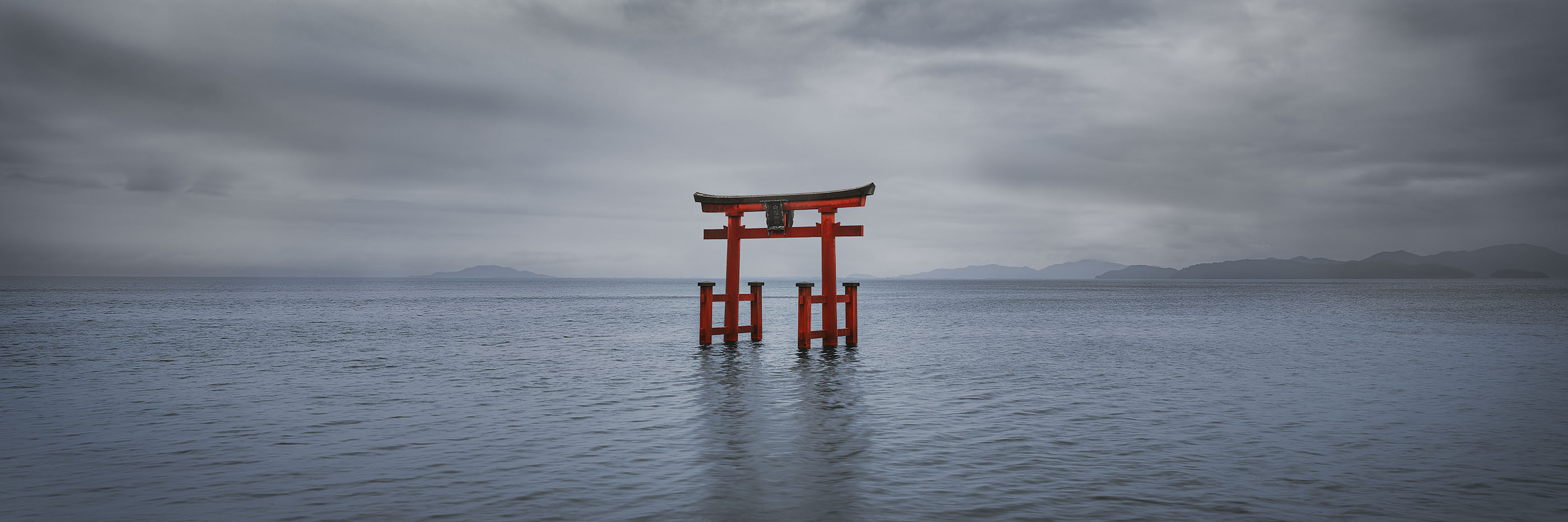
A single torii gate stands in still water under an overcast sky, the only element in a frame otherwise given entirely to water and cloud. The eye arrives at it immediately and has nowhere else to go. That is not a limitation. It is a relief.
View Available Prints of Horizon Gate
.
.
What I See in the Field
When I am out scouting, I encounter visual noise constantly. There is beauty everywhere in the natural world, but beauty and calm are not the same thing. Many of the most striking scenes are also the most complex, places where dozens of elements compete for attention at once and the density of information leaves the eye disoriented rather than settled.
I see it in forests where branches grow in every direction and there is no clear path through. I see it on tangled forest floors and along broken, rocky coastlines where the eye has to keep wandering to take everything in. These places have real power, and a kind of beauty. But they do not produce calm. They keep the directed-attention system working.
My work in the field is to find the alternative, or to build it through composition. The scene where complexity is present but organized, where the eye can move through the frame rather than being stopped, redirected, and fragmented by it. That is the difference I am always looking for, and it is the difference you feel on a wall.
.
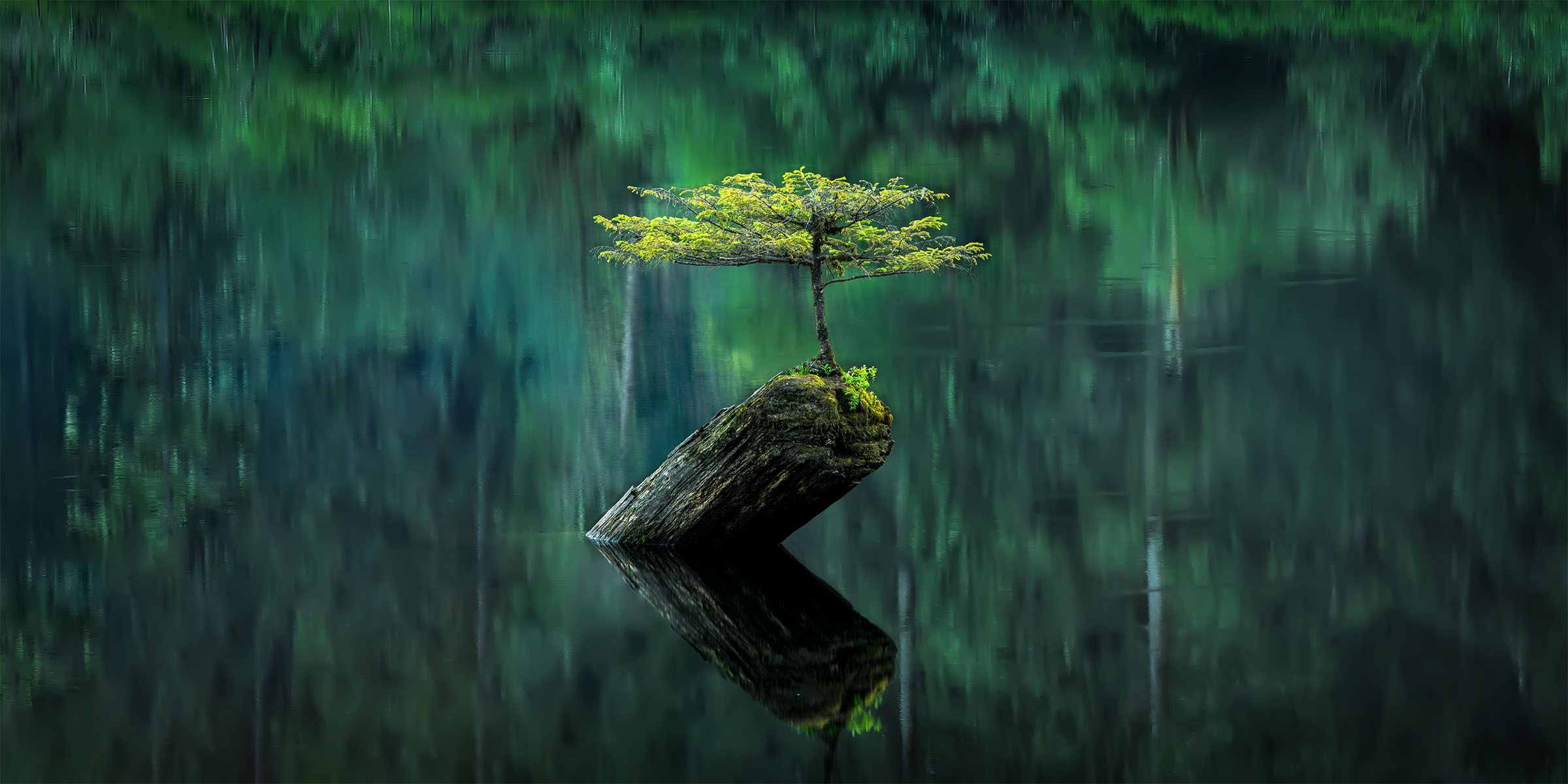
One small tree on a submerged log, perfectly centered, perfectly reflected in the still surface below. Rain streaks soften the forest reflection behind it into something that feels more like atmosphere than background. There is nothing to resolve here. Only something to rest within.
View Available Prints of Quiet Persistence
.
.
The Psychology of a Restorative Visual Environment
A restorative visual environment does the opposite of a depleting one. It reduces cognitive strain while still holding your interest. Drawing on biophilia and attention restoration theory, researchers describe these environments through a handful of qualities: coherence, depth, natural fractal patterns, and what Rachel and Stephen Kaplan called soft fascination. The visual system meets something complex enough to engage but predictable enough to process without effort. Involuntary attention is gently occupied, and directed attention, the kind that fatigues over a long day, is finally allowed to recover.
Natural forms produce this balance better than almost anything else, because they match what human perception evolved to read easily. The fractal geometry of clouds, trees, and water sits at a mid-range complexity the visual cortex processes efficiently, recognizing familiar patterns without strain. Horizons offer prospect, the sense of openness and possibility, while layered depth gives the scene stability. The result is not boredom. It is calm engagement. The mind is held, gently, without being worked.
The effects are measurable. As the external field becomes coherent, internal fragmentation eases, rumination quiets, and parasympathetic activity rises, supporting slower breathing, lower heart rate, and a felt sense of grounding. The body settles as a consequence of the environment rather than through effort. This is the distinction worth keeping clear: the difference between a depleting space and a restorative one is not aesthetic preference. It is functional. One keeps the brain in quiet vigilance. The other lets it soften into presence.
.
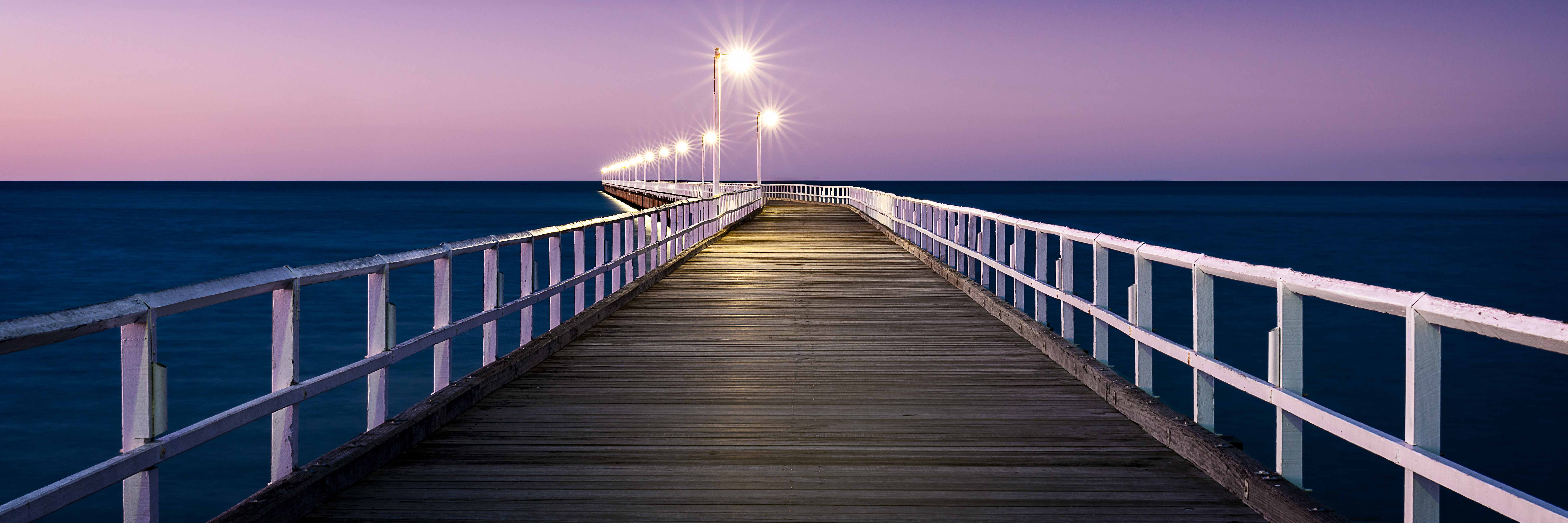
The pier extends toward the horizon under a violet sky, lit by a quiet row of lamps that lead the eye forward without urgency. The water on either side holds the sky's color in a long, still reflection. There is one direction here and it asks nothing of you except to follow it gently.
View Available Prints of Where Attention Leads
.
.
What Makes an Image Calming Rather Than Simply Beautiful
Not every beautiful landscape produces calm, and the distinction is worth understanding before you choose a piece for a room meant for rest. High saturation, dramatic contrast, competing elements, or subject matter that implies motion or instability can make an image extraordinary while still activating the nervous system rather than settling it. A storm, a thundering waterfall, a dense and tangled forest floor: these can move you deeply without restoring you. They have their place and their own psychological function. They are simply not the right choice where cognitive recovery is the goal.
A calming image shares specific, identifiable qualities. It has a clear visual hierarchy that tells the eye where to go and lets it rest there. It has spatial coherence, with elements that feel resolved rather than in tension. Its palette moves through harmonious, analogous tones rather than competing contrasts, so the nervous system processes it without effort. And it holds attention gently instead of demanding it, which is the quality I look for in the field and again in the darkroom.
Those same qualities are what let an image do real work once it is on a wall. The goal in a space is not emptiness; it is coherence. A single large image with a strong focal point gives the eye somewhere to return to, which quietly removes the low, persistent effort of a room that offers nowhere to settle. A coherent natural palette reduces the micro-stress of high-contrast transitions. Genuine spatial depth opens the wall outward rather than compressing it. This is why fine art landscape photography, chosen and placed with intention, functions as more than decoration. One well-chosen image carries the focal point, the palette, and the depth at once, and introduces the kind of natural coherence the brain is prepared to find restorative.
.
..
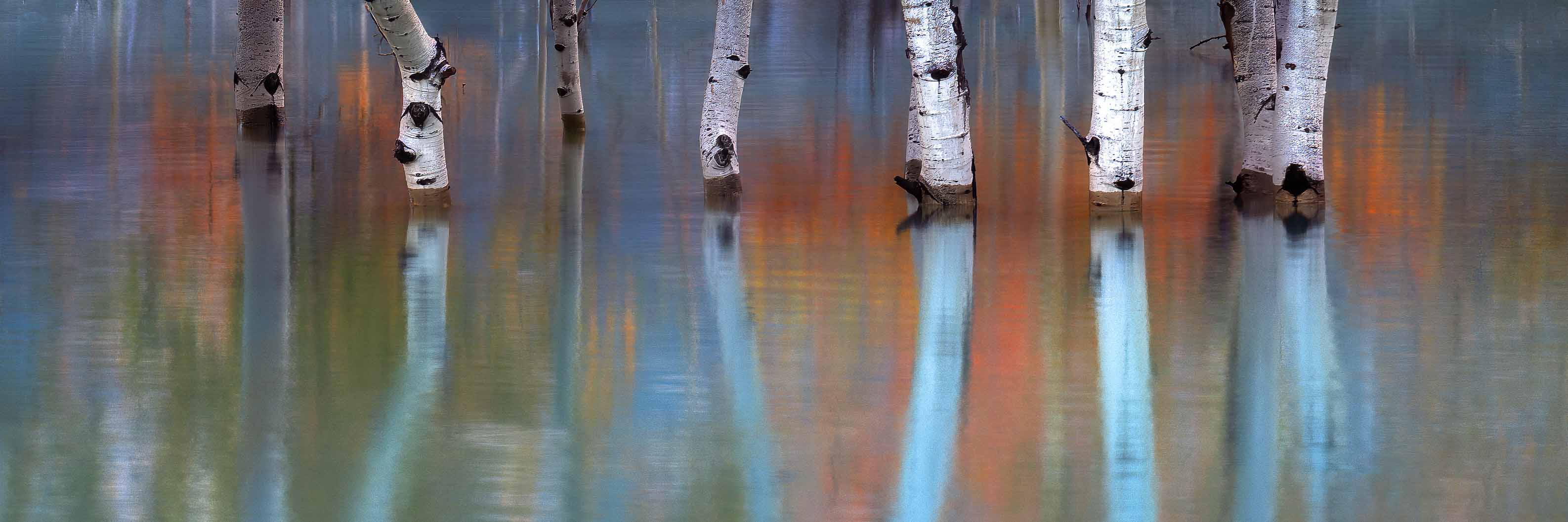
White aspen trunks stand in still water, their vertical rhythm creating a quiet order against the softly blurred reflection of autumn color behind them. The composition does not ask the eye to search. It offers a pattern and then lets the eye settle into it.
View Available Prints of Reflections That Remain
..
.
The Cumulative Effect of a Restorative Space
The most underappreciated part of how visual environments shape wellbeing is that the effect is cumulative. No single moment of visual noise produces real cognitive fatigue. It is the sustained exposure, over hours and days and years, that builds the depletion most people carry without recognizing its source.
Restoration works the same way in reverse. A coherent, restful space does not transform your state in a single viewing. It supports recovery quietly and repeatedly, in peripheral awareness as you work and in full attention when you pause, until that steadiness becomes the ambient condition of the room itself. The image you live with is not something you look at occasionally. It is something your visual system meets continuously, and over time that input shapes the baseline you carry.
This is why designing a calm space is not a single decision. It is a sustained one. Make it intentional. Make it restorative. Make it something your nervous system can trust.
.
.
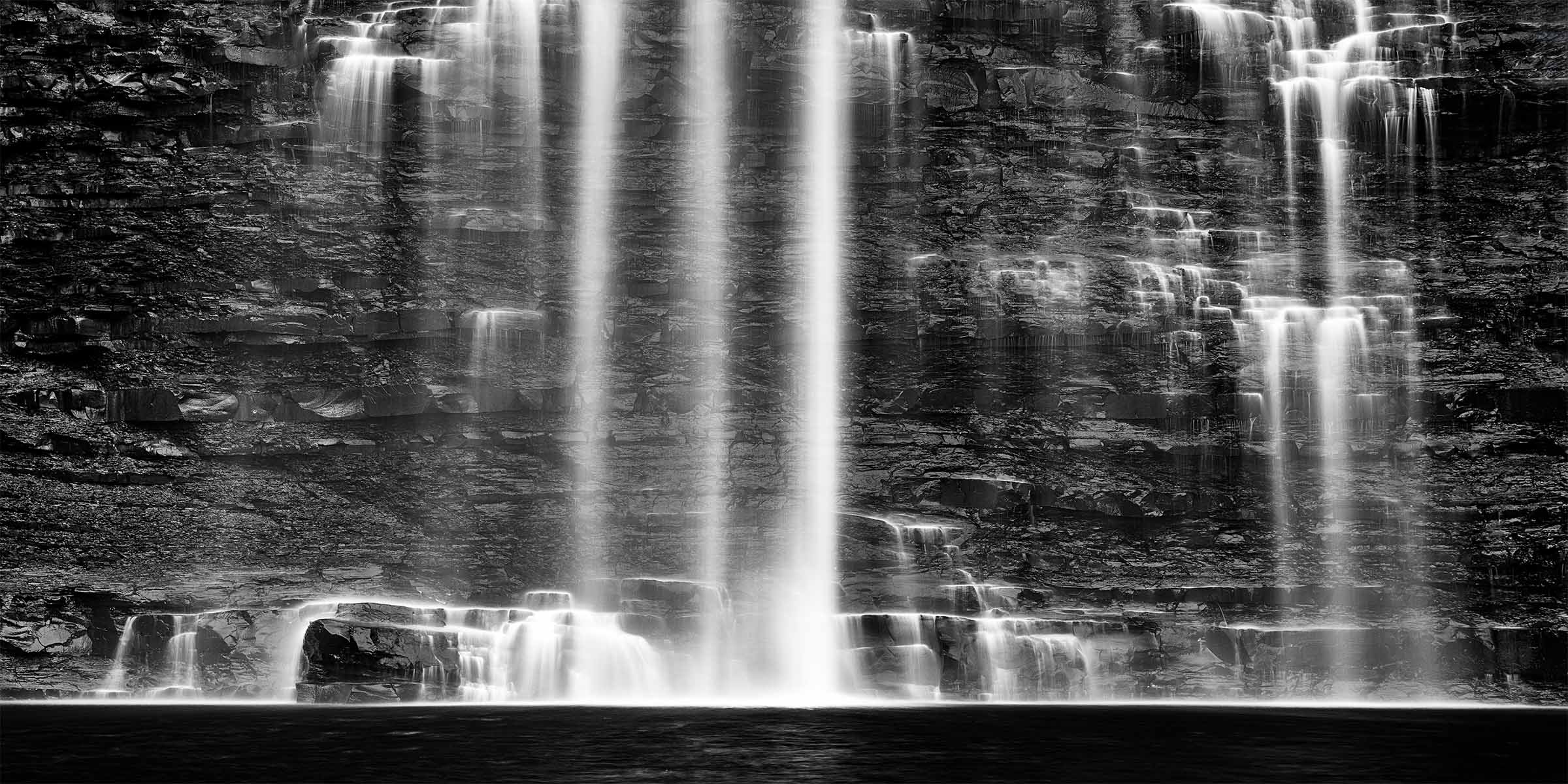
At Watkins Glen in New York's Finger Lakes, water does not crash so much as descend, finding its own paths down the layered shale in streams that a long exposure collapses into something between silk and light. What held me was not the wider view but the detail, and the sound, the layered conversation of water over rock that the mind receives not as noise but as relief. The Weeping Wall is a reminder that release is not weakness; it is what stone does when it has held long enough.
View Available Prints of Weeping Wall
.
.
How to Choose Calming Wall Art for Your Space
When choosing artwork for a calming room, begin with the role the room is meant to play. A bedroom, therapy office, reading space, or quiet living area usually benefits from artwork with a clear focal point, a coherent color palette, and enough visual depth to let the eye move gently into the scene. Look for images that feel settled rather than dramatic, organized rather than busy, and restorative rather than stimulating.
- Start with natural subject matter. Scenes of water, vegetation, and open landscape are the most consistently restorative, and they are the foundation every other choice builds on.
- Choose one clear focal point. Give the eye somewhere to land and rest rather than a field of competing elements to keep searching through.
- Favor images that hold attention gently. The most calming pictures reward a slow look instead of demanding one, which is the difference between an image that soothes and one that merely fills space.
- Look for visual depth and openness. A path, a horizon, or receding space invites the mind to enter the scene, which is central to how nature imagery restores attention.
- Favor coherent, limited color palettes. Coherence lowers the visual processing load and lets the artwork and the room read as a single, settled whole.
- Avoid chaotic or high-contrast imagery in rooms meant for rest. Sharp contrast and busy composition reintroduce the very visual noise you are trying to reduce.
- Scale the artwork to the wall, and place it where the eye naturally falls at rest. Size and position together make an image feel intentional rather than decorative.
.
Bring Calm Into Your Space
If you are designing a space intended to feel calmer, more grounded, or more restorative, explore the collection of limited edition fine art landscape prints or request a complimentary digital mockup to see how a piece may look in your room.
View Calming Landscape Prints Request a Complimentary Mockup
.
Calming Wall Art: Frequently Asked Questions
What kind of wall art makes a room feel calm?
Calming wall art tends to share a few traits: a single clear focal point, a coherent and limited color palette, and a sense of openness or depth that the eye can settle into. Nature imagery, particularly quiet scenes of water, sky, and open landscape, is among the most consistently restorative, because it gives attention somewhere gentle to rest rather than a busy field to keep scanning. The goal is artwork that holds your attention softly instead of demanding it.
Why does nature photography feel restorative?
Research grounded in attention restoration theory suggests that natural scenes engage a soft, effortless form of attention that allows the mind's directed-focus system to recover from fatigue. The biophilia hypothesis adds that humans carry an innate affinity for natural environments, so images of nature can quietly lower the sense of mental strain that built or cluttered visual fields create. In practical terms, a restful nature photograph gives the eye a place to settle and the mind a chance to reset.
Where should calming landscape art be placed in a home?
Place calming landscape art where your eye naturally falls when you are at rest, such as across from a bed, opposite the main seat in a living room, or at the end of a sightline you pass through often. These are the moments when the visual environment does the most to either restore you or deplete you, so they are where restorative imagery earns its place. The aim is for the artwork to meet you in the spaces where you actually pause.
What size art works best for a calming focal point?
For a focal point, the artwork should be large enough to anchor the wall and read as intentional rather than incidental, generally filling a good portion of the available wall space rather than floating small within it. A piece that is too small for its wall reads as decoration and leaves the surrounding emptiness unresolved, which keeps the eye searching. Scale it so the image feels settled and deliberate within the room.
Is large wall art better for reducing visual clutter?
Often, yes, though size matters less than coherence. A single large, calm image can replace several smaller competing pieces and give the eye one clear place to rest, which reduces the visual noise that fragments attention. The key is that the larger piece itself be quiet and coherent, since a large but chaotic image simply makes the clutter bigger.
Featured Fine Art Prints for Calm Spaces
Steve Austin is a psychology professor, behavioral neuroscientist, and fine art landscape photographer. His limited edition landscape prints are available through Steve Austin Fine Art Photography at steveaustinphotography.com. Complimentary digital mockups are available for those who would like to visualize a piece within their own space.