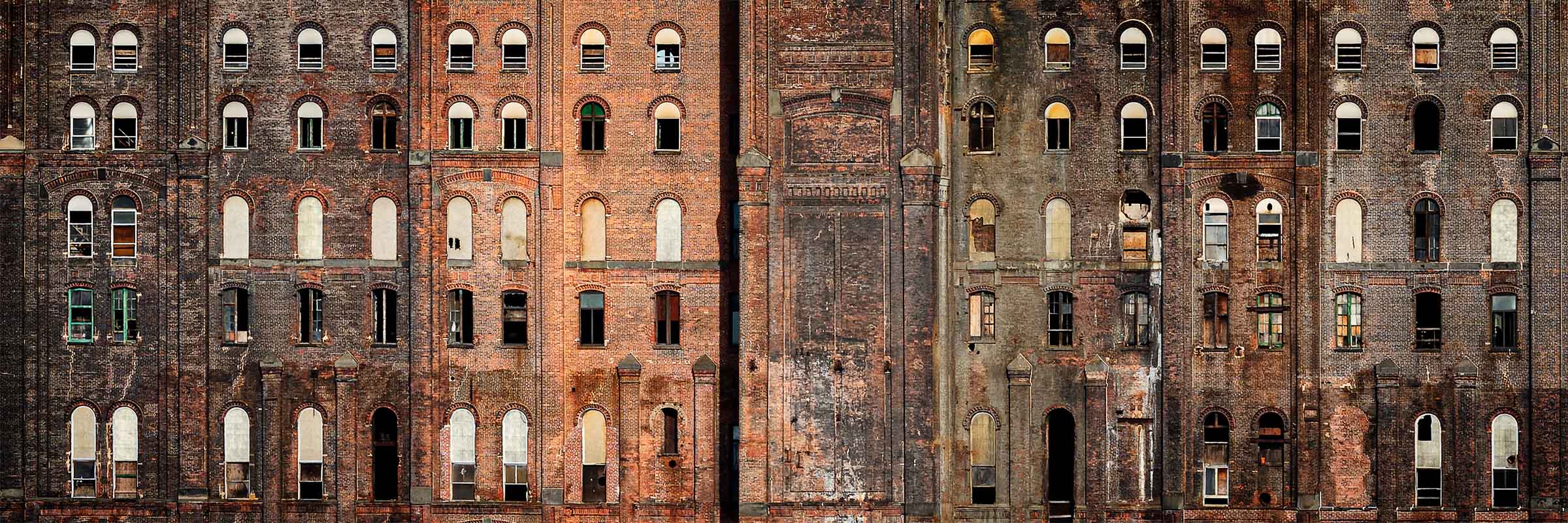
The Domino Sugar Refinery worked the Williamsburg waterfront for more than a century, refining raw cane into the sugar that sweetened a growing country, and then it stopped. For years afterward the long brick wall along Kent Avenue held its ground while the machinery behind it went silent and the city decided what the site would become.
I stood close to it under a flat, overcast light, near enough that the wall was the only thing in front of me, back when the windows were still boarded and broken and the brick still carried a century of soot and weather. Nothing about it asked to be admired. It simply stood, the way something stands when it has outlasted its own purpose and has not yet been told what comes next.
When the site was finally remade, almost none of the old building survived the work. What was kept was the face. The wall that had been its public surface became the single thing worth saving, because a place goes on being recognized by its face long after its inner workings are gone. We hold onto what a thing shows us, and the rest, in time, we let go.
What Was Kept is an invitation to sit with that steadiness, the steadiness of a surface that carried a place's memory after everything behind it had been surrendered, and to notice how much of what endures is simply what we chose to keep.
About This Photograph
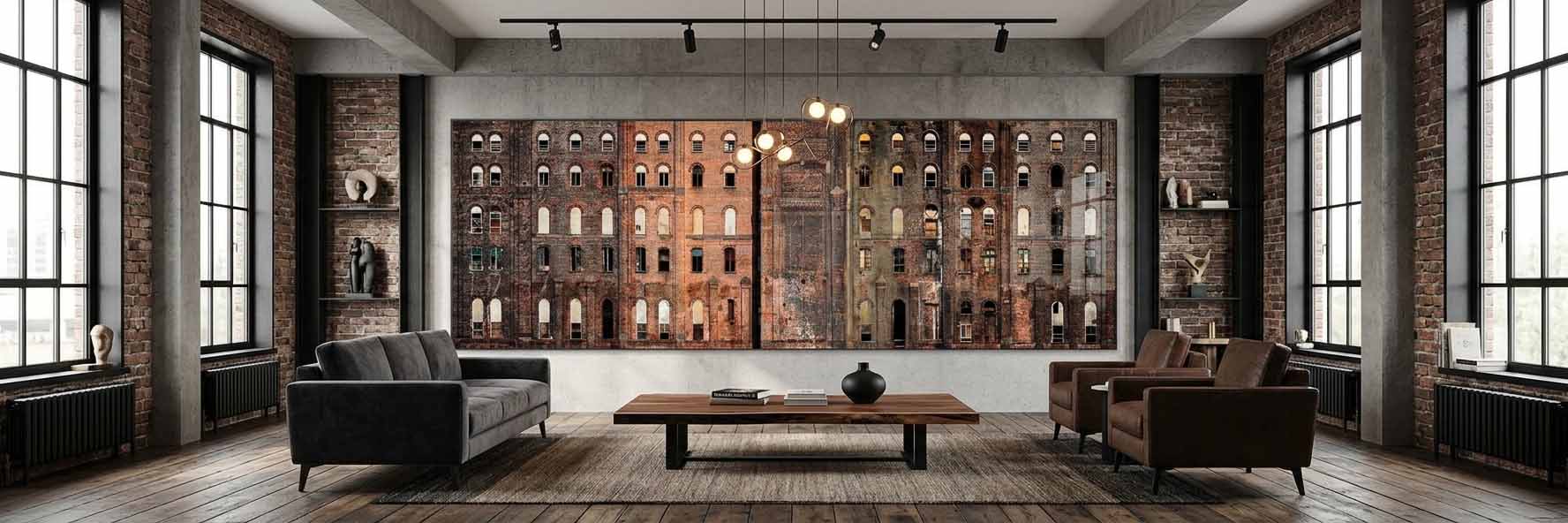
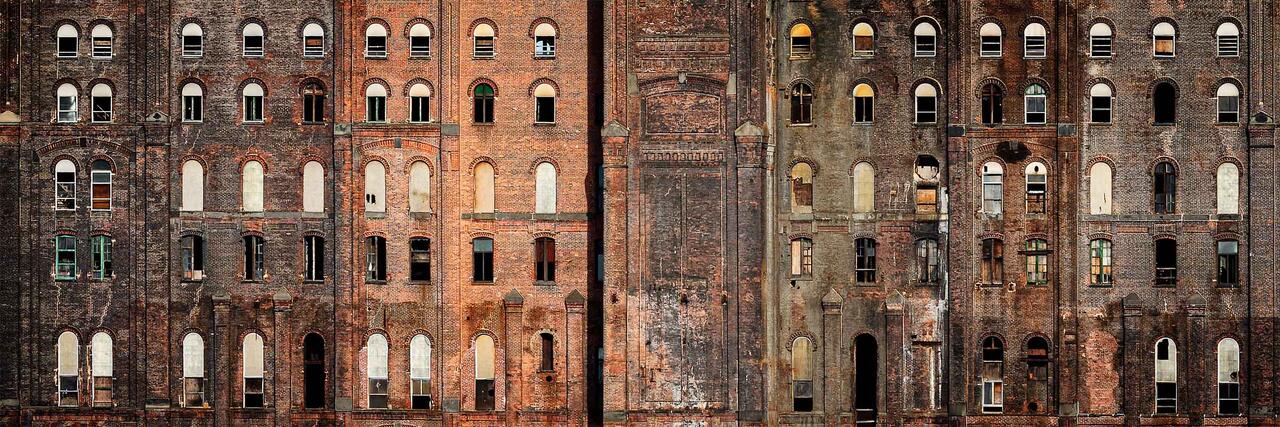
On Kent Avenue in Williamsburg, Brooklyn, facing the surviving brick facade of the Havemeyers and Elder Filter, Pan and Finishing House, long known as the Domino Sugar Refinery, under a flat overcast light. This is a single image. The frame holds the weathered facade with its rows of round-arch windows in the Romanesque Revival manner, its boarded and broken openings, and its soot-darkened brick. Built between 1881 and 1884 to a design led by Theodore A. Havemeyer, a partner in the firm, after fire destroyed the earlier works, the Filter House rose to roughly 155 feet and was for a time the tallest structure on the Brooklyn waterfront. Once among the largest refineries in the world, it closed in 2004, and the three conjoined houses were designated a New York City landmark in 2007. The interior was later gutted and rebuilt as a glass tower set within the preserved brick shell, so this photograph records a state the building no longer holds. Offered as a limited fine art edition on acrylic, metal, and paper, from 12 by 36 inches to 30 by 90 inches.
Every work ships insured and arrives with a signed certificate of authenticity.
If a piece is damaged in transit, the choice of replacement is always yours, and your edition number stays with you.
Production time runs 2 to 3 weeks for metal, 3 to 4 weeks for acrylic and paper, and 5 to 6 weeks for framed work.
Collector's Choice · TruLife ® Acrylic in Italian Frame
Collector Edition of 25· Lumachrome TruLife Acrylic · Handcrafted Italian Frame
TruLife acrylic in a handcrafted Italian frame with a linen liner chosen for the image. Frame series, finish, and liner are settled with you after the order, and production begins from there. The frame and liner add about fourteen inches to the finished dimensions, worth allowing for when planning placement.
Signature Edition · TruLife ® Acrylic, Float Mount
Signature Edition of 50· Lumachrome TruLife Acrylic · Gallery Float Mount
Face-mounted to TruLife acrylic and floated approximately one inch from the wall, with no frame to mediate between the image and the room. UV-resistant, anti-reflective, and scratch-resistant, with a lifetime guarantee against fading.
Signature Edition of 50· ChromaLuxe Metal Print · Gallery Float Mount
Color infused into the aluminum panel itself, floated from the wall on a concealed system. Where acrylic produces luminosity, metal produces clarity. Exceptional fade resistance with no glazing or coating required.
Fine Art Edition of 100· Hahnemühle Baryta Fine Art Paper
Printed without acrylic, so light meets the paper surface directly. Highlights stay luminous, shadows keep their nuance, and the surface has a tactile quality the other presentations approach differently. The understated choice, and the traditional one.
Complimentary shipping within the continental United States. International collector shipping available upon request.
Still deciding
Designing for Stillness
A guide to choosing art for restorative spaces
How to tell whether an image will still hold you in a year, how scale changes what a photograph does in a room, and how to match a piece to the work a room actually performs. It cites the research it draws on, and it is equally clear about where that research stops. About ten minutes to read.