How a Photograph Sharpens the Mind

What the research on nature and attention reveals about focus, clarity, and the images we choose to work beside

There is a state most of us know too well by the middle of a working day. The thoughts come slower. Decisions feel heavier than they should. You read the same sentence twice and still do not hold it. This is not a failure of will. It is the predictable result of a particular kind of attention being spent faster than it is replenished. What is less widely known is how quickly, and how simply, that attention can begin to recover. One of the more surprising answers is also one of the easiest to act on: look at nature. And not even real nature, necessarily. A picture of it can be enough.
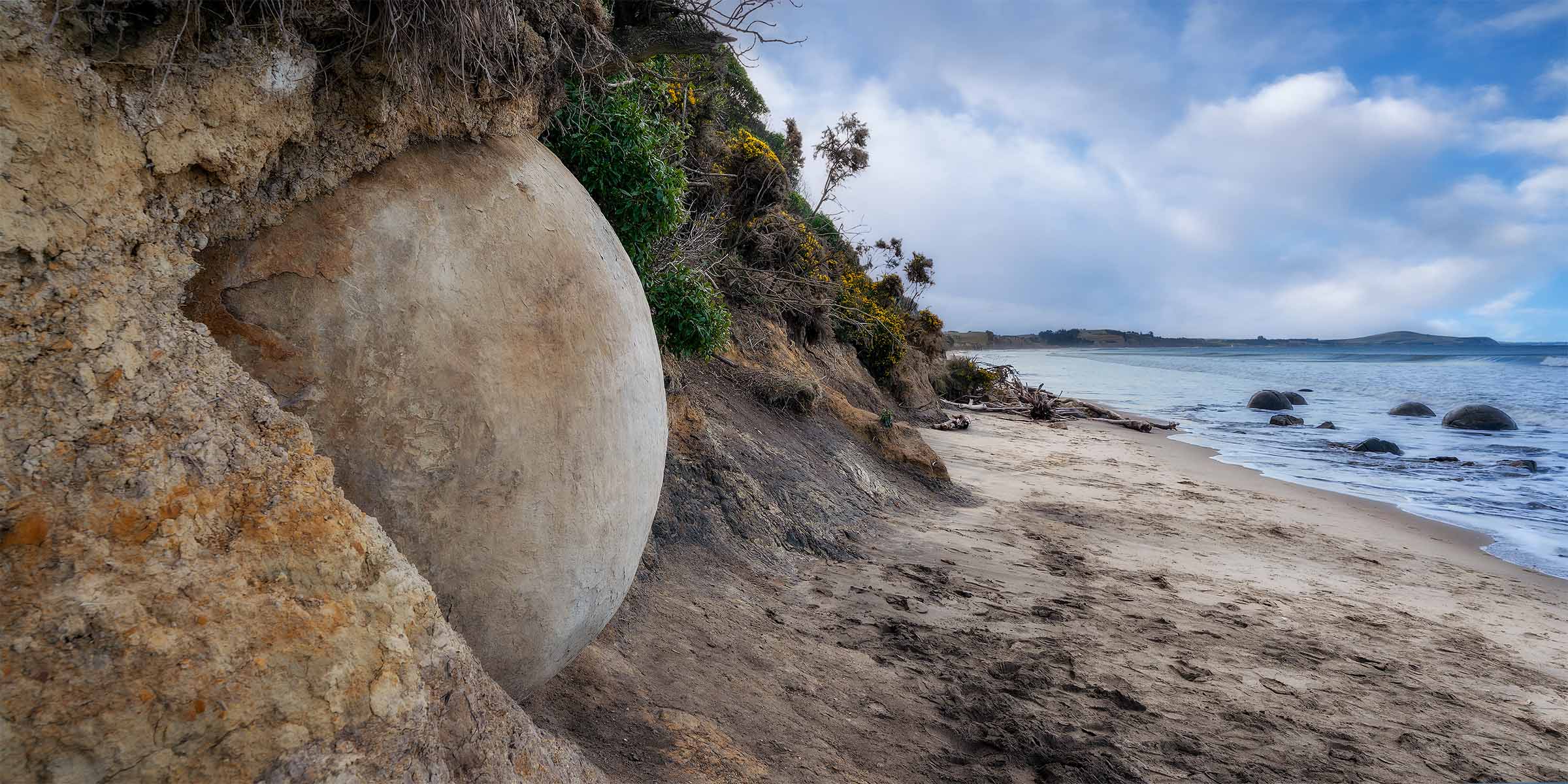
ARTIST’S STORY I almost missed it. I was moving along the base of the cliffs at Moeraki Beach, composing shots, reading the light, when something in my peripheral vision stopped me. There, half emerged from the eroding sandstone face, was a single boulder. Perfectly round. Smooth where the cliff had worn away around it. Positioned at exactly the height and angle of a watching eye. I stood there for a long time before I raised the camera. The Moeraki Boulders form inside the cliffs over millions of years, growing concentrically around a small fragment of organic material, building themselves outward layer by layer with extraordinary patience. Eventually the cliff erodes around them and releases them to the beach below, where the sea takes over, rounding them further, settling them into the sand alongside their companions. This boulder had not yet made that journey. It was still held in the cliff, still watching, still presiding over the beach and the sea and the others that had gone before it. From where I stood, the geometry was unmistakable. A single ancient eye, looking out over the full length of the beach, the other boulders gathered in the surf below like children playing at the water's edge while something older and wiser keeps watch from above. I have thought about that image often since. About what it means to be watched over. Not monitored or judged, but simply held in the quiet attention of something larger and older and more patient than anything we have built or imagined. Nature has always operated this way, attentive in ways we rarely acknowledge, present in ways we rarely notice, offering a steadiness that asks nothing in return. We walk through landscapes and believe ourselves to be observers. But the watching, it turns out, goes both ways. The research on nature and psychological restoration speaks to what natural environments give us when we enter them with openness. But perhaps the more important truth is simpler than any theory. Nature sees us. It has always seen us. Even when we are not looking, there is an eye on things, ancient and unhurried and entirely on our side. The Watcher is a reminder that you have never been as alone in this world as the noise of modern life might sometimes suggest. Limited Fine Art Edition Each image is released in limited editions, with edition size set by presentation and scale, so the most substantial works remain the most rare.
The Watcher

View Available Prints of The Watcher


The Study That Changed How I Think About a Photograph

Some years ago, a study by Katherine Gamble and colleagues at Georgetown set out to test something deceptively narrow. They asked whether simply viewing pictures of nature, as opposed to pictures of city streets, would measurably change a person's attention. Participants looked at one set of images or the other for a few minutes, and their attention was measured before and after with a standard cognitive test. The result was clear. Those who viewed nature images showed improved executive attention afterward, while those who viewed urban images did not. The effect appeared in older adults and in younger university students alike, which suggested it was not a quirk of one group but something broadly human.

What struck me about this study, and what has shaped how I think about my own work since, is its specificity. The improvement was not a vague good feeling. It was executive attention in particular, the mental faculty we lean on for planning, for resisting distraction, for holding a goal in mind while we work toward it. And it was produced not by a walk in the woods but by photographs, viewed indoors, in a matter of minutes.
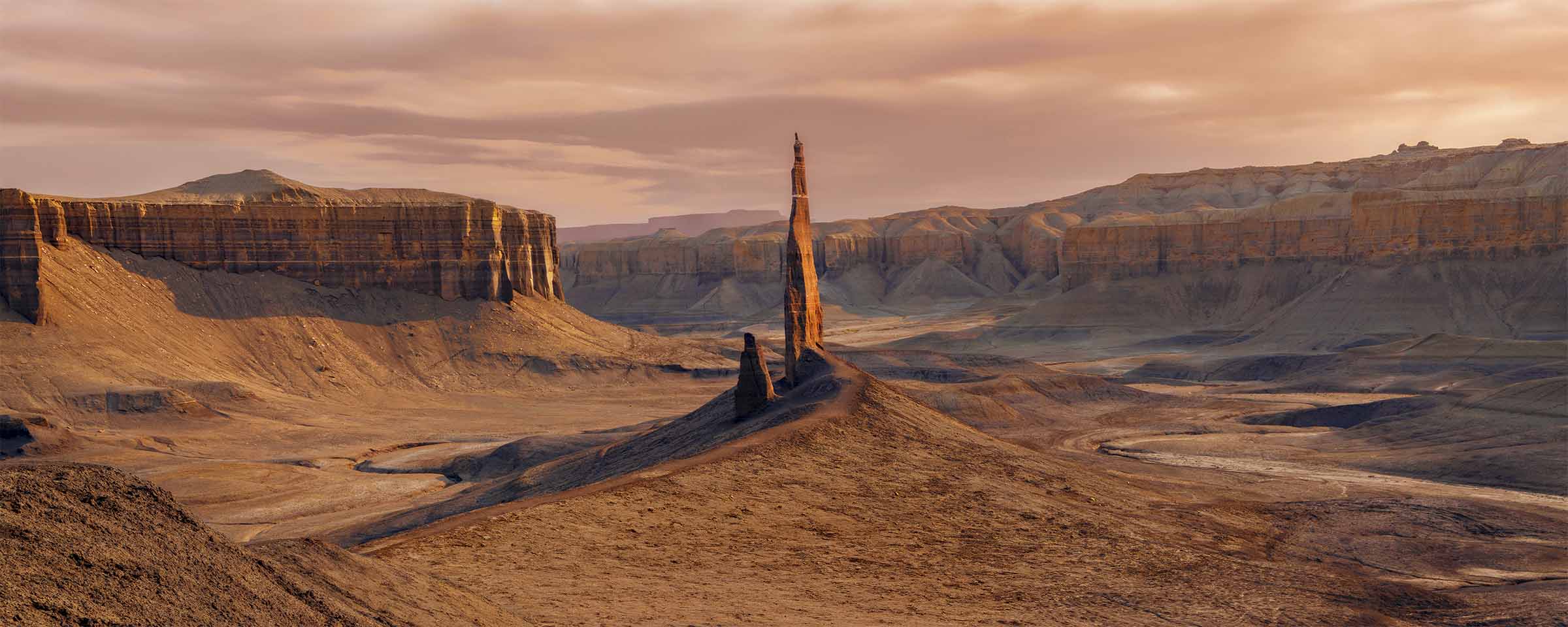
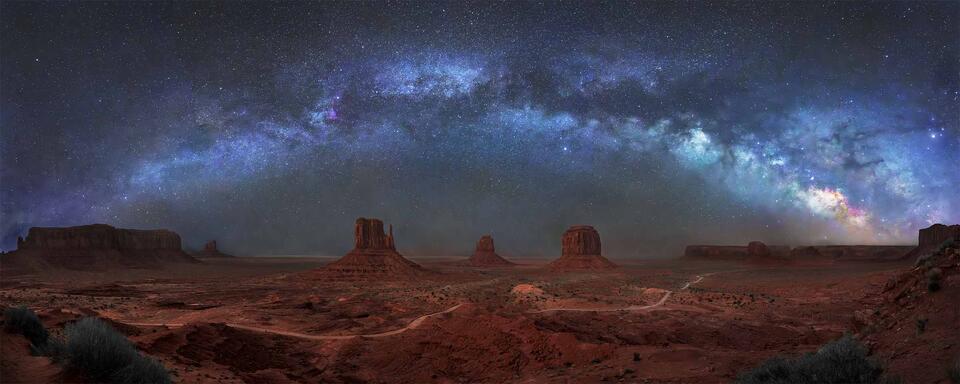
ARTIST’S STORY Some photographs require patience measured in years. I had been to this location in the Utah desert several times before this evening. Each visit the light was wrong, the angle off, the window I was looking for closed before it opened. The Spire was always there, rising from the desert floor with its improbable narrowness against whatever sky the day had offered. But I knew what was possible here. I had seen it in my mind long before I saw it through the lens. So I kept coming back. In the middle of summer, with the temperature well above one hundred degrees and the hike in already behind me, I set up and waited. The Utah desert in that heat has a particular quality of stillness, not the comfortable stillness of a cool morning but something more demanding, a stillness that asks something of you, that tests whether you actually want what you came for. The light was changing. The sun was moving toward the horizon. And then, in a window of perhaps fifteen minutes, it happened. The light caught the Spire at exactly the angle I had been waiting for. The warm evening sun raked across the sandstone and revealed every ridge, every crack, every layer of geological time written into that narrow column of rock. The surrounding landscape fell into soft shadow while the Spire held the light, singular and illuminated, rising from the desert floor with a verticality that defied every expectation the eye brings to an eroded landscape. This formation should not exist. Erosion is a process of reduction, of wearing things down toward the horizontal, toward the flat. That this column of rock has survived while everything around it was ground to mesas and slopes and canyon walls is not just geological accident. It feels like argument. Like proof that some things, shaped by the right forces over sufficient time, arrive at a form so essential that even the most relentless erosion cannot improve upon it. We recognize this quality when we see it. In landscapes and in people. The ones who have been tested by heat and time and the slow erosion of difficulty, and who have emerged not diminished but clarified. Not worn down but worn true. The Spire is for anyone who has kept returning to something difficult because they knew, in a way they could not fully explain, that the light would eventually be right. Limited Fine Art Edition Each image is released in limited editions, with edition size set by presentation and scale, so the most substantial works remain the most rare.
The Spire

View Available Prints of The Spire


Restoration Is Not the Same as Rest

It is tempting to file this under relaxation, but that would miss the point. We tend to assume nature imagery works by calming us down, and it does soothe. But what the attention research describes is closer to sharpening than to sedation. The mind holds a limited reserve of directed, effortful attention, the kind that focus and self-control draw upon, and that reserve drains over a day of demands. Natural scenes engage attention in a softer, effortless way that lets the depleted, effortful kind recover. The outcome is not drowsiness. It is clarity. You return to the task more able, not less alert.

This is the distinction I find most useful, and the one most often missed. A restorative image is not a screensaver for the eyes. It is closer to a brief, recurring recovery for the part of the mind you most need when the work is hard. I have written elsewhere about that recovery as rest and restoration; here the emphasis falls on what comes after the recovery, which is focus.
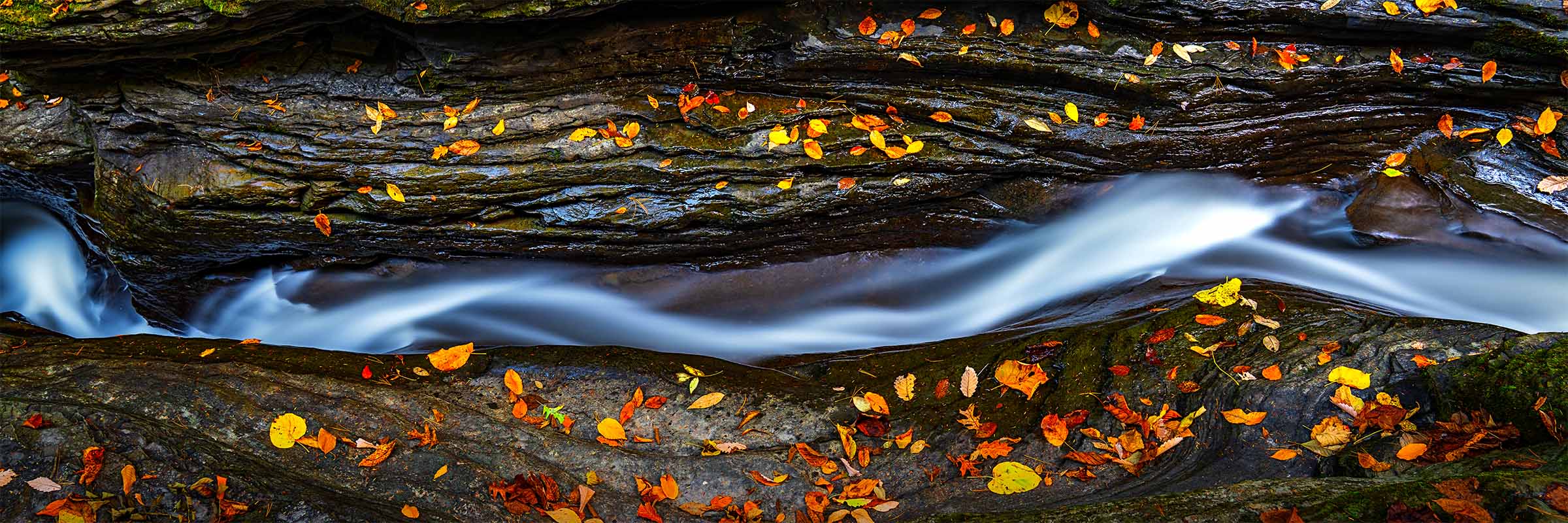
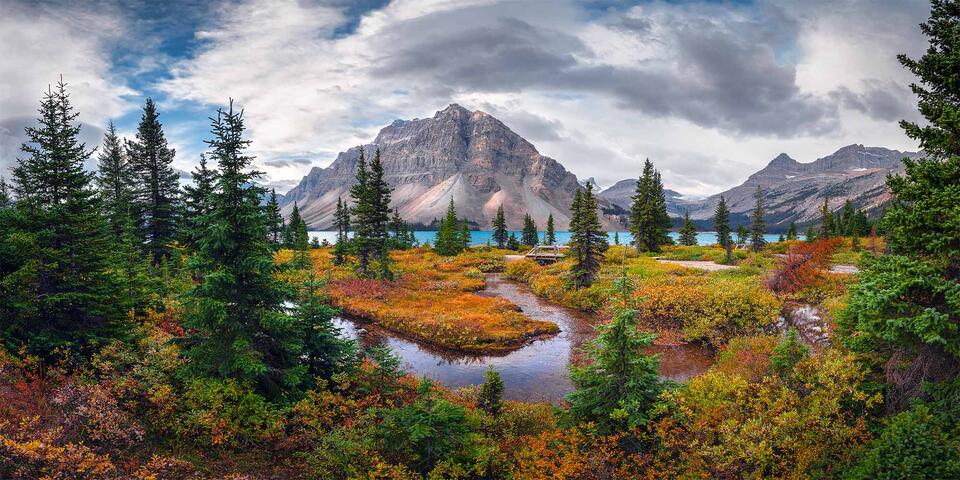
ARTIST’S STORY Water does not force anything. It does not attack the rock or demand passage or exhaust itself against surfaces that will not yield. It simply moves, soft and unhurried and completely committed, until it finds the opening that was always there. And then it flows through with a grace that makes the whole journey look inevitable. I found this scene on an autumn day when the leaves had let go of the trees and settled onto the layered rock in every shade of orange and red and gold, as if the forest had decorated the stage for exactly this moment. The water threaded through the crack in the stone below me, a long exposure collapsing its movement into something between silk and smoke, and I stayed with it for a long time before I raised the camera. What held me was not the color, though the color was extraordinary. It was the quality of the water's movement. Soft. Persistent. Entirely without doubt. It had found its way through solid rock not by being harder than the rock but by being more patient, more willing to follow the available path rather than insist on a path of its own choosing. There is a way of moving through life that this image understands completely. It is not the way of force or rigidity or the exhausting insistence that things should be different than they are. It is softer than that and stronger than that simultaneously. It is the willingness to remain in motion, to stay curious about what openings might exist, to trust that persistence and patience together will find a passage through even the most unyielding surfaces. We spend so much energy hardening ourselves against difficulty, building resistance into our posture and our thinking, when the water has known all along that softness and persistence together are more powerful than anything solid. The rock does not defeat the water. The water simply outlasts the rock. Finding the Way is for anyone who has ever felt blocked, rerouted, or slowed by something that seemed immovable. Keep moving. Stay soft. The opening is there. Limited Fine Art Edition Each image is released in limited editions, with edition size set by presentation and scale, so the most substantial works remain the most rare.
Finding the Way

View Available Prints of Finding the Way


What Makes an Image Restorative

Not every pretty picture does this work, which is a point worth dwelling on. Decades ago, the psychologists Rachel and Stephen Kaplan proposed that environments which genuinely restore attention tend to share four qualities, and the same applies to images of them. The first is a sense of being away, a feeling of having stepped out of the mental setting of ordinary demands. The second is fascination, the soft, effortless pull of something intrinsically interesting, like moving water or shifting light, that holds the eye without taxing it. The third is extent, a sense that the scene is a coherent world large enough for the mind to wander into rather than a fragment glimpsed and exhausted. The fourth is compatibility, a fit between the scene and what the viewer is inclined to do, which is simply to look and be held.

These four are not abstractions to me. They are close to the criteria I am actually weighing, often without naming them, when I decide whether an image is worth making and offering. A photograph can be beautiful and still fail to restore, if it scatters attention rather than receiving it. The images I keep are the ones that do the quieter work.
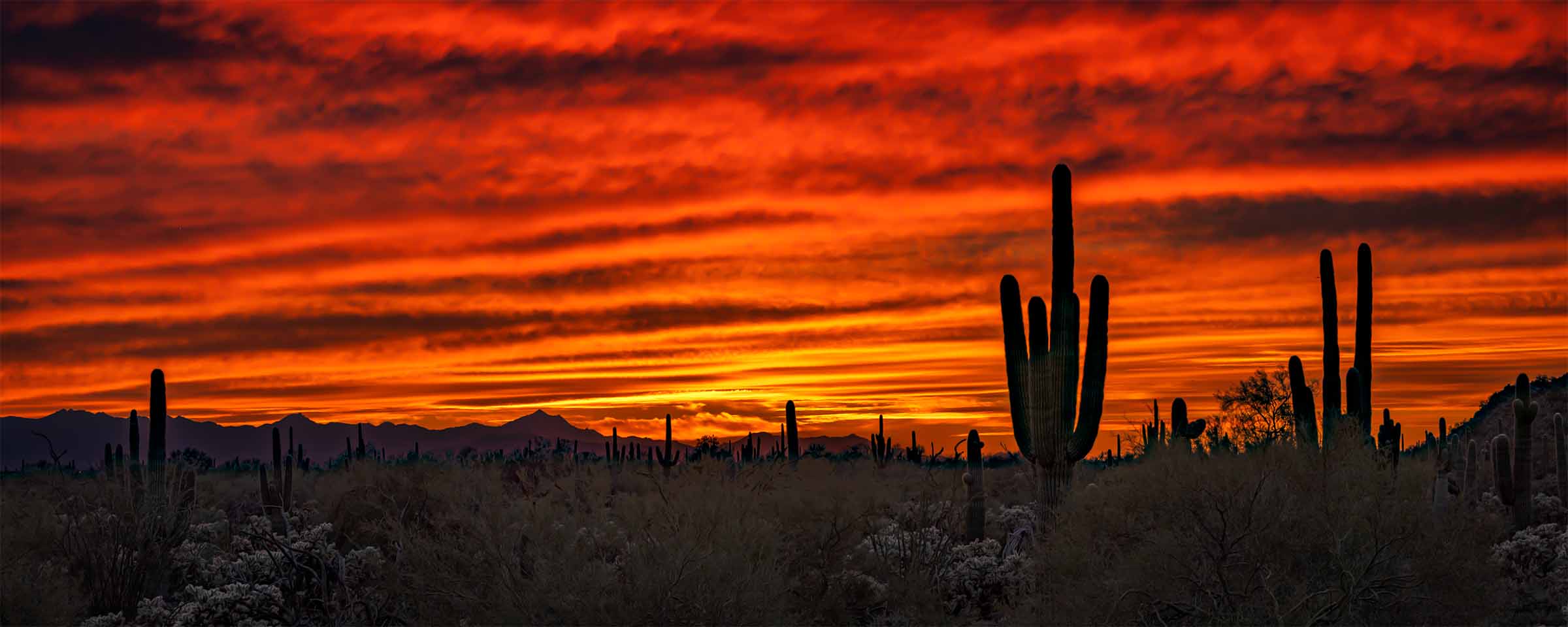
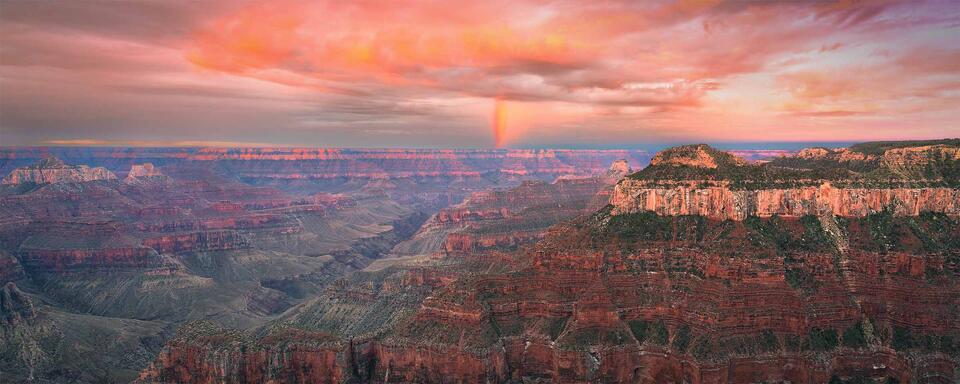
ARTIST’S STORY After twenty years of photographing the Sonoran Desert I thought I knew what an Arizona sunset could do. I had seen hundreds of them, stood in the desert heat as the sky cycled through its evening palette, watched the saguaros go from green to gold to silhouette against the fading light. I knew the rhythms. I knew the patterns. I thought I had a reasonable sense of what was possible. This evening changed that. I had no particular expectation when I set up that night. The conditions looked promising but they always look promising in the Sonoran Desert in the right season. What I was not prepared for was the moment the sky simply decided to abandon all restraint. The clouds caught the last light and held it, amplified it, stretched it across the entire horizon in bands of deep crimson and molten gold that moved and shifted and deepened for what felt like an impossible amount of time. Some sunsets give you two minutes. This one gave and gave and gave, as if the desert itself was putting on a performance it had been rehearsing all year. Living in Arizona means living in a place that regularly produces beauty on a scale that stops conversation and empties the mind of everything except the immediate and overwhelming fact of what is in front of you. The saguaros know this. They have been standing in this desert for centuries, witnessing ten thousand sunsets, arms raised not in surrender but in something closer to perpetual celebration. On this evening they were the perfect audience, dark and still and utterly present against a sky that had caught fire from one edge of the world to the other. This is what the Sonoran Desert does when it decides to remind you why you live here. It does not whisper. It does not suggest. It ignites. The research on awe and psychological restoration tells us that experiences of vast natural beauty produce measurable reductions in stress and a profound expansion of perspective. What the research cannot fully capture is what it feels like to stand in the desert as the sky burns above you and realize, with complete certainty, that whatever you were worried about an hour ago has been temporarily and mercifully incinerated along with everything else. Sonoran Fire is for anyone who has ever stood under an Arizona sky and felt, just for a moment, that the world was exactly as it should be. Limited Fine Art Edition Each image is released in limited editions, with edition size set by presentation and scale, so the most substantial works remain the most rare.
Sonoran Fire

View Available Prints of Sonoran Fire


Not Just Real Nature, But Pictures of It

The most consequential part of all this, for anyone choosing what to put on a wall, is that the effect does not require the real thing. The Gamble study used photographs, and later work has pointed in the same direction, finding cognitive benefit even from viewing nature on a screen or in print rather than through a window. This is the premise beneath everything I make. A landscape photograph, placed where you will actually see it, is not a stand-in for nature that falls short of the original. Within the specific domain of attention, it does real and measurable work of its own.

That reframes what such an image is for. It is less decoration than instrument, a quiet tool positioned where the mind needs help.
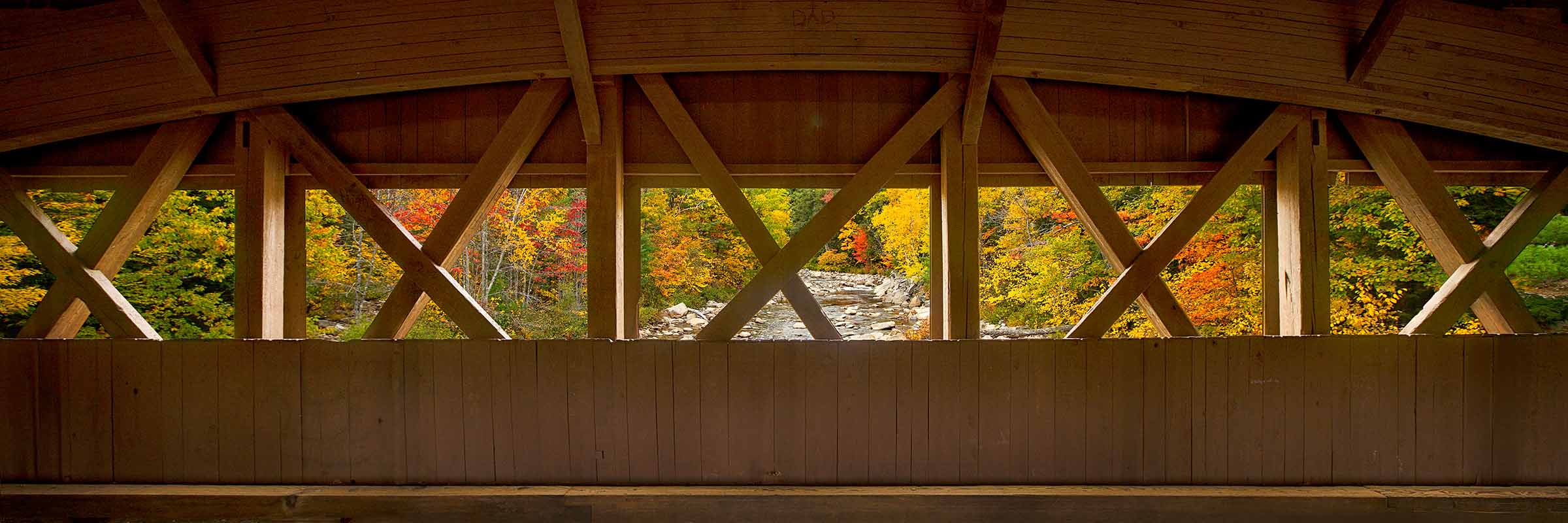
ARTIST’S STORY There is a particular kind of seeing that only becomes possible when you are held. The covered bridges of New Hampshire's White Mountains were built for practical reasons, to protect the wooden decking from the weather, to extend the life of a structure that would otherwise surrender to the seasonal extremes of a New England winter. But step inside one on an autumn morning when the forest on either side of the river has reached its fullest expression of color, and something unexpected happens. The bridge stops being infrastructure and becomes something closer to a frame. Or perhaps a sanctuary. I stopped in the middle of this bridge and turned to face the side. What the timber framework had done to the view outside was extraordinary. The crossed beams and vertical supports had divided the autumn forest into a series of individual panels, each one containing its own arrangement of red and orange and gold, the rocky stream threading through the center panel like a path leading deeper into the color. The cathedral arc of the roof curved above it all, enclosing the space with a warmth that the season outside, for all its brilliance, could not quite match. There is something deeply restorative about the experience of being sheltered while simultaneously connected to something vast and beautiful. The research on psychological restoration tells us that nature environments replenish our depleted attention and reduce the physiological markers of stress. But what this bridge offered was something more specific than that. It offered the particular comfort of enclosure, of being held within a warm and human made space, while the full extravagance of the natural world remained completely visible and completely present just beyond the timber frame. We spend so much of our lives either fully exposed to everything or fully insulated from it. The covered bridge offers a third option. Sheltered and present simultaneously. Protected enough to truly see. Sheltered View is an invitation to find the covered bridge in your own life. The place where you are held just enough to be fully open. Where the frame around the beauty makes the beauty more beautiful. Where being inside and outside at the same time feels, for once, exactly right. Limited Fine Art Edition Each image is released in limited editions, with edition size set by presentation and scale, so the most substantial works remain the most rare.
Sheltered View

View Available Prints of Sheltered View


A Tool for the Thinking Mind

If that is true, then the most valuable place for a restorative image may not be the room where you relax, but the room where you think. The wall a desk faces. The space a difficult decision gets made in. The study, the office, the corner where the hard hours of the day are spent. These are the places where executive attention is most heavily drawn down, and where a single, expansive image given room to work can offer the eye somewhere to recover between demands.

There is a gentler implication too. Because the effect held for older adults, whose reserves of directed attention deplete more readily, this is not only a matter of working productivity. It is part of how a person can support a clear and steady mind across a life. That is a quiet thing to ask of a photograph, and the evidence suggests it can carry it.
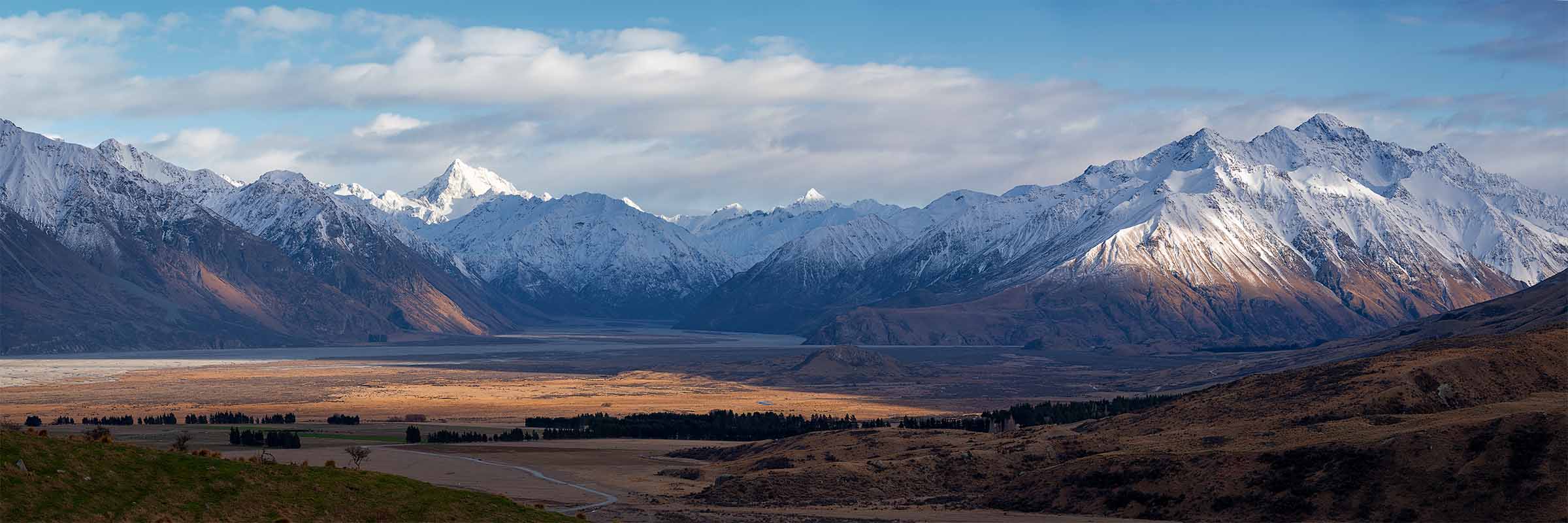
ARTIST’S STORY There are places on this earth that do not feel entirely of it. The Rangitata Valley in New Zealand's South Island is one of them. Standing on the ridge above this scene in the cold still air of a winter morning, the Southern Alps filling the entire horizon with their snow covered peaks, the golden tussock plains stretching away below, the glacial river threading quietly through the middle distance, I understood immediately why Peter Jackson came here to film another world. He did not have to imagine it. He simply had to show up. Winter in this part of New Zealand strips everything back to its essentials. The tussock grasses hold their amber warmth against the cold blue white of the mountains, and the light, low and directional in the winter sky, carves shadows into the peaks with a precision that no other season can match. The result is a landscape that feels simultaneously ancient and immediate, as if you are witnessing something that has looked exactly this way for ten thousand years and will look exactly this way for ten thousand more. There is a particular psychological gift that landscapes of this scale offer. They do not invite comparison. They do not ask how your day is going or what you have accomplished or where you need to be next. They simply exist, massively and indifferently and beautifully, in a way that makes the nervous system release things it has been holding without realizing it. Researchers call this involuntary attention, the effortless absorption that vast natural scenes produce when the mind finally stops managing itself and simply looks. I stood on that ridge for a long time before I raised the camera. Some places deserve that courtesy. Middle Earth is not an escape from the world. It is a reminder of what the world actually is, when you find the right ridge to stand on and give it your full attention. Limited Fine Art Edition Each image is released in limited editions, with edition size set by presentation and scale, so the most substantial works remain the most rare.
Middle Earth

View Available Prints of Middle Earth


Living With Clarity

If your days ask a great deal of your focus, the images around you are not a neutral backdrop. They are either spending your attention or helping to restore it.

I invite you to spend time with the full collection and notice which image holds you without effort, the very sign of the kind of attention this whole idea rests on. And if you are thinking about a particular space, especially one where you work or decide, I am always glad to think it through with you. A complimentary digital mockup will let you see how a piece lives in your own room before you decide. There is no urgency in any of this. Something you intend to think beside for years is worth choosing slowly, and on purpose.

A clear mind is not only rested. It is focused. The right image, in the right place, quietly helps with both.


Featured Fine Art Prints for Nature Photography Enhances Cognitive Function

ARTIST’S STORY I almost missed it. I was moving along the base of the cliffs at Moeraki Beach, composing shots, reading the light, when something in my peripheral vision stopped me. There, half emerged from the eroding sandstone face, was a single boulder. Perfectly round. Smooth where the cliff had worn away around it. Positioned at exactly the height and angle of a watching eye. I stood there for a long time before I raised the camera. The Moeraki Boulders form inside the cliffs over millions of years, growing concentrically around a small fragment of organic material, building themselves outward layer by layer with extraordinary patience. Eventually the cliff erodes around them and releases them to the beach below, where the sea takes over, rounding them further, settling them into the sand alongside their companions. This boulder had not yet made that journey. It was still held in the cliff, still watching, still presiding over the beach and the sea and the others that had gone before it. From where I stood, the geometry was unmistakable. A single ancient eye, looking out over the full length of the beach, the other boulders gathered in the surf below like children playing at the water's edge while something older and wiser keeps watch from above. I have thought about that image often since. About what it means to be watched over. Not monitored or judged, but simply held in the quiet attention of something larger and older and more patient than anything we have built or imagined. Nature has always operated this way, attentive in ways we rarely acknowledge, present in ways we rarely notice, offering a steadiness that asks nothing in return. We walk through landscapes and believe ourselves to be observers. But the watching, it turns out, goes both ways. The research on nature and psychological restoration speaks to what natural environments give us when we enter them with openness. But perhaps the more important truth is simpler than any theory. Nature sees us. It has always seen us. Even when we are not looking, there is an eye on things, ancient and unhurried and entirely on our side. The Watcher is a reminder that you have never been as alone in this world as the noise of modern life might sometimes suggest. Limited Fine Art Edition Each image is released in limited editions, with edition size set by presentation and scale, so the most substantial works remain the most rare.
The Watcher
ARTIST’S STORY Some photographs require patience measured in years. I had been to this location in the Utah desert several times before this evening. Each visit the light was wrong, the angle off, the window I was looking for closed before it opened. The Spire was always there, rising from the desert floor with its improbable narrowness against whatever sky the day had offered. But I knew what was possible here. I had seen it in my mind long before I saw it through the lens. So I kept coming back. In the middle of summer, with the temperature well above one hundred degrees and the hike in already behind me, I set up and waited. The Utah desert in that heat has a particular quality of stillness, not the comfortable stillness of a cool morning but something more demanding, a stillness that asks something of you, that tests whether you actually want what you came for. The light was changing. The sun was moving toward the horizon. And then, in a window of perhaps fifteen minutes, it happened. The light caught the Spire at exactly the angle I had been waiting for. The warm evening sun raked across the sandstone and revealed every ridge, every crack, every layer of geological time written into that narrow column of rock. The surrounding landscape fell into soft shadow while the Spire held the light, singular and illuminated, rising from the desert floor with a verticality that defied every expectation the eye brings to an eroded landscape. This formation should not exist. Erosion is a process of reduction, of wearing things down toward the horizontal, toward the flat. That this column of rock has survived while everything around it was ground to mesas and slopes and canyon walls is not just geological accident. It feels like argument. Like proof that some things, shaped by the right forces over sufficient time, arrive at a form so essential that even the most relentless erosion cannot improve upon it. We recognize this quality when we see it. In landscapes and in people. The ones who have been tested by heat and time and the slow erosion of difficulty, and who have emerged not diminished but clarified. Not worn down but worn true. The Spire is for anyone who has kept returning to something difficult because they knew, in a way they could not fully explain, that the light would eventually be right. Limited Fine Art Edition Each image is released in limited editions, with edition size set by presentation and scale, so the most substantial works remain the most rare.
The Spire
ARTIST’S STORY Water does not force anything. It does not attack the rock or demand passage or exhaust itself against surfaces that will not yield. It simply moves, soft and unhurried and completely committed, until it finds the opening that was always there. And then it flows through with a grace that makes the whole journey look inevitable. I found this scene on an autumn day when the leaves had let go of the trees and settled onto the layered rock in every shade of orange and red and gold, as if the forest had decorated the stage for exactly this moment. The water threaded through the crack in the stone below me, a long exposure collapsing its movement into something between silk and smoke, and I stayed with it for a long time before I raised the camera. What held me was not the color, though the color was extraordinary. It was the quality of the water's movement. Soft. Persistent. Entirely without doubt. It had found its way through solid rock not by being harder than the rock but by being more patient, more willing to follow the available path rather than insist on a path of its own choosing. There is a way of moving through life that this image understands completely. It is not the way of force or rigidity or the exhausting insistence that things should be different than they are. It is softer than that and stronger than that simultaneously. It is the willingness to remain in motion, to stay curious about what openings might exist, to trust that persistence and patience together will find a passage through even the most unyielding surfaces. We spend so much energy hardening ourselves against difficulty, building resistance into our posture and our thinking, when the water has known all along that softness and persistence together are more powerful than anything solid. The rock does not defeat the water. The water simply outlasts the rock. Finding the Way is for anyone who has ever felt blocked, rerouted, or slowed by something that seemed immovable. Keep moving. Stay soft. The opening is there. Limited Fine Art Edition Each image is released in limited editions, with edition size set by presentation and scale, so the most substantial works remain the most rare.
Finding the Way
ARTIST’S STORY After twenty years of photographing the Sonoran Desert I thought I knew what an Arizona sunset could do. I had seen hundreds of them, stood in the desert heat as the sky cycled through its evening palette, watched the saguaros go from green to gold to silhouette against the fading light. I knew the rhythms. I knew the patterns. I thought I had a reasonable sense of what was possible. This evening changed that. I had no particular expectation when I set up that night. The conditions looked promising but they always look promising in the Sonoran Desert in the right season. What I was not prepared for was the moment the sky simply decided to abandon all restraint. The clouds caught the last light and held it, amplified it, stretched it across the entire horizon in bands of deep crimson and molten gold that moved and shifted and deepened for what felt like an impossible amount of time. Some sunsets give you two minutes. This one gave and gave and gave, as if the desert itself was putting on a performance it had been rehearsing all year. Living in Arizona means living in a place that regularly produces beauty on a scale that stops conversation and empties the mind of everything except the immediate and overwhelming fact of what is in front of you. The saguaros know this. They have been standing in this desert for centuries, witnessing ten thousand sunsets, arms raised not in surrender but in something closer to perpetual celebration. On this evening they were the perfect audience, dark and still and utterly present against a sky that had caught fire from one edge of the world to the other. This is what the Sonoran Desert does when it decides to remind you why you live here. It does not whisper. It does not suggest. It ignites. The research on awe and psychological restoration tells us that experiences of vast natural beauty produce measurable reductions in stress and a profound expansion of perspective. What the research cannot fully capture is what it feels like to stand in the desert as the sky burns above you and realize, with complete certainty, that whatever you were worried about an hour ago has been temporarily and mercifully incinerated along with everything else. Sonoran Fire is for anyone who has ever stood under an Arizona sky and felt, just for a moment, that the world was exactly as it should be. Limited Fine Art Edition Each image is released in limited editions, with edition size set by presentation and scale, so the most substantial works remain the most rare.
Sonoran Fire
ARTIST’S STORY There is a particular kind of seeing that only becomes possible when you are held. The covered bridges of New Hampshire's White Mountains were built for practical reasons, to protect the wooden decking from the weather, to extend the life of a structure that would otherwise surrender to the seasonal extremes of a New England winter. But step inside one on an autumn morning when the forest on either side of the river has reached its fullest expression of color, and something unexpected happens. The bridge stops being infrastructure and becomes something closer to a frame. Or perhaps a sanctuary. I stopped in the middle of this bridge and turned to face the side. What the timber framework had done to the view outside was extraordinary. The crossed beams and vertical supports had divided the autumn forest into a series of individual panels, each one containing its own arrangement of red and orange and gold, the rocky stream threading through the center panel like a path leading deeper into the color. The cathedral arc of the roof curved above it all, enclosing the space with a warmth that the season outside, for all its brilliance, could not quite match. There is something deeply restorative about the experience of being sheltered while simultaneously connected to something vast and beautiful. The research on psychological restoration tells us that nature environments replenish our depleted attention and reduce the physiological markers of stress. But what this bridge offered was something more specific than that. It offered the particular comfort of enclosure, of being held within a warm and human made space, while the full extravagance of the natural world remained completely visible and completely present just beyond the timber frame. We spend so much of our lives either fully exposed to everything or fully insulated from it. The covered bridge offers a third option. Sheltered and present simultaneously. Protected enough to truly see. Sheltered View is an invitation to find the covered bridge in your own life. The place where you are held just enough to be fully open. Where the frame around the beauty makes the beauty more beautiful. Where being inside and outside at the same time feels, for once, exactly right. Limited Fine Art Edition Each image is released in limited editions, with edition size set by presentation and scale, so the most substantial works remain the most rare.
Sheltered View
ARTIST’S STORY There are places on this earth that do not feel entirely of it. The Rangitata Valley in New Zealand's South Island is one of them. Standing on the ridge above this scene in the cold still air of a winter morning, the Southern Alps filling the entire horizon with their snow covered peaks, the golden tussock plains stretching away below, the glacial river threading quietly through the middle distance, I understood immediately why Peter Jackson came here to film another world. He did not have to imagine it. He simply had to show up. Winter in this part of New Zealand strips everything back to its essentials. The tussock grasses hold their amber warmth against the cold blue white of the mountains, and the light, low and directional in the winter sky, carves shadows into the peaks with a precision that no other season can match. The result is a landscape that feels simultaneously ancient and immediate, as if you are witnessing something that has looked exactly this way for ten thousand years and will look exactly this way for ten thousand more. There is a particular psychological gift that landscapes of this scale offer. They do not invite comparison. They do not ask how your day is going or what you have accomplished or where you need to be next. They simply exist, massively and indifferently and beautifully, in a way that makes the nervous system release things it has been holding without realizing it. Researchers call this involuntary attention, the effortless absorption that vast natural scenes produce when the mind finally stops managing itself and simply looks. I stood on that ridge for a long time before I raised the camera. Some places deserve that courtesy. Middle Earth is not an escape from the world. It is a reminder of what the world actually is, when you find the right ridge to stand on and give it your full attention. Limited Fine Art Edition Each image is released in limited editions, with edition size set by presentation and scale, so the most substantial works remain the most rare.
Middle Earth


Steve Austin is a psychology professor, behavioral neuroscientist, and fine art landscape photographer. His limited edition landscape prints are available through Steve Austin Fine Art Photography at steveaustinphotography.com. Complimentary digital mockups are available for those who would like to visualize a piece within their own space.