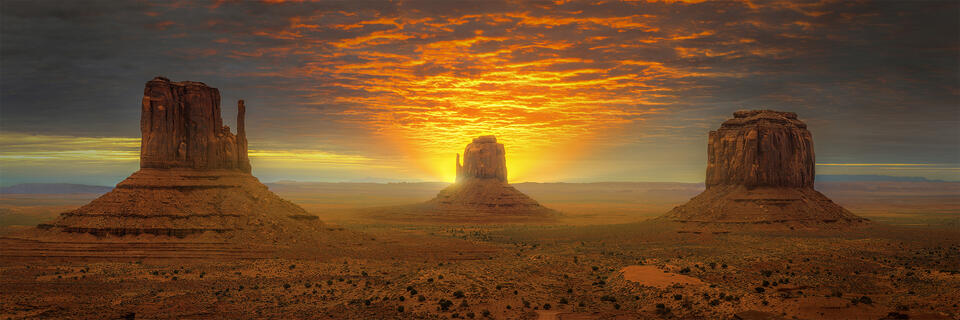
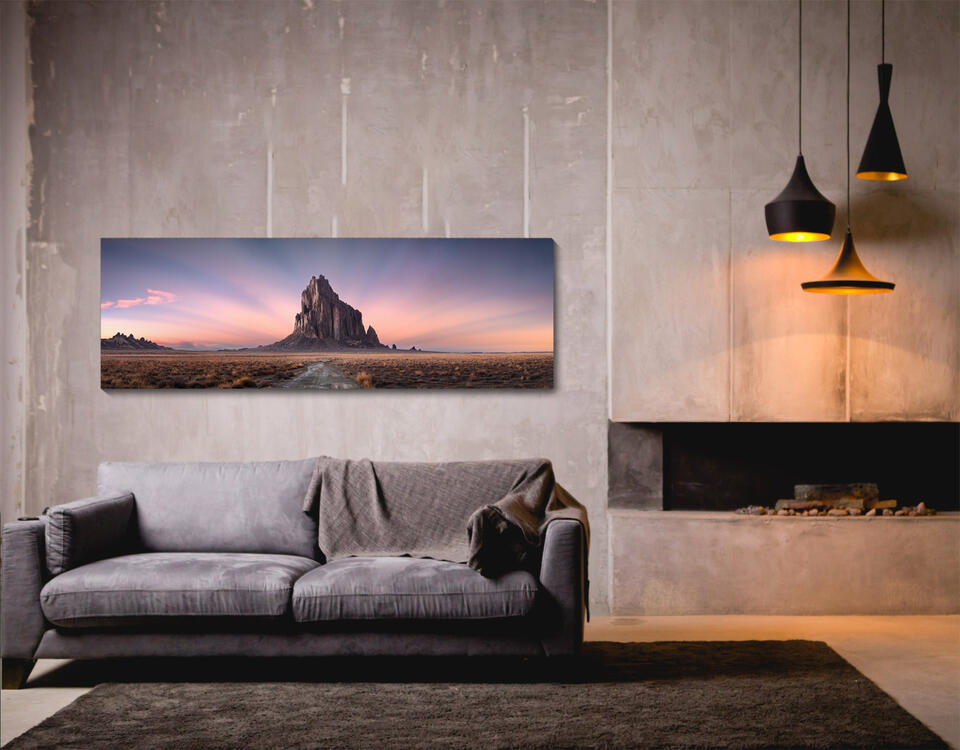
How to Choose the Right Print Size: When Scale Changes Everything
Choosing the right fine art print size depends on wall width, furniture placement, viewing distance, ceiling height, and the emotional role you want the artwork to play in the room.
Most people approach print sizing the way they approach hanging a picture. They measure the wall, find something that fits, and call it a decision. But if you have read anything about why large format landscape photography works the way it does, you already know that sizing is not a decorative choice. It is a psychological one.
The difference between a print that observes and a print that immerses comes down almost entirely to scale. Too small, and the image becomes something you look at. Large enough, and it becomes somewhere you can go. This guide is designed to help you find that threshold for your specific space.
Quick Answer: What Size Fine Art Print Is Right for My Wall?
Print Size Guide at a Glance
For most rooms, choose a fine art print that spans about 60 to 75 percent of the furniture below it. Above a standard 84-inch sofa, that usually means artwork between 50 and 63 inches wide. Smaller rooms, offices, bedrooms, and hallways often work best with an Intimate or Collected size, while open living rooms, dining rooms, executive offices, and large feature walls usually benefit from an Expansive, Horizons, or Statement size. When the goal is immersion rather than decoration, choose the largest size your wall, furniture, and viewing distance can comfortably support.
Understanding Fine Art Print Size Names
Every print in the Steve Austin Fine Art Photography collection carries a name rather than just a number. The ladder has four steps, and those names reflect the psychological role each size is designed to play. They are worth understanding before you look at dimensions.
Intimate sizes are designed for close viewing and smaller walls. They reward attention and work well in spaces where you sit or stand near the image, a reading corner, a home office, a bedroom, a hallway. The experience is personal rather than immersive.
Collected sizes bridge the gap between personal and environmental. These are the prints that begin to shift a room's character without dominating it. They work in mid-sized living spaces, dining rooms, and professional offices where presence matters but the room has other work to do.
Expansive sizes are where the immersive threshold begins. At these dimensions, peripheral vision starts to engage. The image stops competing with the room and begins to define it.
Statement sizes are full environmental scale. These prints are not additions to a space. They are the psychological anchor of a space. They are designed for rooms with high ceilings, long walls, open floor plans, and for collectors who understand that a room with a Statement print is a fundamentally different kind of room than one without.
Not every format offers all four. The panoramic ratios run Intimate, Collected, and Statement, since a fourth step at those proportions would exceed most walls.
Fine Art Print Sizes by Format and Aspect Ratio
Your images are available in five aspect ratio families. Each format has a different psychological character, and the right family depends as much on what the image is doing compositionally as on the dimensions of your wall.
.
4x5 Format — Portrait and Landscape
Intimate 16" x 20" / Collected 24" x 30" / Expansive 32" x 40" / Statement 40" x 50"
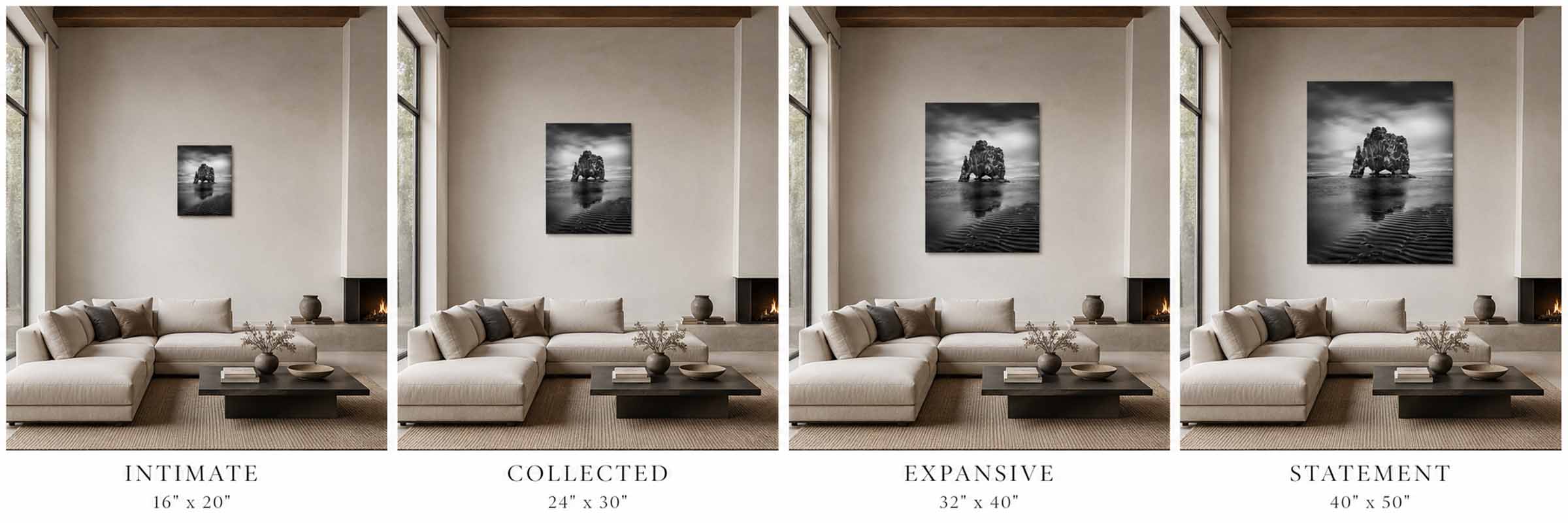
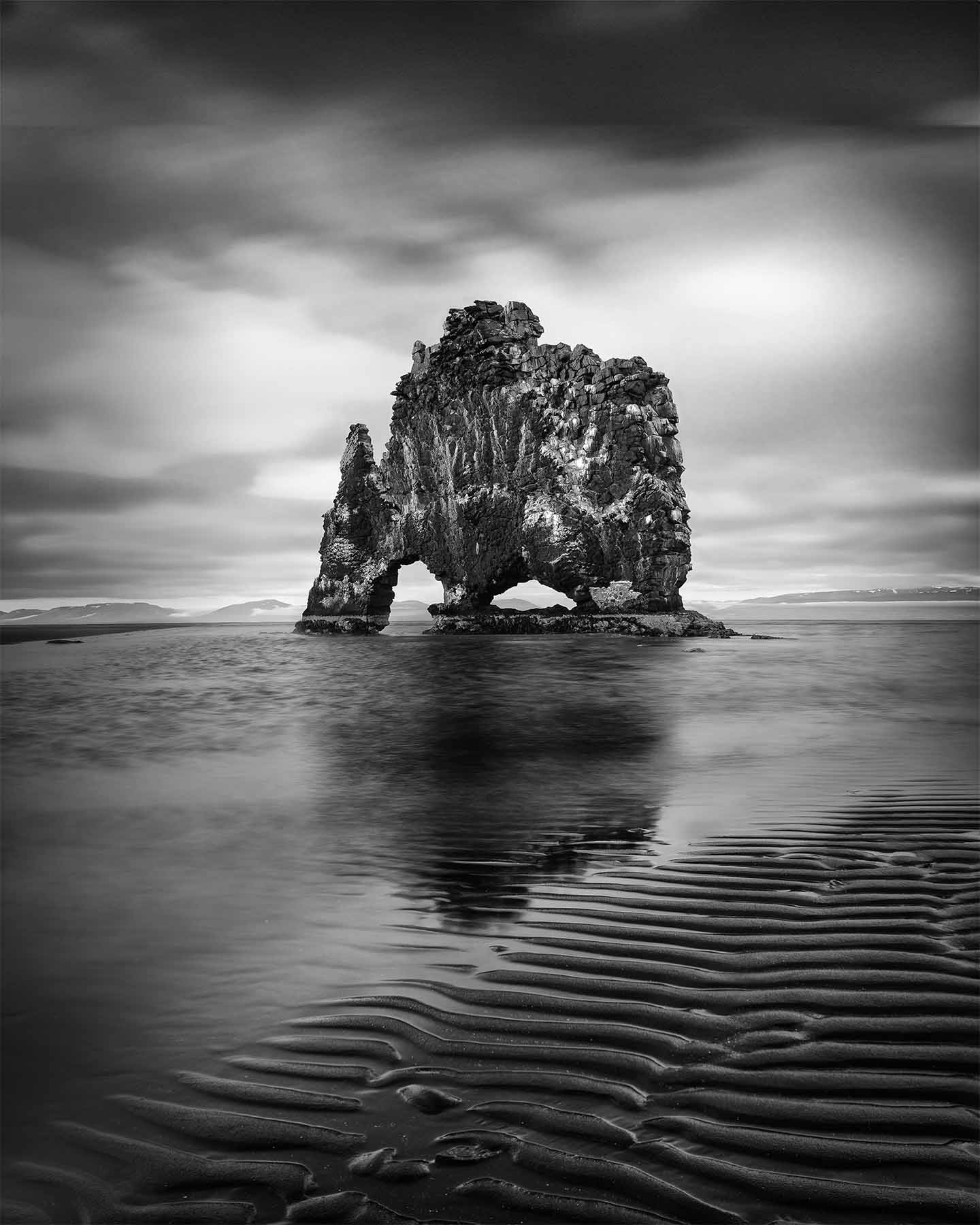
View Available Prints of Lone Guardian
The 4x5 format is the most balanced in the collection. It sits comfortably between horizontal sweep and vertical presence, which makes it adaptable across a wide range of spaces and subject matter. Images in this format tend to anchor a wall rather than extend it, making them well suited to rooms where the print will be the primary focal point on a single wall. The Statement size at 40x50 is genuinely large, but because the format is relatively compact in its proportions, it integrates into a room more easily than a panoramic print of similar height.
Best for: Living rooms, primary bedrooms, dining rooms, professional offices, healthcare waiting areas. Works well above a sofa, mantle, or bed.
Sizing guidance: For walls between 6 and 8 feet wide, the Collected to Expansive range tends to feel intentional without overwhelming the space. For larger walls or open-plan rooms, the Statement size delivers the psychological weight the format is capable of.
2x3 Format — Classic Landscape
Intimate 24" x 36" / Collected 36" x 54" / Expansive 40" x 60" / Statement 56" x 84"

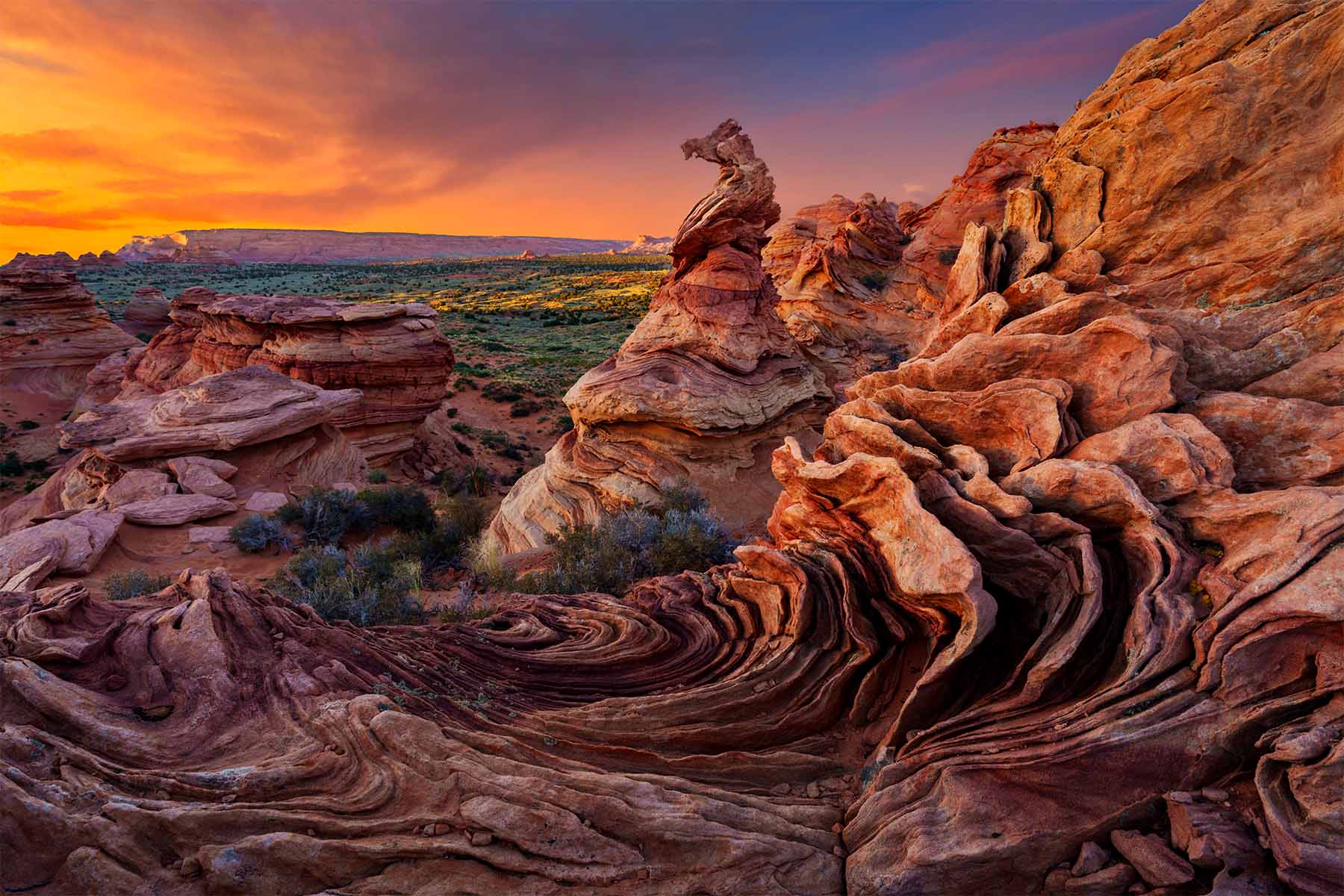
View Available Prints of Poseidon in Stone
The 2x3 is the most traditional landscape format and the one that most closely mirrors how the eye naturally scans a wide scene. It has enough horizontal extension to suggest vastness without crossing into full panoramic territory, which makes it one of the most versatile formats for residential and commercial spaces alike. The Statement size at 56x84 inches is among the most commanding prints in the collection. At that scale, the image occupies a full wall in most rooms and the immersive threshold is crossed completely.
Best for: Great rooms, executive offices, hotel lobbies, healthcare corridors, primary living spaces with walls of 8 feet or more. The Intimate size works beautifully in smaller dedicated spaces such as a study or a meditation room.
Sizing guidance: The Collected size at 36x54 is often the entry point where the format's full compositional intent becomes legible. Below that, fine detail and atmospheric depth can compress in ways that reduce the psychological impact. If your wall can accommodate 40 inches of height, the Expansive is worth serious consideration.
1x2 Panoramic Format — Wide Landscape
Intimate 20" x 40" / Residential 30" x 60" / Statement 40" x 80"

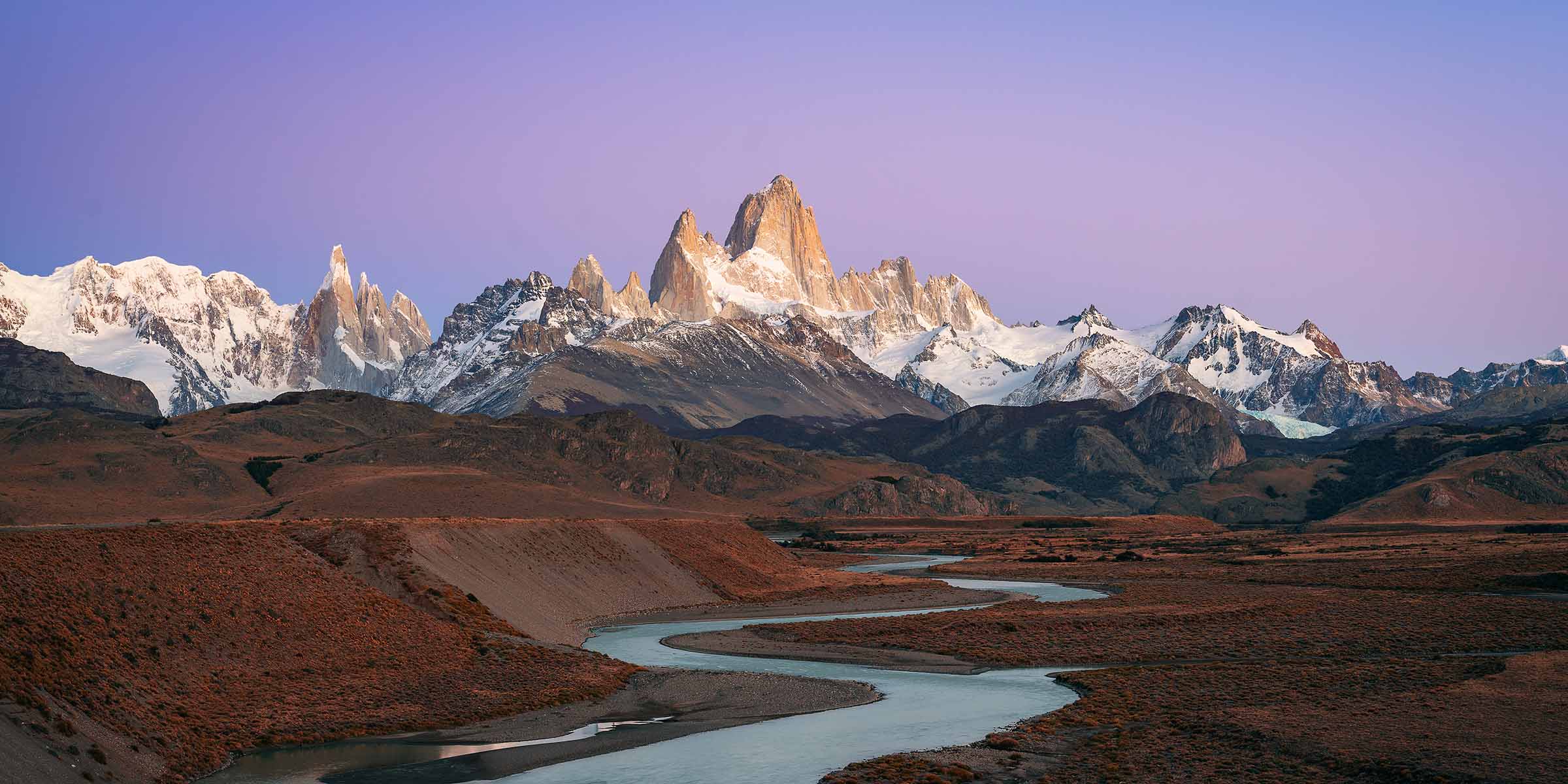
View Available Prints of The River Knows the Way
The 1x2 panoramic is where horizontal sweep begins in earnest. This format places the viewer at the center of a scene that extends significantly to both sides, and at the Residential and Statement sizes, peripheral vision begins to engage on both edges simultaneously. At this scale, the image begins to involve peripheral vision, which is one reason a large panoramic print can feel less like an object on the wall and more like an environment you are entering.
This format is particularly well suited to images with strong horizontal composition, wide valley floors, expansive desert plains, and mountain ranges seen from a distance. It also works exceptionally well above long furniture runs such as a sofa, credenza, or bed in a large primary suite.
Best for: Open-plan living spaces, long accent walls, above extended furniture, corporate reception areas. The Statement size at 40x80 commands a wall of at least 10 feet in width to breathe properly.
Sizing guidance: The Residential size at 30x60 is the sweet spot for most living rooms with standard 8 to 9 foot ceilings. The Statement is designed for spaces with architectural scale.
1x2.5 Panoramic Format — Extended Landscape
Intimate 16" x 40" / Horizons 24" x 60" / Statement 32" x 80"

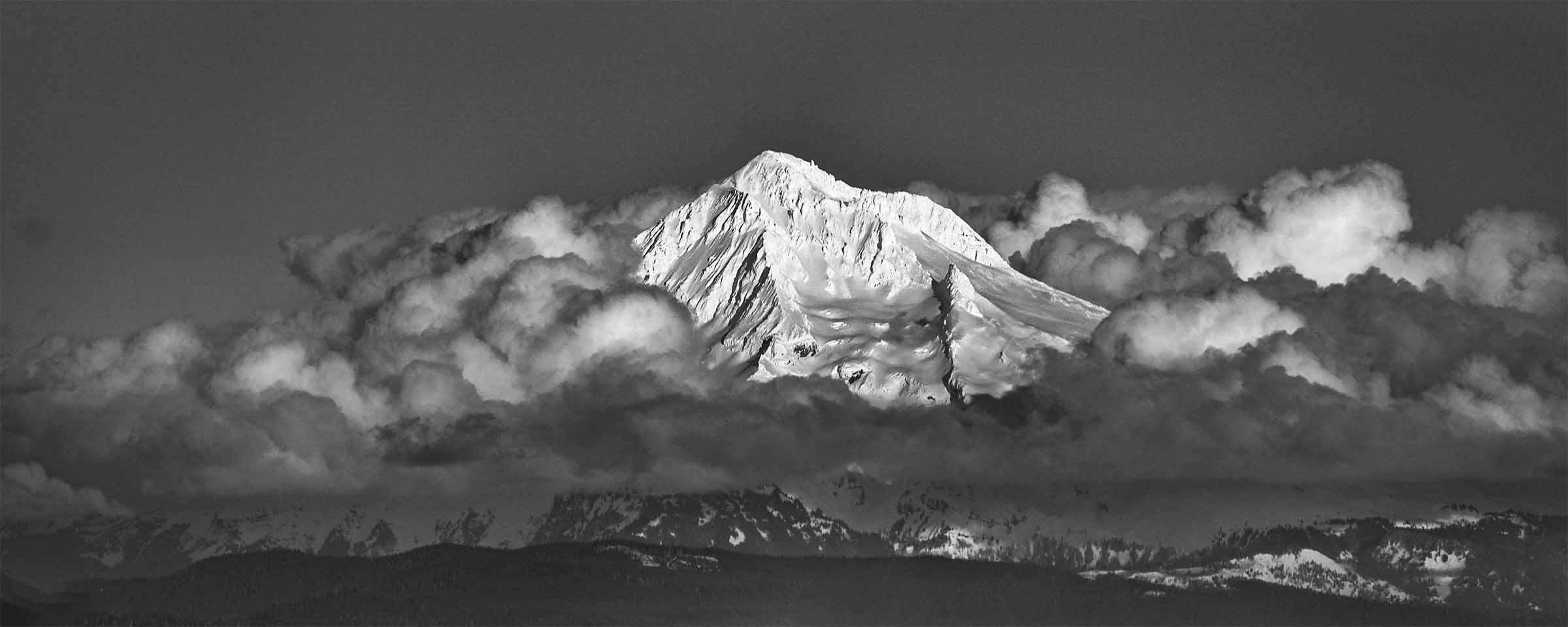
View Available Prints of Unmoored
The 1x2.5 format extends the panoramic ratio further, producing an image that is significantly wider relative to its height. This is the format of the wide horizon, the image where the sky and land divide the frame into broad horizontal registers and the viewer's eye travels across a scene rather than into it. At the Horizons and Statement sizes, this format has a distinctive calming effect that is different in character from the immersive vertigo of deeper panoramics. The extended horizontal register activates prospect responses, the evolutionary comfort of a wide open view with nothing hidden at the edges.
This format tends to read as serene rather than dramatic, which makes it particularly effective in environments designed for rest, recovery, and reflection. Healthcare settings, bedroom walls, and wellness spaces benefit from this quality.
Best for: Bedrooms, wellness and spa environments, healthcare patient rooms and corridors, long low walls, above bed frames in primary suites. The relatively modest height means it can work in spaces where ceiling clearance limits taller formats.
Sizing guidance: The Horizons size at 24x60 is genuinely commanding despite its moderate height. Because the width is so extended, the eye reads it as large even in rooms where vertical space is constrained.
1x3 Panoramic Format — Ultra-Wide Landscape
Intimate 12" x 36" / Horizons 20" x 60" / Statement 30" x 90"
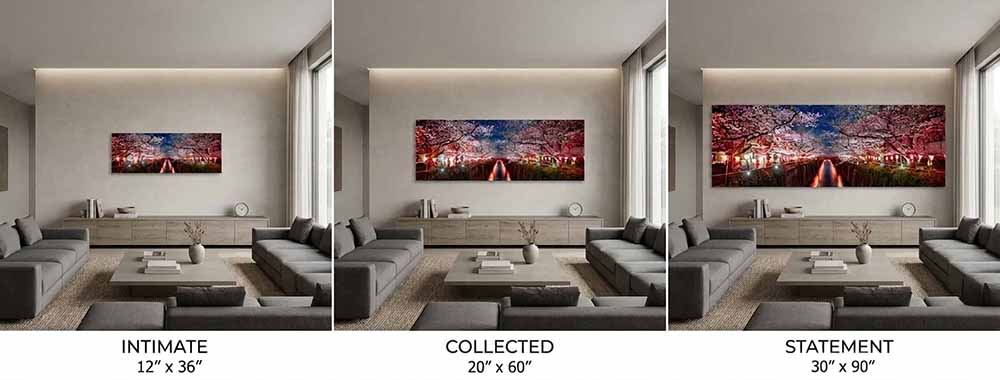
View Available Prints of Sakura Reverie
The 1x3 format is the most extreme panoramic ratio in the collection and the format closest to what the human visual field actually encompasses in a single sweeping gaze. At the Statement size, 30 inches tall by 90 inches wide, this print extends nearly eight feet across the wall. That is not a measurement. It is an environment. Images in this format are typically made with panoramic stitching techniques that capture a full 180-degree sweep of a scene, and the psychological effect when printed at full scale is unlike anything a narrower format can produce. The viewer does not stand before this image. They stand inside it.
The Horizons size at 20x60 is the most approachable entry point for this format and works in spaces where a full Statement print would be architecturally difficult. Even at that scale, the ratio's distinctive character is legible.
Best for: Great rooms and open living areas with long uninterrupted walls, corporate boardrooms, hotel feature walls, architectural feature installations. This format requires a wall of at least 10 feet to accommodate the Statement size, and ideally 12 feet or more for the print to be seen from an appropriate viewing distance.
Sizing guidance: The general rule for panoramic prints is that the minimum viewing distance should be roughly equal to the width of the print. A 90-inch Statement print is best experienced from at least 7 to 8 feet away. Plan your furniture placement accordingly.
How to Find the Right Print Size for Your Wall in Five Steps
Start with the wall, not the image. Measure the wall width and height available, and note any furniture the print will sit above. A print should typically span 60 to 75 percent of the furniture width below it, a proportion that feels intentional rather than accidental, and leave 6 to 12 inches of wall visible on each side rather than running edge to edge.
Frame style, matting, and presentation can also influence how large a finished piece feels on the wall. Visit the Framing and Presentation page to see how different display choices affect the final presence of a fine art print.
Consider your viewing distance. The immersive threshold is not just about size. It is about the relationship between print size and how far away you typically stand or sit. A 40x60 print viewed from 4 feet is more immersive than the same print viewed from 12 feet. Conversely, a very large print in a small room where you are always close to it can feel overwhelming rather than expansive.
Think about the room's psychological function. A space designed for focused work benefits from imagery in the calming, restorative register. A space designed for entertaining or making an impression can carry more dramatic scale and intensity. The format families described above each have a distinct emotional character, and matching that character to the room's purpose is as important as matching the dimensions to the wall.
Use the free digital mockup service. Before committing to a size, take advantage of the complimentary mockup available through Steve Austin Fine Art Photography. Seeing a specific image at a specific size on your actual wall removes the guesswork entirely and makes the psychological effect of the choice visible before the print is made. Contact us for a free mock up.
When in doubt, go larger. Almost every collector who has gone through this process reports that their only regret was not choosing a larger size. A print that is slightly too large for a space challenges the room to rise to it. A print that is slightly too small disappears into the wall. The immersive threshold is a real perceptual phenomenon, and it is worth reaching for.
View our In Situ page to see more examples of how fine art prints can look in residential spaces.
Choose a Print Size That Changes the Feeling of the Room
Your Space Deserves More Than Decoration.
You have spent time in this guide thinking about walls, dimensions, formats, and viewing distances. But the real decision was never about inches. It was about what you want a room to do for you and for everyone who enters it.
A large format landscape print chosen at the right scale does not fill a wall. It changes the psychological character of the space. It gives the eye somewhere genuinely expansive to rest. It introduces the kind of quiet that most built environments never offer.
If you are ready to find the right image and the right scale for your space, start with a free digital mockup. Send us a photograph of your wall and tell us which image or format family interests you. We will show you exactly how it would live in your room before a single print is made.
Request Your Free Digital Mockup
Or if you are still exploring, browse the full collection and let the work speak for itself.
Frequently Asked Questions About Choosing the Right Print Size
What size art looks good above a sofa?
The most reliable guideline is that the print should span approximately 60 to 75 percent of the sofa's width. For a standard 84-inch sofa, that places you in the 50 to 63-inch width range, which corresponds to the Expansive or Statement sizes in most of the format families in this collection. The bottom edge of the print should sit roughly 6 to 8 inches above the sofa back, allowing the piece to read as connected to the furniture rather than floating independently on the wall. For longer sectional sofas or open-plan living spaces, a panoramic format in the 1x2 or 1x2.5 family can follow the full horizontal line of the seating and create a cohesive visual environment rather than a single focal point.
Can a print be too large for a room?
Yes, but it is less common than people expect, and the more frequent mistake is choosing a print that is too small. A print that is slightly too large for a space creates a sense of presence and weight that challenges the room to rise to it. A print that is too small tends to disappear into the wall and loses the psychological impact that makes large format landscape work meaningful. The cases where size genuinely becomes a problem are usually about viewing distance rather than wall space. If the room does not allow you to step back far enough to take the image in fully, the experience shifts from immersive to overwhelming. As a general rule, your comfortable viewing distance should be at least equal to the width of the print. A free digital mockup will show you exactly how a specific size reads in your specific room before any commitment is made.
How do I know if a panoramic format is right for my wall?
Panoramic formats work best on long uninterrupted horizontal walls, above extended furniture runs such as a sofa, bed, or credenza, and in rooms where the ceiling height allows the print to breathe without crowding. If your wall is wider than it is tall and relatively free of interruptions such as windows, doors, or architectural features, a panoramic format will likely feel natural and intentional. If your wall is more vertical in character, or if it is broken by multiple features, a 4x5 or 2x3 format will integrate more cleanly. The panoramic formats in this collection range from the 1x2 family, which has a strong but approachable horizontal sweep, to the 1x3 ultra-wide family, which at Statement scale approaches the full width of the human visual field and produces a genuinely immersive environmental experience.
What is the difference between a print that decorates a room and one that transforms it?
A decorative print fills space. It coordinates with furniture, complements a color palette, and makes a wall look finished. There is nothing wrong with that, but it is a different object with a different purpose than what large format landscape photography is designed to do. A print that transforms a room changes the psychological character of the space. It gives the eye somewhere genuinely expansive to go. It introduces a quality of depth, stillness, or vastness that the built environment cannot produce on its own. The research on this distinction is consistent. People in rooms with large scale nature imagery report lower stress, reduced cognitive fatigue, and a stronger sense of psychological ease than people in rooms without it. The difference is not aesthetic preference. It is a measurable shift in how the nervous system responds to the environment. Scale is the primary mechanism that makes that shift possible, which is why choosing the right size is a psychological decision as much as a spatial one.
How does the free digital mockup service work?
The process is straightforward. Send a photograph of your wall to Steve Austin Fine Art Photography along with any notes about the image or format you are considering. If you are unsure which image or size would work best, include that in your message and the options can be discussed before the mockup is prepared. You will receive a digital rendering showing the specific print at a specific size within your actual space, which makes the scale, proportion, and visual impact of the piece visible before any decision is made. The service is free and carries no obligation. Its purpose is to remove the guesswork from a decision that benefits enormously from being seen rather than imagined.
Featured Fine Art Prints for When Scale Changes Everything