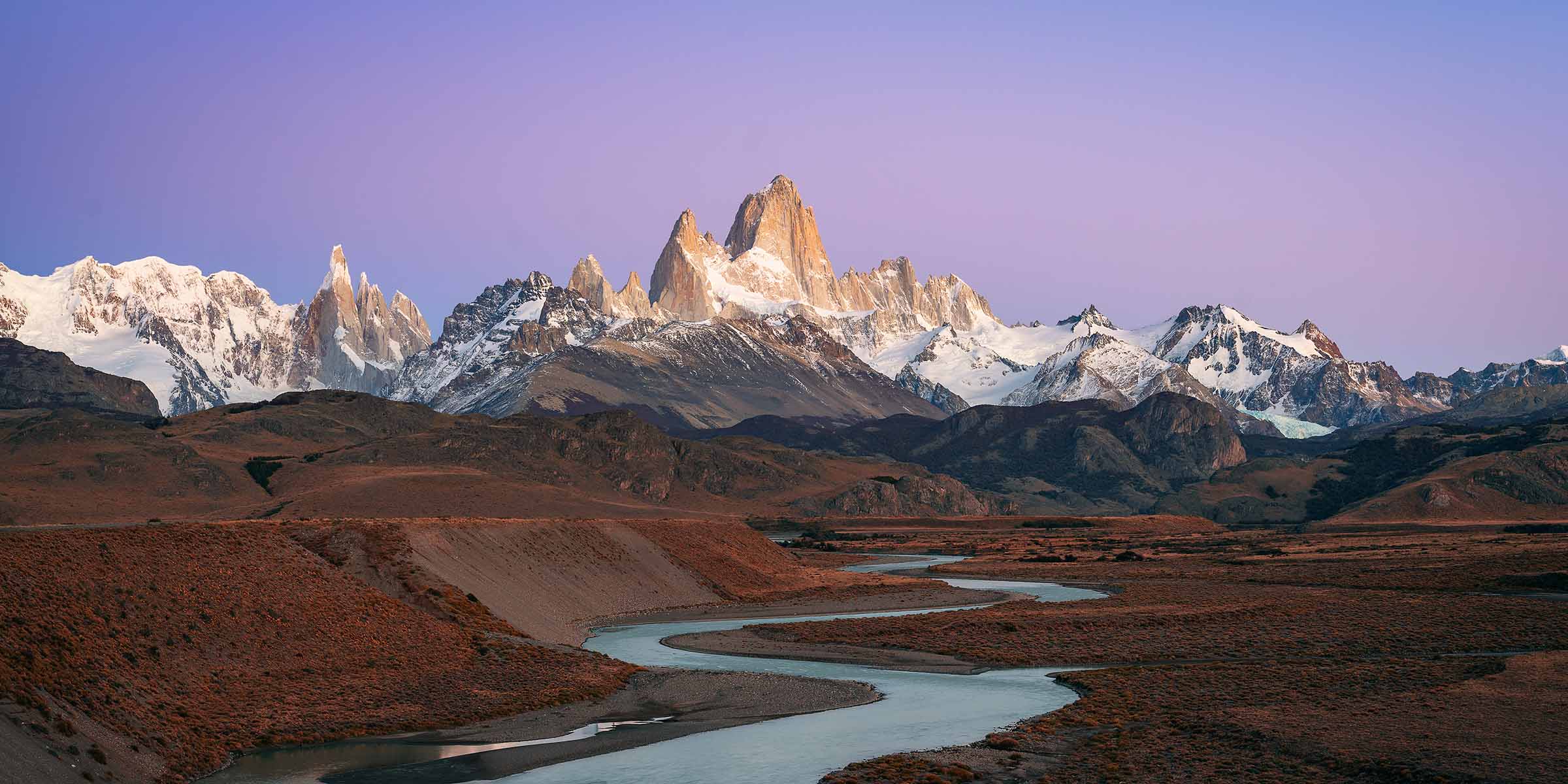
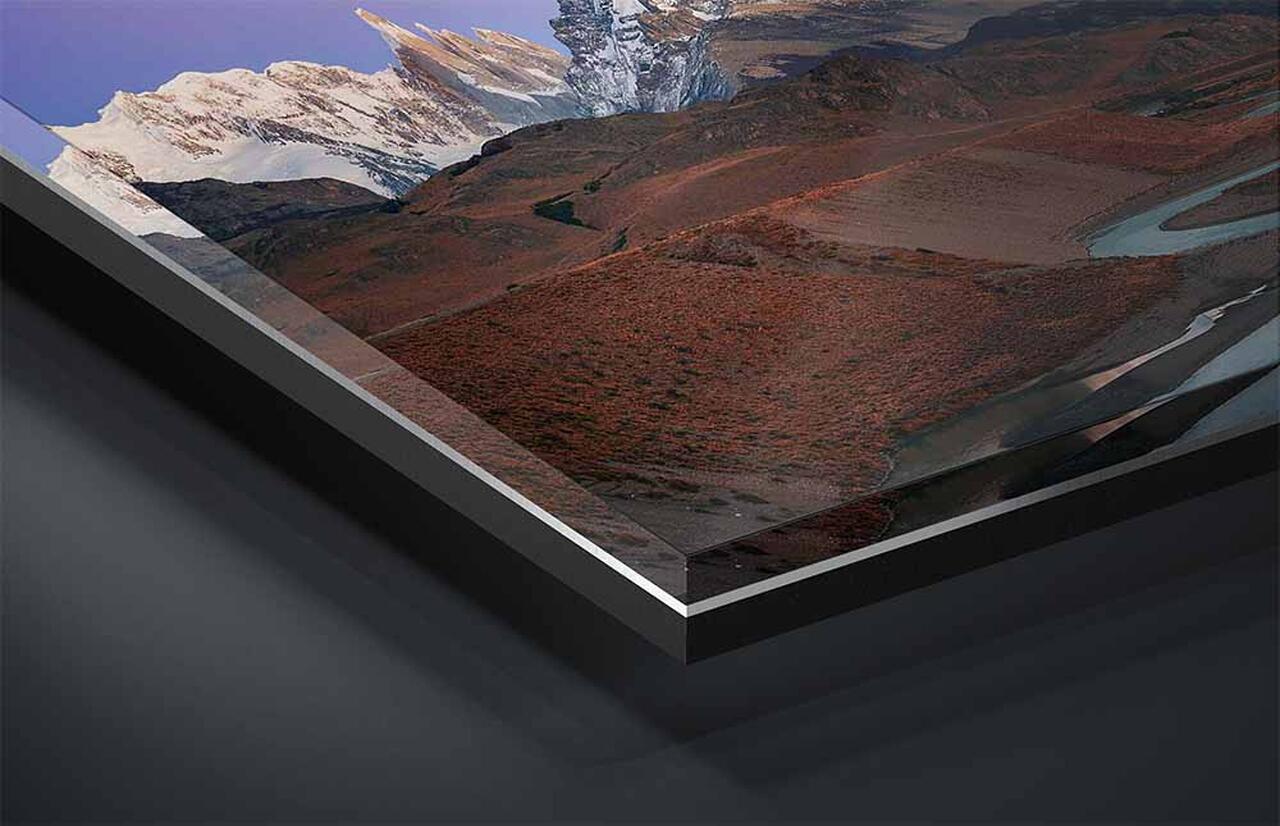
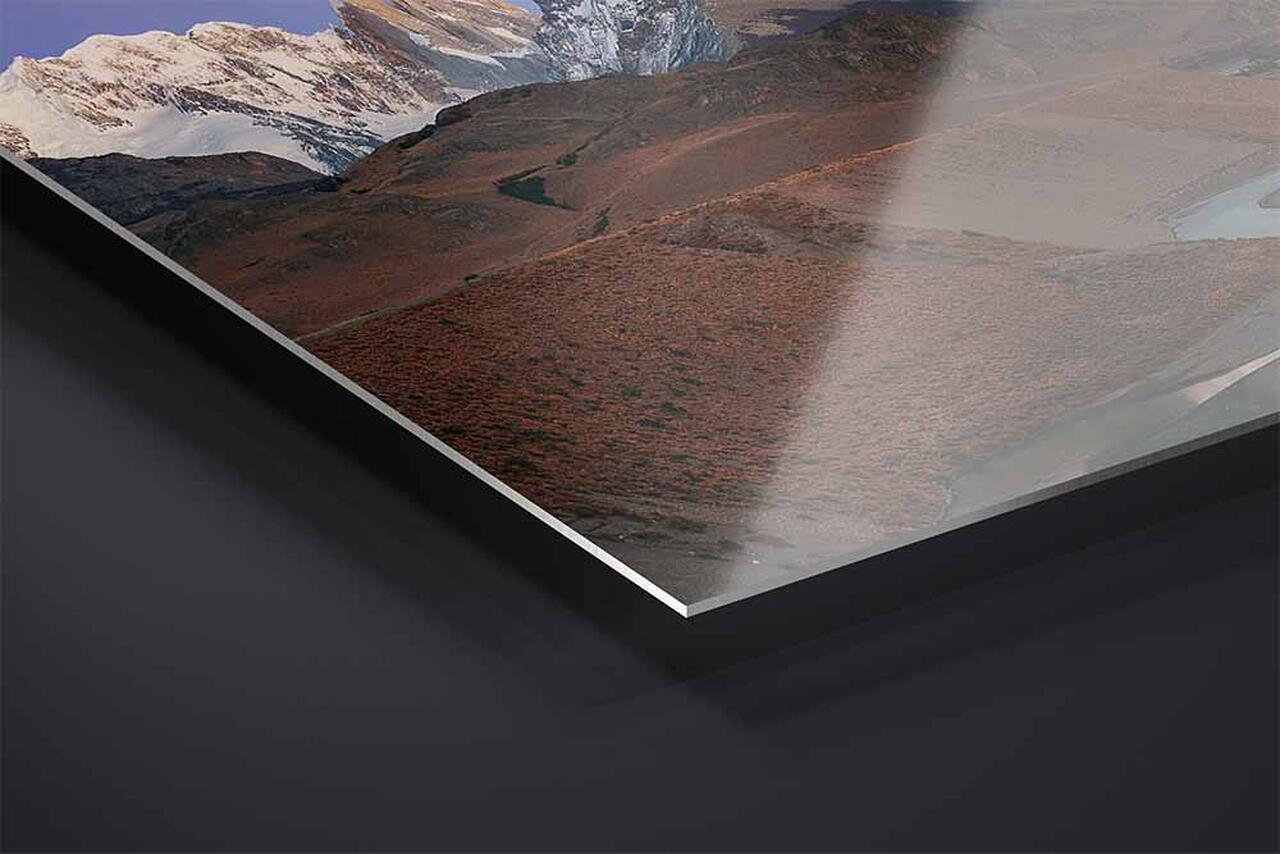
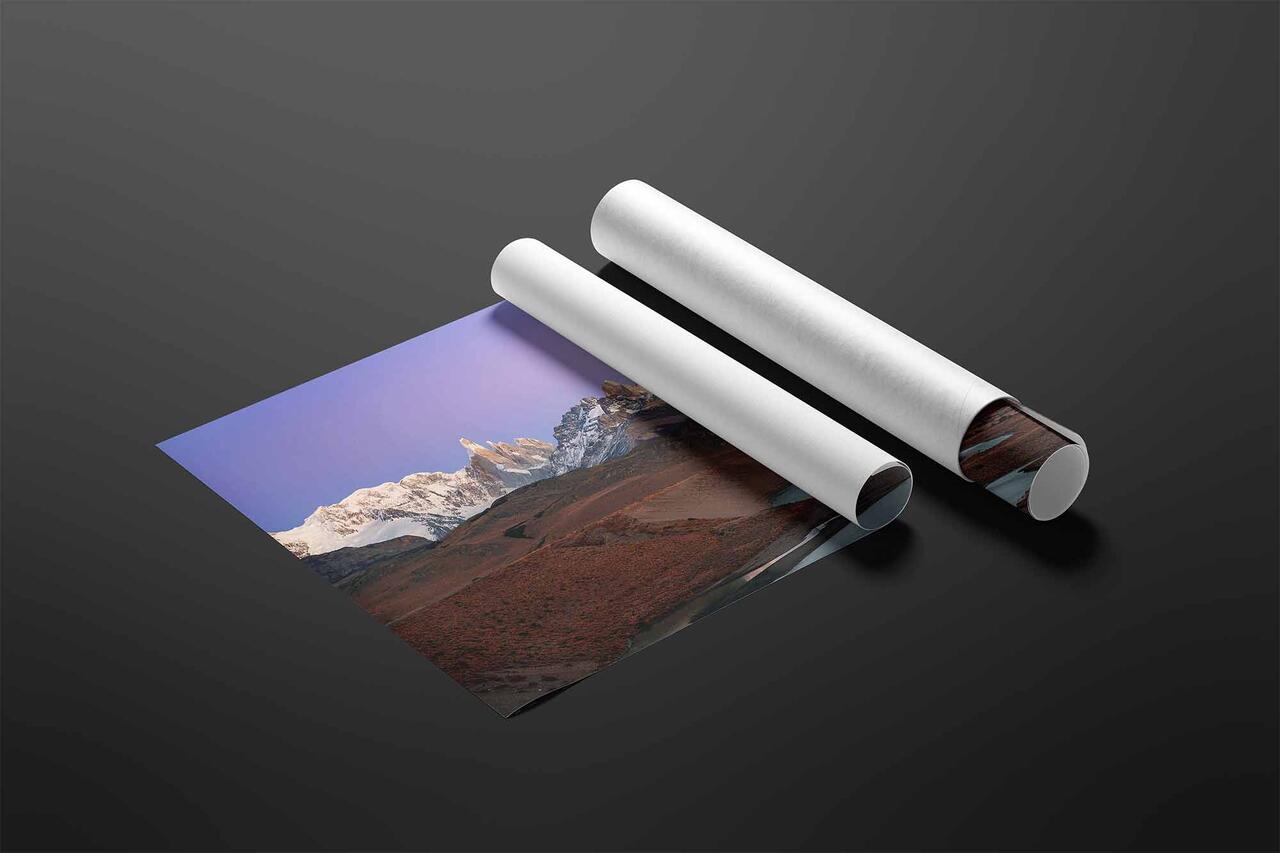
A 2:1 panoramic photograph of Monte Fitz Roy at sunrise above the Rio de las Vueltas near El Chalten, Patagonia, Argentina, available as a limited edition print in three sizes.
Artist's Story
Monte Fitz Roy stands on the Argentina-Chile border above Los Glaciares National Park, and the Tehuelche called it Chaltén, usually translated as the smoking mountain, for the cloud that sits on its summit almost all the time. A clear morning here is not the ordinary condition. It is the exception you turn up for and hope about.
I walked out along the river before dawn, in the dark, picking my way by the sound of the water because there was nothing to see. I set up where the bank felt right and waited without knowing what I had.
Then the summits went gold while I was still standing in the dark.
That is not a poetic way of putting it. Sunrise happens for a place when that place can see the sun, and how far you can see over the curve of the earth depends on how high you are. The valley floor here is about four hundred meters up. The summit is three thousand four hundred. That extra three kilometers lets it see nearly two degrees further around the world than I could, standing at the water. At this latitude the sun climbs about ten degrees an hour when it is near the horizon, so the mountain gets its sunrise something like ten or fifteen minutes before the river does, and the ridges to the east push that out further still.
Which meant I could see the mountain clearly for a while before I could see the ground under my feet, or the river I had been following.
You choose a place in the dark, and the light tells you later whether you chose well.
The River Knows the Way is that morning, when the water I had been following blind turned out to have been pointing at the mountain the whole time.
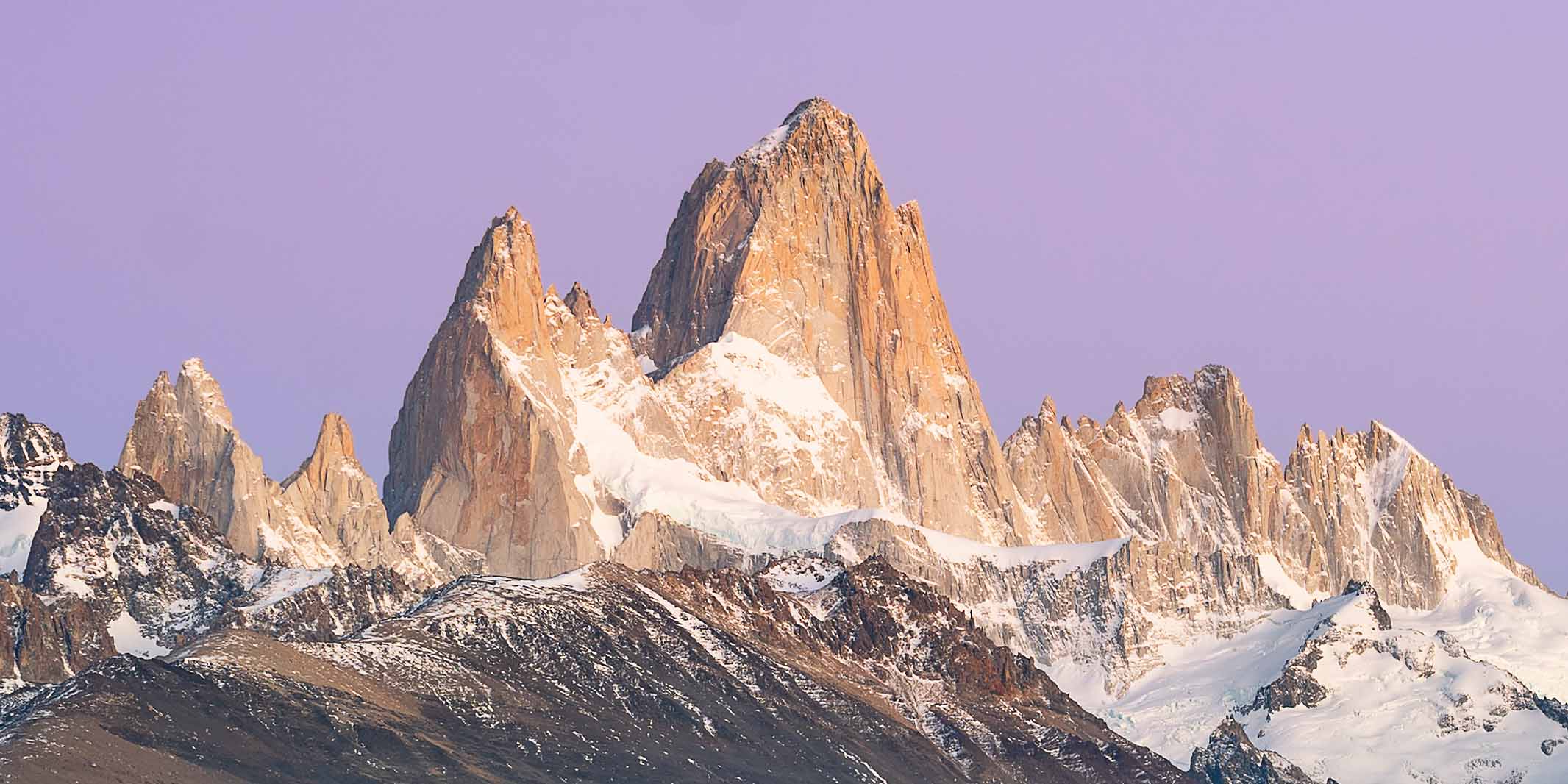
The summit at about a third of the frame width. The granite faces show their vertical fracturing, the ledges holding snow separate from the sheer rock beside them, and the aiguilles along the ridge stand apart with sky between them. Below the peaks the glacier tongues come clear with crevassing visible across them, and along the shoulders the snow separates from the dark rock beneath it. This is the light the summit gets ten or fifteen minutes before the valley floor does. Click to view at full size.
About This Photograph
Los Glaciares National Park near El Chaltén, Santa Cruz Province, Argentina, at sunrise. This is a single frame image. Monte Fitz Roy stands at 3,405 meters on the Argentina-Chile border, with the spire of Cerro Torre at 3,133 meters to its left and the Río de las Vueltas running through the valley below.
The Tehuelche name for the mountain is Chaltén, most often translated as smoking mountain for the cloud that usually forms around its summit, though other readings of the word exist and Fitz Roy is one of several peaks they called by that name. The present name was given on 2 March 1877 by the Argentine geographer Francisco Moreno, for Robert FitzRoy, who had taken HMS Beagle up the Santa Cruz River in 1834.
The photograph is two opposed colors stacked. Across the top the sky measures seventy-three points toward blue; along the bottom the steppe measures warm, with individual readings reaching thirty-four toward red. Because the two are close to equal in quantity they cancel, and the frame as a whole comes out within seven points of neutral.
The River Knows the Way
Steve Austinhttps://www.steveaustinphotography.com/
Location
Monte Fitz Roy, El Chaltén, Argentina
Subject
Monte Fitz Roy · Patagonian steppe · sunrise
Capture
Single frame at sunrise
Format
Photograph · horizontal panorama, 2:1
Sizes
40 × 20 in · 60 × 30 in · 80 × 40 in
Print Media
TruLife Acrylic · ChromaLuxe Metal · Baryta paper
Edition
Limited, 25 / 50 / 100 by presentation
What it Does in a Room
There are miles of ground between the near bank of that river and those peaks, and how much of it survives depends almost entirely on size. Depth is read partly from angular size, from how large things are against one another in your field of view, and a print compresses all of that into whatever width it has. At forty inches the whole distance is packed into a little over three feet and the eye takes it as a flat arrangement of shapes. At eighty the near scrub, the river, the hills, and the range sit at angular sizes far closer to the ones they actually had, and the distance comes back as distance. This is the piece in the collection where going larger buys the most, and it is not detail that is being bought.
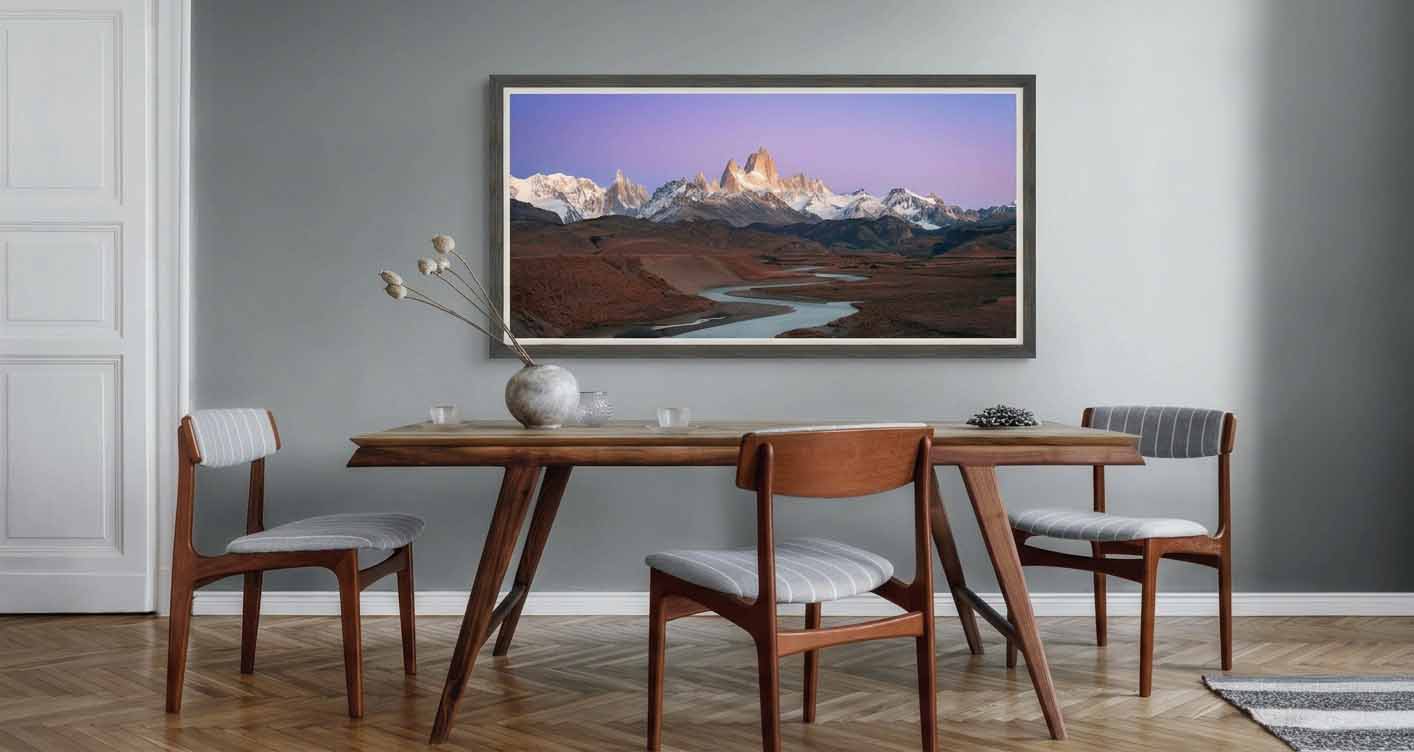
The subject is high in the frame and the space is low. The mountains occupy the top third and the remaining two thirds is foreground and middle ground, which is the reverse of the usual landscape arrangement. That gives it placement latitude nothing else here has. It can hang higher than standard and still put its subject at or near eye level, and above a tall bookcase, a headboard, or a run of cabinets the part that gets sacrificed to the furniture is scrub, not mountain. On a low hang the peaks end up above sightline and the picture starts to feel like something you are looking up at from a hole.
Its two colors sit opposite each other, and a room can take either one. The sky is a cool violet and the ground is a warm rust, they are roughly equal in quantity, and the picture as a whole measures within seven points of neutral because the two cancel. Practically that means a room can pick up the top half or the bottom half and the piece will still work: a rust or terracotta floor agrees with the ground, a gray-violet wall agrees with the sky. Picking up both will make the room look designed around the photograph, which is a legitimate choice and should be one.
Not sure which size the room calls for, or want dimensions not listed here? Sizes beyond 80 × 40 are available on request and ship crated by freight. That conversation is welcome before an order is placed. Start that conversation and I will answer within one business day.
The River Knows the Way, limited edition printSteve Austin112513400USD12https://schema.org/InStock
Questions about this photograph
How small is too small for a photograph this wide?
At the Intimate size the picture is forty inches across and twenty inches tall, and the shapes all hold: the skyline, the river, the sweep of the near bank. What goes is the middle. This photograph is built from three distances, the scrub in front of you, the river and the low hills beyond it, and the range at the back, and it is the middle one that carries the sense of how far apart the other two are. At forty inches the hills between the river and the mountains compress into a dark band, and once that happens the peaks sit directly behind the foreground rather than fifteen miles behind it. You keep the picture and lose the space. The Collected at sixty by thirty is where the middle distance opens again. If you are weighing a size against a specific wall, choosing the right print size covers the measurements and the viewing distances in more detail.
What changes at the largest size?
The range becomes architecture. At eighty by forty the granite faces of Fitz Roy show their vertical fracturing, the ledges holding snow separate from the sheer rock beside them, and the individual aiguilles along the ridge stand apart with sky between them. Cerro Torre resolves as a distinct spire with its own rime. Below the peaks the glaciers show as separate tongues with crevassing visible on them. In the middle ground the low hills separate one behind another instead of merging, which is what restores the depth. Along the river the braided channels and gravel bars read as individual bars with water running between them, and across the near bank the scrub becomes thousands of separate bushes with bare ground between. Why scale matters covers what happens perceptually when a landscape reaches the size where the eye has to cross it.
What kind of room does this photograph suit?
Rooms with a long wall and enough floor to stand back in. A home office, a sitting room, a dining room, the far end of an open plan. It hangs at ordinary height or a little above, and it needs distance in front of it more than most pieces here. On materials it is flexible, since a room can meet either the violet at the top or the rust at the bottom. Two things to avoid. Do not hang it low, since the peaks then sit above sightline and the composition inverts. And keep it away from a second mountain photograph, because the subject is well known enough that two of them in a room read as a travel wall rather than as two pictures. When your mind needs to rest takes the question further.
Every work ships insured and arrives with a signed certificate of authenticity.
If a piece is damaged in transit, the choice of replacement is always yours, and your edition number stays with you.
Production time runs 2 to 3 weeks for metal, 3 to 4 weeks for acrylic and paper, and 5 to 6 weeks for framed work.
Each print is made to order and takes its place in a numbered edition, so sales are final. Before you choose, I am glad to help: send a photo of your wall and I will show you this work in your room at true scale, at no charge. Start a conversation
Collector's Choice · TruLife ® Acrylic in Italian Frame
Collector Edition of 25· Lumachrome TruLife Acrylic · Handcrafted Italian Frame
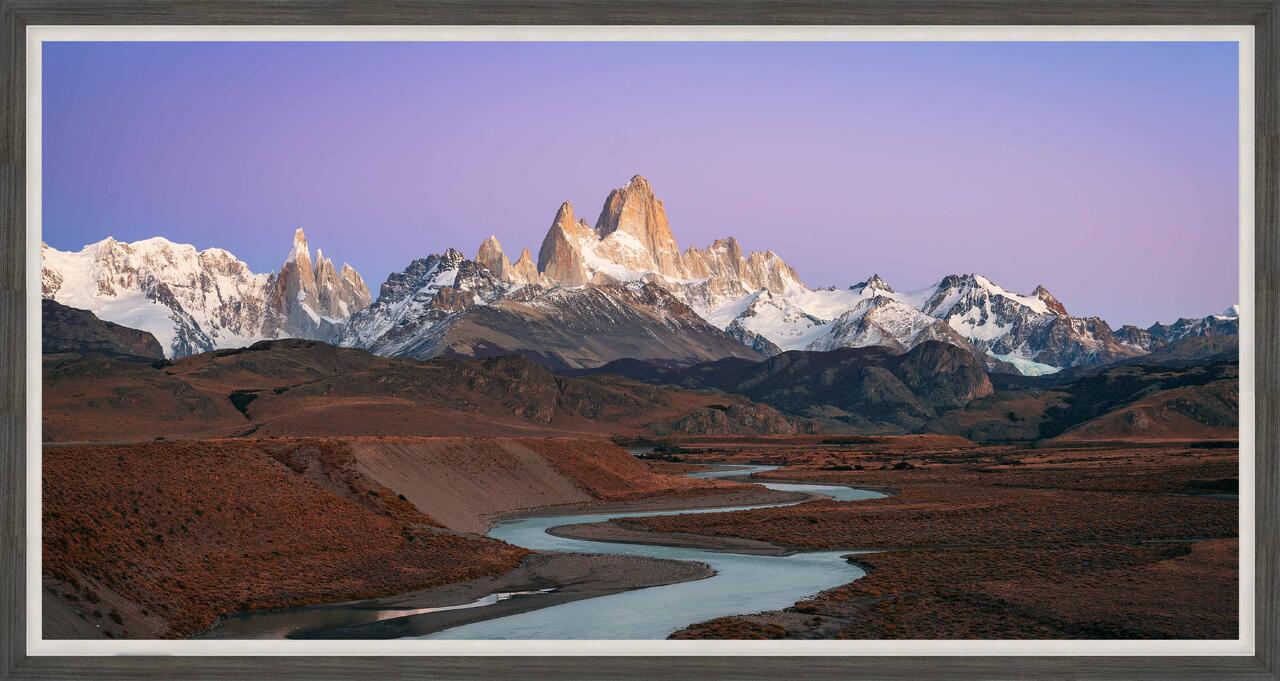
TruLife acrylic in a handcrafted Italian frame with a linen liner chosen for the image. Frame series, finish, and liner are settled with you after the order, and production begins from there. The frame and liner add about fourteen inches to the finished dimensions, worth allowing for when planning placement.
Signature Acrylic Edition of 50· Lumachrome TruLife · Gallery Float Mount
Face-mounted to TruLife acrylic and floated approximately one inch from the wall, with no frame to mediate between the image and the room. UV-resistant, anti-reflective, and scratch-resistant, with a lifetime guarantee against fading.
Signature Metal Edition of 50· ChromaLuxe Print · Gallery Float Mount
Color infused into the aluminum panel itself, floated from the wall on a concealed system. Where acrylic produces luminosity, metal produces clarity. Exceptional fade resistance with no glazing or coating required.
Fine Art Edition of 100· Hahnemühle Baryta Fine Art Paper
Printed without acrylic, so light meets the paper surface directly. Highlights stay luminous, shadows keep their nuance, and the surface has a tactile quality the other presentations approach differently. The understated choice, and the traditional one.
Complimentary shipping within the continental United States. International collector shipping available upon request.
Still deciding
Designing for Stillness
A guide to choosing art for restorative spaces
How to tell whether an image will still hold you in a year, how scale changes what a photograph does in a room, and how to match a piece to the work a room actually performs. It cites the research it draws on, and it is equally clear about where that research stops. About ten minutes to read.