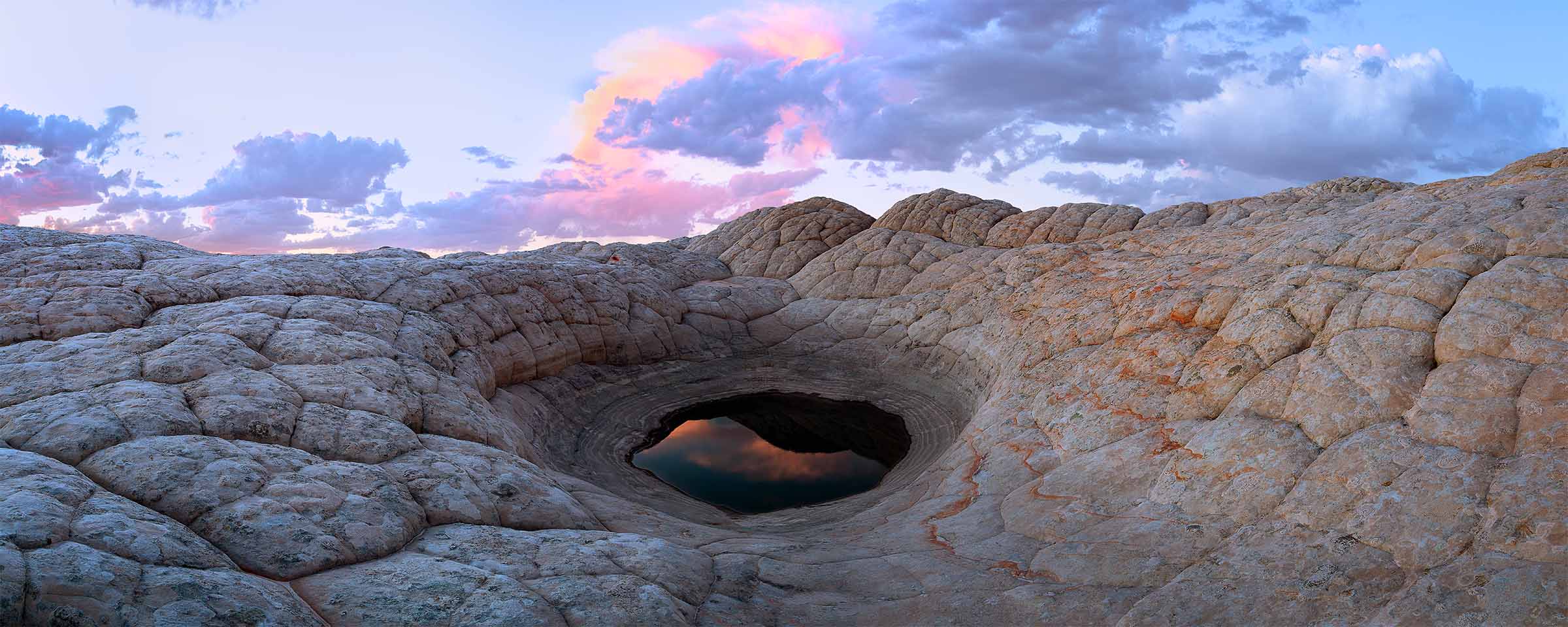
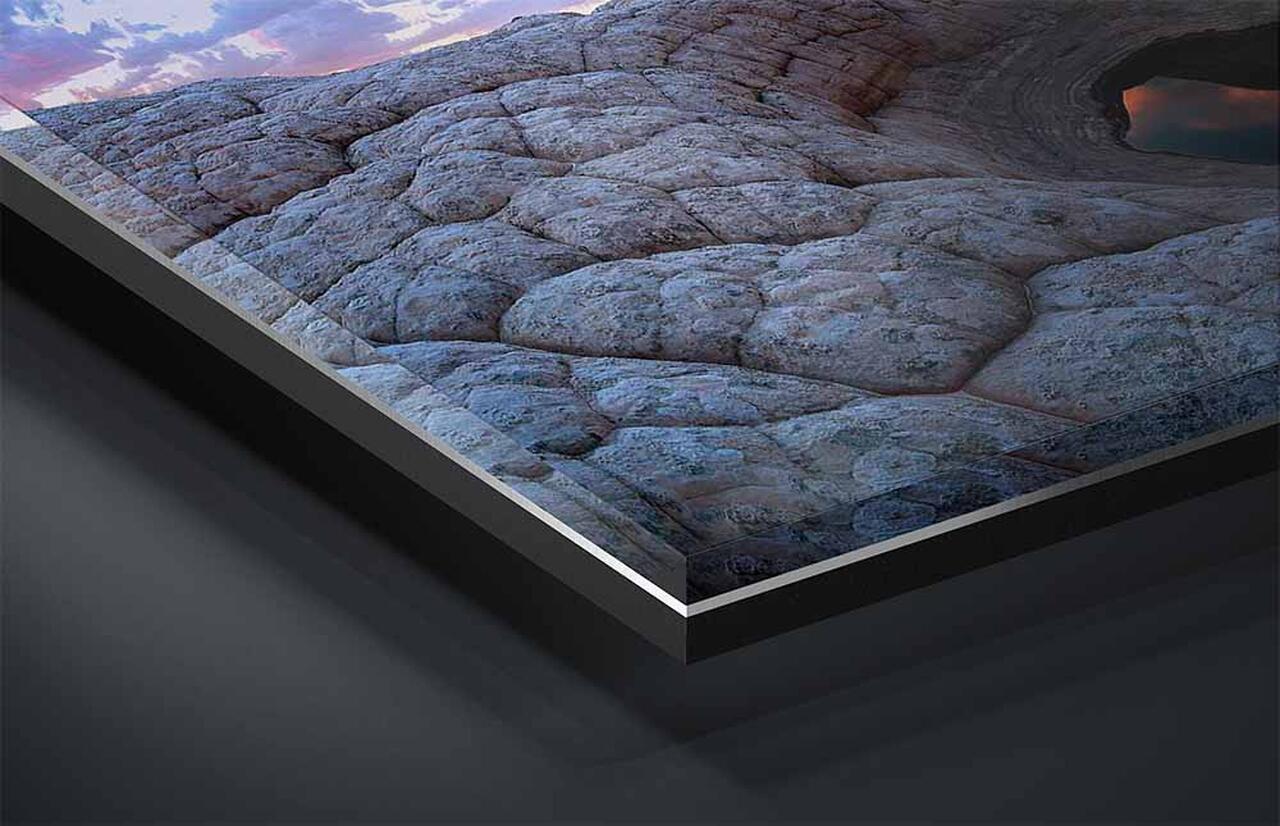
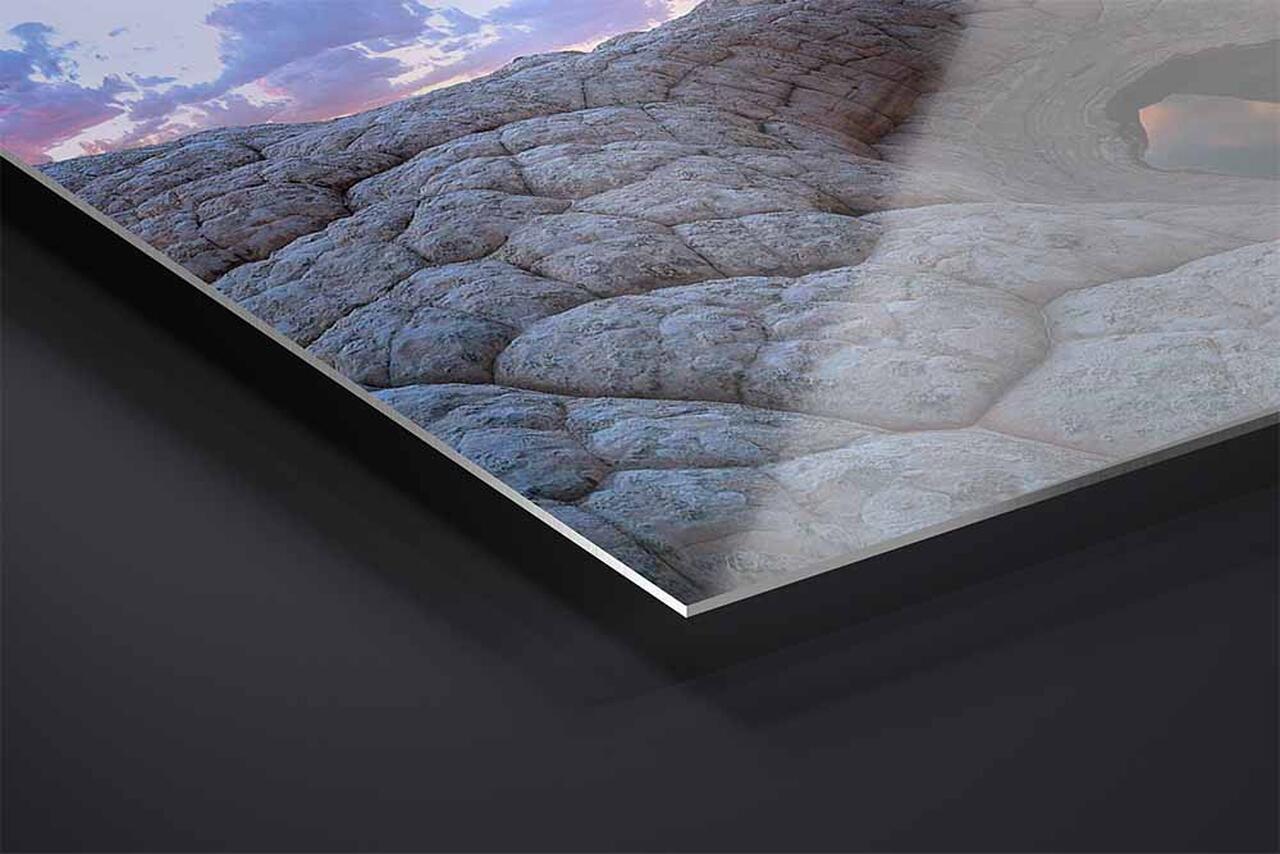
A 5:2 panoramic photograph of a still pool set in white sandstone at White Pocket in the Vermilion Cliffs, Arizona, available as a limited edition print in three sizes.
Artist's Story
This is White Pocket, in the Vermilion Cliffs of northern Arizona. There are no trees in it, no soil, and no shade. It is several square miles of bare sandstone pushed into domes and swells, and the only thing anywhere in this frame that is not solid rock is a pool of water about twelve feet across.
I came over a rise and it was in front of me.
The rock here is Navajo Sandstone, which is old dune sand held together by a weak cement, a mix of calcite, silica, clay, and iron between the grains. Rain is faintly acidic. Where a shallow hollow catches some and holds it, the standing water works on that cement, the grains come loose, and the wind and the next rain take them away.
Then the useful part happens. The hollow is now deeper, so it holds water longer, so it gets more of that work done, so it deepens faster. A pool exists here because it is already a pool.
There is a living component as well. A biofilm forms on the floor of these things, and it appears to do two jobs: it helps dissolve the cement, and it seals the bottom so the water sits longer than it would on bare rock. Dried out, it is a black crust. Put water back on it and it turns green in about a fortnight.
So the still water in the middle of all that rock is not an accident of the terrain. It is the one place where things stopped moving long enough to change what was underneath them.
The Quiet Center is twelve feet of water in several square miles of stone, holding a sky that has nothing else to be reflected in.
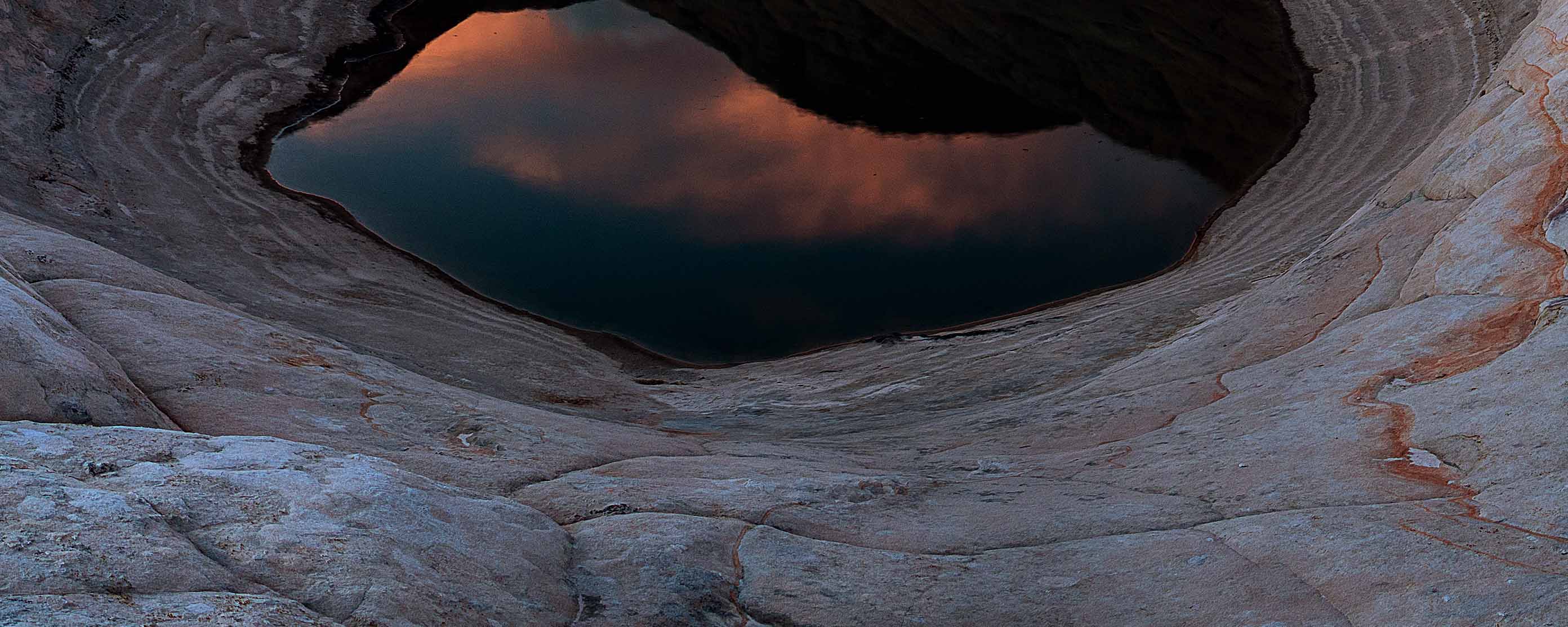
The pool and its rim at about a third of the frame width. The layers step down toward the water as a set of concentric rings, each one the edge of a bed the wind laid and left. In the pool the reflected cloud shows its own edges and the far wall of the basin appears beneath the surface. Across the rock the network of joints resolves into individual cracks with depth in them, and on the right the orange staining runs as fine branching lines along those joints, which is iron that has moved through the stone and settled. Click to view at full size.
About This Photograph
White Pocket, Vermilion Cliffs National Monument, Coconino County, Arizona, at dusk. This is a single frame image. The site sits on the Paria Plateau and is reached only by unpaved road across deep sand.
The lumped and folded surface across this frame is unusual for Navajo Sandstone, which almost everywhere else shows the clean sweeping crossbedding of ancient dunes. The leading account of it is soft-sediment deformation: the sand was still saturated and not yet hardened when something, most likely seismic shaking, liquefied it, and the layers slumped and churned into one another before they set.
This is the brightest photograph in the collection. Its border averages a hundred and thirty-three out of two hundred and fifty-five, against a range of ten to a hundred and three for everything else here, and the picture as a whole averages a hundred and thirty-one. Nothing in it reaches pure white despite that, and almost nothing reaches black.
The Quiet Center
Steve Austinhttps://www.steveaustinphotography.com/
Location
White Pocket, Vermilion Cliffs, Arizona
Subject
White sandstone · desert pothole · dusk sky
Capture
Single frame at dusk
Format
Photograph · horizontal panorama, 5:2
Sizes
40 × 16 in · 60 × 24 in · 80 × 32 in
Print Media
TruLife Acrylic · ChromaLuxe Metal · Baryta paper
Edition
Limited, 25 / 50 / 100 by presentation
What it Does in a Room
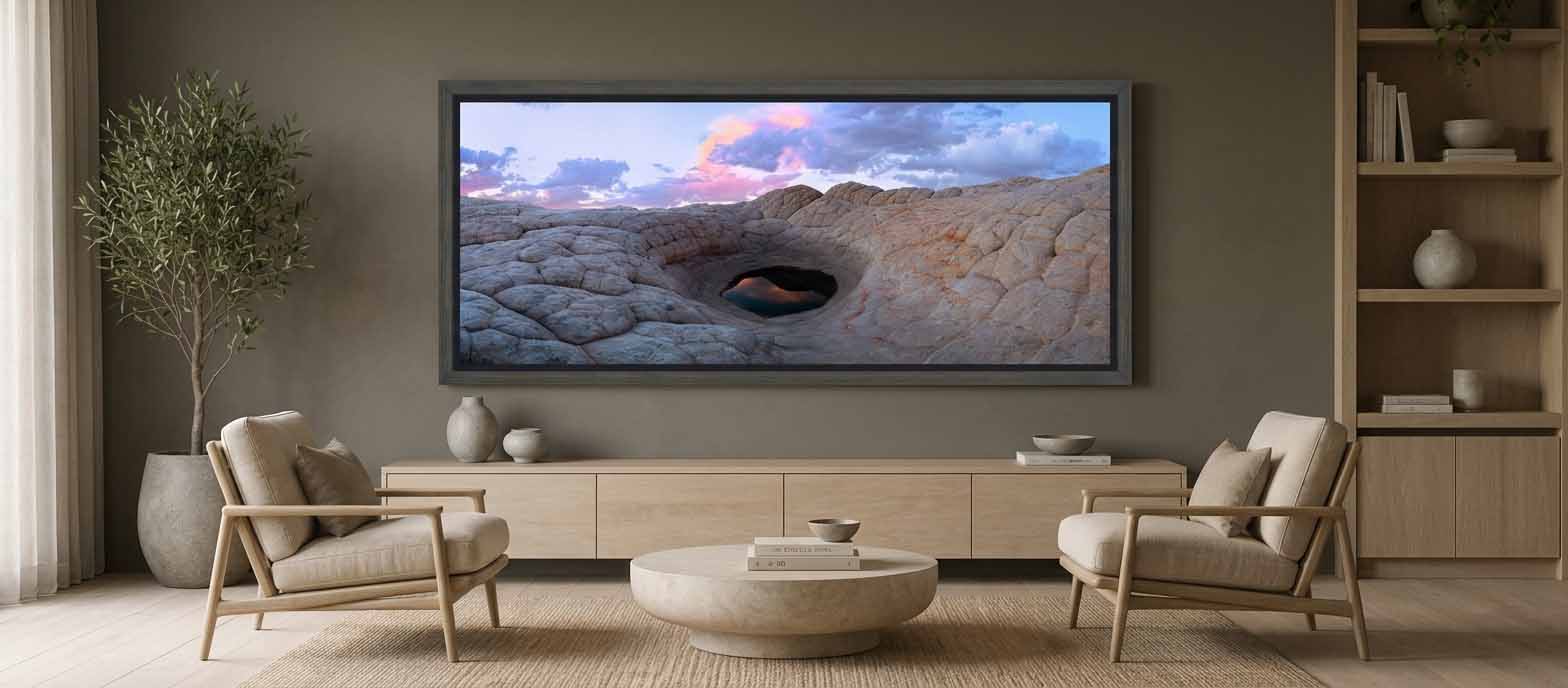
This is the brightest piece in the collection and it behaves accordingly. Its border averages a hundred and thirty-three out of two hundred and fifty-five, which is lighter than most painted walls and far lighter than any plaster with tone in it. Every other photograph here is a darker object placed on a lighter wall. This one is the other way round, and it lifts the wall it hangs on rather than punching a hole in it. On a charcoal, deep gray, or strongly colored wall it will read as a panel of light. On a white or near-white wall it loses its edges and much of its effect, which is the opposite of the usual advice and worth knowing before choosing a room.
Everything in the frame is convex except one thing. The rock is all domes, mounds, and swells, and set into the middle of them is a single concave hollow with water in it. The eye reads rounded forms as solid and hollows as space, so what a viewer gets is a wide field of solid with one small opening in it, and the eye goes to the opening and stays. That sets the hang. The pool sits low in the frame, and the piece reads correctly when the pool lands at or just below standing eye level, which puts the panel a little lower on the wall than usual. Hung high, you are looking up at a hole in the ground, which is not how anyone has ever seen one.
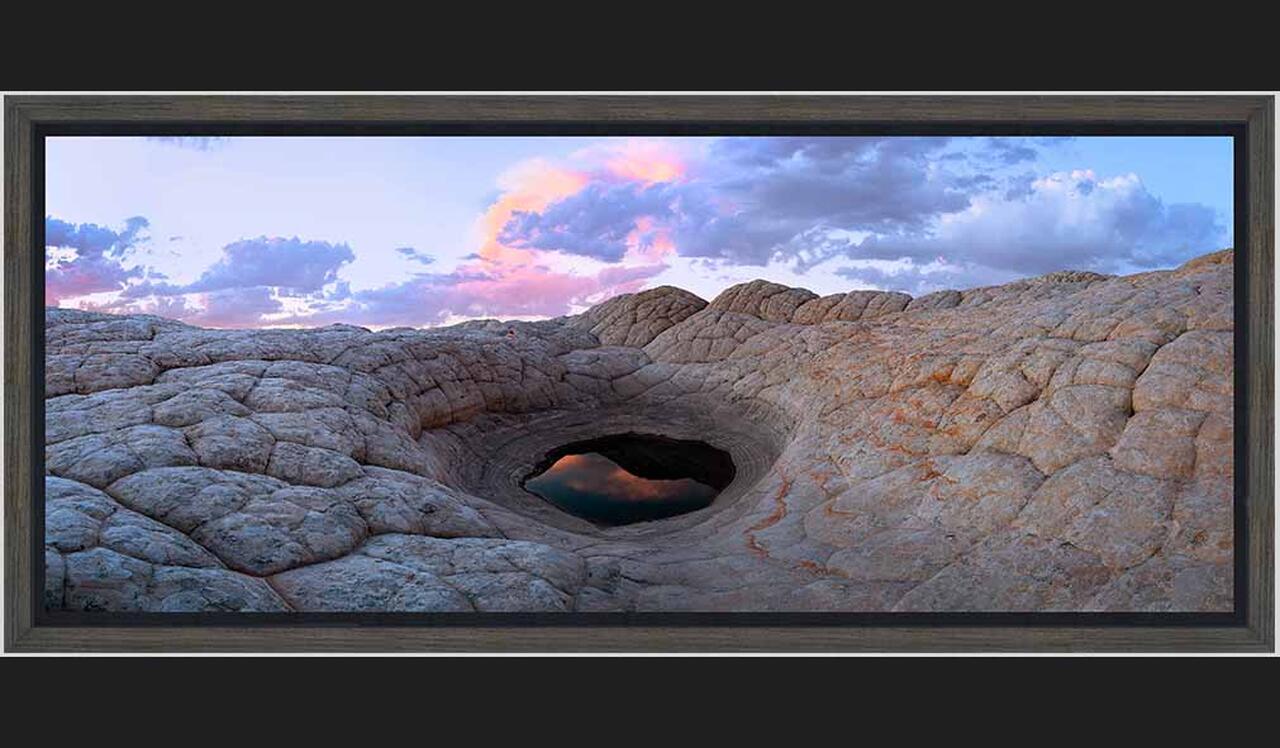
The third thing matters only if it joins others. This is the one photograph in the collection that takes a black liner rather than a white one, because the picture is too bright for white to separate from it. A black reveal does something different from a white one: it closes the image rather than opening it, and the print reads as an object set into the wall instead of a view cut through it. Hung on its own that is simply how it looks. Hung in a room with other pieces from this collection, it will be visibly a different kind of object, and that should be a decision rather than a surprise.
Not sure which size the room calls for, or want dimensions not listed here? Sizes beyond 80 × 32 are available on request and ship crated by freight. That conversation is welcome before an order is placed. Start that conversation and I will answer within one business day.
The Quiet Center, limited edition printSteve Austin95012100USD11https://schema.org/InStock
Questions about this photograph
How small is too small for a photograph this wide?
At the Intimate size the picture is forty inches across and sixteen inches tall, and the structure survives it well. The pool holds as a dark shape, the domes hold, and the sky holds. What goes is the surface. This rock is covered edge to edge in a fine network of joints and seams that divide it into panels, and those lines are what make it read as rock rather than as a rendered form; at sixteen inches tall they compress into a soft mottling. The reflection in the pool goes at the same point, so the water becomes a dark hole rather than a mirror with a cloud in it, which removes the thing the title refers to. The Collected at sixty by twenty-four is where the jointing and the reflection both come back. If you are weighing a size against a specific wall, choosing the right print size covers the measurements and the viewing distances in more detail.
What changes at the largest size?
The rock shows how it was made. At eighty by thirty-two the contorted bedding becomes visible inside the domes, layer folded over layer rather than the clean parallel lines sandstone usually shows, and the network of joints resolves into individual cracks with depth in them. Around the rim of the hollow the layers come clear as a set of concentric rings stepping down toward the water. In the pool the reflected cloud shows its own edges and the far wall of the basin appears beneath the surface. On the right the orange staining resolves into fine branching lines following the joints, which is iron that has moved through the rock and settled. Along the horizon the individual domes separate one behind another into the distance. Why scale matters covers what happens perceptually when a landscape reaches the size where the eye has to cross it.
What kind of room does this photograph suit?
Rooms with a wall darker than the picture. An entry with deep-toned plaster, a sitting room with painted walls, a study, a hall. It hangs a little lower than most pieces, so that the pool lands at or just below standing eye level. On materials it is accommodating, since it carries almost no color and what it has is cool, so it sits well against gray stone, concrete, and cool plaster. Two things to avoid. Do not put it on white or near-white, since it is lighter than the wall would be and it will lose its edges. And keep it away from a floor or counter in pale stone directly beneath it, because a photograph of bare rock above a real slab of it reads as a sample rather than as a picture. When your mind needs to rest takes the question further.
Every work ships insured and arrives with a signed certificate of authenticity.
If a piece is damaged in transit, the choice of replacement is always yours, and your edition number stays with you.
Production time runs 2 to 3 weeks for metal, 3 to 4 weeks for acrylic and paper, and 5 to 6 weeks for framed work.
Each print is made to order and takes its place in a numbered edition, so sales are final. Before you choose, I am glad to help: send a photo of your wall and I will show you this work in your room at true scale, at no charge. Start a conversation
Collector's Choice · TruLife ® Acrylic in Italian Frame
Collector Edition of 25· Lumachrome TruLife Acrylic · Handcrafted Italian Frame
TruLife acrylic in a handcrafted Italian frame with a linen liner chosen for the image. Frame series, finish, and liner are settled with you after the order, and production begins from there. The frame and liner add about fourteen inches to the finished dimensions, worth allowing for when planning placement.
Signature Acrylic Edition of 50· Lumachrome TruLife · Gallery Float Mount
Face-mounted to TruLife acrylic and floated approximately one inch from the wall, with no frame to mediate between the image and the room. UV-resistant, anti-reflective, and scratch-resistant, with a lifetime guarantee against fading.
Signature Metal Edition of 50· ChromaLuxe Print · Gallery Float Mount
Color infused into the aluminum panel itself, floated from the wall on a concealed system. Where acrylic produces luminosity, metal produces clarity. Exceptional fade resistance with no glazing or coating required.
Fine Art Edition of 100· Hahnemühle Baryta Fine Art Paper
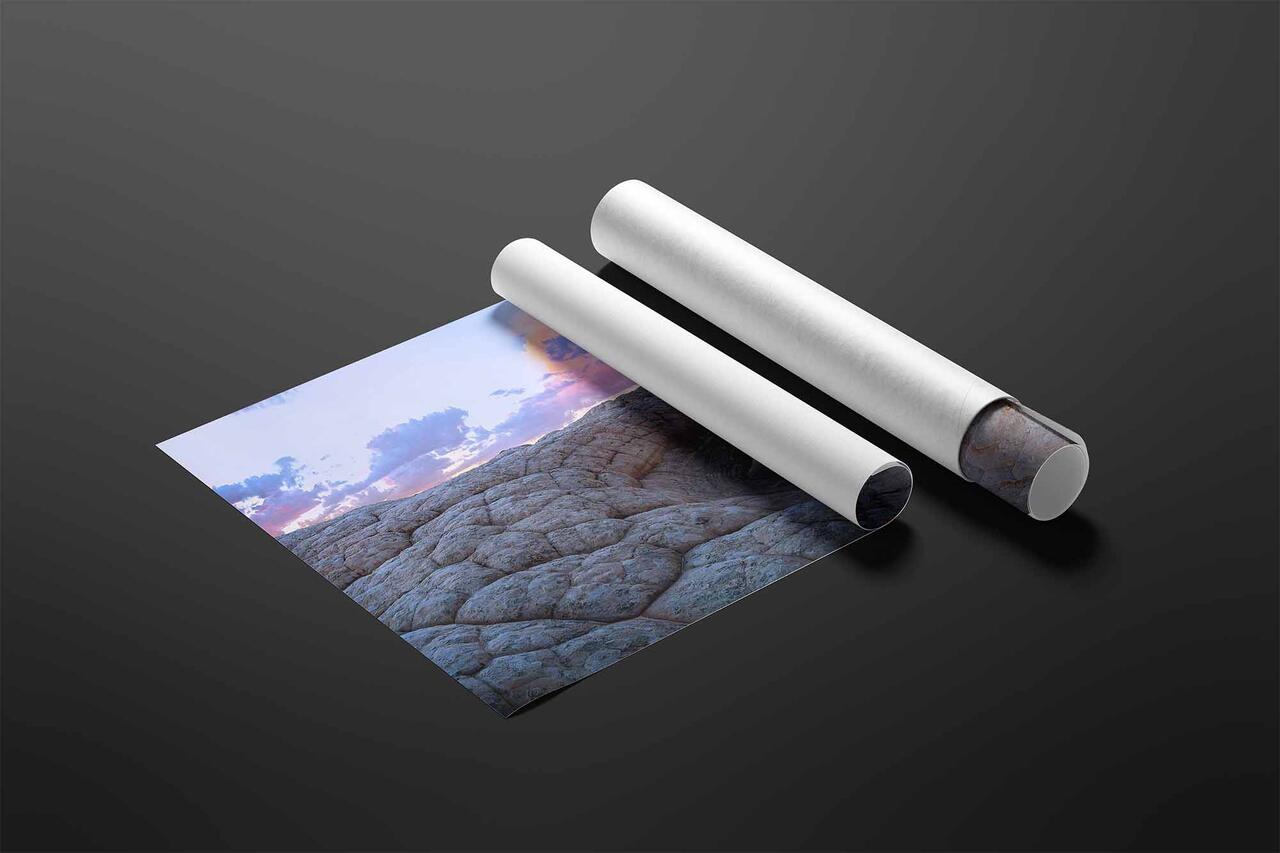
Printed without acrylic, so light meets the paper surface directly. Highlights stay luminous, shadows keep their nuance, and the surface has a tactile quality the other presentations approach differently. The understated choice, and the traditional one.
Complimentary shipping within the continental United States. International collector shipping available upon request.
Still deciding
Designing for Stillness
A guide to choosing art for restorative spaces
How to tell whether an image will still hold you in a year, how scale changes what a photograph does in a room, and how to match a piece to the work a room actually performs. It cites the research it draws on, and it is equally clear about where that research stops. About ten minutes to read.