Where Attention Leads: The Quiet Discipline of the Receding Path
View Available Prints of Fleeting
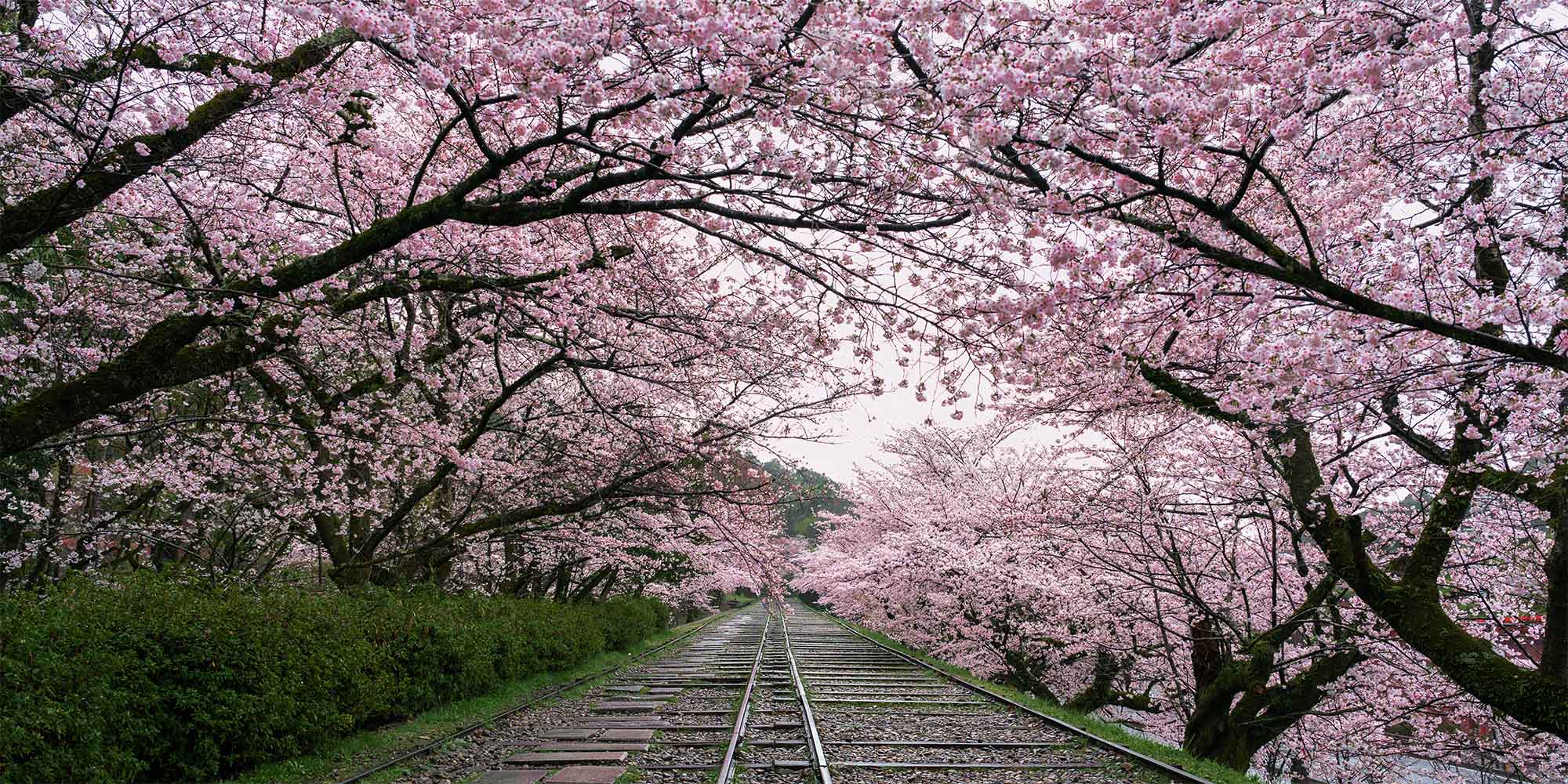
There is a particular kind of image the eye enters rather than simply observes. An avenue of blossom over a railway, a corridor of bamboo, a pier reaching toward the horizon, a colonnade narrowing into shadow. You do not scan these scenes the way you scan a crowded street or a cluttered room. You travel them. The gaze sets off down the path almost before you have decided to look, and it keeps going, drawn toward some point you cannot quite resolve.
We tend to call these compositions "leading lines," and the phrase is accurate as far as it goes. But it describes a technique without naming the experience. What these images actually do is more interesting, and it runs against the usual assumption about strong composition. We often praise a photograph for "grabbing" attention or being "eye-catching," as though the goal were to seize the viewer and hold on. The receding path does something closer to the opposite. It does not capture the eye. It releases it. And in that release is the beginning of rest.
This collection is built around that idea. Each image offers the gaze a clear, effortless route to follow, and in doing so it occupies attention without taxing it. The eye is held, but relaxed. That distinction, between attention that is captured and attention that is at rest, is the whole subject of this piece.
.
The eye takes the path of least resistance
Before a viewer interprets anything in a photograph, before any thought of place or meaning, the visual system is already at work sorting the scene into depth and structure. Converging lines are among the most powerful tools it has for this. Linear perspective, the apparent narrowing of parallel edges as they recede, is one of the strongest depth cues available to a single eye, and the brain reads it almost instantly. A scene with lines that converge toward a point is, in a very literal sense, easy to understand.
There is a second principle working alongside it. The Gestalt psychologists described a tendency they called good continuation: the eye prefers to follow a continuous contour rather than break away from it. Give the gaze an unbroken line and it will travel the length of that line without being asked. Put two of them together, converging, and you have not so much suggested a direction as removed every alternative.

View Available Prints of Into the Infinite
Into the Infinite is almost a textbook diagram of this. The pier pilings march away from the camera in near-perfect one-point perspective, the two rows compressing toward a single vanishing point lost in pale haze. There is very little to decide here. The composition has already done the deciding. The result is a kind of perceptual quiet, because the work of organizing the scene, which usually goes on beneath notice, has mostly been done for you.
This matters for how an image feels. Processing fluency, the ease with which the mind takes in a stimulus, tends to register as a mild positive state. Scenes that are easy to parse feel calmer and are generally preferred. A clear path lowers the cost of looking, and that low cost is part of what we experience as calm.
.
The promise of more
Ease alone, though, would only get you a pleasant image, not a compelling one. What gives the receding path its pull is that it withholds something. You can see where to go, but you cannot quite see what is there.
The environmental psychologists Rachel and Stephen Kaplan studied this directly, asking why people prefer some landscapes over others. Among the qualities they identified, one of the most reliable predictors of preference was what they called mystery: the sense that moving deeper into a scene would reveal more than is currently visible. A path that bends out of sight, a light source you cannot locate, a corridor that fades before it ends. Mystery is the promise of information just beyond reach, and it draws the viewer forward without ever letting them arrive.
Nearly every image in this group trades on it. Where Prayers Walk, the vermilion tunnel of torii gates at Fushimi Inari, recedes through gate after gate toward a warm glow that the eye keeps reaching for and never resolves. The bamboo path does the same in green, its corridor narrowing into deeper forest. The pier at dusk steps a line of lamps gently into the distance, each one a little smaller, the last ones dissolving into the blue.
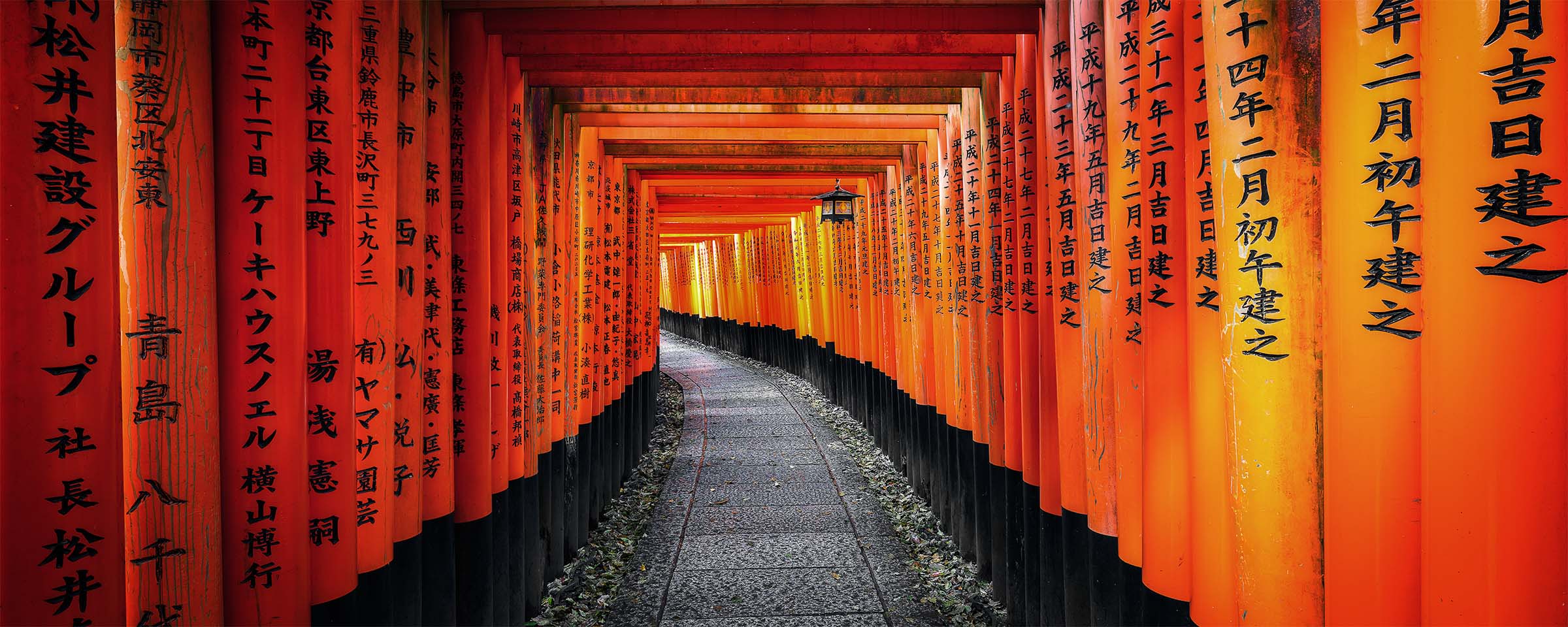
View Available Prints of Where Prayers Walk
The Kaplans connected this to a broader theory of why nature restores us. Their attention restoration theory distinguishes between directed attention, the effortful, controllable focus we use to work and concentrate, and which fatigues with use, and what they termed soft fascination, an effortless and involuntary form of attention that certain scenes invite. Soft fascination holds the mind gently, without demanding control, and under those conditions the depleted machinery of directed attention is thought to recover. A path that offers mystery is almost custom-built to produce this state. It occupies the gaze fully, yet asks nothing of it.
Alongside mystery, the Kaplans noted a related quality they called extent: the sense of being in a coherent, connected world that continues beyond what you can see. A corridor supplies this almost by definition. The frame ends, but the scene clearly does not.
.
Shelter with a view
There is one more layer worth naming, because several of these images satisfy it unusually well. The geographer Jay Appleton proposed that human beings carry an inherited preference for places that offer both prospect and refuge: a clear view outward combined with a sense of enclosure and shelter. The idea, which remains a theory rather than a settled fact, is that such places once meant safety, the ability to see without being seen, and that we still find them quietly reassuring.
A tunnel built of pilings or stone is a near-perfect expression of this pairing. Into the Infinite and the torii corridor both wrap the viewer in structure, a roof and walls of repeating forms, while holding open a bright aperture at the far end. You are inside something, protected, and yet your view runs cleanly to the light. That combination tends to read not merely as interesting but as safe, and safety is the ground on which any restorative experience has to stand.

View Available Prints of Sakura Reverie
Held, but relaxed
Put these layers together and a single thesis emerges. These images guide the gaze effortlessly toward a distant point, give it the promise of more without the demand of resolution, and often surround it with a sense of shelter. The eye is thoroughly occupied. It is also entirely at ease.
This is why I would resist describing the effect as hypnotic or as a matter of capturing attention. Those words suggest a viewer overpowered, attention seized and pinned. What actually happens is gentler and, for our purposes, more valuable. The directed attention we spend all day depleting is allowed to step back, while the softer, involuntary kind takes over the looking. The viewer is held in the image, but the holding costs them nothing. That is the restorative state, and it is the opposite of capture.
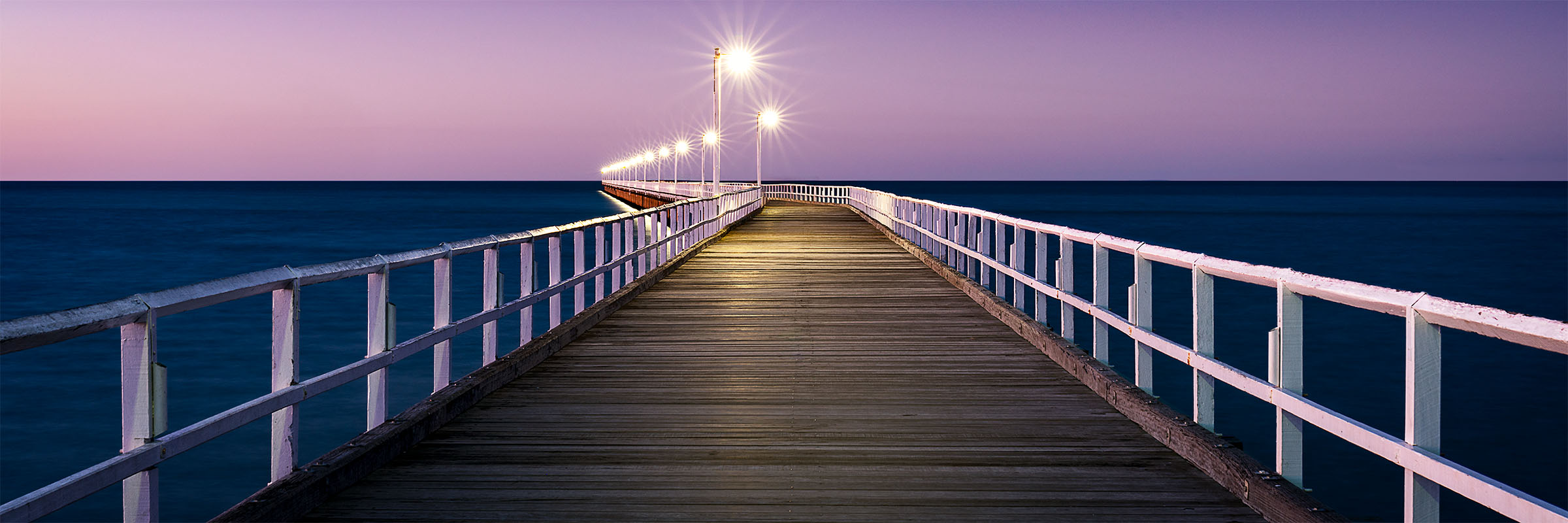
View Available Prints of Where Attention Leads
Built and grown, the same quiet levers
It is worth noticing that these compositions reach the viewer the same way whether the corridor was engineered or whether it grew. The torii gates and the pier are human constructions, geometric and deliberate. The bamboo path is a living thing, irregular and organic. Yet they pull on the same perceptual and psychological mechanisms: convergence, continuation, mystery, extent, the offer of shelter and view.
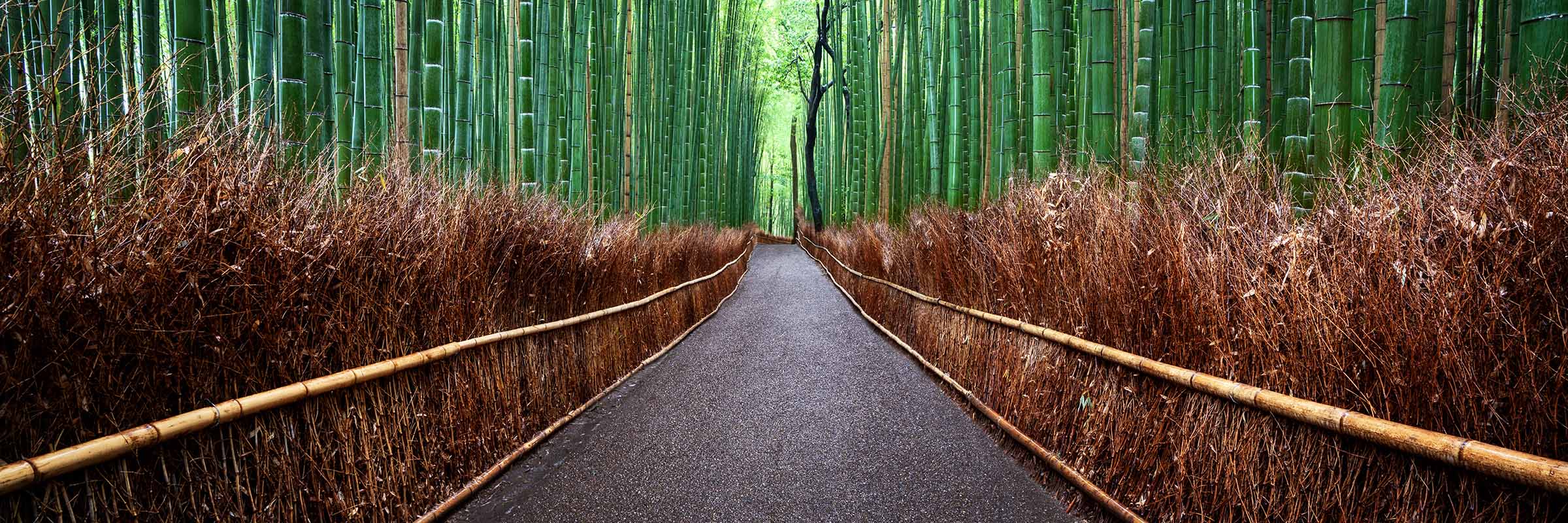
View Available Prints of Still Passage
The bridge offers a third case. On the Brooklyn Bridge walkway, the cables do not simply recede; they radiate outward from the stone tower at the center, a fan of lines converging on a single node. Here the leading lines are not a path on the ground but a structure in the air, and the eye is drawn to the same kind of focal point by a different geometry. It keeps one foot in the built environment while obeying the same rules as the forest.
This is, I think, the quiet argument running underneath the whole set. The restorative pull of a receding view is not a property of nature alone, and it is not a trick of architecture alone. It lives in the geometry of the gaze itself, in how the human visual system meets a line that promises somewhere to go.
.
A composed route for attention
Which returns us to where we began. A photograph like this is not really a picture of a pier, a shrine, or a stand of bamboo. The subject is almost incidental. What the image offers is a route for attention to travel, a designed sequence of ease, pull, and rest that the viewer's own perceptual system completes.
That is the difference between recording a scene and composing an environment. The places in these images were found, but the experience they produce was built, line by line, toward a single point on the horizon. The eye goes where the composition leads. And on a path like these, where it leads is somewhere quieter than where it started.
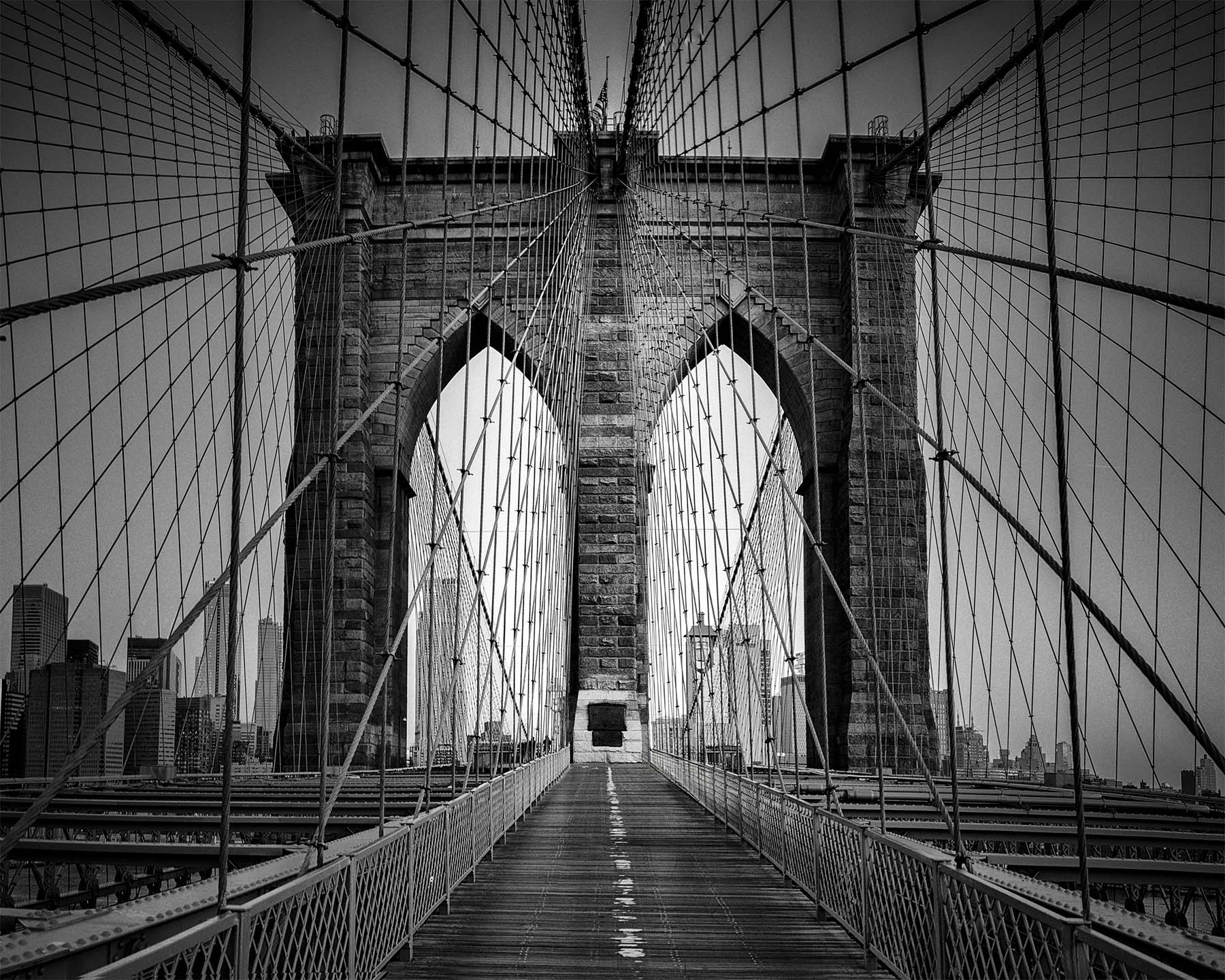
View Available Prints of Roebling's Cathedral
Bring the path into your space
If something in these images held you, that is worth taking seriously. Most of what competes for our attention all day asks something of us. A composition like these asks nothing, and gives the eye a quiet place to go. That is not decoration. It is a small, deliberate change to the environment you live and work in.
Explore the full collection of limited edition prints, or reach out about sizing, framing, and placement for a particular room. If you have a specific space in mind, a workspace, a waiting area, a wall you face every day, I am glad to help you choose the image and scale that will do the most for it.
Frequently asked questions
Do these images actually have a calming effect, or is that just a way of describing them?
The framing is grounded in research, though it is worth being precise about what the evidence supports. A substantial body of work in environmental psychology finds that even representations of nature, photographs and projected scenes rather than the real thing, can produce measurable reductions in stress and improvements in attention. The effects are generally more modest than time spent in actual landscapes, but they are real and they replicate. What a print cannot do is match a forest. What it can do is offer the kind of effortless, mystery-laden view that the research associates with attention recovery, and keep offering it on a wall where you would otherwise have blank space.
Where is the best place to hang an image like this?
The effect depends on the eye being able to travel into the image, so these compositions reward a wall you face rather than one you only pass. A spot you settle in front of, a desk you look up from, a chair you read in, a room where focus gets spent and needs somewhere to rest. Hallways and transitional spaces work less well for this particular kind of picture, because the gaze never stays long enough to make the journey the composition is offering.
Does size matter for the effect?
To a degree, yes. A larger print fills more of your visual field, including the periphery, which deepens the sense of being inside the scene rather than looking at it from outside. For these receding compositions in particular, where the entire point is the pull toward a distant vanishing point, a generous scale tends to strengthen the experience. Smaller prints still read beautifully; they simply behave more like a window than a doorway.
Does black and white or color change how the image feels?
Both can be restorative, and the choice is more about temperament and room than about effect. Black and white strips a scene to structure, light, and line, which foregrounds the geometry doing the psychological work. Color, as in the torii corridor, adds an emotional register and a warmth that some spaces want. Neither is more "correct." It is worth choosing the one that suits the room you are designing and the mood you want it to hold.
A bridge or a pier is human-made. Can a built subject really feel restorative?
Yes, and that is part of the argument this collection makes. The qualities associated with attention recovery, a clear and easily understood structure, the sense of more to discover, the pairing of shelter and open view, are not exclusive to forests and shorelines. They live in the geometry of a scene and in how the eye meets it. A colonnade of pilings or a span of bridge cables can satisfy those conditions as fully as a stand of bamboo. The subject is the occasion; the structure is the effect.
Are these available as fine art prints?
Yes. Every image is produced as an archival, limited edition print, made to live with you for decades. Each is offered in four presentations, so the work can be matched to the room and to the feeling you want it to hold. The museum-framed Collector Edition, limited to twenty-five worldwide, pairs a handcrafted Italian ROMA frame with Lumachrome TruLife acrylic. The Signature Edition, limited to fifty, float-mounts that same TruLife acrylic frameless against the wall, and a second Signature Edition of fifty uses ChromaLuxe metal for a cooler, more contemporary surface. The Fine Art Edition of one hundred is printed on Hahnemühle Baryta paper for collectors drawn to the traditional printmaking surface. Sizes run from Intimate at 24 by 36 inches up to Statement at 56 by 84 inches, with custom dimensions available on request. The editions are scaled so that the largest and most involved presentations are also the rarest, and once an edition fills it closes permanently. Full materials and editioning are explained in the FAQ, and the museum-grade framing options are detailed here. If you would like help choosing a presentation, size, or placement for a particular space, I am glad to talk it through.
Explore further
The images in this essay live across several galleries. Buildings & Bridges holds the bridge and pier work, Reflection gathers the water and mirrored scenes, Asia holds the cherry blossom, torii, and bamboo images, and Urban Calm collects the quieter city work.
To judge scale and presentation before choosing, the In Situ gallery shows these works framed and mounted on real walls.
For related reading, When Your Mind Needs to Rest sets out the science of attention restoration that underlies this piece, You Are Not Buying Scenery explains the idea of an image as a designed environment, and Passing in the Night turns the same restorative lens on the nighttime city.
Featured Fine Art Prints for Where Attention Leads