Why We Are Wired to Need the Natural World
There is a word for the quiet relief most people feel when they step out of a city and into a forest, or when they finally look up from a screen toward a window with a tree in it. The biologist Edward O. Wilson called it biophilia, the innate human tendency to affiliate with life and with the living processes of the natural world. He argued that this is not a learned preference or a passing cultural fashion but an inheritance, written into us across the long stretch of evolution during which survival depended on reading landscapes correctly. We did not arrive in the modern world as blank slates. We arrived already tuned to green, to water, to open horizons, and to the slow, legible movements of the natural world.
That idea sits at the center of how I think about photography. I am a psychologist and behavioral neuroscientist by training, and I make landscape images because I am persuaded that they do something measurable to the people who live with them. A well-chosen photograph of nature is not a pleasant accent on a wall. It is a small, continuous intervention in a person's psychological environment. This is part of why I have argued elsewhere that you are not buying scenery when you bring one of these images into your home. You are introducing a stimulus that the nervous system has been preparing to meet for a very long time.
Biophilia explains why that introduction matters. If our attraction to nature were purely aesthetic, almost anything attractive would satisfy it. The research suggests something more specific and more useful: that certain natural scenes reliably lower stress, restore depleted attention, and steady the emotions, and that they do so whether we are standing inside the landscape or simply looking at a faithful image of it. The eye does not seem to insist on the difference.
In this article I want to trace where biophilia comes from, what the evidence actually shows, and why some images calm us while others, for all their drama, quietly do the opposite. Along the way I will use a few of my own photographs, not as decoration but as examples of specific psychological mechanisms at work. The first of them sits below.
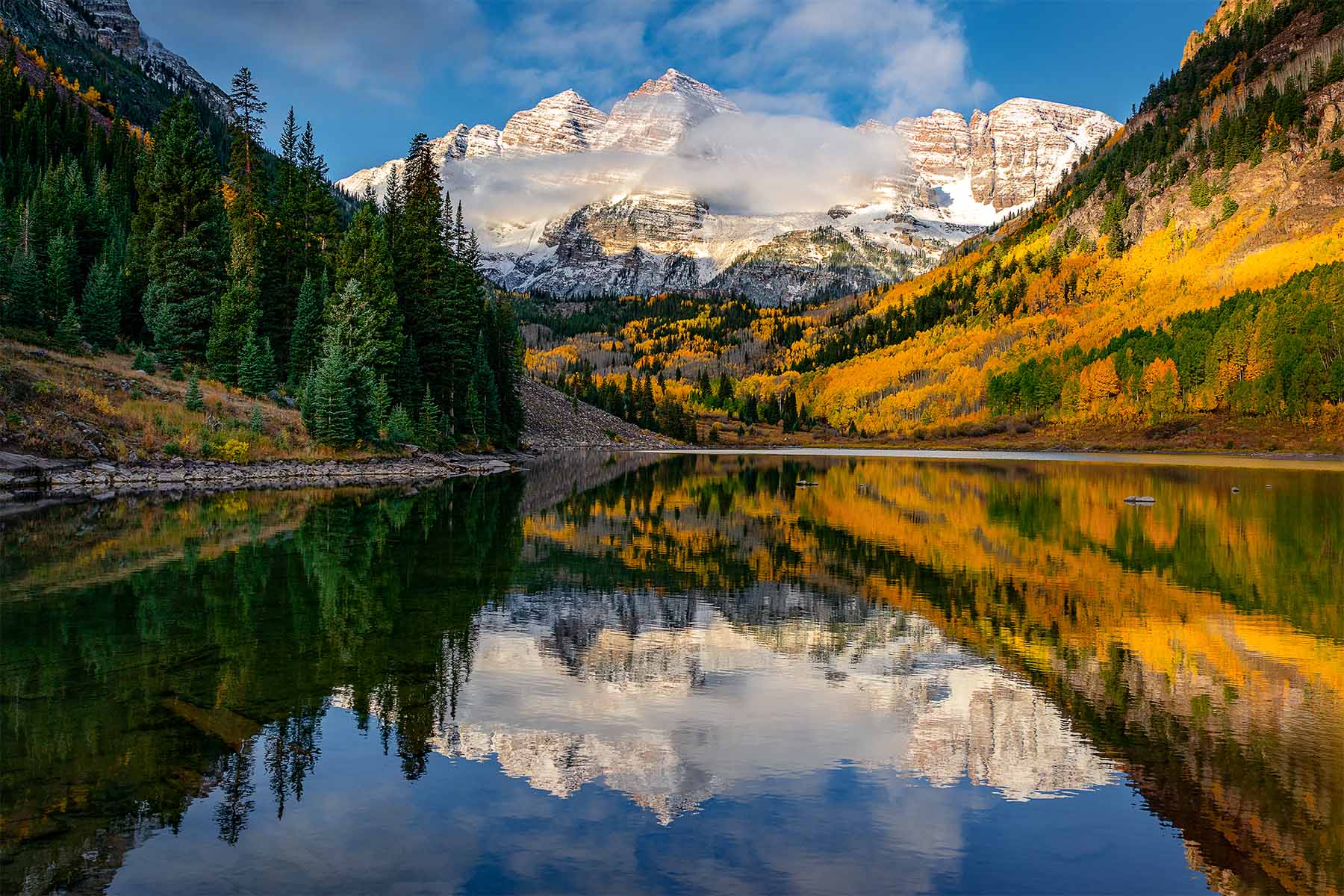
View Available Prints of Resting in Reflection
An affiliation older than language
Wilson did not invent the feeling. He named it. The deeper claim is evolutionary: our ancestors who could quickly distinguish a safe, resource-rich setting from a barren or dangerous one were more likely to survive and to pass that sensitivity on. Over time, the argument goes, a preference for certain landscapes settled into the species the way a preference for sweetness and fat did. It is older than language, older than agriculture, older than any idea we have about what makes a view beautiful.
Researchers studying landscape preference have found a pattern that recurs across very different cultures. People tend to gravitate toward open ground scattered with trees, a visible source of water, and a vantage point that offers both a long view outward and a sense of shelter at the back. This is sometimes called the savanna hypothesis, after the kind of country in which much of human evolution unfolded. The consistency is the interesting part. Present people with images of widely varied environments and the natural scenes, particularly those containing water, tend to win again and again.
.

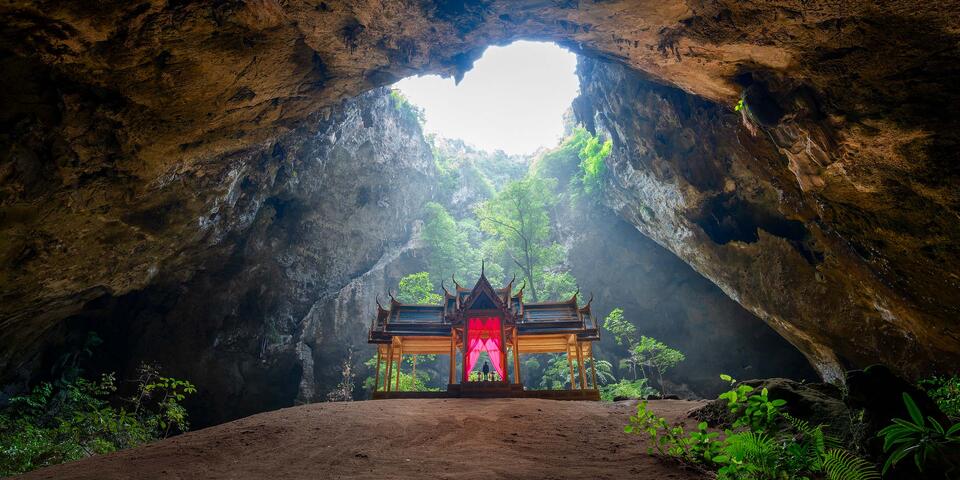
View Available Prints of Beauty in the Forest
.
The photograph above, Resting in Reflection, is built almost entirely from those ancient preferences. There is prospect in the open valley and the receding ridgelines, a quiet sense of refuge in the framing, and calm water holding the whole scene in a mirror. What makes it feel restful is not its subject matter alone but its structure, the particular arrangement of depth, stillness, and coherence that the eye reads as safety before the conscious mind has formed a single thought.
What the research actually found
https://www.steveaustinphotography.com/gallery/when-your-mind-needs-to-rest/The strongest early evidence that all of this has real physiological consequences came from a hospital. In a landmark 1984 study published in the journal Science, the environmental psychologist Roger Ulrich examined nearly a decade of recovery records for patients who had undergone gallbladder surgery in a suburban Pennsylvania hospital. The patients were closely matched, with one difference that turned out to matter a great deal. Some recovered in rooms that looked out on a small stand of trees. Others faced a brick wall. Those with the natural view had shorter postoperative stays, drew fewer negative comments in the nurses' notes, and needed fewer doses of strong pain medication. A single environmental variable, the content of a window, tracked with how much suffering people reported and how quickly they healed.
Two complementary theories grew up around findings like these. Ulrich's own stress reduction theory emphasizes the fast, largely emotional and physiological calming that natural scenes can trigger, a settling of the body that happens well below the level of deliberate thought. The Kaplans, Stephen and Rachel, added attention restoration theory, which addresses a different kind of depletion. Modern life leans heavily on what they called directed attention, the effortful, top-down focus we use to fight off distraction and stay on task. That capacity fatigues. Nature, they proposed, offers a gentle alternative they named soft fascination, an effortless and undemanding form of interest that lets directed attention recover. I have written more fully about this in the science of attention restoration and landscape art, and for readers who want the academic framing, this clear overview of attention restoration theory lays out the model well.
Soft fascination has an opposite, and the contrast is the key to choosing images well. Hard fascination, the kind produced by a thriller, a sporting event, or a turbulent and dramatic photograph, seizes attention completely and leaves no room for the mind to rest or reflect. It can be exhilarating. It is not restorative. The Kaplans described four qualities that together make a setting restorative: a sense of being away from ordinary demands, enough extent that the scene feels like a coherent world worth entering, compatibility with what a person actually needs, and soft fascination at the quiet center of it all.
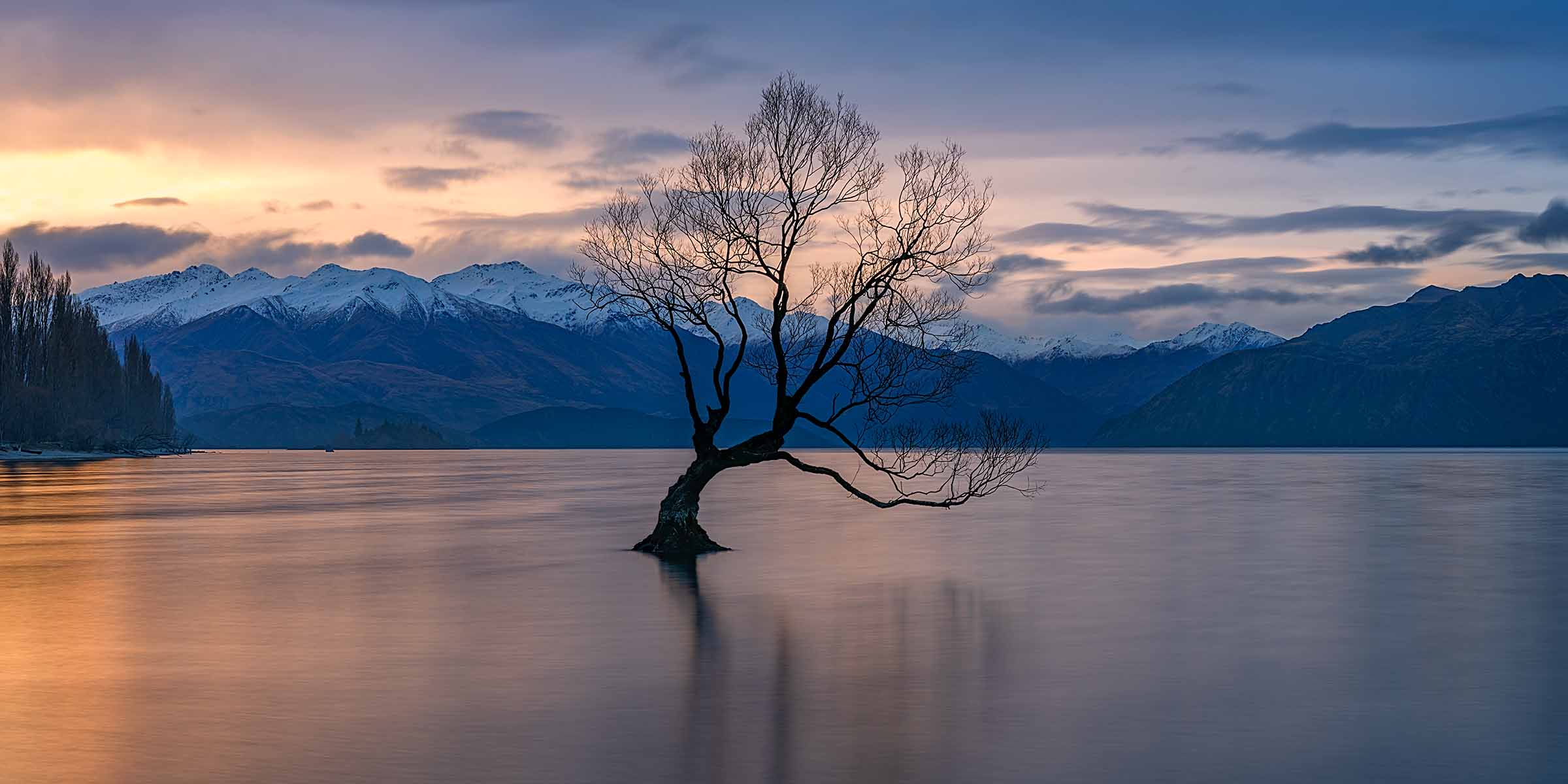
View Available Prints of Lone Willow
.
Lone Willow is, to my eye, close to a textbook case of soft fascination. The long-exposure water is glassy and even, the light is muted and pastel, and a single tree provides one quiet anchor for the eye without ever demanding effort from it. There is interest here, but it is the kind you can rest inside rather than the kind that grips you. Imagine instead a churning waterfall or a storm-lit sky in the same spot. Both would be powerful, and both would pull the nervous system toward arousal rather than calm. The choice between those two modes is the difference between an image that excites and an image that restores, and it is a choice I make deliberately every time.
Water, green, and the body's quiet response
Among the elements of a natural scene, two appear to carry unusual weight: water and vegetation. Ulrich observed that views of greenery, and of water especially, seem to hold the gaze gently and to interrupt anxious or stressful trains of thought. A growing body of work on so-called blue space has since linked the presence of water to lower self-reported stress and greater calm, while exposure to green settings has been associated with reductions in heart rate, blood pressure, and circulating stress hormones. These are not enormous effects from a single glance, but they are real, repeatable, and cumulative, which matters a great deal for anything you live with daily rather than visit once. I have explored the cognitive side of this in more depth in my piece on the cognitive benefits of nature photography.
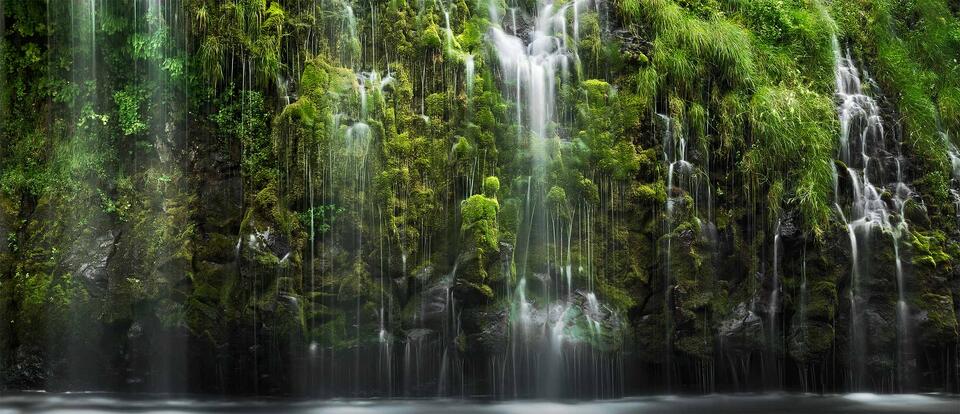
Unbroken brings both of those potent elements into a single, open composition: still water in the foreground and living green rising on the cliffs beyond, held together under a calm sky. It offers prospect and extent without tipping into the dramatic, and it adds the one quality the cooler, more reflective images in this group lack, which is the simple, grounding presence of vegetation. That combination is not accidental. When I select an image to function as a restorative environment, I weigh which natural cues it carries, because the cues are doing much of the quiet work.

View Available Prints of Unbroken
Pattern, fractals, and the eye that recognizes them
One of the most intriguing threads in this research concerns geometry rather than subject. Nature is saturated with fractals, patterns that repeat at finer and finer scales: the branching of trees and rivers, the irregular line of a coastline, the structure of a fern, the edges of clouds. The physicist Richard Taylor and his collaborators proposed a model they call fractal fluency, the idea that the human visual system, having developed surrounded by these patterns, processes them with unusual ease. In Richard Taylor's fractal fluency research at the University of Oregon, viewing fractals of a particular complexity has been shown to lower physiological stress, an effect measured through skin response and brain activity.
The detail that makes this useful is that the effect is specific to mid-range complexity, the level found in trees, clouds, and mountains, rather than in the simplest patterns or the most chaotic ones. There seems to be a sweet spot the eye recognizes as natural. This same principle appears as one of the fourteen patterns of biophilic design, where it is described as the balance between order and complexity that an environment needs in order to feel alive without feeling overwhelming.
Glacier Lagoon is the most pattern-driven image in this group, and I include it for exactly that reason. The repeating ridges of ice, the recurring pockets of blue meltwater, and the self-similar structure that runs from the largest forms down to the smallest are precisely the kind of mid-range natural geometry that fractal fluency describes. It is doing a job none of the other images do, which is to let the eye rest in pattern itself.

From the air, the glacier felt like a living map of time, carved into ridges and folds that stretched endlessly beneath me. I drifted over its frozen spine, searching for the quiet places where meltwater gathers, and suddenly the ice opened into pockets of electric blue, glowing like hidden worlds beneath the surface. Each pool looked like a heartbeat pulsing inside the glacier, a reminder that even in the coldest places, there is motion, depth, and life. Flying over it, I felt both small and connected, witnessing a landscape that holds its own quiet form of wonder.
View Available Prints of Glacier Lagoon
From wilderness to wall: biophilia by design
The practical conclusion writes itself once the science is laid out. Most of us now spend the overwhelming majority of our lives indoors, often in rooms engineered for everything except restoration. Biophilic design is the discipline of deliberately bringing nature's qualities back into those spaces, and where direct contact with the outdoors is not possible, faithful representations of nature carry a meaningful share of the benefit. This is the reasoning behind my work on designing calm spaces in a visually noisy world, and it is why I keep returning to the conviction that art belongs in daily life rather than treated as mere decoration. A large, well-made nature print is not an ornament competing for attention. Chosen well, it is a designed psychological environment that you happen to be able to hang.
Reflections That Remain is the image I would hang where a day most needs to slow down. It is the most purely meditative frame in this set, soft in palette, harmonious, and low in arousal, abstract enough that the analytical mind loosens its grip and simply rests. It is less a window onto a place than an invitation to stay a moment longer, which connects it to the practice I describe in my writing on how contemplative landscape photography returns you to yourself.
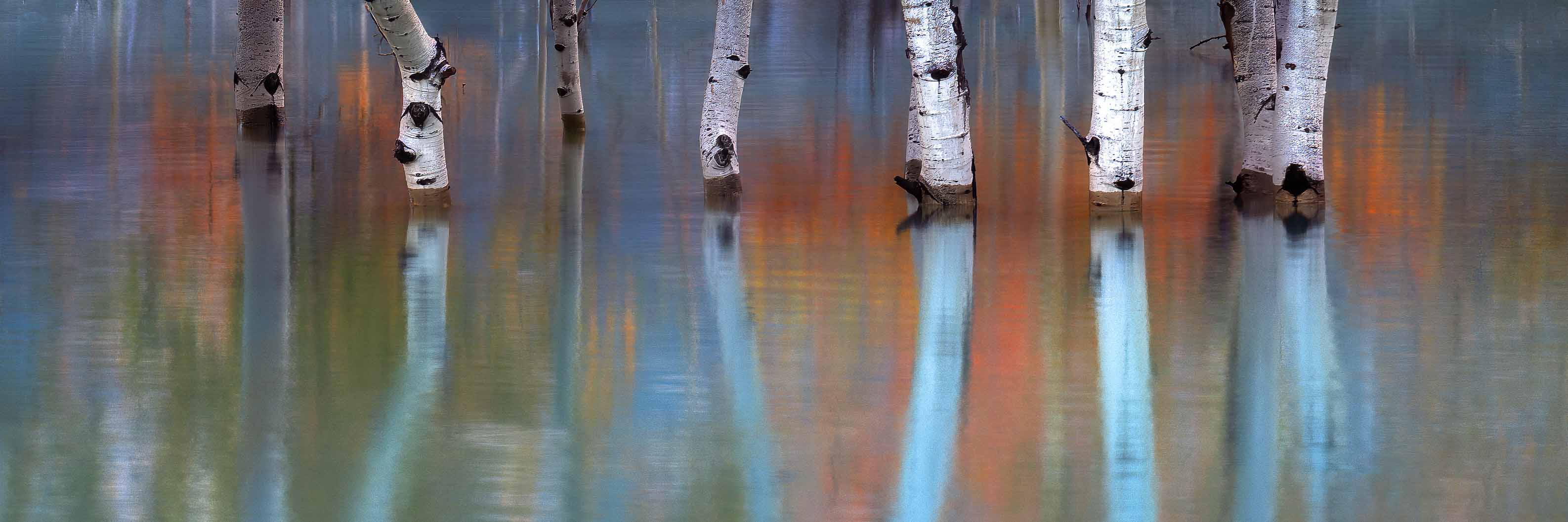
Standing at the edge of a flooded meadow, I watched the aspen trunks dissolve into their reflections, colors softening as they met the water. The surface held the landscape gently, not as it was, but as it felt, blurred, quieter, more forgiving. In that stillness, I was reminded how nature offers us space to slow down and see ourselves without sharp edges. The contrast between what stands firm above the water and what wavers below mirrors how we are often seen differently than we see ourselves. This image is an invitation to rest your attention, let the mind settle, and allow reflection to become a form of healing rather than judgment.
View Available Prints of Reflections That Remain
Biophilia
Biophilia is, in the end, a kind of homecoming the body recognizes before the mind does. The calm that arrives when you look at the right landscape is not sentimentality and it is not nostalgia. It is an ancient system finding, briefly, the conditions it was built for. The research from Ulrich to Kaplan to Taylor keeps pointing at the same conclusion from different angles: that the natural world is not optional furniture for the human nervous system but something closer to a nutrient, and that even its image can feed us.
This is why I describe what I do as designing psychological environments rather than making pictures. The science is not a marketing flourish laid over the work after the fact. It is the reason the work exists and the standard against which I judge it. A photograph chosen for these qualities, for soft fascination, for water and green, for mid-range pattern, for prospect and refuge, does its work quietly and continuously, in the background of an ordinary day, asking nothing and giving something back each time the eye happens to land on it.
If you take one idea from all of this, let it be that you have more say over your inner weather than you might assume. The walls you live with are not neutral. They are either adding to the noise or helping to quiet it. Biophilia simply tells us which direction the natural world points, and how reliably it points there.
Featured Fine Art Prints for Why We Are Wired to Need the Natural World
Steve Austin is a psychology professor and behavioral neuroscientist whose limited edition landscape photography is grounded in attention restoration theory, biophilia, and the documented psychological effects of nature exposure. His work is made for collectors who understand that what surrounds them shapes how they think, feel, and recover.