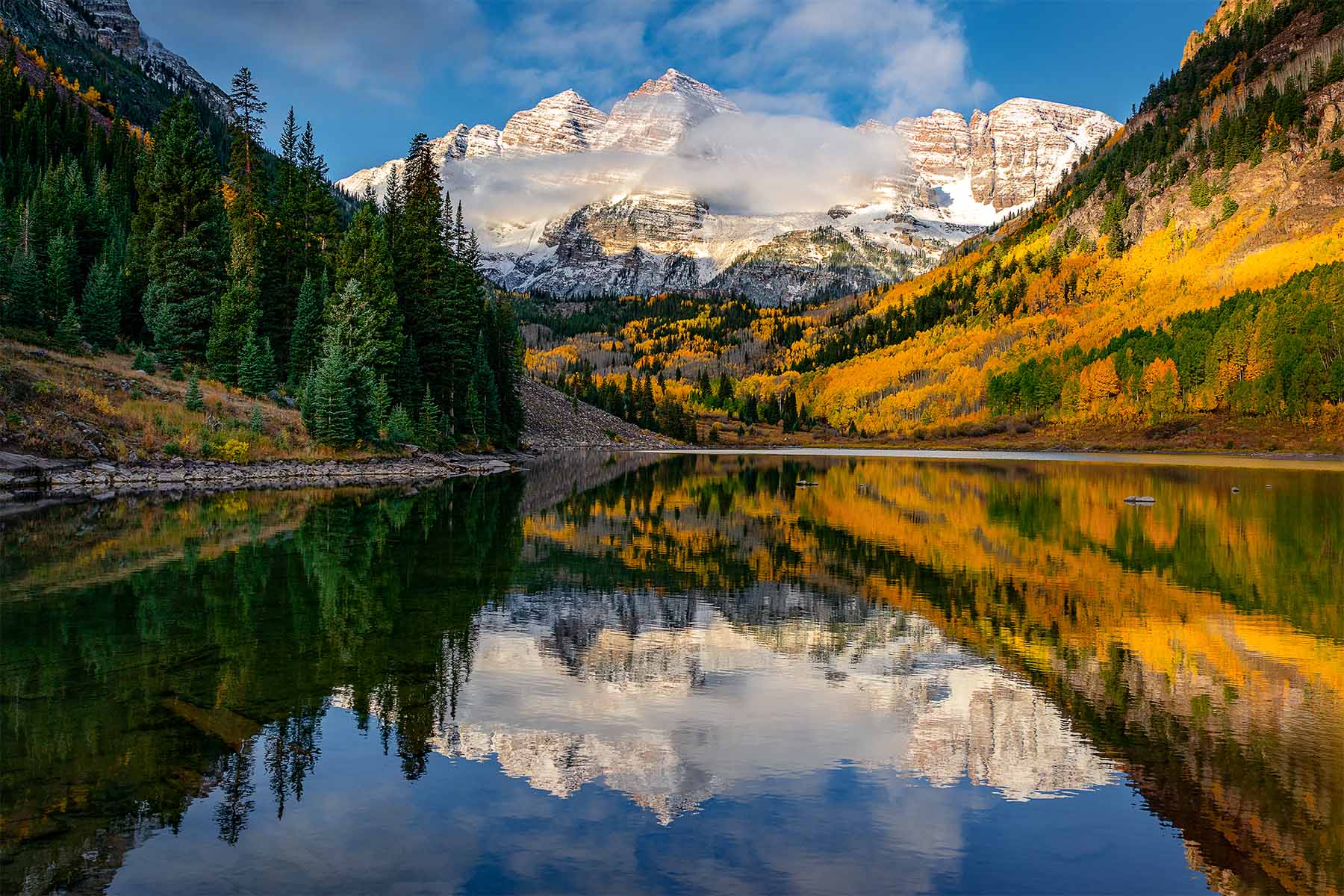
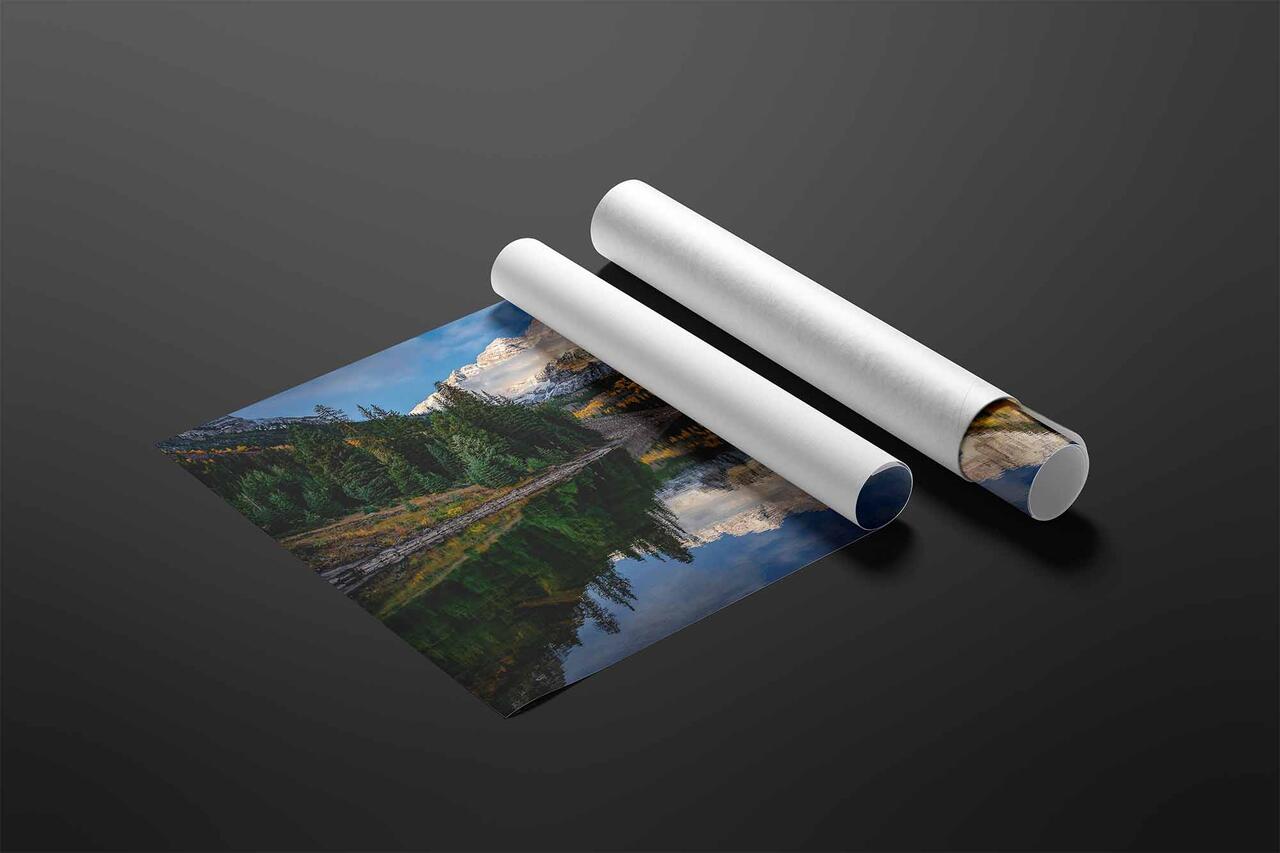
A 3:2 photograph of the Maroon Bells reflected in Maroon Lake with autumn aspen and fresh snow, near Aspen, Colorado, available as a limited edition print in four sizes.
Artist's Story
This is Maroon Lake, ten miles southwest of Aspen, and it is one of the most photographed views in North America. There were other people on the shore. I am not going to pretend otherwise.
What I did not know until later is what those mountains are made of.
Most Colorado fourteeners are granite, which is rock that cooled from melt and grew together as interlocking crystals. These are not. The Maroon Bells are sedimentary, built from mud and sand that rivers carried down off an earlier range and dropped into a basin, roughly two hundred and seventy to three hundred million years ago. That earlier range is called the Ancestral Rocky Mountains, and it is gone.
So the peaks in this photograph are made of the wreckage of a previous Rocky Mountains, compacted into rock and then lifted back up into mountains again.
The color comes from the iron in that sediment, oxidized. It is rust, in the same sense that the red in a desert is rust, and it is the reason the range is called what it is called.
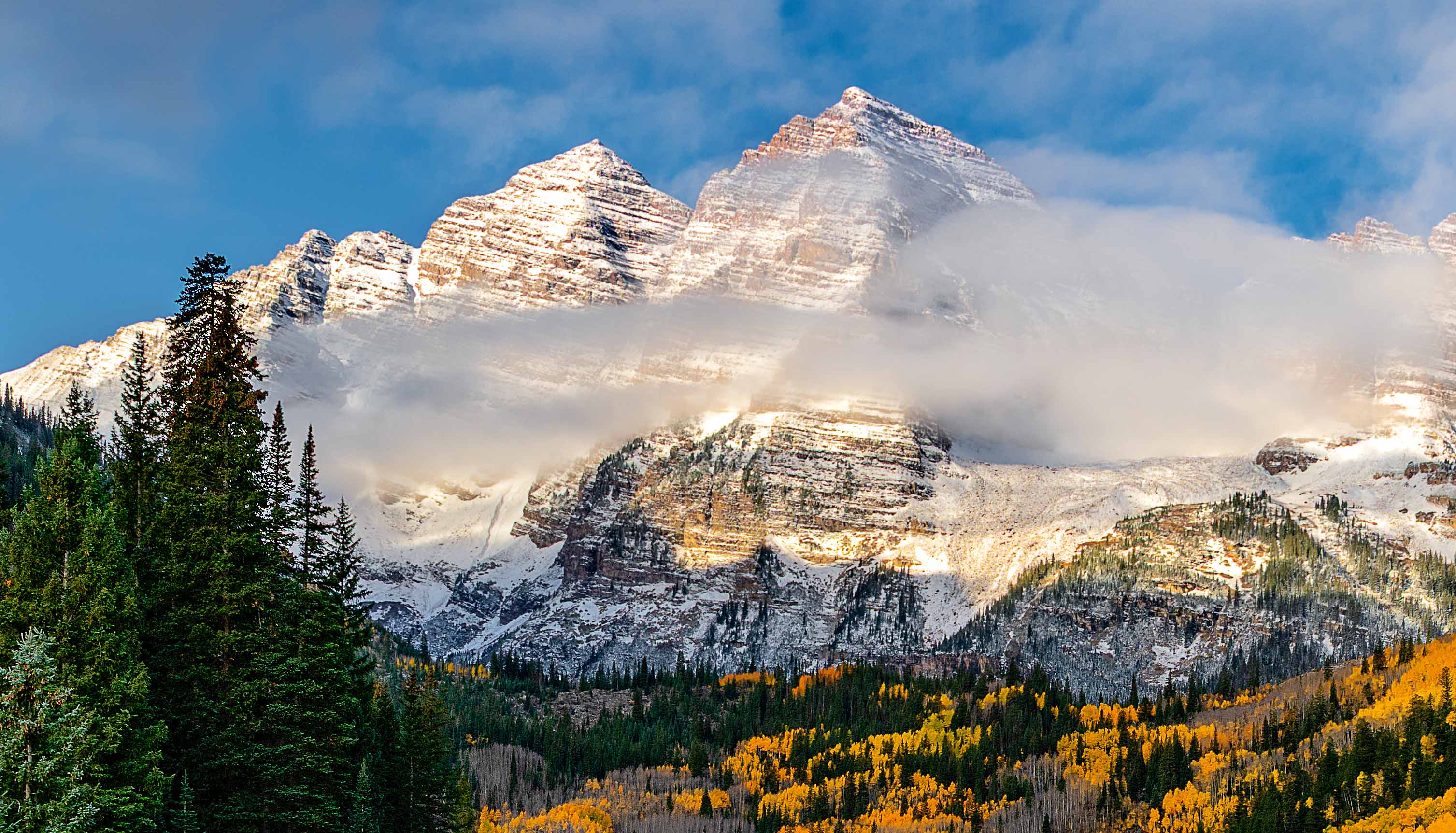
You can see the fabric of it from the shore. Look along the faces and the horizontal banding runs right across them. Those lines are bedding planes, the surfaces where one load of sediment settled on top of the last, and the rock still parts along them. It is loose and layered and it comes away in the hand, which is why the Bells are among the more difficult peaks in the state to climb despite looking, from here, like the most solid thing in Colorado.
Resting in Reflection is a lake, an autumn hillside, and a pair of mountains assembled out of an older set of mountains that fell down first.
The peaks at about a third of the frame width. The horizontal bedding runs visibly across every face, one layer above another, with the fresh snow lying in the ledges those layers make and darker rock showing between them. The couloirs and gullies separate from the faces around them. Below the snowline the aspen resolve into individual crowns with dark conifers standing between, and cloud crosses the lower faces as a distinct band with the rock showing through it. Click to view at full size.
About This Photograph
Maroon Lake, in the Maroon Bells–Snowmass Wilderness of the White River National Forest, about ten miles southwest of Aspen, Colorado. This is a single frame image, made in autumn with new snow on the peaks and the aspen at color. Maroon Peak stands at 14,163 feet and North Maroon Peak at 14,022 feet, and the valley they close was carved by glaciers.
The photograph is split laterally rather than vertically. Along the left edge it averages thirty-two out of two hundred and fifty-five in brightness and measures neutral in color; along the right edge it averages eighty-two and runs eighty-nine points toward red, with one measurement reaching a hundred and sixty-six. That is a conifer stand on one side and a lit aspen slope on the other, and it is the widest side-to-side difference in the collection.
The snow on the peaks measures within a point of neutral, and the reflection of it measures within five. Whatever the water is doing to the rest of the scene, it is returning the snow almost exactly.
Resting in Reflection
Steve Austinhttps://www.steveaustinphotography.com/
Location
Maroon Bells, Aspen, Colorado
Subject
Maroon Bells · autumn aspen · mountain reflection
Capture
Single frame in autumn
Format
Photograph · vertical, 2:3
Sizes
24 × 16 · 36 × 24 · 48 × 32 · 60 × 40
Print Media
TruLife Acrylic · ChromaLuxe Metal · Baryta paper
Edition
Limited, 25 / 50 / 100 by presentation
What it Does in a Room
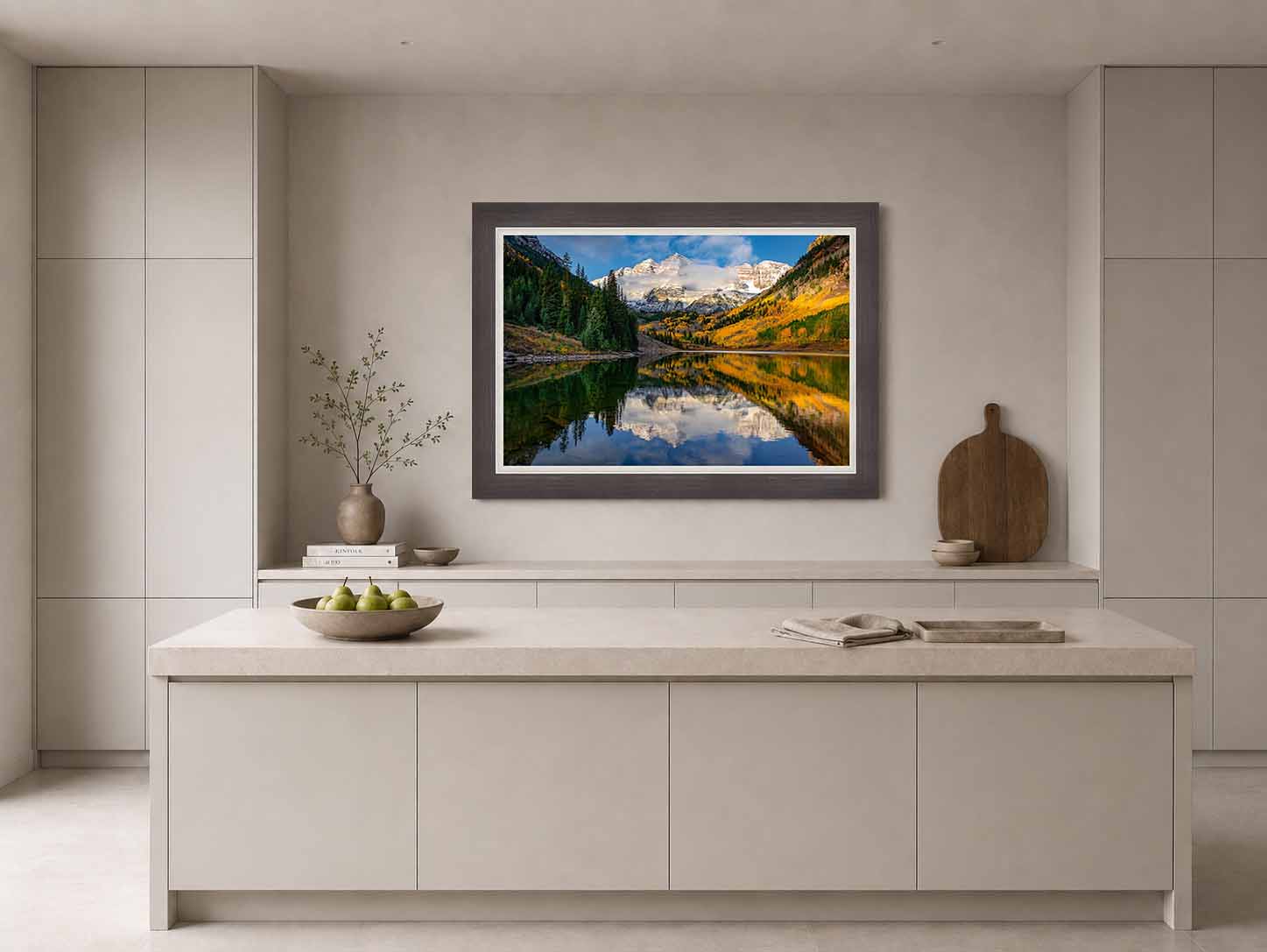
Everything else in this collection is a panorama, and a panorama needs a run of wall. This one does not. At three to two it is an ordinary photographic shape, taller relative to its width than anything else offered here, and that opens walls the panoramas cannot use: the space between two windows, a chimney breast, the short wall of a room, a stair landing, a kitchen. If you have been looking at this collection and thinking that the proportions do not suit your house, this is the piece that will.
It also takes in differently. A photograph three times as wide as it is tall cannot be seen all at once from close range, so a panorama asks the eye to travel and asks the room to give the viewer distance. This shape is taken in whole, in one look, from a few feet away. That makes it the piece to choose for a small room, a narrow one, or anywhere a person cannot step back far enough to see a long picture properly. It loses nothing at three feet.
The third thing is worth being straight about. This view is among the most photographed in North America, and most people who see it on a wall will recognize it. That changes the job the picture is doing. It is not introducing anyone to somewhere new; it is putting up something a visitor may already have a relationship with, and it will start conversations. In a room where people gather, that is an asset. In a room meant to be a retreat, recognition works against rest, and one of the quieter pieces here will serve better.
Not sure which size the room calls for, or want dimensions not listed here? Sizes beyond 60 × 40 are available on request and ship crated by freight. That conversation is welcome before an order is placed. Start that conversation and I will answer within one business day.
Resting in Reflection, limited edition printSteve Austin65011000USD15https://schema.org/InStock
Questions about this photograph
How small is too small for a photograph this shape?
At the smallest size the picture is 24 inches across and 16 inches tall. A three to two frame holds its content at small sizes far better than a panorama does, because the height does not fall away as fast and there is no long traverse to lose. The peaks, the reflection, the gold slope, and the dark conifer stand are all large shapes that read from anywhere in a room. What goes is the aspen. That slope on the right is thousands of individual crowns, and below a certain size it stops being trees and becomes a field of gold, which also takes its reflection with it. The horizontal banding on the peaks is the other early casualty, and since that banding is the subject of this page, it matters. The Expansive at forty-eight by thirty-two is where the slope becomes trees again. If you are weighing a size against a specific wall, choosing the right print size covers the measurements and the viewing distances in more detail.
What changes at the largest size?
The mountains show their construction. At the largest size the horizontal bedding runs visibly across every face of both peaks, one layer above another, with the snow lying in the ledges those layers make and the darker rock showing between. The couloirs and gullies separate from the faces around them. On the right the aspen slope resolves into individual crowns with dark conifers standing between them, and the same happens in its reflection, softer. Along the left the conifer stand separates into individual trees with their own shapes rather than a dark mass. In the water the cloud reflected below the peaks shows the same edges as the cloud above them, and the shallows in the near foreground go transparent enough that the lake bed appears through them. Why scale matters covers what happens perceptually when a landscape reaches the size where the eye has to cross it.
What kind of room does this photograph suit?
Rooms where people come and go. A kitchen, an entry, a family room, a guest room, a landing. It hangs at ordinary height and does not need a long wall or a deep room. On materials it is more demanding than most of the collection, because it contains a full spectrum, blue sky, white snow, gold aspen, dark green conifer, and red rock, so it finds something to agree with almost anywhere and something to argue with almost anywhere too. Give it a neutral ground and let it supply the color. Two things to avoid. Do not hang it on a strongly colored wall, since whatever the color is, the picture already has it and a second helping flattens the effect. And keep it away from another autumn or mountain image, because the subject is common enough that two of them in a room read as a set. When your mind needs to rest takes the question further.
Every work ships insured and arrives with a signed certificate of authenticity.
If a piece is damaged in transit, the choice of replacement is always yours, and your edition number stays with you.
Production time runs 2 to 3 weeks for metal, 3 to 4 weeks for acrylic and paper, and 5 to 6 weeks for framed work.
Each print is made to order and takes its place in a numbered edition, so sales are final. Before you choose, I am glad to help: send a photo of your wall and I will show you this work in your room at true scale, at no charge. Start a conversation
Collector's Choice · TruLife ® Acrylic in Italian Frame
Collector Edition of 25· Lumachrome TruLife Acrylic · Handcrafted Italian Frame
TruLife acrylic in a handcrafted Italian frame with a linen liner chosen for the image. Frame series, finish, and liner are settled with you after the order, and production begins from there. The frame and liner add about fourteen inches to the finished dimensions, worth allowing for when planning placement.
Signature Acrylic Edition of 50· Lumachrome TruLife · Gallery Float Mount
Face-mounted to TruLife acrylic and floated approximately one inch from the wall, with no frame to mediate between the image and the room. UV-resistant, anti-reflective, and scratch-resistant, with a lifetime guarantee against fading.
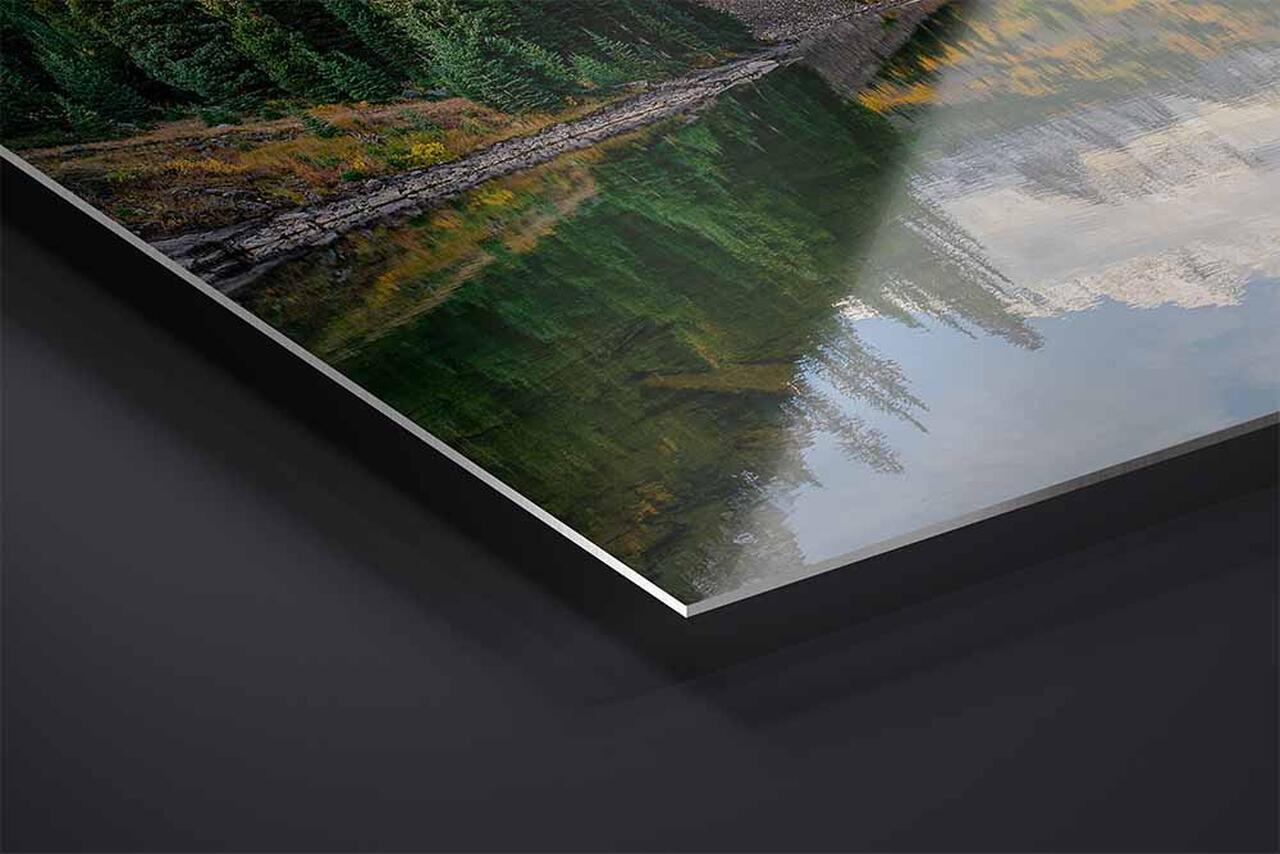
Signature Metal Edition of 50· ChromaLuxe Print · Gallery Float Mount
Color infused into the aluminum panel itself, floated from the wall on a concealed system. Where acrylic produces luminosity, metal produces clarity. Exceptional fade resistance with no glazing or coating required.
Fine Art Edition of 100· Hahnemühle Baryta Fine Art Paper
Printed without acrylic, so light meets the paper surface directly. Highlights stay luminous, shadows keep their nuance, and the surface has a tactile quality the other presentations approach differently. The understated choice, and the traditional one.
Complimentary shipping within the continental United States. International collector shipping available upon request.
Still deciding
Designing for Stillness
A guide to choosing art for restorative spaces
How to tell whether an image will still hold you in a year, how scale changes what a photograph does in a room, and how to match a piece to the work a room actually performs. It cites the research it draws on, and it is equally clear about where that research stops. About ten minutes to read.