The Art of Staying: how contemplative landscape photography returns you to yourself
We live in an environment engineered for distraction. Every surface competes for attention. Every device delivers an unending stream of information, obligation, and noise. We move through our days in a state of continuous partial attention, never fully anywhere, never fully gone, just perpetually skimming the surface of our own experience. Most of us have forgotten what it feels like to simply stay with something. To look at one thing, without agenda, without moving on, until it begins to reveal itself.
That capacity, the ability to be genuinely present with what is in front of you, is not a personality trait. It is a skill. And like any skill, it can be supported or undermined by the environment you inhabit. The question worth asking is not whether you are a contemplative person. The question is whether the environment you live in gives contemplation anywhere to land.
This is one of the quieter arguments for bringing intentional landscape photography into a home. Not that it is beautiful, though it may be. Not that it fills a wall, though it does. But that a single, well-chosen image, one with genuine depth and psychological weight, can function as a daily invitation to stop, look, and return briefly to yourself. And when the images you choose are made with that intention at their center, they do not simply decorate a room. They change how it feels to be in one.
View Available Prints of What Remains
What Stillness Actually Looks Like
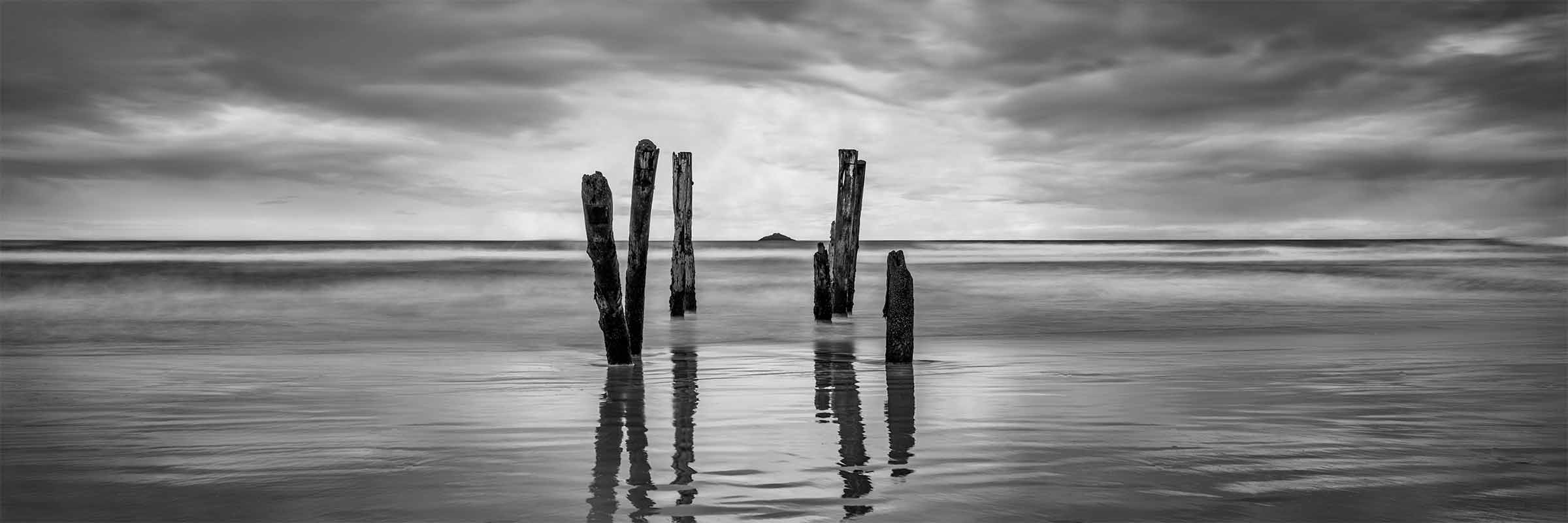
There is something in this image that resists hurrying. The old pier posts rise from water stilled by a long exposure into something closer to glass. The sky moves, but slowly, its clouds drawn into soft horizontal bands that suggest time passing rather than urgency. A small island sits on the horizon, patient and indifferent. The posts themselves are remnants, what remains when a structure has been reduced by time and weather to its most essential form. They are not ruins exactly. They are what endures.
To spend time with an image like this is to be placed, almost involuntarily, into a different relationship with time. The visual environment it creates is one of spaciousness and stillness, two qualities that are increasingly rare in contemporary life and that psychological research consistently identifies as conditions the mind needs in order to restore itself. Rachel and Stephen Kaplan developed attention restoration theory to describe exactly this: that environments possessing what they called fascination, extent, compatibility, and being away allow the directed attention system to rest and recover. This image holds all four of those qualities simultaneously, if you want to go deeper on what this means for the images you live with, my article on mental rest and landscape art covers it in full. It does not demand that you figure anything out. It simply gives you somewhere to be.
That is what contemplation actually is, not a technique, not a discipline requiring a quiet room or a particular disposition. It is what happens naturally when an environment stops competing for your attention and starts holding it instead. When you can look at something and feel no pressure to respond, evaluate, or move on. When staying feels like enough.
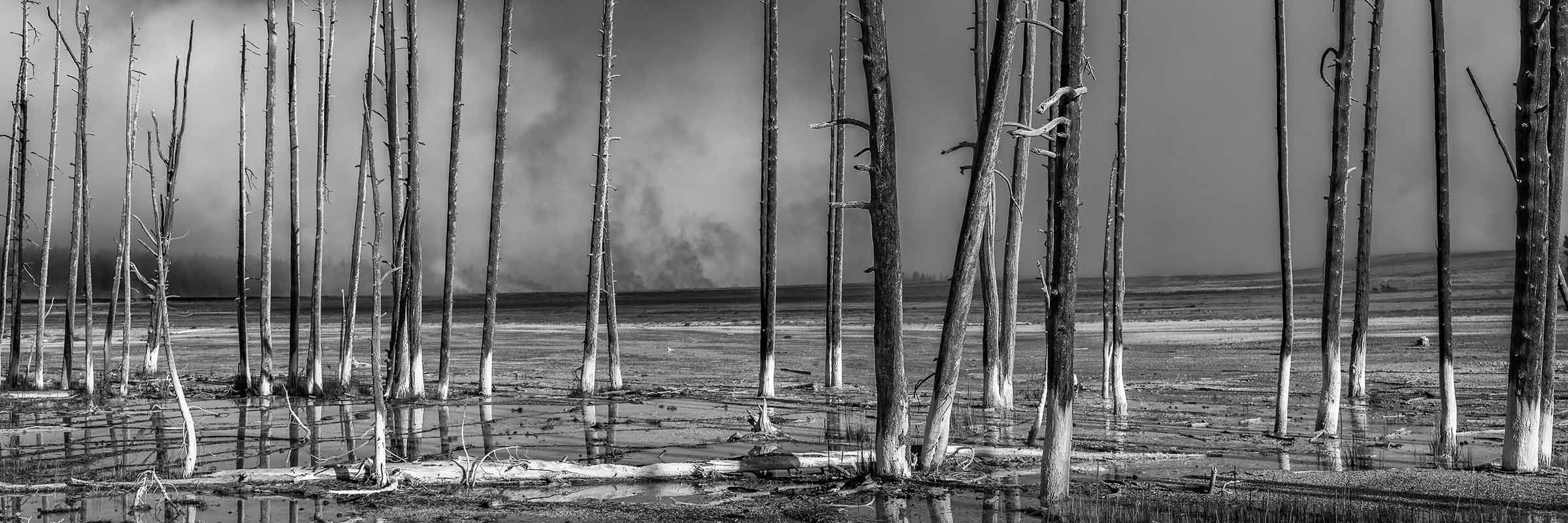
View Available Prints of All Is Not Lost
The Presence Within Absence
If the St. Clair image speaks to stillness through openness, this image from Yellowstone speaks to it through endurance. The dead trees stand in shallow water and mineral flats, stripped of leaves, stripped of bark in places, reduced to their structural essence. Behind them, geothermal steam rises in great slow columns against a heavy sky. There is nothing living here in the conventional sense, and yet the image is profoundly alive, charged with a quality of witness, as if these trees have been standing through something enormous and have not finished standing yet.
What makes this image contemplative is precisely what makes it unusual. There is no conventional beauty here, no golden light, no dramatic color, no scenic reassurance. What it offers instead is something more demanding and more rewarding: an invitation to sit with complexity. With the fact that landscapes carry history. With the recognition that endurance and stillness are not the same as passivity. With the understanding that a place stripped to its essentials can be more present, not less.
This is the register of contemplative landscape photography that goes beyond calming imagery. It asks the viewer to bring their full attention rather than simply receive a pleasant experience. For a collector willing to meet it there, it becomes one of the most psychologically rich objects in a home, one that rewards sustained looking in a way that decorative imagery never can.
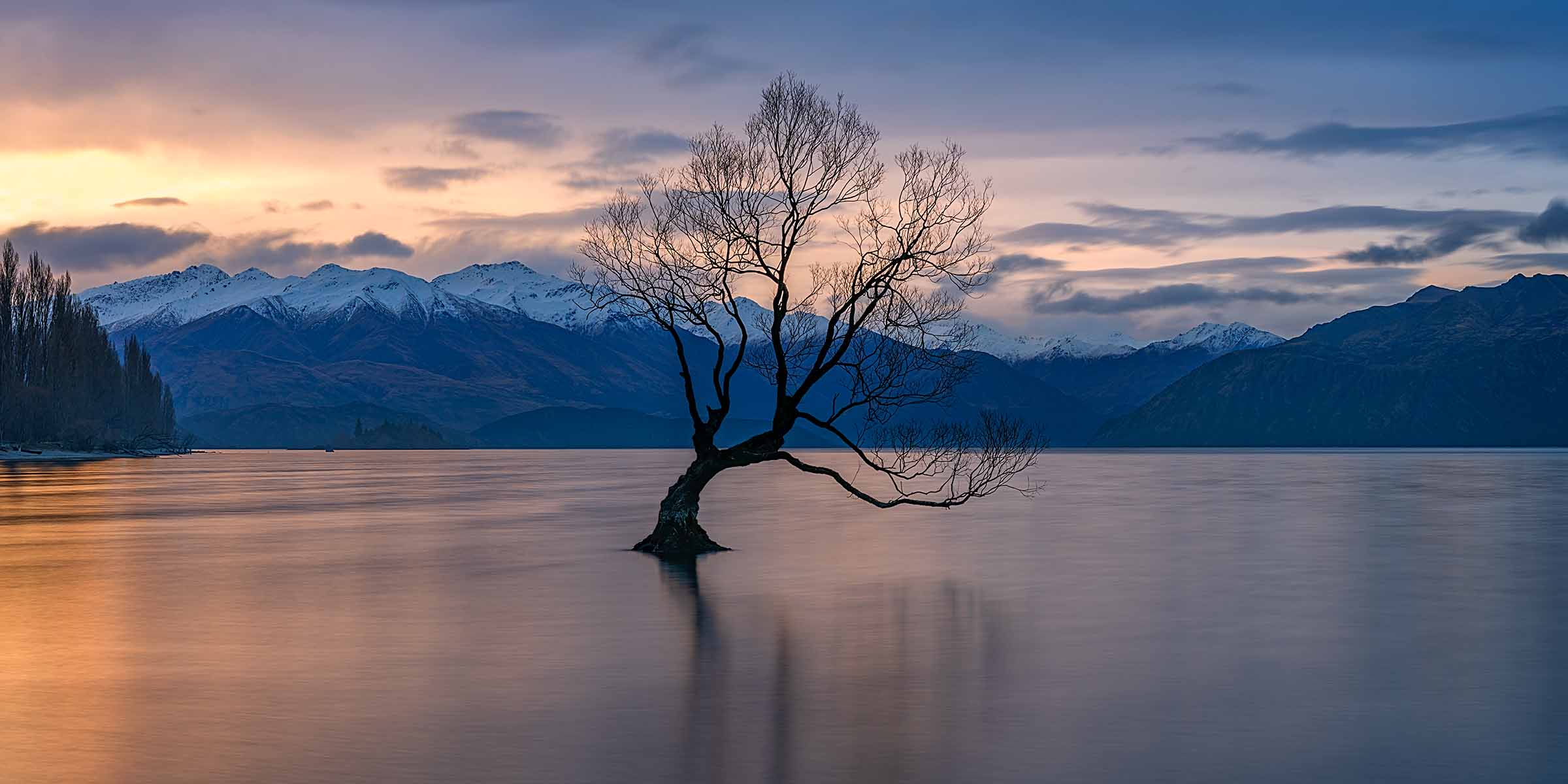
The lone willow of Lake Wanaka stands rooted in the shallows, and I waded into the pre-dawn cold to catch it in a different light than most visitors find. When the sun arrived from the side, it cast a soft pastel warmth across the still water for only a few minutes. Research on biophilia suggests we are drawn to solitary trees at a level that predates conscious thought, an ancient recognition of shelter and of knowing where we stand.
View Available Prints of Lone Willow
Solitude as an Invitation
The lone willow tree at Lake Wanaka in New Zealand is one of the most photographed subjects in the Southern Hemisphere, and for reasons that go well beyond its undeniable visual beauty. There is something in the image of a single tree, standing in still water at the edge of a vast mountain landscape, that speaks directly to the human experience of solitude, not loneliness, but the particular quality of aloneness that feels chosen rather than imposed.
In this image, made at dusk when the mountains behind the lake were still holding the last blue light of the day and the water had settled into an almost perfect mirror, the tree stands with a quality that can only be described as composure. Its branches reach asymmetrically outward, not quite symmetrical, not quite resolved, and that incompleteness is part of what makes it so compelling to look at. It feels like a living thing in the act of being itself, without audience, without performance.
For the viewer standing in front of this image on an ordinary morning, that quality of composure can function as a kind of model. Not something to imitate, but something to be briefly near. Research on nature imagery and stress reduction consistently finds that even brief visual exposure to natural scenes reduces cortisol levels and activates the parasympathetic nervous system, the physiological state associated with rest, recovery, and restored attention. I explore what this means in practice in my article on nature photography and cognitive function. The mechanism is not fully understood, but the effect is reliable. Something in us recognizes these environments and responds to them as if we have come home.
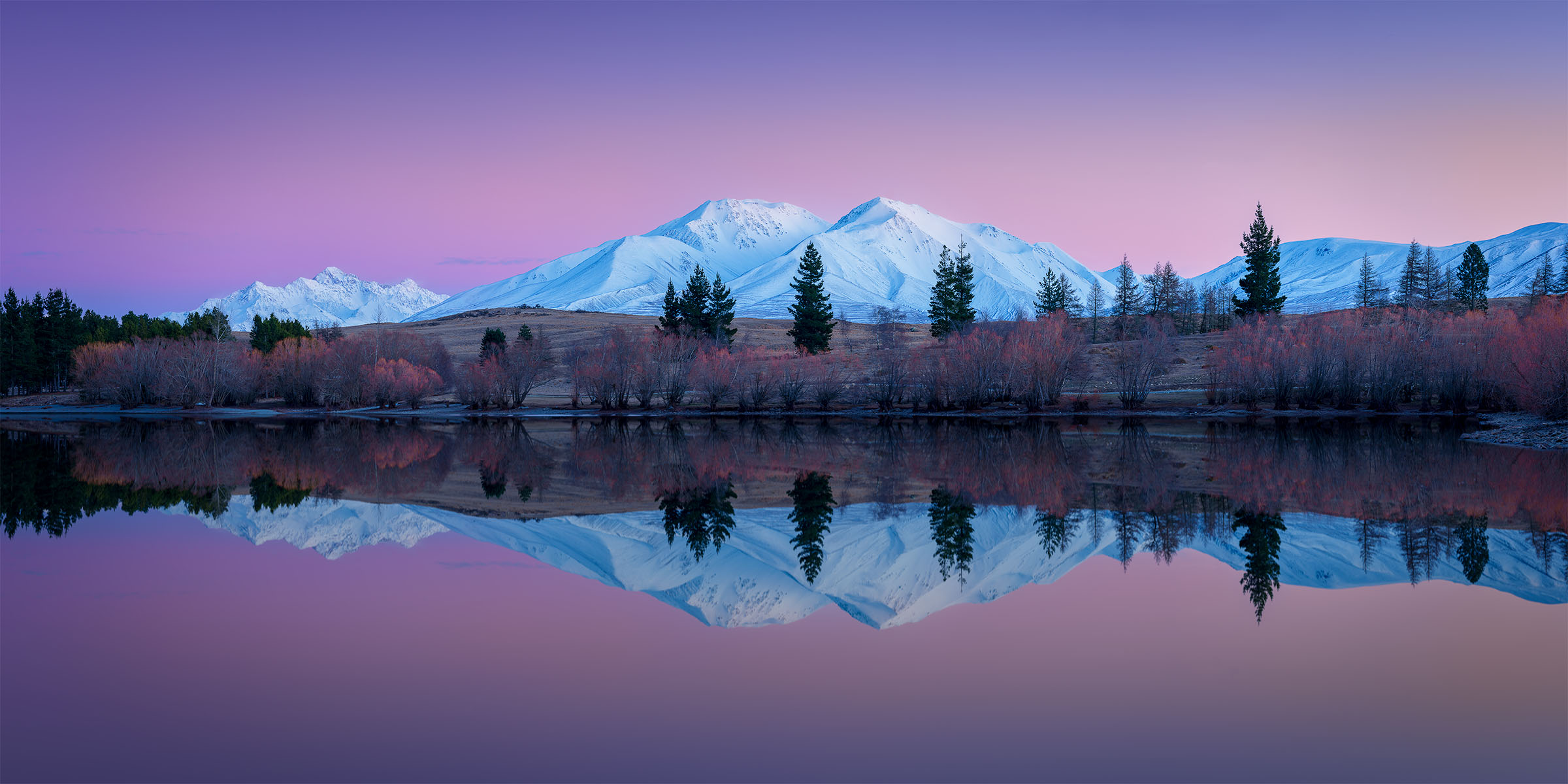
Before sunrise at Ashburton Lakes, the cold was sharp enough to chase me repeatedly back to the warmth of my car, yet something told me this morning was worth enduring. This place is often restless with wind, but on this rare day the water lay perfectly still, reflecting the mountains with a quiet clarity I had not seen in weeks. As the sun began its slow rise, an alpenglow washed across the peaks, gently igniting the landscape in soft light. In that moment, the stillness felt deeply restorative, as if the world itself had paused to breathe. As a psychologist, I have seen how calm environments can widen our perspective, and standing here reminded me how nature has a way of settling the mind without asking anything in return. This image is an invitation to hold that calm, to step into a moment where reflection and balance come naturally.
View Available Prints of Held in Stillness
When the World Doubles Itself
There are moments in landscape photography when the natural world appears to pause and reflect on itself, literally, in the case of a perfectly still body of water that mirrors a mountain range with such precision that the image becomes a kind of visual palindrome. This image, made at dawn when the air was cold enough to hold the water absolutely motionless, is one of those moments.
The reflection here is not merely a compositional device. It creates a doubling of the world that is psychologically significant, a sense that what you are seeing has weight and completeness, that it exists in full rather than partially. The snow-capped mountains, the autumn foliage burning red and amber along the shoreline, the progression of pink and violet in the sky above, all of it is present twice, each version affirming the other. The result is an image that feels resolved in a way that the world rarely does. Finished. Held.
This is what contemplative landscape photography can offer that no other art form quite replicates: the experience of a moment that is complete in itself. In a culture that treats every moment as a waypoint toward the next one, an image that communicates genuine resolution, that says this, here, now, is enough, carries a psychological weight that accumulates quietly over time. It is not dramatic. It does not announce itself. It simply changes the quality of the room it lives in, and by extension, the quality of attention available to the person who lives there.
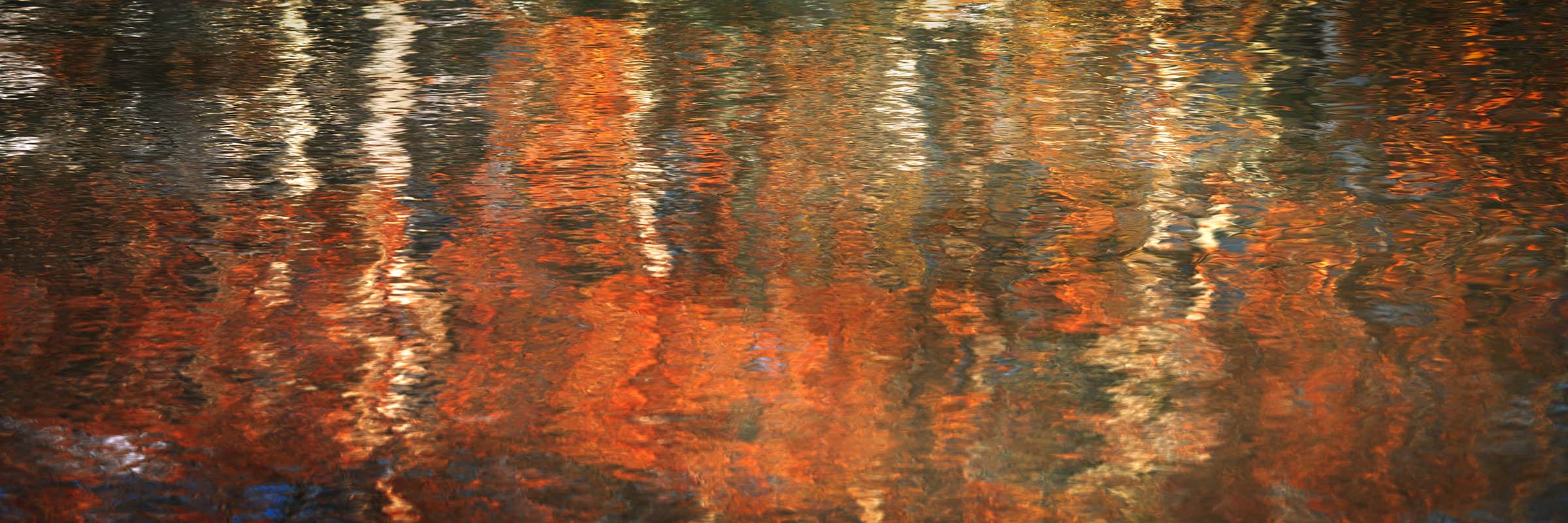
Reflections in Motion invites the eye to slow down and drift, much like the water itself. Autumn leaves dissolve into ripples of color, blurring certainty and creating space for personal meaning to emerge. As the surface shifts, the scene becomes less about what is seen and more about what is felt, a quiet mirror for reflection and contemplation. There is a gentle permission here to pause, to let the mind wander without needing clarity or resolution. In these moving reflections, nature offers a calm reminder that stillness does not require stillness at all.
View Available Prints of Reflections in Motion
The Paradox of Moving Stillness
This final image operates differently from the others and is included here deliberately, because contemplation is not always a still or quiet experience. Sometimes presence arrives through immersion in something that is moving, something that demands the eye follow it without being able to resolve it into a fixed point.
The surface of this water carries the reflected colors of autumn aspens, amber, copper, rust, ivory, broken and redistributed by gentle current into something that hovers between abstraction and representation. You know what you are looking at, and you do not quite know what you are looking at. The eye moves through it without finding a place to stop, and paradoxically, that continuous motion produces a state of absorbed attention that is indistinguishable from stillness. This is what psychologists call soft fascination, the kind of effortless, non-demanding engagement that characterizes the most restorative natural environments. The mind is occupied without being directed. It follows without effort. And in that following, something releases.
This is photography as environmental intervention in its most precise form. The image does not ask you to think about it. It simply draws you in and holds you there, in that particular quality of absorbed, effortless attention, for as long as you are willing to stay.
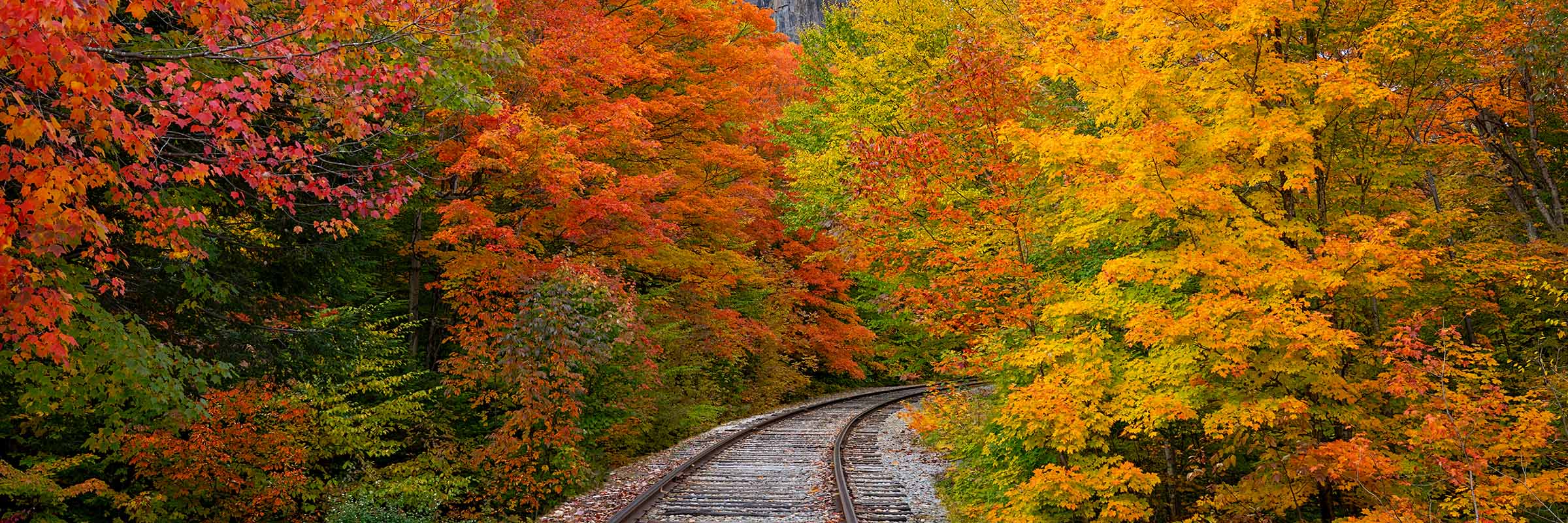
This curve of railway track bends out of sight into a tunnel of saturated autumn color, showing you the invitation rather than the destination. Research on stress and restoration tells us that nature reliably returns us to the present, where the bend in the path is not a threat but simply the next beautiful thing waiting to be met. Some seasons ask you to let go. This one asks you to lean in.
View Available Prints of The Turning
The Daily Practice You Did Not Know You Were Building
There is a difference between seeing an image and being with one. Most of us see hundreds of images every day, on screens, in advertisements, on the feeds we scroll without quite meaning to. We process them and release them in fractions of a second, moving immediately to the next. The images we choose to live with on our walls operate differently, but only if we allow them to.
A collector who acquires work with genuine psychological depth and then learns to spend even a few minutes with it each day, standing in front of it without agenda, letting the eye move through it at its own pace, is building something that research consistently supports as genuinely restorative. Harvard Medical School identifies visualization of tranquil scenes as one of the proven approaches that elicit the relaxation response, the physiological counterpart to stress. A contemplative landscape photograph, lived with daily, offers exactly that, not as a formal practice you have to schedule, but as a natural consequence of the environment you choose to inhabit.
The images in this article are made for exactly that purpose. Each one was composed with a specific psychological outcome in mind, not to be impressive, not to document a location, but to create an experience of presence that is available to you every day, in your own home, whenever you are willing to stop and look. They will be there tomorrow, unchanged, holding the same stillness, offering the same invitation. In a life that asks for your attention constantly and returns very little in exchange, that reliability is worth more than it might first appear.
Steve Austin is a psychology professor and behavioral neuroscientist whose limited edition landscape photography is grounded in attention restoration theory, biophilia, and the documented psychological effects of nature exposure. His work is made for collectors who understand that what surrounds them shapes how they think, feel, and recover.
Featured Fine Art Prints for The Art of Staying
Steve Austin is a psychology professor and behavioral neuroscientist whose limited edition landscape photography is grounded in attention restoration theory, biophilia, and the documented psychological effects of nature exposure. His work is made for collectors who understand that what surrounds them shapes how they think, feel, and recover.