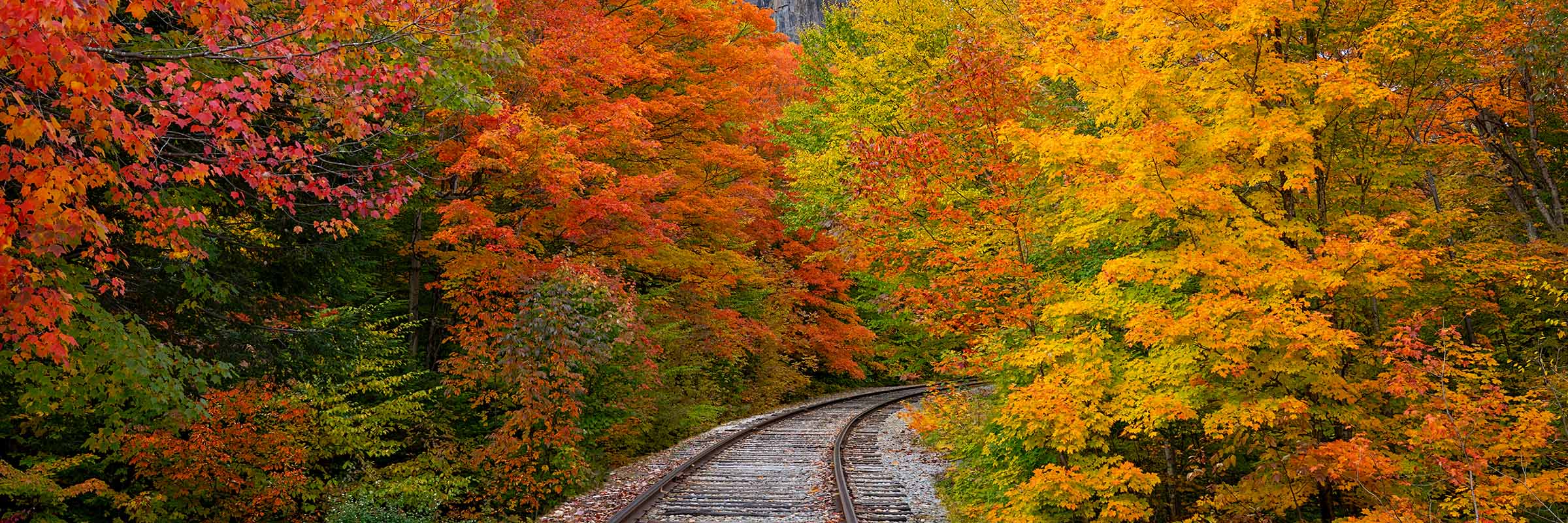
A 3:1 panoramic photograph of a railroad curving through peak fall color in Crawford Notch, New Hampshire, available as a limited edition print in three sizes.
Artist's Story
Above the Arethusa Falls trailhead in Crawford Notch, the old Mountain Division line bends through a stand of maples that had turned all at once. Red, orange, gold, and still some green, the whole slope of it lit on a single October morning.
I stood at the bend for a while before I made the frame.
The color is not something the trees added. It was there the whole time. All summer the leaves are full of the same yellows and oranges, carotenoid pigments, but chlorophyll floods the leaf so heavily with green that you do not see them. Autumn is the tree pulling that chlorophyll back out, breaking it down and drawing the nutrients into the trunk before it drops the leaf for good.
The green goes first, and what is left is what was always underneath. The reds are the exception, made fresh in the dying leaf. But the blaze on this slope is mostly subtraction. The tree is not decorating itself. It is closing the leaves down and reclaiming what it can, and the color is the sign of that withdrawal.
The rails were laid through this notch in 1875 and they still run it. They hold the same bend, up into the trees and out of sight behind the yellow maple on the right. The slope does this once a year. The line goes through it either way.
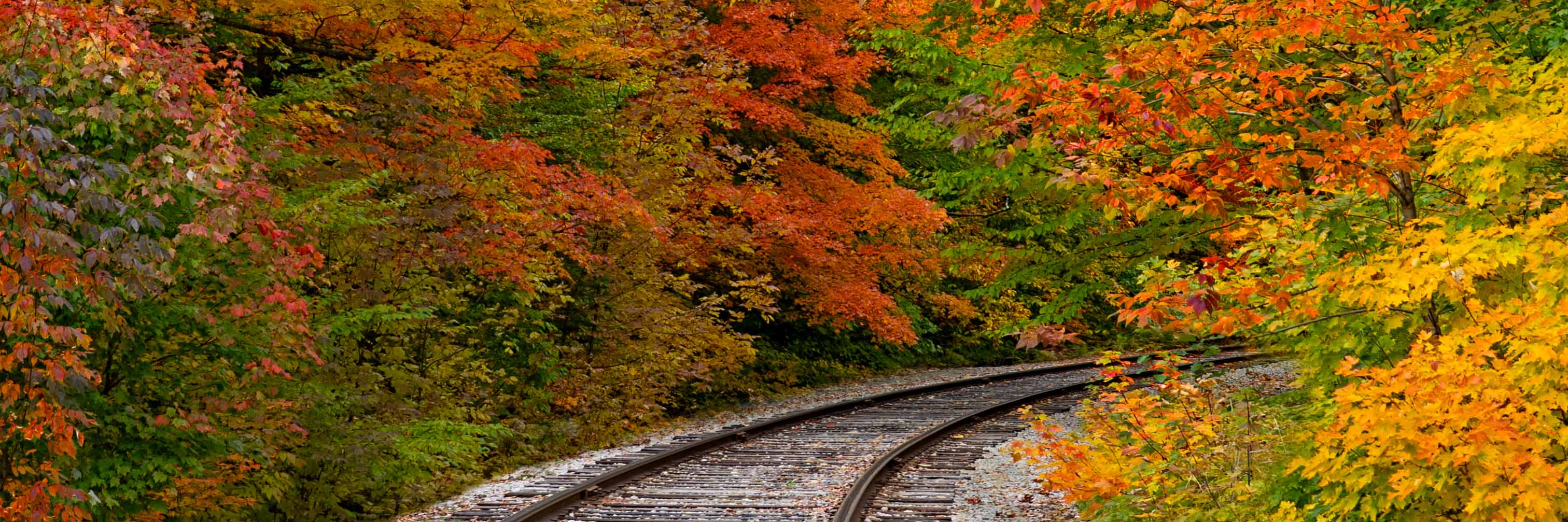
The curve and the trackbed at about one third of the frame width. On a ninety inch print this section runs roughly thirty inches across. Fallen leaves collect between the ties, the ballast separates into individual crushed stone, and the maple above the rails breaks into single leaves. Click to view at full size.
About This Photograph
Photographed at the Arethusa Falls trailhead in Crawford Notch State Park, Hart's Location, New Hampshire, at peak fall color in October. This is a single frame image. The subject is a stand of sugar and red maples beside a curving section of the Mountain Division line, with the shoulder of Mount Bemis in the gap above the trees.
The yellows and oranges are carotenoid pigments, present all season and revealed once the chlorophyll breaks down. The reds are anthocyanins, made fresh in the leaf as it shuts down.
The rails run in from the bottom edge and bend out of sight at about three fifths of the frame width. The line was built by the Portland and Ogdensburg Railroad, opened through the notch in 1875, and has been operated since 1995 by the Conway Scenic Railroad.
The Turning
Steve Austinhttps://www.steveaustinphotography.com/
Location
Crawford Notch, White Mountains, New Hampshire
Subject
Sugar and red maple · Mountain Division line · October
Capture
Single frame
Format
Photograph · horizontal panorama, 3:1
Sizes
36 × 12 in · 60 × 20 in · 90 × 30 in
Print Media
TruLife Acrylic · ChromaLuxe Metal · Baryta paper
Edition
Limited, 25 / 50 / 100 by presentation
What it Does in a Room
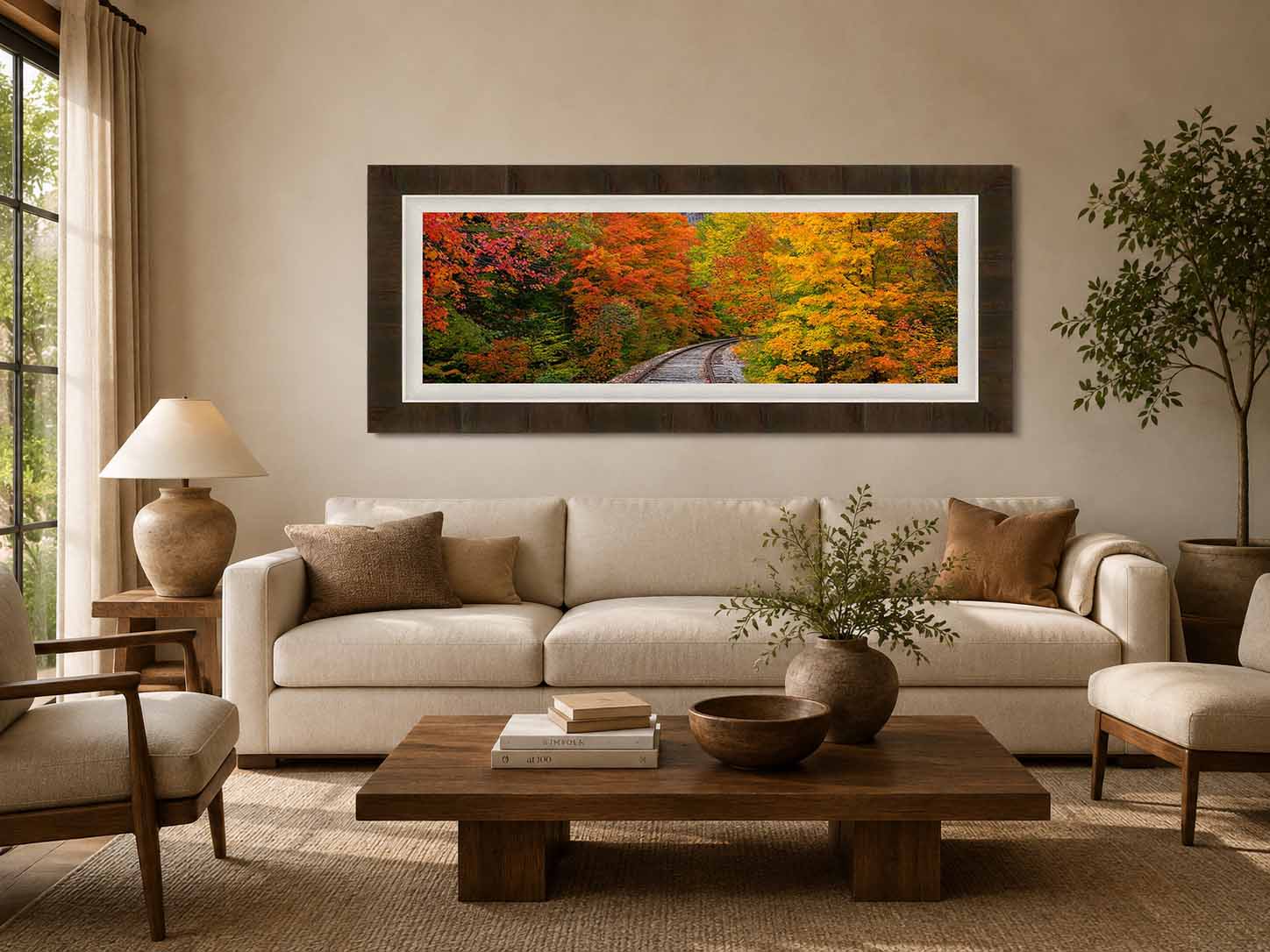
This is a saturated photograph and it behaves like one. Put strong warm color on a neutral wall and the wall shifts the other way. Bone and white plaster read a shade cooler and cleaner near the frame, and the picture reads warmer than it does on a screen. That is simultaneous contrast, and it is why this print looks more intense in a room than it does in a preview. The closer the wall is to neutral, the stronger it runs.
The proportion does something separate from the color. Seven and a half feet of horizontal panel sets a strong line across a wall, and everything else in the room measures itself against that line. Furniture below it squares up to it. The eye travels the length of the wall rather than up it, which reads as width in a room that does not have much ceiling. At sixty by twenty the same thing happens at a quieter volume, over a console or a sideboard, where the panel and the furniture below it hold one horizontal together.
It changes through the day. Warm afternoon and evening light pushes the oranges and golds forward and the picture runs hot. Under cooler lamps the greens in the understory and the gray of the ballast come up, the color separates into more distinct bands, and the photograph reads deeper and quieter. Both are worth seeing before the piece is hung for good.
Not sure which size the room calls for, or want dimensions not listed here? Sizes beyond 90 × 30 are available on request and ship crated by freight. That conversation is welcome before an order is placed. Start that conversation and I will answer within one business day.
The Turning, limited edition printSteve Austin70012900USD11https://schema.org/InStock
Questions about this photograph
How small is too small for a photograph this wide?
At three to one, the smallest size in this family is thirty-six inches across and twelve inches tall. That is a true panorama proportion, and at twelve inches of height the picture reduces to its two simplest facts: the sweep of color and the line running through it. The canopy reads as broad bands, red into orange into gold into the green wedge at the left, and the track reads as one continuous curve. That is a legible photograph and a useful one, because the proportion fits walls that will not take much else. A narrow stretch between two doorways, the space above a bench or a headboard, the long wall of a galley kitchen. At sixty by twenty, from about six feet back, the bands begin to break up. Individual crowns separate out of the color, the ballast picks up its grain, and the ties resolve into separate timbers. That is the size at which the picture stops being a shape and starts being a place. If you are weighing a size against a specific wall, choosing the right print size covers the measurements and the viewing distances in more detail.
What changes at the largest size?
The canopy stops being color and becomes leaves. At thirty-six by twelve the maples read as bands, orange against gold against a wedge of green. At ninety by thirty a single branch of orange maple can be followed from the trunk out to its farthest leaf, and the red maple at the left edge separates into individual lobed shapes with light coming through them. The ballast changes at the same width, from gray texture into crushed stone with fallen leaf caught between the ties. What changes beyond detail is the width itself. Seven and a half feet is more than a person takes in at once from a normal viewing distance, so the picture stops arriving whole. The eye enters at the track, travels right to the point where the rails go behind the yellow maple, and comes back through the color on the way out. The canopy on both flanks moves past the edge of what you are looking at directly, which is what makes the frame read as being among the trees rather than in front of them. Why scale matters covers what happens perceptually when a landscape reaches the size where the eye has to cross it.
What kind of room does this photograph suit?
Quiet rooms with warm materials and long walls. This runs from deep green shadow through orange and gold to a pale gap of sky, and it is warm throughout. Against white, bone, pale gray, or warm plaster it becomes the source of color in the room and the rest of the space arranges itself around it. Oak, walnut, wool, leather, and unglazed ceramic take that warmth back up and carry it into the furniture, so the picture reads as part of the room rather than as an object on the wall. The proportion suits a wall people move past rather than sit in front of. A hallway, a stair landing, an entry, or a long wall passed on the way somewhere gives the curve something to do, because a receding line reads differently from an angle than it does square on, and the point where the rails disappear shifts as you walk. At ninety by thirty it does its clearest work on a wall of its own, with nothing else competing for the color. Designing calm spaces takes the question further.
Every work ships insured and arrives with a signed certificate of authenticity.
If a piece is damaged in transit, the choice of replacement is always yours, and your edition number stays with you.
Production time runs 2 to 3 weeks for metal, 3 to 4 weeks for acrylic and paper, and 5 to 6 weeks for framed work.
Each print is made to order and takes its place in a numbered edition, so sales are final. Before you choose, I am glad to help: send a photo of your wall and I will show you this work in your room at true scale, at no charge. Start a conversation
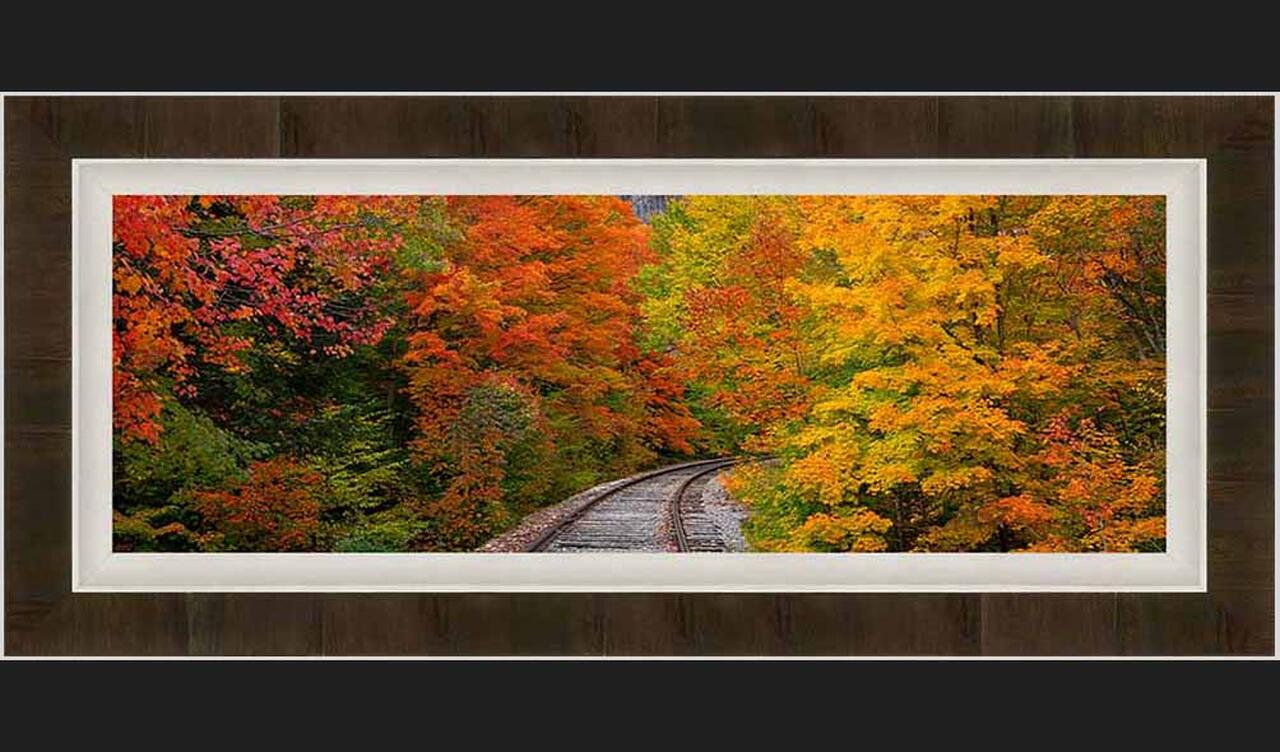
Collector's Choice · TruLife ® Acrylic in Italian Frame
Collector Edition of 25· Lumachrome TruLife Acrylic · Handcrafted Italian Frame
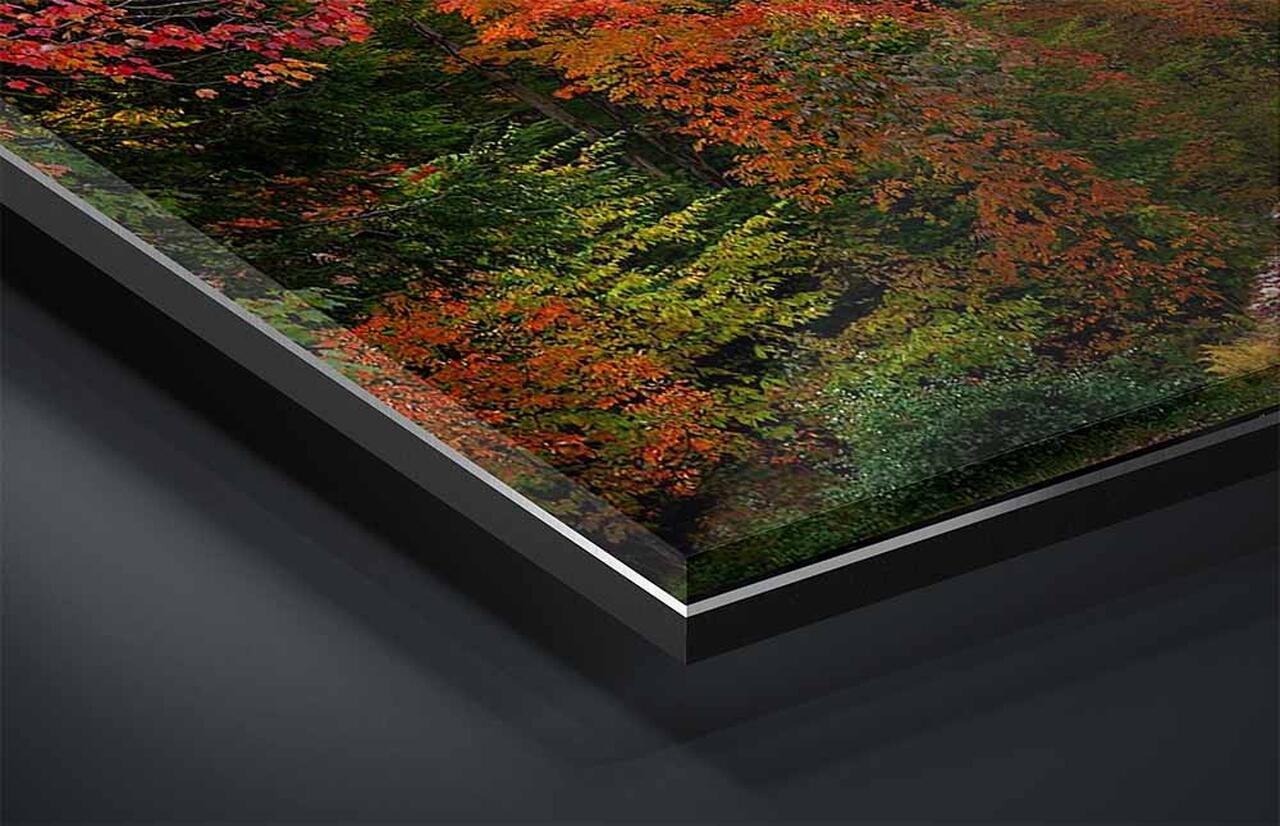
TruLife acrylic in a handcrafted Italian frame with a linen liner chosen for the image. Frame series, finish, and liner are settled with you after the order, and production begins from there. The frame and liner add about fourteen inches to the finished dimensions, worth allowing for when planning placement.
Signature Acrylic Edition of 50· Lumachrome TruLife · Gallery Float Mount
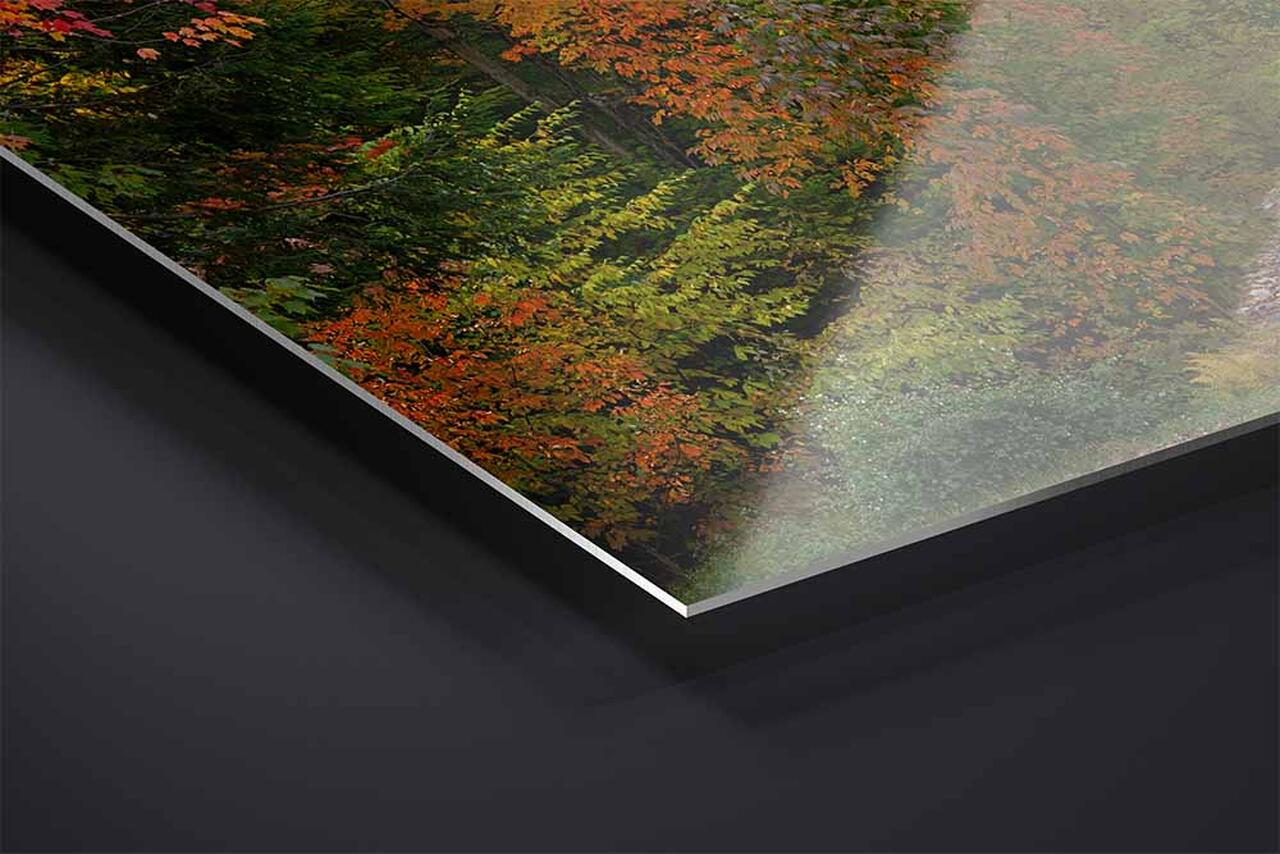
Face-mounted to TruLife acrylic and floated approximately one inch from the wall, with no frame to mediate between the image and the room. UV-resistant, anti-reflective, and scratch-resistant, with a lifetime guarantee against fading.
Signature Metal Edition of 50· ChromaLuxe Print · Gallery Float Mount
Color infused into the aluminum panel itself, floated from the wall on a concealed system. Where acrylic produces luminosity, metal produces clarity. Exceptional fade resistance with no glazing or coating required.
Fine Art Edition of 100· Hahnemühle Baryta Fine Art Paper
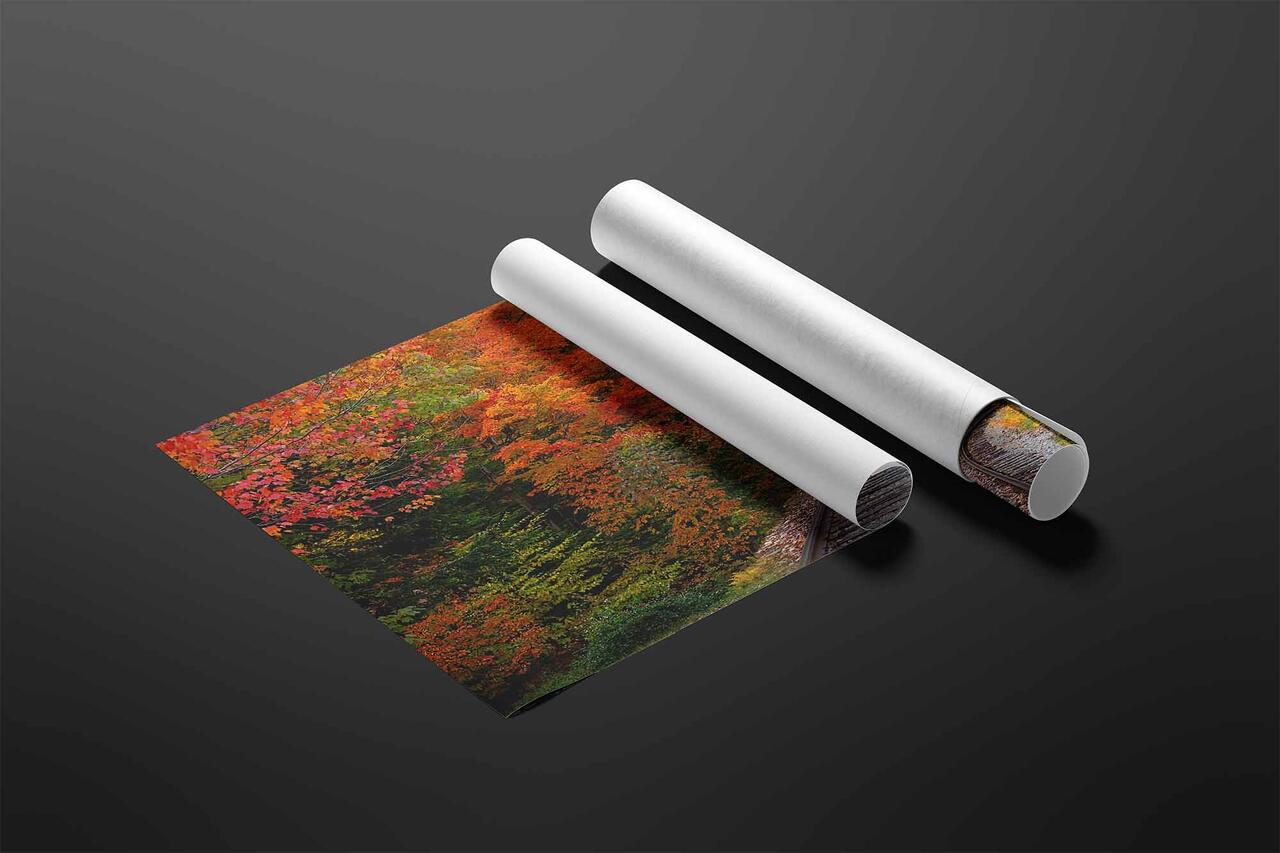
Printed without acrylic, so light meets the paper surface directly. Highlights stay luminous, shadows keep their nuance, and the surface has a tactile quality the other presentations approach differently. The understated choice, and the traditional one.
Complimentary shipping within the continental United States. International collector shipping available upon request.
Still deciding
Designing for Stillness
A guide to choosing art for restorative spaces
How to tell whether an image will still hold you in a year, how scale changes what a photograph does in a room, and how to match a piece to the work a room actually performs. It cites the research it draws on, and it is equally clear about where that research stops. About ten minutes to read.