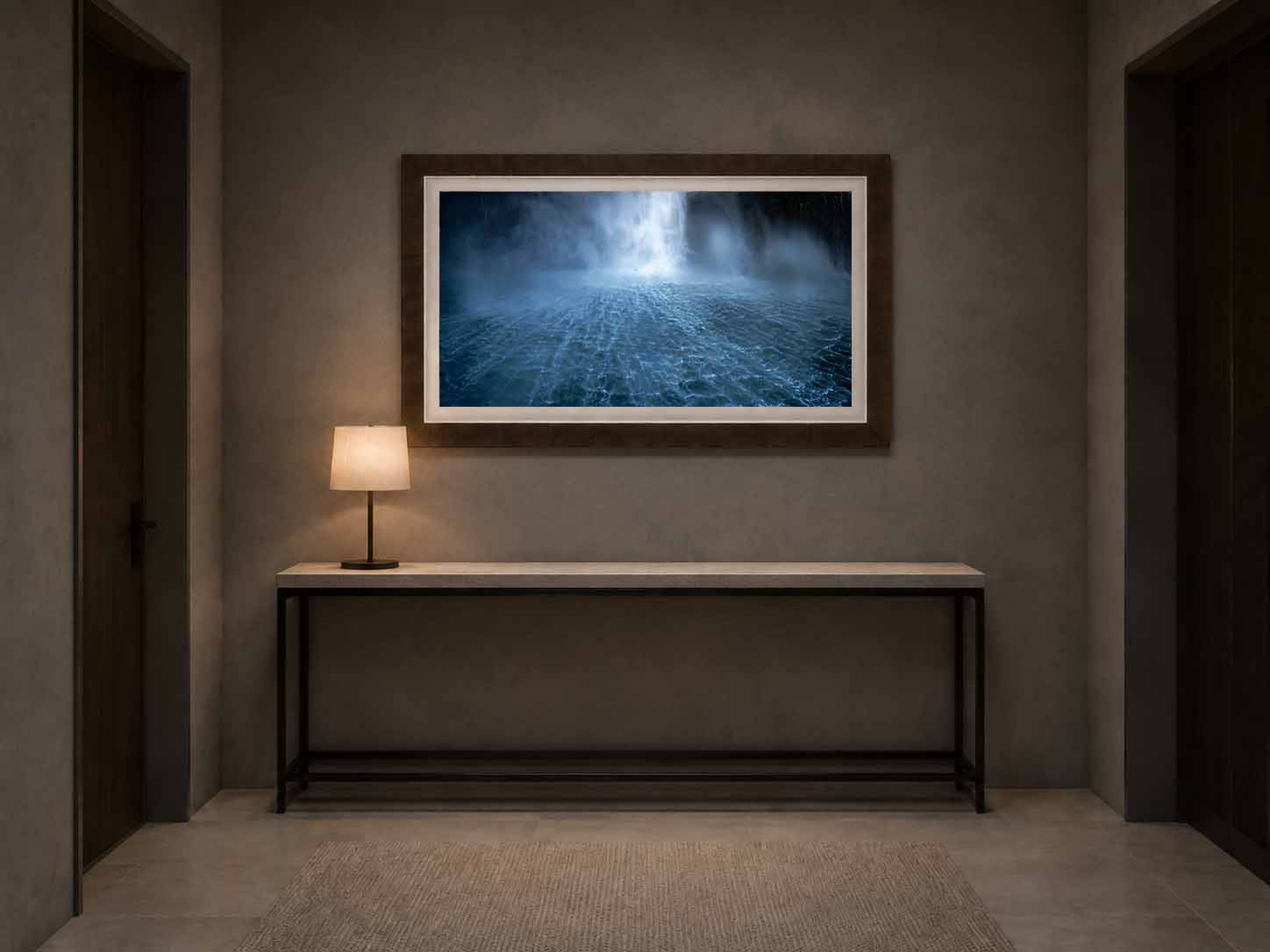
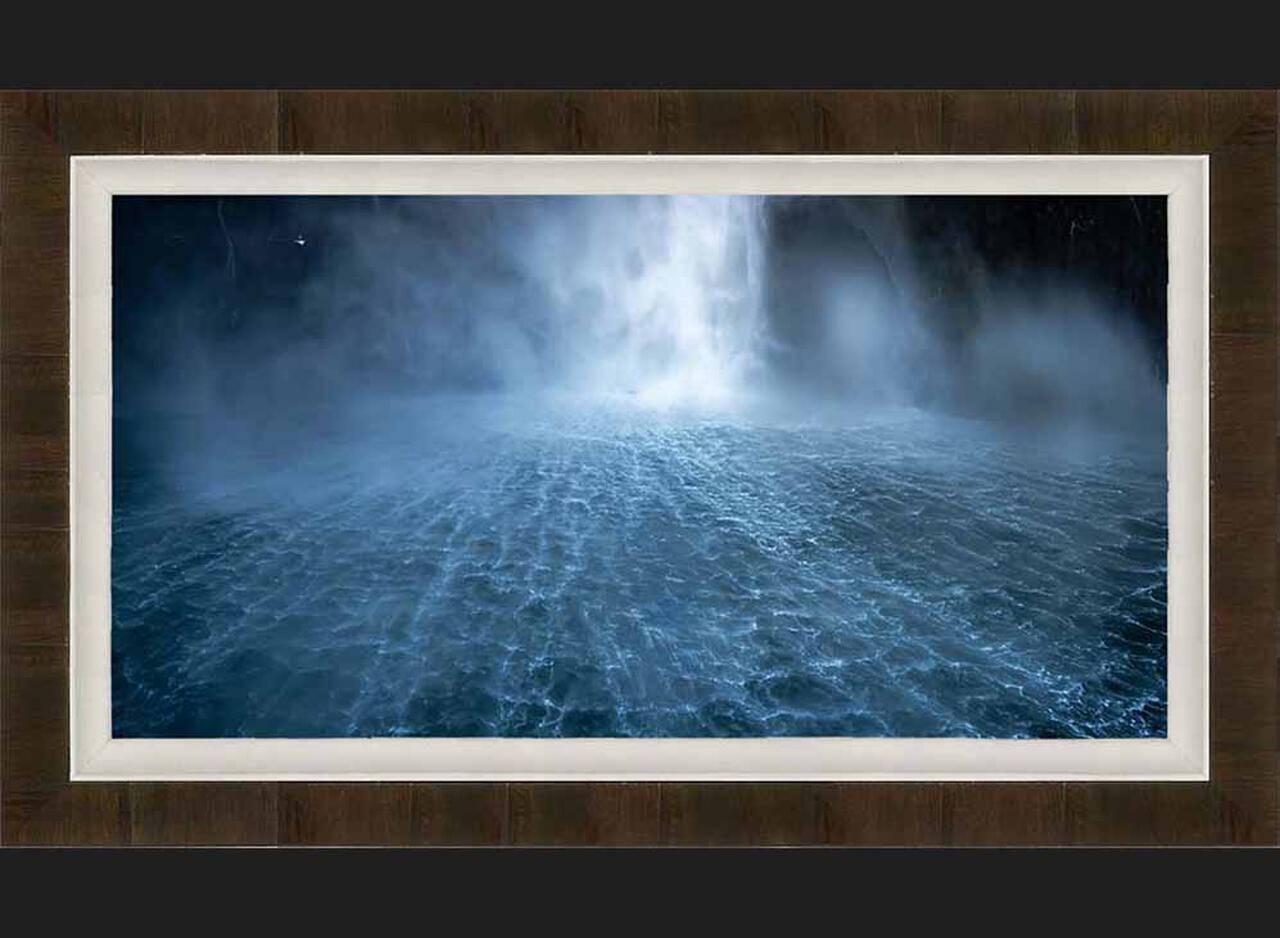
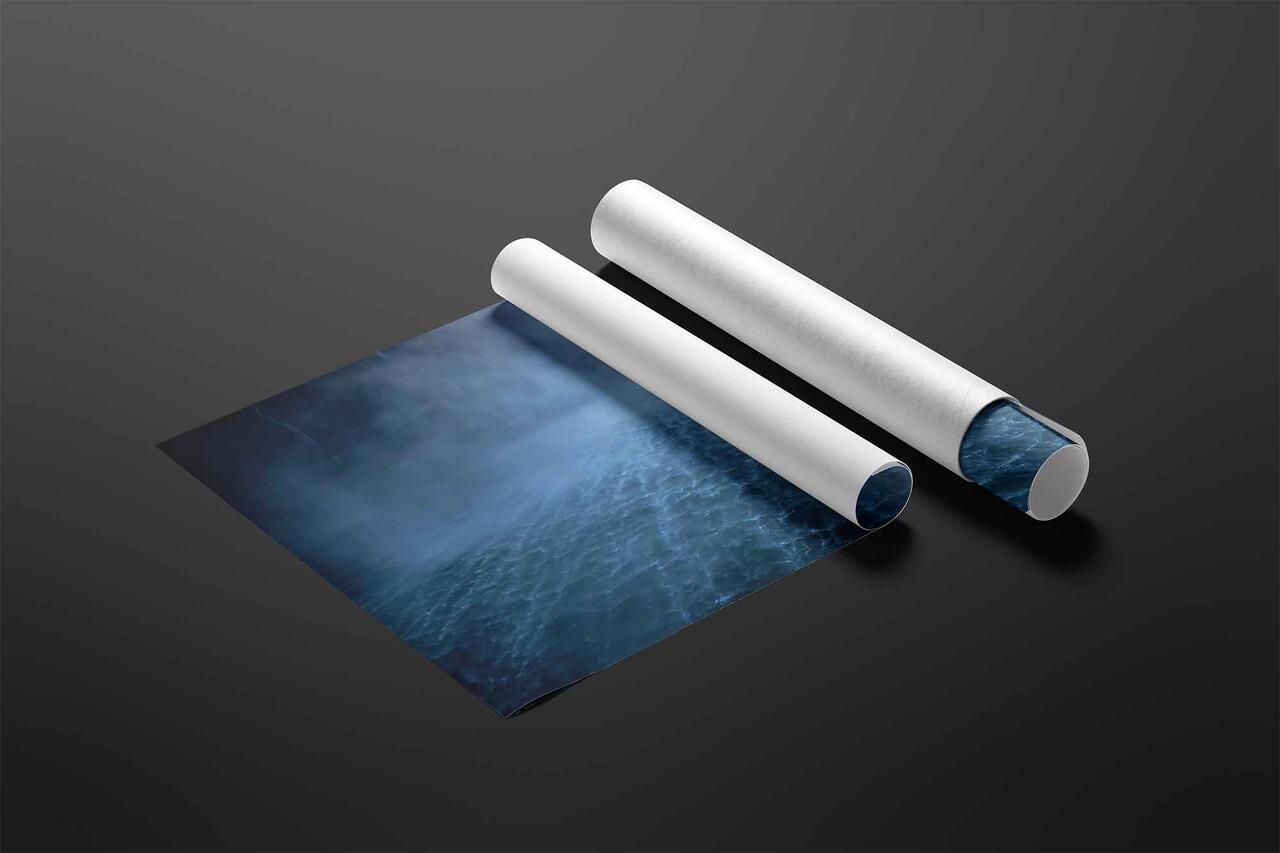
A 2:1 panoramic photograph of the water surface at the base of Stirling Falls, Milford Sound, New Zealand, available as a limited edition print.
Artist's Story
At the base of Stirling Falls, in Milford Sound on New Zealand's South Island, a hundred and fifty-five meters of water hits the fiord at once, and this is the surface where it lands. Not the fall itself but the plane beneath it, torn open by the weight of what is coming down. The boats push in close enough to put you over it, and the wind the falling water drags with it flattens and shreds the surface into something that does not read as water at all.
I pointed the camera down into that instead of up at the drop, and let a long exposure gather it.
What is strange about the impact zone is how little of it is liquid. A waterfall this size falls fast enough to drag a column of air down with it, and at the bottom that air blasts outward across the surface, so what you are looking at is water and wind and atomized mist all moving together, the boundary between them gone. The violence is not at the top, in the plunge. It is here, at the meeting, where free flowing mist meets the harsh reality of the water below.
Beneath the Roar is that surface, the place a waterfall stops being a waterfall and becomes the fiord, photographed from a few feet above it.
A few days later I went back out to the same boat, having not captured the entire essence of the falls, and turned the camera up into the water instead. There is something in that frame I did not see until I was home. That one is The Apparition.
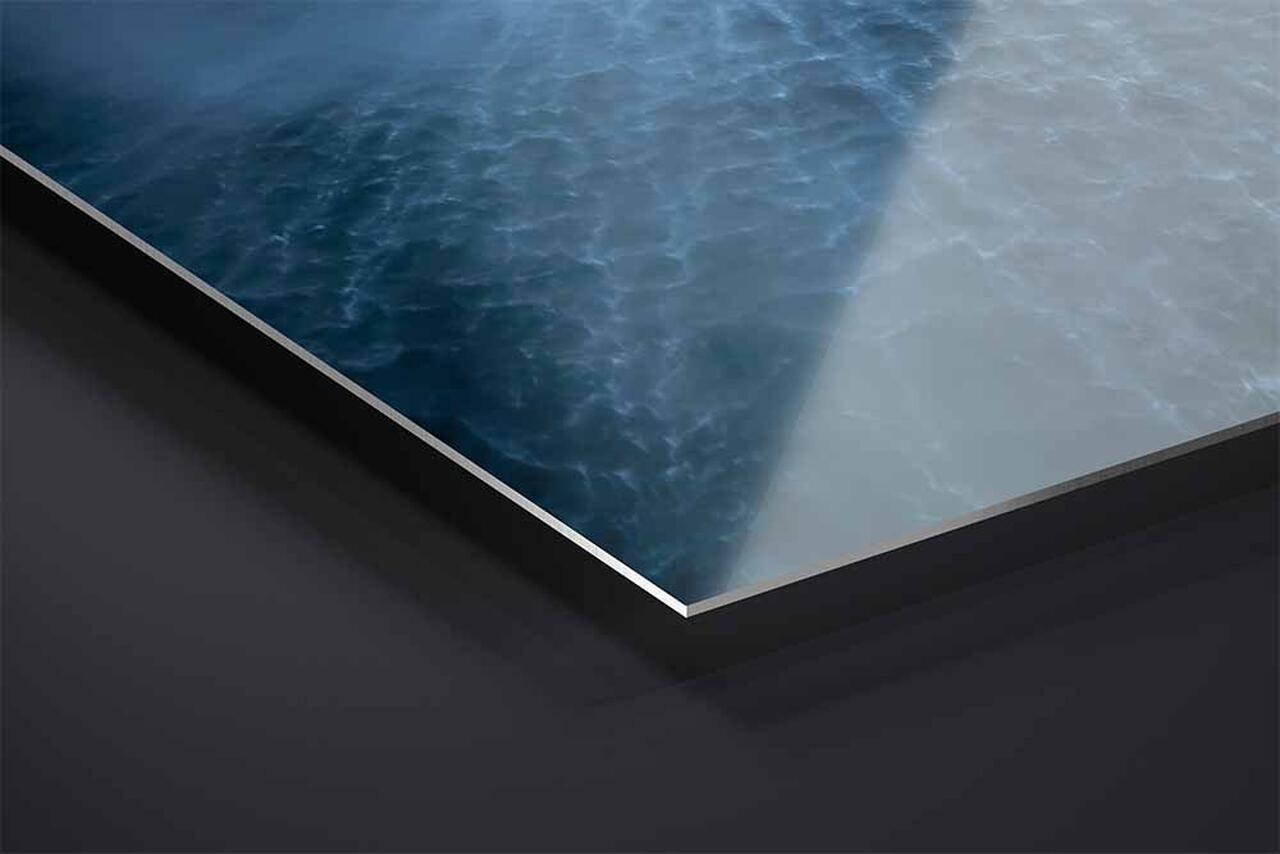
The surface to the right of the impact, about a quarter of the frame width. Streaks running one way, chop running the other, and the water standing up where they meet. Click to view at full size.
About This Photograph
Photographed at the base of Stirling Falls in Milford Sound, in Fiordland National Park on the South Island of New Zealand, from a cruise boat at the foot of the falls. This is a single frame long exposure, with no compositing. The subject is the impact zone at the water's surface, where the falling water meets the fiord in wind-driven spray and turbulence. Stirling Falls drops about 155 meters from a hanging valley high above the sound, fed by rain and snowmelt in one of the wettest inhabited regions on earth. A fall of that height pulls a strong downdraft of air with it, and at the base that air blasts outward across the water, which is what shreds the surface and drives the spray sideways rather than letting it settle.
Beneath the Roar
Steve Austinhttps://www.steveaustinphotography.com/
Location
Stirling Falls, Milford Sound, New Zealand
Subject
The surface of the fiord where the falls land, shredded by downdraft
Capture
Single frame, long exposure from a boat, no compositing
Format
Photograph · horizontal panorama, 2:1
Sizes
40 × 20 in · 60 × 30 in · 80 × 40 in
Print Media
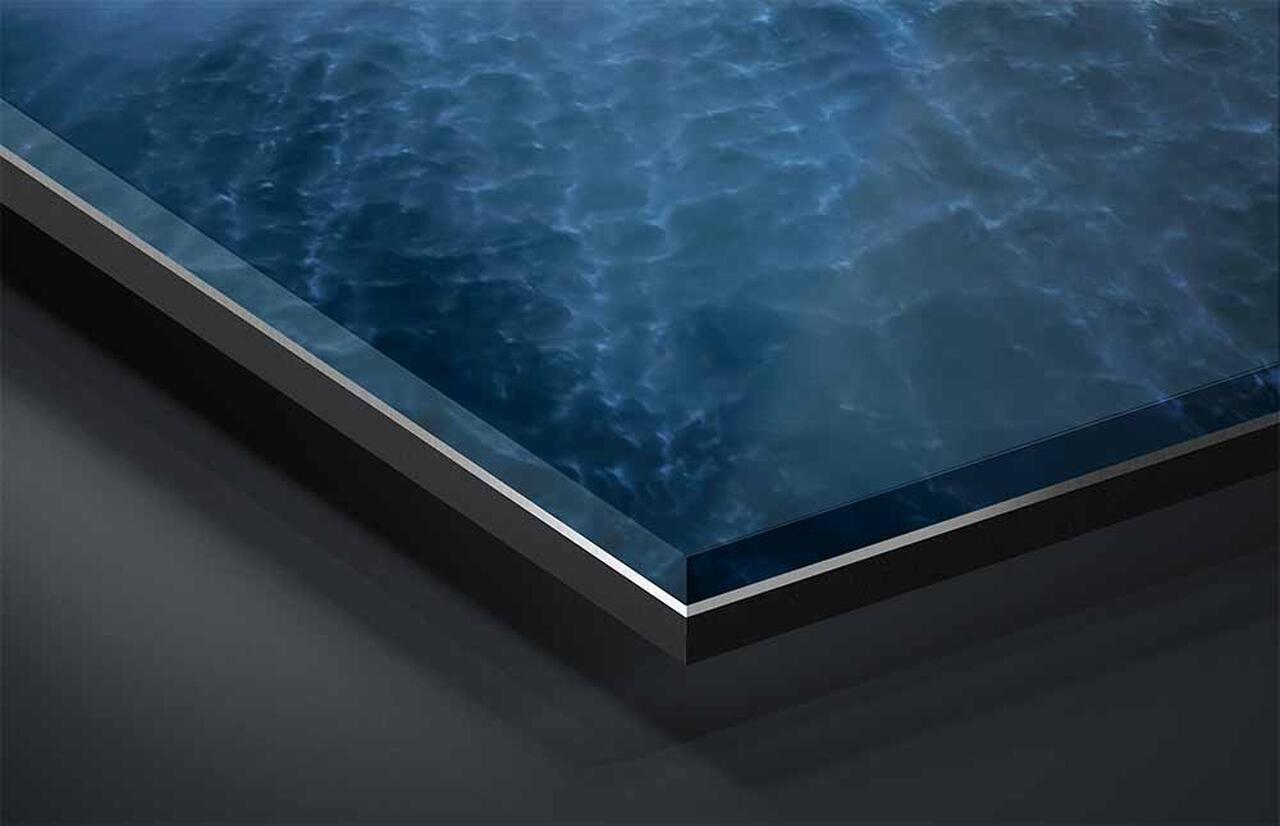
TruLife Acrylic · ChromaLuxe Metal · Baryta paper
Edition
Limited, 25 / 50 / 100 by presentation
What it Does in a Room
A photograph of a surface with no horizon in it does something a view cannot. It stops being a window.
Two to one is the panoramic proportion that still holds a scene. Wider than that and a photograph becomes a band, read left to right like a sentence. Narrower and it reverts to being a picture on a wall. At two to one the frame is decisively horizontal without giving up height, so a composition can fill it rather than merely stretch across it. In a room it works with the architecture instead of against it. Most walls are built on horizontal lines, and a wide frame extends them, which is why this shape settles above a sofa, a credenza, a long console, or a headboard more comfortably than any other. It asks for a run of wall rather than height. Give it one and it makes the wall feel longer than it is.
Here the width is carrying a surface rather than a scene. The camera is pointed down, so there is no horizon and no sky, only water running to the edges of the frame with the fall coming into it at the top. On a wall that reads as material rather than as a view, closer to a piece of stone or a length of cloth than to a window, and a print like that lives more quietly than a landscape does. It also has no focal point. The eye moves across the surface, out to the edges, back toward the bright disturbance at the top, and never has to arrive anywhere. That is what makes it restful in a room you spend time in rather than pass through.
It is one of the two coolest photographs in the collection, running from near black at the edges through deep teal across the surface to pale blue-grey mist at the top, with no warm note in it anywhere. That makes it easy to place in cool rooms and a deliberate contrast in warm ones. Against gray, slate, steel, plaster, and pale stone it belongs immediately. Against oak and walnut it becomes the one cool element in the space, which works if that is what the room needs. It is also dark overall, weighted low, with the mist as the only bright passage, so it will not brighten a room. What it rewards most is a light aimed at it and a wall people come close to, because the surface only becomes legible as water at short range and reads as texture from across a room.
Not sure which size the room calls for, or want dimensions not listed here? Sizes beyond 80 × 40 are available on request and ship crated by freight. That conversation is welcome before an order is placed. Start that conversation and I will answer within one business day.
Beneath the Roar, limited edition printSteve Austin112513400USD12https://schema.org/InStock
Questions about this photograph
How small is too small for a photograph this wide?
At two to one, the Intimate size is forty inches across and twenty inches tall. That is a comfortable proportion, wide enough to read as a panorama but with enough height that it still behaves like a picture rather than a band. Of the panoramic families this is the one that holds up best at its smallest size. What this particular photograph loses at that scale is everything it is made of. There is no subject here, only surface, and at twenty inches tall the surface stops being water and becomes a texture, a blue-grey field with a bright patch at the top. That is not a bad object, but it is a different one. The Collected at sixty by thirty is where the surface becomes water again. The Statement at eighty by forty is where you can see what the wind is doing to it. If you are weighing a size against a specific wall, choosing the right print size covers the measurements and the viewing distances in more detail.
What changes at the largest size?
The surface stops being one thing and becomes several. At forty by twenty it reads as an even field of ripple. At eighty by forty you can see that it is not even at all: there are radial streaks running outward from directly under the fall, cross-hatched by wind chop coming the other way, with patches where the water is being pushed flat and patches where it is standing up in short broken crests. The two directions meeting is the argument the photograph makes about a downdraft, made visible: water being driven outward from under the fall, and wind chop running across it. The mist resolves at the same time, from a soft glow into distinct sheets moving at different speeds. This is a photograph with no subject in it, so scale does not reveal a hidden object. It reveals a pattern, and the pattern is what happened. Why scale matters covers what happens perceptually when a landscape reaches the size where the eye has to travel across it.
What kind of room does this photograph suit?
Cool rooms first, and quiet ones. This runs from near black at the edges through deep teal across the surface to pale blue-grey mist at the top, with no warm note anywhere in it. Against gray, slate, steel, plaster, and pale stone it belongs immediately and reads as depth rather than as an object on the wall. Against oak and walnut it becomes the one cool element in the room, which works if that is what the space needs and fights if it is not. It is dark overall and will not brighten a room. What it rewards most is a wall people come close to, because from across a room this reads as texture and only at short range does it become water with wind on it. A light aimed at it helps for the same reason: everything in this picture sits in the middle and lower range, and a dim room keeps most of it from you.
Every work ships insured and arrives with a signed certificate of authenticity.
If a piece is damaged in transit, the choice of replacement is always yours, and your edition number stays with you.
Production time runs 2 to 3 weeks for metal, 3 to 4 weeks for acrylic and paper, and 5 to 6 weeks for framed work.
Each print is made to order and takes its place in a numbered edition, so sales are final. Before you choose, I am glad to help: send a photo of your wall and I will show you this work in your room at true scale, at no charge. Start a conversation
Collector's Choice · TruLife ® Acrylic in Italian Frame
Collector Edition of 25· Lumachrome TruLife Acrylic · Handcrafted Italian Frame
TruLife acrylic in a handcrafted Italian frame with a linen liner chosen for the image. Frame series, finish, and liner are settled with you after the order, and production begins from there. The frame and liner add about fourteen inches to the finished dimensions, worth allowing for when planning placement.
Signature Acrylic Edition of 50· Lumachrome TruLife · Gallery Float Mount
Face-mounted to TruLife acrylic and floated approximately one inch from the wall, with no frame to mediate between the image and the room. UV-resistant, anti-reflective, and scratch-resistant, with a lifetime guarantee against fading.
Signature Metal Edition of 50· ChromaLuxe Print · Gallery Float Mount
Color infused into the aluminum panel itself, floated from the wall on a concealed system. Where acrylic produces luminosity, metal produces clarity. Exceptional fade resistance with no glazing or coating required.
Fine Art Edition of 100· Hahnemühle Baryta Fine Art Paper
Printed without acrylic, so light meets the paper surface directly. Highlights stay luminous, shadows keep their nuance, and the surface has a tactile quality the other presentations approach differently. The understated choice, and the traditional one.
Complimentary shipping within the continental United States. International collector shipping available upon request.
Still deciding
Designing for Stillness
A guide to choosing art for restorative spaces
How to tell whether an image will still hold you in a year, how scale changes what a photograph does in a room, and how to match a piece to the work a room actually performs. It cites the research it draws on, and it is equally clear about where that research stops. About ten minutes to read.