You are not Buying Scenery
There is a particular kind of landscape photograph that stops you.
Not because it is technically flawless or geographically impressive, but because something in it reaches past your eyes and touches a quieter part of your mind. For a moment, the noise falls away. The list of things you need to do, the conversation you are still processing, the low-grade tension that follows most of us through the day, it recedes. You are simply present. Standing still. Looking.
Most people call that a beautiful photograph. I call it the beginning of a different conversation about what landscape photography can actually be.
I did not set out to make photographs. I set out to understand what happens in the human mind when it encounters the natural world, and I spent years in research doing exactly that. What I found, confirmed by decades of environmental psychology and neuroscience, is that the experience of nature, even a visual representation of it, is not a luxury. It is a biological need. And when a photograph is made with that understanding at its center, it stops being scenery. It becomes something closer to an environment.
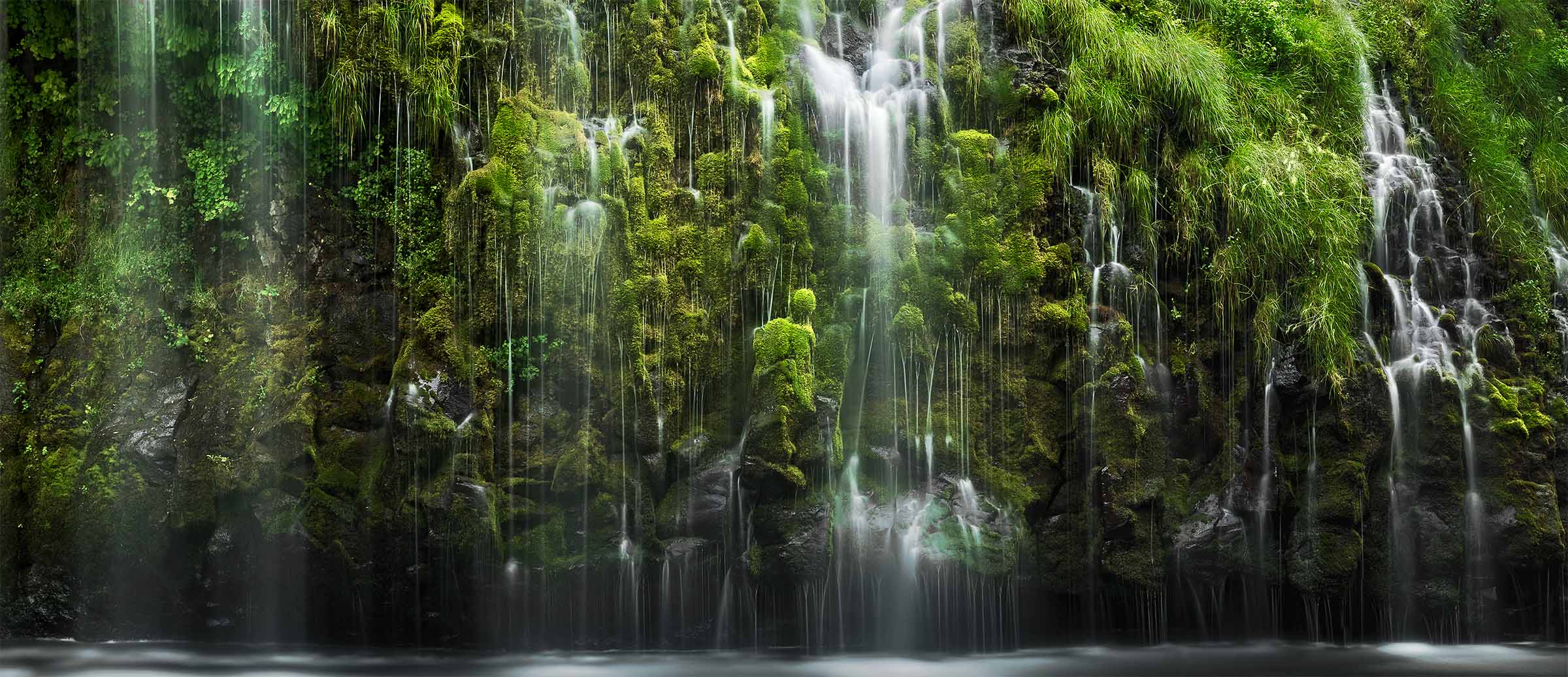
Reaching Mossbrae Falls required leaving the easy path behind, crossing the river, and earning the quiet that waits on the other side. Tucked into the Northern California wilderness, the water seemed to pour straight from the mossy walls, turning stone into something soft and alive. As I stood there in stillness, a familiar form emerged through the veil of falling water, nature’s own version of Rodin’s The Thinker, hidden in plain sight. It reminded me that calm is not the absence of noise, it is the space where we finally notice what has been there all along. As a psychologist, I see how stress narrows our vision, and this image invites you to pause, breathe, and let quiet reveal the deeper meaning waiting behind the mist.
View Available Prints of The Quiet Thinker
What the Image Is Actually Doing
I made The Quiet Thinker at a waterfall I had visited before, but on this particular morning something shifted in how I was seeing it. The water was familiar. The moss-covered rock face, the soft light filtering through the canopy, the mist rising off the pool below, I had photographed elements like these many times. But as I stood there, I noticed something in the moss formations along the rock face: a shape that felt unmistakably human, a presence within the landscape rather than simply a surface to look at. The rock face appeared to be thinking. Observing. Waiting with a patience that made my own restlessness feel almost absurd.
That moment clarified something I had been moving toward for years. What I was trying to do with landscape photography was not capture the beauty of a place. I was trying to capture the quality of contact between a human nervous system and the natural world. The feeling of being genuinely inside something larger than yourself. The particular quieting that happens when your attention is drawn outward rather than inward. That is not a scenic experience. That is a psychological one. And it can be designed.
Every decision I made in composing that image was made in service of that psychological outcome, the wide panoramic format that wraps the viewer's peripheral vision, the placement of the waterfalls to create a sense of depth and immersion, the long exposure that softened the water into something contemplative rather than dramatic. None of those decisions were aesthetic preferences. They were intentional choices made to replicate, as faithfully as possible, the experience of standing inside that place and feeling the mind go quiet.
Why This Works: The Science Underneath the Stillness
The quieting I am describing is not mystical, and it is not only a matter of taste. It is measurable, and it has a literature.
Most of a modern day is spent in what psychologists call directed attention. It is the effortful, top-down focus we use to read screens, hold conversations, make decisions, and ignore distractions. It is also a finite resource. Spend enough hours drawing on it and it fatigues, which is why concentration frays, irritability rises, and small problems start to feel larger than they are by late afternoon.

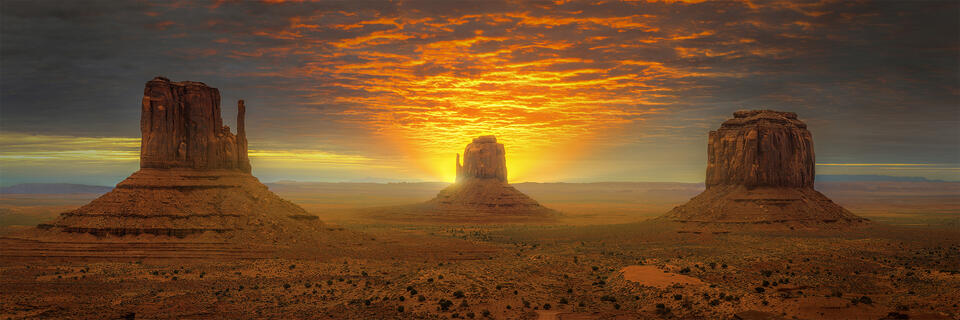
I’ll always remember the quiet of this morning, a stillness so complete it felt like the desert itself was taking a long, steady breath. The sky was heavy with clouds, and I expected nothing more than a muted dawn, but I waited with a few travelers who had become friends in the dark. Then, in an instant, the sun broke through, flooding the mesas with golden light and turning the valley into a living reminder that every day carries its own possibility. Sitting there in that glow, I felt the kind of renewal that nature gives so freely, the same sense of presence and hope I aim to share through my work. This image holds that moment, an invitation to embrace wonder whenever it rises.
View Available Prints of Emergence
Attention Restoration Theory, developed by Rachel and Stephen Kaplan, offers an explanation for why nature seems to reverse this. Natural settings tend to engage a softer mode of attention, what the Kaplans called soft fascination. A moving stream, drifting mist, the texture of moss across stone: these hold the mind effortlessly, without demanding the kind of focus that depletes us. While soft fascination is occupied, the directed-attention system is finally allowed to rest and recover. The theory identifies a handful of qualities that make a setting restorative, among them a sense of being away from ordinary demands, enough richness to feel genuinely immersed, and a fit between the place and what the mind is quietly looking for. A well-made landscape image can carry several of those qualities into a room.
Underneath the attention research sits something older. The biophilia hypothesis, associated with biologist Edward O. Wilson, proposes that humans carry an innate affinity for living systems and the landscapes our species evolved within. It helps explain why a beam of light reaching into a canyon or water pouring over a green wall registers as relief rather than as mere decoration. The response feels immediate because, in an evolutionary sense, it is.

Walking along the shoreline has always been a way for me to return to myself, and on this evening the sky transformed into a quiet cascade of color that stopped me in my tracks. I watched as light moved gently across the water, and this small fishing jetty became an invitation to step forward, toward the horizon and into present. Standing there, I felt how naturally the mind settles when given space to wander without urgency. This image is meant to offer that same experience, a quiet passage of light and water that invites you to pause, breathe, and reconnect with calm.
View Available Prints of Heaven's Door
The part that matters most for a photograph is this. The benefit does not depend on being outdoors. In a study published in 1984, environmental psychologist Roger Ulrich found that surgical patients whose hospital windows looked onto trees recovered faster and required less pain medication than otherwise similar patients whose windows faced a brick wall. A view did the work. Research that followed has repeatedly found that simulated and photographic representations of nature produce real, if generally smaller, reductions in physiological stress and improvements in attention and mood. The effect of an image tends to be more modest than the effect of standing in the place itself. But it is real, and it is repeatable.
Repeatability is the quiet argument for living with a photograph rather than merely visiting a landscape. The forest is hours away and the weather rarely cooperates. A considered image is on the wall every morning, offering the same point of return on the days you most need one and the days you forget to look for it.
This is the ground my work stands on. I am not claiming that a print will fix a hard week. I am saying that a representation of nature, made with these mechanisms in mind, can do measurable work for the nervous system of the person who lives with it, again and again, without being asked.
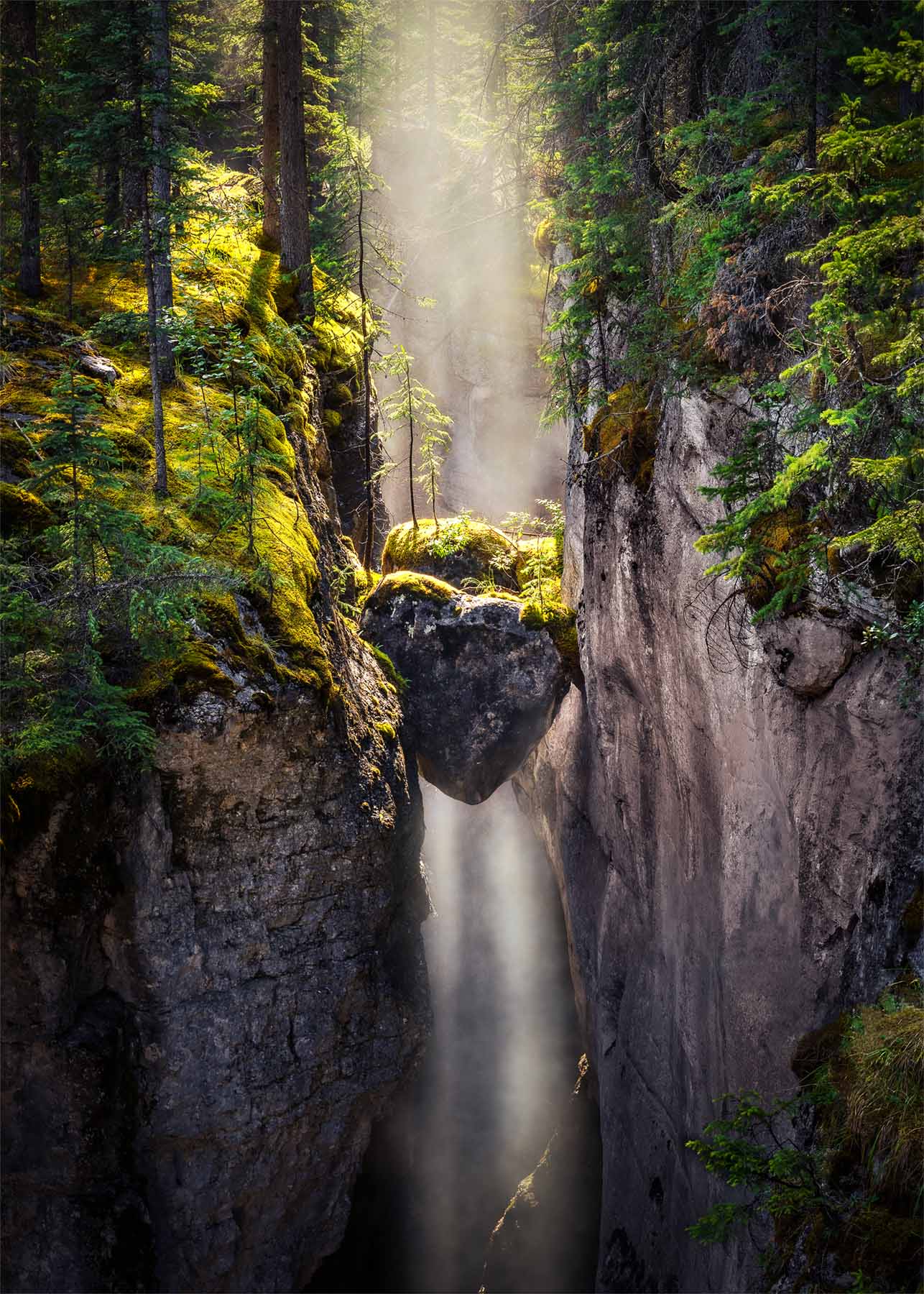
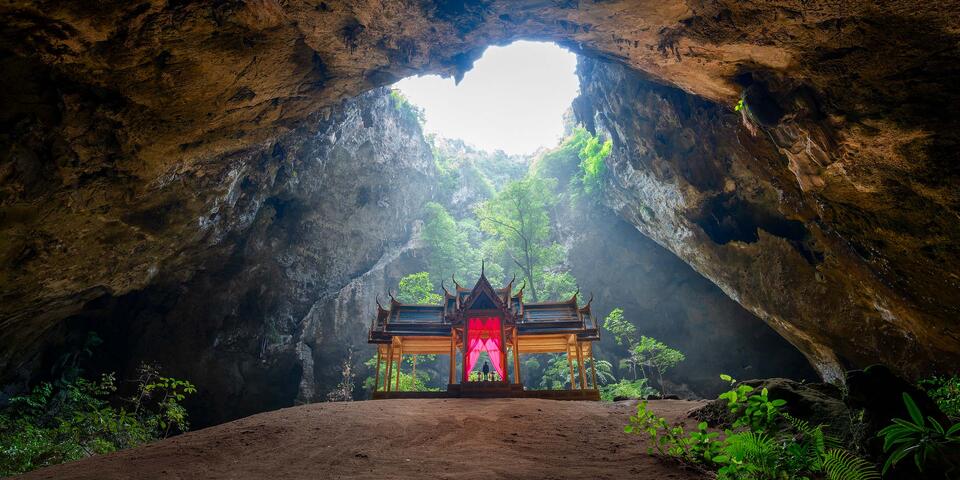
For a few fleeting mornings each July in Jasper, the sun would rise at the perfect angle, sending a single beam of light deep into this hidden canyon. I returned to this spot many times, waiting for the moment when the forest would awaken and the mist would rise like breath from the earth. Standing there, I felt the quiet power of nature reaching inward, offering the same calm and clarity I hope my work brings to others. Now lost to the wildfire of 2024, this scene lives on only in memory, a reminder of how precious and restorative these rare moments can be..
View Available Prints of Heart of the Forest
There is a second mechanism worth naming for an image like this one. Alongside the gentle restoration of attention, expansive landscapes can produce awe, the response to something vast enough that the mind has to reorganize itself to take it in. Research on awe suggests it tends to quiet self-focused rumination, slow the felt sense of time, and shift attention away from the narrow loop of personal concern. Scale, in other words, is not only an aesthetic decision. It is part of how a photograph does its work. A piece sized and composed to surround you is making room for a response that a small, contained image cannot.
What You Are Actually Acquiring
When you bring a work like this into your home, you are not buying a representation of a waterfall. You are acquiring a psychological environment, one that has been designed, with scientific understanding and artistic precision, to do something specific to the mind of the person who lives with it. To offer, on an ordinary Tuesday morning or a difficult evening, a reliable point of return. A place to rest attention that is not a screen, not a task, not another demand. Just the presence of something vast and patient and indifferent to your particular problems.
That is a different object than scenery. It requires a different kind of looking to make. It deserves a different kind of consideration to acquire.
The collectors who find their way to this work tend to know, before they can fully articulate it, that they are not looking for something to fill a wall. They are looking for something that changes how a room feels to be in. Something that earns its place in a life rather than simply occupying space in a home. If that is what you are looking for, we are having the right conversation.
See It in Your Own Space
If an image has stayed with you while reading, that is worth noticing. I offer complimentary digital mockups so you can see how a piece lives on your own wall, at the scale and in the light of the room you actually spend your mornings in, before you decide anything at all.
Request a complimentary mockup or explore the full collection when the time feels right. There is no hurry. In my experience, the piece that belongs in a space tends to make itself known.
A Few Questions, Answered
Can a photograph really do what being in nature does?
Not to the same degree, and I would be cautious of anyone who claimed otherwise. The research is consistent that representations of nature, photographs included, produce real reductions in stress and real gains in attention, generally smaller than the effect of standing in the place itself. What a print offers that a forest cannot is repeatability. It is present every day, in the room where you already live, on the mornings you need it and the ones you forget to look for it.
What does "limited edition" mean for these works?
Each image is released in a finite, numbered edition and is never reprinted beyond it. [Steve, insert your specific edition size and any format tiers here, or point readers to the individual piece pages where those details live.] Once an edition closes, the work is retired. That is part of why these are acquired rather than simply purchased.
How do I choose the right size?
Scale is not only a question of wall space. As described above, an expansive piece is part of how the image does its psychological work, so the larger choice is often the more restorative one rather than merely the grander one. The simplest way to decide is to see it. A complimentary digital mockup shows the work at true scale on your own wall before you commit to anything.
How does the complimentary mockup work?
Send a photograph of the wall you have in mind along with rough dimensions, and you will receive a visualization of the piece in that space at accurate scale. [Steve, adjust this to match your actual process and turnaround.] There is no obligation attached. It exists so the decision is made with your eyes rather than your imagination.
Featured Fine Art Prints for You are not Buying Scenery
Steve Austin is a psychology professor, behavioral neuroscientist, and fine art landscape photographer. His limited edition landscape prints are available through Steve Austin Fine Art Photography at steveaustin.art. Complimentary digital mockups are available for those who would like to visualize a piece within their own space.