Where Attention Opens: The Psychology of Awe, Scale, and the Landscapes That Make Us Small
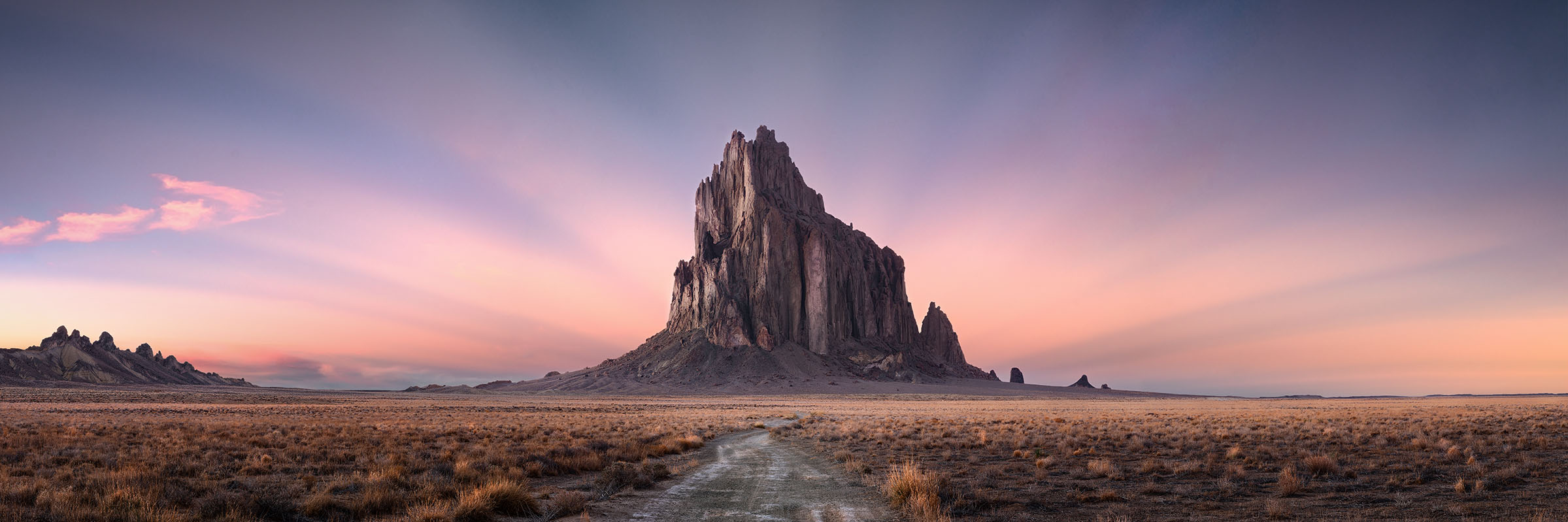
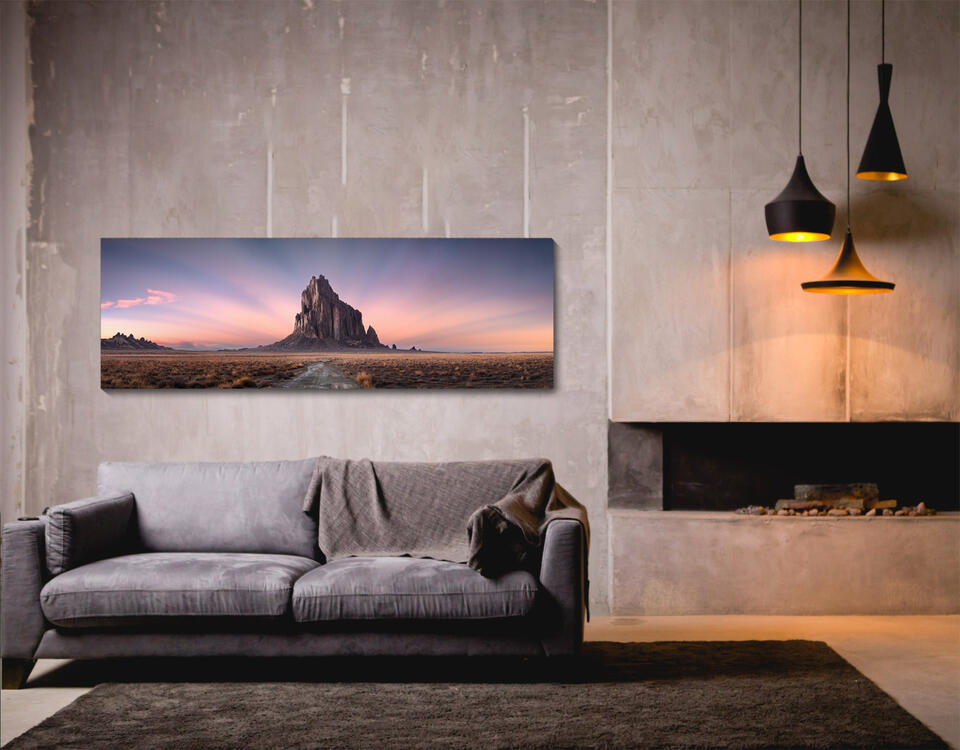
Magnificent light rays spread over Shiprock New Mexico casting a magnificent sight and a sense of awe.
Ascension

View Available Prints of Into the Ascension


There is a particular kind of quiet that arrives before any thought does. You come around a bend, or you crest a rise, or the light shifts, and the thing in front of you is simply too large for the mind to file away. For a moment you do not reach for words. You do not reach for your phone. You stand there, and the running commentary that fills most of your waking hours goes still.

I felt it the evening I made this photograph. The monolith rose from the New Mexico desert with a presence far more powerful than I had imagined, as though the land itself had pushed it upward through time. As the sun dropped low, soft pink light radiated from behind the stone and the whole scene tipped into something close to otherworldly. It stopped me where I stood. In that stillness the past felt near, ancient, and steadying, and my own concerns felt suddenly very small in a way that was not diminishing but freeing.

Psychologists have a name for that experience. They call it awe, and it is one of the most powerful and least appreciated emotions we are capable of feeling. It is also, I have come to believe, one of the two essential things a great landscape can do for a tired mind.

In an earlier essay I wrote about the first of those two things, the way an image can take your attention by the hand and lead it somewhere, down a path, along a river, into the depth of a frame, giving the eye a quiet journey to follow. This essay is about the second thing, which is almost the opposite move. Not the eye being led inward, but the mind being opened outward. Not direction, but expansion.

ARTIST’S STORY Most people photograph waterfalls from a distance. They find the angle that captures the full drop, the elegant cascade, the postcard version of power made beautiful and safe. I understand that instinct. But it was never the view that interested me most. This was taken from a boat at the base of Stirling Falls in Milford Sound, New Zealand, one of the most dramatically alive places on earth. Milford Sound is known for its waterfalls, sheer cliffs, and the kind of scale that makes you reconsider your assumptions about your own size. What makes Stirling Falls unusual is what the boats do there. They do not stop at a respectful distance. They drive directly into it. When the bow pushed under the fall, the sound became total. Mist filled everything. The camera was soaked within seconds. And at the center of the chaos was that column of white light descending through the spray, blazing against the dark canyon walls on either side, looking less like water and more like something that had traveled a long way to arrive at this exact point. We talk about stress as noise, as the accumulation of demands and interruptions that crowd the mind until there is no room left for clear thought or genuine rest. What I have found, both in the research and in my own experience behind the lens, is that certain encounters with nature do not reduce the noise gradually. They replace it entirely. They overwhelm the system so completely that something in you simply stops fighting and lets go. That is what Stirling Falls does. It does not ask you to relax. It does not offer gentle suggestion. It simply arrives with such totality that resistance becomes irrelevant. Beneath the Roar is not a quiet image. But it leads somewhere quiet. Sometimes the path to stillness runs directly through the thing that undoes you. Limited Fine Art Edition Each image is released in limited editions, with edition size set by presentation and scale, so the most substantial works remain the most rare.
Beneath the Roar

View Available Prints of Beneath the Roar


What Awe Actually Is

For most of the history of psychology, awe was treated as too rare and too slippery to study. That has changed. Over the last two decades, researchers led by Dacher Keltner at Berkeley and Jonathan Haidt have built a working definition that is surprisingly precise. Awe, they propose, has two core ingredients. The first is perceived vastness, something that exceeds your ordinary frame of reference, whether in physical size, in age, in complexity, or in meaning. The second is a need for accommodation, the sense that what you are seeing does not fit your existing mental categories, so your mind has to stretch and reorganize itself to take it in.

That second ingredient is the one most people miss, and it is the one that does the restorative work. When the mind has to expand to accommodate something larger than itself, a quiet but measurable shift happens. The sense of the self gets smaller. Researchers call it the small self, and far from being unpleasant, it tends to feel like relief. The endless internal negotiation that drives so much of our daily stress, the planning, the comparing, the rehearsing of conversations that have not happened yet, briefly loses its grip. You are returned to a larger context, and your problems are returned to their actual size.

This is not poetry. It is observable. Experiences of awe have been linked to reduced inflammation, lower stress, greater generosity, a more accurate sense of time, and a measurable drop in self-focused rumination. The natural world is the most reliable source of it we have ever found.
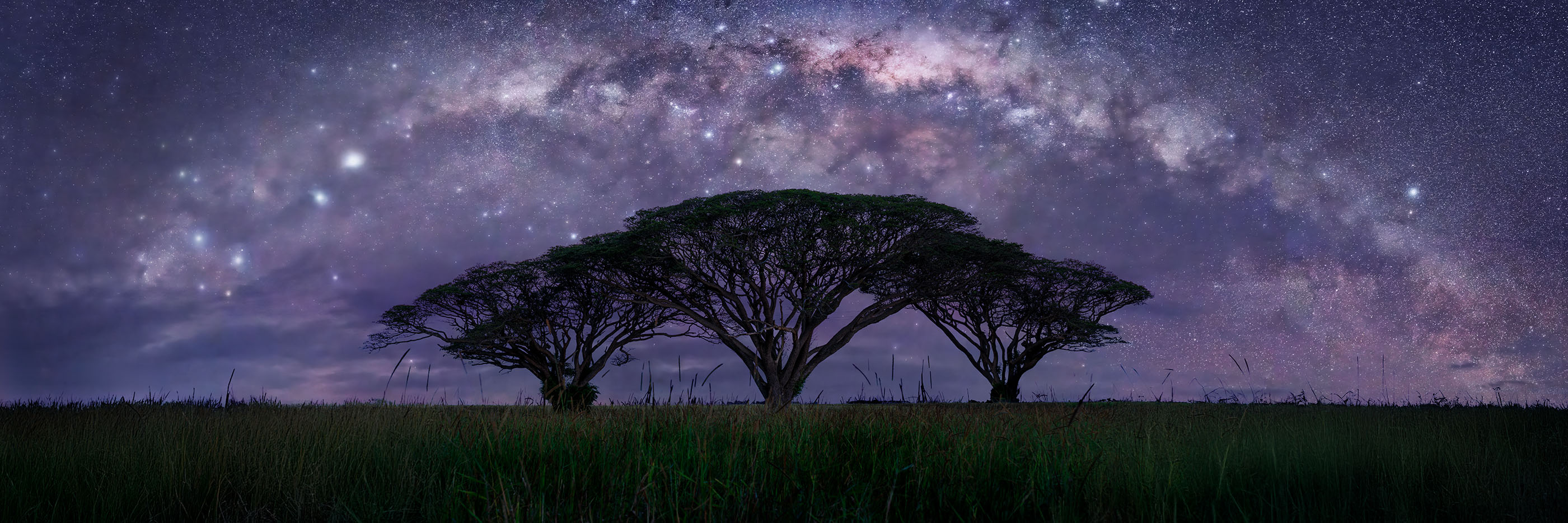
Panoramic night landscape showing three silhouetted trees in an open field, perfectly aligned beneath a glowing Milky Way arching across a star filled sky in Ro
Arc of the Infinite

View Available Prints of Arc of the Infinite


Two Ways a Landscape Restores You

My work has always been grounded in the science of how nature restores the human mind, and there are two distinct mechanisms at play. The first is the one I described in the companion essay, the gentle, effortless engagement that the Kaplans called soft fascination, where the eye is drawn along and attention is quietly replenished. That is restoration through ease.

Awe is restoration through expansion. It works not by soothing attention but by overwhelming it in the right proportion, by presenting the mind with something so large or so beautiful that it has no choice but to open. Both are forms of recovery. Both quiet the noise. But they feel different, and they live in different images. A still forest path restores you by letting your attention rest. A vast desert monolith at last light restores you by reminding you how small the things that exhaust you really are.

The best landscape collection holds both. This essay, and the five images in it, are about the second kind.

Why Scale Is Not a Detail

Here is where awe and the physical scale of a work become inseparable, and where a photograph stops being a picture and starts being an environment.

The research on nature imagery and psychological restoration consistently shows that larger representations of natural scenes produce stronger effects. The reason is rooted in how vision works. A small image is processed by central, focused vision, the same effortful attention you use to read this sentence. A large image, one that fills enough of your visual field, begins to engage peripheral vision as well, and peripheral vision is the channel through which immersion and the felt sense of presence arrive. At sufficient scale, you are no longer looking at a landscape. You are, in a quiet but real way, standing inside one.

This is why awe cannot be delivered at postcard size. An image that depicts vastness needs to be presented with enough scale that the vastness can actually reach you. The two have to match. It is also why I release each image across a range of presentations and sizes rather than a single format, so the scale of the work can be chosen to fit the scale of the space and the response you want the room to have. An awe image asked to live small is an argument the room never quite wins.

The four images that follow each carry a different flavor of awe, and each one earns its scale.

The Expanse
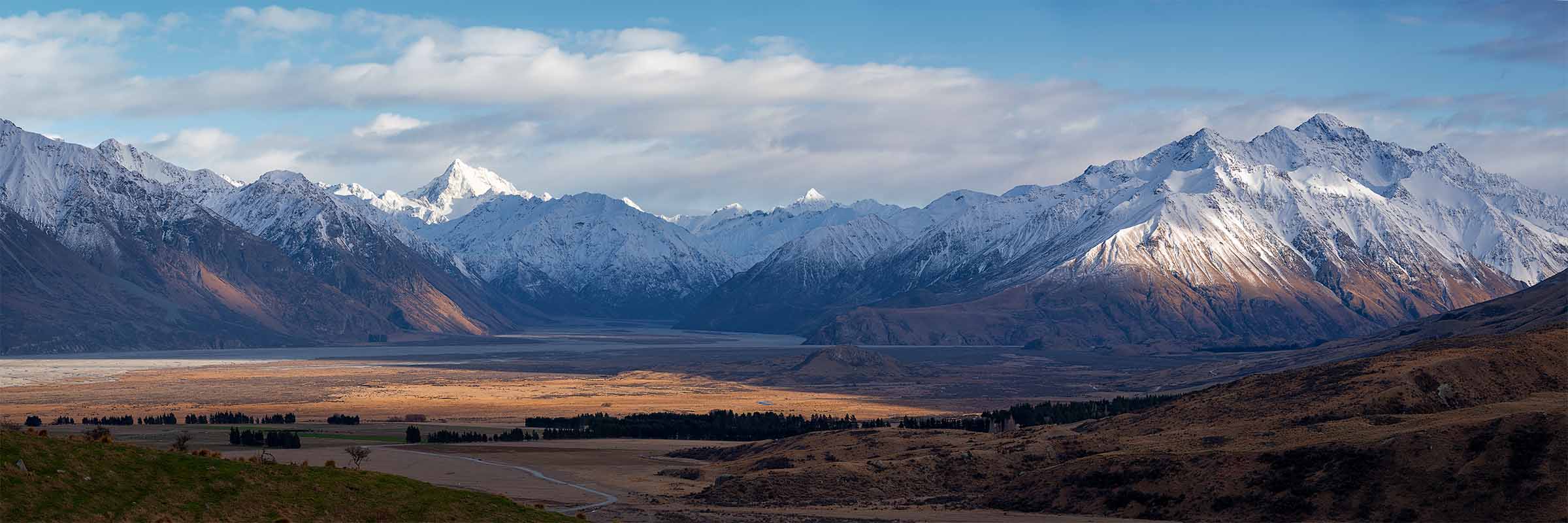
ARTIST’S STORY There are places on this earth that do not feel entirely of it. The Rangitata Valley in New Zealand's South Island is one of them. Standing on the ridge above this scene in the cold still air of a winter morning, the Southern Alps filling the entire horizon with their snow covered peaks, the golden tussock plains stretching away below, the glacial river threading quietly through the middle distance, I understood immediately why Peter Jackson came here to film another world. He did not have to imagine it. He simply had to show up. Winter in this part of New Zealand strips everything back to its essentials. The tussock grasses hold their amber warmth against the cold blue white of the mountains, and the light, low and directional in the winter sky, carves shadows into the peaks with a precision that no other season can match. The result is a landscape that feels simultaneously ancient and immediate, as if you are witnessing something that has looked exactly this way for ten thousand years and will look exactly this way for ten thousand more. There is a particular psychological gift that landscapes of this scale offer. They do not invite comparison. They do not ask how your day is going or what you have accomplished or where you need to be next. They simply exist, massively and indifferently and beautifully, in a way that makes the nervous system release things it has been holding without realizing it. Researchers call this involuntary attention, the effortless absorption that vast natural scenes produce when the mind finally stops managing itself and simply looks. I stood on that ridge for a long time before I raised the camera. Some places deserve that courtesy. Middle Earth is not an escape from the world. It is a reminder of what the world actually is, when you find the right ridge to stand on and give it your full attention. Limited Fine Art Edition Each image is released in limited editions, with edition size set by presentation and scale, so the most substantial works remain the most rare.
Middle Earth

View Available Prints of Middle Earth


If Shiprock concentrates awe into a single vertical form, this image spreads it across the entire horizon. I made it from a ridge above the Rangitata Valley on a cold, still winter morning, the Southern Alps filling the whole skyline with their snow-covered peaks, the golden tussock plains stretching away below, a glacial river threading quietly through the middle distance. Standing there, I understood immediately why this landscape has stood in for other worlds on film. No one had to imagine it. They only had to show up.

This is the breadth register of awe, the kind that comes not from one towering object but from sheer extent, from a space so wide the eye cannot hold all of it at once. It is the visual equivalent of a long, slow exhale, and it is one of the most direct invitations to the small self that I have ever stood inside.

The Small Self
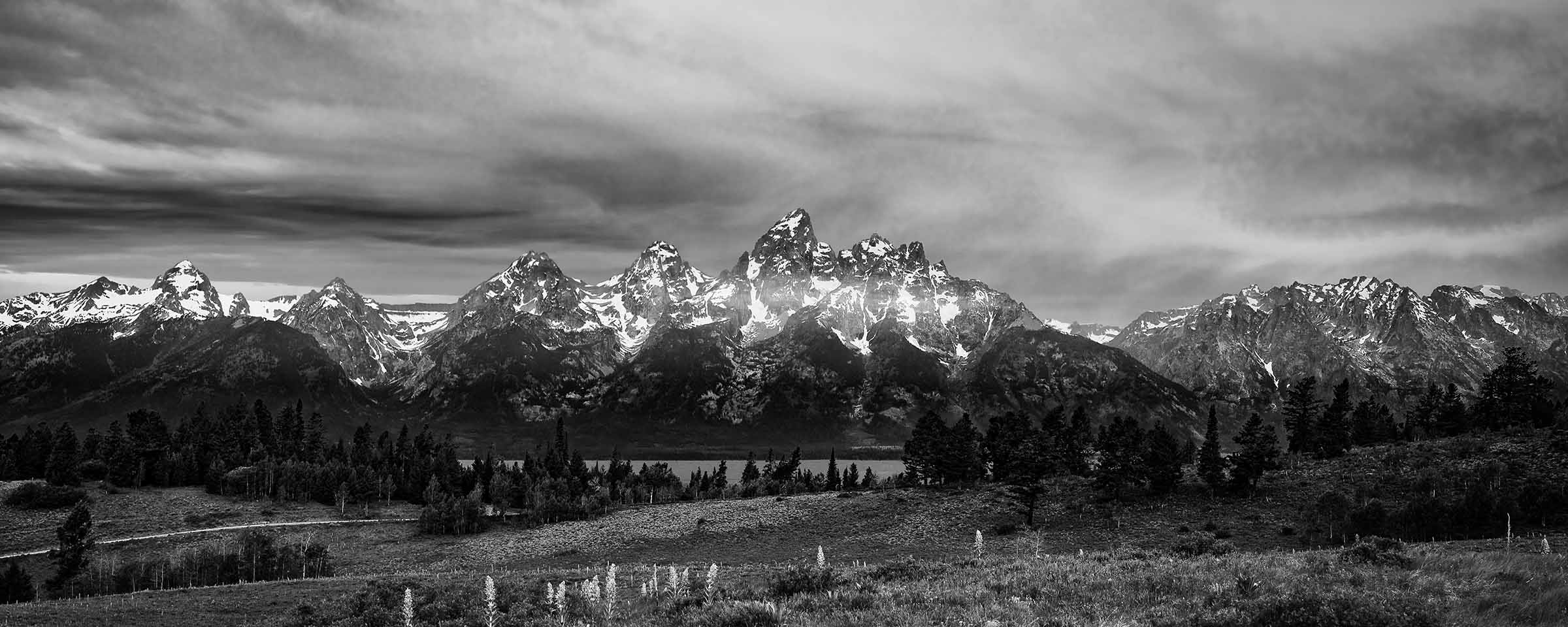
Black and white panoramic view of the Teton Range in Wyoming, with jagged mountain peaks rising above a quiet valley and scattered trees beneath a dramatic sky
Unspoken

View Available Prints of Unspoken


The Tetons rise without introduction. They command a frame through scale, silence, and permanence, and standing before them I felt small in a way that was grounding rather than reducing, as if the mountains were carrying time so that I did not have to. I made this one in black and white deliberately. Stripped of color, the scene comes down to its essentials, sky, stone, and land, with nothing left to distract from the sheer fact of the range. The eye travels the ridgeline and then outward, pulled into a vastness that asks nothing and explains nothing.

This is the small self made visible. In moments like this, nature does not speak to be understood. It simply stands, and in its presence the mind quiets, perspective returns, and the weight of the day is set down for a while. It is the clearest illustration in my collection of what the researchers mean when they talk about awe restoring us by making us, for a moment, gloriously minor.

The Vastness Overhead

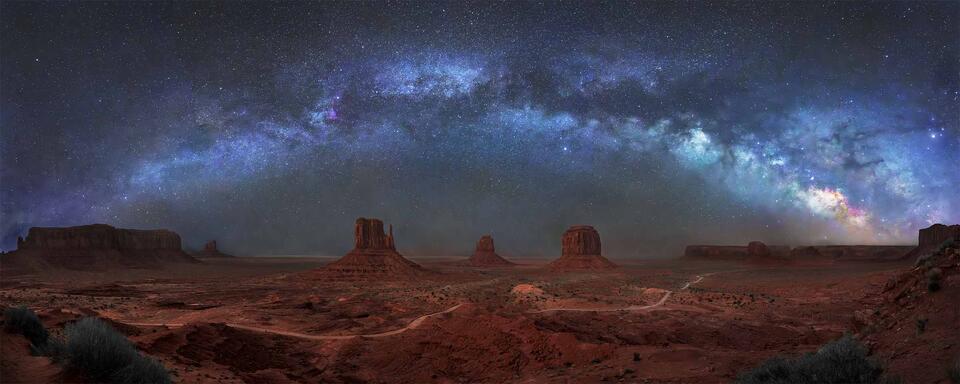
A sweeping panoramic view of Monument Valley, Navajo Nation, beneath a complete arch of the Milky Way galaxy stretching from horizon to horizon.
Mother Earth, Father Sky

View Available Prints of Mother Earth, Father Sky


There is a reason nearly every culture has located its sense of the sacred in the night sky. The cosmos is the original source of awe, the vastness against which everything else is measured. I set up before midnight in Monument Valley and waited as the Milky Way revealed itself, slowly, the way it always does, light that had traveled billions of years arriving over this particular stretch of ancient desert on this particular night. Below it, the buttes rose like children standing in the presence of something immeasurably larger than themselves.

This image opens the post up to its widest scale, the literal vastness of the universe overhead. It also breaks the daylight palette of the others, and that contrast matters. Awe is heightened by variety, by the sense that wonder takes many forms. A reader who has moved through desert, alpine valley, and mountain range arrives here and finds the ceiling lifted entirely.

The Power That Steadies
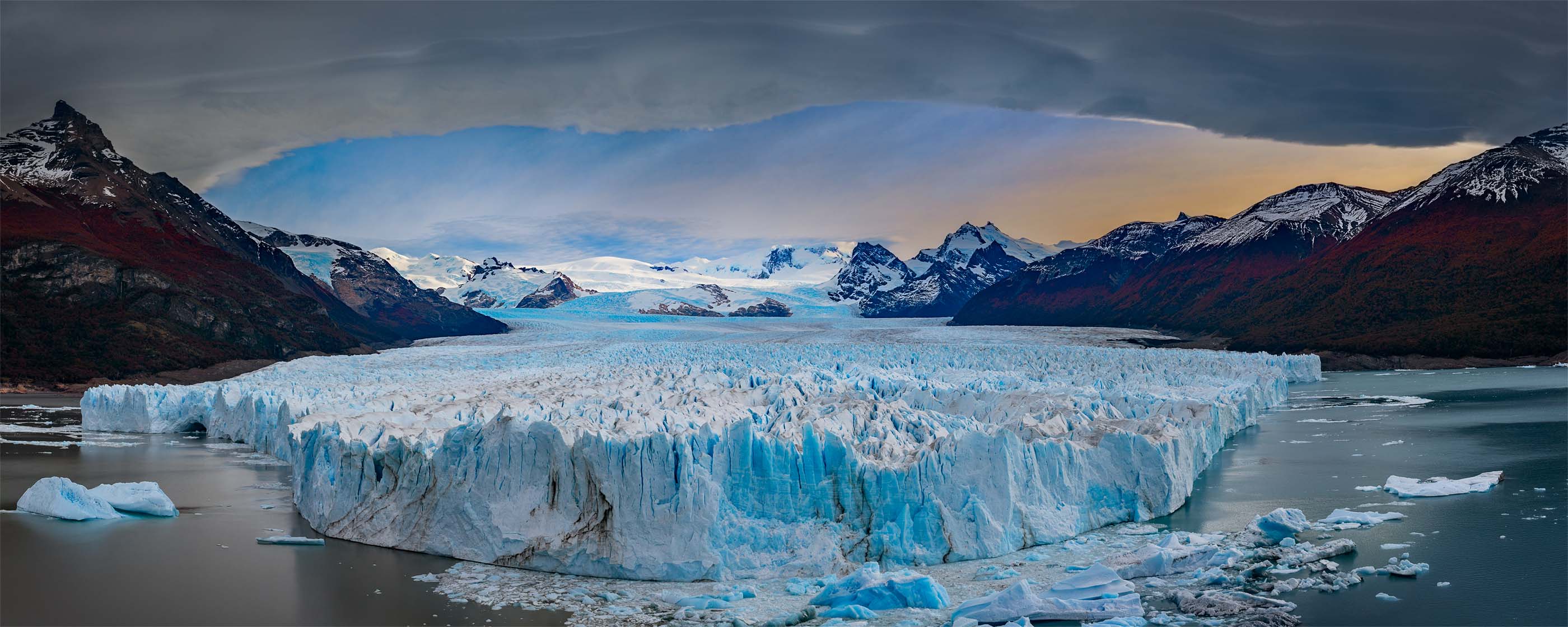
A vast glacier stretches across a calm lake as mountains frame the scene and clouds part above, creating the feeling of the sky opening over the ice.
Unveiled Heaven

View Available Prints of Unveiled Heaven


Scale is not only size. It is also force, and there is a flavor of awe that comes from standing before something elemental and undeniable. I made this photograph before an immense wall of ice as the sky opened and light poured through in soft beams, turning the glacier into something luminous and almost otherworldly. What had begun as quiet observation became deeply grounding, as if the earth were inviting me to pause and witness its power.

As a psychologist, I have watched stress narrow the mind, pulling it tighter and tighter around its worries. Awe does the reverse. The scale of this landscape softened my thoughts and expanded my view, and the daily concerns that had seemed so large were returned to their place. This is clarity arriving through wonder rather than through effort, and it is the note I want to close on, because it is the whole purpose of the work.

Not Decoration. A Designed Environment.

Most of what fills our walls is chosen quickly and noticed rarely. The images in this collection ask for something different. They are not made to match a sofa or to fill a blank space. They are made to do something to the people who live with them, to open the mind a little wider, to quiet the noise, and to return a sense of proportion to a life that too easily loses it.

That is why scale matters, why the editions exist, and why I think carefully about how each image is presented rather than simply printed. An image built to produce awe is an environmental intervention, not an ornament. Given the room it needs, it will keep doing its quiet work for as long as you live with it.
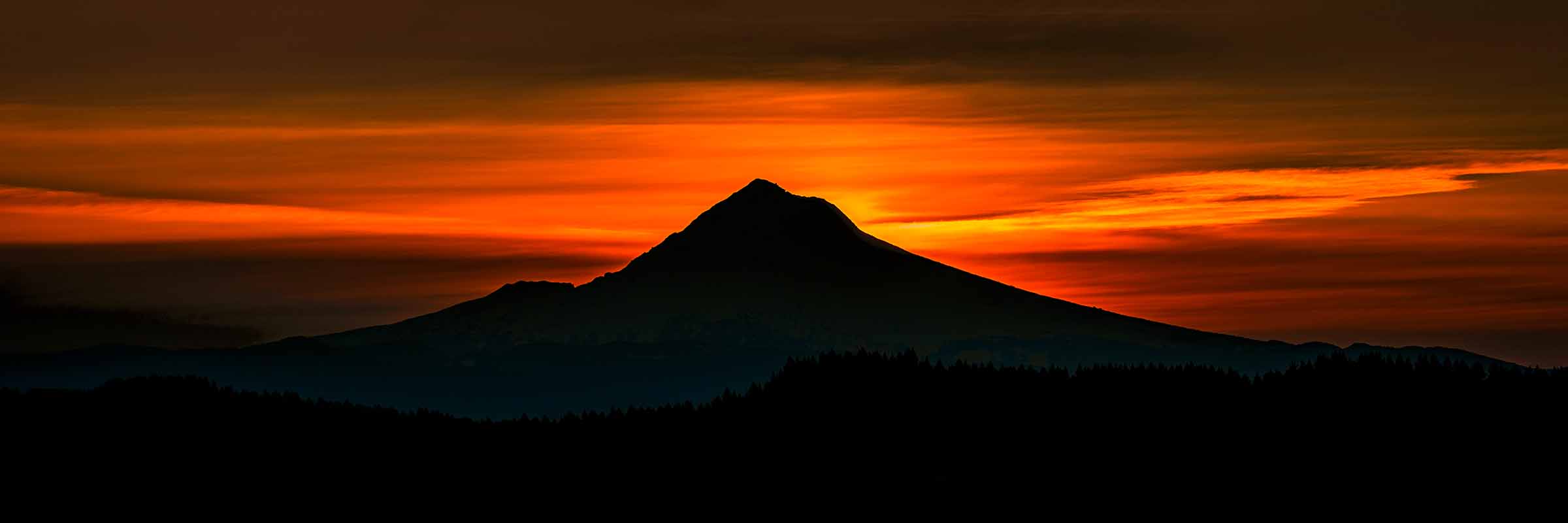
ARTIST’S STORY Mount Hood does not make promises. I spent an entire summer with a clear view of it from a friend's house, watching it every morning and every evening, learning its moods and its habits. Most days it was shrouded in cloud, its summit hidden behind grey that arrived before dawn and stayed well past dark. On the clearer days it rose against a featureless blue sky, beautiful in the way that familiar things are beautiful, present and real but not fully revealing itself. A mountain holding something back. That is the complicated relationship Hood has with those who love it. You can see it every day for weeks and still feel as if you have not quite seen it. As if the mountain is deciding, on its own terms and its own schedule, what it is willing to show you and when. And then one evening, without announcement or particular warning, the sky behind it caught fire. I watched it happen from the same place I had been watching every day all summer. The sun descended behind the horizon and the sky responded with a depth and intensity of color that I had not seen all season, deep crimson and burning orange spreading from horizon to horizon in horizontal bands that seemed to pulse with their own light. And against all of that, Mount Hood stood in complete and perfect darkness. Not diminished by the shadow but defined by it. Its geometry suddenly precise and absolute, the perfect triangle of its summit cutting into that burning sky with an authority that weeks of cloudy indifference had only sharpened. There is something profound about the relationship between shadow and light that this image understands completely. The mountain does not need to be illuminated to be present. Its darkness against that blazing sky is its own kind of statement, a reminder that sometimes the most powerful presence in a scene is the one that holds its form quietly while everything around it burns. I had watched that mountain every day for months. It waited until it was ready to show me this. Hood in Shadow is for anyone who has been patient with something that has not yet revealed its full beauty. Keep watching. The sky will eventually do what it did that evening. And when it does, you will understand that every ordinary day that came before it was simply the mountain deciding you were ready. Limited Fine Art Edition Each image is released in limited editions, with edition size set by presentation and scale, so the most substantial works remain the most rare.
Hood in Shadow

View Available Prints of Hood in Shadow


If one of these images has stopped you the way the desert stopped me, I would invite you to spend some time with the full collection and to consider not only which image speaks to you but what scale would let it speak most clearly in your space. That conversation, about the work, the space, and the response you want the room to have, is always welcome. 


Featured Fine Art Prints for Where Attention Opens

Magnificent light rays spread over Shiprock New Mexico casting a magnificent sight and a sense of awe.
Ascension
ARTIST’S STORY Most people photograph waterfalls from a distance. They find the angle that captures the full drop, the elegant cascade, the postcard version of power made beautiful and safe. I understand that instinct. But it was never the view that interested me most. This was taken from a boat at the base of Stirling Falls in Milford Sound, New Zealand, one of the most dramatically alive places on earth. Milford Sound is known for its waterfalls, sheer cliffs, and the kind of scale that makes you reconsider your assumptions about your own size. What makes Stirling Falls unusual is what the boats do there. They do not stop at a respectful distance. They drive directly into it. When the bow pushed under the fall, the sound became total. Mist filled everything. The camera was soaked within seconds. And at the center of the chaos was that column of white light descending through the spray, blazing against the dark canyon walls on either side, looking less like water and more like something that had traveled a long way to arrive at this exact point. We talk about stress as noise, as the accumulation of demands and interruptions that crowd the mind until there is no room left for clear thought or genuine rest. What I have found, both in the research and in my own experience behind the lens, is that certain encounters with nature do not reduce the noise gradually. They replace it entirely. They overwhelm the system so completely that something in you simply stops fighting and lets go. That is what Stirling Falls does. It does not ask you to relax. It does not offer gentle suggestion. It simply arrives with such totality that resistance becomes irrelevant. Beneath the Roar is not a quiet image. But it leads somewhere quiet. Sometimes the path to stillness runs directly through the thing that undoes you. Limited Fine Art Edition Each image is released in limited editions, with edition size set by presentation and scale, so the most substantial works remain the most rare.
Beneath the Roar
Panoramic night landscape showing three silhouetted trees in an open field, perfectly aligned beneath a glowing Milky Way arching across a star filled sky in Ro
Arc of the Infinite

ARTIST’S STORY There are places on this earth that do not feel entirely of it. The Rangitata Valley in New Zealand's South Island is one of them. Standing on the ridge above this scene in the cold still air of a winter morning, the Southern Alps filling the entire horizon with their snow covered peaks, the golden tussock plains stretching away below, the glacial river threading quietly through the middle distance, I understood immediately why Peter Jackson came here to film another world. He did not have to imagine it. He simply had to show up. Winter in this part of New Zealand strips everything back to its essentials. The tussock grasses hold their amber warmth against the cold blue white of the mountains, and the light, low and directional in the winter sky, carves shadows into the peaks with a precision that no other season can match. The result is a landscape that feels simultaneously ancient and immediate, as if you are witnessing something that has looked exactly this way for ten thousand years and will look exactly this way for ten thousand more. There is a particular psychological gift that landscapes of this scale offer. They do not invite comparison. They do not ask how your day is going or what you have accomplished or where you need to be next. They simply exist, massively and indifferently and beautifully, in a way that makes the nervous system release things it has been holding without realizing it. Researchers call this involuntary attention, the effortless absorption that vast natural scenes produce when the mind finally stops managing itself and simply looks. I stood on that ridge for a long time before I raised the camera. Some places deserve that courtesy. Middle Earth is not an escape from the world. It is a reminder of what the world actually is, when you find the right ridge to stand on and give it your full attention. Limited Fine Art Edition Each image is released in limited editions, with edition size set by presentation and scale, so the most substantial works remain the most rare.
Middle Earth
Black and white panoramic view of the Teton Range in Wyoming, with jagged mountain peaks rising above a quiet valley and scattered trees beneath a dramatic sky
Unspoken
A sweeping panoramic view of Monument Valley, Navajo Nation, beneath a complete arch of the Milky Way galaxy stretching from horizon to horizon.
Mother Earth, Father Sky
A vast glacier stretches across a calm lake as mountains frame the scene and clouds part above, creating the feeling of the sky opening over the ice.
Unveiled Heaven

ARTIST’S STORY Mount Hood does not make promises. I spent an entire summer with a clear view of it from a friend's house, watching it every morning and every evening, learning its moods and its habits. Most days it was shrouded in cloud, its summit hidden behind grey that arrived before dawn and stayed well past dark. On the clearer days it rose against a featureless blue sky, beautiful in the way that familiar things are beautiful, present and real but not fully revealing itself. A mountain holding something back. That is the complicated relationship Hood has with those who love it. You can see it every day for weeks and still feel as if you have not quite seen it. As if the mountain is deciding, on its own terms and its own schedule, what it is willing to show you and when. And then one evening, without announcement or particular warning, the sky behind it caught fire. I watched it happen from the same place I had been watching every day all summer. The sun descended behind the horizon and the sky responded with a depth and intensity of color that I had not seen all season, deep crimson and burning orange spreading from horizon to horizon in horizontal bands that seemed to pulse with their own light. And against all of that, Mount Hood stood in complete and perfect darkness. Not diminished by the shadow but defined by it. Its geometry suddenly precise and absolute, the perfect triangle of its summit cutting into that burning sky with an authority that weeks of cloudy indifference had only sharpened. There is something profound about the relationship between shadow and light that this image understands completely. The mountain does not need to be illuminated to be present. Its darkness against that blazing sky is its own kind of statement, a reminder that sometimes the most powerful presence in a scene is the one that holds its form quietly while everything around it burns. I had watched that mountain every day for months. It waited until it was ready to show me this. Hood in Shadow is for anyone who has been patient with something that has not yet revealed its full beauty. Keep watching. The sky will eventually do what it did that evening. And when it does, you will understand that every ordinary day that came before it was simply the mountain deciding you were ready. Limited Fine Art Edition Each image is released in limited editions, with edition size set by presentation and scale, so the most substantial works remain the most rare.
Hood in Shadow

Common Questions About Awe and Scale

What is awe, in the psychological sense?

Awe is the feeling that arrives when we encounter something vast enough that the mind has to stretch to take it in, vast in size, in age, or in meaning. Researchers connect it to a smaller, quieter sense of self, less rumination, and a restored sense of proportion, which is much of why time in nature leaves us feeling steadied. It is one of the most reliably restorative experiences we have access to, and it is the reason these images are made the way they are

Does the size of a print really change how it affects you?

Yes, and more than most people expect. A small image is read by focused, central vision, the same effortful attention you use to read a page, while a large one begins to engage peripheral vision, the channel through which immersion and a felt sense of presence arrive. At sufficient scale you are no longer looking at a landscape so much as standing inside one, which is why an image meant to produce awe needs room to do its work

How do I choose the right scale for my space?

Begin with the response you want the room to have rather than with the dimensions of the wall. A piece meant to anchor a space and shift its whole feeling asks for more scale than one meant as a quiet accent, and the viewing distance matters as much as the wall size. I release each image across a range of presentations and sizes for exactly this reason, and I am always glad to help match a particular piece and its scale to a particular room. 

What makes these different from ordinary landscape prints?

They are made as designed environments rather than as decoration. Each image is chosen and presented with its psychological effect in mind, grounded in research on awe, attention, and the way nature quiets the mind, so that living with the work does something for you over time rather than simply filling a space. That intention, more than any single subject or location, is what the collection is built around.


Steve Austin is a psychology professor and behavioral neuroscientist whose research focuses on stress regulation, attention restoration, and the psychological effects of nature exposure. His photography is the applied expression of that research, landscape images designed not to decorate spaces but to change how it feels to be in them.

Join the newsletter for first access to new work and limited releases, along with essays on the psychology of nature and well-being and the occasional story from behind the image.