
2_5 Template
2_5 Template
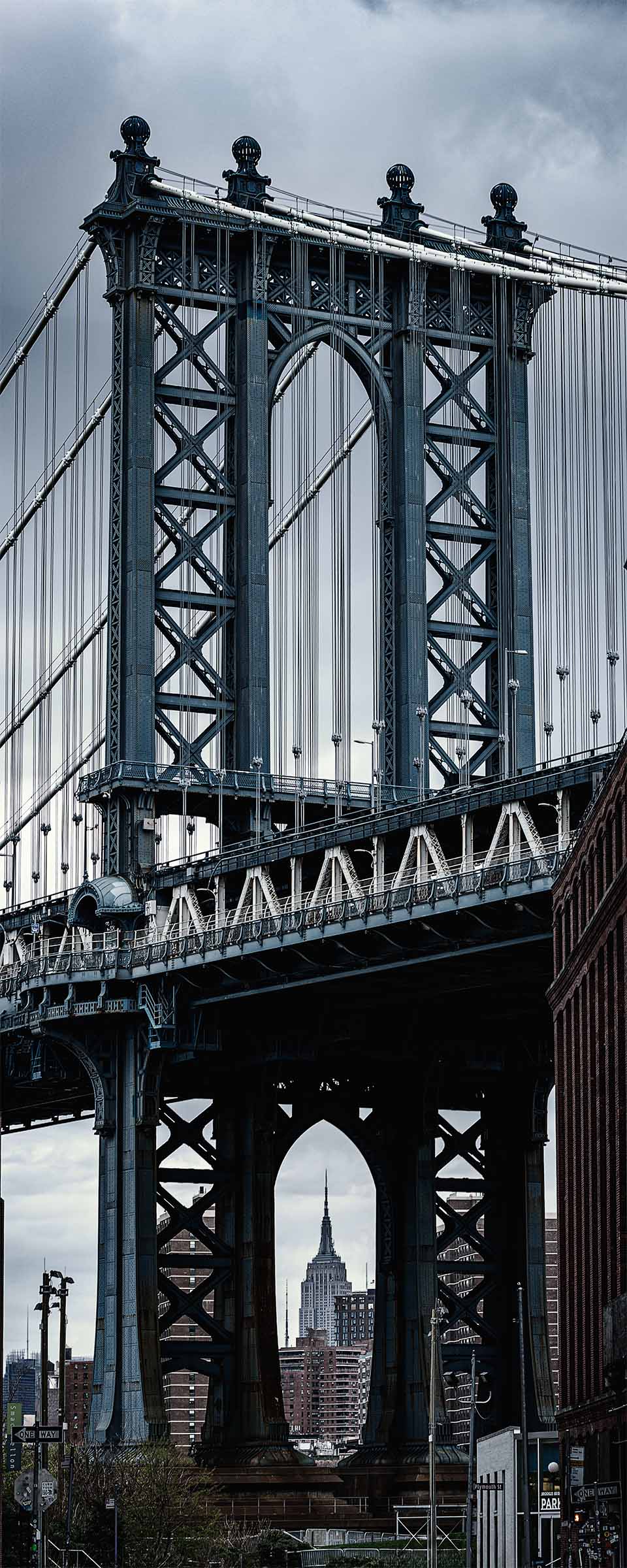
A 2:5 photograph of the Manhattan Bridge tower with the Empire State Building framed in its arch, DUMBO, Brooklyn, New York, available as a limited edition print in three sizes.
Artist's Story
I went to the corner of Washington and Plymouth on an early summer afternoon to take the famous photograph, having never been there before. Everyone who goes goes for the same thing: the Empire State Building appears inside the arch of the bridge tower, and it only does that from a few feet of pavement.
Nobody arranged it.
The Manhattan Bridge opened in 1909. The Empire State Building was finished in 1931, twenty-two years later, by a different set of people who had no interest in what a bridge tower in Brooklyn happened to frame. The street grid down there was laid out before either of them existed. Three unconnected decisions, made decades apart by people who never consulted one another, and the result is one of the most photographed sightlines in New York.
So the thing everybody queues for is an accident that nobody can take credit for, and one that could be closed tomorrow by a single building going up in the wrong place.
Alignment is a coincidence that has held for ninety-five years, photographed from the several feet of pavement where it works.
About This Photograph
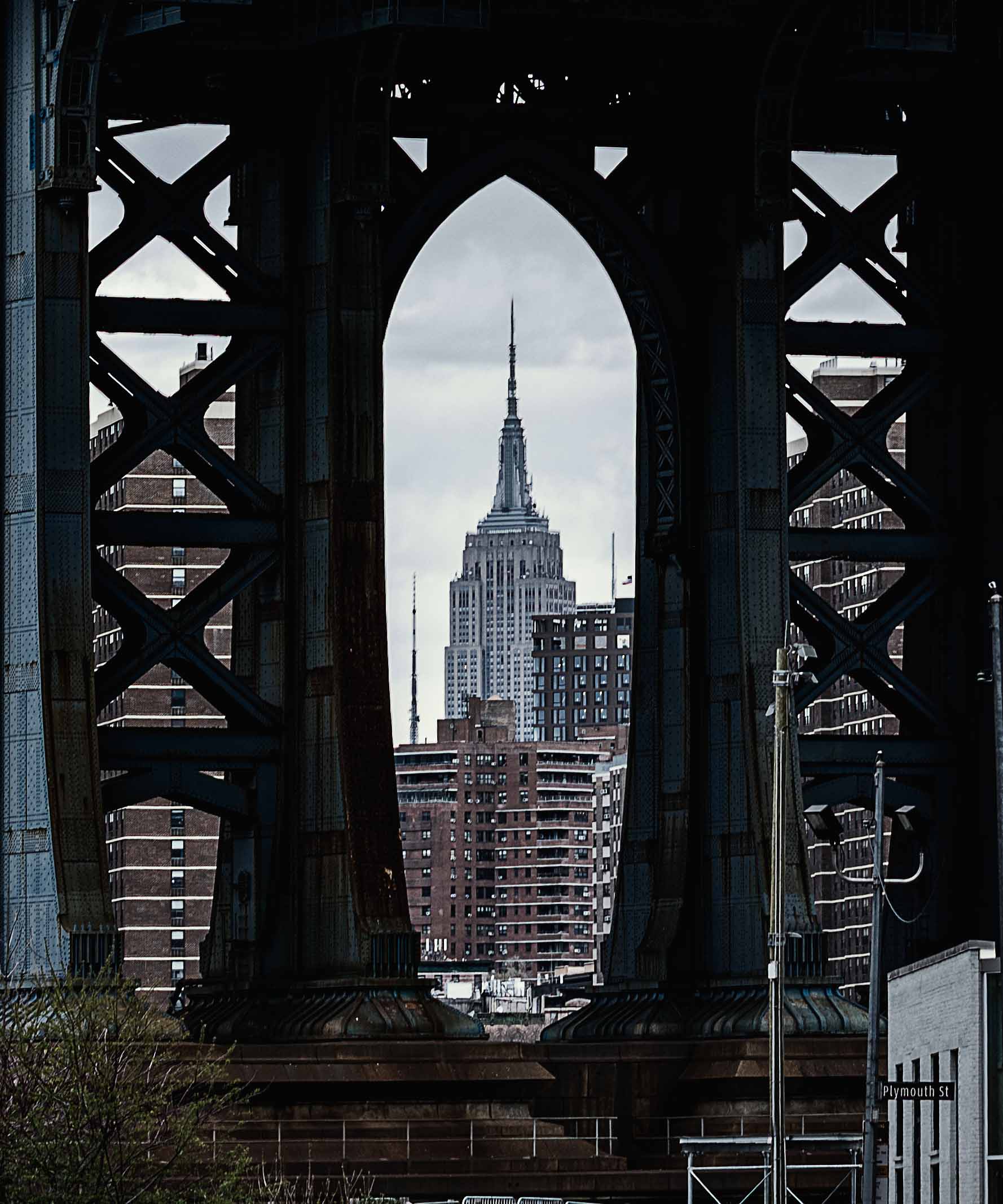
The Brooklyn tower of the Manhattan Bridge, photographed from the corner of Washington and Plymouth Streets in DUMBO on a summer afternoon, with the Empire State Building framed in the arch beneath the deck. Single frame. The bridge opened in 1909 and runs 6,855 feet.
It was the first major suspension bridge designed using deflection theory, which allowed a lighter and shallower stiffening truss than anything before it. Its designer, Leon Moisseiff, also ran the subway and streetcar tracks along the outer edges of the deck instead of down the middle. When two loaded trains entered from opposite directions the roadway dipped four feet on each side, eight feet of total displacement, and the bridge needed reconstruction for most of a century. Moisseiff applied the same theory to the Tacoma Narrows Bridge, which collapsed in 1940.
What it Does in a Room
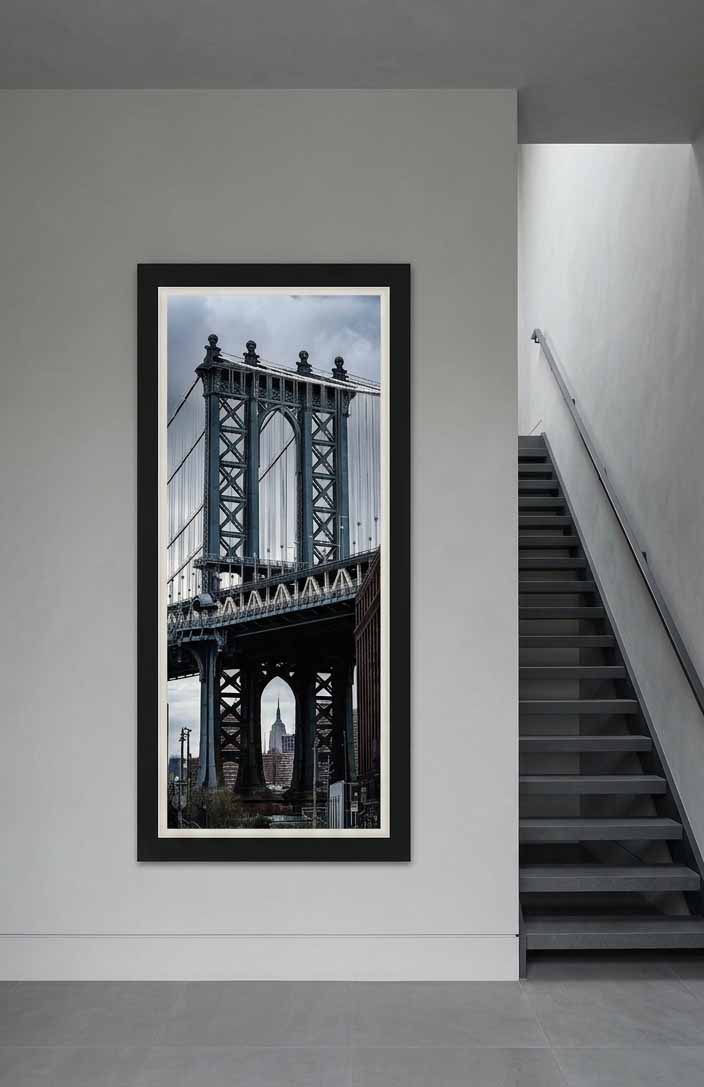
At the largest size this is taller than a person and it cannot be seen all at once. Thirty-two inches wide by eighty tall, hung with its base near the floor, puts the top of the image around seven feet up, and a viewer standing eight feet back has to work the eye from top to bottom. That is a different demand from a wide panorama, because the head turns sideways easily and tilts up and down far less comfortably. The eye does most of the work instead, and the extremes of the frame sit above and below the natural line of sight. The practical result is that this piece rewards standing close and looking up, which is the position the photograph was made from, and it loses most of its effect from across a room.
It holds the largest range of distance of anything in this collection. The bridge tower filling the frame stood perhaps a hundred feet from the camera. The Empire State Building visible in the arch beneath it is roughly four miles away. Between those two things there is nothing: no middle ground, no intervening subject, just a jump from an object close enough to touch to one at the far side of an island. That gap is what the picture is for, and it is why the piece opens a wall rather than sitting on it. In a small or shallow room that recession has somewhere to go, which is unusual. Most photographs with this much depth need space in front of them. This one supplies its own.
Its lightest and darkest parts are nearly seven feet apart, and no single lamp will serve both. Measured in horizontal strips the picture runs a hundred and seventy-nine at the top, down through a hundred, to twenty-two two thirds of the way down where the deck blocks the sky, then forty at the base. The standard deviation across the whole frame is the widest of any photograph here. On a print this tall that range is not a tonal problem but a physical one: light placed to suit the bright overcast sky at the top will leave the street at the bottom unreadable, and light placed for the street will wash the sky out. Even, ambient illumination across the whole height matters more on this piece than on anything else in the collection.
Related reading: Designing Calm Spaces in a Visually Noisy World
Scale
All three sizes shown to scale, aligned left and sharing a center line.
Sizes and Pricing
This photograph is offered in three sizes and four presentations, from the framed Collector's Choice to the Fine Art Edition on paper. Full pricing across all sizes and presentations.
Each edition closes permanently once filled.
Not sure which size the room calls for, or want dimensions not listed here? Sizes beyond 32 × 80 are available on request and ship crated by freight. That conversation is welcome before an order is placed. Start that conversation and I will answer within one business day.
Questions about this photograph
How small is too small for a photograph this tall?
At the Intimate size the picture is sixteen inches across and forty tall, and the structure holds: the tower, the arch, the deck and the Empire State Building all read as shapes. What goes is the steel. The cross-bracing in the tower legs closes into a flat pattern, the suspender wires merge into a grey haze, and the lattice under the deck becomes a dark band. Since the subject is a thing made of thousands of separate riveted members, that is a substantial loss. The Empire State Building also stops being a building and becomes a silhouette. The Collected at twenty-four by sixty returns the bracing. If you are weighing a size against a specific wall, choosing the right print size covers the measurements and the viewing distances in more detail.
What changes at the largest size?
At thirty-two by eighty, working down the frame: the four finials on top of the tower resolve with their moulded detail. The cross-bracing separates into individual members with the rivet lines along them. The suspender wires pull apart into a curtain of separate verticals hanging from the main cable. Under the deck the lattice girders show their diagonals, and the walkway railings and light standards resolve. Through the arch the Empire State Building shows its setbacks and the mast on top. And at the base the street furniture becomes legible, the one-way signs, the Plymouth Street plate, the brick courses on the building at the right. Why scale matters covers what happens perceptually when a photograph reaches the size where the eye has to cross it.
What kind of room does this photograph suit?
A tall wall, met close. A stair hall, an entry, a double-height space, a narrow pier between openings, a landing. Hang it low, with the base fourteen to eighteen inches off the floor, so the whole height sits within reach of the eye. On materials it wants cool neutrals and matte surfaces, grey plaster and dark stone, since the picture itself is fourteen points cool and carries almost no colour. Three things to avoid. Do not rely on a single lamp or downlight, for the reason above. Do not hang it on a wall under about nine feet, because at the largest size it will crowd the ceiling and the top of the tower is the part that needs air. And keep real arches and arched openings out of the same view, since the whole photograph is built around one. When your mind needs to rest takes the question further.