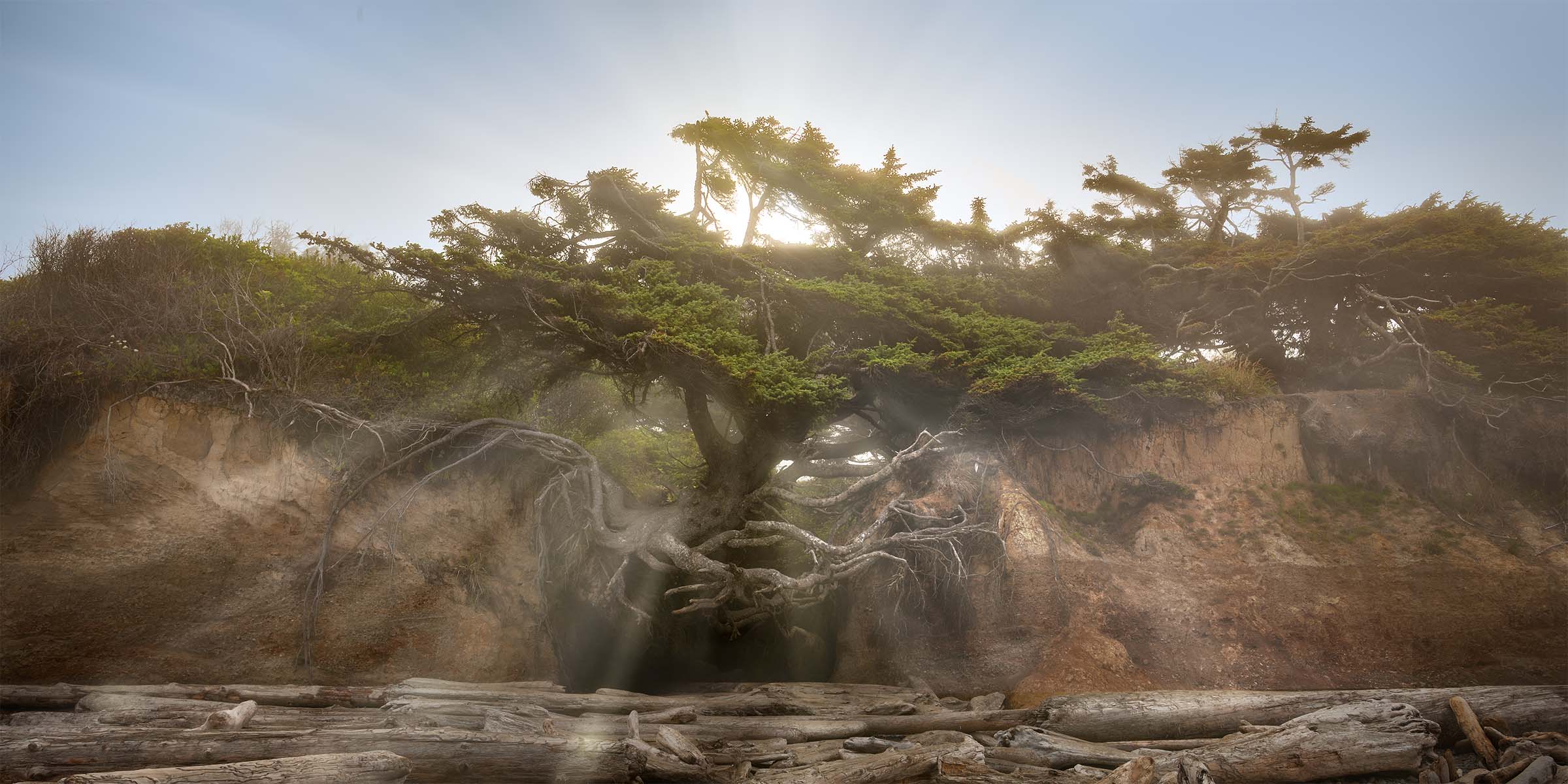
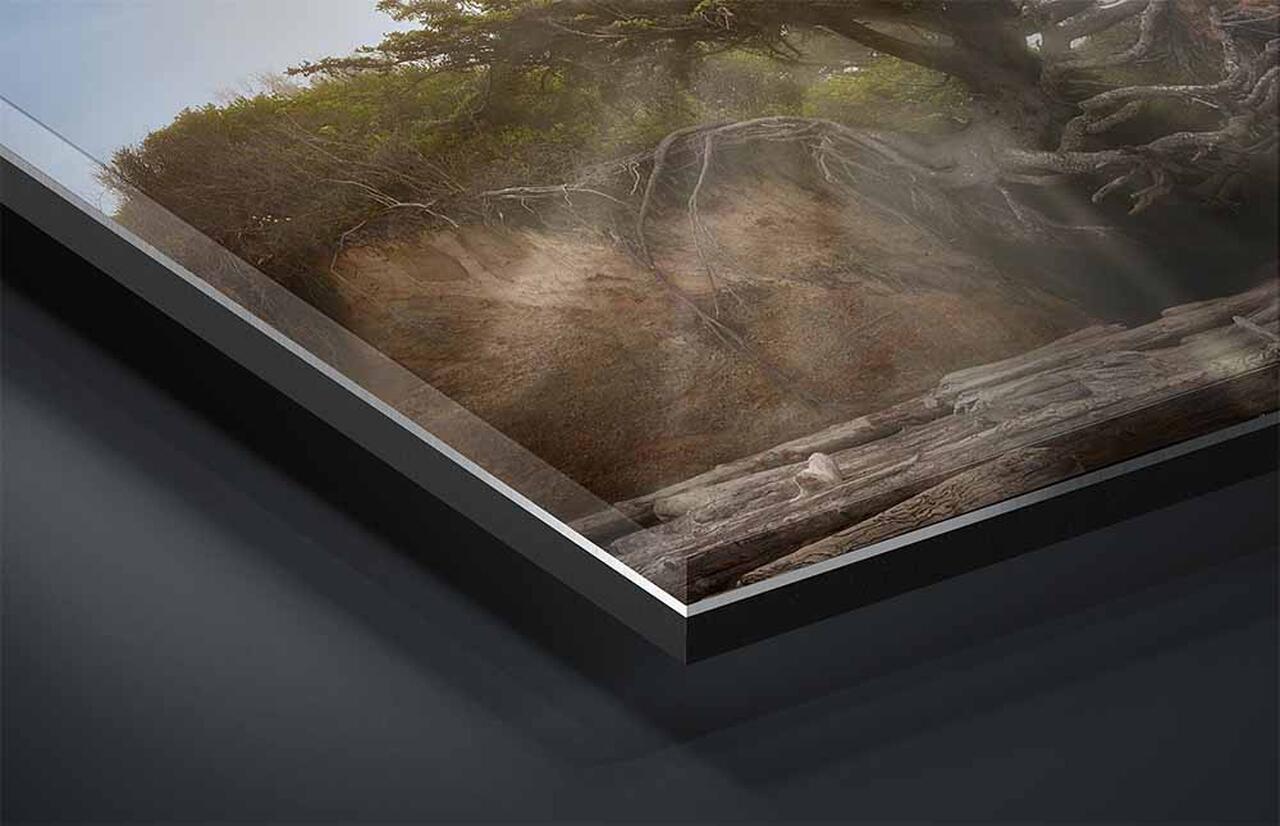
A 2:1 panoramic photograph of the Kalaloch Tree of Life on the Washington coast, available as a limited edition print in three sizes and four presentations.
Artist's Story
On the Kalaloch coast of Olympic National Park, in Washington, a Sitka spruce known as the Tree of Life grows out over open air. The bluff that once held it has washed away, carved into a cave by a small stream running to the Pacific, and the tree now spans the gap on a bridge of its own exposed roots. Some things stay by holding on rather than standing firm. By the ordinary rules this one should have gone into the sea long ago. It has not.
I made this from the beach below, among the driftwood the tide had stacked at its base, as the morning sun rose behind the crown and broke through the branches in the sea haze.
What holds me here is not fragility but its opposite. There is a kind of steadiness that has nothing to do with solid ground, that comes instead from the decision to remain, renewed against every reason to let go. The mind knows the difference. Stability, it turns out, is not always the same as comfort. Sometimes it is only this: staying, with everything exposed, because leaving is not yet the answer.
Holding On is that refusal made visible, roots in the air, still reaching, still green.
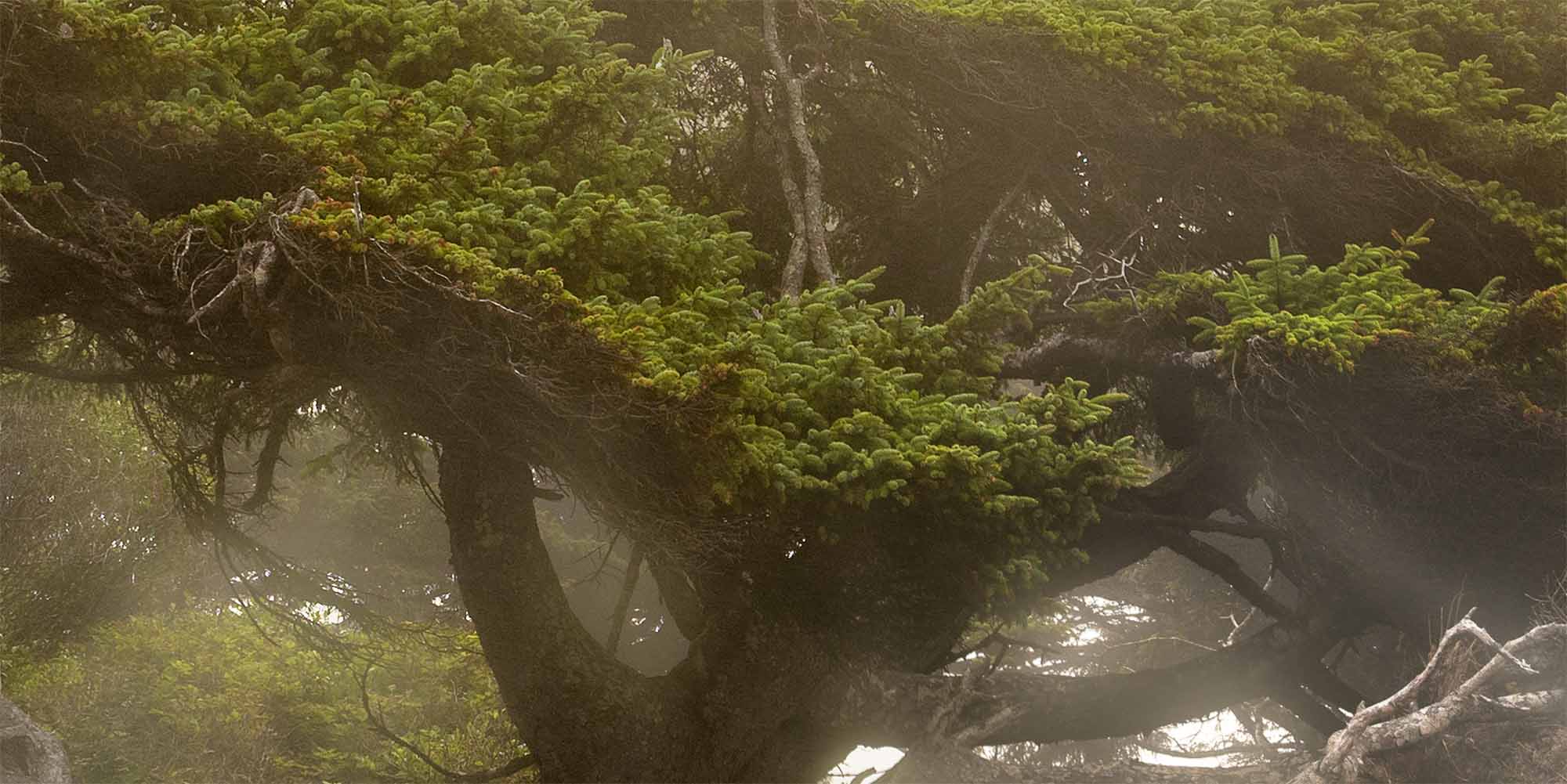
Detail at roughly one sixth of the frame width. The new growth separates from the older foliage at the branch tips, and the light comes through the crown as haze rather than glare. Click to view at full size.
About This Photograph
Photographed at Kalaloch Beach in Olympic National Park, on the Pacific coast of Washington, from the beach below the bluff looking inland toward the tree, in the morning with the sun behind the crown.
Made in a single frame. The rays through the branches were in the scene, thrown by the sun in the sea haze, and I strengthened them in processing.
The subject is the Kalaloch Tree of Life, also known as the Tree Root Cave tree, a Sitka spruce suspended over a cave where a stream eroded the bluff beneath it. Its exposed roots bridge the gap between the two banks and the tree continues to grow.
Holding On
Steve Austinhttps://www.steveaustinphotography.com/
Location
Kalaloch Beach, Olympic National Park, Washington
Subject
The Kalaloch Tree of Life
Capture
Single frame in morning light
Format
Photograph · horizontal panorama, 2:1
Sizes
40 × 20 in · 60 × 30 in · 80 × 40 in
Print Media
TruLife Acrylic · ChromaLuxe Metal · Baryta paper
Edition
Limited, 25 / 50 / 100 by presentation
What it Does in a Room
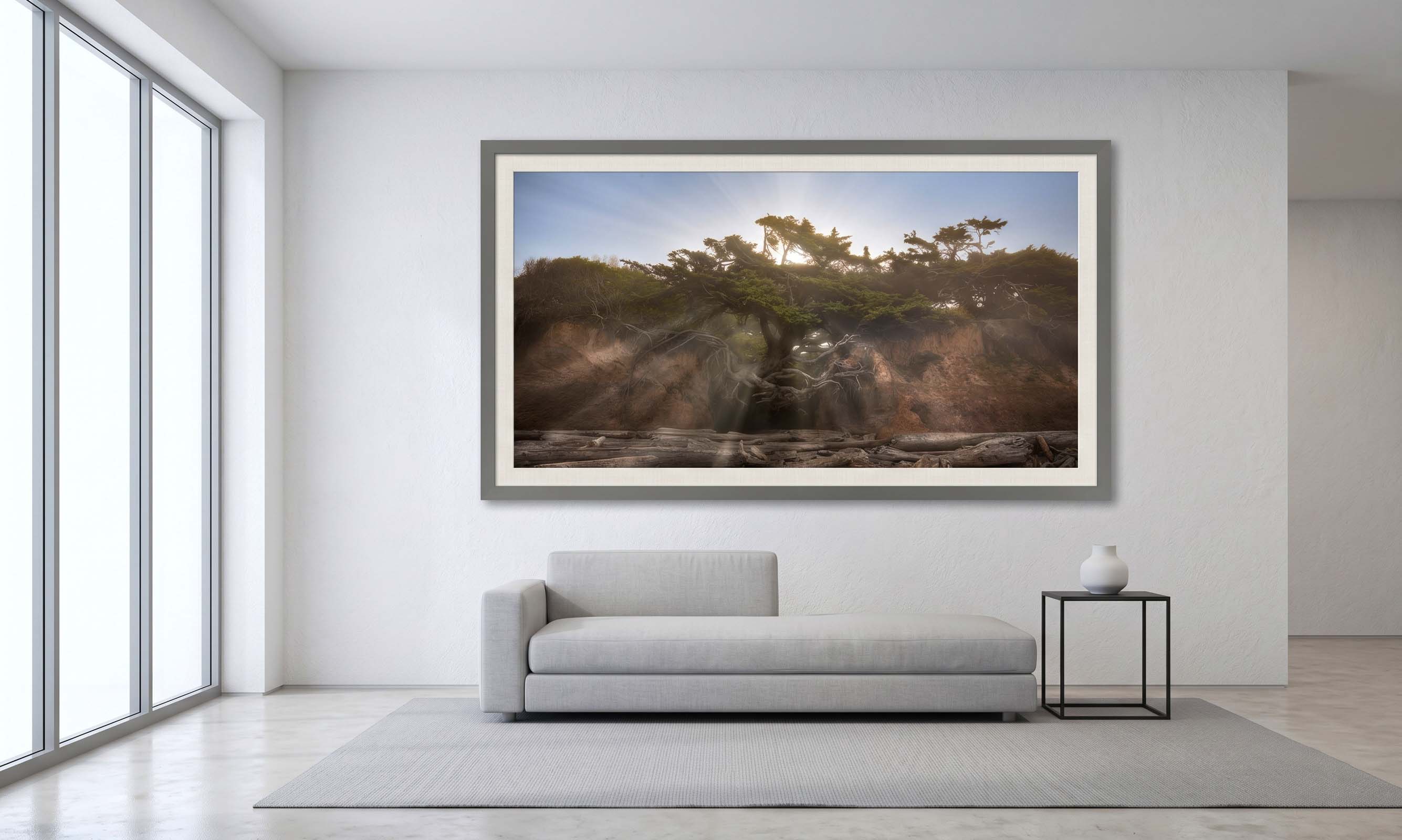
The tree is centered and roughly symmetrical, arms out to both sides, roots fanning below. That arrangement reads as a figure before it reads as a tree, and the eye recognizes it from across a room without needing to work anything out.
What it does from there is hold still. The haze softens every edge in the frame, the palette runs from pale blue through green to a warm gray sand, and nothing in it is sharp enough to demand attention or dull enough to lose it. That combination is unusual. Most photographs either announce themselves or recede, and this one does neither. It stays available, which is a different quality and the more useful one on a wall you live with rather than visit.
The color is easy to place. Cool overall, with enough warmth in the sand and driftwood that it does not read as cold. It will sit against gray, white, oak, and linen without adjustment, and in a room with a lot of wood the driftwood in the foreground picks that up rather than competing with it.
It also wants light, though less than most. The haze depends on the pale sky at the top staying pale, and on a wall that never sees daylight the upper third will darken and the rays will lose their source. A room with any natural light will do. It does not need direct sun.
Not sure which size the room calls for, or want dimensions not listed here? Sizes beyond 80 × 40 are available on request and ship crated by freight. That conversation is welcome before an order is placed. Start that conversation and I will answer within one business day.
Holding On, limited edition printSteve Austin112513400USD12https://schema.org/InStock
Questions about this photograph
How small is too small for a photograph this wide?
At one to two, the Intimate size is forty inches across and twenty inches tall. That is a comfortable proportion, wide enough to read as a panorama but with enough height that it still behaves like a picture rather than a band. Of the panoramic families this is the one that holds up best at its smallest size, and a twenty by forty print will anchor a modest wall on its own. Where it starts to feel small is on a large open wall or above a full-length sofa, where the surrounding space overwhelms it. The Collected and Statement sizes are where the roots do the work. If you are weighing a size against a specific wall, choosing the right print size covers the measurements and the viewing distances in more detail.
What changes at the largest size?
The roots are the whole question. At twenty inches tall they read as a tangle. You see that something is holding the tree up and that it is complicated, but you cannot tell what is attached to what, and the mass below the trunk is more texture than structure. At forty inches tall it resolves into individual roots. You can follow one out from the base of the trunk, across the open mouth of the cave, and find where it enters the bank on the far side. Then another, and another, until the whole span reads as a set of separate decisions rather than as a knot. That is the difference between believing the caption and seeing the thing for yourself. The photograph claims a tree is bridging a gap on its own roots, and only at size does the picture actually prove it. Why scale matters covers what happens perceptually when a landscape reaches the size where the eye has to travel across it.
What kind of room does this photograph suit?
A bright one. Everything about this image depends on the haze holding, and haze is made of pale values with very little contrast, so it wants light on it. In a room with real daylight the sky stays open, the rays keep their source, and the whole frame breathes. On a wall that never sees natural light the upper third darkens and the image loses the quality that makes it worth having.
Beyond that it is easy to place. Cool overall, with enough warmth in the driftwood and the bluff that it does not read as cold, and there is no hard black anywhere to fight a room's palette. It sits well against white, gray, concrete, and pale stone. In a room with a lot of heavy warm wood it will read slightly out of key, since the photograph's own wood is weathered gray rather than brown.
Every work ships insured and arrives with a signed certificate of authenticity.
If a piece is damaged in transit, the choice of replacement is always yours, and your edition number stays with you.
Production time runs 2 to 3 weeks for metal, 3 to 4 weeks for acrylic and paper, and 5 to 6 weeks for framed work.
Collector's Choice · TruLife ® Acrylic in Italian Frame
Collector Edition of 25· Lumachrome TruLife Acrylic · Handcrafted Italian Frame
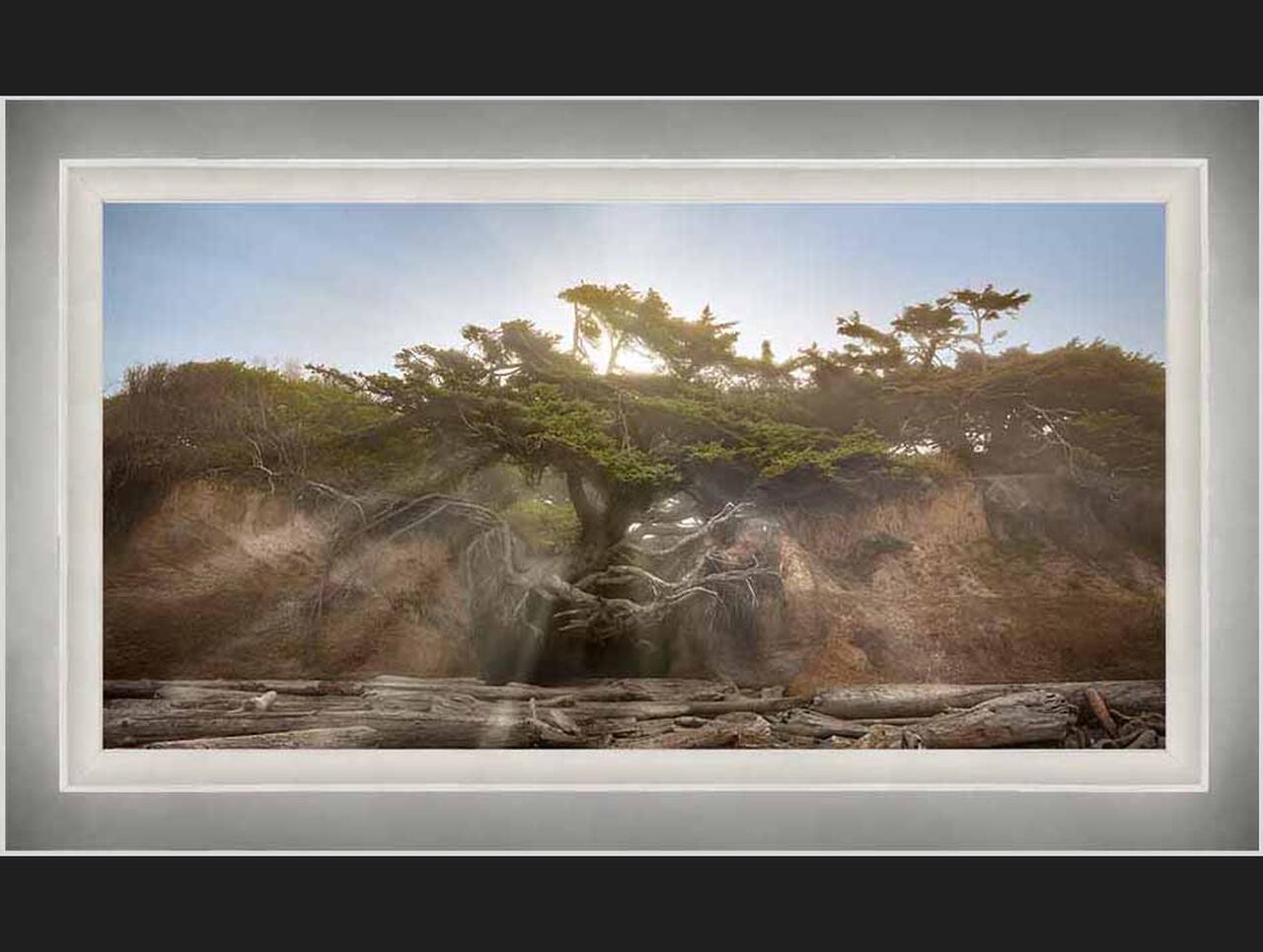
TruLife acrylic in a handcrafted Italian frame with a linen liner chosen for the image. Frame series, finish, and liner are settled with you after the order, and production begins from there. The frame and liner add about fourteen inches to the finished dimensions, worth allowing for when planning placement.
Signature Edition · TruLife ® Acrylic, Float Mount
Signature Edition of 50· Lumachrome TruLife Acrylic · Gallery Float Mount
Face-mounted to TruLife acrylic and floated approximately one inch from the wall, with no frame to mediate between the image and the room. UV-resistant, anti-reflective, and scratch-resistant, with a lifetime guarantee against fading.
Signature Edition of 50· ChromaLuxe Metal Print · Gallery Float Mount
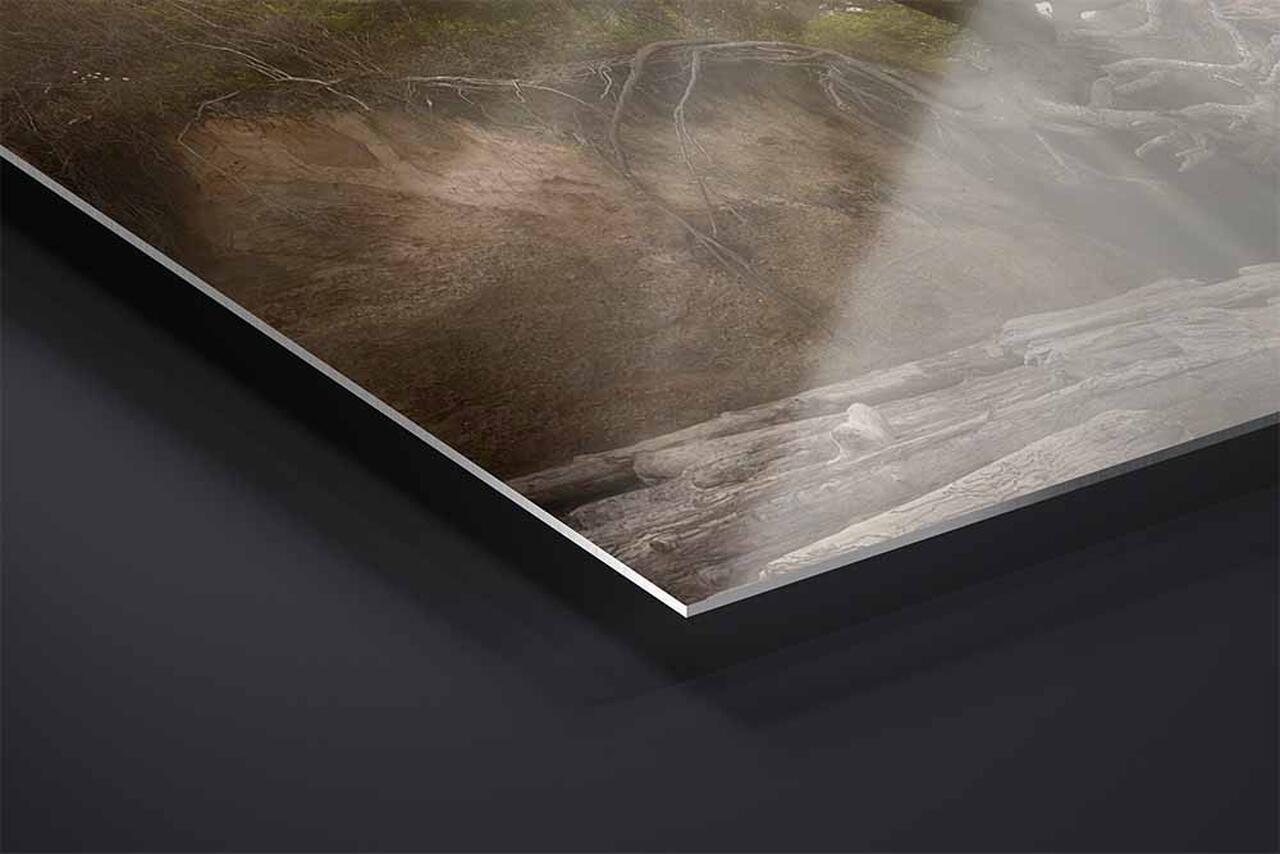
Color infused into the aluminum panel itself, floated from the wall on a concealed system. Where acrylic produces luminosity, metal produces clarity. Exceptional fade resistance with no glazing or coating required.
Fine Art Edition of 100· Hahnemühle Baryta Fine Art Paper
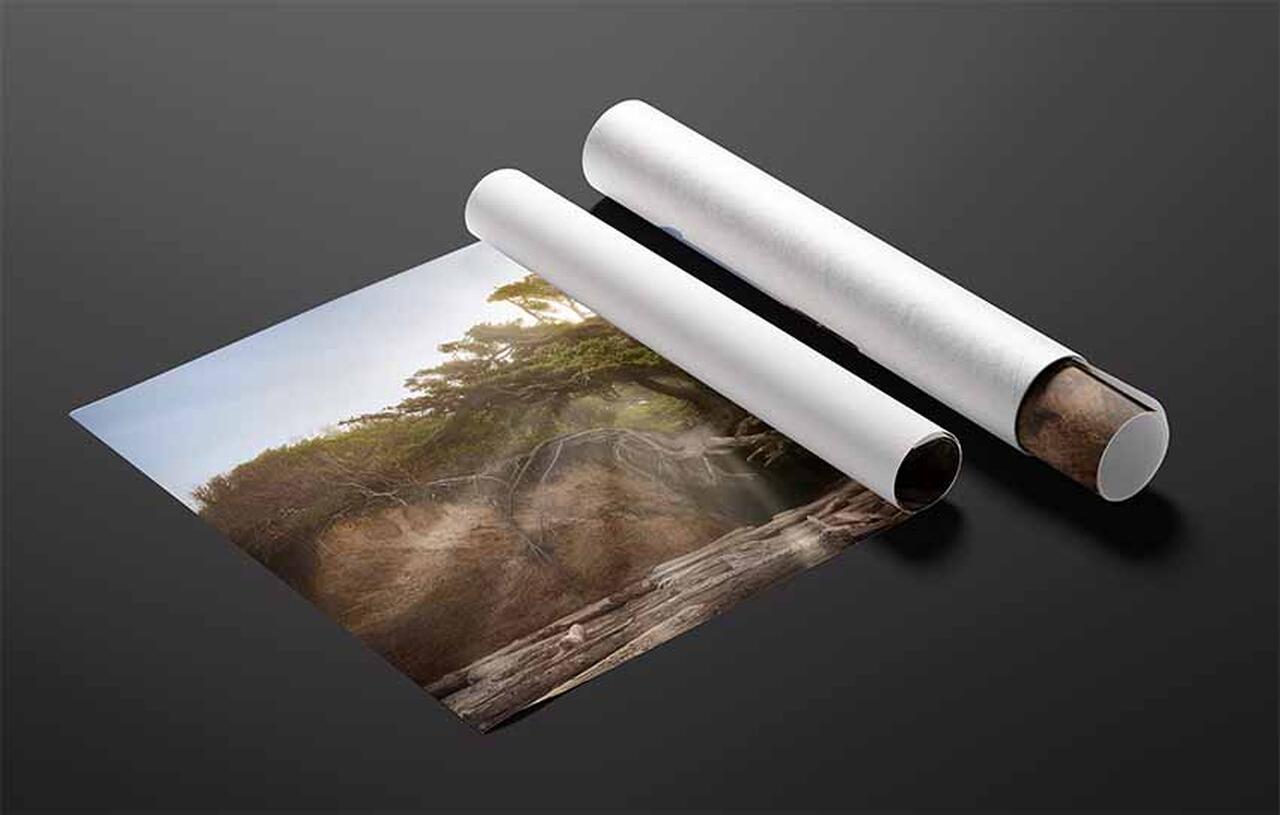
Printed without acrylic, so light meets the paper surface directly. Highlights stay luminous, shadows keep their nuance, and the surface has a tactile quality the other presentations approach differently. The understated choice, and the traditional one.
Complimentary shipping within the continental United States. International collector shipping available upon request.
Still deciding
Designing for Stillness
A guide to choosing art for restorative spaces
How to tell whether an image will still hold you in a year, how scale changes what a photograph does in a room, and how to match a piece to the work a room actually performs. It cites the research it draws on, and it is equally clear about where that research stops. About ten minutes to read.