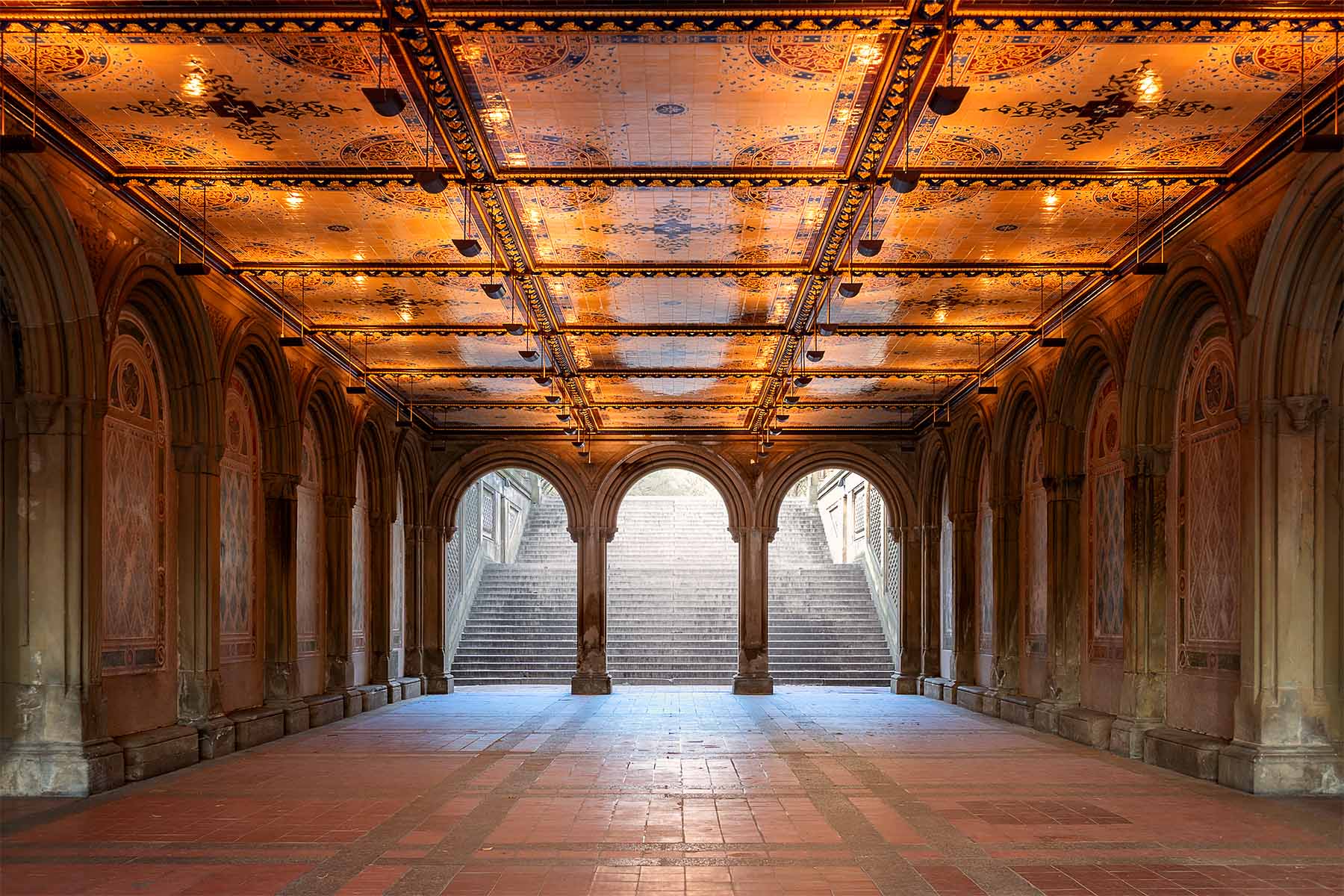
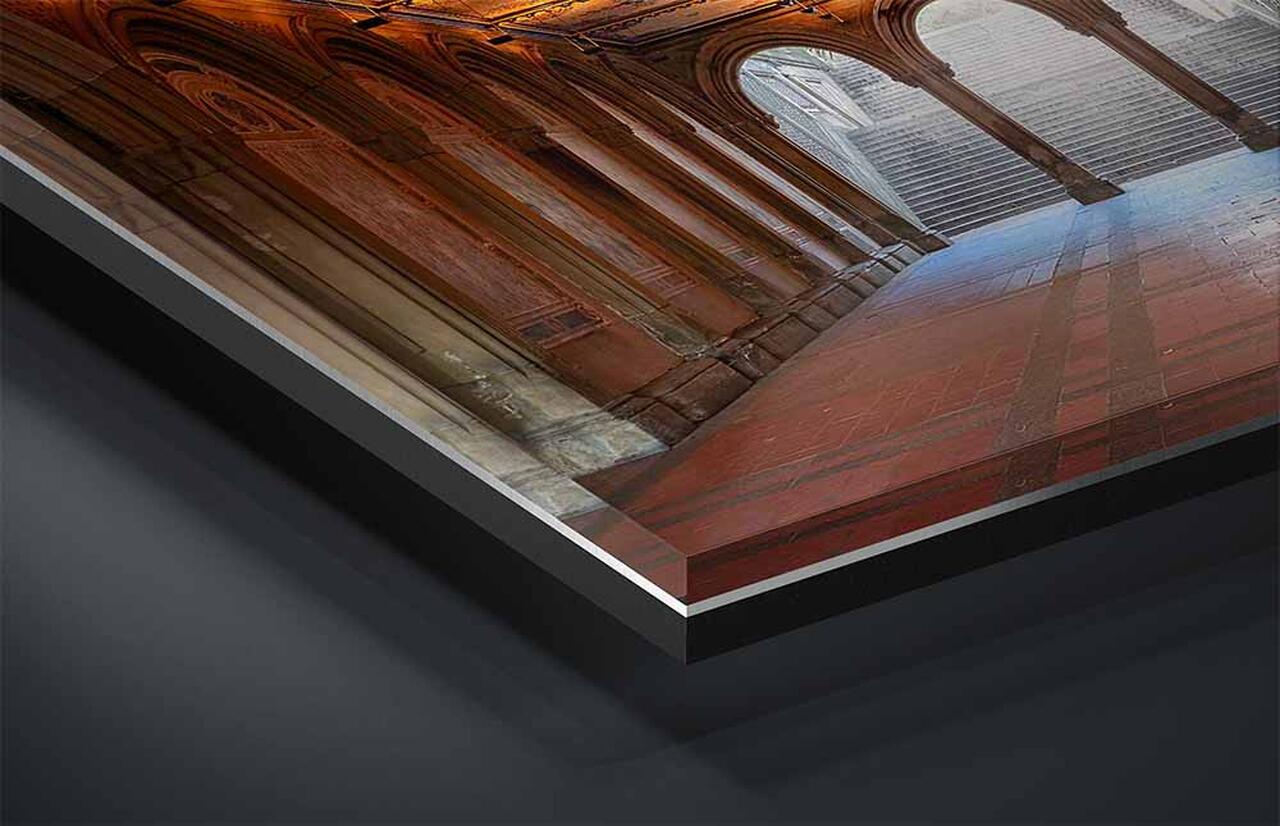
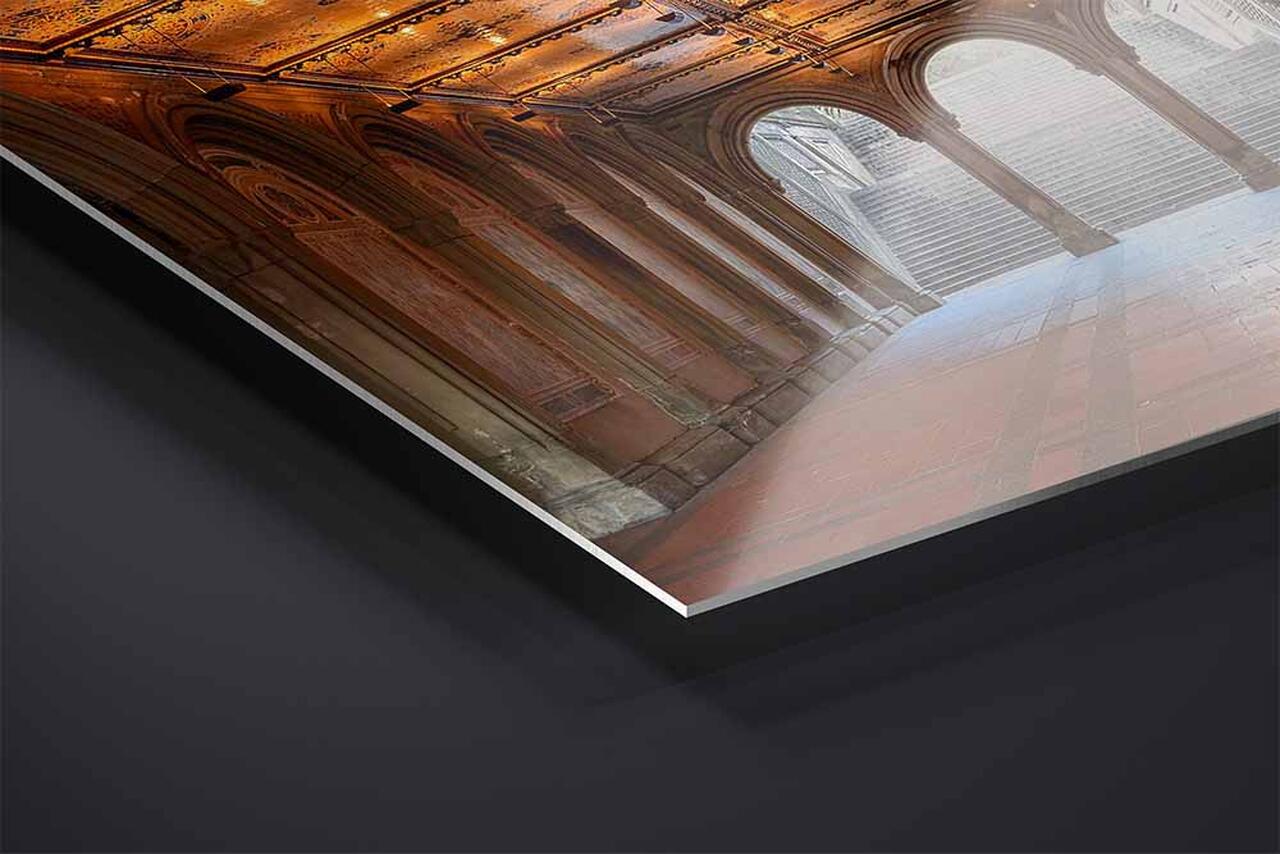
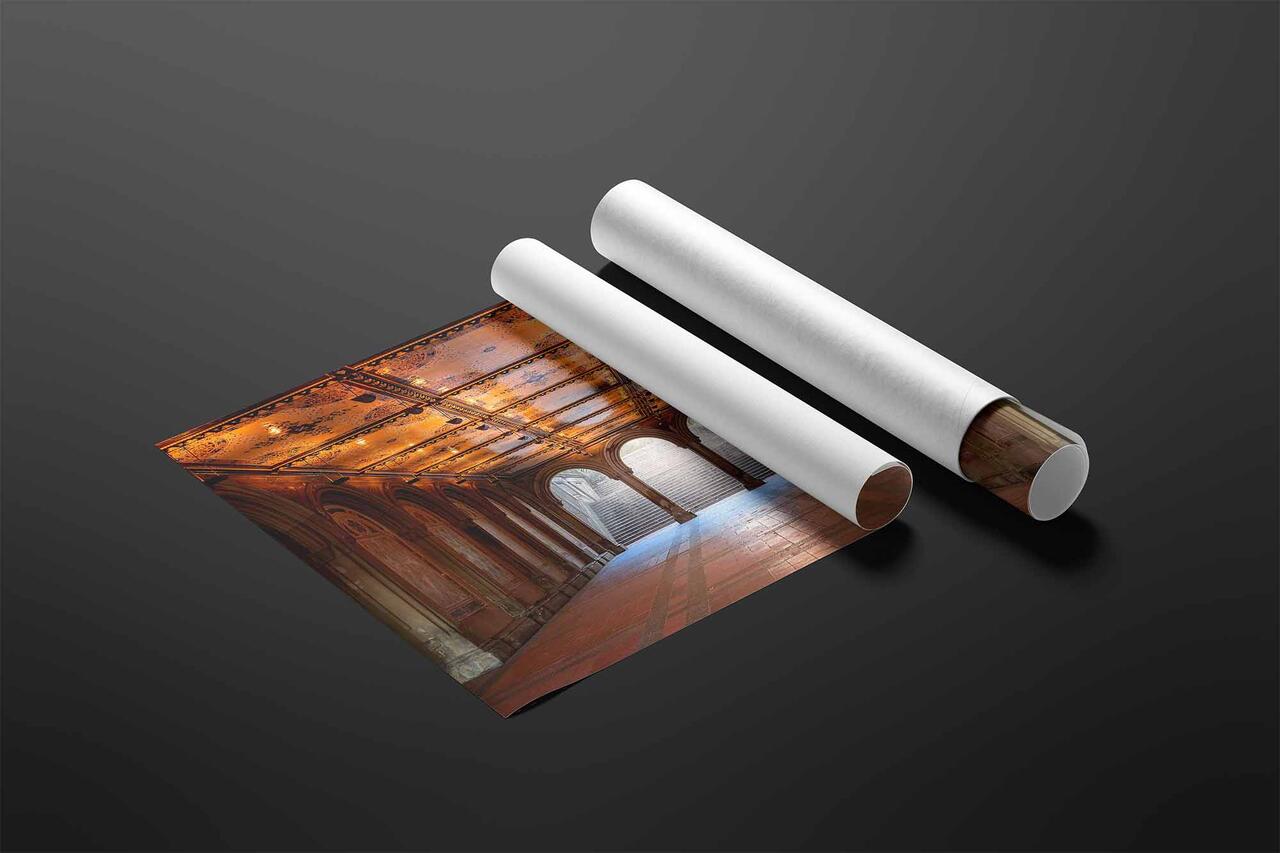
A 3:2 horizontal photograph of the Minton encaustic tile ceiling and arcade at Bethesda Terrace, Central Park, available as a limited edition print in four sizes.
Artist's Story
I stood in front of the Bethesda Fountain a little after sunrise in early summer and turned south into the arcade, toward the granite stairs that climb to the Mall. I had come for the ceiling. I had never been in the passage before, and at that hour nobody else had come down into it yet.
The ceiling was warm all the way across. The stairs at the far end were not.
Encaustic tile carries its color in the body rather than on the surface. Colored clays are inlaid into the tile and fired with no glaze over them, which leaves a matte face that scatters light in every direction and returns no highlight. A surface like that adds nothing of its own. What it shows is its pigment multiplied by whatever light reaches it. Very little reaches that ceiling directly, because a carriage road runs across the top of the arcade. The light arrives secondhand, off the Roman brick paving laid on edge underfoot and off the mustard-olive New Brunswick sandstone of the piers and walls. Both are warm. The granite of the stairs is the only pale, cool material in the passage, and it is the only one standing in open daylight.
The file holds the result as a gradient. Across the top tenth of the frame the red channel sits one hundred seventeen points above the blue. In the band holding the granite steps the same figure drops below twenty. Ninety-seven points of separation inside a single photograph, produced by nothing more than the order in which the materials are stacked.
Inlay is the method, and it is the reason any of this survived. The color in those tiles is in them, not on them, which is why the faces came through a century of water from the road above, a removal, and more than twenty years in storage, and went back up in 2007 still carrying the same earth tones and cobalt.
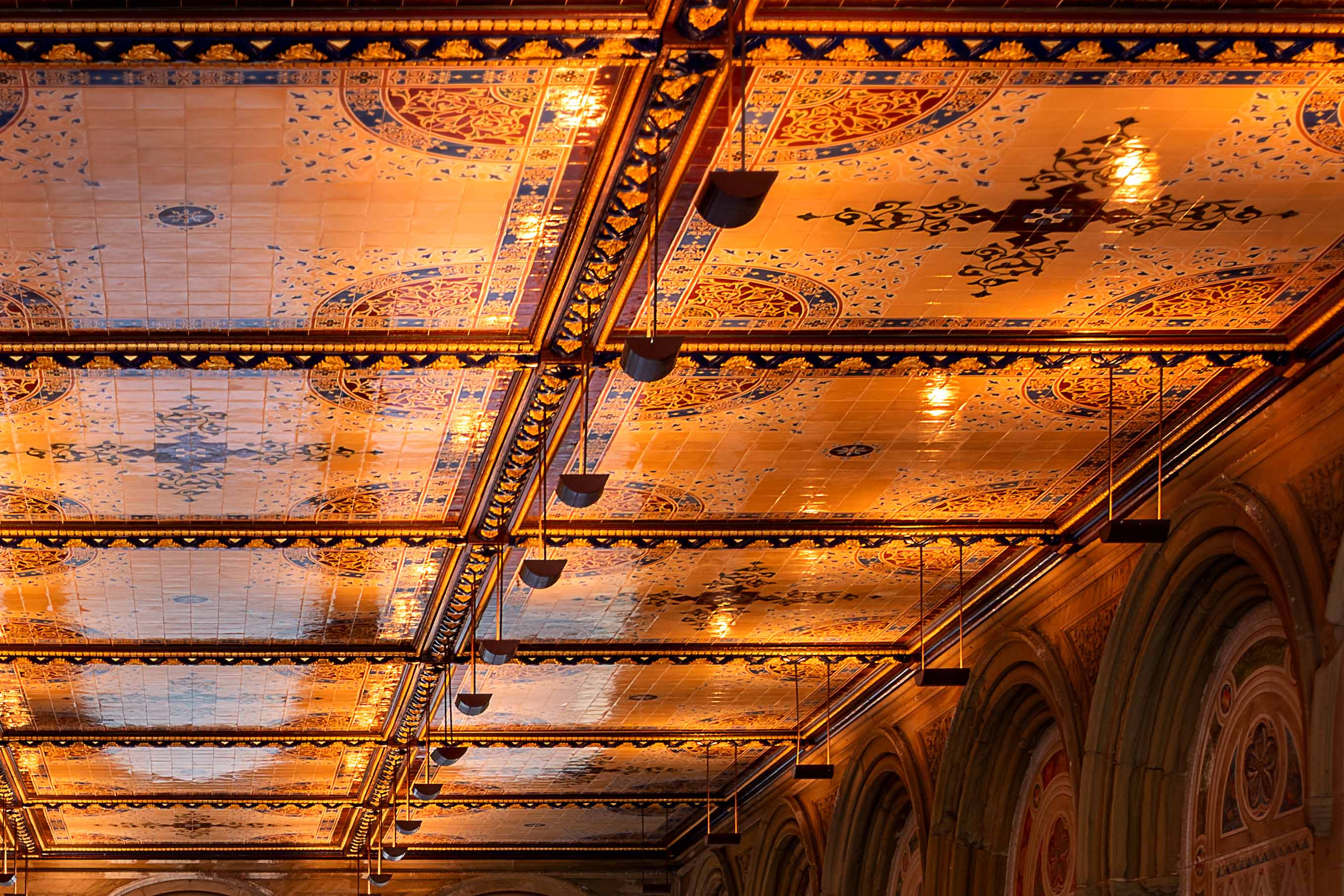
This crop is about 30 percent of the frame width, roughly 18 inches across on the 60 inch print. Individual tiles separate with their joints visible, and the central medallions divide into their two designs, the dark cross-form and the circular scrollwork. The border courses between panels break into their repeating units, and the ornament along the beam soffits resolves leaf by leaf. The pendant fixtures separate from their suspension rods and read as hanging bowls. Across the tile faces the lamps appear a second time as elongated reflections, which is the ceiling returning the light of the passage below it. Click to view at full size.
About This Photograph
The Bethesda Terrace Arcade runs beneath the 72nd Street Cross Drive, connecting the Mall to the lower terrace and the Lake. This view looks south from the fountain to the granite stairs. Three bracketed frames, stitched. The ceiling holds 15,876 encaustic tiles in 49 panels of 324, designed by Jacob Wrey Mould and fired by Minton and Company in Stoke-on-Trent between 1865 and 1867. It is the only suspended tile ceiling Minton is known to have made.
A carriage road sits directly on top of it, which proved to be its undoing. Water and salt worked down from the roadway and corroded the iron suspension holding the panels. All 49 came down in the 1980s and went back up on a stainless steel system that keys each tile individually.
Inlay
Steve Austinhttps://www.steveaustinphotography.com/
Location
Bethesda Terrace Arcade, Central Park, New York
Subject
Minton tile ceiling · arcade · Central Park
Capture
Three-frame stitched, bracketed, sunrise
Format
Photograph · horizontal, 3:2
Sizes
24 × 16 in · 36 × 24 in · 48 × 32 in · 60 × 40 in
Print Media
TruLife Acrylic · ChromaLuxe Metal · Baryta paper
Edition
Limited, 25 / 50 / 100 by presentation
What it Does in a Room
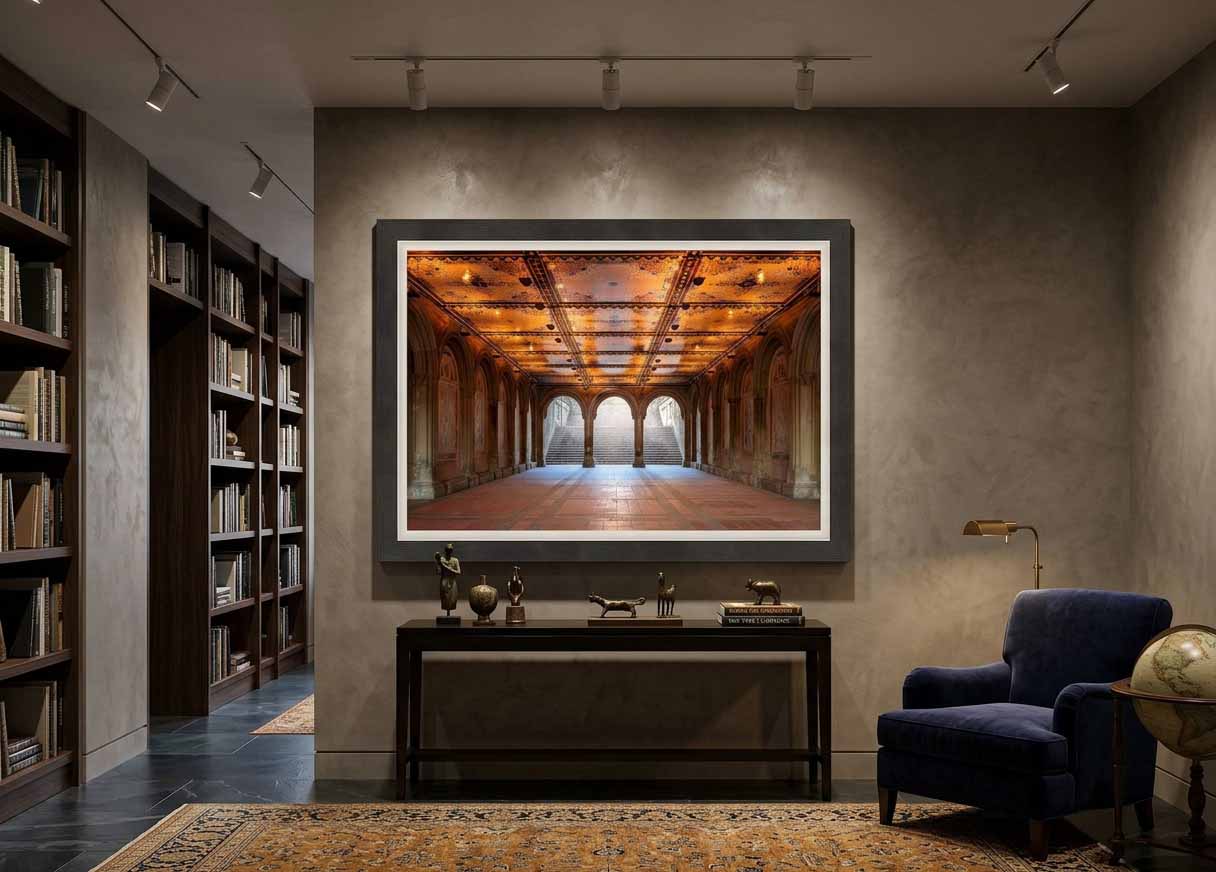
The light in this photograph and the information in it run in opposite directions. Sampled three percent in from the edges, the top band averages 49.27 in luminance and the bottom band 97.79, so the base of the print is close to twice as bright as its top. The detail is distributed the other way. The upper third carries the tile field, the beam courses and the pendant fixtures, and the lower third is plain brick paving. That decides how the print should be lit. A picture light angled up from below, or a table lamp set under the frame, raises the half with nothing in it and leaves the ornament where it already was. Even frontal light, or light biased slightly toward the top of the frame, is the correct choice here.
The photograph is built on a single vanishing point that sits inside the frame. The column profile records the convergence: luminance runs 58.94 at the left edge and 67.27 at the right, rising to 131.57 and 138.32 across the two center columns. The left-to-right correlation is 0.7923, close to the axis without sitting on it. A one-point perspective only holds from in front of it. Seen from a shallow angle the convergence shears and the passage stops reading as a passage at all. That rules out hallway walls, stair walls and any position where a print is passed rather than faced. The placement this one needs is a wall you stand square to: the end of a room, the wall opposite a seating group, the face of a landing.
The brightest region of the print is a pictured opening. The granite stairs read 131.57 and 138.32 against a perimeter mean of 63.74, and 0.5579 percent of the frame sits above 245, nearly all of it in that stair mass. So the photograph contains a visible exit to daylight, and that exit is cooler than everything around it: the red channel runs below twenty points above blue in the stair band, against one hundred seventeen at the ceiling. A real window in the same field of view puts two openings and two color temperatures in one glance, and the pictured one loses. Choose a wall where the window is behind the viewer or off to one side rather than alongside the frame.
Not sure which size the room calls for, or want dimensions not listed here? Sizes beyond 60 × 40 are available on request and ship crated by freight. That conversation is welcome before an order is placed. Start that conversation and I will answer within one business day.
How small is too small for a photograph this wide?
The architecture survives every size. The arches, the piers, the convergence toward the stairs and the warm-to-cool split from ceiling to granite all hold at 24 × 16. What goes is the tile. Each tile is six inches square in life, and at 24 inches wide the ceiling reduces to pattern with no individual tile in it, which means the two panel designs stop being distinguishable. Since the page turns on what happens at the surface of those tiles, losing them costs the picture its subject. Individual tiles begin to separate at 48 × 32 and the medallions become fully legible at 60 × 40. If you are weighing a size against a specific wall, choosing the right print size covers the measurements and the viewing distances in more detail.
What changes at the largest size?
At 60 × 40 the frame resolves from the top down. Individual tiles separate and the central medallions divide into their two designs, the small rosette and the large pinwheel. The dark border courses that edge each panel break into their repeating units. The pendant fixtures separate from their suspension rods and read as hanging objects rather than as bright points. The carved capitals on the piers take on relief, and the decorated wall bays between them resolve into their lattice. The circular medallions above the side arches show their interior tracery. The granite stairs divide into individual treads with their nosings visible. And at the bottom edge the paving breaks into single Roman bricks laid on edge in herringbone. Why scale matters covers what happens perceptually when a photograph reaches the size where the eye has to cross it.
What kind of room does this photograph suit?
A room with a wall you stand square to. Dining rooms, libraries, a sitting room where the seating faces one wall, the end wall of a long room. Hang it with the center of the image at 60 inches from the floor. Materials in the print give a room three to work with: warm brick red at the base, mustard-olive stone through the middle, and cool gray granite at the center. Matching any one of them leaves the other two intact. Three things to avoid. Do not hang it where it will be seen at an angle, because the single vanishing point shears and the passage flattens. Do not put it beside a window, because the print already contains an opening to daylight and a real one will beat it. Do not light it from below, because the bottom of the frame is already the brightest part and holds the least. When your mind needs to rest takes the question further.
Every work ships insured and arrives with a signed certificate of authenticity.
If a piece is damaged in transit, the choice of replacement is always yours, and your edition number stays with you.
Production time runs 2 to 3 weeks for metal, 3 to 4 weeks for acrylic and paper, and 5 to 6 weeks for framed work.
Each print is made to order and takes its place in a numbered edition, so sales are final. Before you choose, I am glad to help: send a photo of your wall and I will show you this work in your room at true scale, at no charge. Start a conversation
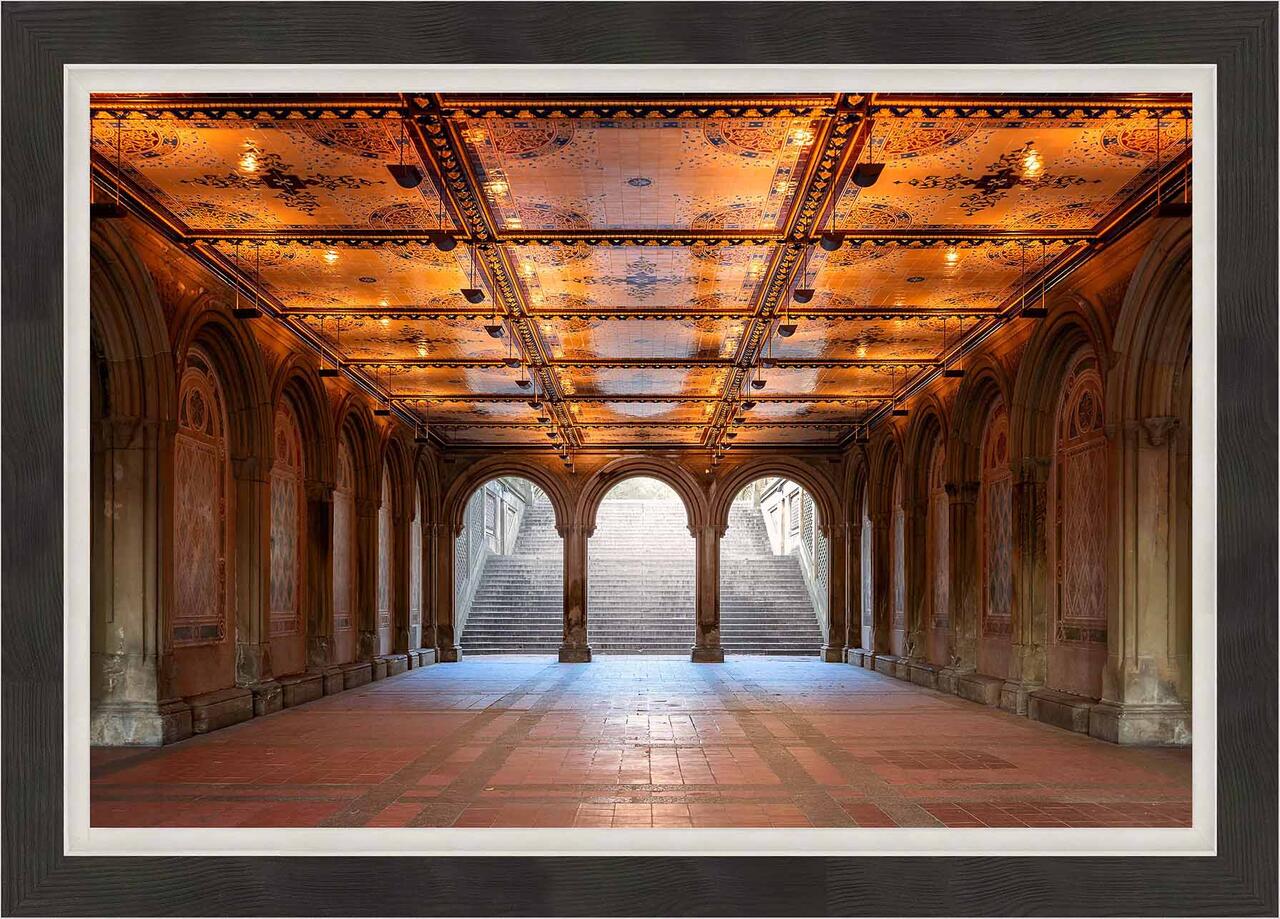
Collector's Choice · TruLife ® Acrylic in Italian Frame
Collector Edition of 25· Lumachrome TruLife Acrylic · Handcrafted Italian Frame
TruLife acrylic in a handcrafted Italian frame with a linen liner chosen for the image. Frame series, finish, and liner are settled with you after the order, and production begins from there. The frame and liner add about fourteen inches to the finished dimensions, worth allowing for when planning placement.
Signature Acrylic Edition of 50· Lumachrome TruLife · Gallery Float Mount
Face-mounted to TruLife acrylic and floated approximately one inch from the wall, with no frame to mediate between the image and the room. UV-resistant, anti-reflective, and scratch-resistant, with a lifetime guarantee against fading.
Signature Metal Edition of 50· ChromaLuxe Print · Gallery Float Mount
Color infused into the aluminum panel itself, floated from the wall on a concealed system. Where acrylic produces luminosity, metal produces clarity. Exceptional fade resistance with no glazing or coating required.
Fine Art Edition of 100· Hahnemühle Baryta Fine Art Paper
Printed without acrylic, so light meets the paper surface directly. Highlights stay luminous, shadows keep their nuance, and the surface has a tactile quality the other presentations approach differently. The understated choice, and the traditional one.
Complimentary shipping within the continental United States. International collector shipping available upon request.
Still deciding
Designing for Stillness
A guide to choosing art for restorative spaces
How to tell whether an image will still hold you in a year, how scale changes what a photograph does in a room, and how to match a piece to the work a room actually performs. It cites the research it draws on, and it is equally clear about where that research stops. About ten minutes to read.