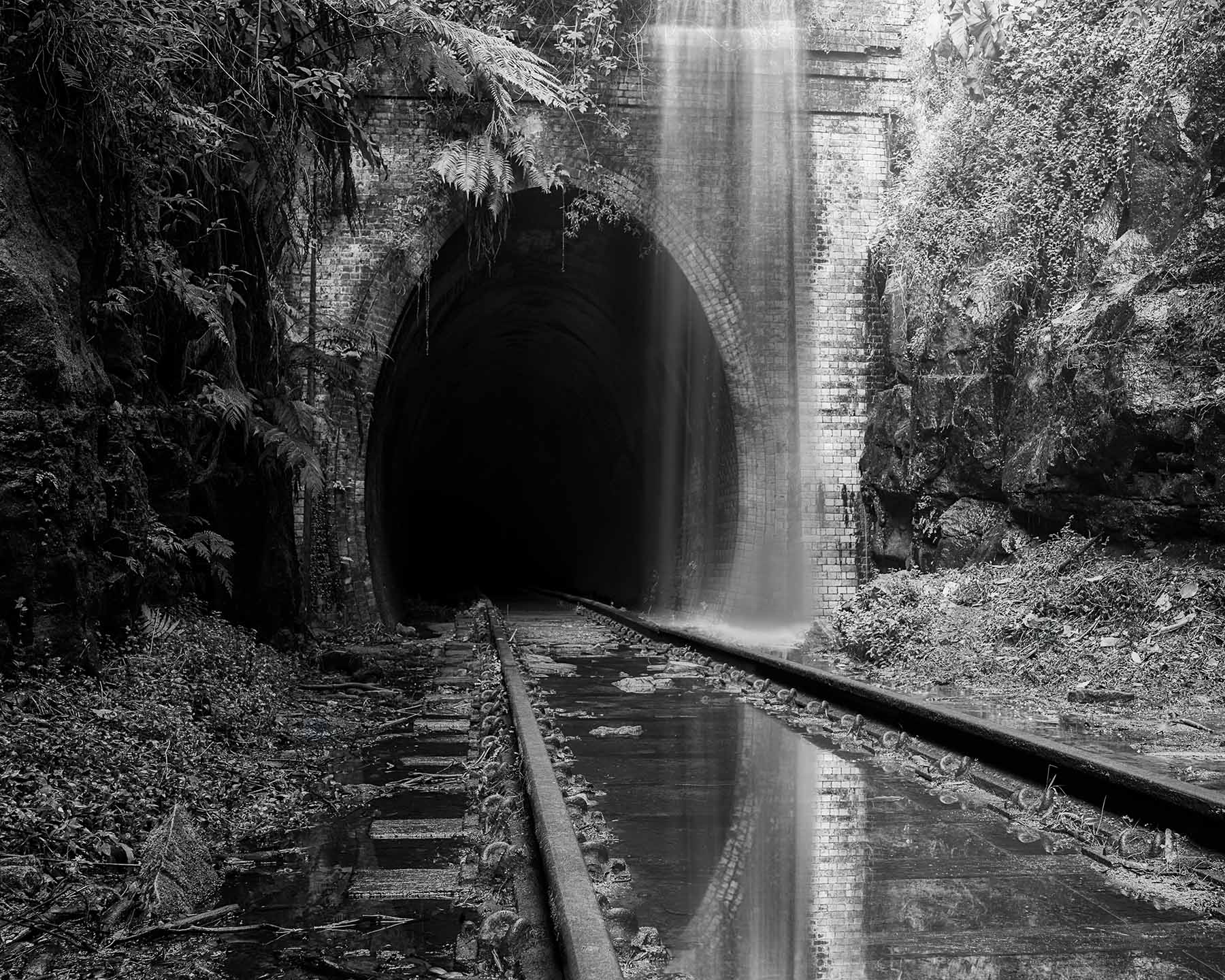
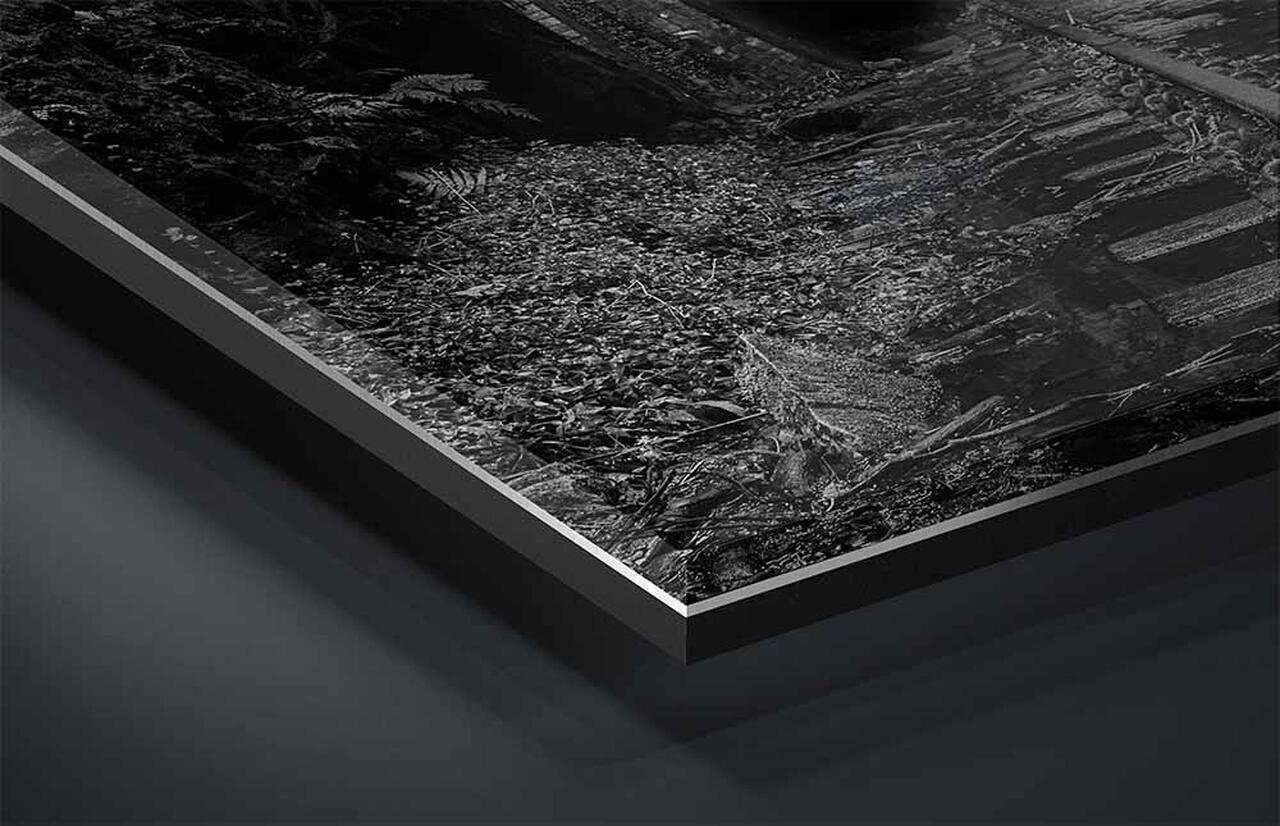
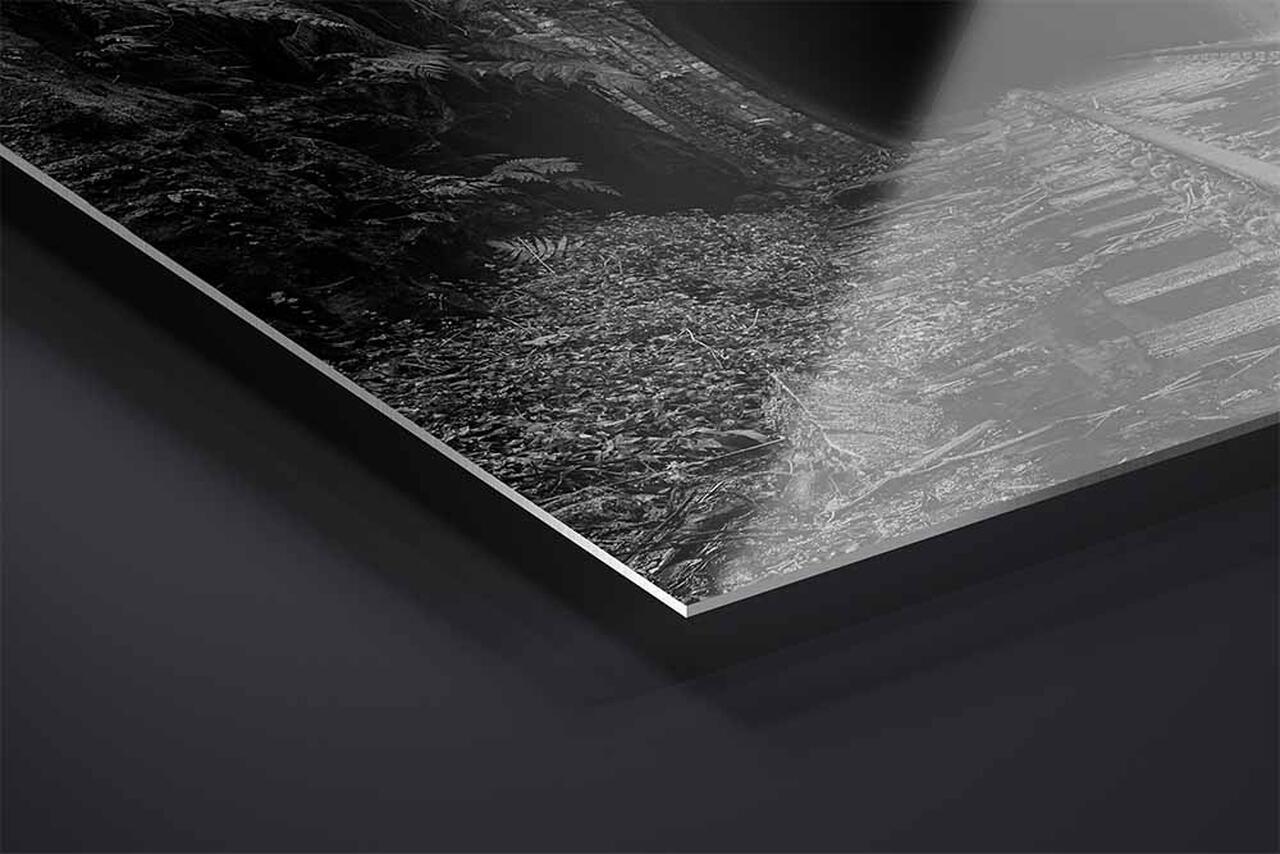
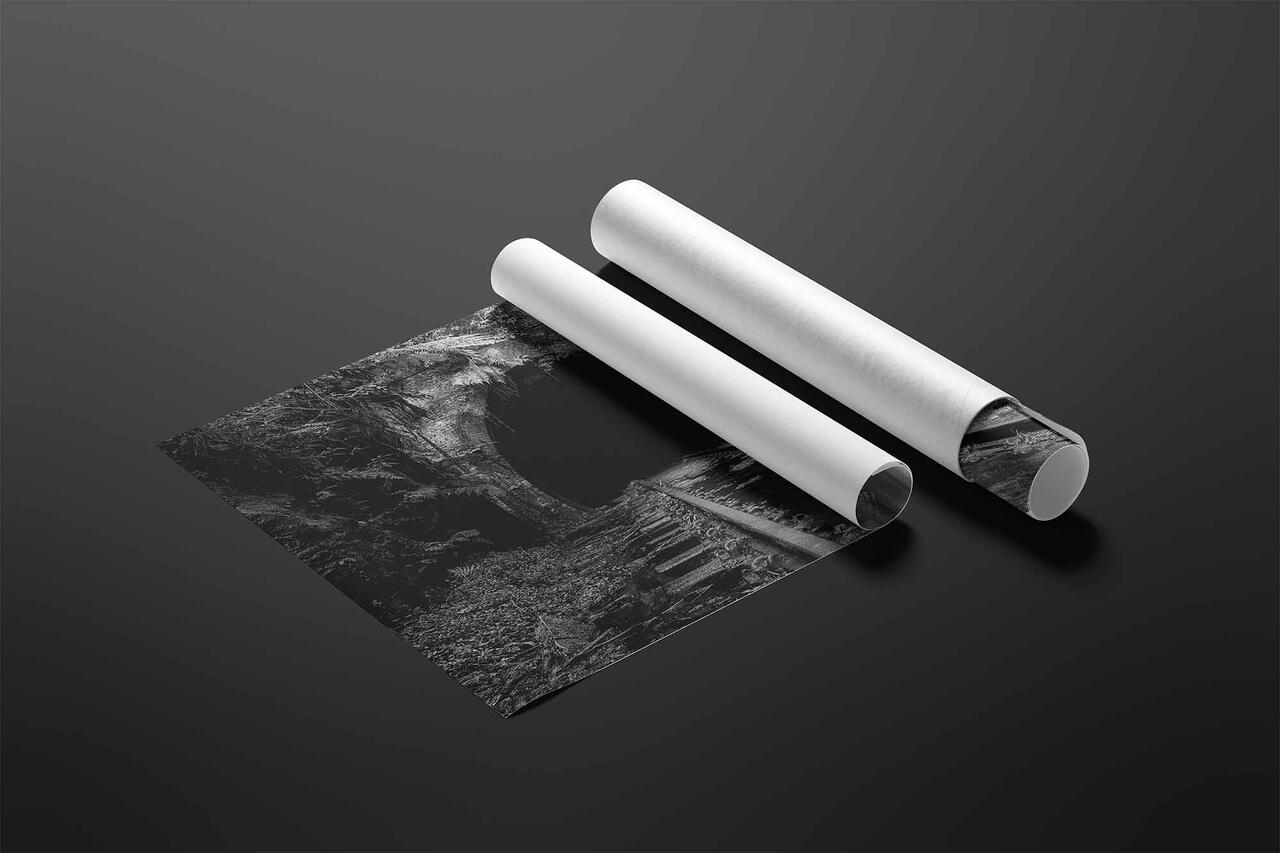
A 5:4 black and white photograph of a waterfall over the portal of a disused railway tunnel at Helensburgh, Australia, available as a limited edition print.
Artist's Story
The Metropolitan Tunnel runs 624 meters into the sandstone south of Sydney, in New South Wales. It opened in 1889 to carry coal and passengers on the Illawarra line, and it closed in 1915, when steam and soot had made it dangerous and the railway was rerouted through better tunnels nearby. On the day I was there a waterfall was pouring over the brick arch and the old rails ran straight into a dark that swallowed them.
I set up on the flooded track and let a long exposure smooth the falling water and the pooled reflection.
It is tempting to call a place like this abandoned and reclaimed by nature, and that is the story everyone tells about it. It is also not quite true. The tunnel was never given back. After the trains left, the colliery took it over as a reservoir, its far end plugged with concrete to hold water. And the darkness the rails run into is not empty. It holds one of the largest glow worm colonies in the state, enough that access is now restricted to protect them. This is not a ruin returning to wilderness. It is a piece of industrial infrastructure quietly doing a third and fourth job nobody designed it for.
Reclaimed is that arch and that dark, still in use, just not by us.
I made this one in black and white because color would have told you it was green and wet and let you stop there. Without it, you stay longer. I wrote about why the absence of color settles a scene in Why Black and White Fine Art Photography Feels So Calm.
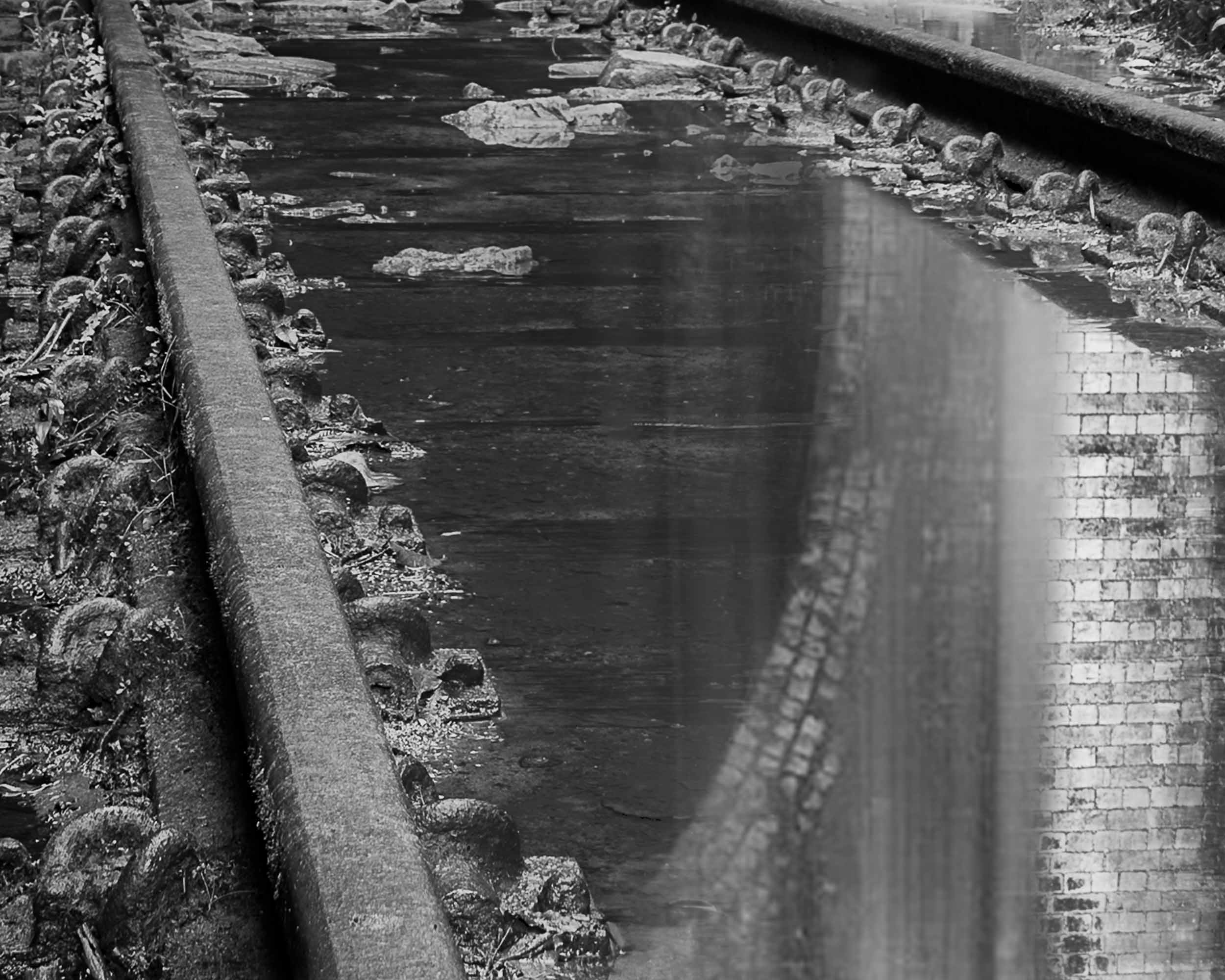
The flooded track, about a third of the frame width. The sleepers, the chairs holding the rail, and the arch coming back at you off the water. Click to view at full size.
About This Photograph
Photographed at the Metropolitan Tunnel, a disused railway tunnel at Helensburgh, south of Sydney in New South Wales, Australia. This is a single frame long exposure, rendered in black and white. The subject is the tunnel's brick portal with a waterfall running over the arch and the original track disappearing into the dark. The tunnel is 624 meters long, built as part of the Illawarra line extension south from Sutherland, opened on 1 January 1889, and closed in 1915 after steam and soot made it hazardous and the line was rerouted through new tunnels. The colliery later converted it to a water reservoir, plugging the southern end with concrete in 1928. It now holds one of the largest glow worm colonies in New South Wales, and access is restricted to protect them.
Reclaimed
Steve Austinhttps://www.steveaustinphotography.com/
Location
Metropolitan Tunnel, Helensburgh, New South Wales
Subject
The tunnel portal with a waterfall over the arch and track running into the dark
Capture
Single frame, long exposure from the flooded track, rendered in black and white
Format
Photograph · horizontal, 5:4
Sizes
20 × 16 in · 30 × 24 in · 40 × 32 in · 50 × 40 in
Print Media
TruLife Acrylic · ChromaLuxe Metal · Baryta paper
Edition
Limited, 25 / 50 / 100 by presentation
What it Does in a Room
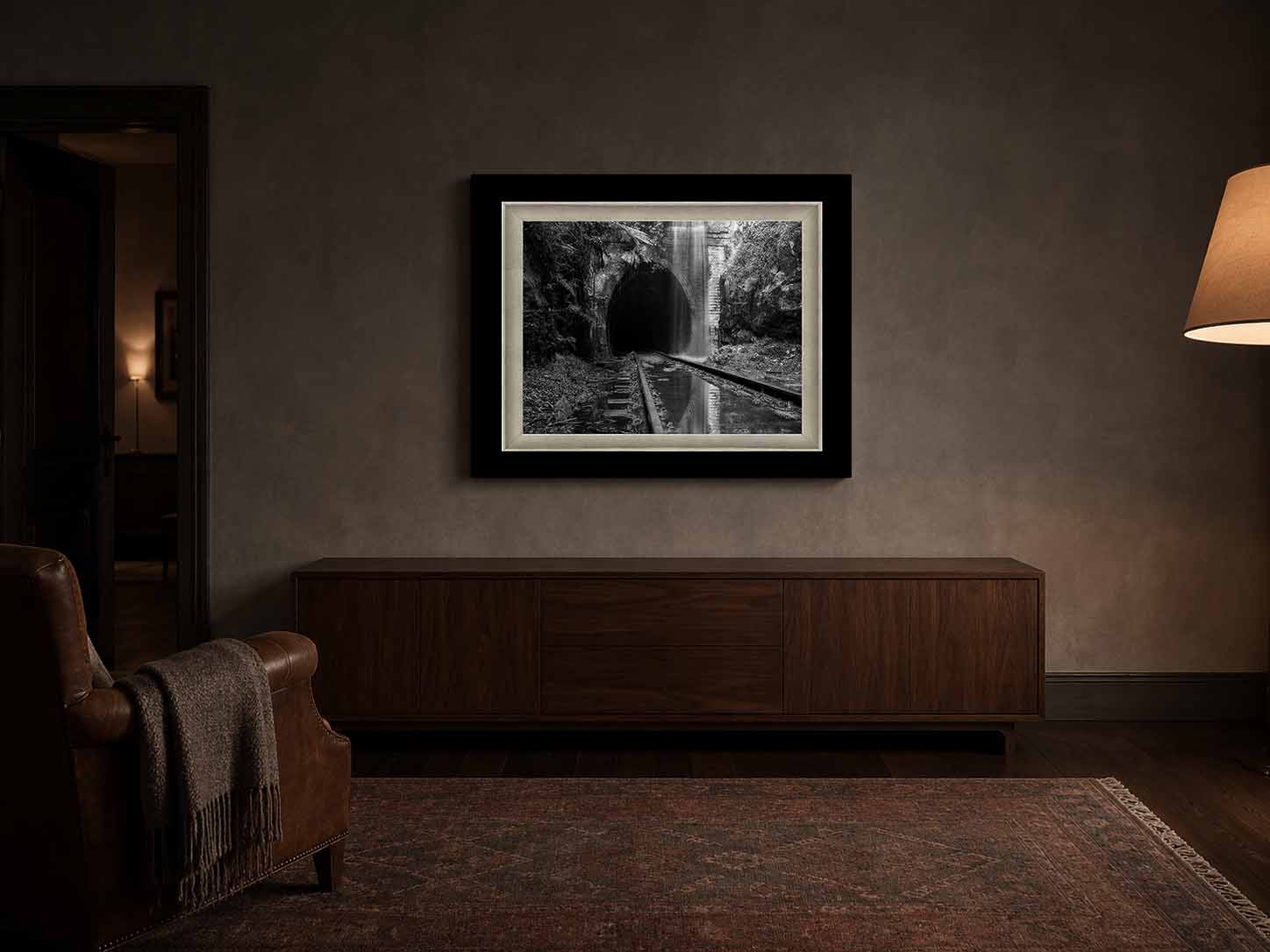
A photograph with a large area of true black in it does something no bright picture can. It gives a wall depth instead of surface.
Five to four is the oldest working proportion for a picture, and it behaves like one. A panorama extends a wall and sends the eye traveling along it. A shape this close to square gathers instead. Nothing pulls sideways, so the composition inside the frame is free to organize itself around a center, and the print reads as a single object on the wall rather than a span of one. Practically, it is the shape that fits where a wide piece cannot: above a console or a desk, between two doorways, over a mantel, on the short wall of a room. It does not need a long run of wall. It needs a center.
Here the center is a hole. The arch sits in the middle of the frame with the track running into it, and what fills that arch is nothing at all, the deepest black in the collection. That is what the proportion is holding: a boundary, and then an absence behind it. On a wall the effect is unusual and it does not wear off. The eye goes to the opening because it is the darkest thing in the room, finds nothing there, and comes back out along the rails. Most photographs give you somewhere to arrive. This one gives you somewhere that refuses to be arrived at, which is a stranger and more durable thing to live with.
This is by a wide margin the darkest photograph in the collection, with a quarter of the frame at or near true black, and that is the thing to plan for. It will not brighten a room and it does not try. What it does instead is anchor one, the way a dark object does, and it holds a wall with real weight even at modest size. Being black and white, it places anywhere: warm white plaster, gray, deep green, walnut or stone. Against a pale wall the contrast is dramatic and the arch reads as a cut through the surface. Against a dark wall the piece sits into the room and the waterfall becomes the only bright thing present, which is the quieter and, to my eye, the better of the two. What it rewards most is a light aimed at it, since almost all of the information in this photograph lives in the shadows.
Not sure which size the room calls for, or want dimensions not listed here? Sizes beyond 50 × 40 are available on request and ship crated by freight. That conversation is welcome before an order is placed. Start that conversation and I will answer within one business day.
At five to four, the Intimate size is twenty inches across and sixteen inches tall. That is a small piece, and it works where a small piece belongs: a narrow entry, a bookshelf wall, the wall beside a desk, a spot read from a few feet away. This photograph loses less than most at that scale, because its structure is an arch, a black opening, and two rails, and none of that depends on detail. What compresses is everything at the edges. The brickwork becomes texture rather than courses, the ferns and vines become a dark mass, and the sleepers under the water stop being separate objects. The Collected at thirty by twenty-four is the first size where the brick reads as brick. The Statement at forty by thirty-two and the Expansive at fifty by forty are where the arch takes on the scale of a real opening and the piece starts to behave like a doorway in the wall. If you are weighing a size against a specific wall, choosing the right print size covers the measurements and the viewing distances in more detail.
What changes at the largest size?
The shadows, which is where most of this photograph lives. At twenty by sixteen the dark areas are dark and that is all they are. At fifty by forty they open up. The voussoirs of the arch separate into individual bricks with the mortar lines between them. The masonry inside the mouth of the tunnel becomes visible for several meters before it goes, so the opening stops being a flat black shape and becomes a space with a distance in it. The flooded track resolves at the same time, into individual sleepers, the chairs and keys holding the rail, and the leaf litter lying under the water. The waterfall does the opposite, staying exactly as smooth as the long exposure made it, so the contrast between the softest thing in the frame and the most detailed grows rather than closes. This is a photograph where the largest size does not add drama. It adds evidence. Why scale matters covers what happens perceptually when a landscape reaches the size where the eye has to travel across it.
What kind of room does this photograph suit?
Almost any of them, because there is no color in it to agree or disagree with anything. What sets it apart is weight. A quarter of this frame is at or near true black, which makes it the darkest photograph in the collection and gives it presence out of all proportion to its size. It will not brighten a room. It anchors one. Warm white plaster, gray, deep green, walnut, and stone all work. Against a pale wall the arch reads as a cut through the surface and the contrast is dramatic. Against a dark wall the piece sits into the room and the waterfall becomes the only bright thing present, which is the quieter reading and the one I would choose. What it rewards most is a light aimed at it, since almost everything worth seeing here lives in the shadows and a dim room keeps it from you.
Every work ships insured and arrives with a signed certificate of authenticity.
If a piece is damaged in transit, the choice of replacement is always yours, and your edition number stays with you.
Production time runs 2 to 3 weeks for metal, 3 to 4 weeks for acrylic and paper, and 5 to 6 weeks for framed work.
Collector's Choice · TruLife ® Acrylic in Italian Frame
Collector Edition of 25· Lumachrome TruLife Acrylic · Handcrafted Italian Frame
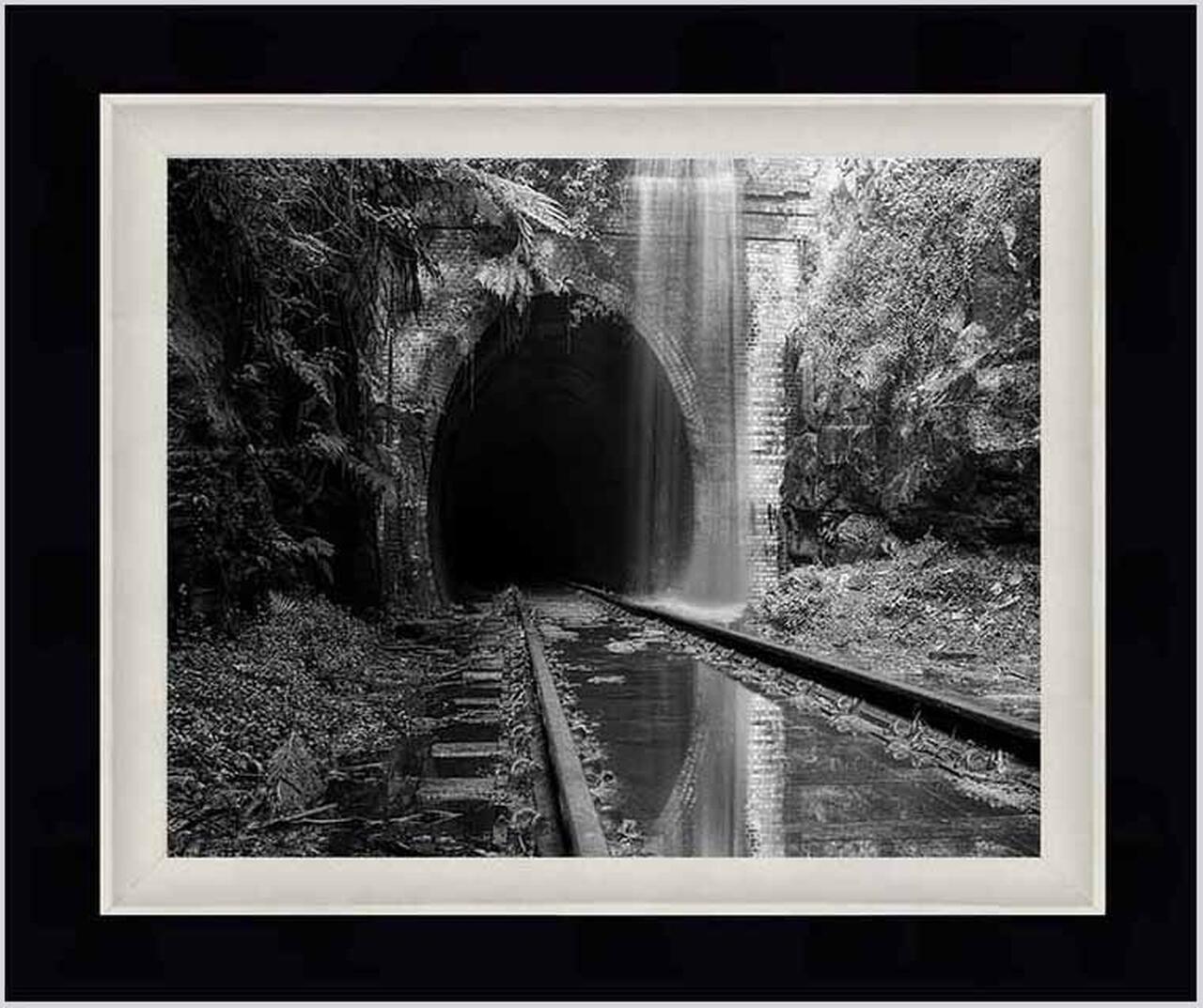
TruLife acrylic in a handcrafted Italian frame with a linen liner chosen for the image. Frame series, finish, and liner are settled with you after the order, and production begins from there. The frame and liner add about fourteen inches to the finished dimensions, worth allowing for when planning placement.
Signature Edition · TruLife ® Acrylic, Float Mount
Signature Edition of 50· Lumachrome TruLife Acrylic · Gallery Float Mount
Face-mounted to TruLife acrylic and floated approximately one inch from the wall, with no frame to mediate between the image and the room. UV-resistant, anti-reflective, and scratch-resistant, with a lifetime guarantee against fading.
Signature Edition of 50· ChromaLuxe Metal Print · Gallery Float Mount
Color infused into the aluminum panel itself, floated from the wall on a concealed system. Where acrylic produces luminosity, metal produces clarity. Exceptional fade resistance with no glazing or coating required.
Fine Art Edition of 100· Hahnemühle Baryta Fine Art Paper
Printed without acrylic, so light meets the paper surface directly. Highlights stay luminous, shadows keep their nuance, and the surface has a tactile quality the other presentations approach differently. The understated choice, and the traditional one.
Complimentary shipping within the continental United States. International collector shipping available upon request.
Still deciding
Designing for Stillness
A guide to choosing art for restorative spaces
How to tell whether an image will still hold you in a year, how scale changes what a photograph does in a room, and how to match a piece to the work a room actually performs. It cites the research it draws on, and it is equally clear about where that research stops. About ten minutes to read.