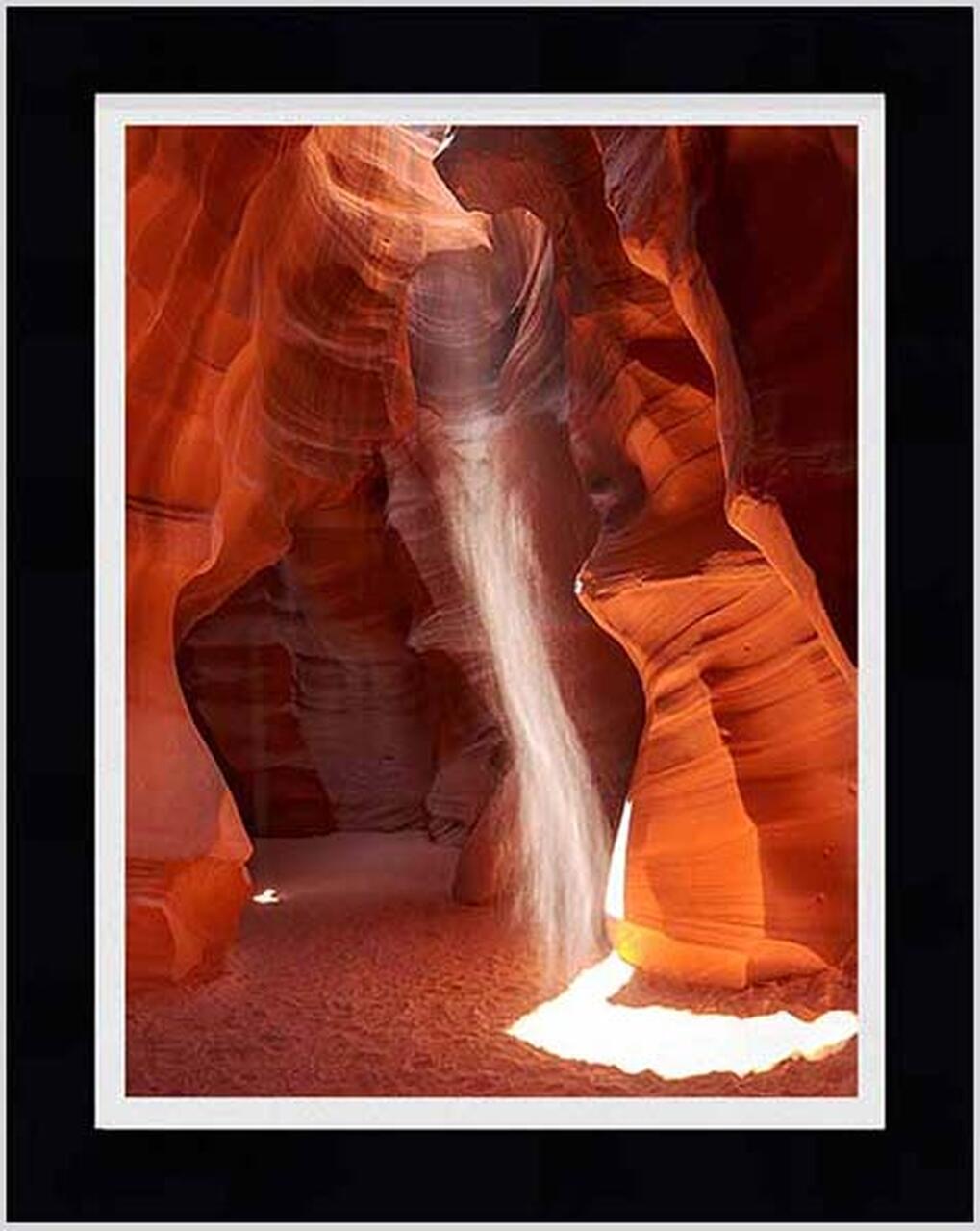
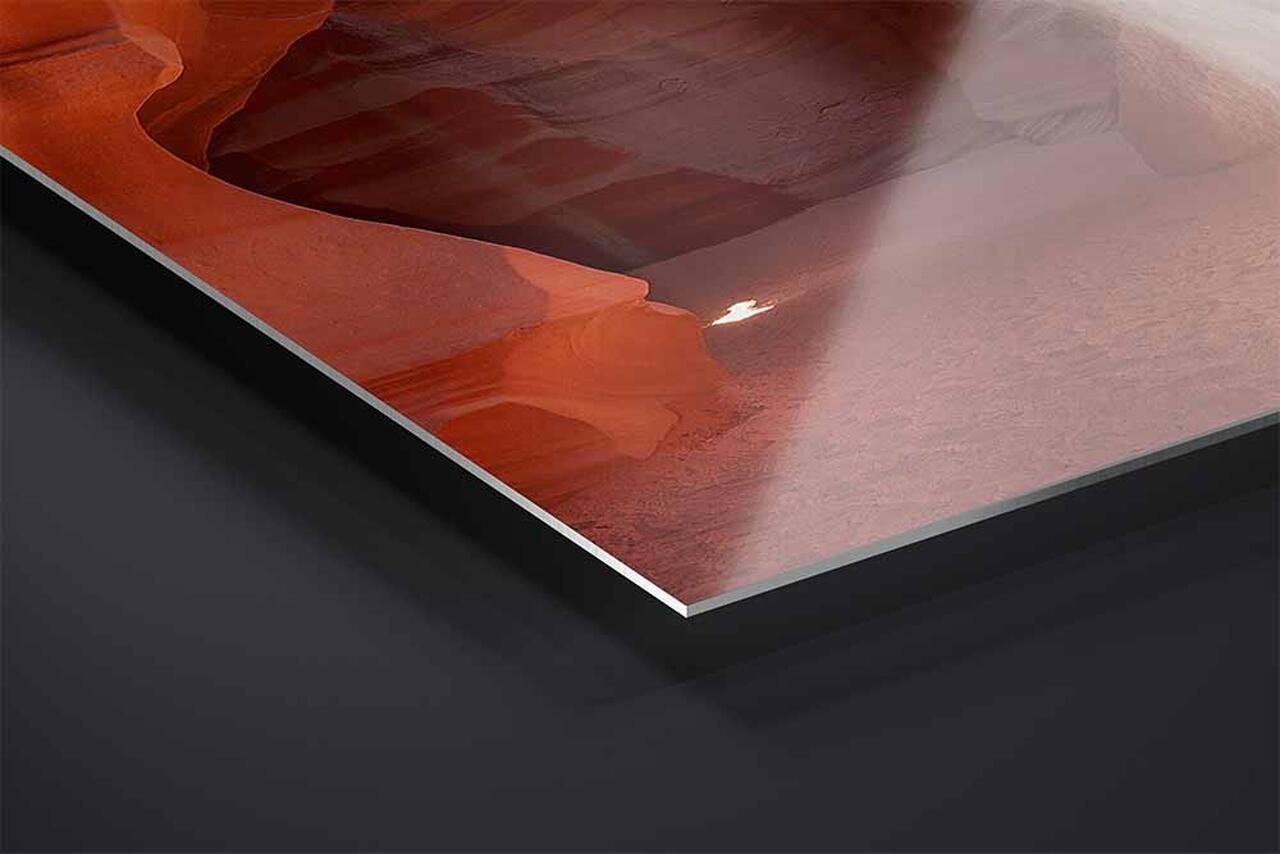
A 4:5 vertical photograph of a light beam falling through Upper Antelope Canyon, Arizona, available as a limited edition print in four sizes and four presentations.
Artist's Story
Antelope Canyon does not hold still. Cut over millions of years by floodwater working through Navajo Sandstone, its walls are a record of a landscape still in negotiation with time. What looks permanent is only slow.
I was there near midday, when the beam comes down through the slot, and our guide threw a cup of sand into it. I made the frame while it fell.
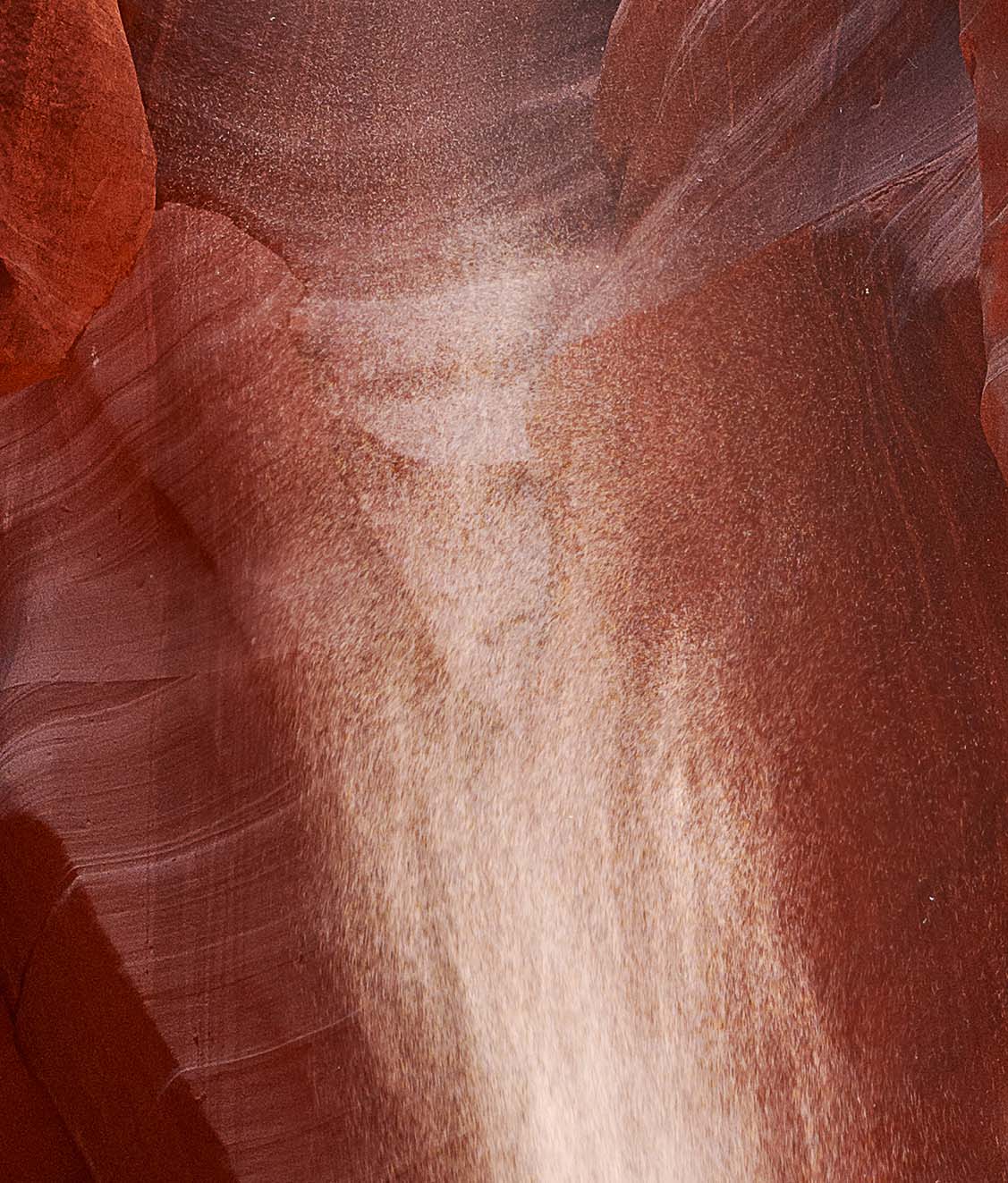
I did not see the figure. At the speed that sand was falling, no eye could have. I found it later on a screen, in a frame that had held a fraction of a second still: a shape with shoulders and what looked like the brim of a hat, standing in the light. It lasted less time than a blink, it was made of falling sand, and no one present witnessed it. The camera is not an extension of the eye. It is a different instrument with a different relationship to time, and now and then it brings back something nobody was there to see.
Shapeshifter is that fraction of a second. A figure that was never quite there, kept by a machine that does not blink.
Detail at full resolution, roughly one eighth of the frame width. The shoulders and the brim are near the top of the falling sand. The shape lasted less time than a blink and was not visible to anyone standing in the canyon.
About This Photograph
Upper Antelope Canyon lies near Page, Arizona, on the Navajo Nation, and is accessible only on a guided tour. The canyon is cut into Navajo Sandstone by floodwater working through a narrow fracture over a very long period, which is what produces the fluted, layered walls.
XXXXX
Steve Austinhttps://www.steveaustinphotography.com/
Location
Upper Antelope Canyon, Page, Arizona
Subject
Light beam · slot canyon · falling sand
Capture
Single frame, midday
Format
Photograph · vertical, 4:5
Sizes
16 × 20 in · 24 × 30 in · 32 × 40 in · 40 × 50 in
Print Media
TruLife Acrylic · ChromaLuxe Metal · Baryta paper
Edition
Limited, 25 / 50 / 100 by presentation
What it Does in a Room
A vertical photograph does something a wide one cannot. It gives the eye somewhere to fall.
Most rooms are built on horizontals. Countertops, sofa backs, windowsills, the line where the wall meets the floor. A tall frame cuts across all of it, and that interruption is the point. Where a panorama settles into a room and extends it sideways, a vertical stops the eye and turns it downward, or upward, along the length of the frame. At four to five the proportion is upright without being narrow, so the image still has width enough to hold a scene rather than a sliver of one. Practically, this is the shape that fits where a panorama will not: a chimney breast, the wall between two windows, a stairwell, a narrow entry. It does not need a long run of wall. It needs height.
Here the whole frame is a fall. The beam enters at the top, the sand comes down through it, and the light lands in a pool on the canyon floor at the bottom of the picture. The eye starts high and follows it down, which is the same direction the photograph itself was taken in, looking into a slot from above. Hung at standing height, that descent happens in front of you rather than on a wall, and the walls of the canyon close in on both sides the way they did in the place itself.
Not sure which size the room calls for, or want dimensions not listed here? Sizes beyond 40 × 50 are available on request and ship crated by freight. That conversation is welcome before an order is placed. Start that conversation and I will answer within one business day.
How small is too small for a photograph this tall?
At four to five, the Intimate size is sixteen inches across and twenty inches tall. That is a small piece by any measure, and it works where a small piece belongs: a narrow entry, a bookshelf wall, a powder room, a spot that is read from a few feet away rather than across a room. What it will not do is hold a large wall or carry a room on its own. The Collected at twenty-four by thirty is the first size that reads as a piece of art rather than as a framed picture, and the Statement and Expansive sizes are where the frame starts to behave like a window in the wall. If you are weighing a size against a specific wall, choosing the right print size covers the measurements and the viewing distances in more detail.
What changes at the largest size?
The figure is the answer, and it is not a small difference. The shape in the falling sand is subtle by nature, since it is made of grains suspended in light rather than of anything solid. At sixteen by twenty it is a slight thickening in the beam that most people will look past. At forty by fifty it is unmistakable. The rounded head, the darker band beneath it, the way the body dissolves back into falling sand below the shoulders, all of that resolves and stays resolved. The sandstone does the same thing on a longer scale. The cross-bedded striations in the canyon walls read as a general banding at the smaller sizes and as individual layers at the largest, each one a record of how the rock was laid down. This is the photograph in the collection where size changes what the image is about, not just how much of it you can see. Why scale matters covers what happens perceptually when a landscape reaches the size where the eye has to travel across it.
What kind of room does this photograph suit?
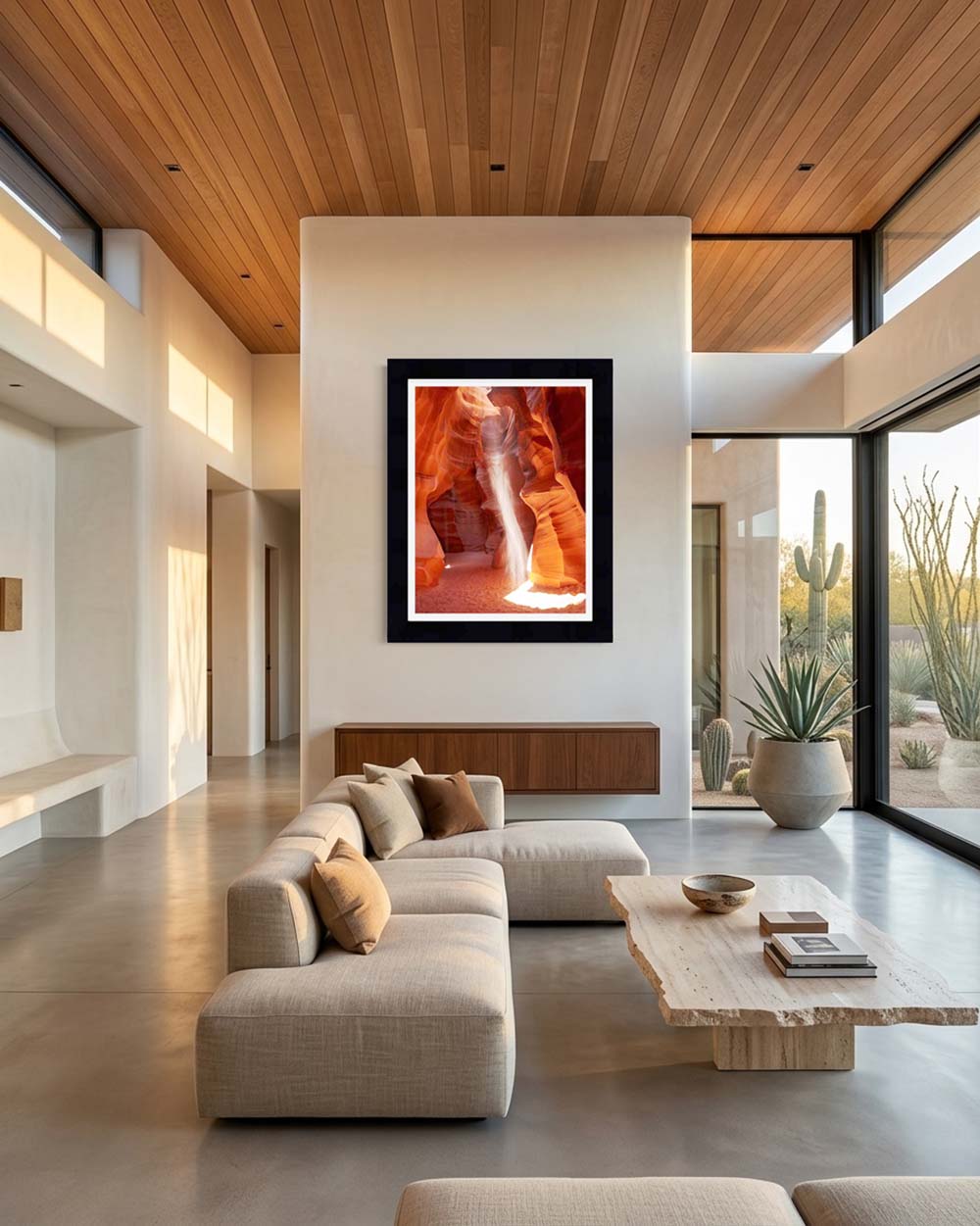
This is the most saturated image in the collection and it behaves accordingly. The frame runs orange and red end to end, with a single column of pale light through the center and no cool note anywhere in it. It does not blend into a color scheme, it sets one. That makes neutral rooms the natural home. Warm white plaster, oak, walnut, travertine, linen, concrete. Against those the image is the only color in the room and it holds the space without effort. Against a room that already has strong color, particularly blues or greens, the two will fight and the photograph will lose, since its color is the whole point of it. The value structure runs middle to dark with real weight in the shadowed rock, so this is not a piece that brightens a dim room, but the beam gives it an internal light source that most dark images do not have, and that holds up in lower light better than you would expect. The one thing it asks for is height. It is a tall frame built on a downward fall, and it wants a wall that lets that fall happen: a chimney breast, a pier between windows, a stairwell, an entry.
Every work ships insured and arrives with a signed certificate of authenticity.
If a piece is damaged in transit, the choice of replacement is always yours, and your edition number stays with you.
Production time runs 2 to 3 weeks for metal, 3 to 4 weeks for acrylic and paper, and 5 to 6 weeks for framed work.
Each print is made to order and takes its place in a numbered edition, so sales are final. Before you choose, I am glad to help: send a photo of your wall and I will show you this work in your room at true scale, at no charge. Start a conversation
Collector's Choice · TruLife ® Acrylic in Italian Frame
Collector Edition of 25· Lumachrome TruLife Acrylic · Handcrafted Italian Frame
TruLife acrylic in a handcrafted Italian frame with a linen liner chosen for the image. Frame series, finish, and liner are settled with you after the order, and production begins from there. The frame and liner add about fourteen inches to the finished dimensions, worth allowing for when planning placement.
Signature Acrylic Edition of 50· Lumachrome TruLife · Gallery Float Mount
Face-mounted to TruLife acrylic and floated approximately one inch from the wall, with no frame to mediate between the image and the room. UV-resistant, anti-reflective, and scratch-resistant, with a lifetime guarantee against fading.
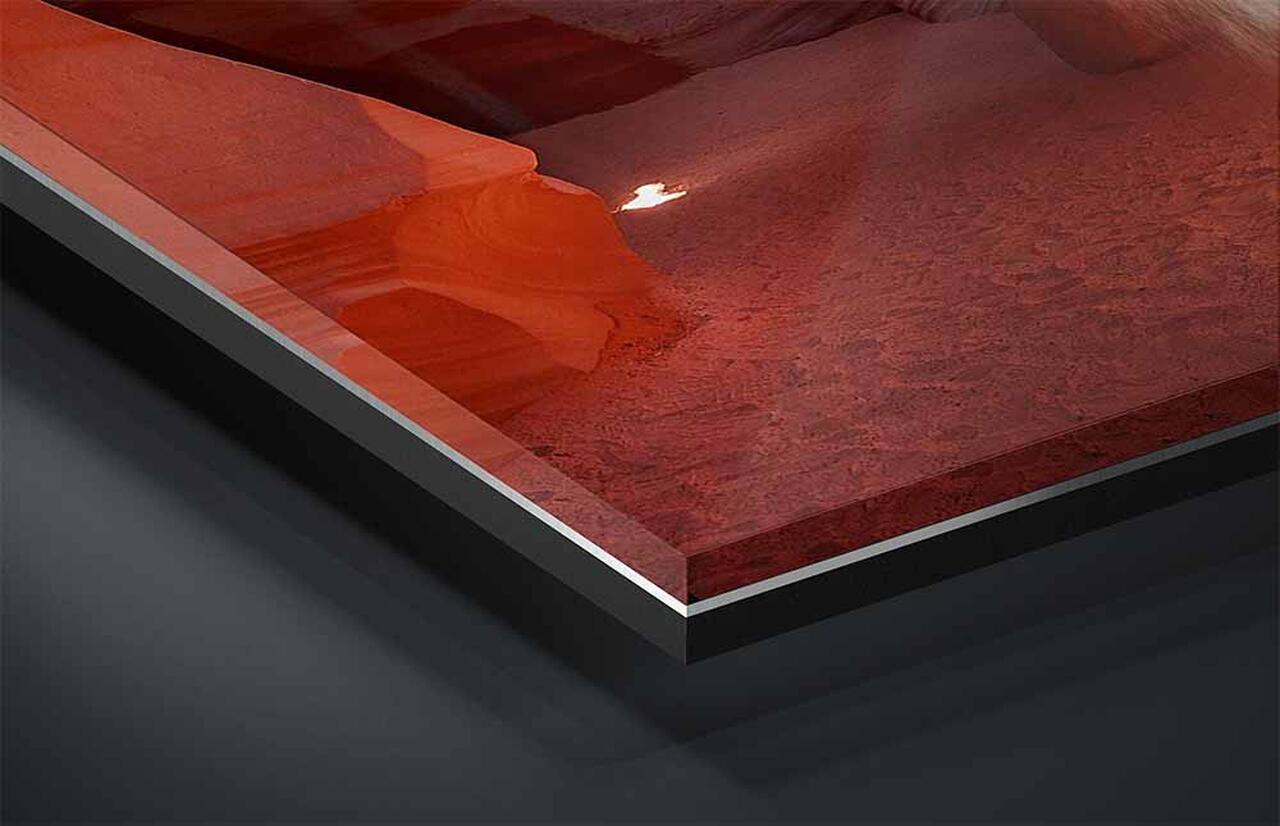
Signature Metal Edition of 50· ChromaLuxe Print · Gallery Float Mount
Color infused into the aluminum panel itself, floated from the wall on a concealed system. Where acrylic produces luminosity, metal produces clarity. Exceptional fade resistance with no glazing or coating required.
Fine Art Edition of 100· Hahnemühle Baryta Fine Art Paper
Printed without acrylic, so light meets the paper surface directly. Highlights stay luminous, shadows keep their nuance, and the surface has a tactile quality the other presentations approach differently. The understated choice, and the traditional one.
Complimentary shipping within the continental United States. International collector shipping available upon request.
Still deciding
Designing for Stillness
A guide to choosing art for restorative spaces
How to tell whether an image will still hold you in a year, how scale changes what a photograph does in a room, and how to match a piece to the work a room actually performs. It cites the research it draws on, and it is equally clear about where that research stops. About ten minutes to read.