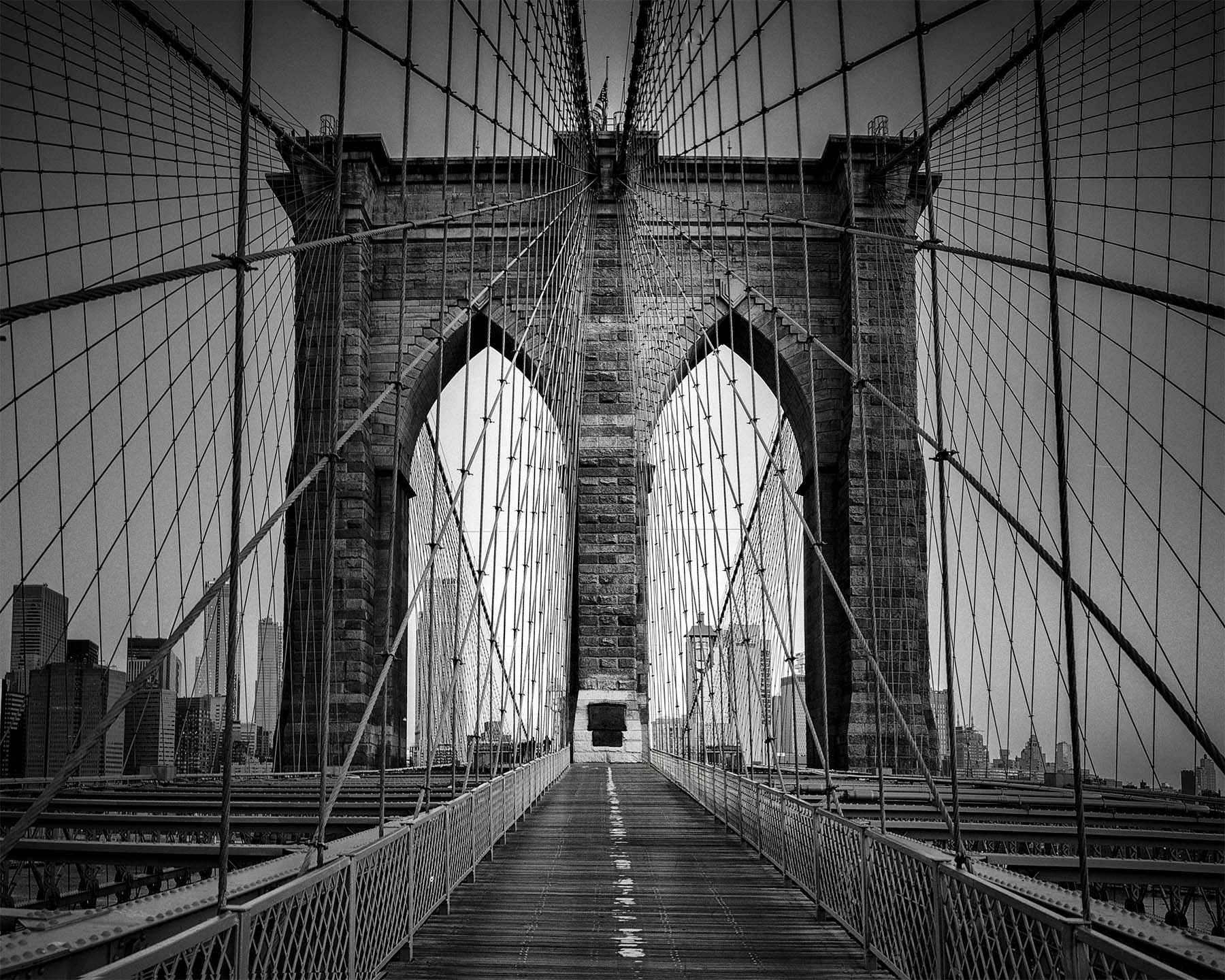
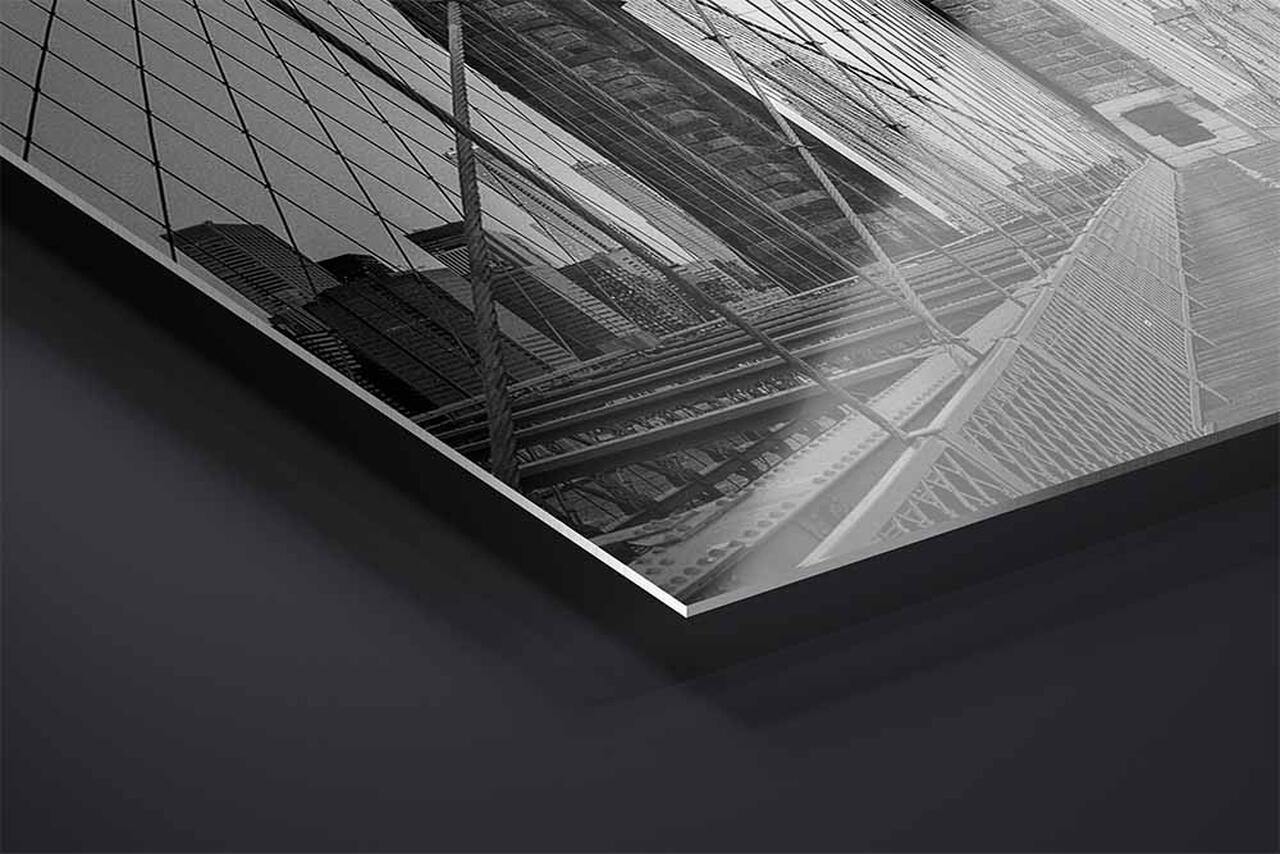
A 5:4 horizontal black and white photograph of the Gothic arches of a Brooklyn Bridge tower, available as a limited edition print in four sizes and four presentations.
Artist's Story
On the Brooklyn Bridge, the walkway passes beneath two pointed arches cut through a tower of granite and limestone. They are neo-Gothic, and they are not ornament. A pointed arch carries load down through masonry more steeply than a round one, which is why cathedral builders spent four centuries refining the shape. John Roebling used it for the same reason they did. It holds.
He never saw it built. He died of tetanus in 1869, before the first stone went down. His son Washington took over and was struck down by caisson disease in the third year, left partly paralyzed in a room in Brooklyn Heights. Washington's wife Emily taught herself the mathematics of hanging cable and ran the site for eleven years. At least twenty men died building it. The possessive in the title is doing a great deal of quiet work.
I walked out at first light and waited for a gap in the few people already up there, making the frame in the seconds the walkway came clear.
Stand under a tall vaulted opening and something in the body responds. The gaze lifts. The sense of the space around you opens out. It is a reliable effect, and it has nothing to do with what anyone intended by it. Roebling was solving a problem in compression. The reverence is a byproduct of the solution, and knowing that has never once reduced it for me.
Roebling's Cathedral is that old shape, borrowed for load and doing its other work anyway, over a walkway in New York.
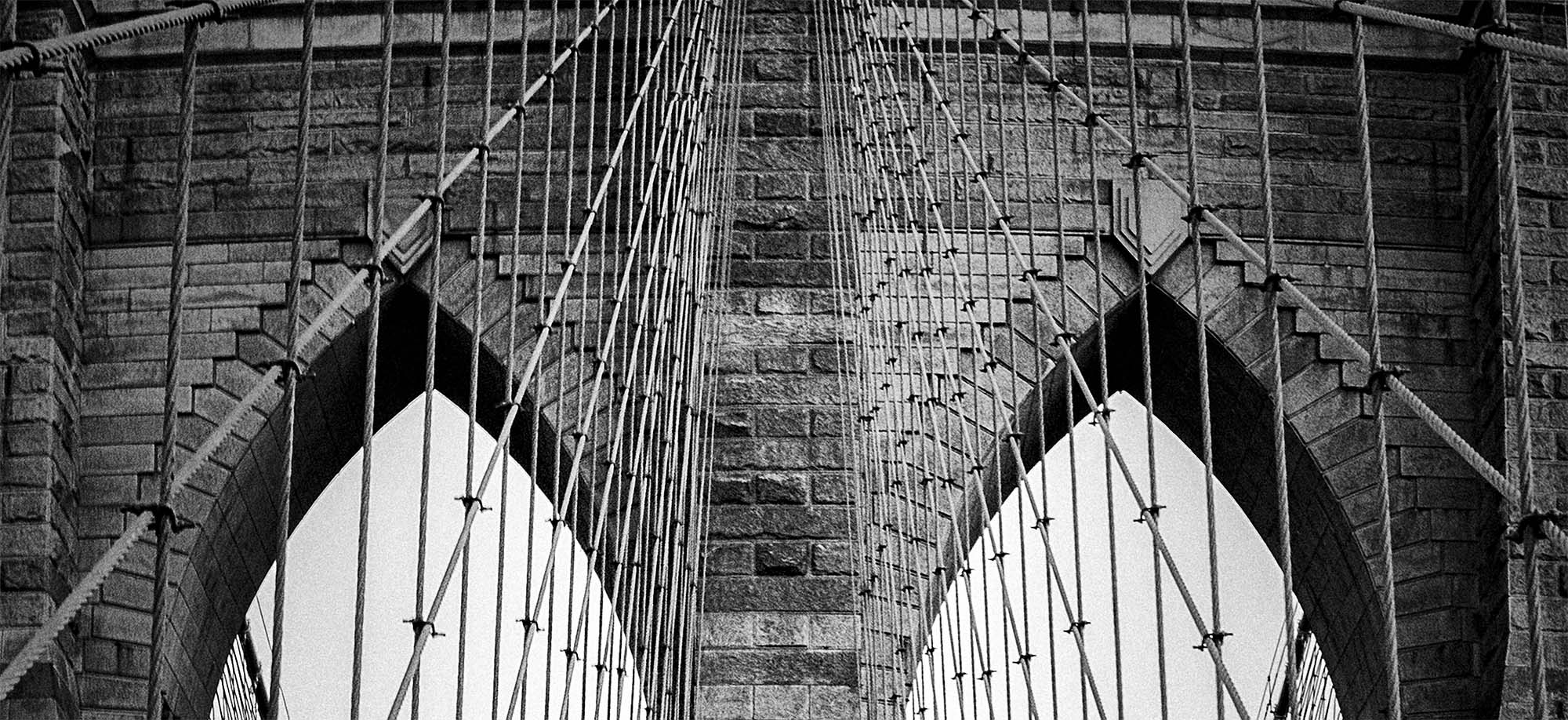
The crown of the left arch, about one fifth of the frame width. The pointed apex, the stepped stones turning the load down into the pier, and the suspender cables crossing in front of them. Click to view at full size.
About This Photograph
Photographed from the pedestrian promenade of the Brooklyn Bridge in New York City, looking along the walkway to the tower ahead, in the early morning. This is a single frame image, rendered in black and white. The subject is the Brooklyn Bridge, designed by John A. Roebling and opened on May 24, 1883. It was the first suspension bridge built with steel wire cable, and its main span of 1,595.5 feet ran roughly fifty percent longer than any suspension bridge before it. The towers rise 276.5 feet above the water, built of limestone, granite, and Rosendale cement, each one pierced by a pair of pointed Gothic arches over the passageways below. Construction ran from 1870 to 1883 and cost at least twenty lives. Presented as a horizontal print, offered as an archival limited edition from 20 by 16 inches to 50 by 40 inches on acrylic, metal, or archival paper.
XXXXX
Steve Austinhttps://www.steveaustinphotography.com/
Location
Brooklyn Bridge Promenade, New York, New York
Subject
Brooklyn Bridge tower arches, from the pedestrian promenade
Capture
Single frame, early morning
Format
Horizontal · 5:4
Sizes
20 × 16 in · 30 × 24 in · 40 × 32 in · 50 × 40 in
Print Media
TruLife Acrylic · ChromaLuxe Metal · Baryta paper
Edition
Limited, 25 / 50 / 100 by presentation
What it Does in a Room
A photograph only slightly wider than it is tall does something a panorama cannot. It stays in one place.
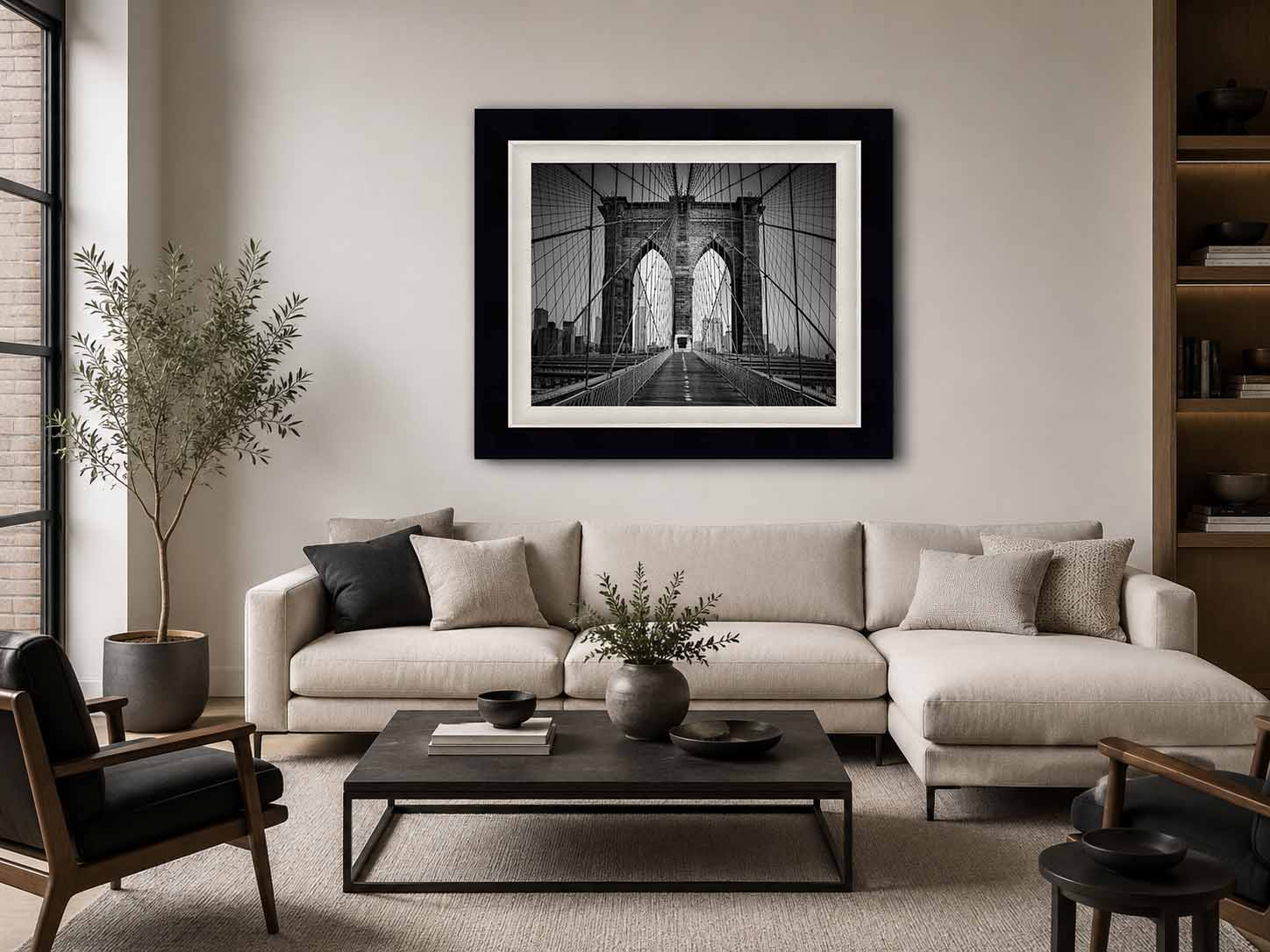
Five to four is the oldest working proportion for a picture, and it behaves like one. A panorama extends a wall and sends the eye traveling along it. A shape this close to square gathers instead. Nothing pulls sideways, so the composition inside the frame is free to organize itself around a center, and the print reads as a single object on the wall rather than a span of one. That containment is why the proportion has outlasted every fashion since panel painting, and why it still turns up as the eight by ten plate and the sixteen by twenty frame. Practically, it is the shape that fits where a wide piece cannot: above a console or a desk, between two doorways, over a mantel, on the short wall of a room. It does not need a long run of wall. It needs a center.
Here the center is literal. The frame is symmetrical to a degree that is rare outside architecture, and symmetry is quieting. The eye finds the middle immediately, follows the walkway down to the base of the tower, then rises through the arches, and that sequence repeats every time someone looks. Because the walkway runs straight out of the picture at the viewer's feet, what it rewards most is a wall people walk toward: the end of a hallway, the far side of an entry, a stair landing, the wall across from a door. In those places the perspective agrees with the way the body is already moving. The picture also holds its own edges, dark at the perimeter and bright through the arches, so it separates cleanly on a pale wall and on a dark one. From across the room it reads as two arches and a vanishing line. From arm's length it becomes hundreds of individually resolved cables and the courses of the masonry behind them, which is reason enough to hang it where both distances happen.
Not sure which size the room calls for, or want dimensions not listed here? Sizes beyond 50 × 40 are available on request and ship crated by freight. That conversation is welcome before an order is placed. Start that conversation and I will answer within one business day.
How small is too small for a photograph built on this much detail?
At five to four, the Intimate size is twenty inches across and sixteen inches tall. That is a small piece by any measure, and it works where a small piece belongs: a narrow entry, a bookshelf wall, the wall beside a desk, a spot that is read from a few feet away rather than across a room. At that size the arches and the walkway hold, and the cable web reads as texture rather than as individual lines. The Collected at thirty by twenty-four is the first size where the cables separate into countable strands, and it is also the first size that reads as a piece of art rather than as a framed picture. The Statement and Expansive sizes are where the frame starts to behave like an opening in the wall and the tower takes on something close to its real presence. If you are weighing a size against a specific wall, choosing the right print size covers the measurements and the viewing distances in more detail.
What changes at the largest size?
The cable web and the stone behind it, and the change is not subtle. Look at the pier between the two arches, where the suspender cables cross the masonry. At twenty by sixteen that region reads as a general weave over a gray wall. At fifty by forty the cables separate into individual strands, each one holding its own edge against the stone, and you can follow a single line from the walkway rail up to the point where it disappears behind the tower. The masonry resolves at the same time. The courses become distinct, the joints appear, and the surface variation from block to block turns into something you can actually read. Those two things sit in the same part of the frame, which means the largest sizes give you the machine and the wall it hangs from at once, in the same glance. This is the photograph where size changes how much of the engineering you can see, and the engineering is the subject. Why scale matters covers what happens perceptually when an image reaches the size where the eye has to travel across it.
What kind of room does this photograph suit?
More rooms than you might expect, because there is no color in it to agree or disagree with anything. This is a black and white photograph with a full range, dark and weighted at its edges and bright to the point of paper white through the arches, which means it separates on a pale wall and on a dark one alike. Warm white plaster, gray, deep green, walnut, stone, exposed brick all work. Rooms with architecture of their own tend to gain the most, since the picture is architecture and the two reinforce each other. A visible stair, a coffered ceiling, a stone surround, a heavy door frame. What it rewards most is a wall people walk toward. The walkway runs straight out of the frame at the viewer's feet, so the perspective agrees with anyone approaching it, which makes the end of a hallway, the far side of an entry, a stair landing, or the wall across from an office door the placements where the photograph does the most work. Hung to the side of a room it still holds, and gives up some of that effect.
Every work ships insured and arrives with a signed certificate of authenticity.
If a piece is damaged in transit, the choice of replacement is always yours, and your edition number stays with you.
Production time runs 2 to 3 weeks for metal, 3 to 4 weeks for acrylic and paper, and 5 to 6 weeks for framed work.
Each print is made to order and takes its place in a numbered edition, so sales are final. Before you choose, I am glad to help: send a photo of your wall and I will show you this work in your room at true scale, at no charge. Start a conversation
Collector's Choice · TruLife ® Acrylic in Italian Frame
Collector Edition of 25· Lumachrome TruLife Acrylic · Handcrafted Italian Frame
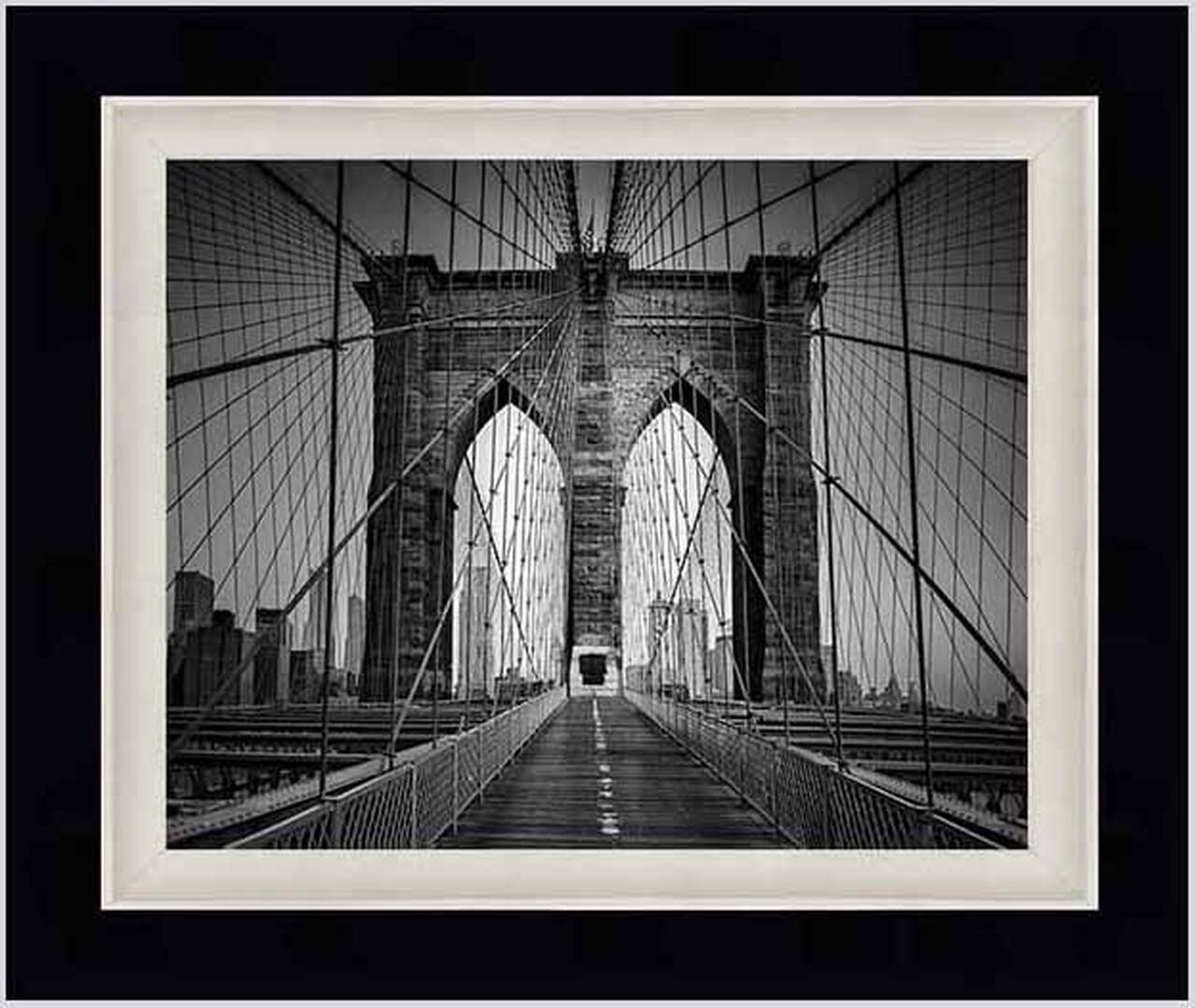
TruLife acrylic in a handcrafted Italian frame with a linen liner chosen for the image. Frame series, finish, and liner are settled with you after the order, and production begins from there. The frame and liner add about fourteen inches to the finished dimensions, worth allowing for when planning placement.
Signature Acrylic Edition of 50· Lumachrome TruLife · Gallery Float Mount
Face-mounted to TruLife acrylic and floated approximately one inch from the wall, with no frame to mediate between the image and the room. UV-resistant, anti-reflective, and scratch-resistant, with a lifetime guarantee against fading.
Signature Metal Edition of 50· ChromaLuxe Print · Gallery Float Mount
Color infused into the aluminum panel itself, floated from the wall on a concealed system. Where acrylic produces luminosity, metal produces clarity. Exceptional fade resistance with no glazing or coating required.
Fine Art Edition of 100· Hahnemühle Baryta Fine Art Paper
Printed without acrylic, so light meets the paper surface directly. Highlights stay luminous, shadows keep their nuance, and the surface has a tactile quality the other presentations approach differently. The understated choice, and the traditional one.
Complimentary shipping within the continental United States. International collector shipping available upon request.
Still deciding
Designing for Stillness
A guide to choosing art for restorative spaces
How to tell whether an image will still hold you in a year, how scale changes what a photograph does in a room, and how to match a piece to the work a room actually performs. It cites the research it draws on, and it is equally clear about where that research stops. About ten minutes to read.