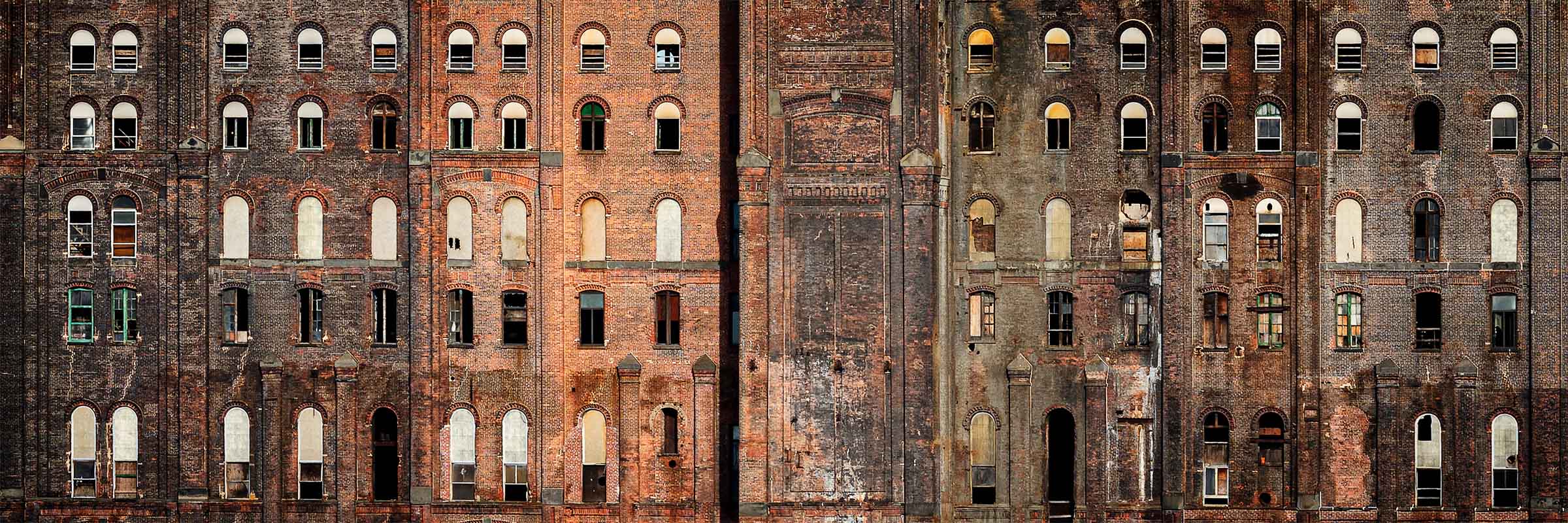
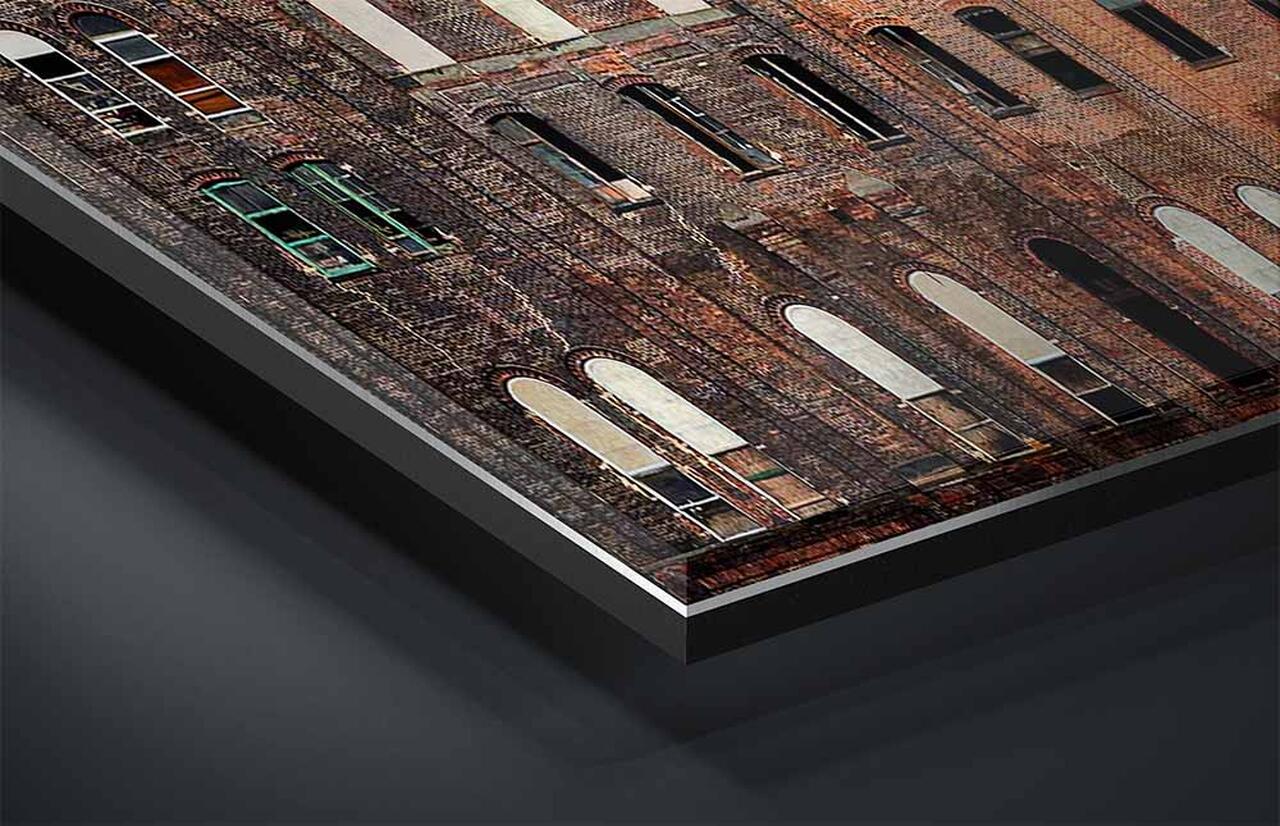
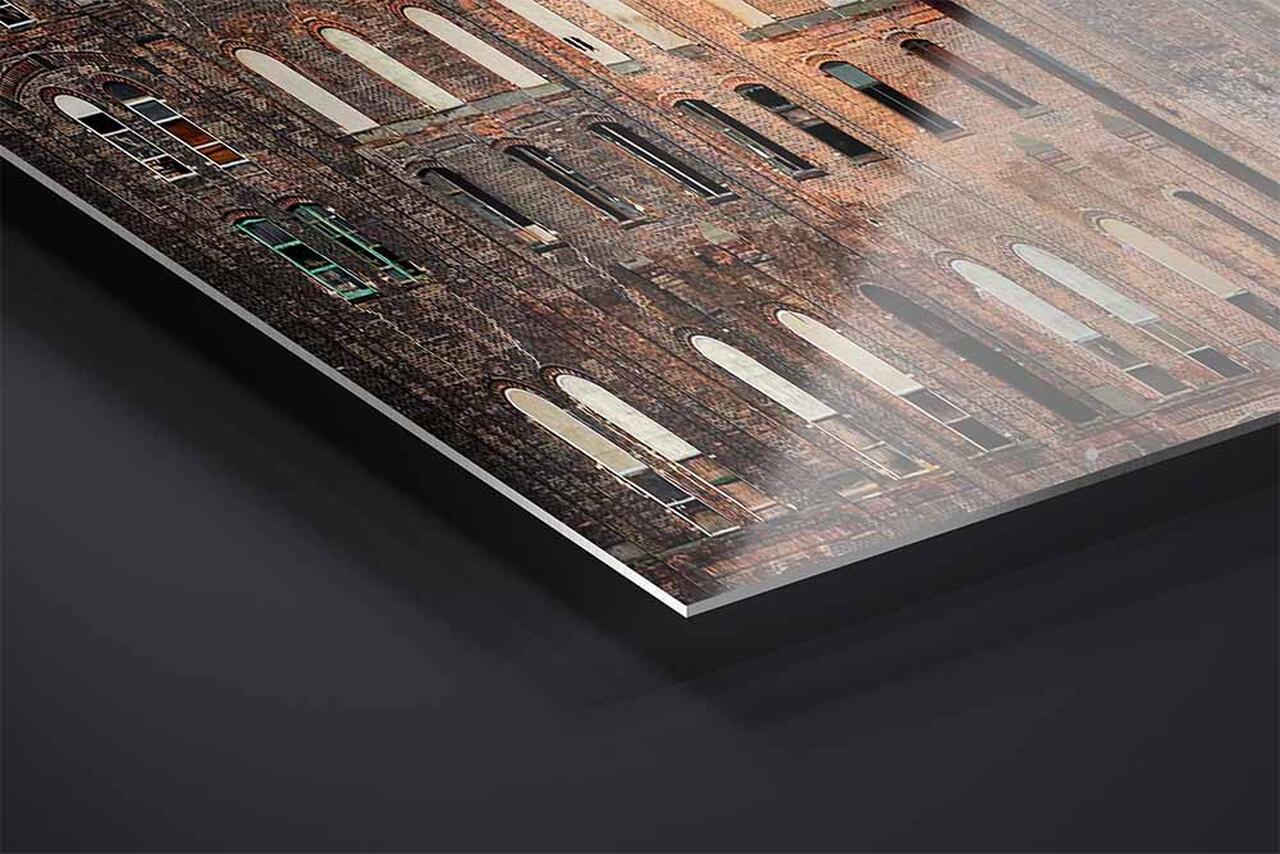
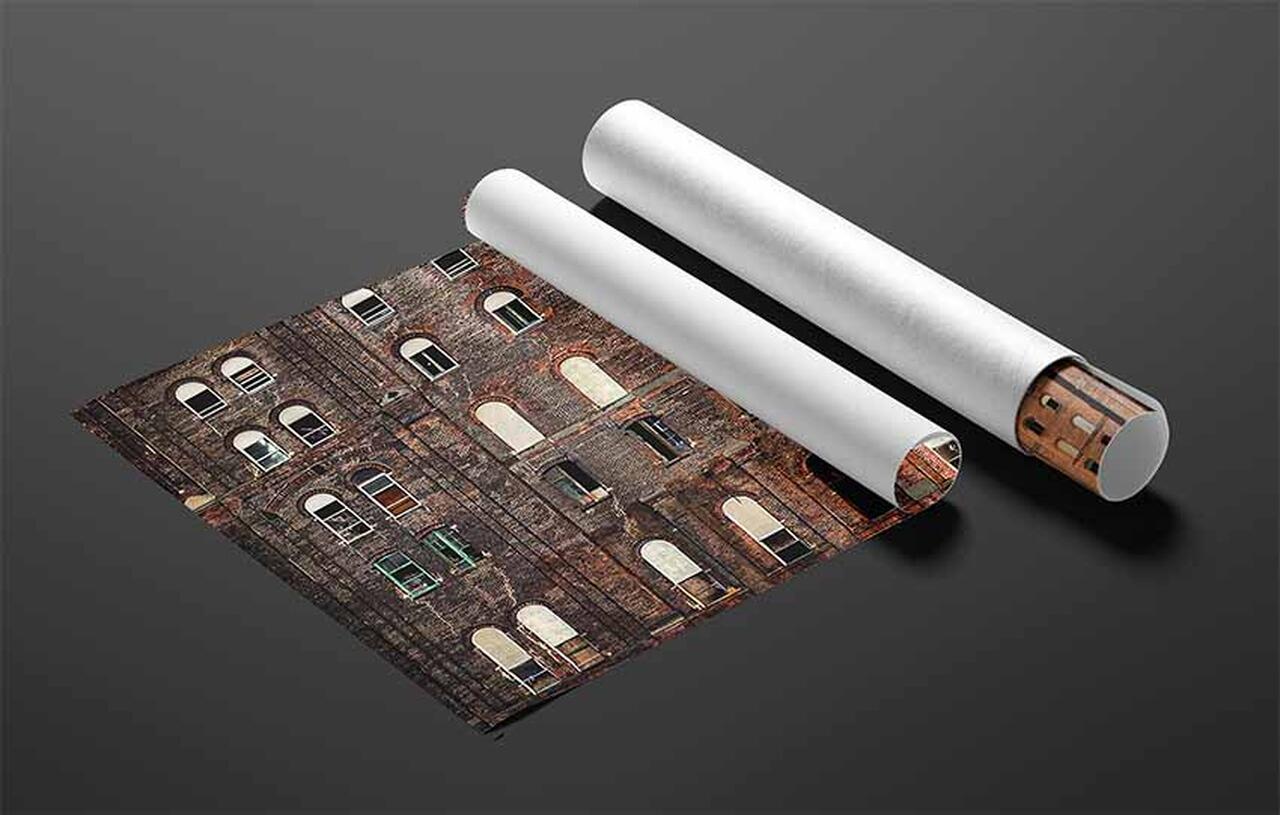
A 3:1 panoramic photograph of the Domino Sugar Refinery's brick facade and arched windows, Williamsburg, Brooklyn, New York, available as a limited edition print in three sizes.
Artist's Story
I went in the summer of 2018 because I knew the building was about to be restored and I wanted it in the state it had weathered into. I photographed it from across the East River with a long lens, which is why the wall reads dead flat: no leaning, no convergence, every window the same size from the bottom course to the top.
Everything that was inside it came out through those openings.
The facade was designated a New York City landmark in 2007, which meant it could not be breached. The interior was another matter. The refining plant, the stainless syrup tanks, a century of machinery, all of it had to go, and none of it could leave through the wall. A small team spent a few years cutting the works into pieces small enough to pass through the arched openings in this frame and carrying them out at ground level. The windows set the maximum size of anything that could get out.
What went in afterward went in the same way. A crane was assembled inside the hollowed shell and a fifteen-storey glass building was put up within it, standing free, set back about twelve feet from the brick on every side. The wall was left exactly where it was.
What Was Kept is the face of a refinery that outlived everything it was built to hold, photographed while it still carried the soot.
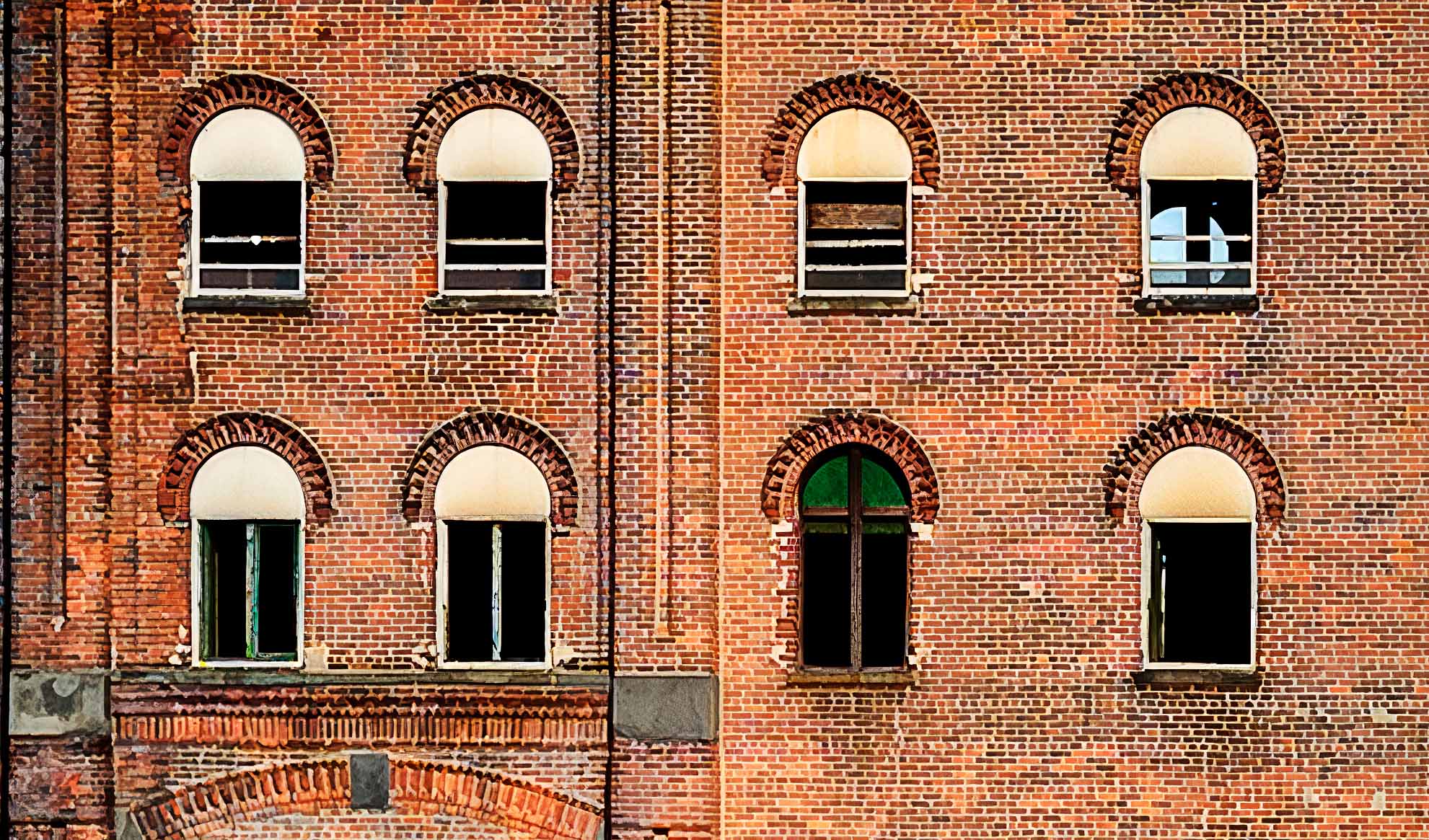
This crop is 24 percent of the frame width, about 22 inches across on the 90 inch print. Over each opening the voussoirs read as individual wedge-cut bricks fanning out to carry the wall above. The boarded windows show their planks and the gaps between them, and where the glass has gone the surviving sash is legible, green paint still on it in two of the openings. Along the lower left a corbelled course steps out from the wall. Click to view at full size.
About This Photograph
The Havemeyers and Elder Filter, Pan and Finishing House on the Williamsburg waterfront in Brooklyn, long known as the Domino Sugar Refinery, photographed in 2018 from across the East River under flat overcast light. Single frame. Built between 1881 and 1884 to a design led by Theodore A. Havemeyer after fire destroyed the earlier works, it rose to roughly 155 feet, closed in 2004, and was landmarked in 2007.
The arches are structural before they are decorative. A load-bearing brick wall cannot simply have holes cut in it. Something has to carry the masonry above every opening, and before steel lintels were cheap and plentiful that something was an arch. There are dozens of them in this frame alone, and the Romanesque Revival manner the building is usually described in follows from the way it had to be built rather than from a preference.
What Remains
Steve Austinhttps://www.steveaustinphotography.com/
Location
Williamsburg, Brooklyn, New York, United States
Subject
Domino Sugar Refinery · brick facade · arched windows
Capture
Single frame, midday
Format
Photograph · horizontal panorama, 3:1
Sizes
36 × 12 in · 60 × 20 in · 90 × 30 in
Print Media
TruLife Acrylic · ChromaLuxe Metal · Baryta paper
Edition
Limited, 25 / 50 / 100 by presentation
What it Does in a Room
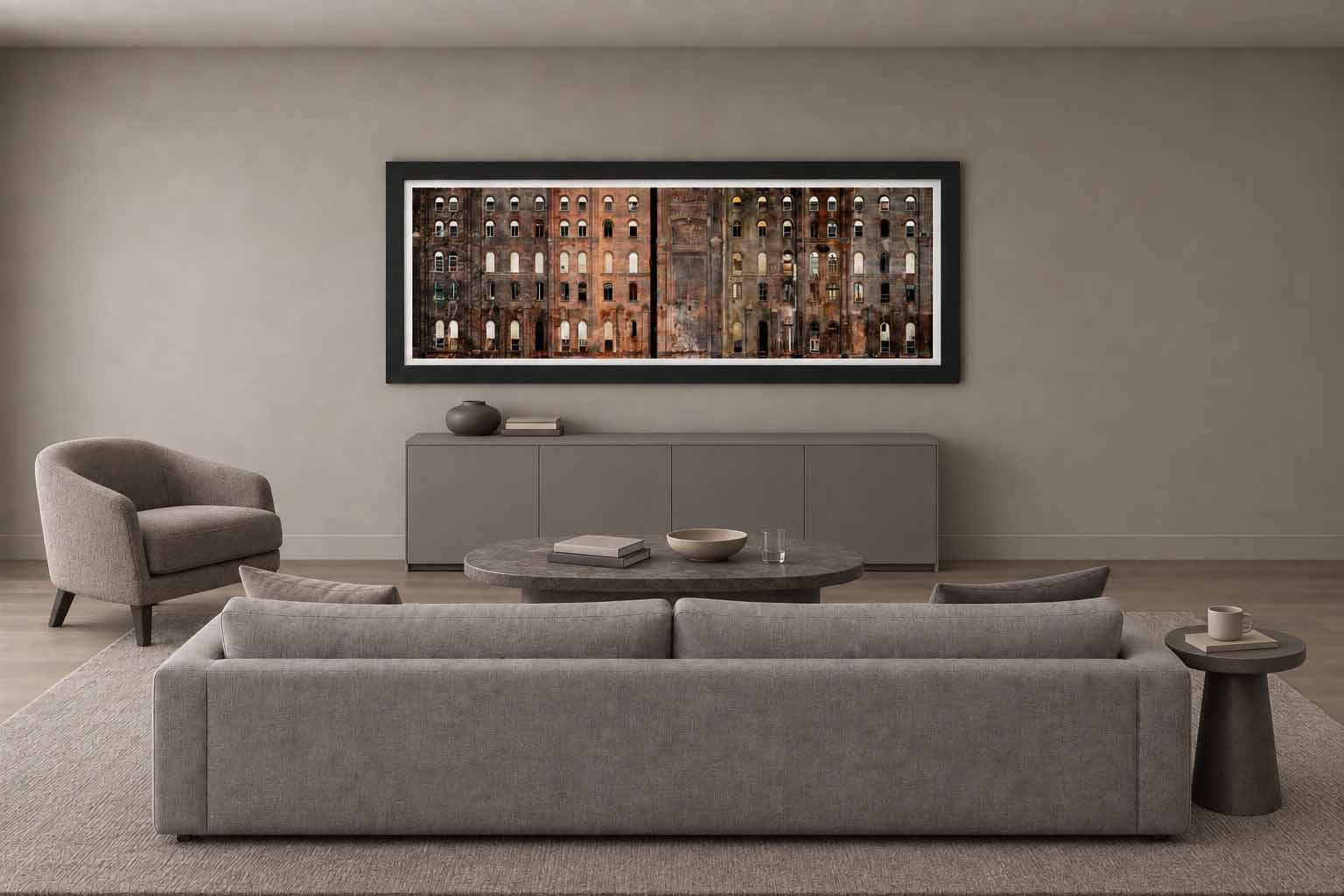
This is a photograph of a wall, and it will be hung on a wall. That sounds trivial and it is not. Almost every photograph asks a wall to pretend it is not there: a landscape behaves as an opening, a view onto somewhere else, and the flatter and plainer the wall around it the better that illusion holds. This picture makes no such claim. It was taken square on from a long way off, so there is no perspective in it and no depth to speak of, and what it presents is a plane. It agrees with the surface it hangs on rather than contradicting it. The practical consequence is that it is the one piece here that can go on a wall with character, plaster with texture, a pigmented or uneven finish, without the two fighting.
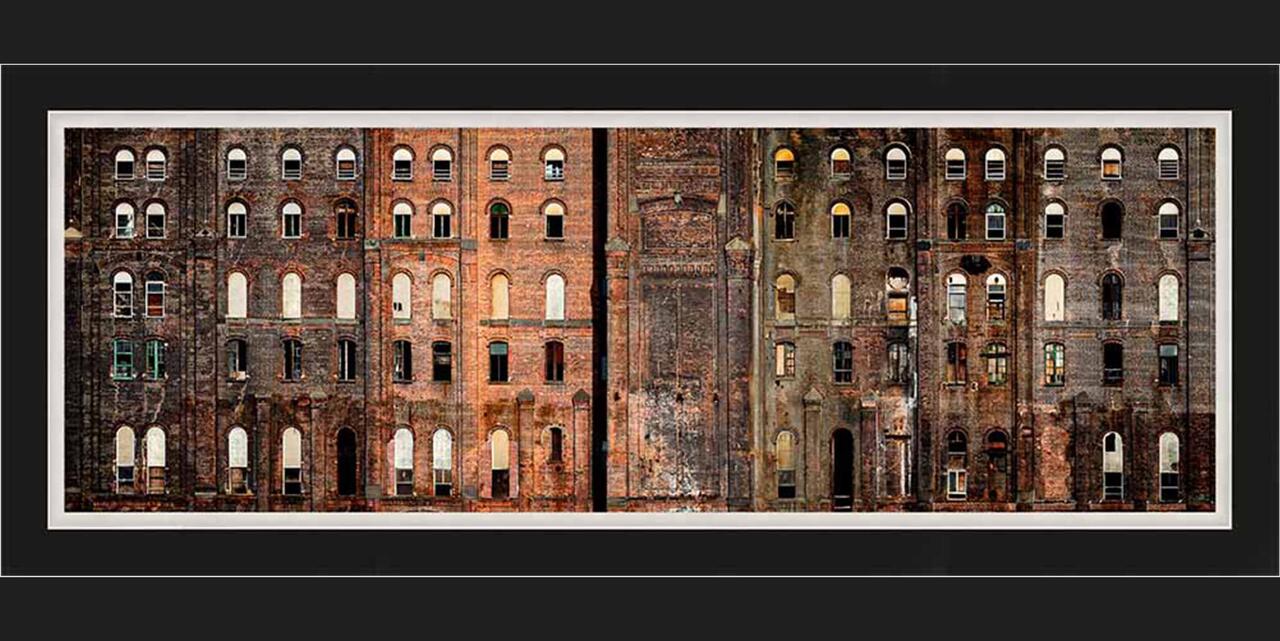
It already contains its own divisions. Measured in vertical strips the picture runs sixty-seven, eighty-two, ninety-three, a hundred and twenty-eight, a hundred and ten, ninety-seven, ninety-three, eighty, eighty-seven, seventy-seven, and the warmth tracks it, from twenty-one points red at the left edge to seventy-five in the brightest bay. Those are not lighting variations. They are different sections of the building, of different ages and different brick, standing side by side. So the frame is already subdivided, which means a wide moulding will not read as an intrusion the way it would on a continuous image. It also means the piece should not be hung straddling a corner, a pier or a change of wall plane, because the architecture's divisions will read as continuations of the building's own.
And nothing in it moves, or ever could. There is no water, no cloud, no sky, no light source, no vehicle, no person, no foliage. Every other photograph in this collection contains at least one thing that was in motion when it was made or that changes with the hour, and part of what those pictures do in a room is hold a moment against a day that keeps going. This one holds nothing, because there was nothing to hold. It looked the same at nine as at four. In a room that changes a great deal through the day, that steadiness is the thing it offers, and it is worth putting somewhere the change is visible.
Not sure which size the room calls for, or want dimensions not listed here? Sizes beyond 90 × 30 are available on request and ship crated by freight. That conversation is welcome before an order is placed. Start that conversation and I will answer within one business day.
What Remains, limited edition printSteve Austin70012900USD11https://schema.org/InStock
Questions about this photograph
How small is too small for a photograph this wide?
At the Intimate size the picture is thirty-six inches across and twelve tall, and the pattern holds. The rows of arched openings hold, the vertical bays hold, and the warm mass of brick holds. What goes is the condition, which is the reason the photograph exists. The boarded openings stop reading as boards and become dark rectangles. The broken panes become marks. The surviving painted sash loses its colour and its peeling. What you are left with is a handsome brick elevation rather than a building that has been abandoned for fourteen years. The Collected at sixty by twenty brings the boards back as planks. If you are weighing a size against a specific wall, choosing the right print size covers the measurements and the viewing distances in more detail.
What changes at the largest size?
At ninety by thirty the wall becomes bricks. Individual courses separate across the whole facade, and over each opening the voussoirs read as separate wedge-cut bricks rather than as a curve. In the boarded windows the planks pull apart with the gaps between them, and where the glass has gone the broken edges are legible. The surviving sash shows its paint, green in places, and where that paint has lifted. At the tops of the piers the corbelling and the dentil courses resolve into individual projecting bricks. And across the whole surface the water staining and the pale efflorescence read as distinct patterns rather than as tone, which is what a century of weather on a wall actually looks like. Why scale matters covers what happens perceptually when a photograph reaches the size where the eye has to cross it.
What kind of room does this photograph suit?
A long wall in almost any room. This is the most forgiving piece in the collection: it has no deep shadow and no bright highlight, it sits in the middle of the tonal range throughout, and it will neither disappear in a dim room nor blow out in a bright one. Hang it at standard height with the centre at about fifty-seven inches. On materials it welcomes warmth, since it is forty-one points warm itself, and it sits comfortably with timber, leather and warm plaster. Three things to avoid. Do not hang it on an exposed brick or masonry wall, for the obvious reason that the two will be compared as brick rather than looked at. Use neutral bulbs rather than warm ones, since a warm lamp pushes an already orange picture further and the cooler bays stop separating. And keep it away from anything with a regular grid, including panelled joinery, tiled surfaces and gridded windows. When your mind needs to rest takes the question further.
Every work ships insured and arrives with a signed certificate of authenticity.
If a piece is damaged in transit, the choice of replacement is always yours, and your edition number stays with you.
Production time runs 2 to 3 weeks for metal, 3 to 4 weeks for acrylic and paper, and 5 to 6 weeks for framed work.
Each print is made to order and takes its place in a numbered edition, so sales are final. Before you choose, I am glad to help: send a photo of your wall and I will show you this work in your room at true scale, at no charge. Start a conversation
Collector's Choice · TruLife ® Acrylic in Italian Frame
Collector Edition of 25· Lumachrome TruLife Acrylic · Handcrafted Italian Frame
TruLife acrylic in a handcrafted Italian frame with a linen liner chosen for the image. Frame series, finish, and liner are settled with you after the order, and production begins from there. The frame and liner add about fourteen inches to the finished dimensions, worth allowing for when planning placement.
Signature Acrylic Edition of 50· Lumachrome TruLife · Gallery Float Mount
Face-mounted to TruLife acrylic and floated approximately one inch from the wall, with no frame to mediate between the image and the room. UV-resistant, anti-reflective, and scratch-resistant, with a lifetime guarantee against fading.
Signature Metal Edition of 50· ChromaLuxe Print · Gallery Float Mount
Color infused into the aluminum panel itself, floated from the wall on a concealed system. Where acrylic produces luminosity, metal produces clarity. Exceptional fade resistance with no glazing or coating required.
Fine Art Edition of 100· Hahnemühle Baryta Fine Art Paper
Printed without acrylic, so light meets the paper surface directly. Highlights stay luminous, shadows keep their nuance, and the surface has a tactile quality the other presentations approach differently. The understated choice, and the traditional one.
Complimentary shipping within the continental United States. International collector shipping available upon request.
Still deciding
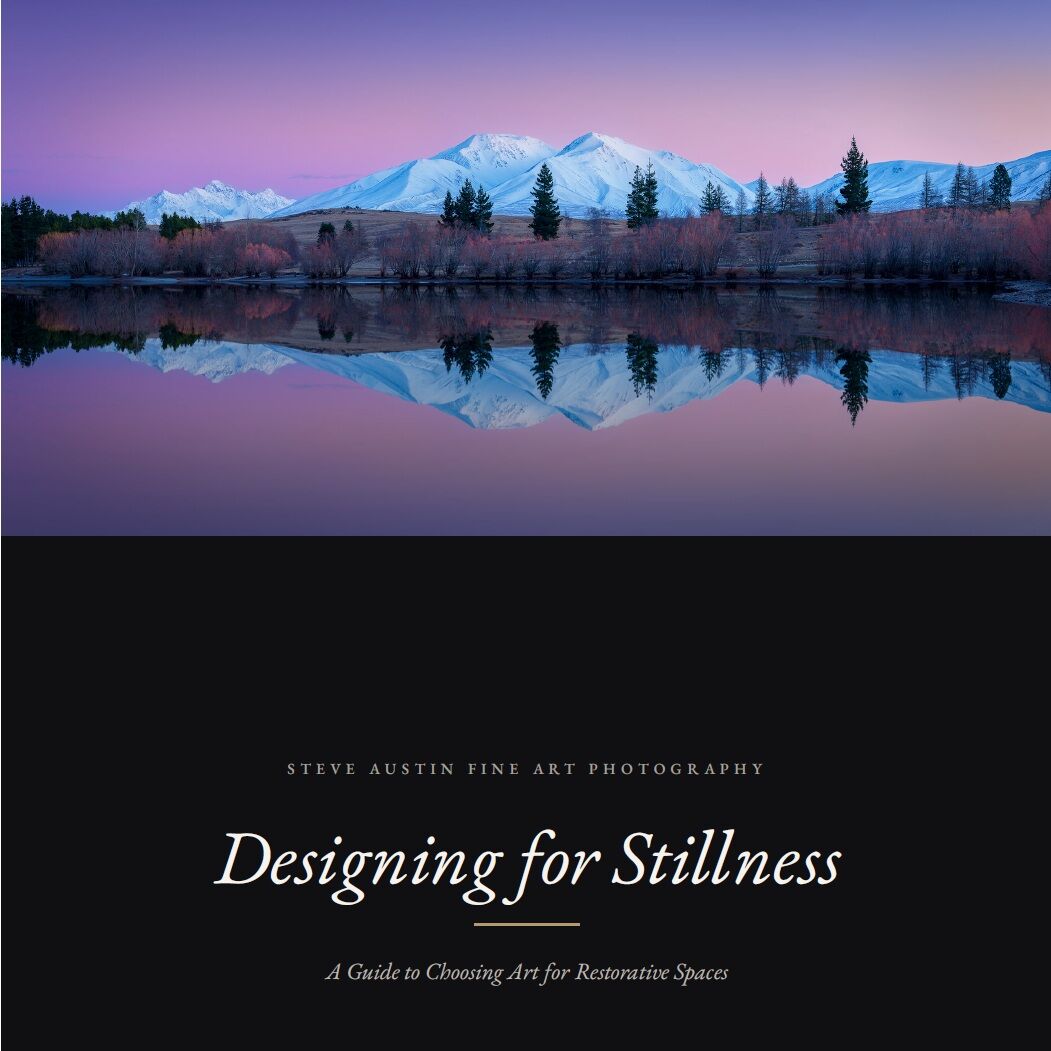
Designing for Stillness
A guide to choosing art for restorative spaces
How to tell whether an image will still hold you in a year, how scale changes what a photograph does in a room, and how to match a piece to the work a room actually performs. It cites the research it draws on, and it is equally clear about where that research stops. About ten minutes to read.