Why Awe Belongs on Your Walls: The Psychology Behind Landscape Photography That Moves You
There is a moment that every serious collector of fine art knows. You are standing in front of an image, and something shifts. Your breath slows. The noise in your head, the running list of obligations, the unresolved conversations, the low-grade hum of modern life, goes quiet. For a few suspended seconds, you are simply present. You are not thinking about yourself at all.
That moment has a name. Psychologists call it awe.
And it is not accidental. It is not a byproduct of pretty scenery. It is a specific psychological state with measurable effects on the mind and body, and it is one of the most underappreciated dimensions of what separates truly great landscape photography from imagery that merely decorates a wall.

View Available Prints of Emergence
What Awe Actually Is
Awe is one of the most fascinating constructs in contemporary psychological research. It sits at the intersection of wonder, humility, and cognitive expansion. Dacher Keltner, a psychologist at UC Berkeley and one of the foremost researchers on the science of awe, describes it as the feeling we get in the presence of something vast that challenges our existing understanding of the world. It is the emotional response to encountering something that exceeds our current mental frameworks and asks us to expand them.
What makes awe particularly compelling from a psychological standpoint is what it does to self-referential thinking. One of the most consistent findings in the awe research is what Keltner and his colleagues describe as the "small self" effect. When we experience awe, our sense of personal identity temporarily diminishes. We stop being the center of our own narrative. The relentless internal monologue, the anxious preoccupation with personal problems, the rumination that characterizes so much of modern psychological distress, quiets.
This is not escapism. It is recalibration.
Positive psychology research has shown that the human mind, when not actively engaged in a task, tends to wander toward worry. It gravitates toward unresolved problems, social anxieties, and worst-case scenarios. This default mode of thinking is a significant contributor to stress, anxiety, and a diminished sense of wellbeing. Awe interrupts that pattern. It pulls attention outward, toward something larger than the self, and in doing so, it offers the mind a rare and genuine reprieve.
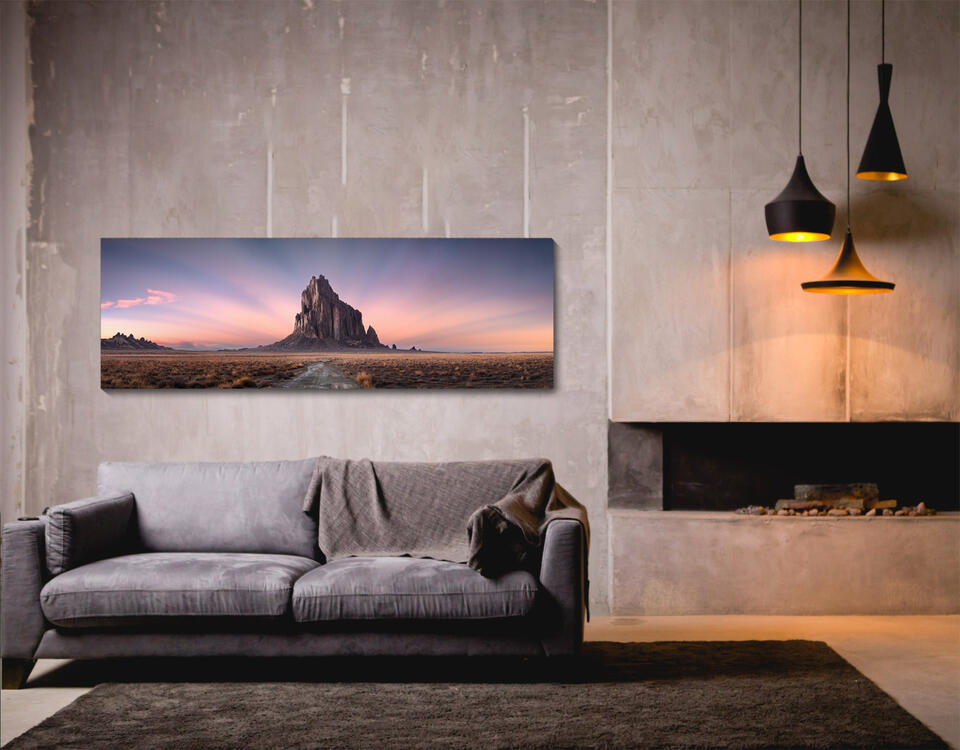
View Available Prints of Ascension
A Rock Rising from the Earth
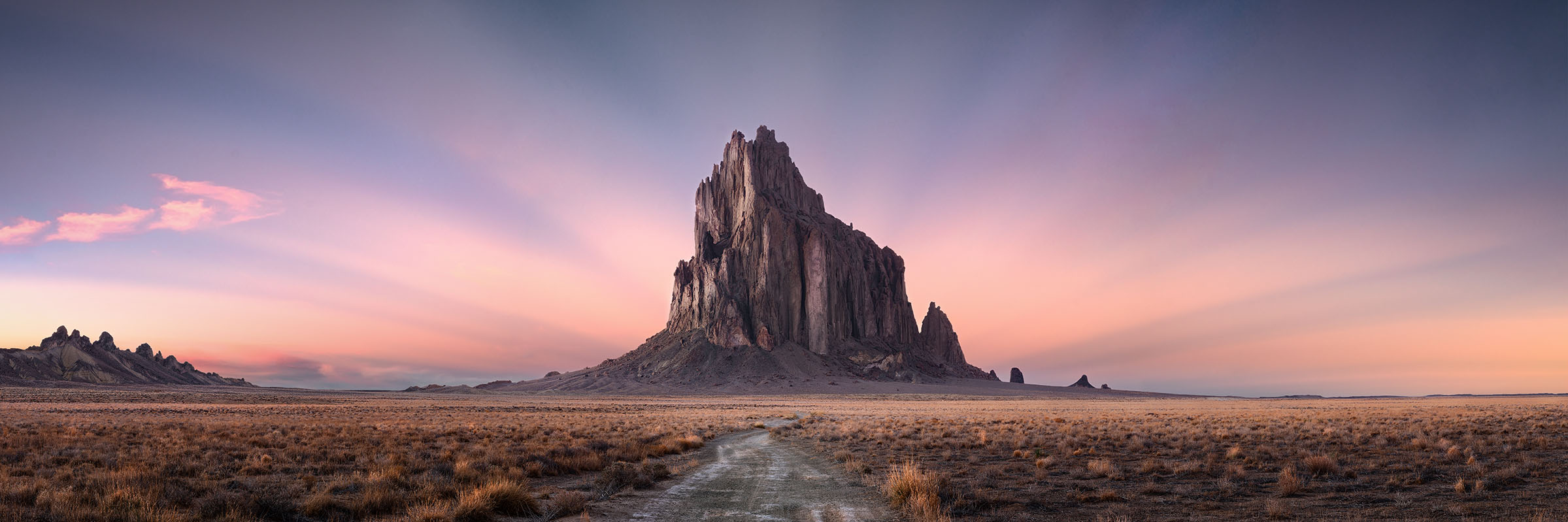
I photographed *Ascension* at Shiprock, New Mexico, a volcanic formation that rises dramatically from the high desert plain with almost nothing around it for miles. Standing at the end of that dirt road, looking toward this ancient geological presence against a sky dissolving into pink and violet, I was not thinking about deadlines or decisions or the thousand small frictions of daily life.
I was thinking about time. About the 27 million years this formation has stood in that desert. About how many human lives, with all of their urgency and drama, had passed within its sight. About how small and temporary my particular concerns were in that context.
That is the small self effect in its purest form. Not a technique. Not a practice you have to discipline yourself to maintain. Just the immediate, involuntary response to standing before something genuinely vast.
As a psychologist, I understand what was happening in that moment neurologically and emotionally. As a photographer, my entire focus became how to preserve it. How to compose the image so that the viewer, standing in their home or office years later, could be pulled into that same perceptual and emotional experience. The wide panoramic format was deliberate. The placement of the path leading directly toward the formation was deliberate. The expansive foreground of open desert was deliberate. Every compositional decision was made in service of one outcome: delivering that feeling of scale, of geological permanence, of the self becoming small and quiet in the presence of something ancient and immovable.
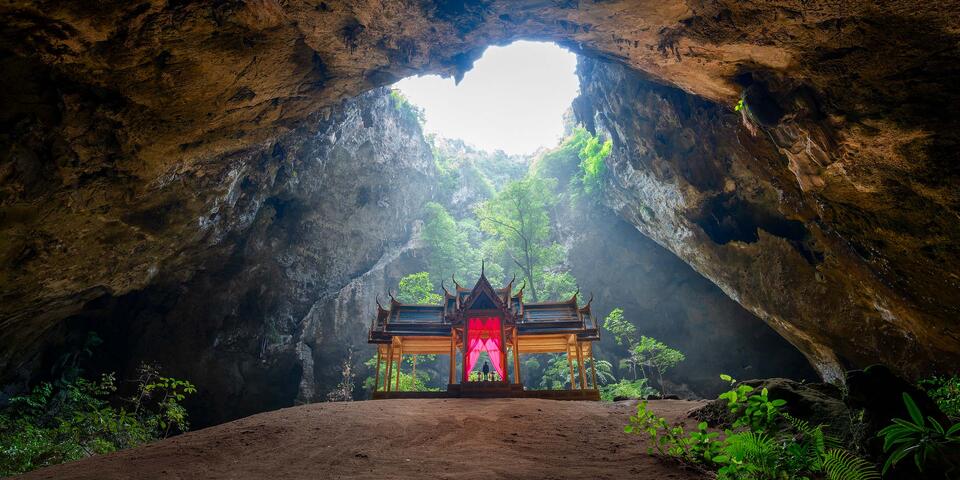
View Available Prints of Heart of the Forest
Light Dancing in a Canyon
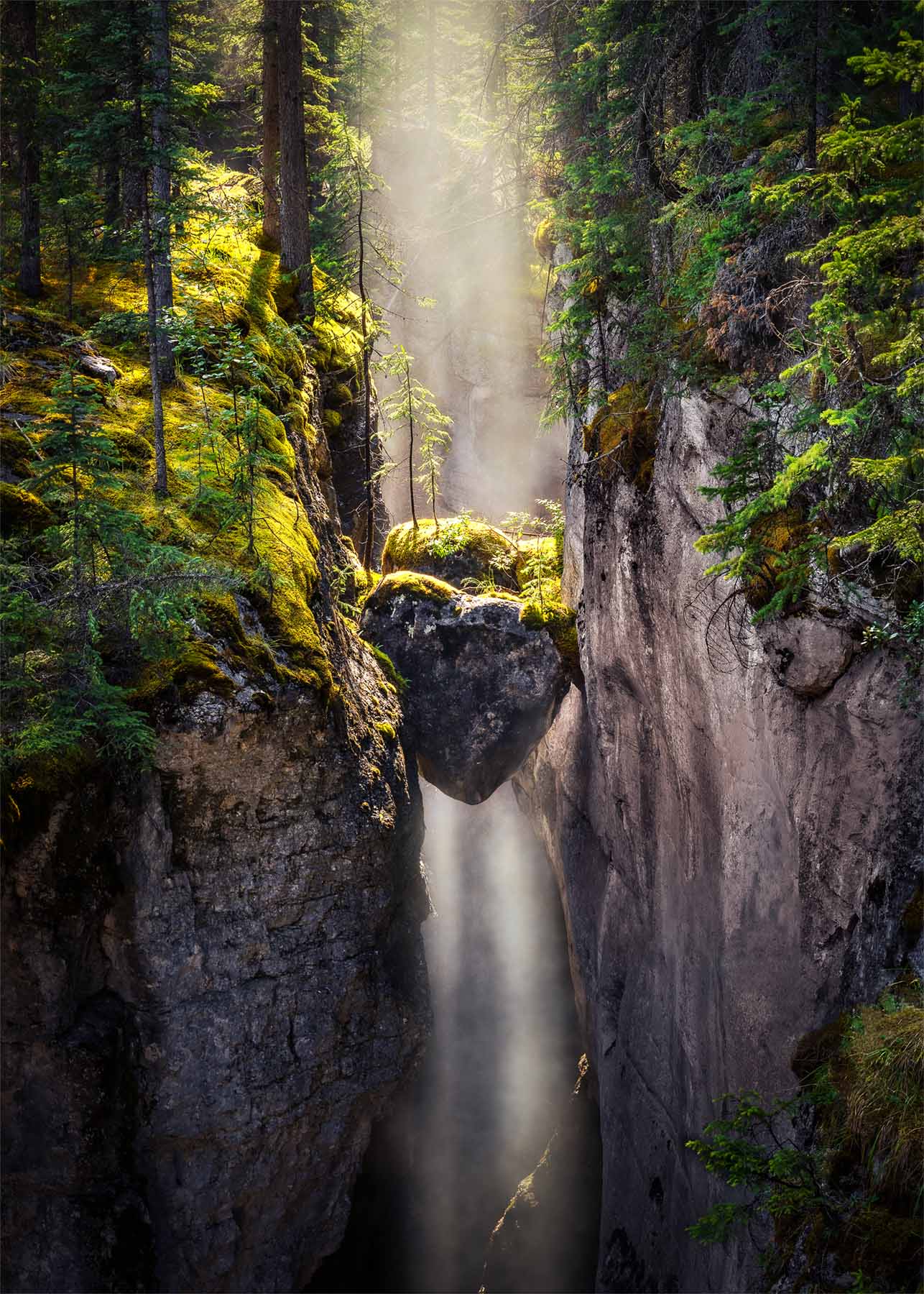
*Heart of the Forest* came to me differently. I was hiking through Maligne Canyon in the Canadian Rockies, crossing back and forth over the ravine, when I came to a stop. Suspended between the canyon walls was a boulder shaped unmistakably like two hearts joined together. Below it, water fell invisibly into the darkness. Above it, light began to pour down through the narrow opening of the crevasse in shafts, and the mist from the waterfall caught those rays and made them visible, almost tangible, as they moved.
I stood there for a long time.
What struck me in that moment was not just the beauty of the scene, though it was extraordinary. It was the feeling that nature had arranged something specifically for me. A heart-shaped stone, suspended in midair, lit from above, in the middle of a wilderness canyon. As a psychologist, I know that this is a form of apophenia, the human tendency to find meaningful patterns in random phenomena. But I also know that this tendency is not a flaw. It is one of the ways awe works on us. It makes us feel connected to something larger, seen by something beyond ourselves, and in that feeling, the psychological constructs we carry, the worry, the loneliness, the sense that our struggles are uniquely burdensome, soften and release.
That is what I wanted to give to anyone who views this image. Not just a beautiful forest scene. A moment of felt connection. A reminder that the stories we tell ourselves about our problems are not always accurate representations of reality.
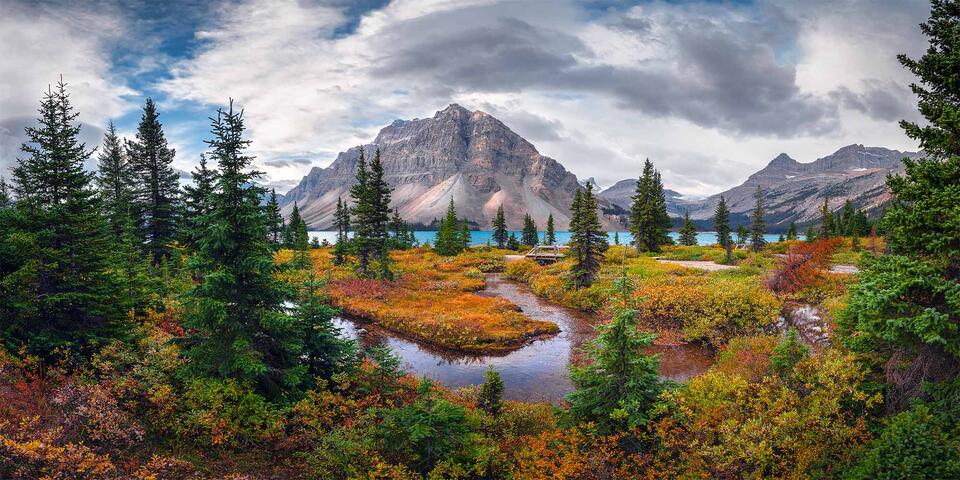
View Available Prints of Last Glow
Why This Belongs on Your Walls
Fine art collectors have always understood, intuitively, that the work they choose to live with matters. That it shapes the emotional texture of a space. That it influences how they feel when they wake up in the morning and move through their day. What the psychology of awe adds to this intuition is a specific, evidence-informed framework for understanding why.
When you place a large-scale landscape image in your home or workspace, you are not simply adding visual interest. You are installing a recurring psychological experience. Every time that image catches your attention, and a well-composed, large-format landscape will catch your attention consistently, it has the potential to initiate that small-self shift. To briefly interrupt the internal monologue. To recalibrate your sense of scale and proportion. To remind you, without words, that the world is larger and more extraordinary than the problems currently occupying your mind.
This is what distinguishes intentional fine art photography from decorative imagery. The difference is not purely aesthetic. It is functional. A photograph that evokes genuine awe is not doing the same psychological work as a photograph that simply looks attractive on a wall. One is a stimulus. The other is an environment.
The research on awe also has something to say about scale. Studies have consistently shown that the awe response is more reliably triggered by experiences of vastness, and that visual representations of vast landscapes can initiate this response even in the absence of direct nature exposure. This is one reason why large-format printing matters in fine art landscape photography. A small reproduction of Shiprock does not carry the same psychological weight as a print that commands a wall. Scale is not an aesthetic preference. It is a functional variable.
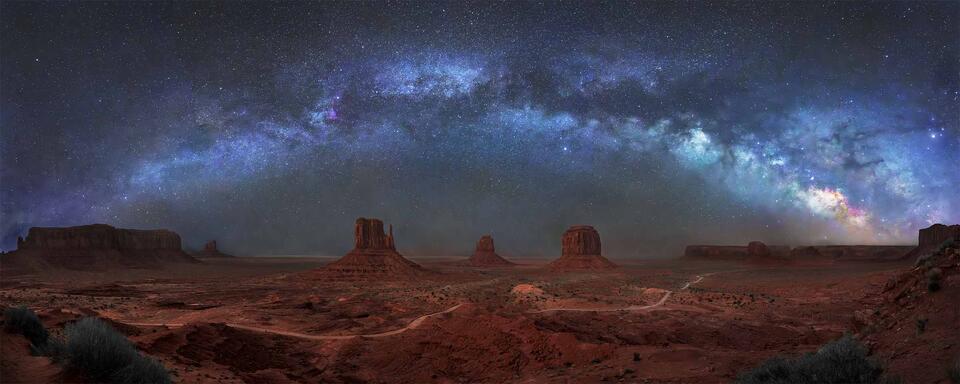
View Available Prints of Sentinels
Collecting with Intention
There is a particular kind of collector who understands this. They are not simply looking for something that matches their sofa or fills a blank wall. They are thinking about how they want to feel in their space. They are making deliberate choices about the psychological environment they inhabit every day. They understand that visual surroundings are not neutral, that what we look at shapes how we think and feel, and they approach the act of collecting as a form of intentional living.
If you are that kind of collector, I would invite you to look at landscape photography through the lens of awe. Ask not only whether an image is beautiful, but whether it is vast. Whether it creates a sense of scale that makes you feel, even briefly, small in the best possible way. Whether it has the capacity to quiet the mind rather than stimulate it. Whether it will still hold you ten years from now, or whether its power will fade as the novelty does.
The images that endure are the ones that carry genuine psychological depth. They are composed with intention, printed with precision, and grounded in an understanding of how visual experience shapes human wellbeing. They are not scenery. They are environments.
And they belong on your walls.
Living With Awe
An image that produces genuine awe does something a merely beautiful one cannot. It interrupts the running monologue, recalibrates your sense of scale, and reminds you, without words, that the world is larger than the problems occupying your mind. Lived with daily, that interruption becomes a quiet, recurring gift rather than a single moment.
I invite you to spend time with the full collection and notice which image makes you feel, even briefly, small in the best possible way. And if you are considering a particular wall or room, I am always glad to think it through with you. A complimentary digital mockup will let you see how a piece lives in your own space before you decide. There is no urgency in any of this. An image you intend to live with for years is worth choosing slowly, and on purpose.
Featured Fine Art Prints for Why Awe Belongs on Your Walls
Steve Austin is a psychology professor, and fine art landscape photographer. His limited edition landscape prints are available through Steve Austin Fine Art Photography at steveaustinphotography.com. Complimentary digital mockups are available for those who would like to visualize a piece within their own space.