Art as a Daily Experience, Not a Decoration
Most art in most homes is ignored most of the time.
This is not a criticism. It is simply what happens when art is chosen without psychological intention. A piece is selected because it fits the color scheme, fills a wall, or arrives at the right moment in a renovation. It is noticed when guests comment on it and forgotten the rest of the time. Over weeks and months it fades into the visual background of the space, present but no longer seen. It has become wallpaper.
This is the difference between decorative art and what I think of as environmental art. Decorative art produces an aesthetic event. You see it, you respond to it, and then you habituate to it. Environmental art becomes something else entirely. It becomes a psychological anchor in the space you inhabit, functioning not just when you look at it directly but in the peripheral awareness of every hour you spend in that room. It works on you continuously, whether or not you are consciously engaging with it.
Understanding this distinction changes everything about how you choose the art you live with.
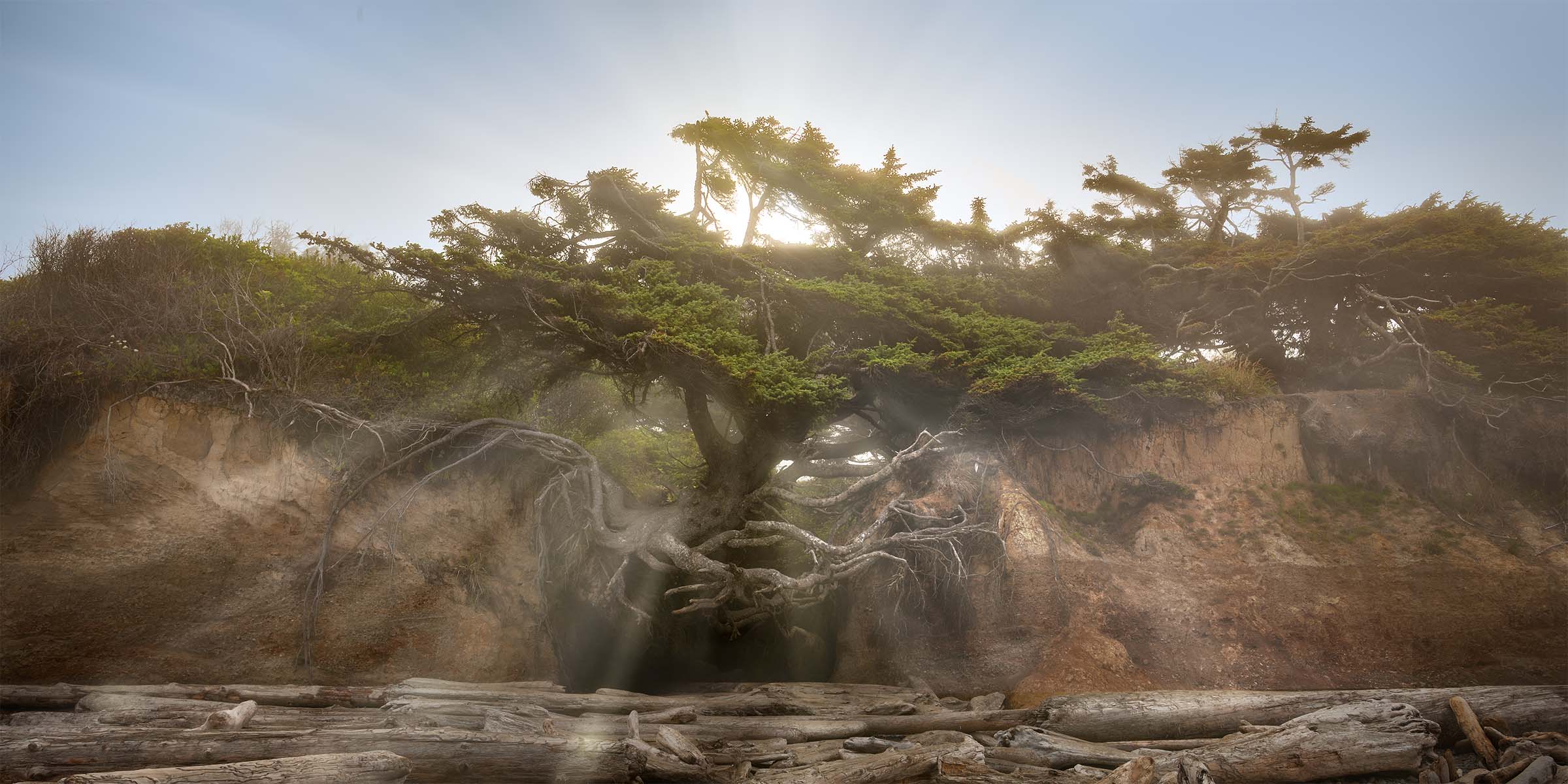
A tree clings to the edge of an eroded bluff at Kalaloch Beach, its root system fully exposed and reaching in every direction across the hollow beneath it. It has no right to still be standing. And yet here it is. The longer you look, the more the roots reveal themselves, forms and figures emerging from the tangle that were not visible at first. That is not an accident. That is what survival looks like up close.
View Available Prints of Holding on
Why Art Stops Working
From a psychological perspective, the brain is wired to reduce its response to stimuli that are predictable, repetitive, or low in informational richness. This is habituation, a fundamental neural process that conserves cognitive energy. When the visual system has fully encoded a stimulus, it downregulates its attention to it. The art that once caught your eye as you passed through the room no longer registers. It is still there. Your brain has simply decided it no longer needs to process it.
Art that habituates quickly tends to share certain qualities. It often relies on novelty or intensity rather than layered depth. High saturation, dramatic focal points, or emotionally charged subject matter generates strong initial arousal, but arousal without complexity burns out. The viewer extracts the dominant signal rapidly and the nervous system adapts. What initially felt stimulating becomes visually silent within months, sometimes weeks.
Highly graphic, overly symmetrical, or emotionally one-dimensional images follow this pattern consistently. They produce an immediate aesthetic reaction that stabilizes and fades because the image offers little perceptual depth to revisit. Once the visual system has encoded its structure, there is no ongoing exploratory demand.
By contrast, art that maintains its presence over extended daily exposure possesses what could be described as structured complexity. It offers multiple levels of perceptual access. At first glance there is a clear compositional anchor, but continued viewing reveals secondary layers. Subtle tonal gradients, depth cues, textural variation, atmospheric transitions, and spatial openness create a field that can be explored repeatedly without cognitive strain. The image never fully exhausts itself perceptually. There is always something more to find.
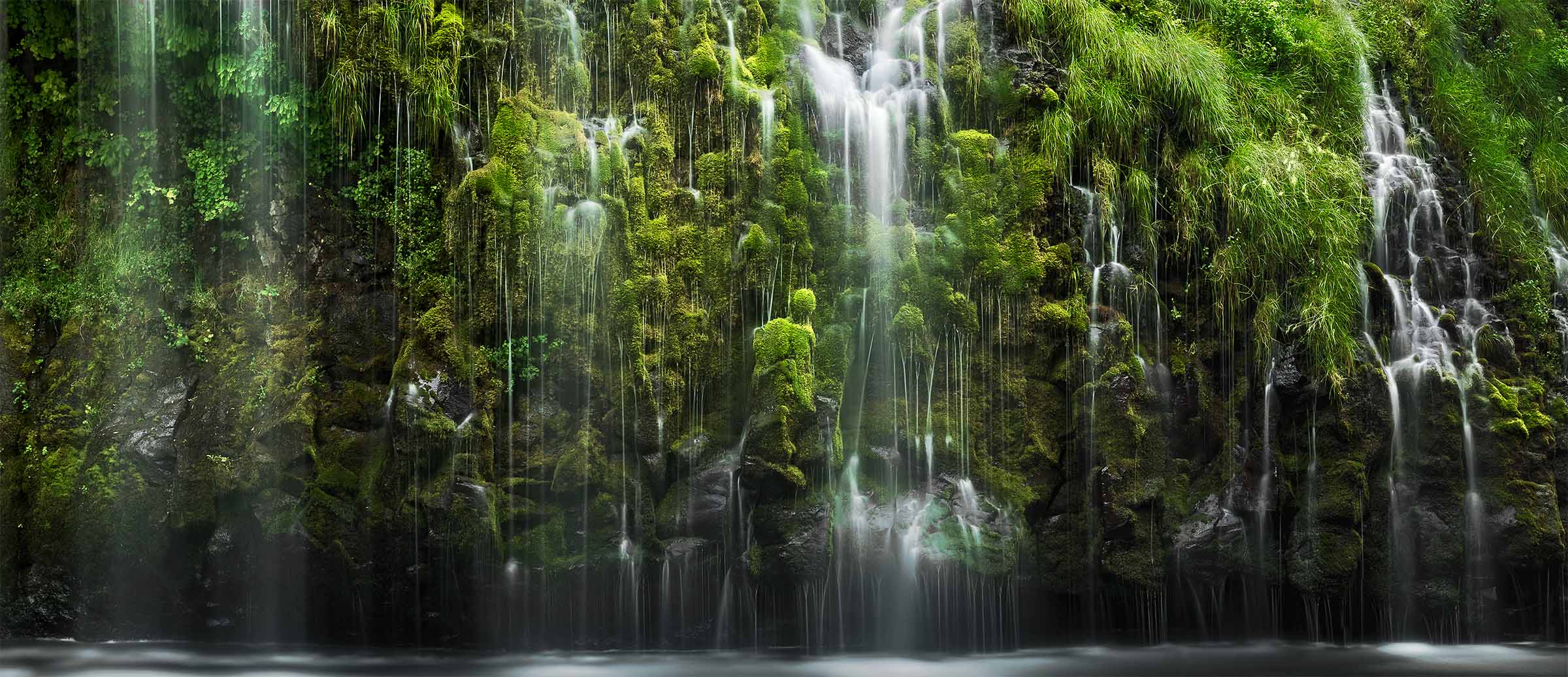
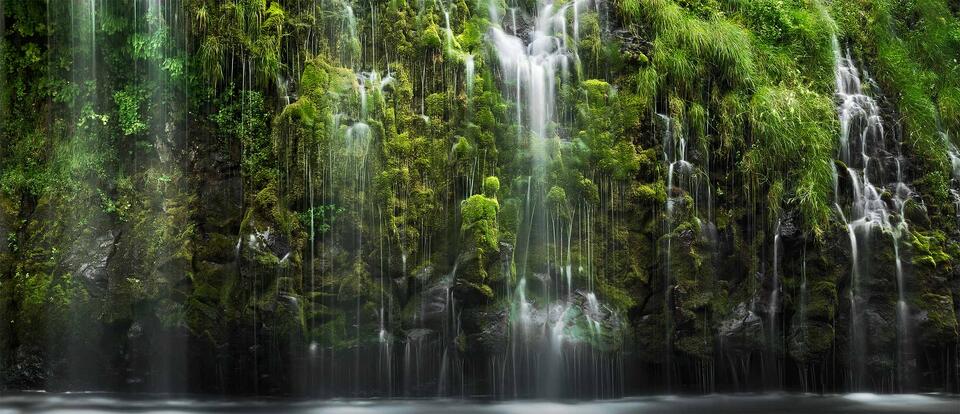
A wall of moss and water, lush and alive from edge to edge, with dozens of quiet streams finding their way downward through the green. The image has been on my wall for five years. I am still finding things within it. That is not a coincidence. It is the design.
View Available Prints of The Quiet Thinker
What Five Years Teaches You About an Image
I have lived with The Quiet Thinker for five years. It hangs in my living room and I encounter it daily, in passing, in moments of deliberate looking, and in the peripheral awareness of time spent in that space.
What I have noticed over those five years is not that the image has faded. It is that my relationship with it has deepened. In the early months I was drawn to the overall composition, the curtain of water, the lush green of the moss, the soft mist at the base. Over time I began to notice individual details I had missed entirely in the first viewing. Forms emerging from the moss. Shapes that appear and disappear depending on the quality of light in the room at a given hour. I started showing it to guests, asking them what they see, and the conversations that followed were among the most genuinely interesting exchanges that art has ever prompted in my home.
The image became a shared experience rather than a private one. And my own connection to it deepened each time because I was seeing it through new eyes alongside people encountering it for the first time.
This is what environmental art does that decorative art cannot. It grows with you. The relationship evolves. The image you live with in year
five is not the same psychological experience as the image you brought home in year one, even though nothing about the image itself has changed. What has changed is the depth of your relationship with it.
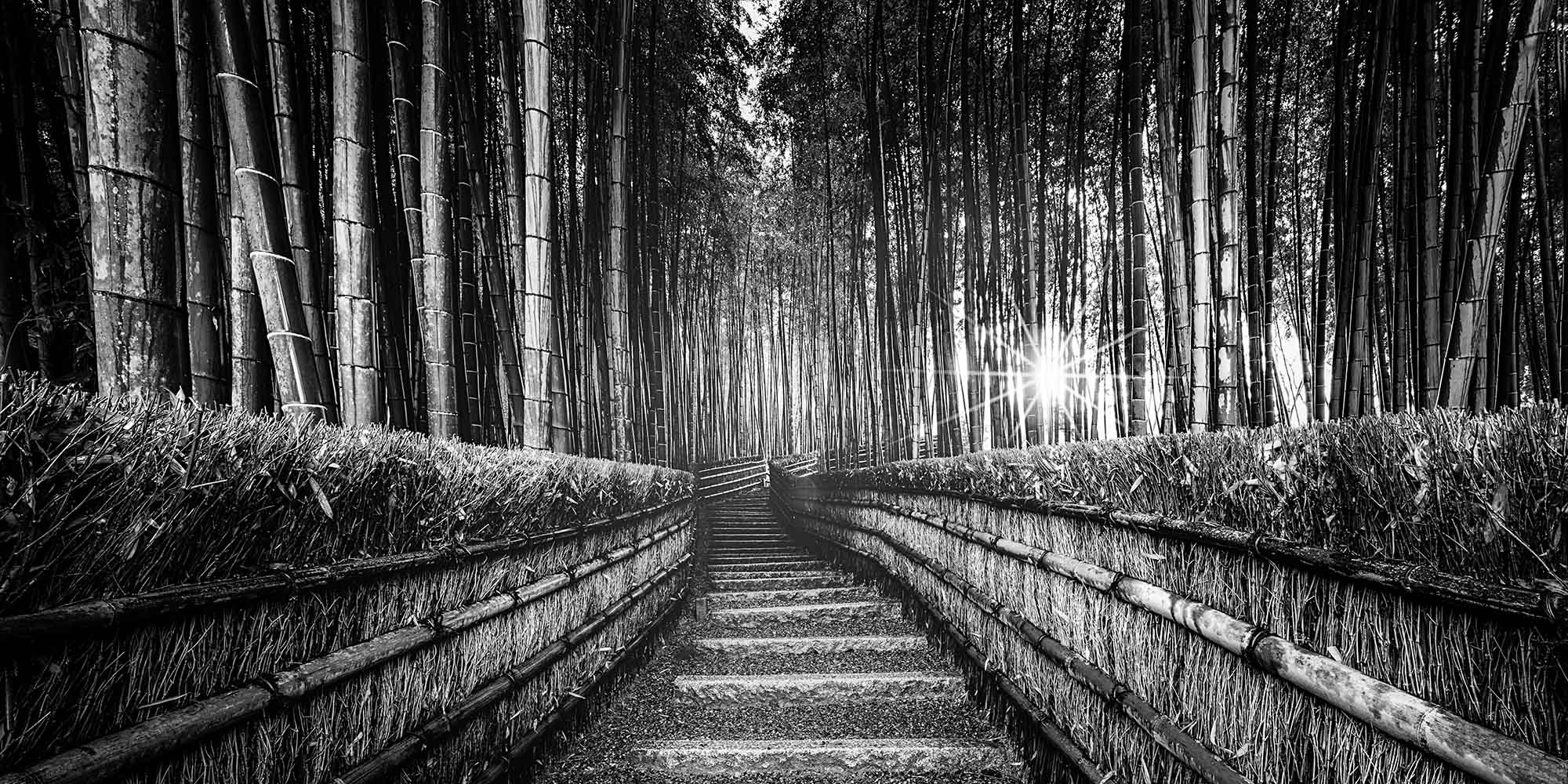
Stone steps ascend through the Arashiyama bamboo forest in Kyoto, the vertical rhythm of the stalks creating a corridor that narrows toward a single point of light at the top. Remove color from a composition this structured and what remains is pure geometry, depth, and the feeling of moving toward something. This image has no interest in revealing itself quickly.
View Available Prints of One Step Into Quiet
The Psychology of Sustained Engagement
From a neuroscience perspective, art that maintains restorative presence over time likely involves oscillation rather than spike. It does not repeatedly trigger high sympathetic activation. Instead it supports what researchers describe as alpha-dominant wakeful relaxation, a state in which attention drifts and returns gently without the cognitive system being placed under demand. The image functions less as a stimulus and more as a stable environmental field.
The Kaplans' concept of soft fascination is central here. An image that sustains restorative engagement must invite gentle exploration over time. If it is too simple, there is nothing to explore. If it is too chaotic, exploration becomes effortful and depleting. The ideal balance lies in mid-range complexity, particularly the fractal structures common in natural environments. These patterns are processed fluently by the visual cortex but never fully exhausted perceptually. They allow micro-movements of attention without demanding executive control.
There is also an emotional dimension to sustained engagement that is often overlooked. Art that maintains its presence over time tends to contain emotional ambiguity or depth rather than a single declarative mood. An image that conveys a clear, fixed emotional signal, pure joy, pure drama, pure intensity, is psychologically complete on first viewing. There is nothing left to feel that you have not already felt. But an image that holds emotional complexity, one that can feel expansive on one day and grounding on another, remains psychologically flexible. That flexibility is what supports long-term relevance.
Another critical factor is what might be called perceptual breathing room. Images with spatial openness, coherent depth, and areas of visual rest allow the autonomic nervous system to settle repeatedly rather than arriving at a fixed resting point and stopping. Prospect-refuge dynamics can operate over time, providing a subtle and recurring sense of safety and possibility each time the eye returns to the image.
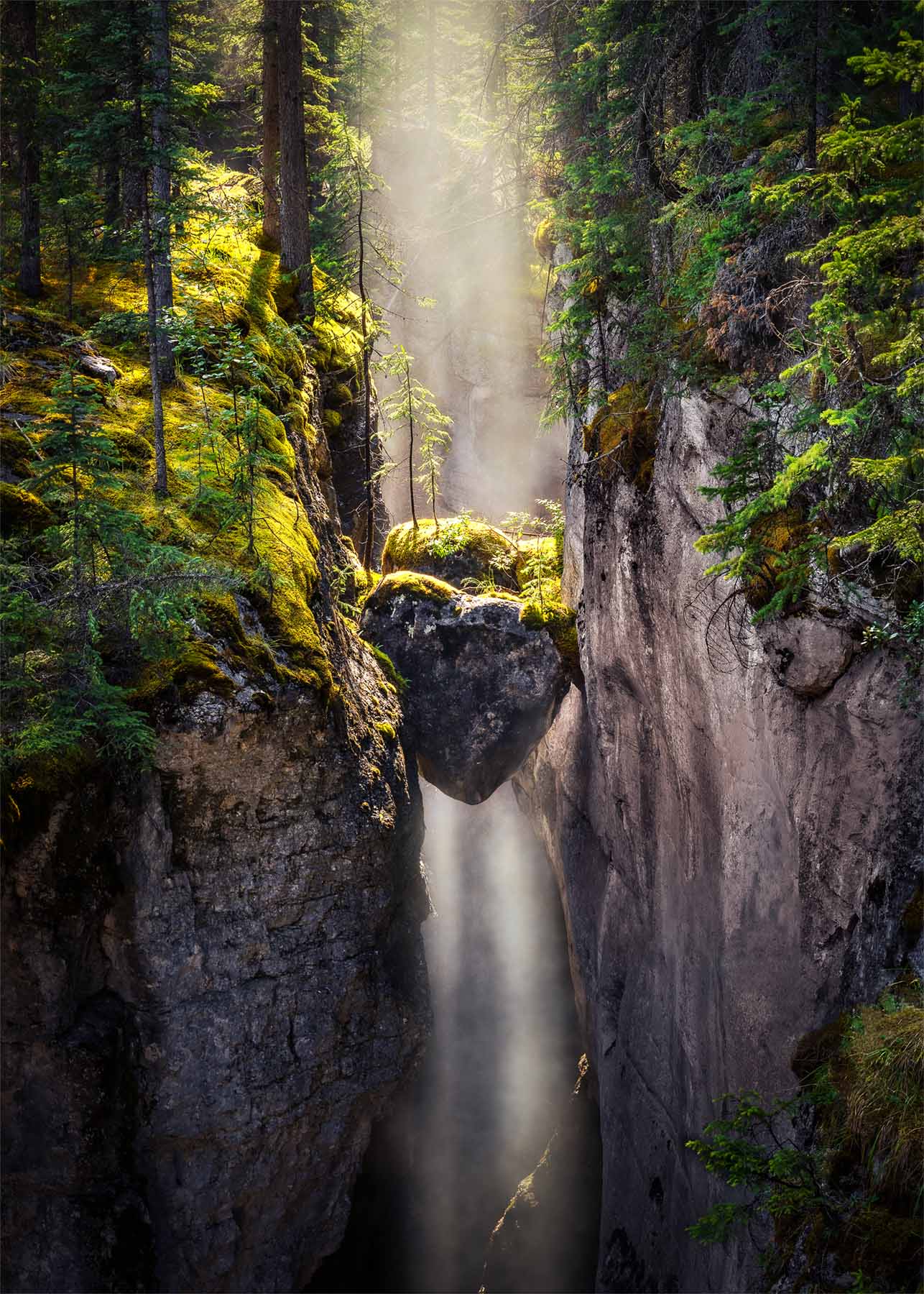
Water falls through a narrow canyon in Maligne Canyon, the light finding the stone walls and the mist in ways that shift with the hour and the season. When this image is lit correctly in the room, the waterfall comes alive. I have stood before it in stressful moments and felt myself fall into the scene, hearing the water in my mind, arriving somewhere far from the difficulty of the day. Five years later it remains a safe space. Not a decoration. A destination.
View Available Prints of Heart of the Forest
Images That Reveal Themselves Over Time
The most psychologically durable images in my collection share a quality I have come to think of as inexhaustibility. No single viewing exhausts them. There is always another layer of detail, another quality of light, another emotional register available depending on what you bring to the image on a given day.
This quality is not accidental. It is the result of intentional construction in the field and in the digital darkroom. When I am composing an image, I am not simply capturing what is in front of me. I am thinking about what the image will do to someone who lives with it for ten years. I am asking whether the composition has enough layered depth to sustain that kind of relationship. Whether the light carries emotional complexity rather than a single fixed mood. Whether the subject matter connects to biophilic predispositions, the deep evolutionary familiarity with water, trees, stone, and open landscapes, that does not exhaust quickly because it maps onto long-standing perceptual frameworks rather than contemporary novelty.
Images that align with these evolutionary templates do not become background noise in the way that purely graphic or trend-driven work does. They remain biologically familiar, which means the visual system continues to find them worth engaging with across years of daily exposure.
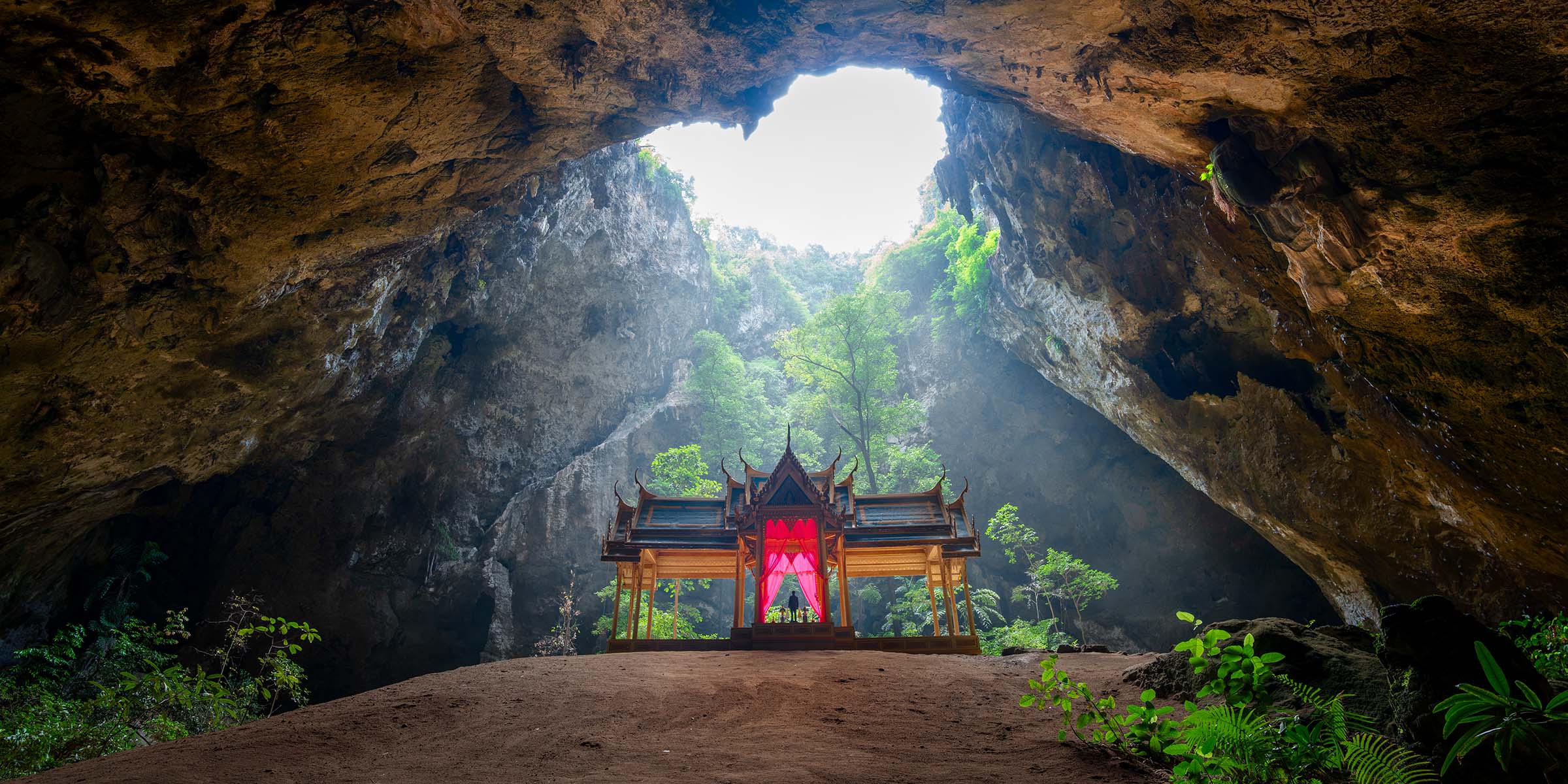
A royal pavilion sits inside the Phraya Nakhon Cave in Thailand, light pouring through the opening in the cave ceiling above to illuminate the structure and the jungle beyond. The composition moves through four distinct worlds simultaneously: the dark cave interior, the architectural precision of the pavilion, the natural chaos of the jungle, and the open sky above. A single human figure stands in the doorway, barely visible, providing the only sense of scale. This image contains a lifetime of looking.
View Available Prints of A Temple Within a Temple
Choosing Art You Will Never Outgrow
The practical question for a collector who understands this distinction is not which image is most beautiful. It is which image will still be working on you in ten years. Which image will deepen rather than fade. Which image you will still be discovering things within when the rest of the room has changed around it.
This requires a different kind of looking than most people bring to the art selection process. It requires asking not how an image makes you feel in the first thirty seconds of viewing it, but whether it has the structural complexity, the emotional depth, and the biological familiarity to sustain a long-term relationship. It requires resisting the pull of novelty and intensity in favor of the quieter, more durable qualities of layered depth and perceptual openness.
It also requires honesty about the spaces you inhabit and what you need those spaces to do. A collector who spends long hours in a home office working through cognitively demanding problems needs images that restore rather than stimulate. A collector who lives in a high-activity family environment needs images that offer genuine visual rest rather than additional stimulation. The right image for a space is not the most dramatic or the most impressive. It is the one whose psychological function matches what the space and the person actually need.
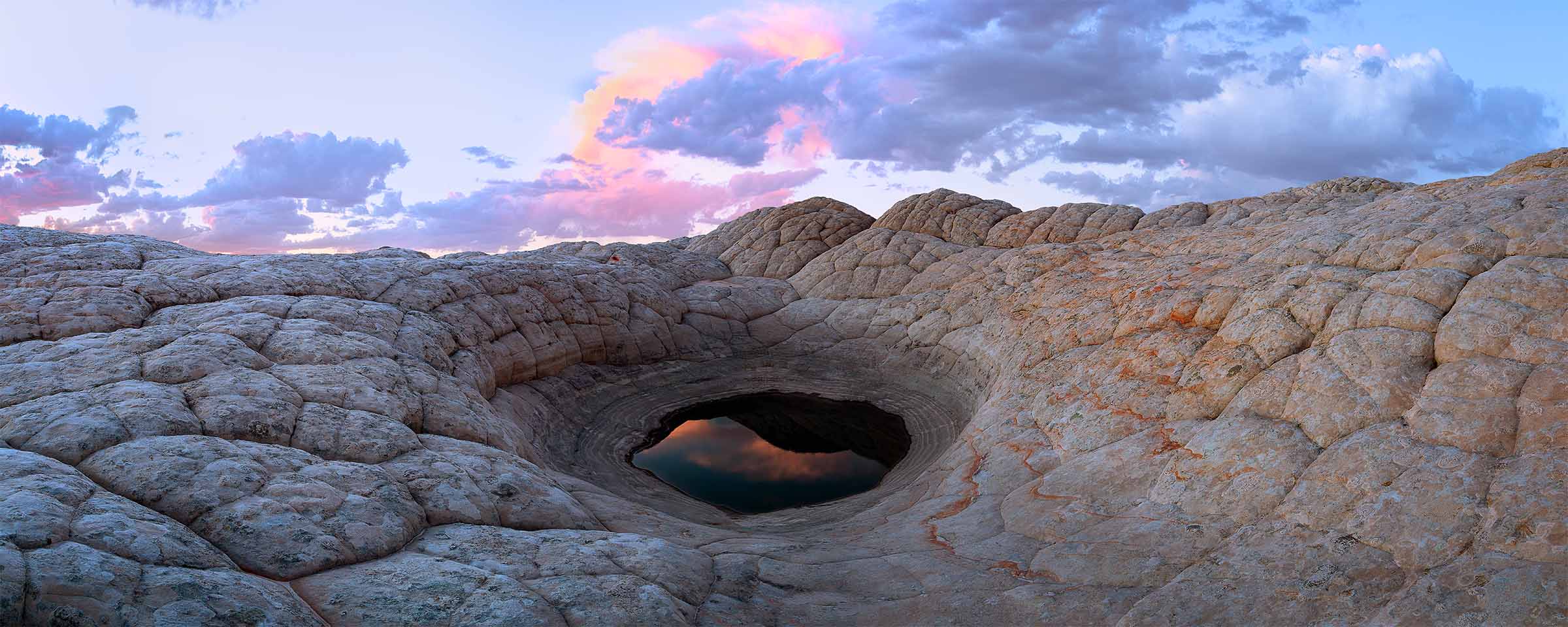
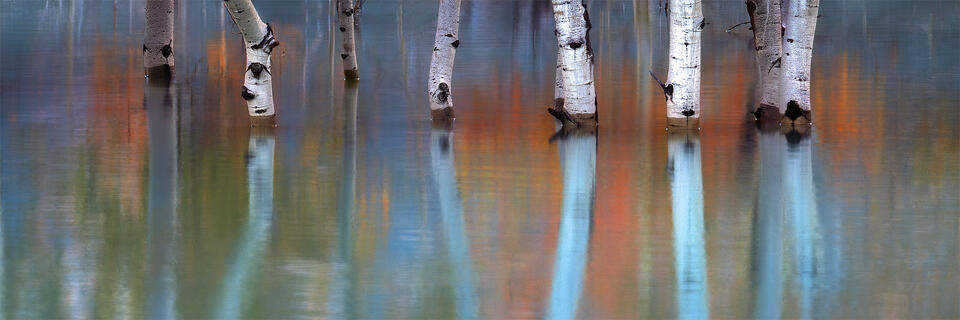
A natural pool sits in a depression in the white sandstone of the Arizona desert, reflecting the sunset clouds above in a perfect oval mirror set into the organic surface of the rock. The textured stone moves in every direction around it, fractal and endlessly detailed. The pool holds the sky. The rock holds the pool. The image holds your attention gently, indefinitely, without ever quite giving all of itself away.
View Available Prints of The Quiet Center
Art as Environment
In the language of environmental psychology, the distinction I am drawing here is between a space that extracts attentional resources and one that replenishes them. Decorative art is neutral at best in this equation. It occupies the wall without contributing meaningfully to the psychological quality of the space. Environmental art, chosen with genuine psychological intention and possessing the structural qualities that resist habituation, contributes actively and continuously to the restorative character of the space you inhabit.
This is what I mean when I say I am not selling scenery. I am designing psychological environments. Every image in my collection is selected and constructed with the intention of functioning as a long-term psychological anchor in the spaces where people think, rest, recover, and live. The measure of success is not whether it is beautiful on first viewing. It is whether it is still working on you, still revealing itself, still providing something your nervous system needs, years after you brought it home.
Decorative art produces an aesthetic event. Environmental art becomes part of the architecture of your inner life.
Choose accordingly.
Living With an Image That Lasts
Every photograph in this collection is made as a limited edition, archival print, built to be lived with for years rather than noticed once and forgotten. If one of these images has held your attention longer than the others, that response is worth trusting. It is the beginning of the kind of relationship this entire essay is about.
I invite you to spend time with the full collection, where each piece can be seen at the size and presentation that suit it best, or to explore the curated collections, where images are grouped by the psychological work they are designed to do.
If you are considering a particular wall, a quiet room, or a space meant to slow the people who move through it, I am always glad to think it through with you. A complimentary digital mockup will let you see a specific image within your own space before you decide. There is no urgency in any of this. An image you intend to live with for a decade is worth choosing slowly, and on purpose.
Featured Fine Art Prints for Art as a Daily Experience, Not a Decoration
Steve Austin is a psychology professor, behavioral neuroscientist, and fine art landscape photographer. His limited edition landscape prints are available through Steve Austin Fine Art Photography at steveaustinphotography.com. Complimentary digital mockups are available for those who would like to visualize a piece within their own space.