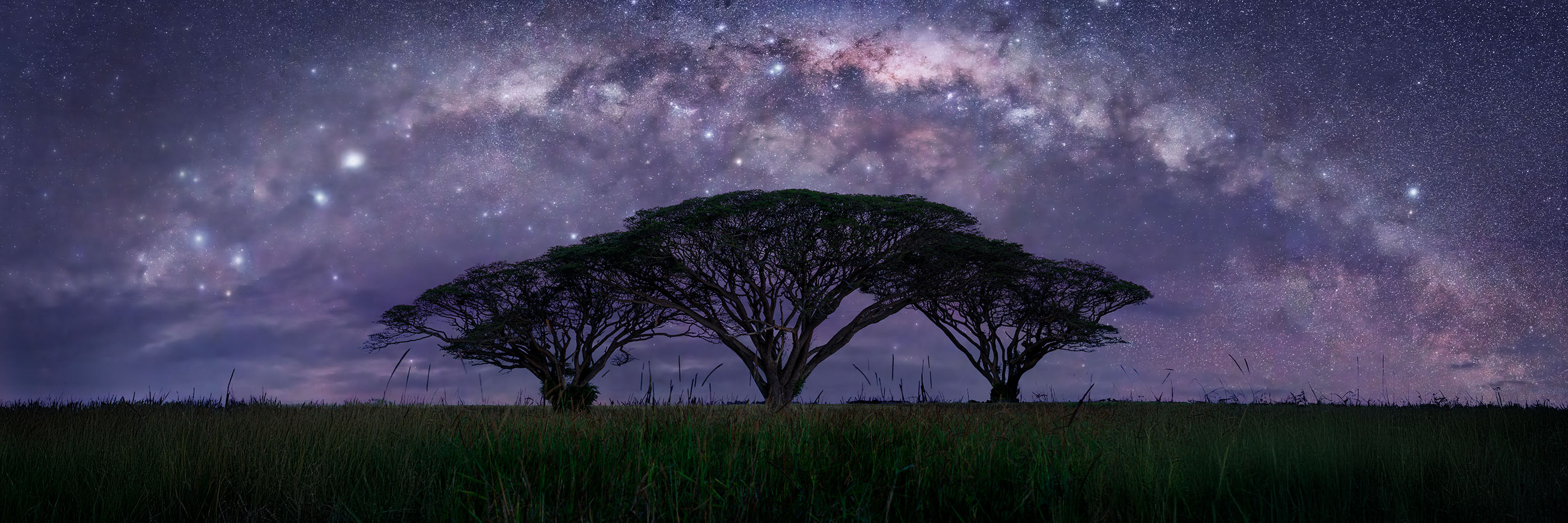
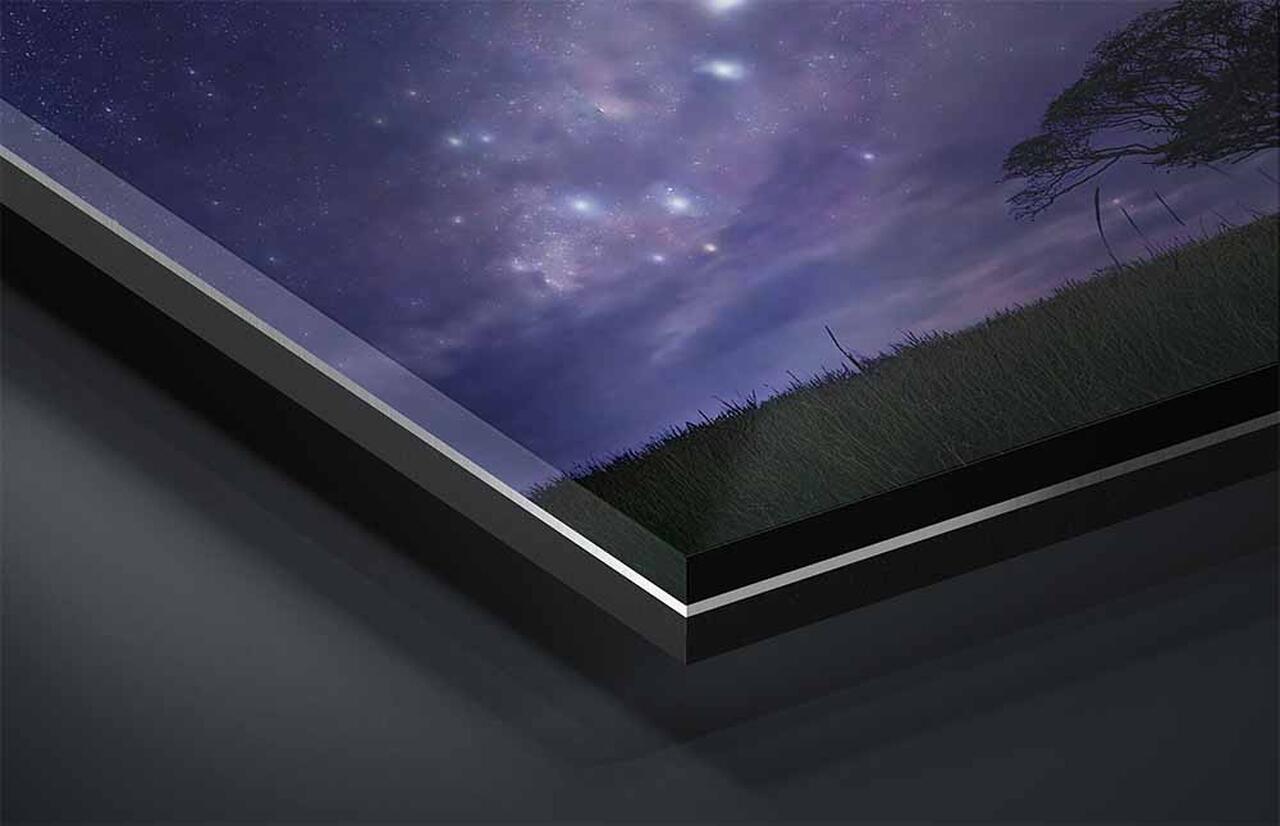
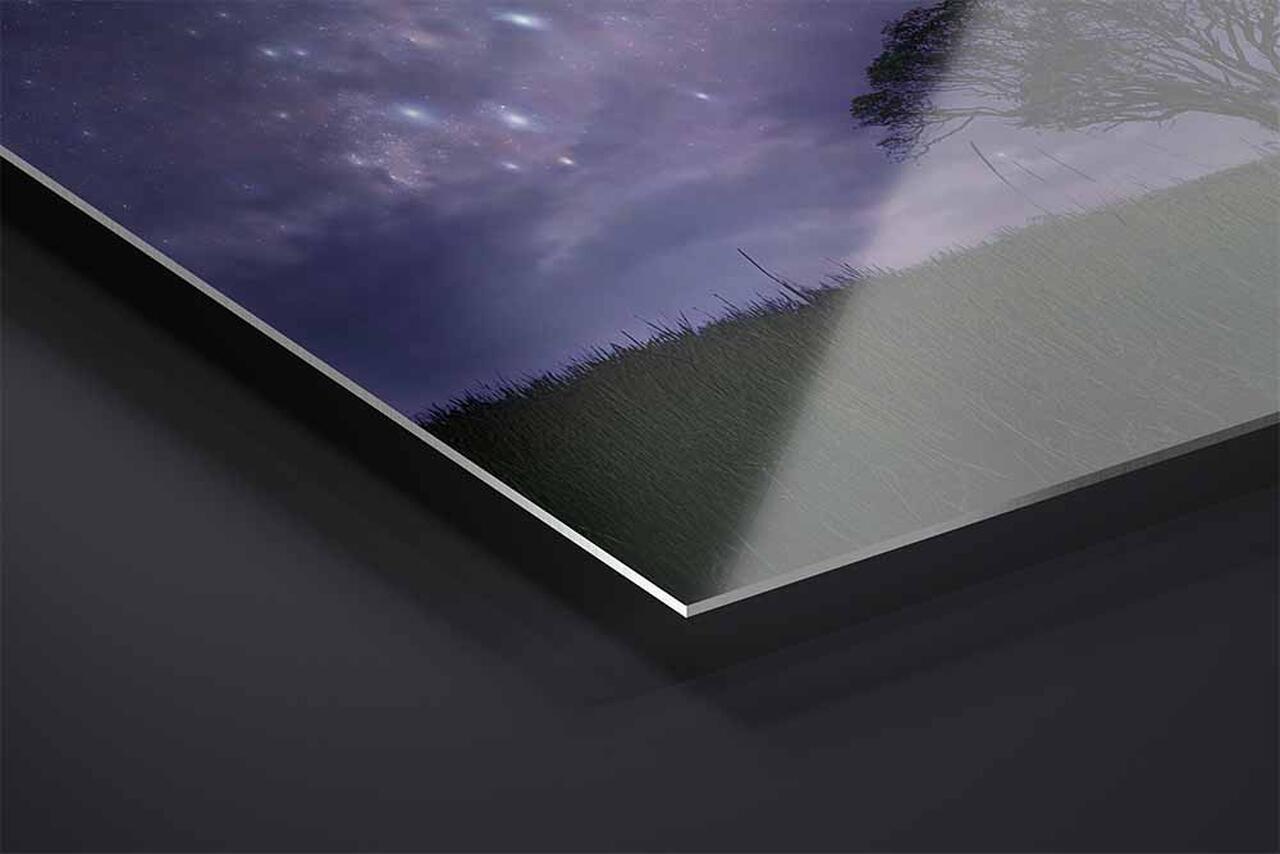
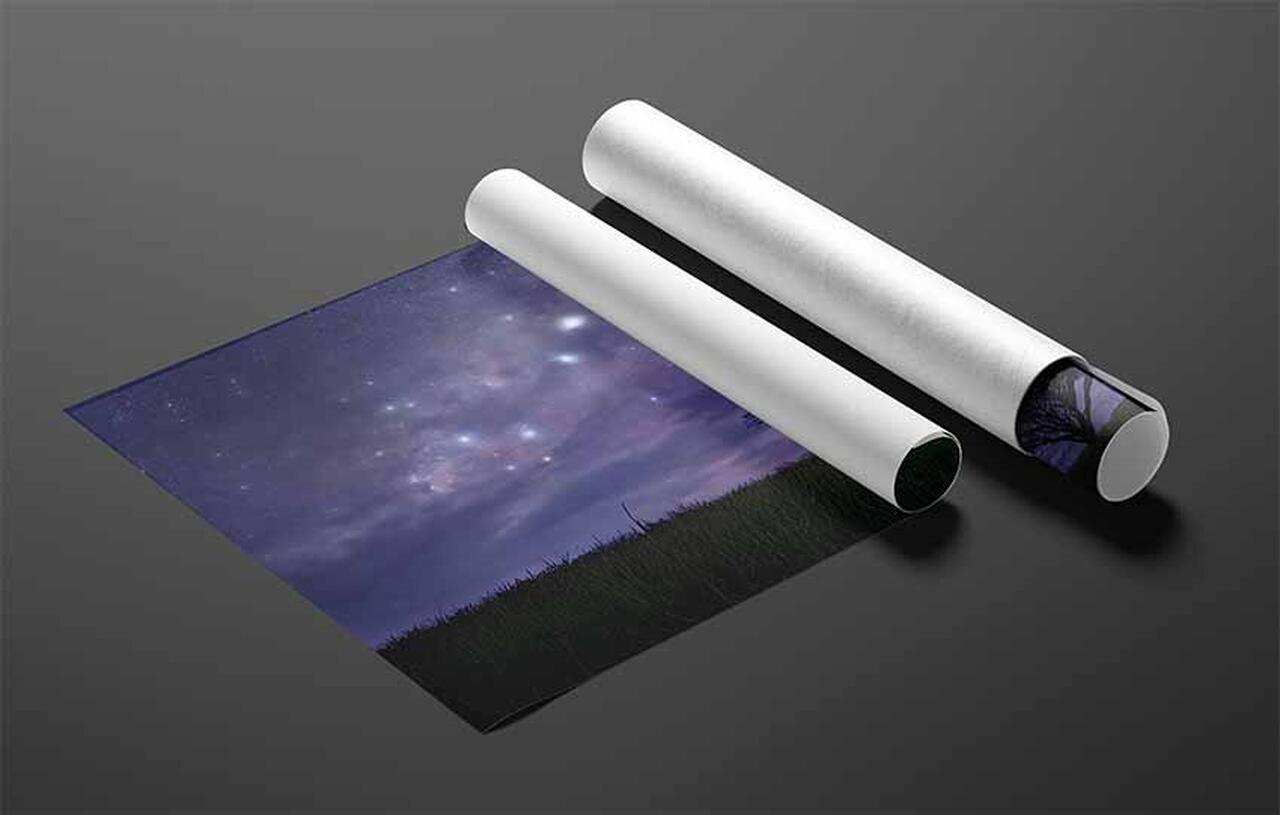
A 3:1 panoramic photograph of the Milky Way arching above three trees near Rockhampton, Queensland, Australia, available as a limited edition print in three sizes.
Artist's Story
Three trees stand in a paddock outside Rockhampton, in central Queensland, and their canopies make one long arch between them. I had been looking at that arch for a while before I worked out what I wanted to put above it.
The Milky Way is not a thing in the sky. It is our own galaxy, and we are inside it, about halfway out along one of the arms. Looking at that band is looking edgewise through the disc from within it, which is why it appears as a band rather than a patch, and why it forms a complete circle all the way around us. What you can see at any moment is the half of the circle that is above your horizon. That half is an arch.
The bright, crowded part of it is the direction of the galactic centre, which sits about twenty-nine degrees south on the sky. Rockhampton sits almost exactly on the Tropic of Capricorn, twenty-three and a half degrees south, which puts the centre of the galaxy within about six degrees of straight overhead. From most of Europe and North America it barely clears the horizon. Here it goes over the top of you.
The dark patches running through the bright band are not gaps. They are clouds of dust inside the disc, blocking the light of everything behind them.
This photograph is built rather than caught, and I would rather say so. The grass and the trees were photographed at blue hour, the sky later that night and facing a different way, and the two were stitched and put together afterward. The arch overhead is real and the arch below it is real. Their agreement is mine.
Arc of the Infinite is a canopy that curves and a galaxy that curves, placed so that one answers the other.
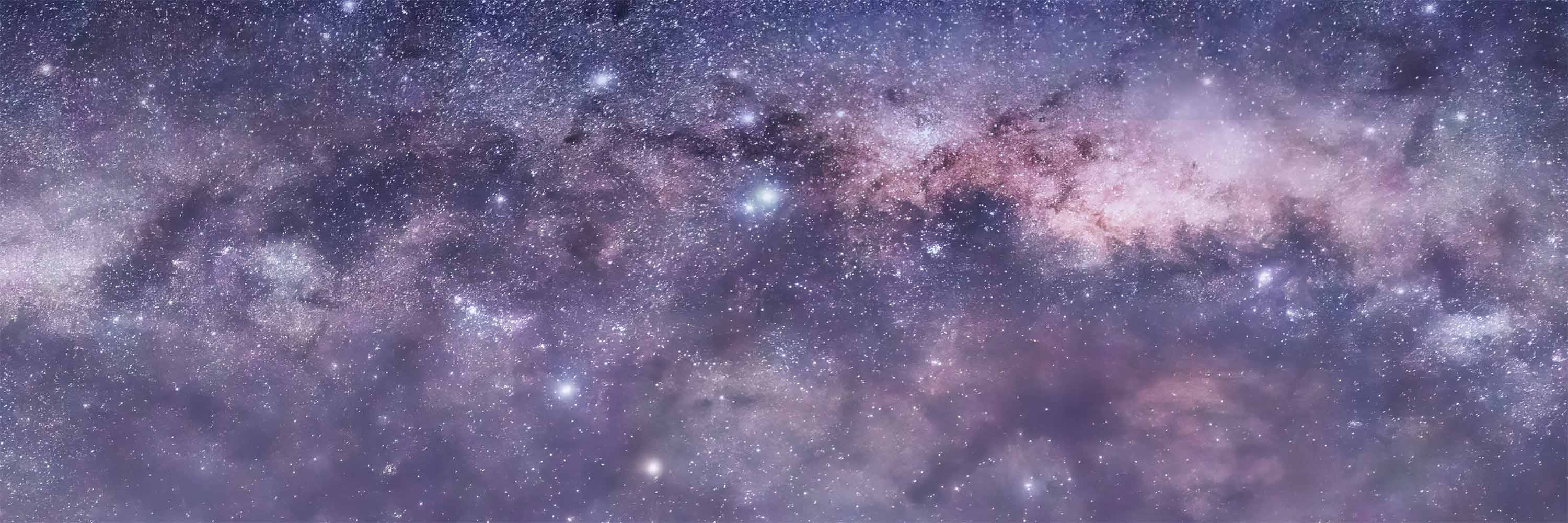
This crop is 33 percent of the frame width, about 30 inches across on the 90 inch print. The band has separated into individual stars, and the brighter ones carry color, blue-white near the center and warm below it. The dust lanes hold their edges against the star field behind them, and faint stars run out to the corners. Click to view at full size.
About This Photograph
Near Rockhampton, central Queensland, Australia. This is a composite image. The foreground was photographed at blue hour and the night sky later the same evening facing a different direction, both as stitched panoramas, and the two were combined afterward. Rockhampton sits within a few kilometers of the Tropic of Capricorn.
The Milky Way is the disc of our own galaxy seen edgewise from inside it, which is why it reads as a band and why the band closes into a complete circle around the sky. Its brightest region is the direction of the galactic centre, at a declination of about twenty-nine degrees south, which passes within roughly six degrees of the zenith at this latitude. The dark lanes running through it are interstellar dust.
Measured across the frame, nothing in this photograph reaches pure white, and nothing comes near it, despite thousands of stars. The brightest sustained passage in the picture is a hundred and eighty-nine out of two hundred and fifty-five. Almost a quarter of the frame sits at or near black, nearly all of it in the grass along the bottom.
Arc of the Infinite
Steve Austinhttps://www.steveaustinphotography.com/
Location
Rockhampton, Queensland, Australia
Subject
Milky Way · silhouetted trees · night sky
Capture
Composite, blue hour and night
Format
Photograph · horizontal panorama, 3:1
Sizes
36 × 12 in · 60 × 20 in · 90 × 30 in
Print Media
TruLife Acrylic · ChromaLuxe Metal · Baryta paper
Edition
Limited, 25 / 50 / 100 by presentation
What it Does in a Room
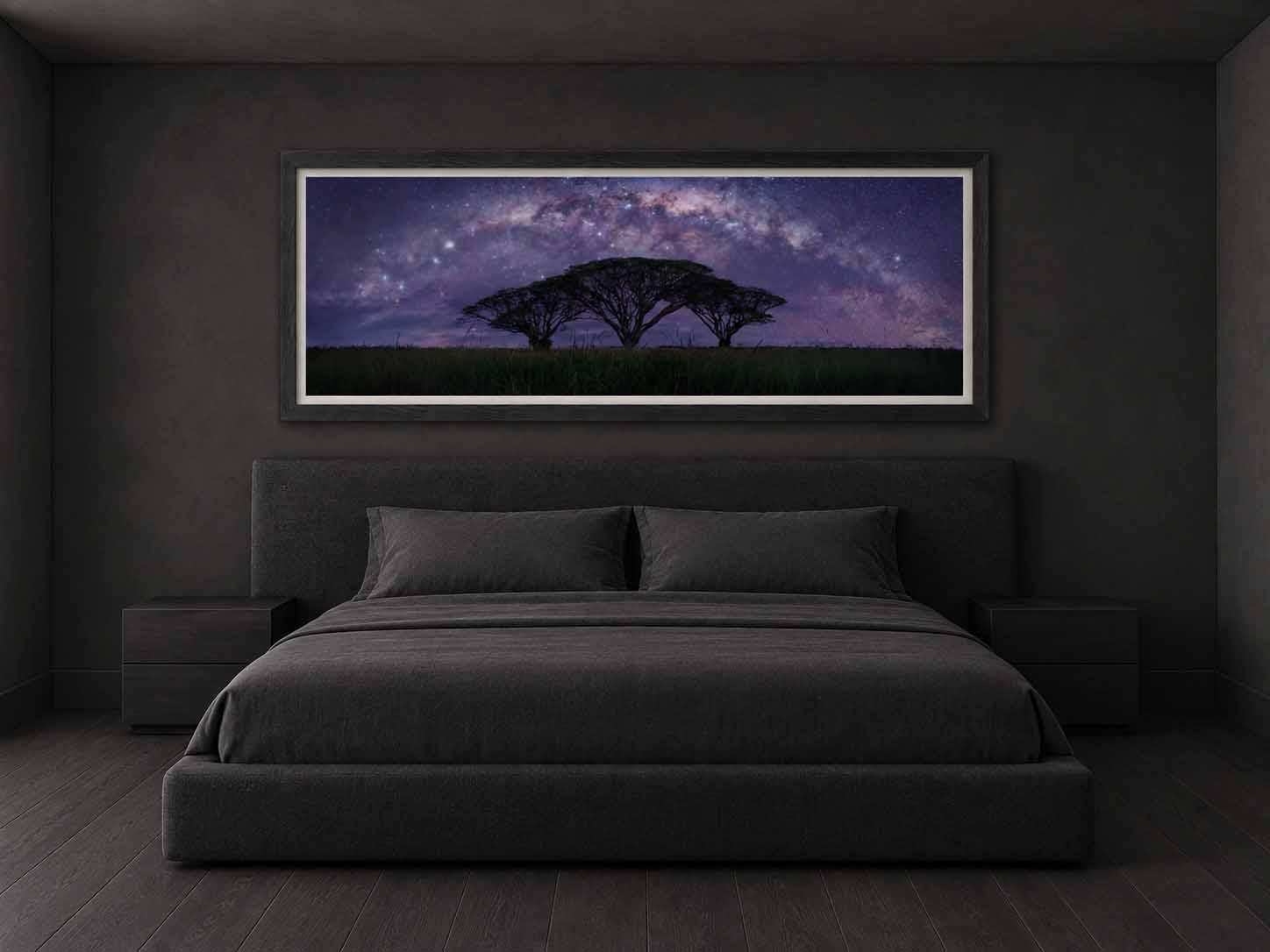
The whole picture is two arches answering each other, and both are centered. That places one hard condition on hanging it: it has to sit in the middle of its wall, because an arch pushed off center reads immediately as leaning, in a way a rectangle full of trees or water never does. It also wants clear wall above it. The apex of the galactic arch sits close to the top edge of the frame, and a soffit, a beam, or a run of cabinets crowding the top will crop the eye's sense of the curve even when it does not crop the print. Give it a centered position on an unbroken wall and it does what it is built to do.
Its base is almost solid black. The bottom edge of this frame averages nine out of two hundred and fifty-five, which is the darkest bottom edge in the collection, and it stays that dark right across the width. That has a practical consequence. Above a dark console, a charcoal bench, or a black cabinet run, the picture and the furniture merge into one object and the panel appears to sit on something rather than float on a wall, which is generally the better look. Above a pale surface, the bottom edge of the print reads as a hard line and the piece looks cut off. The furniture beneath this one matters more than usual.
It is also two different pictures stacked. The upper half carries the finest detail in the collection, thousands of individual stars and the dust lanes between them, and it rewards being approached as much as anything here. The lower half is pure silhouette with no detail in it at all, by design. So walking up to this piece pays off only in the top half, and the viewing distance is set entirely by the sky. That makes it a good choice for a wall someone stands close to and a poor one for a spot where the top of the frame is above comfortable sightline.
Not sure which size the room calls for, or want dimensions not listed here? Sizes beyond 90 × 30 are available on request and ship crated by freight. That conversation is welcome before an order is placed. Start that conversation and I will answer within one business day.
Arc of the Infinite, limited edition printSteve Austin70012900USD11https://schema.org/InStock
Questions about this photograph
How small is too small for a photograph this wide?
At the Intimate size the picture is thirty-six inches across and twelve inches tall, and the two arches hold, because both are large simple curves. The trees hold as silhouettes. What goes is the sky, which is most of the point. Individual stars occupy a few pixels each, so below the middle sizes they merge into a general glow and the band stops being made of anything. The dust lanes go with them, and once the dark lanes are gone the bright region flattens into a smear rather than reading as structure with depth in it. The Collected at sixty by twenty is where the stars separate and the lanes reappear. If you are weighing a size against a specific wall, choosing the right print size covers the measurements and the viewing distances in more detail.
What changes at the largest size?
The band becomes stars. At ninety by thirty the brightest region resolves into thousands of separate points rather than a glow, and the brighter ones show their color, some warm, some blue-white. The dust lanes cutting through the band read as distinct shapes with edges, dark against the star field behind them rather than as vague shadow. Away from the band the sky fills with fainter stars all the way to the frame edges. Along the horizon the trees resolve from a single mass into three separate canopies with sky visible between their branches, and the fine structure of the outer twigs becomes legible against the sky. In the foreground the grass separates into individual blades along the top of the sward. Why scale matters covers what happens perceptually when a photograph reaches the size where the eye has to cross it.
What kind of room does this photograph suit?
Rooms with a long unbroken wall and something dark beneath it. A wine cellar, a study, a sitting room, a hall. Center it, and give it clear wall above. On materials it is undemanding, since it carries one cool color and very little of it, and it sits well against charcoal, deep gray, and dark timber. Two things to avoid. Do not hang it above a pale console or a light stone counter, because the near-black base will stop dead at the frame edge. And keep it away from bright lighting on the wall, since the picture has no white anywhere in it and a lit wall will make it look muddy rather than dark. When your mind needs to rest takes the question further.
Every work ships insured and arrives with a signed certificate of authenticity.
If a piece is damaged in transit, the choice of replacement is always yours, and your edition number stays with you.
Production time runs 2 to 3 weeks for metal, 3 to 4 weeks for acrylic and paper, and 5 to 6 weeks for framed work.
Each print is made to order and takes its place in a numbered edition, so sales are final. Before you choose, I am glad to help: send a photo of your wall and I will show you this work in your room at true scale, at no charge. Start a conversation
Collector's Choice · TruLife ® Acrylic in Italian Frame
Collector Edition of 25· Lumachrome TruLife Acrylic · Handcrafted Italian Frame
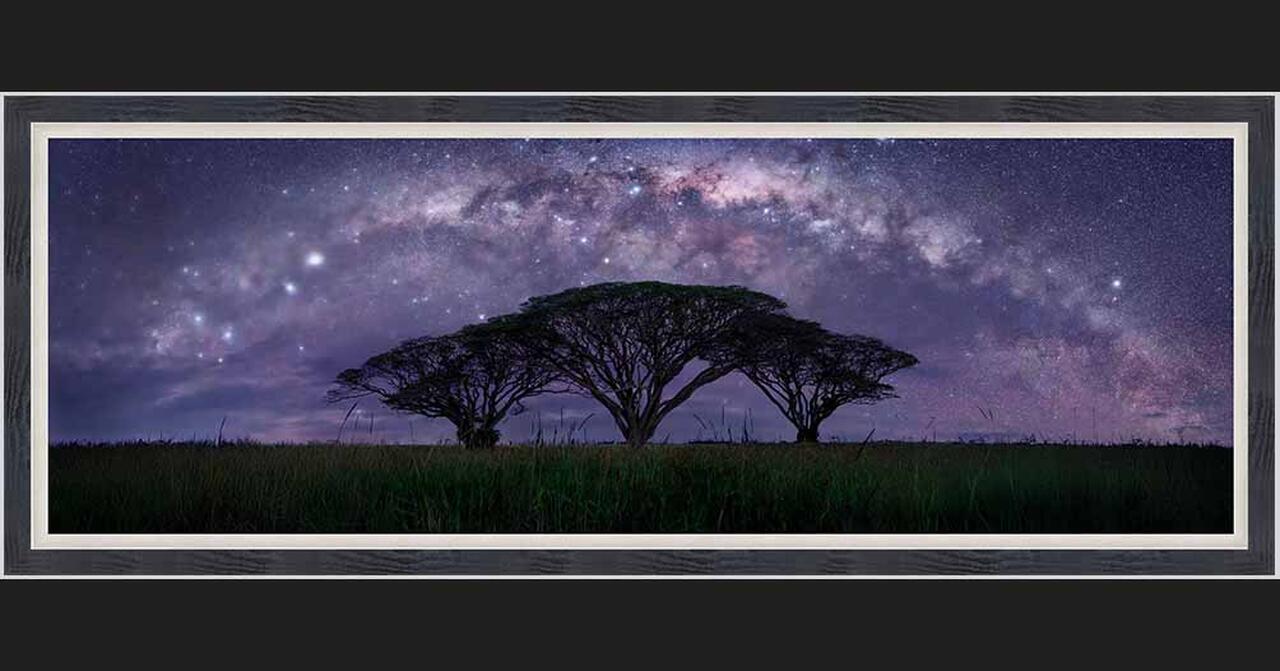
TruLife acrylic in a handcrafted Italian frame with a linen liner chosen for the image. Frame series, finish, and liner are settled with you after the order, and production begins from there. The frame and liner add about fourteen inches to the finished dimensions, worth allowing for when planning placement.
Signature Acrylic Edition of 50· Lumachrome TruLife · Gallery Float Mount
Face-mounted to TruLife acrylic and floated approximately one inch from the wall, with no frame to mediate between the image and the room. UV-resistant, anti-reflective, and scratch-resistant, with a lifetime guarantee against fading.
Signature Metal Edition of 50· ChromaLuxe Print · Gallery Float Mount
Color infused into the aluminum panel itself, floated from the wall on a concealed system. Where acrylic produces luminosity, metal produces clarity. Exceptional fade resistance with no glazing or coating required.
Fine Art Edition of 100· Hahnemühle Baryta Fine Art Paper
Printed without acrylic, so light meets the paper surface directly. Highlights stay luminous, shadows keep their nuance, and the surface has a tactile quality the other presentations approach differently. The understated choice, and the traditional one.
Complimentary shipping within the continental United States. International collector shipping available upon request.
Still deciding
Designing for Stillness
A guide to choosing art for restorative spaces
How to tell whether an image will still hold you in a year, how scale changes what a photograph does in a room, and how to match a piece to the work a room actually performs. It cites the research it draws on, and it is equally clear about where that research stops. About ten minutes to read.