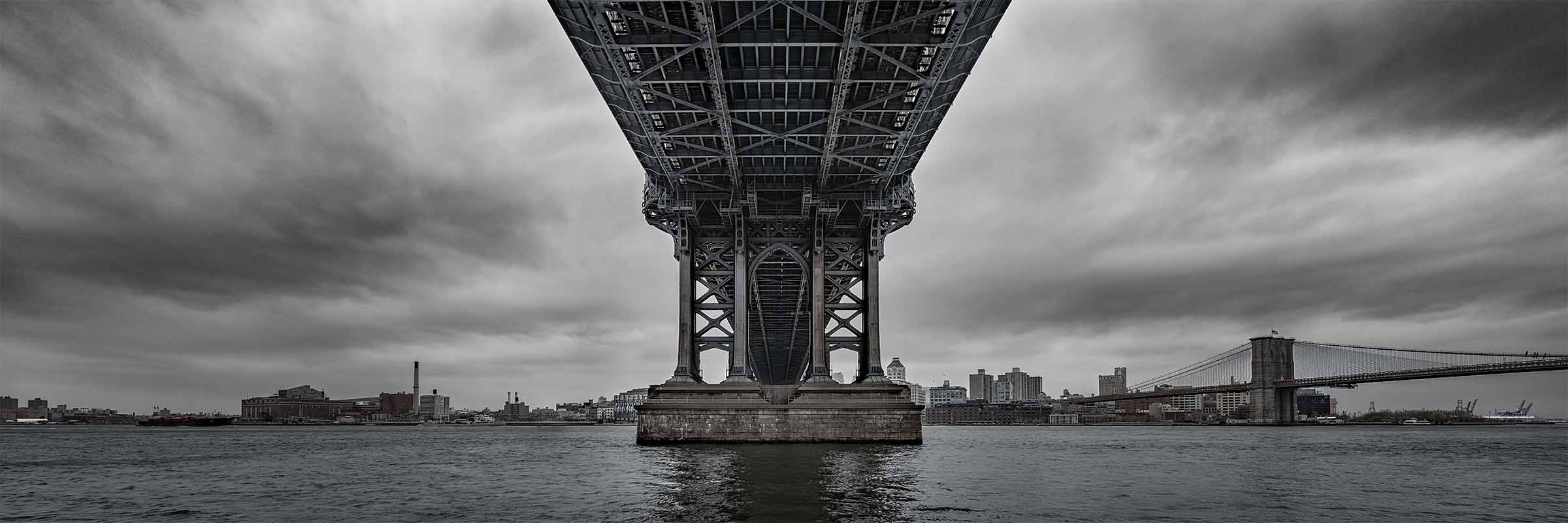
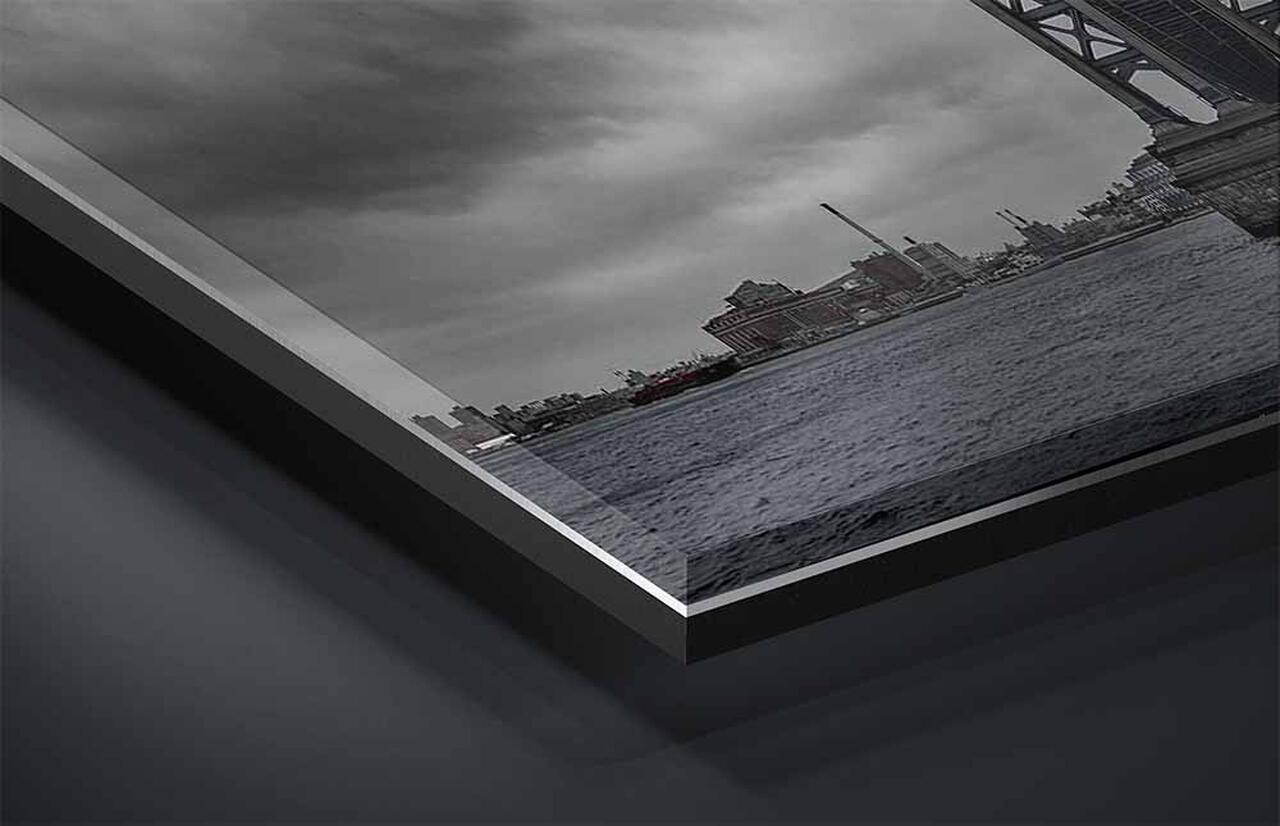
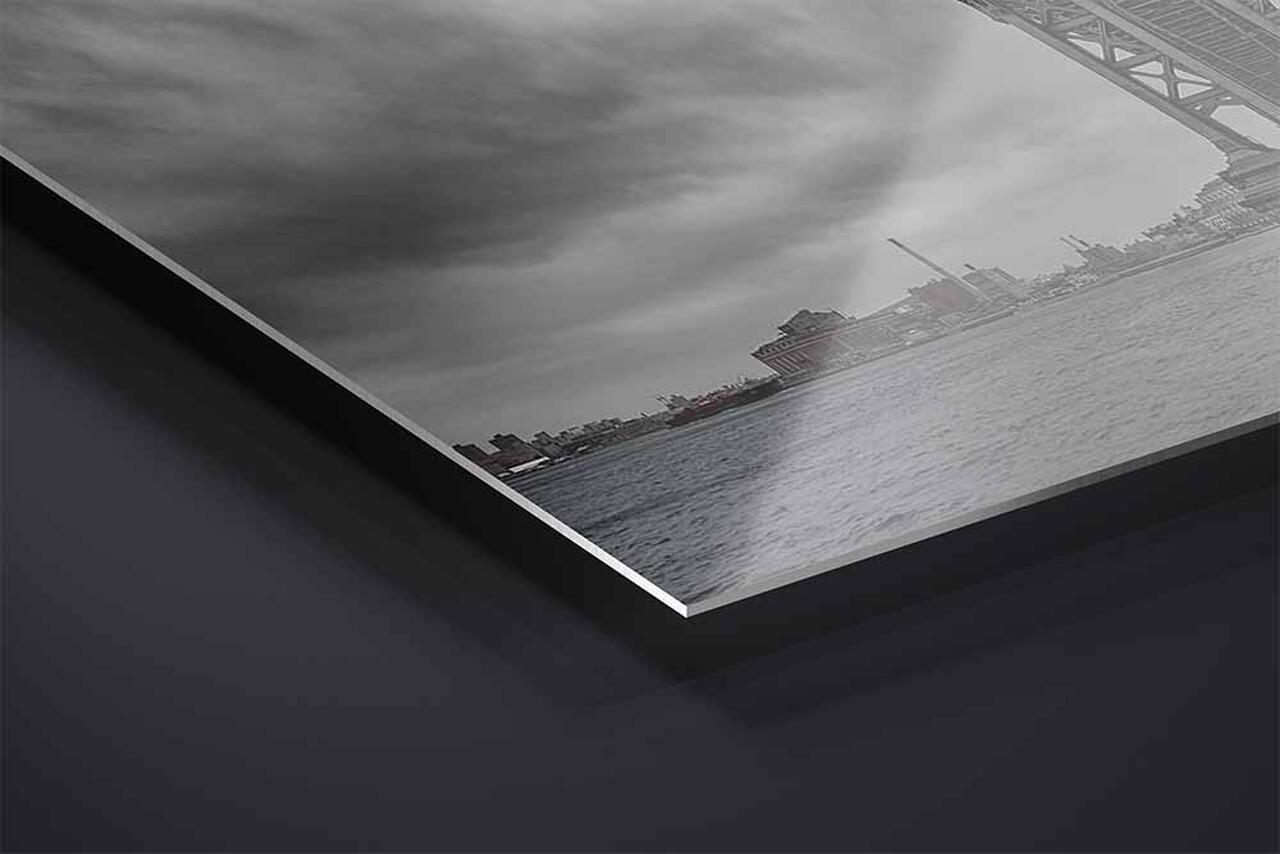
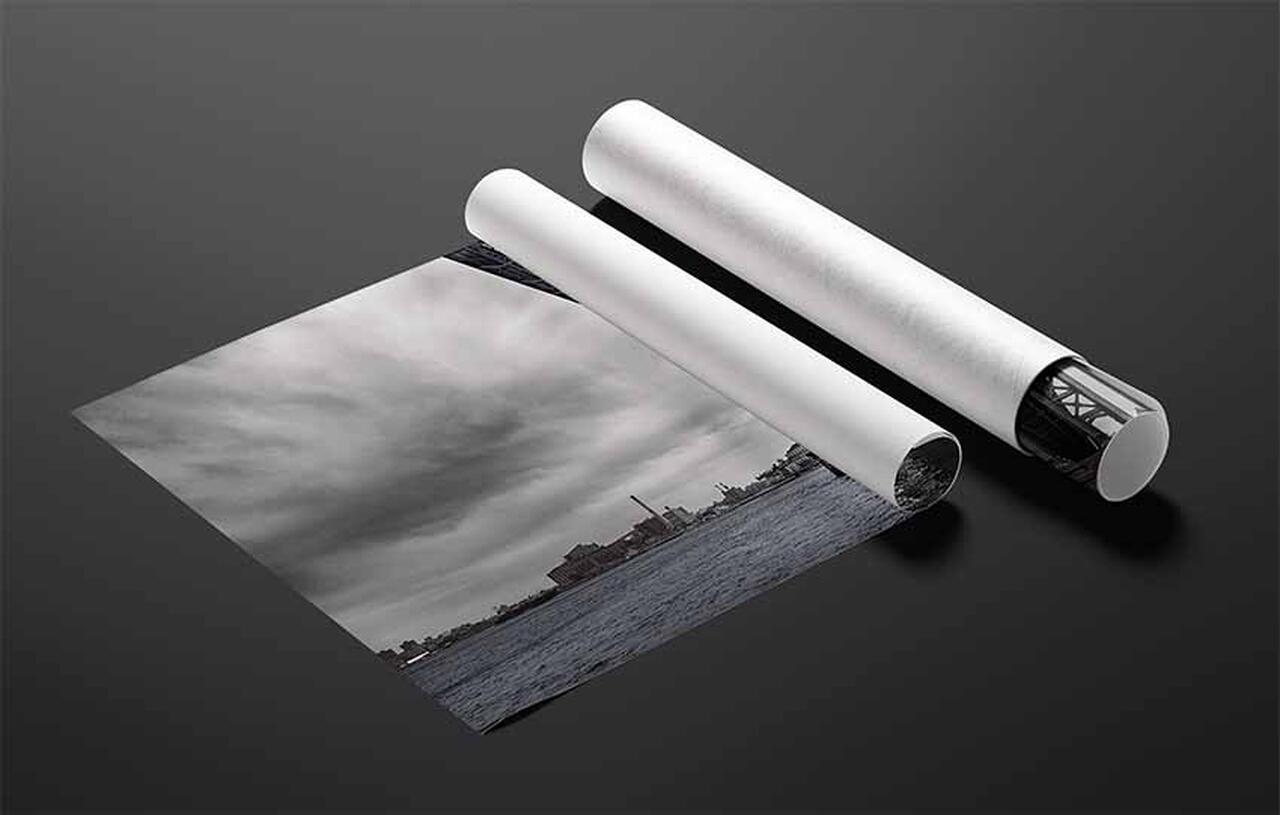
A 3:1 panoramic photograph looking south beneath the Manhattan Bridge to the East River and the Brooklyn Bridge beyond, available as a limited edition print.
Artist's Story
I stood on the FDR at the Manhattan Bridge anchorage in mid afternoon in early summer, against the concrete barrier that runs along the road, and looked south down the East River with the Brooklyn Bridge off to the right. I had come for the weather. The cloud deck was solid and the light was flat, and I wanted the underside of the bridge against it. I pulled the color down afterward, close to the point where it disappears. The only trace left in the file is in the water.
Everything in the frame sat at roughly the same brightness except the bridge.
A solid overcast is a diffuser. Cloud scatters sunlight across the whole sky, so light arrives from every direction at once instead of from one, which removes shadows and removes the difference between what the sun lights and what the sky lights. Under a source like that almost every surface outdoors gets lit, because almost every surface faces some part of the sky. The underside of a bridge does not. It faces straight down, away from the only lit hemisphere, and nothing reaches it except what comes back up off the river. That is why the steel reads as a silhouette while the buildings across the water, under the same cloud, read as tone.
The file separates the two cleanly. Sampled in vertical tenths, the columns holding open sky average one hundred forty-two and one hundred forty in brightness, and the two columns holding the bridge drop to sixty-eight and seventy-one. Seventy-four points across a single boundary, while everything else in the frame stays within forty points of the average.
Beneath the Crossing names a position. The picture only exists from directly under the deck, where the one surface the sky cannot reach fills the middle of the frame and the lit city runs out on both sides of it.
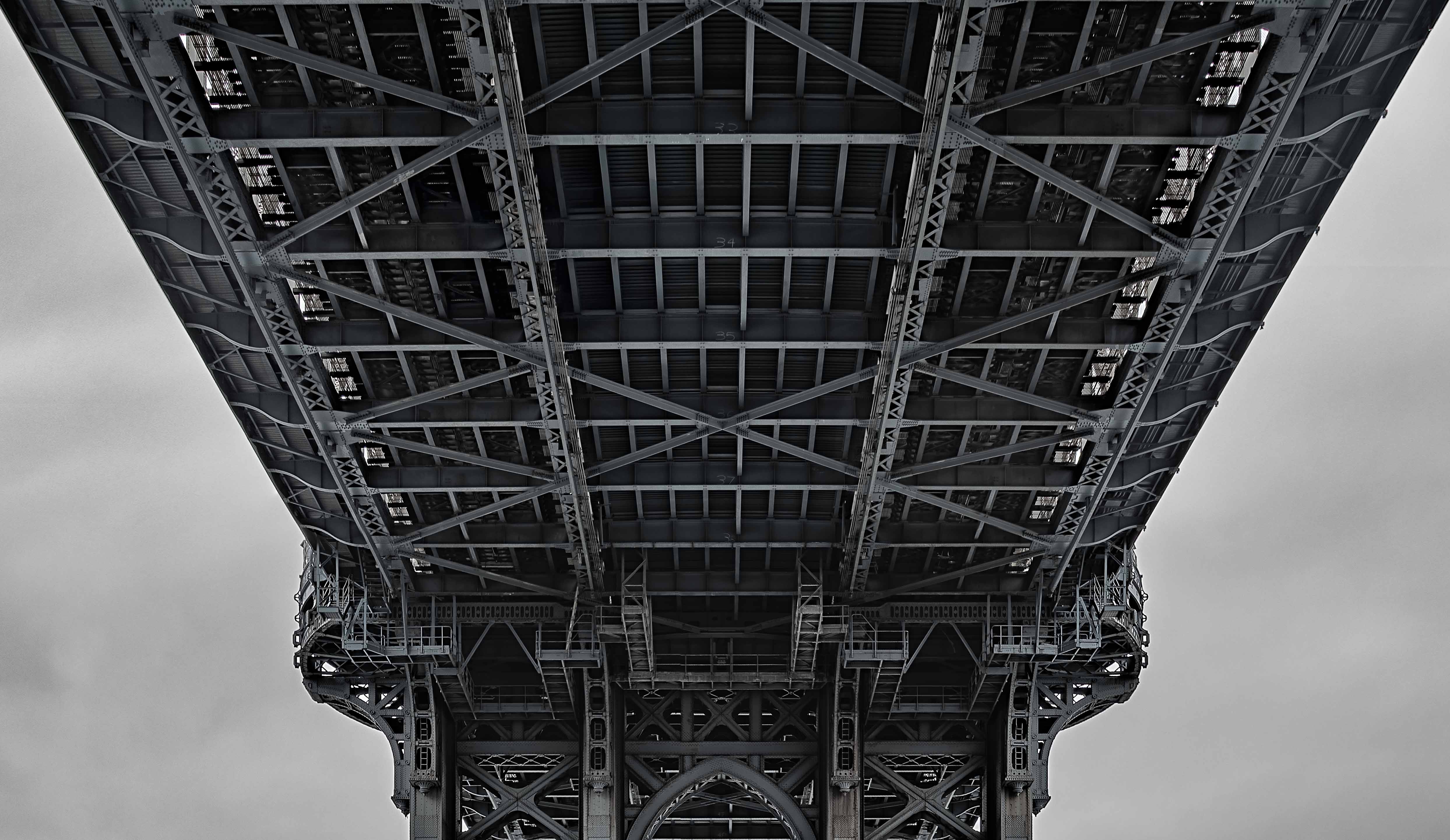
This crop is about 34 percent of the frame width, roughly 31 inches across on the 90 inch print. The stiffening truss separates member by member with the rivet lines running along every flange and the gusset plates reading at the joints. Between the trusses the transverse floor beams resolve one by one, each carrying its stenciled panel number, and daylight comes through the lattice along both outer edges. Below the deck the catwalks and their railings come away from the steel above them, and at the bottom the tower legs meet the deck with the head of the elliptical bracing visible between them. Click to view at full size.
About This Photograph
The Manhattan Bridge crosses the East River from Canal Street to the Flatbush Avenue Extension, 6,855 feet end to end with a main span of 1,470. This view looks south from the FDR beneath the Manhattan anchorage, with the Brooklyn Bridge at the right edge. Three frames, stitched. Leon Moisseiff designed it and it opened on December 31, 1909, the first suspension bridge built on Josef Melan's deflection theory and the first to use a lightly webbed Warren truss.
Deflection theory let the deck stiffen itself through its own sag, so the four parallel trusses under it run only 24 feet deep and are hinged at the towers. It moved. Renovations in 1940 found that trains entering from opposite ends could shift the bridge as much as 8 feet.
Beneath the Crossing
Steve Austinhttps://www.steveaustinphotography.com/
Location
Manhattan Bridge, East River, New York
Subject
Manhattan Bridge · East River · Brooklyn Bridge
Capture
Three-frame stitched panorama, mid afternoon
Format
Photograph · horizontal panorama, 3:1
Sizes
36 × 12 in · 60 × 20 in · 90 × 30 in
Print Media
TruLife Acrylic · ChromaLuxe Metal · Baryta paper
Edition
Limited, 25 / 50 / 100 by presentation
What it Does in a Room
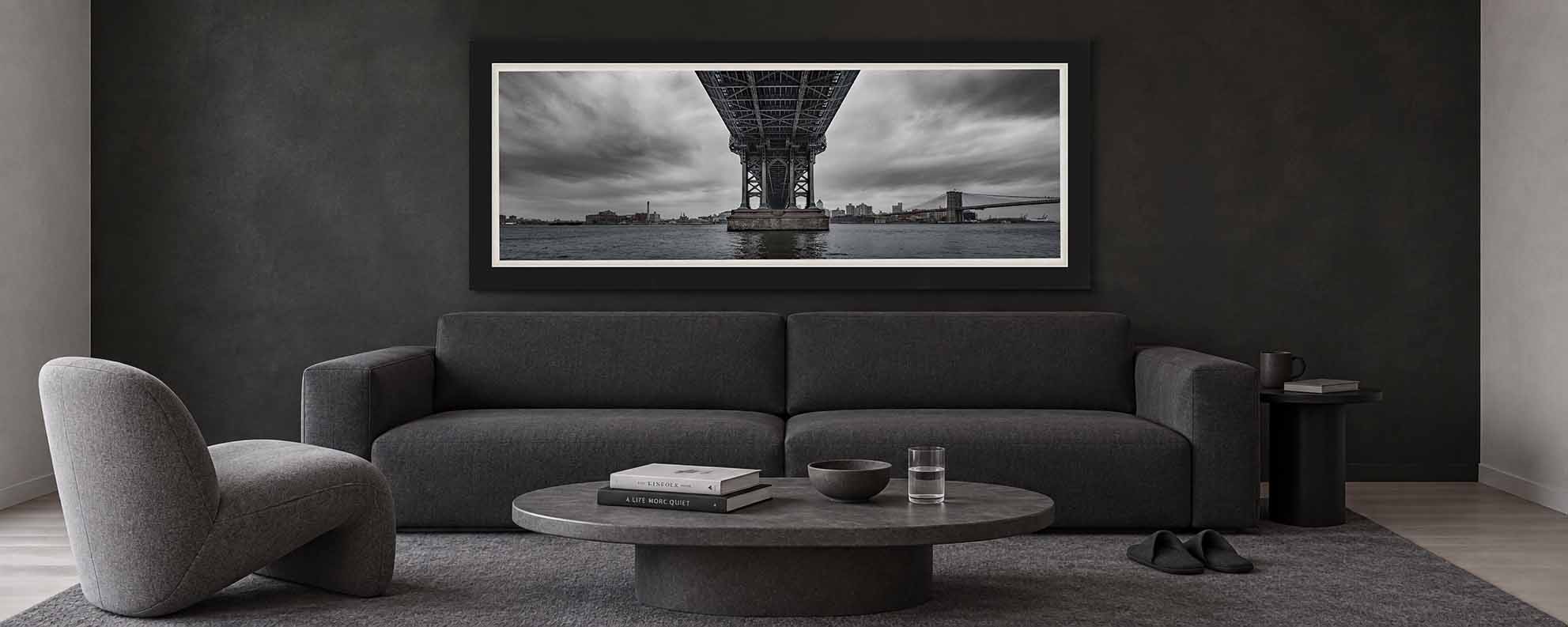
This photograph is dark in the middle and bright at both ends. Sampled in vertical tenths, the two center columns average 68.61 and 71.60 while the columns to either side of them run 142.86 and 140.02, and the outermost tenths hold at 100.37 and 103.06. The print has no dark edge of its own, so it does not stop at its own boundary. On a pale wall the outer thirds run out into the plaster and the panorama loses its ends, which is the same fact that decided the liner. Hang it on a wall with real tone in it, mid gray or deeper, and let the liner and the moulding do the stopping.
There is no highlight anywhere in this file. Only 0.0299 percent of the frame sits above 245, and the mean and median are 111.51 and 112.72, within a point and a quarter of each other. Nothing in it flares under a bright room, which makes it more tolerant of strong ambient light than most prints. The dark end is where it is vulnerable. Half a percent of the frame is pure black and 6.53 percent is near it, all of it in the truss, and in a dim room that mass closes into one flat shape and the structure inside it disappears. This print wants more light rather than less.
A single horizontal runs the full width of the image, the Brooklyn shoreline, broken only by the pier. At three to one, a line that crosses the entire print becomes a level. Half a degree of tilt is visible on it, and so is any real horizontal in the room that sits near it and does not agree: a picture rail, a mantel shelf, a countertop, a window head, the top of a bookcase. Hang it dead level with a spirit level rather than by eye, and give it a stretch of wall with no competing horizontal inside the same glance.
Not sure which size the room calls for, or want dimensions not listed here? Sizes beyond 90 × 30 are available on request and ship crated by freight. That conversation is welcome before an order is placed. Start that conversation and I will answer within one business day.
Beneath the Crossing, limited edition printSteve Austin70012900USD11https://schema.org/InStock
Questions about this photograph
How small is too small for a photograph this wide?
The shape survives at any size. The dark mass of the bridge splitting a bright sky, the shoreline running the full width, the Brooklyn Bridge at the right edge, all of it holds. What goes is the inside of the truss. The steel is a lightly webbed lattice and the picture depends on being able to see through it, so when the members merge into one solid silhouette the photograph stops being about a structure and becomes a shape. That is the point where it no longer supports its own argument. The lattice begins to open up around the middle of the size range and is fully legible at the largest. If you are weighing a size against a specific wall, choosing the right print size covers the measurements and the viewing distances.
What changes at the largest size?
At full size the print resolves left to right. At the far left a moored barge separates from the seawall and the low industrial waterfront divides into individual buildings with the smokestack standing clear of them. Across the top the overcast breaks into layered banks with visible edges rather than one gray field. In the center the truss opens: individual lattice members separate, the gusset plates show at the joints, and the rivet lines run along the flanges. Below the deck the catwalk and its railing come away from the steel above them. Inside the tower legs the elliptical bracing and the cross-bracing resolve as separate systems. At the base the granite pier divides into courses with its joints visible above the waterline. At the right the Brooklyn Bridge cables separate strand by strand and the flag reads on the tower. Why scale matters covers what happens perceptually when a photograph reaches the size where the eye has to cross it.
What kind of room does this photograph suit?
A long uninterrupted wall with tone in it. Living rooms, a wide hallway with enough depth to stand back from, the long side of a dining room, a conference room. Hang it with the center of the image at 60 inches from the floor, and use a level. Materials are simple here because the print is effectively achromatic: mid to deep gray plaster or paint, stone, blackened steel, dark wood. Three things to avoid. Do not put it on a white or near-white wall, because the outer thirds of the image are brighter than the wall will forgive and the panorama will lose its ends. Do not hang it in a room you keep dim, because the truss closes into a solid and takes the subject with it. Do not hang it near a strong horizontal line that will disagree with the shoreline. When your mind needs to rest takes the question further.
Every work ships insured and arrives with a signed certificate of authenticity.
If a piece is damaged in transit, the choice of replacement is always yours, and your edition number stays with you.
Production time runs 2 to 3 weeks for metal, 3 to 4 weeks for acrylic and paper, and 5 to 6 weeks for framed work.
Each print is made to order and takes its place in a numbered edition, so sales are final. Before you choose, I am glad to help: send a photo of your wall and I will show you this work in your room at true scale, at no charge. Start a conversation
Collector's Choice · TruLife ® Acrylic in Italian Frame
Collector Edition of 25· Lumachrome TruLife Acrylic · Handcrafted Italian Frame
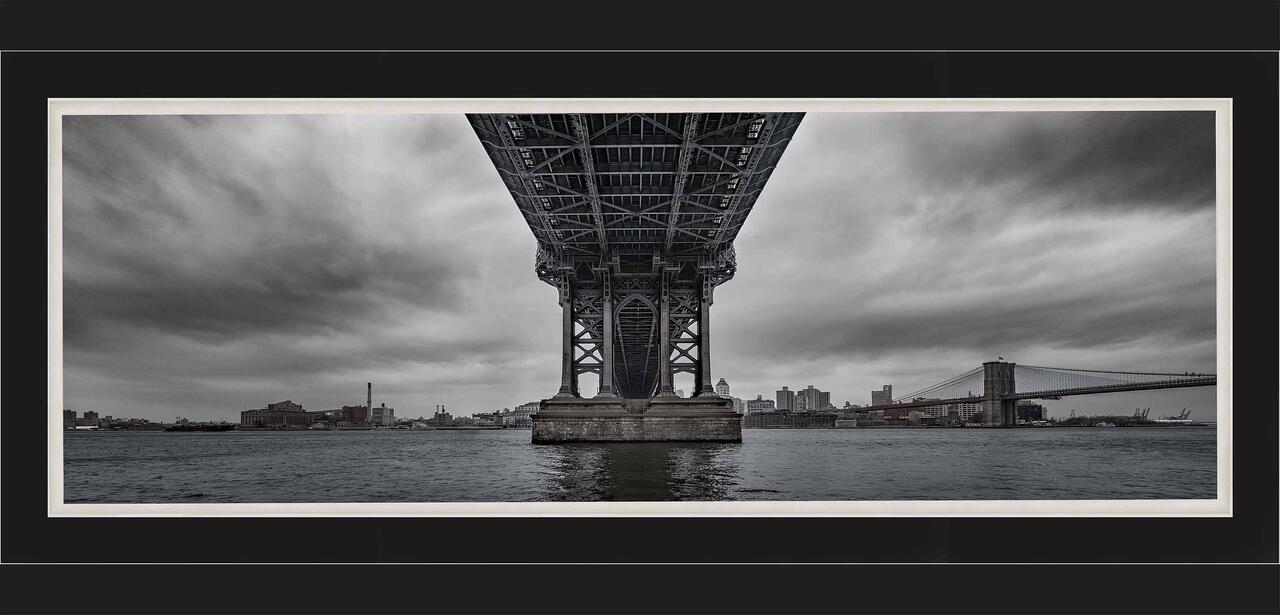
TruLife acrylic in a handcrafted Italian frame with a linen liner chosen for the image. Frame series, finish, and liner are settled with you after the order, and production begins from there. The frame and liner add about fourteen inches to the finished dimensions, worth allowing for when planning placement.
Signature Acrylic Edition of 50· Lumachrome TruLife · Gallery Float Mount
Face-mounted to TruLife acrylic and floated approximately one inch from the wall, with no frame to mediate between the image and the room. UV-resistant, anti-reflective, and scratch-resistant, with a lifetime guarantee against fading.
Signature Metal Edition of 50· ChromaLuxe Print · Gallery Float Mount
Color infused into the aluminum panel itself, floated from the wall on a concealed system. Where acrylic produces luminosity, metal produces clarity. Exceptional fade resistance with no glazing or coating required.
Fine Art Edition of 100· Hahnemühle Baryta Fine Art Paper
Printed without acrylic, so light meets the paper surface directly. Highlights stay luminous, shadows keep their nuance, and the surface has a tactile quality the other presentations approach differently. The understated choice, and the traditional one.
Complimentary shipping within the continental United States. International collector shipping available upon request.
Still deciding
Designing for Stillness
A guide to choosing art for restorative spaces
How to tell whether an image will still hold you in a year, how scale changes what a photograph does in a room, and how to match a piece to the work a room actually performs. It cites the research it draws on, and it is equally clear about where that research stops. About ten minutes to read.