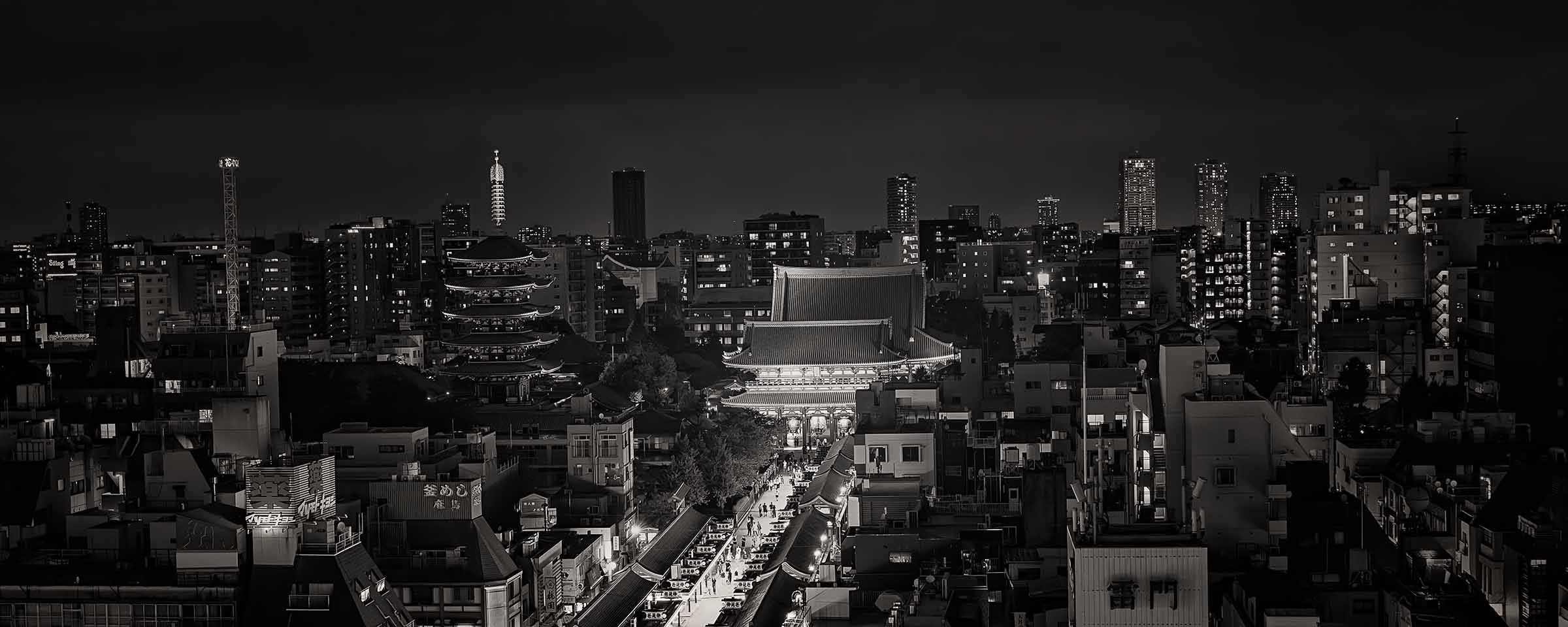
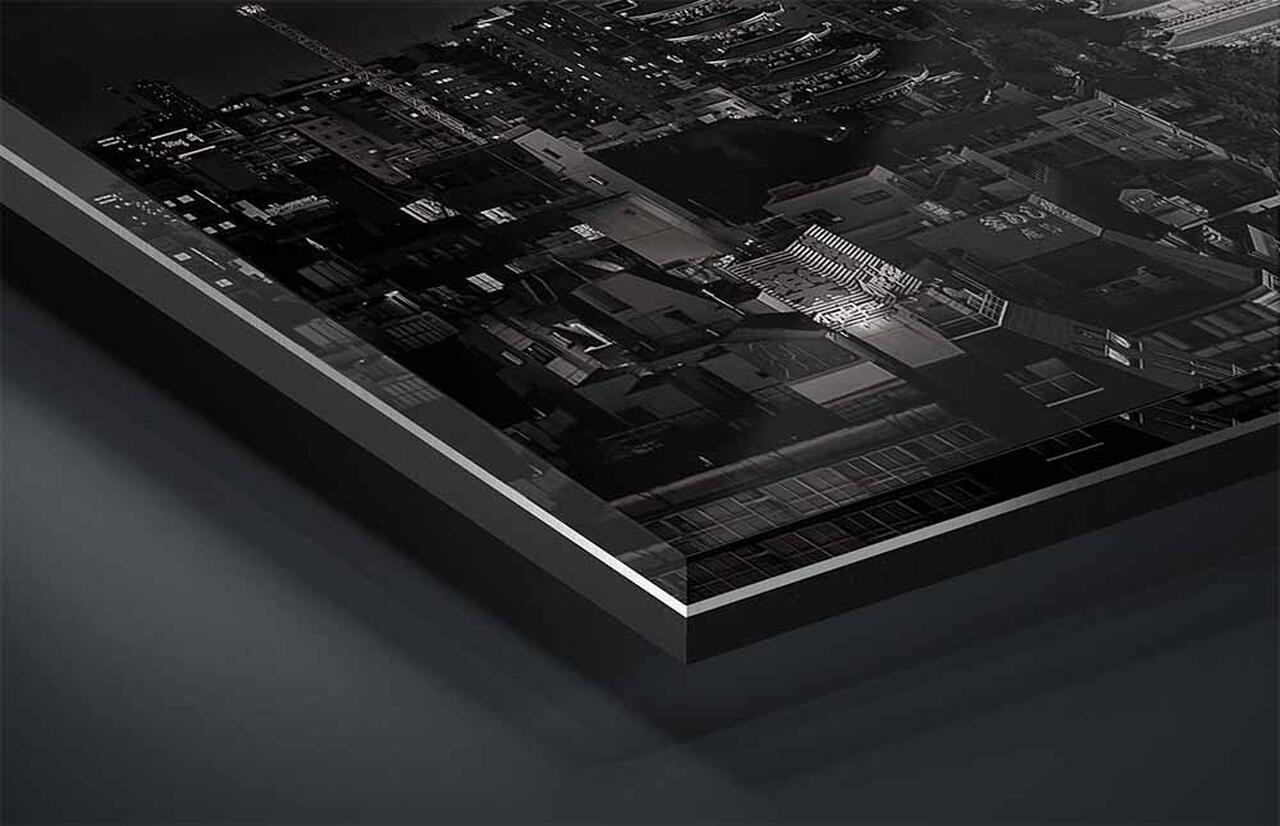
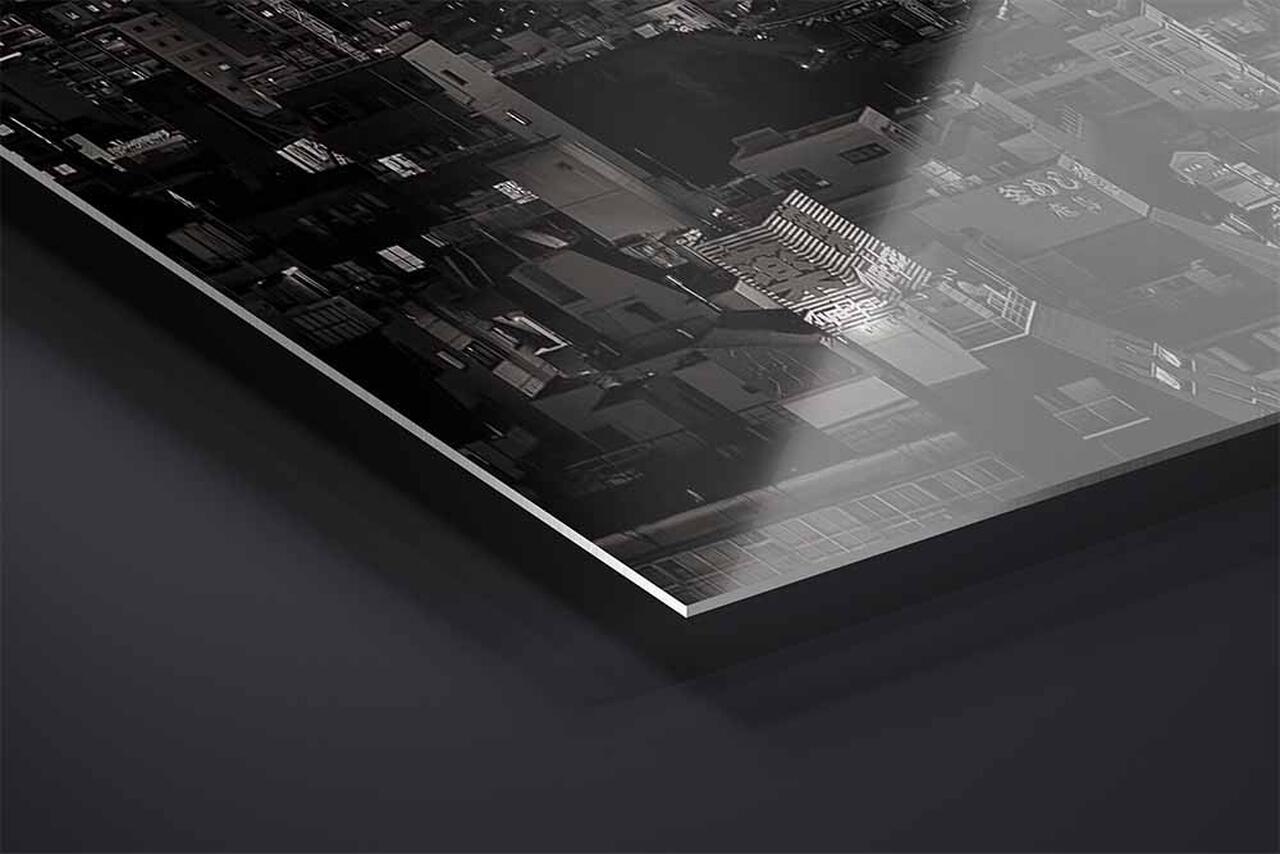
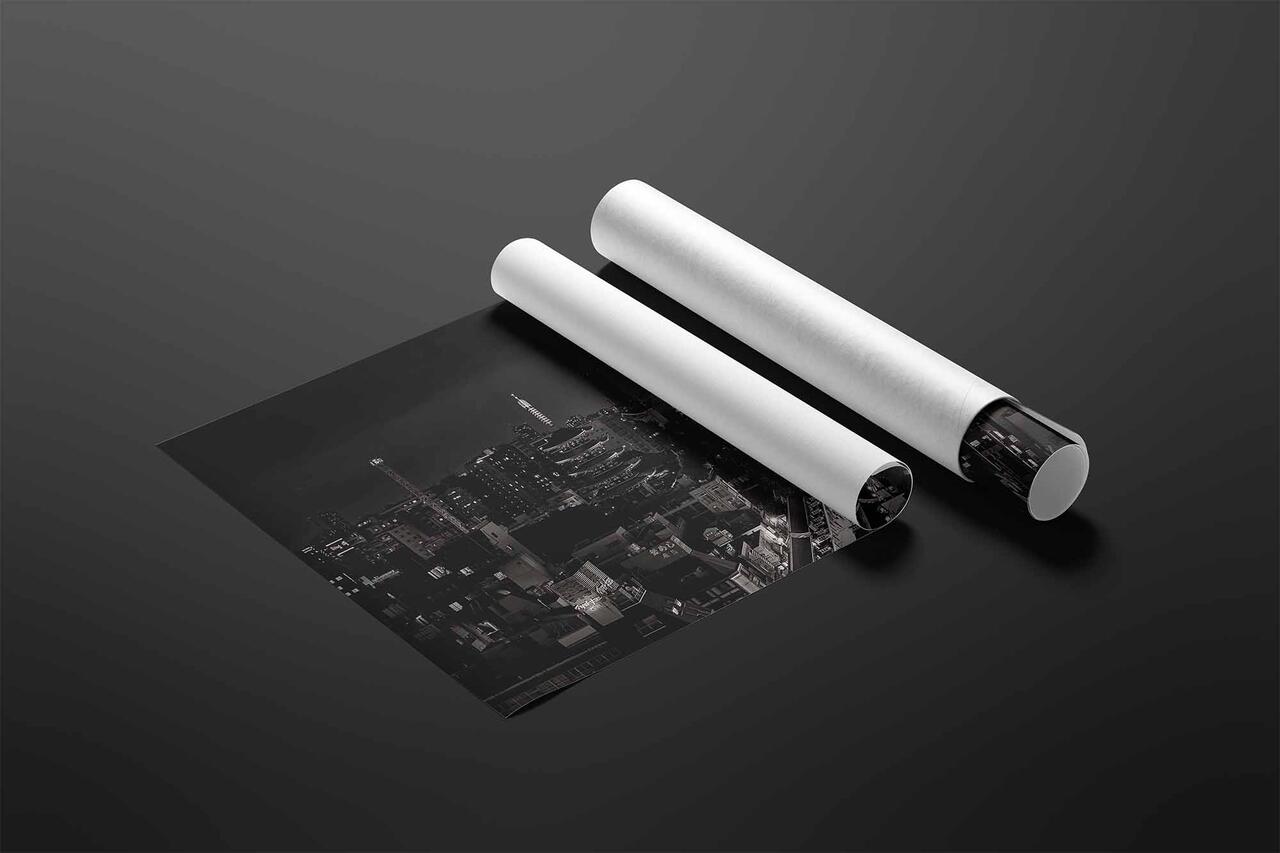
A 5:2 panoramic photograph of Sensō-ji and Nakamise-dōri at night in black and white, Asakusa, Tokyo, Japan, available as a limited edition print in three sizes.
Artist's Story
I went up to the terrace on the Asakusa Culture Tourist Information Center at about half past eight, before going into the temple grounds at all. It was my first time in Asakusa and I wanted to see the shape of the place before walking into it.
From up there the whole thing is one bright line running away from the terrace.
That line is a sandō, a temple approach, and it was built rather than worn into place. Kaminarimon stands at the near end. Behind it Nakamise-dōri runs about two hundred and fifty meters with roughly ninety shops facing each other across it. At the far end stands Hōzōmon, a second and much larger gate, and past that the main hall. Four structures on a single straight axis, arranged so that arriving takes a quarter of a kilometer and two thresholds instead of a step off the street.
Everything around it was built without reference to it. The towers behind, the apartment blocks, the rooftop plant and air handling units, the signage: none of it sits on the axis or answers it. From the terrace the line reads as the one ordered thing in a field that has no order at all, and it measures. The middle fifth of this frame is three times brighter than either edge.
Between Towers and Time is a quarter kilometer of deliberate arrangement, photographed from the one raised place in Asakusa that stands on the end of it. I went down and walked it afterward.
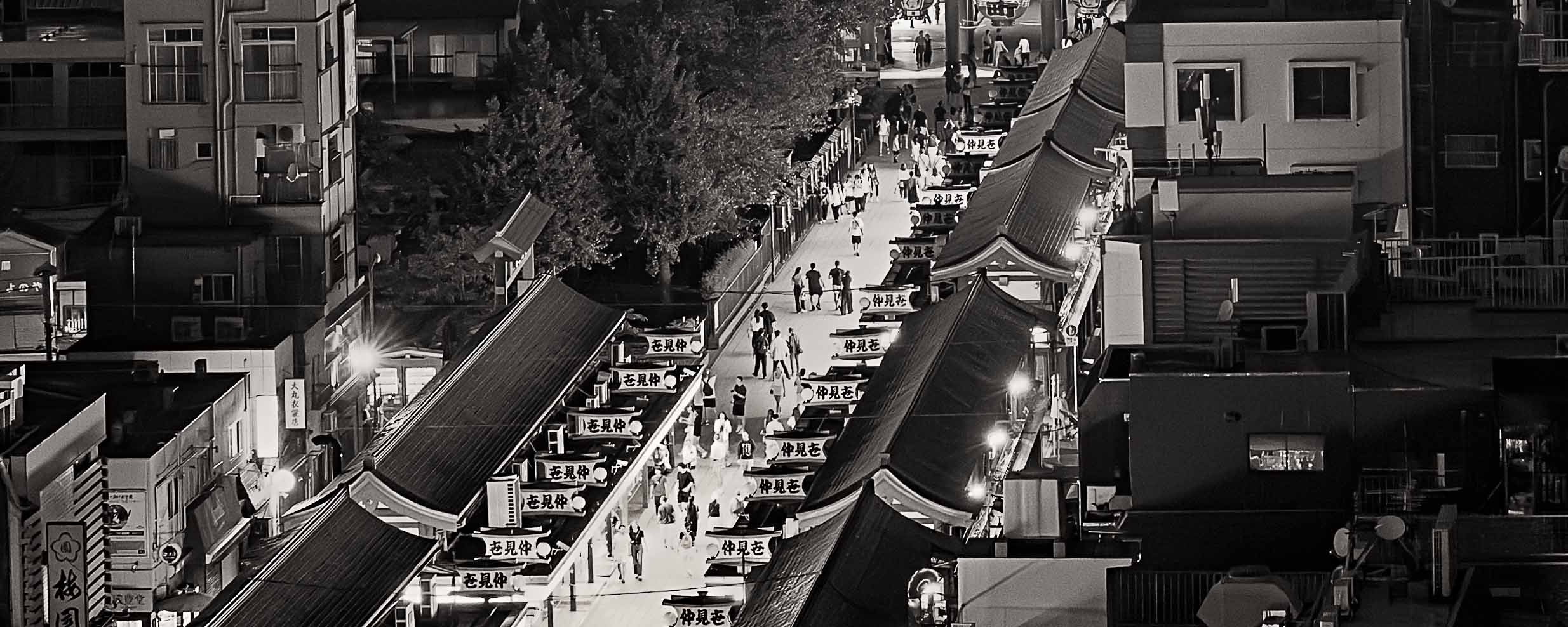
This crop is 24 percent of the frame width, about 19 inches across on the 80 inch print. The shop awnings pull apart along both sides of the approach, and the banners hanging between them read as characters. The people become people, spaced along the street with the direction each is walking legible, and the lanterns of Kaminarimon hang at the far end. On the rooftops either side, air handling units, satellite dishes and railings resolve into separate objects. Click to view at full size.
About This Photograph
Sensō-ji, in Asakusa, Tokyo, photographed from the terrace of the Asakusa Culture Tourist Information Center on the far side of the street from Kaminarimon. Single frame at night, rendered in black and white with a split tone, neutral through the sky and slightly warm through the city below it.
The shops lining the approach are there because of a bargain. In the Edo period the residents living around the temple were granted the right to set up stalls along the walk in, in exchange for keeping the grounds clean as the number of pilgrims grew. Nakamise-dōri has run on that arrangement ever since. It is among the oldest shopping streets in Japan, rebuilt after the Great Kantō earthquake and again after the war, and still carrying about ninety shops.
Between Towers and Time
Steve Austinhttps://www.steveaustinphotography.com/
Location
Sensō-ji, Asakusa, Tokyo, Japan
Subject
Sensō-ji · Nakamise-dōri · Asakusa at night
Capture
Single frame, night
Format
Photograph · horizontal panorama, 5:2
Sizes
40 × 16 in · 60 × 24 in · 80 × 32 in
Print Media
TruLife Acrylic · ChromaLuxe Metal · Baryta paper
Edition
Limited, 25 / 50 / 100 by presentation
What it Does in a Room
This is a wide photograph that the eye reads upward rather than across. Measured in vertical strips, the middle fifth of the frame runs fifty-five and fifty-seven while the outer strips sit at nineteen and fifteen, so the bright material forms a spine up the center rather than spreading laterally. The brightest edge is the bottom one. The eye enters at the base, follows the line of the approach away into the frame, and stops at the main hall. On a panorama two and a half times as wide as it is tall, that is the reverse of what the shape leads you to expect, and it has one practical consequence: the piece does not need the lateral clearance a panorama usually wants. Its activity is in the middle.
Its only color is a three-point warm shift, and that shift is fragile. The picture is black and white but not neutral: the sky measures exactly zero on the red-blue axis and the city below it runs warm by roughly three points, which is what separates the two halves as material rather than merely as tone. Three points is a narrow margin. Under a warm bulb the lamp's own cast lands on the whole print and swamps it, so the sky picks up the same warmth as the city and the split closes. A full-color photograph would survive that with most of its character intact. This one loses the only distinction it has. Neutral light is not a preference here.
It is also a field of small bright points on black, and that makes the room visible in it. Over half the frame sits near black and three percent is at true zero, and scattered across that darkness are several hundred lit windows, signs and lamps, each one a few pixels of high contrast. Anything in the room producing a small bright point behaves the same way: a standby light on a device, a glint off a handle, a cut-glass edge, a reflection of a downlight. On most photographs those go unnoticed. Here they join the picture, because the picture is already made of them, and a viewer cannot easily tell which points belong to Tokyo and which belong to the room.
Not sure which size the room calls for, or want dimensions not listed here? Sizes beyond 80 × 32 are available on request and ship crated by freight. That conversation is welcome before an order is placed. Start that conversation and I will answer within one business day.
Between Towers and Time, limited edition printSteve Austin95012100USD11https://schema.org/InStock
Questions about this photograph
How small is too small for a photograph this wide?
At the Intimate size the picture is forty inches across and sixteen tall, and the structure holds. The bright approach holds as a line, the main hall holds as a roof, and the pagoda holds as a shape. What goes is the population. The people walking Nakamise become a texture rather than figures, and once they are gone the street stops being a street in use. The shop awnings merge into a single lit strip. The lit windows across the towers behind lose their separation and read as general glow. The Collected at sixty by twenty-four returns the awnings and the windows. If you are weighing a size against a specific wall, choosing the right print size covers the measurements and the viewing distances in more detail.
What changes at the largest size?
At eighty by thirty-two, working through the frame: the pagoda's five tiers separate with each lit eave distinct from the one above it. On the main hall the tile courses read across the roof and the curve of the ridge becomes a drawn line. At Hōzōmon the upper story separates from the roof above the gate. Down Nakamise the individual shop awnings pull apart, and the people on the street become people rather than marks, with the direction they are walking legible. Across the towers behind, the lit windows become individually countable. And on the nearer rooftops the water tanks, air handling units and antennas resolve into separate objects, which is most of what fills the dark two thirds of this picture. Why scale matters covers what happens perceptually when a photograph reaches the size where the eye has to cross it.
What kind of room does this photograph suit?
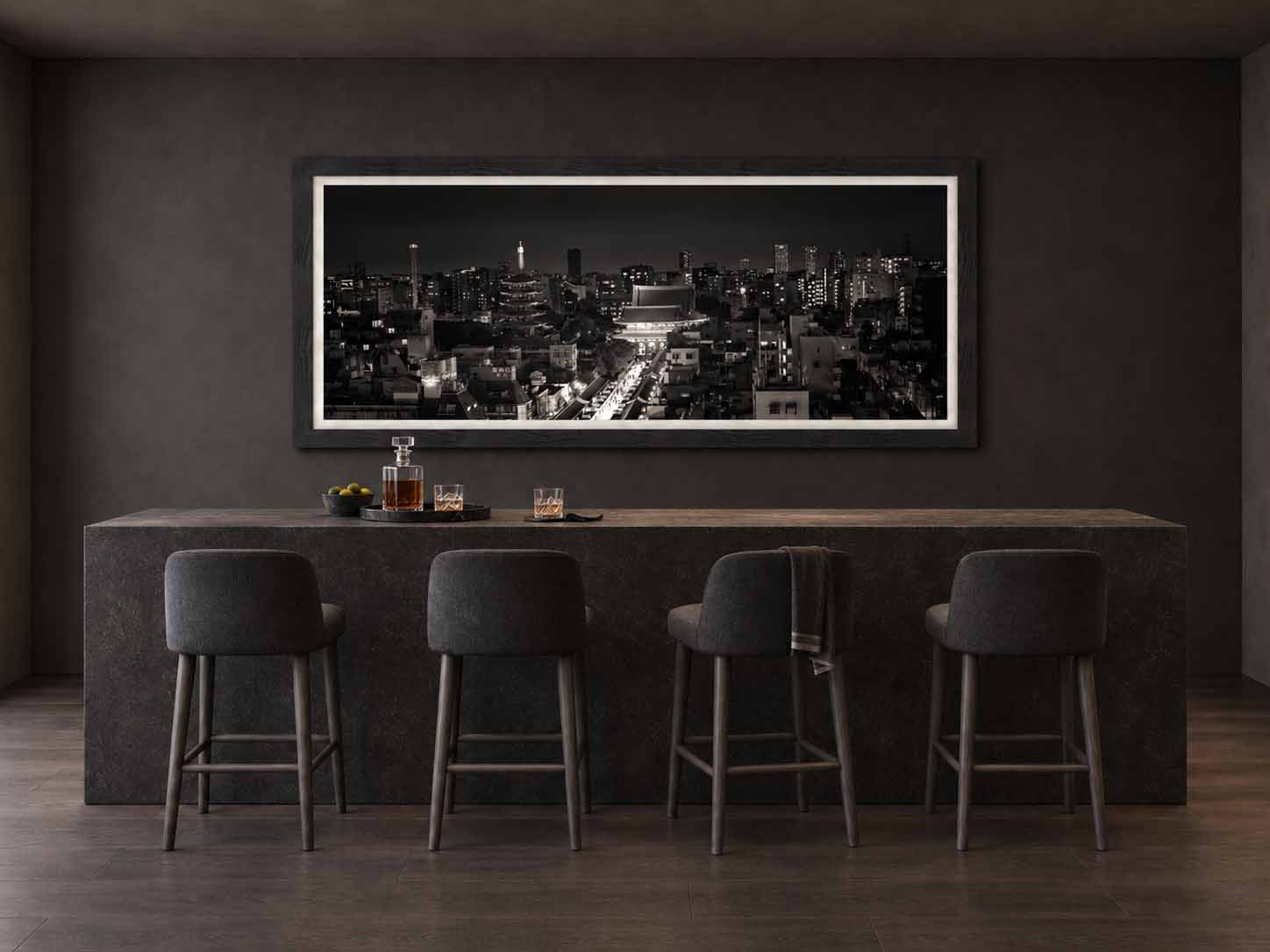
A dark room used in the evening. A study, a den, a dining room, a long hall, a lower level. Hang it at standard height with the center at about fifty-seven inches. On materials it wants charcoal, deep neutral gray, and matte surfaces throughout, and because it carries almost no color it will not argue with a scheme in either direction. Three things to avoid. Use neutral bulbs rather than warm ones, since the split tone that separates the sky from the city is only three points wide and a warm lamp closes it. Keep it away from a window or a mirror facing it, because the picture is a field of small bright points on black and a reflected room adds more of them. And avoid anything nearby that produces a glint, whether polished hardware, cut glass, or a device with a standby light. When your mind needs to rest takes the question further.
Every work ships insured and arrives with a signed certificate of authenticity.
If a piece is damaged in transit, the choice of replacement is always yours, and your edition number stays with you.
Production time runs 2 to 3 weeks for metal, 3 to 4 weeks for acrylic and paper, and 5 to 6 weeks for framed work.
Each print is made to order and takes its place in a numbered edition, so sales are final. Before you choose, I am glad to help: send a photo of your wall and I will show you this work in your room at true scale, at no charge. Start a conversation
Collector's Choice · TruLife ® Acrylic in Italian Frame
Collector Edition of 25· Lumachrome TruLife Acrylic · Handcrafted Italian Frame
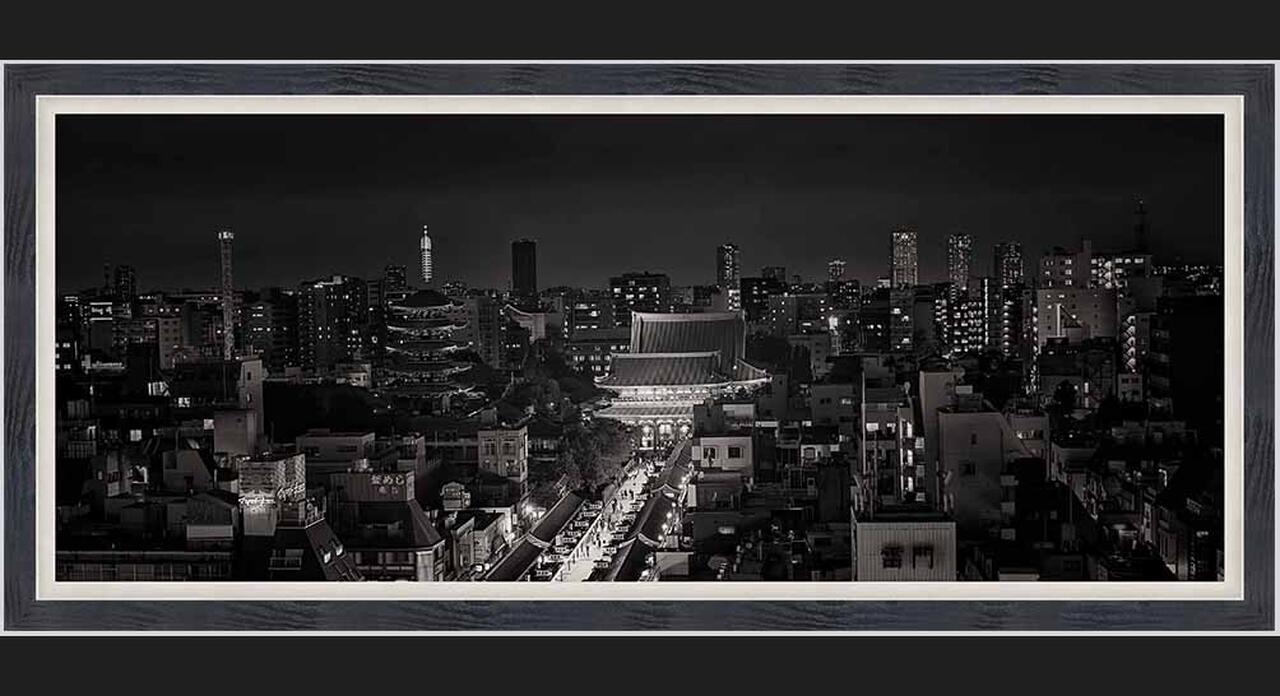
TruLife acrylic in a handcrafted Italian frame with a linen liner chosen for the image. Frame series, finish, and liner are settled with you after the order, and production begins from there. The frame and liner add about fourteen inches to the finished dimensions, worth allowing for when planning placement.
Signature Acrylic Edition of 50· Lumachrome TruLife · Gallery Float Mount
Face-mounted to TruLife acrylic and floated approximately one inch from the wall, with no frame to mediate between the image and the room. UV-resistant, anti-reflective, and scratch-resistant, with a lifetime guarantee against fading.
Signature Metal Edition of 50· ChromaLuxe Print · Gallery Float Mount
Color infused into the aluminum panel itself, floated from the wall on a concealed system. Where acrylic produces luminosity, metal produces clarity. Exceptional fade resistance with no glazing or coating required.
Fine Art Edition of 100· Hahnemühle Baryta Fine Art Paper
Printed without acrylic, so light meets the paper surface directly. Highlights stay luminous, shadows keep their nuance, and the surface has a tactile quality the other presentations approach differently. The understated choice, and the traditional one.
Complimentary shipping within the continental United States. International collector shipping available upon request.
Still deciding
Designing for Stillness
A guide to choosing art for restorative spaces
How to tell whether an image will still hold you in a year, how scale changes what a photograph does in a room, and how to match a piece to the work a room actually performs. It cites the research it draws on, and it is equally clear about where that research stops. About ten minutes to read.