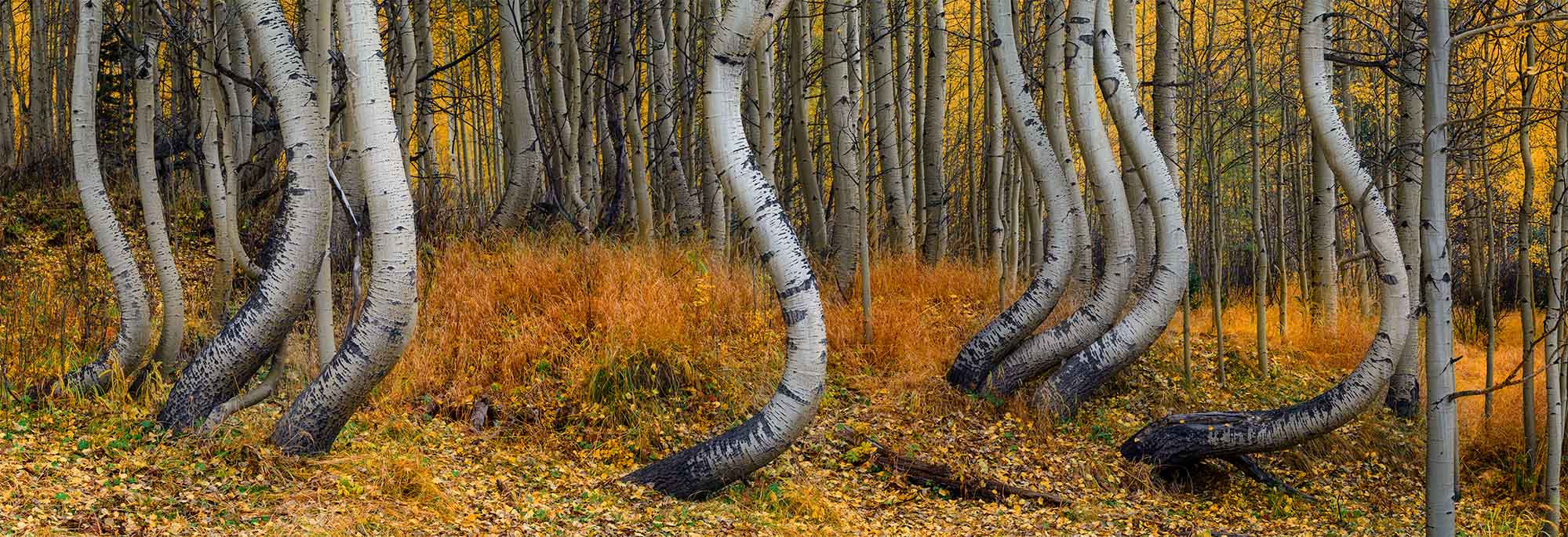
Near Telluride, in the western San Juan Mountains of southwestern Colorado, a stand of aspens comes out of the ground all bending the same way, each trunk sweeping low before turning back toward vertical. The shape has a name, pistol butt, and a cause. As saplings these trees were pushed downhill season after season by creeping soil and the slow settling weight of snowpack, and they answered by growing back upright. The curve is not damage. It is the record of a correction that worked, held in the wood for the rest of the tree's life.
I stopped here in the middle of the morning, with the sun full on the canopy and the leaves lit through, and built the frame from a series of overlapping exposures so the whole stand would hold together at size.
What settles me in a grove like this is that nothing here was shaped alone. Whatever pressed on one of these trees pressed on all of them, and every trunk carries the same answer to it. The mind, which spends a great deal of energy treating its own difficulty as singular, finds that proposition quietly corrective. Not that hardship is shared in the abstract, but that here is a whole stand of evidence, in front of you, that a shape can be made by pressure and still be sound.
In Rhythm is that shared curve, a hundred separate trees carrying one common history in the way they stand.
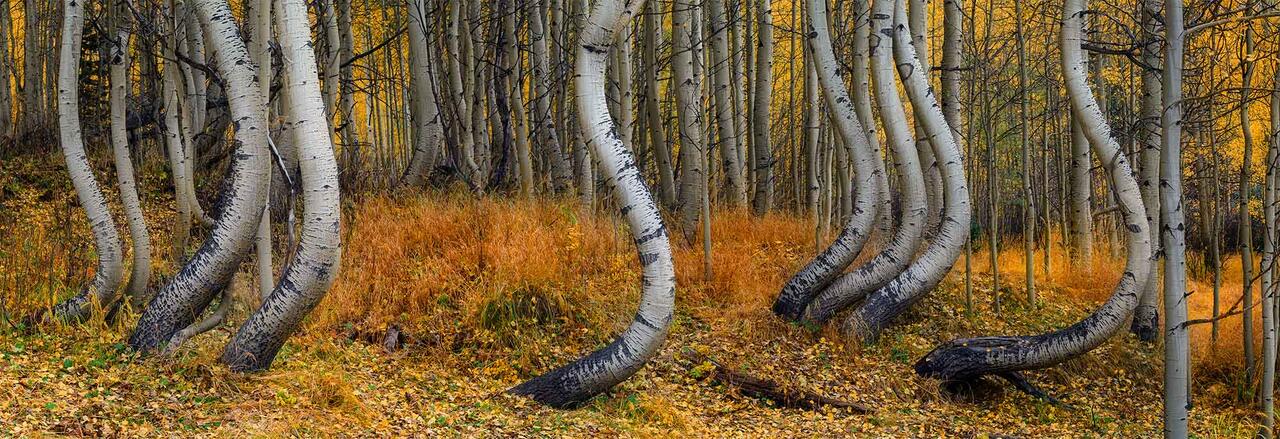
Photographed in an aspen grove near Telluride, in San Miguel County, southwestern Colorado, on the western flank of the San Juan Mountains, in autumn, midmorning with full sun on the canopy. Made as a stitched panorama from several overlapping frames to produce a high-resolution file. The subject is a stand of quaking aspen, Populus tremuloides, whose trunks show the pronounced basal curve known as pistol butting, which forms when young trees are pushed downslope by creeping soil and snowpack and then grow back toward vertical. Aspen color in this part of the San Juans typically peaks from mid-September into early October. The frame holds the curved white trunks against autumn grasses and a floor of fallen yellow leaves, with the surrounding stand behind. Presented as a horizontal panorama, offered as an archival limited edition print from 12 by 36 inches to 30 by 90 inches on acrylic, metal, or archival paper.
Every work ships insured and arrives with a signed certificate of authenticity.
If a piece is damaged in transit, the choice of replacement is always yours, and your edition number stays with you.
Production time runs 2 to 3 weeks for metal, 3 to 4 weeks for acrylic and paper, and 5 to 6 weeks for framed work.
Collector's Choice · TruLife ® Acrylic in Italian Frame
Collector Edition of 25· Lumachrome TruLife Acrylic · Handcrafted Italian Frame
TruLife acrylic in a handcrafted Italian frame with a linen liner chosen for the image. Frame series, finish, and liner are settled with you after the order, and production begins from there. The frame and liner add about fourteen inches to the finished dimensions, worth allowing for when planning placement.
Signature Edition · TruLife ® Acrylic, Float Mount
Signature Edition of 50· Lumachrome TruLife Acrylic · Gallery Float Mount
Face-mounted to TruLife acrylic and floated approximately one inch from the wall, with no frame to mediate between the image and the room. UV-resistant, anti-reflective, and scratch-resistant, with a lifetime guarantee against fading.
Signature Edition of 50· ChromaLuxe Metal Print · Gallery Float Mount
Color infused into the aluminum panel itself, floated from the wall on a concealed system. Where acrylic produces luminosity, metal produces clarity. Exceptional fade resistance with no glazing or coating required.
Fine Art Edition of 100· Hahnemühle Baryta Fine Art Paper
Printed without acrylic, so light meets the paper surface directly. Highlights stay luminous, shadows keep their nuance, and the surface has a tactile quality the other presentations approach differently. The understated choice, and the traditional one.
Complimentary shipping within the continental United States. International collector shipping available upon request.
Still deciding
Designing for Stillness
A guide to choosing art for restorative spaces
How to tell whether an image will still hold you in a year, how scale changes what a photograph does in a room, and how to match a piece to the work a room actually performs. It cites the research it draws on, and it is equally clear about where that research stops. About ten minutes to read.