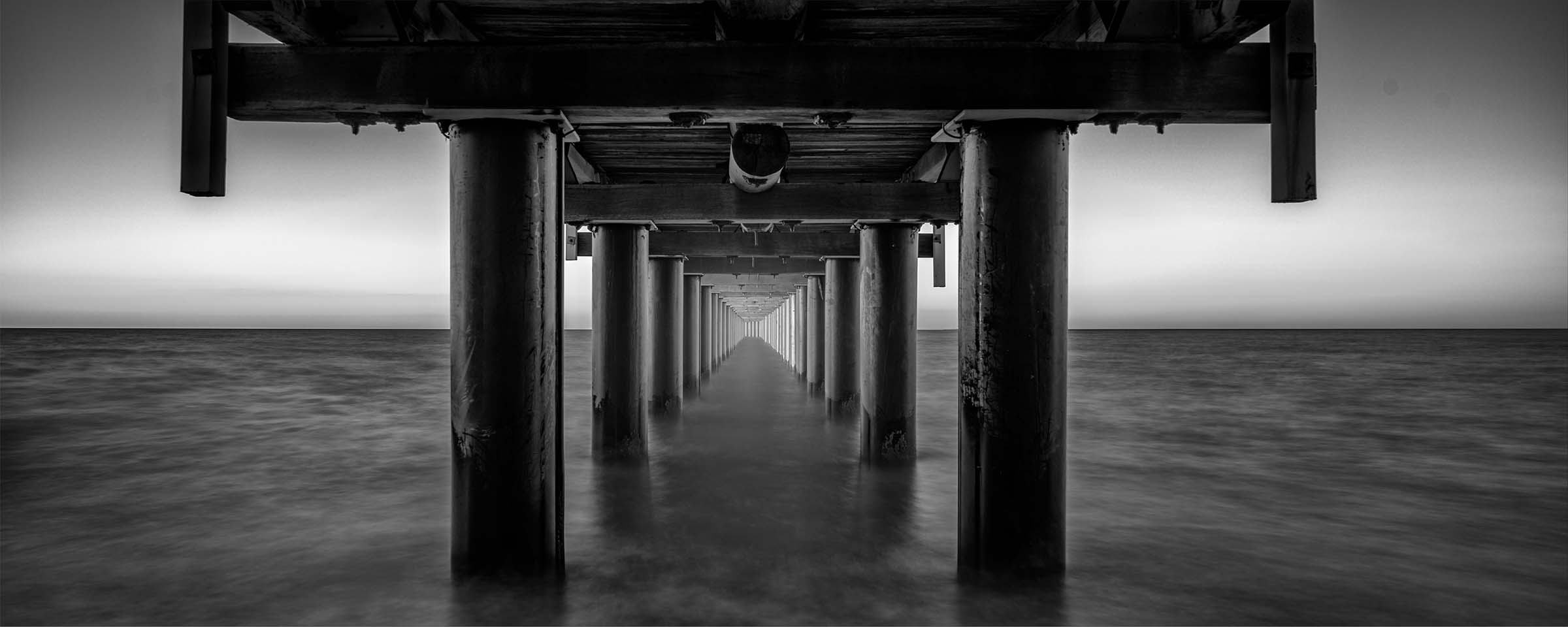
A 5:2 panoramic black and white photograph beneath Urangan Pier at Hervey Bay, Queensland, Australia, available as a limited edition print in three sizes.
Artist's Story
Underneath Urangan Pier, at Hervey Bay on the Queensland coast, the structure becomes something else. Above, it is a deck and a railing and a place to walk. Below, it is a colonnade, two rows of pylons standing in the water and repeating away from you until they are too small and too close together to tell apart. Nobody designed this to be looked at. It is simply what holds the thing up.
I had come for a photograph on the deck above, and stopped here on the way out, at the base of the steps, with low light coming through from the far end.
The thing this picture does is lead. There is one direction available and everything in the frame is pointed down it. I measured the symmetry afterward out of curiosity: fold the photograph down its middle and the two halves agree to within about six percent of each other. That is closer to true than almost anything built by hand ever gets, and it is why the eye goes straight to the end and stays there.
The other decision was to take the color out, and that does something specific. Color is what tells you when. Warm light means morning or evening, blue means the middle of the day or the shade, and every color photograph is therefore fixed to an hour. Remove it and the hour goes with it. There is nothing left in this frame to say what time it is, and not much to say what year.
What is left is the geometry. Two rows of identical cylinders at a constant interval, running out to a point, with nothing to date them and nothing to tell you how big they are. You can look down that corridor as far as you like.
Into the Infinite is that colonnade, running out to where the pattern closes and there is nothing left to count. The deck above it is a different photograph, Where Attention Leads, made in color at dusk.
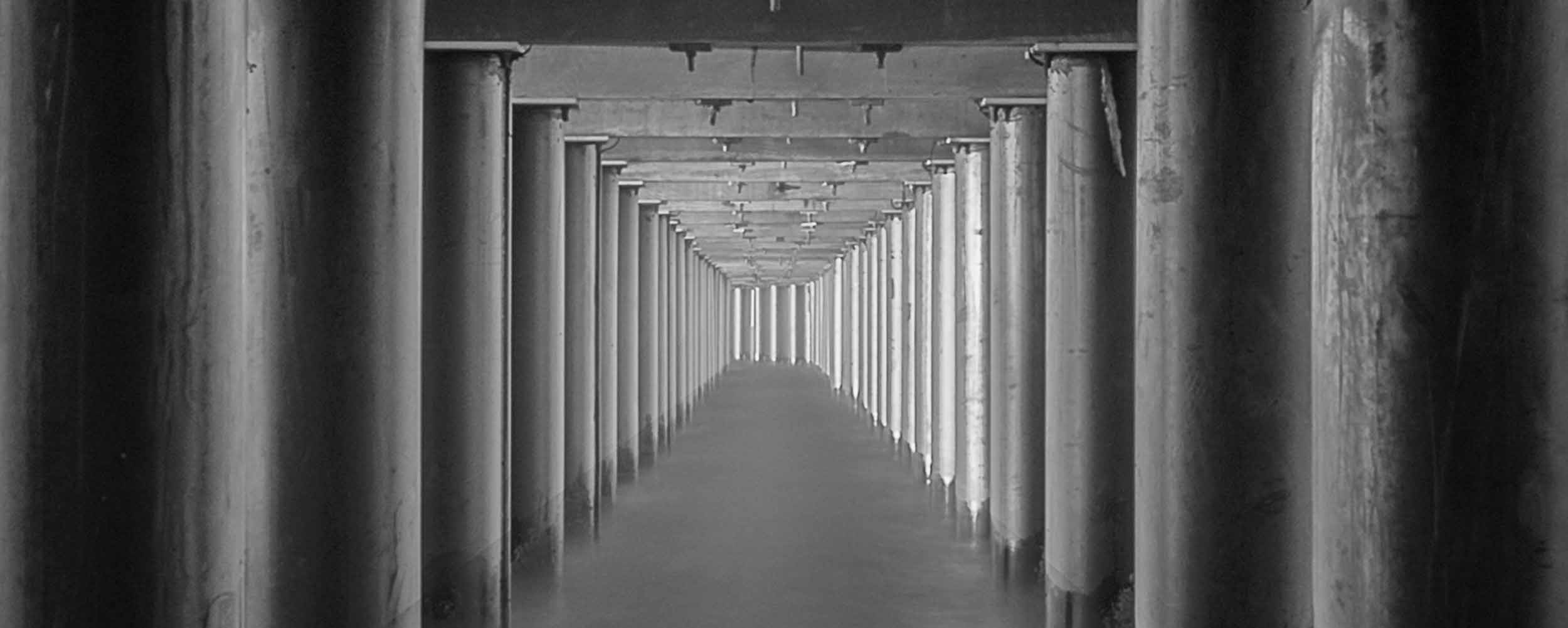
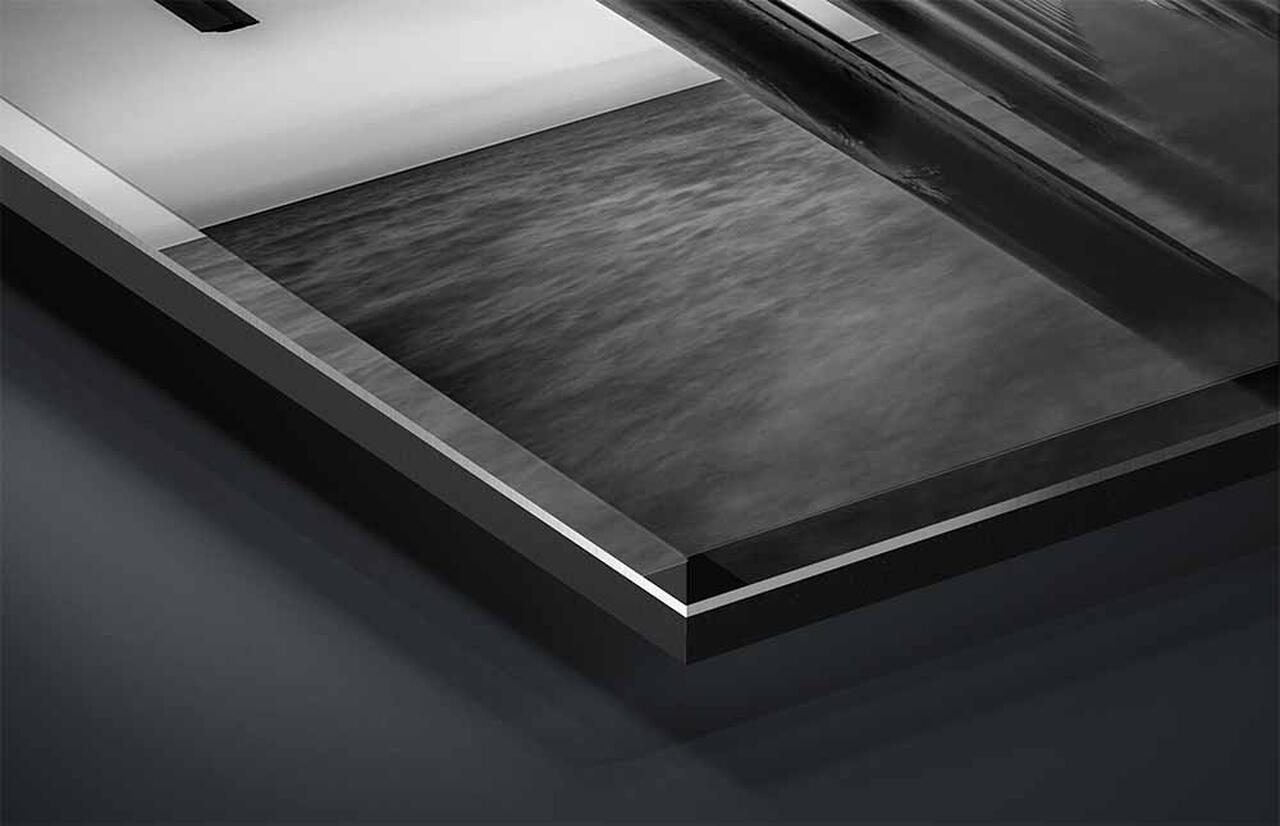
The far run at about a third of the frame width. Rank after rank of pylons separates individually, further down the corridor than any smaller size allows, so the depth becomes a distance rather than an effect. Overhead the deck resolves into separate beams and boards, and the fittings bolted to their undersides read as individual objects. On the near supports the seams and the staining come clear, along with the line where the water has been working on them. Click to view at full size.
About This Photograph
Beneath Urangan Pier at Hervey Bay, Queensland, Australia, from the shore end looking out along the underside toward the open bay, in low light late in the day. This is a black and white long exposure, made long enough that the moving water renders as smooth mist around the supports.
The conversion is neutral, with no toning of any kind. Measured across the frame the three channels are identical to the decimal, which is unusual even in black and white work and means the photograph carries no color cast at all, warm or cool, anywhere in it.
It also uses the full range. Two point two percent of the frame is pure black and the picture reaches pure white as well, with the middle ninety percent spanning three to two hundred and seventeen out of two hundred and fifty-five. Almost a quarter of the image sits at or near black, nearly all of it in the underside of the deck along the top edge.
Into the Infinite
Steve Austinhttps://www.steveaustinphotography.com/
Location
Urangan Pier, Hervey Bay, Australia
Subject
Pier substructure · repeating pylons · black and white
Capture
Single frame, long exposure
Format
Photograph · horizontal panorama, 5:2
Sizes
40 × 16 in · 60 × 24 in · 80 × 32 in
Print Media
TruLife Acrylic · ChromaLuxe Metal · Baryta paper
Edition
Limited, 25 / 50 / 100 by presentation
What it Does in a Room
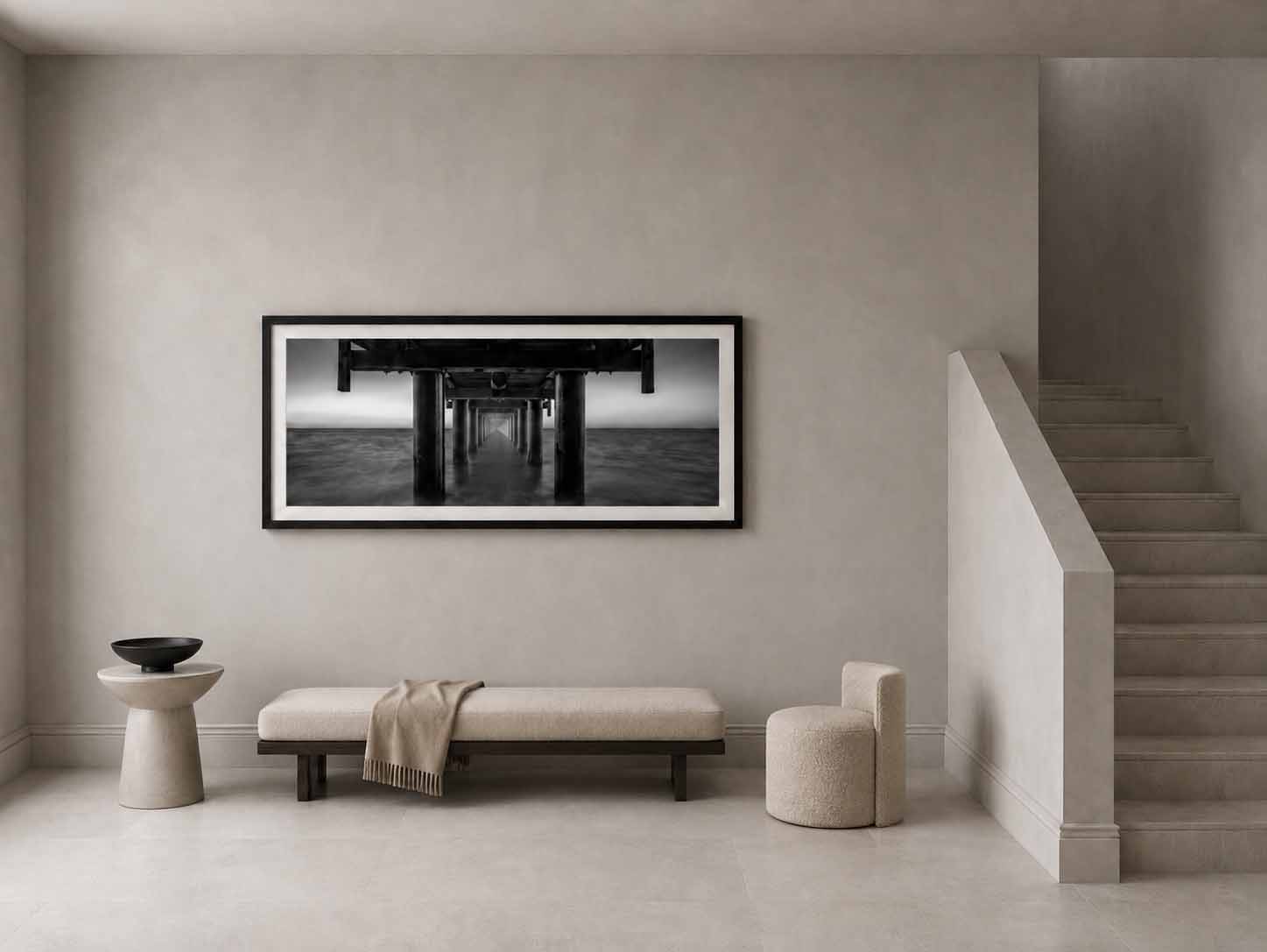
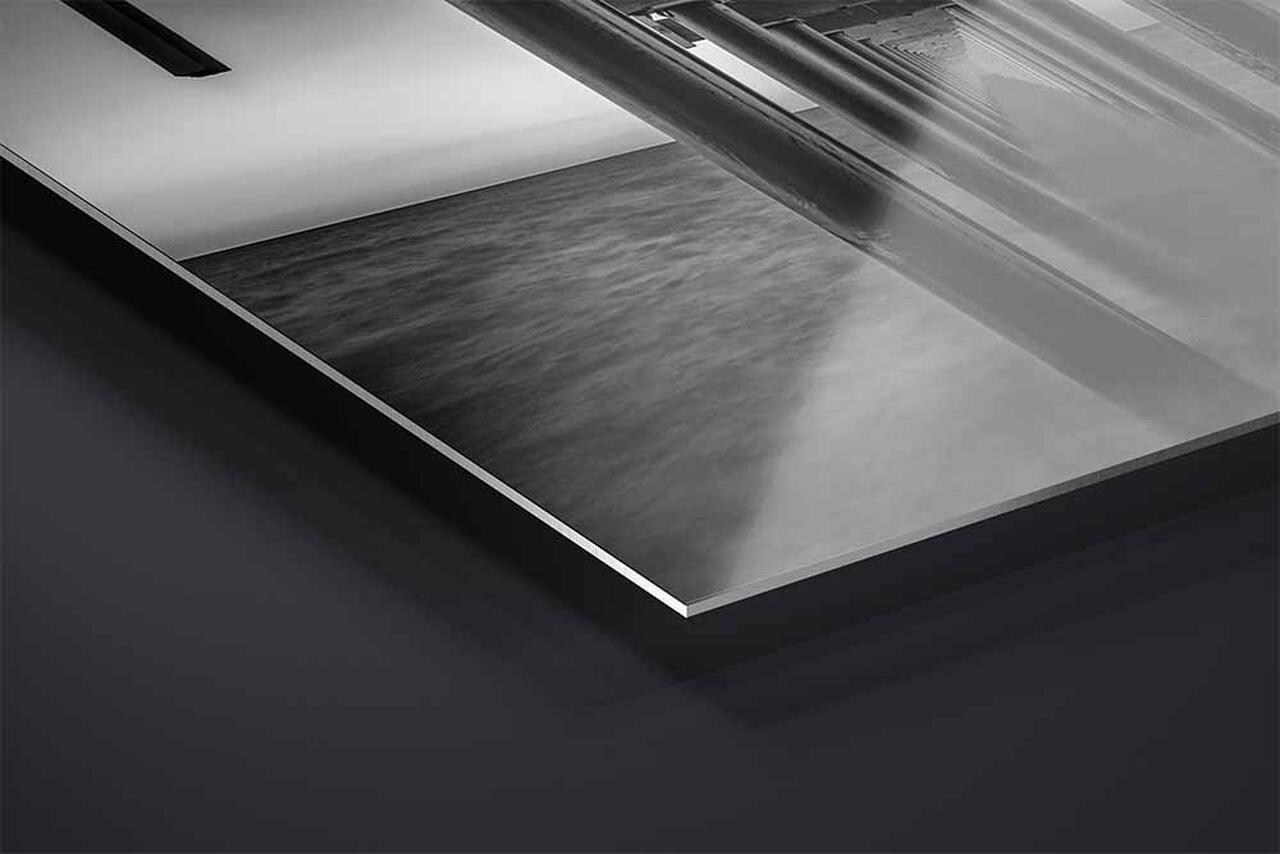
This is the one photograph in the collection where the presentation matters more than the frame. It reaches pure black across better than two percent of its area and pure white as well, and almost a quarter of the picture sits at or near black. A print surface that cannot hold a deep black will show it immediately here, because the black is not incidental, it is the top third of the composition. On acrylic the blacks stay closed and the whole underside of the deck reads as one solid mass. On paper they open slightly and the deck becomes a dark gray with structure in it, which is a legitimate and quieter version of the same picture. Choose the presentation before choosing the wall.
It is also completely immune to the light in the room, which almost nothing is. The conversion is neutral to the decimal, so there is no warm or cool bias anywhere in it for a bulb to push against. A color photograph under a warm bulb goes warmer and under a cool one goes flatter, and choosing where a color piece hangs means thinking about what will be switched on nearby. This one looks the same under everything. It can go in a room with mixed lighting, in a room where the bulbs will be changed by somebody else, or in a room lit by whatever happens to be there.
The third thing depends on the room rather than the picture. Everything in this frame repeats at a constant interval, and in a room with irregular architecture, angled walls, openings at different heights, furniture that does not line up, it becomes the only regular rhythm present and reads as a piece of order introduced deliberately. In a room that is already highly regular, a rank of identical cabinets or a grid of windows, that reading disappears and the picture becomes one more repeat among several. The same photograph does two different jobs, and which one depends entirely on what is already on the walls.
Not sure which size the room calls for, or want dimensions not listed here? Sizes beyond 80 × 32 are available on request and ship crated by freight. That conversation is welcome before an order is placed. Start that conversation and I will answer within one business day.
Into the Infinite , limited edition printSteve Austin95012100USD11https://schema.org/InStock
Questions about this photograph
How small is too small for a photograph this wide?
At the Intimate size the picture is forty inches across and sixteen inches tall, and the structure survives it well. The two rows of pylons, the dark deck above, and the bright water on both sides are all large simple shapes, and the symmetry reads at any size. What goes is the depth. That corridor is built from perhaps twenty ranks of supports receding one behind another, and past a certain point they are separated by a few pixels rather than a few inches; at sixteen inches tall the far half of the run collapses into a single soft mass and the picture becomes four columns and a smudge. The near pylons also lose their surface, the marks and staining that show them to be real objects standing in seawater. The Collected at sixty by twenty-four is where the far ranks separate again. If you are weighing a size against a specific wall, choosing the right print size covers the measurements and the viewing distances in more detail.
What changes at the largest size?
The corridor gets longer. At eighty by thirty-two the ranks of pylons separate individually far further down the run than they do at any smaller size, so the depth reads as a measurable distance rather than as an effect. On the near supports the surface comes clear: the marks and staining, the seams, the fixings and brackets, and the line where the water has been working on them. Overhead the underside of the deck resolves into separate beams, cross braces, and boards with gaps between them, and the fittings bolted to them become individual objects. In the water the long exposure shows as directional streaking rather than as a uniform mist, so you can see which way the water was moving. Why scale matters covers what happens perceptually when a photograph reaches the size where the eye has to cross it.
What kind of room does this photograph suit?
Rooms with irregular architecture and rooms with mixed light. A stair hall, an entry with several openings, a room with angled walls, an office lit by whatever is on. It hangs at ordinary height and must be centered on its wall, because the composition is symmetrical to within a few percent and any offset will be visible. On materials it is entirely unfussy, since it carries no color at all. Three things to avoid. Do not hang it where furniture will crop one end, for the same reason. Keep it away from a run of identical repeats, a bank of cabinets, a grid of panes, a row of doors, because the picture is already a repeat and a second one nearby cancels it. And do not hang it with its companion piece made on the deck above, since the two are the same structure from two positions and are stronger in separate rooms. When your mind needs to rest takes the question further.
Every work ships insured and arrives with a signed certificate of authenticity.
If a piece is damaged in transit, the choice of replacement is always yours, and your edition number stays with you.
Production time runs 2 to 3 weeks for metal, 3 to 4 weeks for acrylic and paper, and 5 to 6 weeks for framed work.
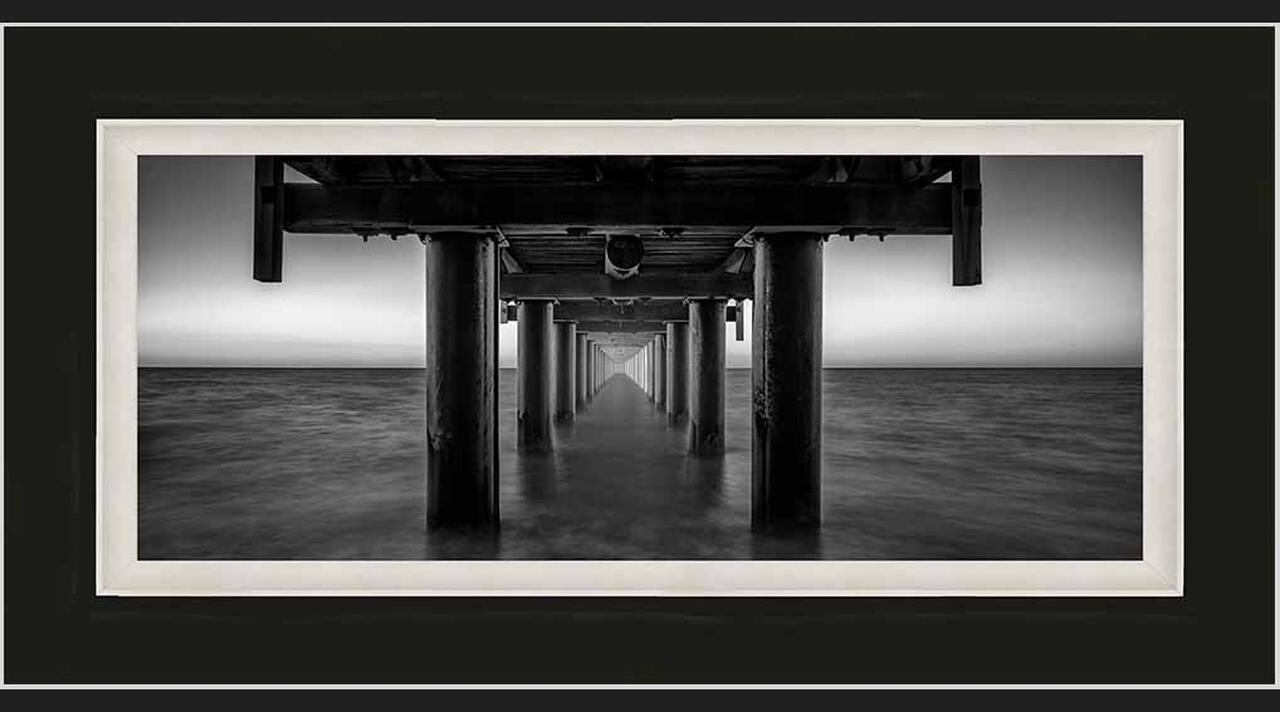
Collector's Choice · TruLife ® Acrylic in Italian Frame
Collector Edition of 25· Lumachrome TruLife Acrylic · Handcrafted Italian Frame
TruLife acrylic in a handcrafted Italian frame with a linen liner chosen for the image. Frame series, finish, and liner are settled with you after the order, and production begins from there. The frame and liner add about fourteen inches to the finished dimensions, worth allowing for when planning placement.
Signature Edition · TruLife ® Acrylic, Float Mount
Signature Edition of 50· Lumachrome TruLife Acrylic · Gallery Float Mount
Face-mounted to TruLife acrylic and floated approximately one inch from the wall, with no frame to mediate between the image and the room. UV-resistant, anti-reflective, and scratch-resistant, with a lifetime guarantee against fading.
Signature Edition of 50· ChromaLuxe Metal Print · Gallery Float Mount
Color infused into the aluminum panel itself, floated from the wall on a concealed system. Where acrylic produces luminosity, metal produces clarity. Exceptional fade resistance with no glazing or coating required.
Fine Art Edition of 100· Hahnemühle Baryta Fine Art Paper
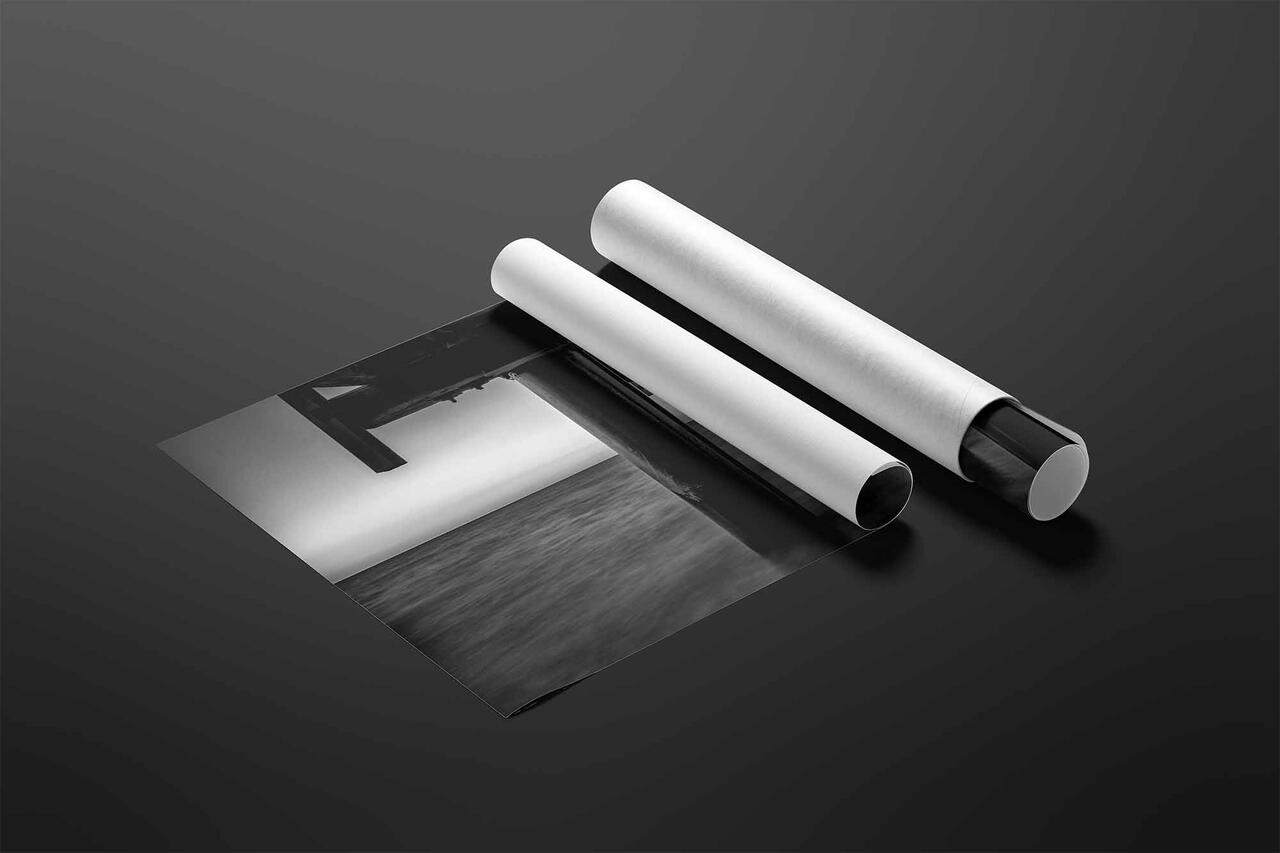
Printed without acrylic, so light meets the paper surface directly. Highlights stay luminous, shadows keep their nuance, and the surface has a tactile quality the other presentations approach differently. The understated choice, and the traditional one.
Complimentary shipping within the continental United States. International collector shipping available upon request.
Still deciding
Designing for Stillness
A guide to choosing art for restorative spaces
How to tell whether an image will still hold you in a year, how scale changes what a photograph does in a room, and how to match a piece to the work a room actually performs. It cites the research it draws on, and it is equally clear about where that research stops. About ten minutes to read.