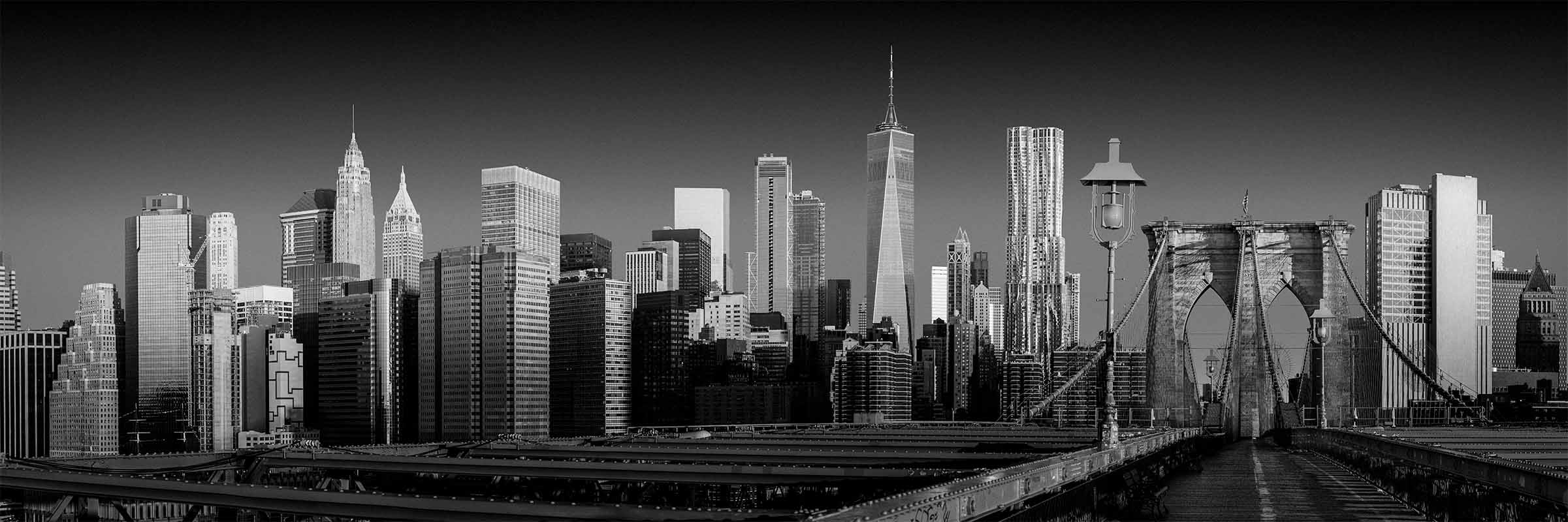
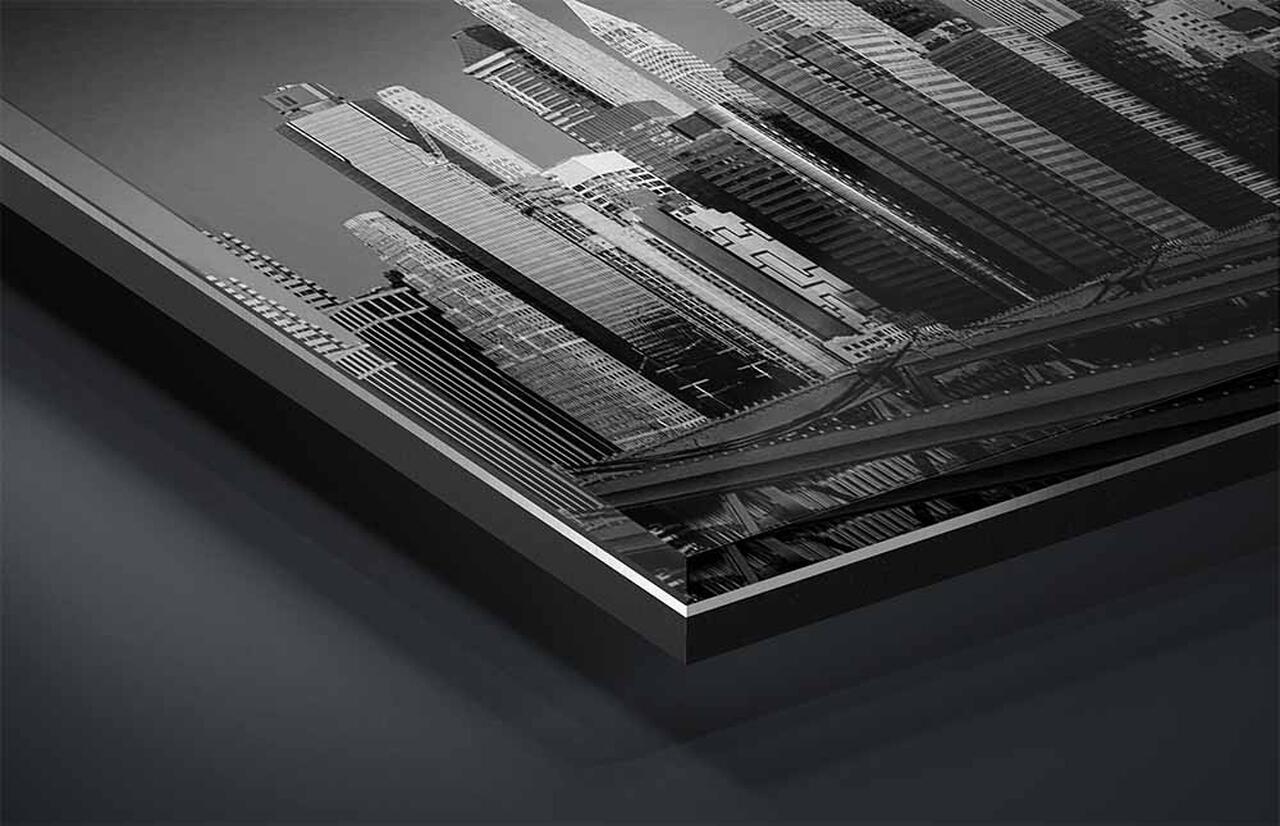
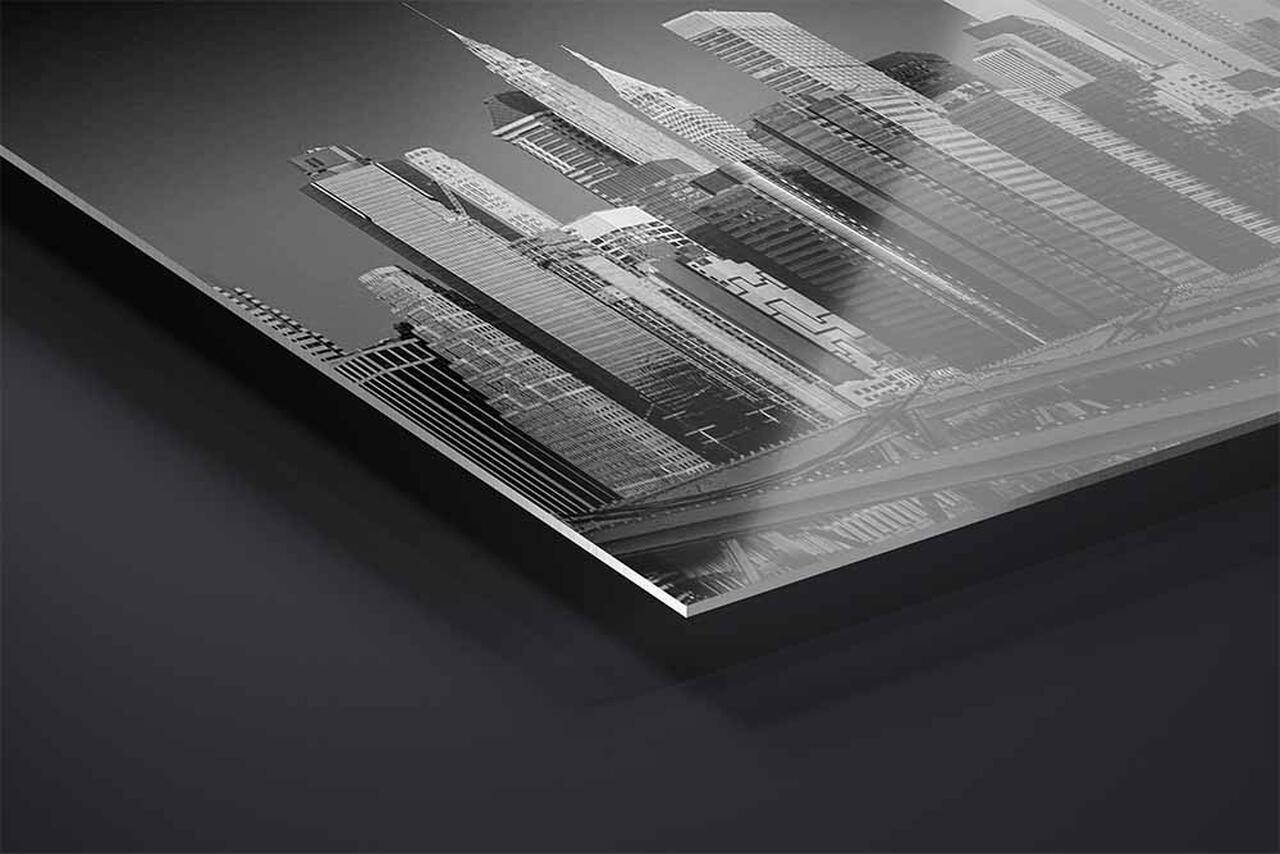
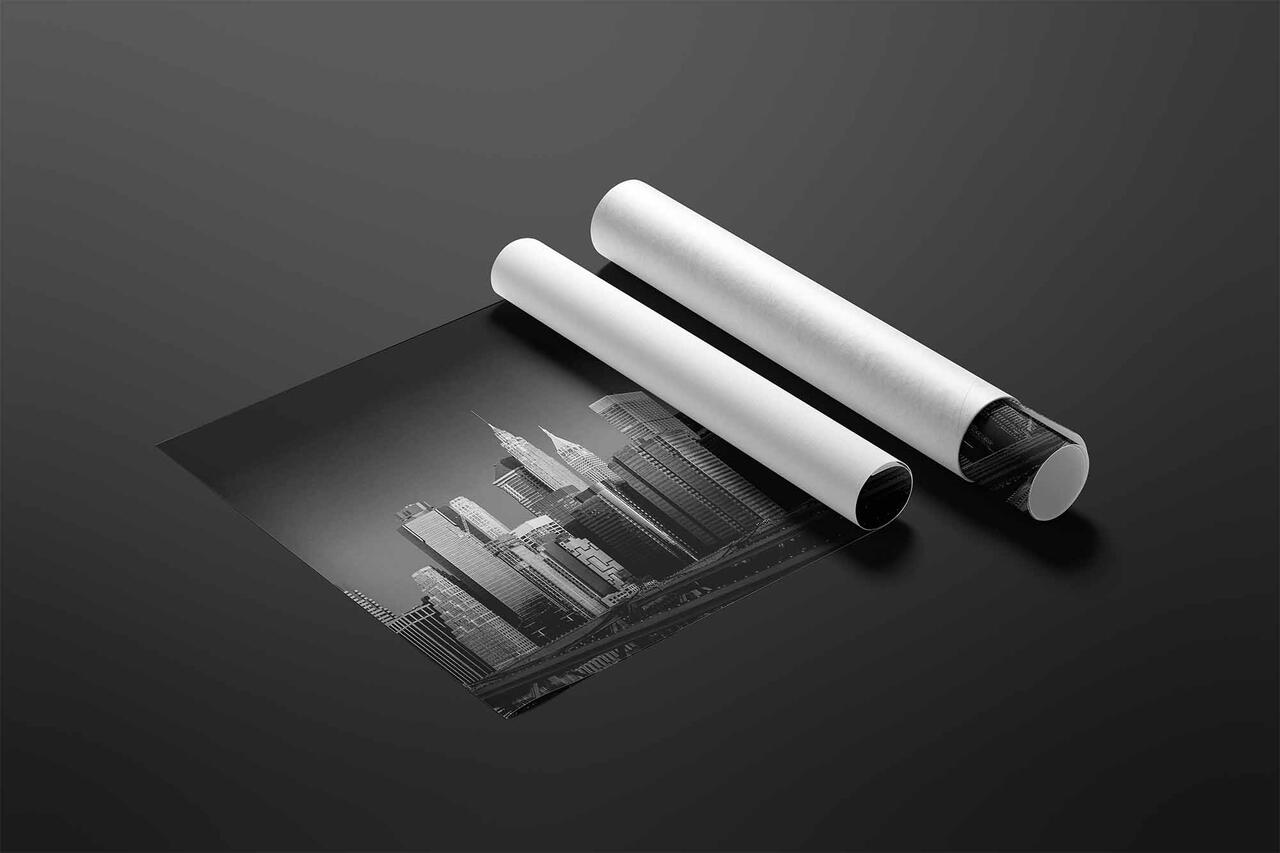
A 3:1 panoramic photograph of the Manhattan skyline from the Brooklyn Bridge promenade, New York City, United States, available as a limited edition print in three sizes.
Artist's Story
I was walking into the city on an early spring morning and stopped on the Brooklyn Bridge promenade because of the light. It was coming in low from the side and catching the faces of the buildings while everything else was still flat.
The picture is an interpretation of that. I darkened the sky, and I darkened the bridge and the lower part of the skyline, and I brought up what the side light was doing, because that was the only thing I had stopped for. The tonal shape of this photograph is mine. The light on the buildings was there.
The bridge under my feet was designed six times stronger than John Roebling thought it needed to be.
In 1878 the wire contractor, J. Lloyd Haigh, was caught substituting rejected steel for the wire that had already passed inspection. Of eighty rings tested, five met the standard. The bad wire was woven into the main cables by then and could not be pulled out. Washington Roebling worked out what it had cost: the bridge was now four times stronger than necessary rather than six. He let it stand, added a hundred and fifty extra wires to each cable, and it has held for more than a hundred and forty years. Haigh went to prison.
There is a second margin in this frame. The diagonal cables running down from the tower were put there to stiffen the deck, and they turned out to be unnecessary. They were kept because they looked right. Margin is a bridge that has never used everything it was given.
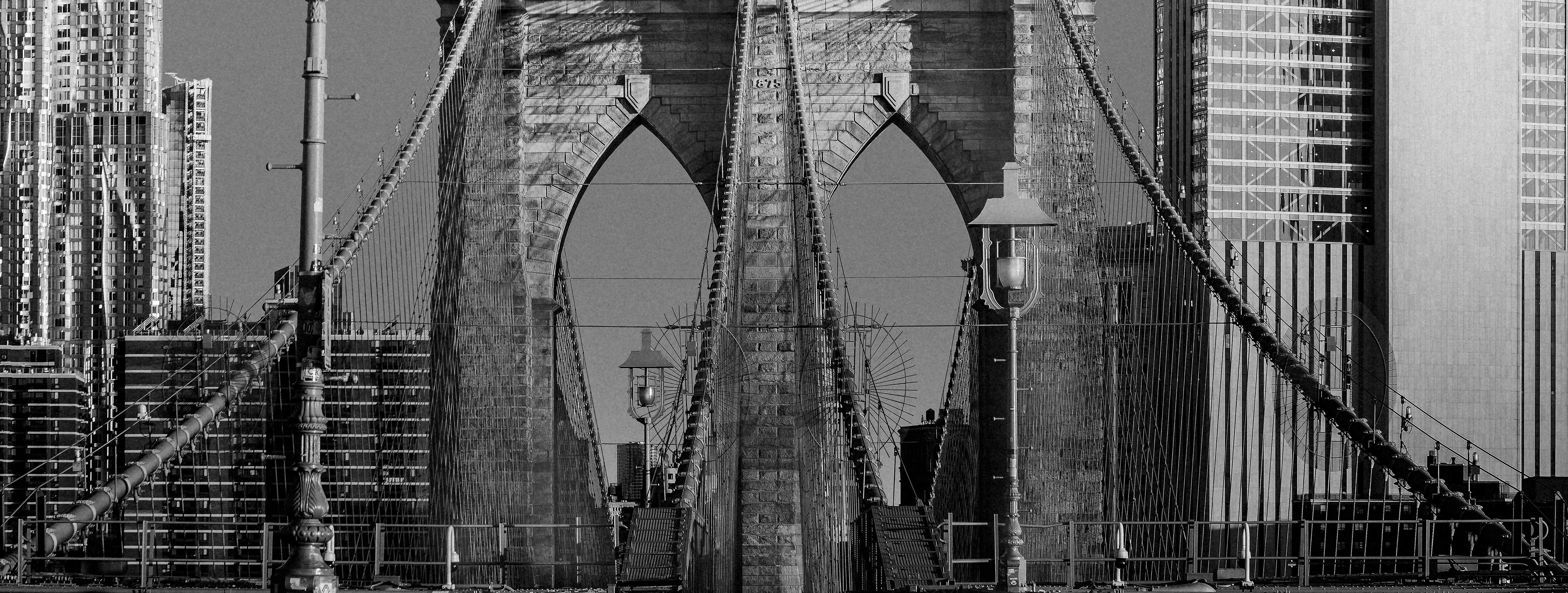
This crop is 20 percent of the frame width, about 18 inches across on the 90 inch print. The tower shows its individual stone courses and the stepped voussoirs of both arches, with the year 1875 carved above them. The suspender wires separate into a dense curtain of verticals with the diagonal stays crossing through, and the lamp standards resolve with their fluting and lantern glass. Click to view at full size.
About This Photograph
The Brooklyn Bridge pedestrian promenade, looking toward Lower Manhattan on an early spring morning. Seven frames stitched into a single panorama, rendered in black and white, with the sky and the lower half of the frame darkened and the side light on the buildings brought up.
The walkway sits above the traffic, and that was deliberate. Roebling put the promenade on a raised central deck over the two roadways, arguing that a walk above the traffic in a crowded commercial city would be of incalculable value. Almost no other bridge of the period did it. It is the reason the view from here is unobstructed and the reason this photograph is possible at all: on a contemporary bridge you would be looking through a railing at the level of the cars.
Margin
Steve Austinhttps://www.steveaustinphotography.com/
This picture contains two different kinds of space stacked on top of each other. Below the skyline everything is linear perspective: the planks, the rails, the trusses and the stays all converge, and the walkway runs from the bottom edge of the frame away into the distance. Above the skyline there is no depth at all. The buildings sit as a flat elevation, all at effectively the same distance, with no overlap the eye can use. So the lower half of the print opens the wall and the upper half sits on it. That is an unusual thing for one photograph to do and it is worth respecting when hanging: the piece needs its bottom edge clear and visible, because that is the half doing the spatial work.
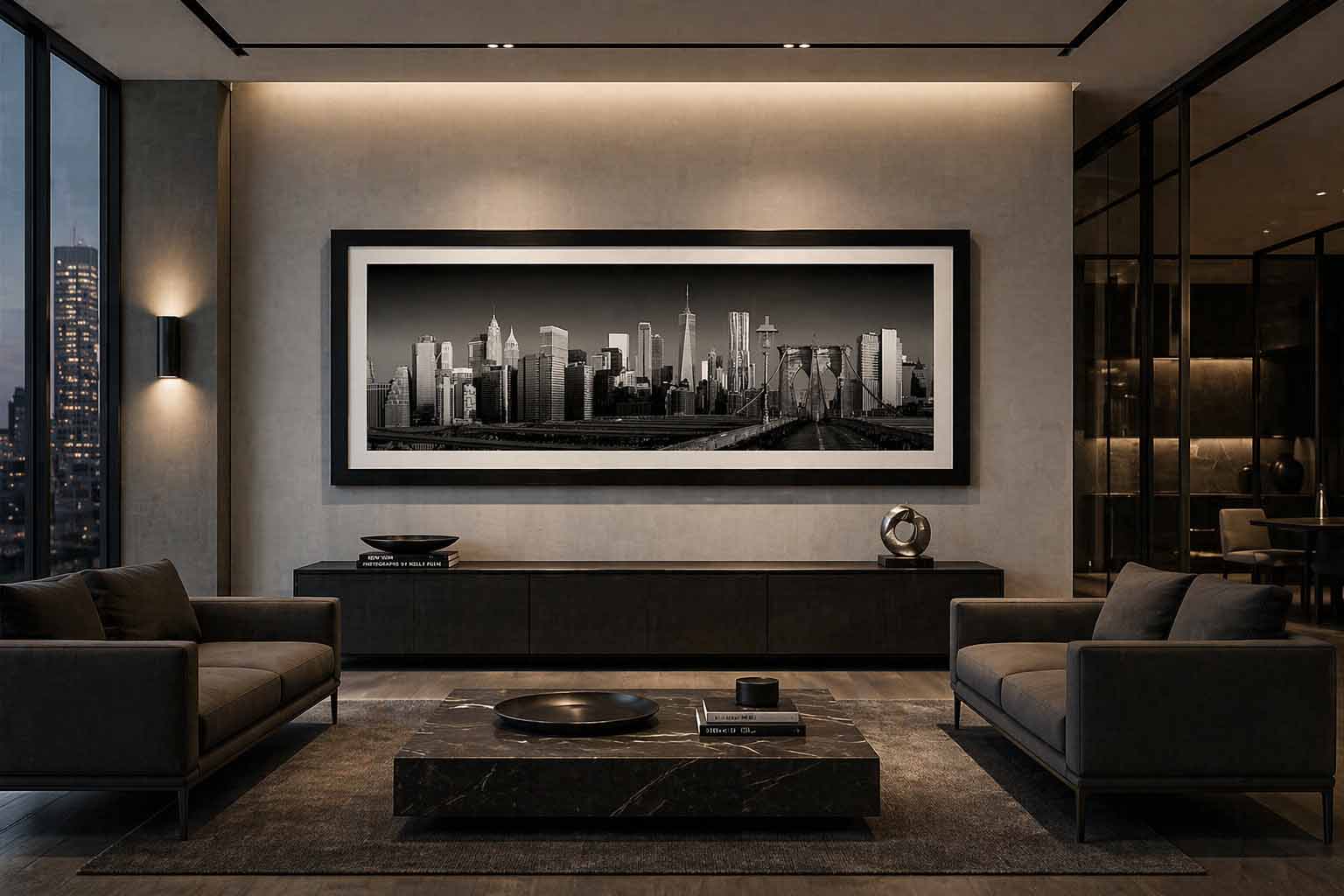
It is one bright band in a dark field. Measured in horizontal strips the picture runs five, twenty-six, fifty-five, ninety-six, a hundred and thirty, a hundred and twenty-two, ninety, fifty-one, forty, twenty-nine. The lit skyline occupies about a fifth of the frame's height and nearly a third of the picture sits at or below twenty-five, with five percent at true black. On a ninety inch print that band is roughly six inches tall and seven and a half feet long. In a dim room it reads as a lit slot in the wall rather than as a picture on it, which is the effect the tonal work in this photograph was done for. In a bright room the band loses its edges and the whole thing flattens.
And it implies where you are standing. The walkway runs out of the bottom of the frame, which means the picture puts the viewer on the bridge rather than in front of it, and that only works if the print is hung low enough for the floor of the image to sit near the floor of the eye. Hang it at gallery height and the promenade appears below the viewer, as if seen from a floor above, and the body position the photograph offers is withdrawn. Centre it at about fifty-two inches, lower than standard, and the walkway meets the viewer where it should.
Not sure which size the room calls for, or want dimensions not listed here? Sizes beyond 90 × 30 are available on request and ship crated by freight. That conversation is welcome before an order is placed. Start that conversation and I will answer within one business day.
How small is too small for a photograph this wide?
At the Intimate size the picture is thirty-six inches across and twelve tall, and the large shapes hold. The skyline holds, One World Trade Center holds, the masonry tower holds, and the lamp standard holds as a silhouette. What goes is the bridge. Twelve inches of height leaves about four for the entire foreground, and at that scale the planks, the rails and the truss work compress into a dark band with no structure in it. The diagonal stays merge into the tower. Since half the argument of this photograph is that it has a foreground, that is a real loss. The Collected at sixty by twenty returns the planks and the stays. If you are weighing a size against a specific wall, choosing the right print size covers the measurements and the viewing distances in more detail.
What changes at the largest size?
At ninety by thirty, working through the frame: across the skyline the lit windows become individually countable and the facade panels on One World Trade Center read as separate floors up the taper. The construction crane at the left resolves with its jib and lattice. On the right the masonry tower shows its stone courses and the profiles of both arches. The diagonal stays separate into individual cables with their anchor points visible where they meet the deck. The lamp standard shows its fluting and the glass in the lantern. And across the foreground the walkway planks separate one from the next, with the gaps between them and the rivet lines along the rails legible. Why scale matters covers what happens perceptually when a photograph reaches the size where the eye has to cross it.
What kind of room does this photograph suit?
A long wall in a room used in the evening, with enough depth that a viewer can stand back ten or twelve feet. A living room, a dining room, a study, a wide landing. Hang it low, with the centre at about fifty-two inches. On materials it wants charcoal and cool grey, matte throughout, since it carries no colour of its own and depends on the contrast between its lit band and its dark. Three things to avoid. Do not hang it above tall furniture, because the lower third of the frame is the half that gives the picture depth and anything blocking it removes that. Do not hang it in a bright room, since the band needs darkness around it to read as light. And keep another Manhattan skyline out of the same sightline, because the two will be compared building by building rather than looked at. When your mind needs to rest takes the question further.
Every work ships insured and arrives with a signed certificate of authenticity.
If a piece is damaged in transit, the choice of replacement is always yours, and your edition number stays with you.
Production time runs 2 to 3 weeks for metal, 3 to 4 weeks for acrylic and paper, and 5 to 6 weeks for framed work.
Each print is made to order and takes its place in a numbered edition, so sales are final. Before you choose, I am glad to help: send a photo of your wall and I will show you this work in your room at true scale, at no charge. Start a conversation
Collector's Choice · TruLife ® Acrylic in Italian Frame
Collector Edition of 25· Lumachrome TruLife Acrylic · Handcrafted Italian Frame
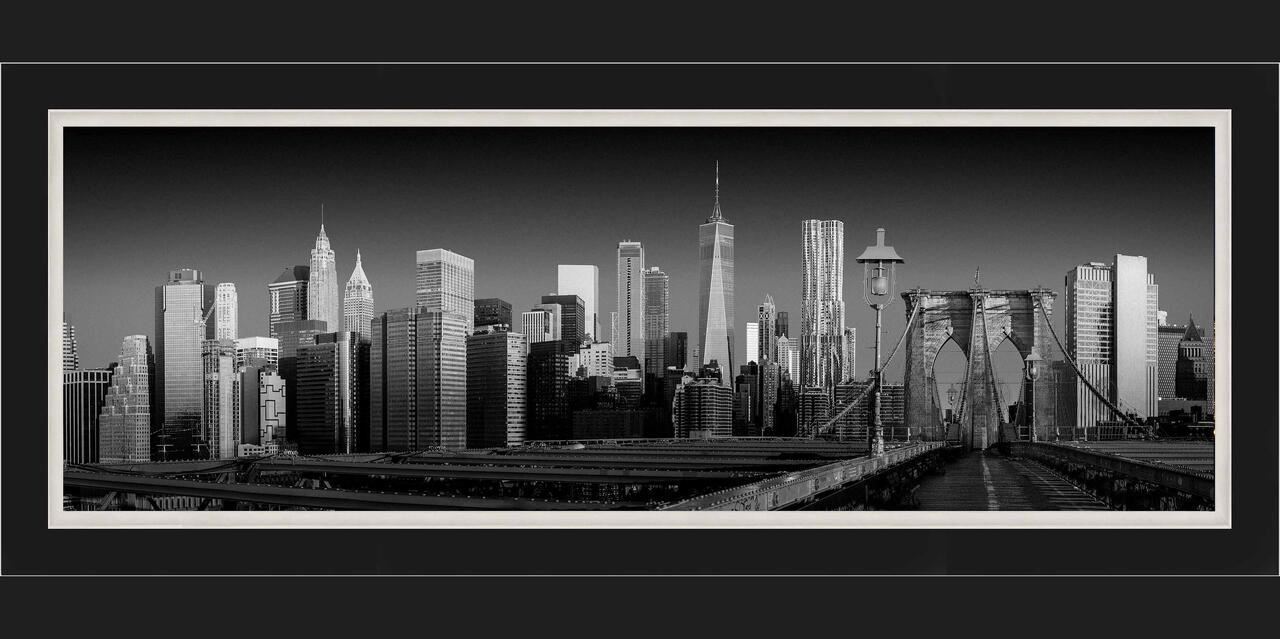
TruLife acrylic in a handcrafted Italian frame with a linen liner chosen for the image. Frame series, finish, and liner are settled with you after the order, and production begins from there. The frame and liner add about fourteen inches to the finished dimensions, worth allowing for when planning placement.
Signature Acrylic Edition of 50· Lumachrome TruLife · Gallery Float Mount
Face-mounted to TruLife acrylic and floated approximately one inch from the wall, with no frame to mediate between the image and the room. UV-resistant, anti-reflective, and scratch-resistant, with a lifetime guarantee against fading.
Signature Metal Edition of 50· ChromaLuxe Print · Gallery Float Mount
Color infused into the aluminum panel itself, floated from the wall on a concealed system. Where acrylic produces luminosity, metal produces clarity. Exceptional fade resistance with no glazing or coating required.
Fine Art Edition of 100· Hahnemühle Baryta Fine Art Paper
Printed without acrylic, so light meets the paper surface directly. Highlights stay luminous, shadows keep their nuance, and the surface has a tactile quality the other presentations approach differently. The understated choice, and the traditional one.
Complimentary shipping within the continental United States. International collector shipping available upon request.
Still deciding
Designing for Stillness
A guide to choosing art for restorative spaces
How to tell whether an image will still hold you in a year, how scale changes what a photograph does in a room, and how to match a piece to the work a room actually performs. It cites the research it draws on, and it is equally clear about where that research stops. About ten minutes to read.