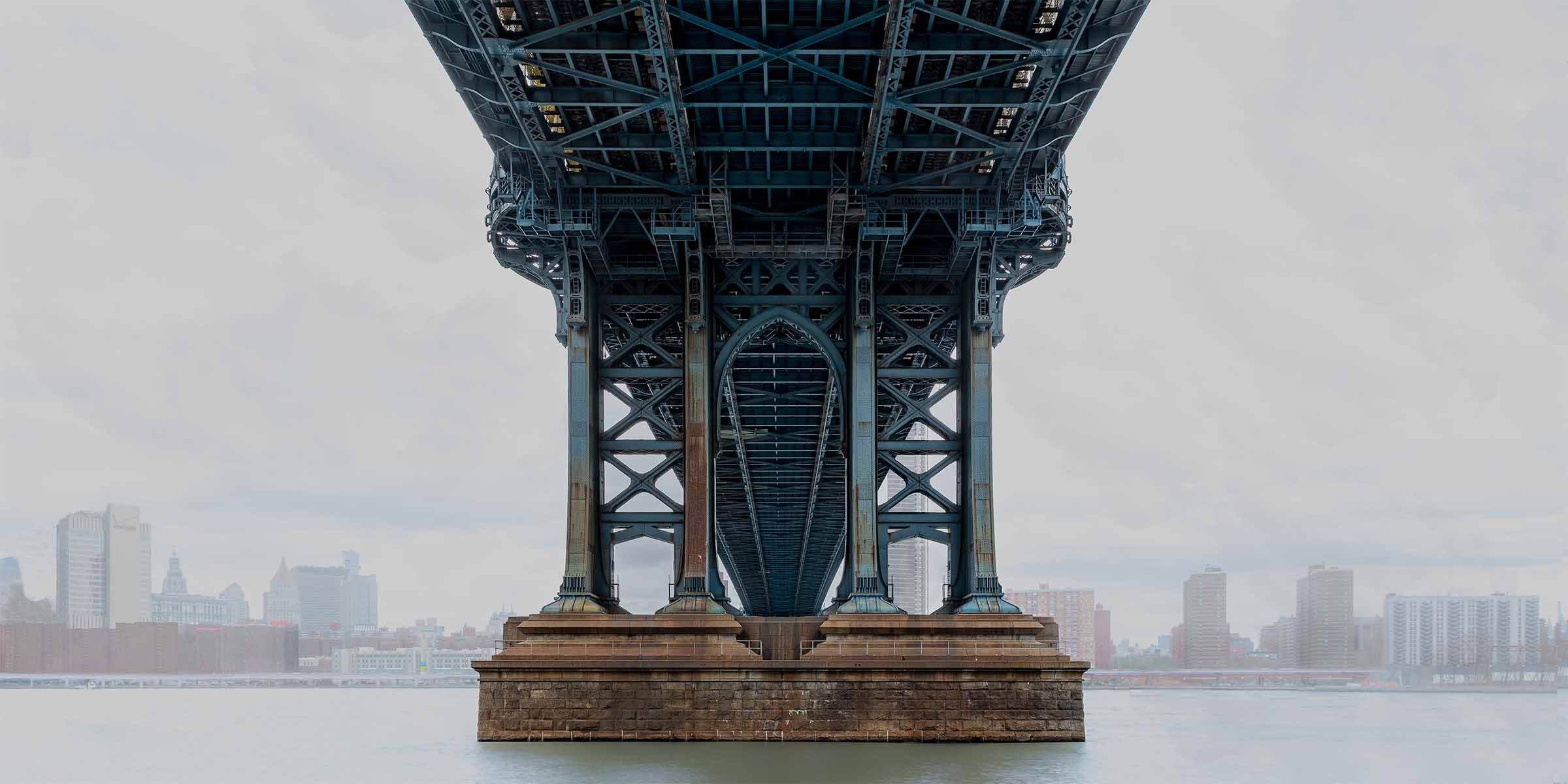
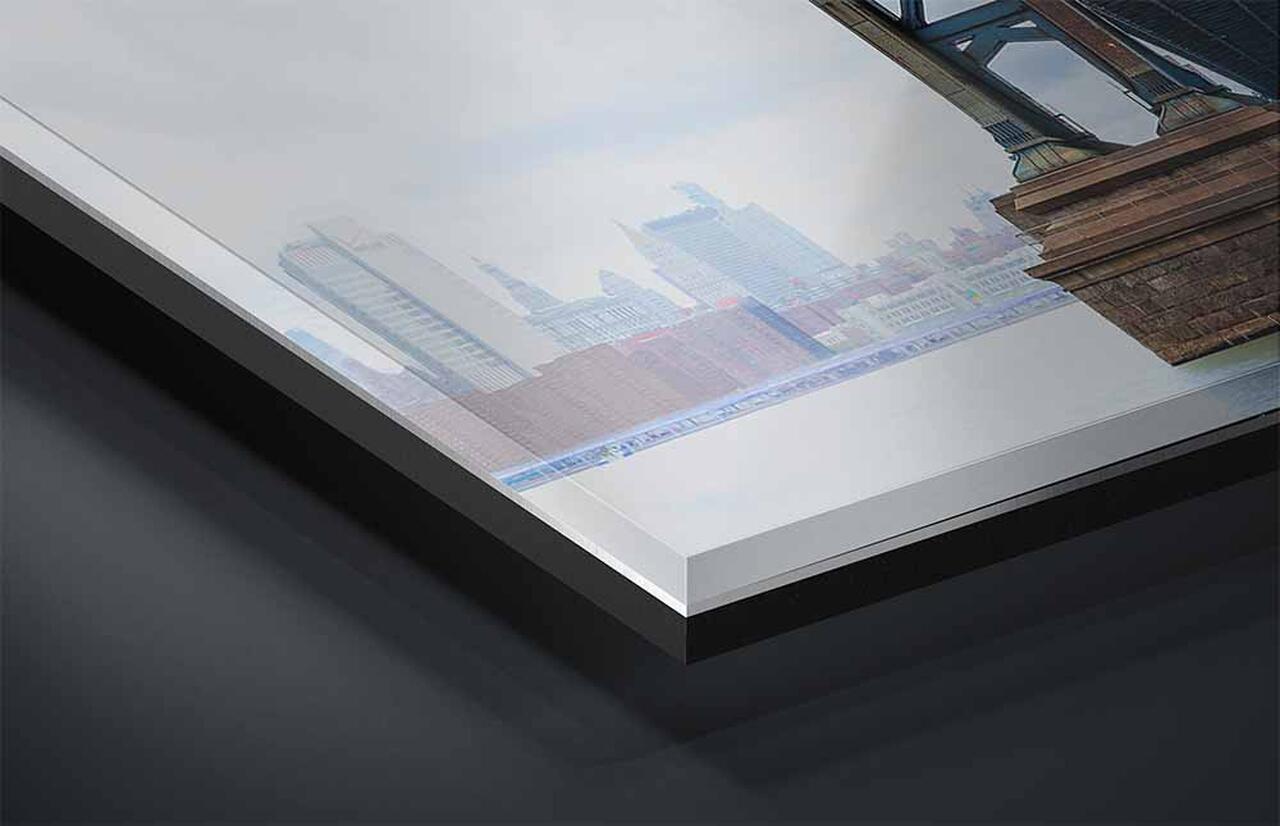
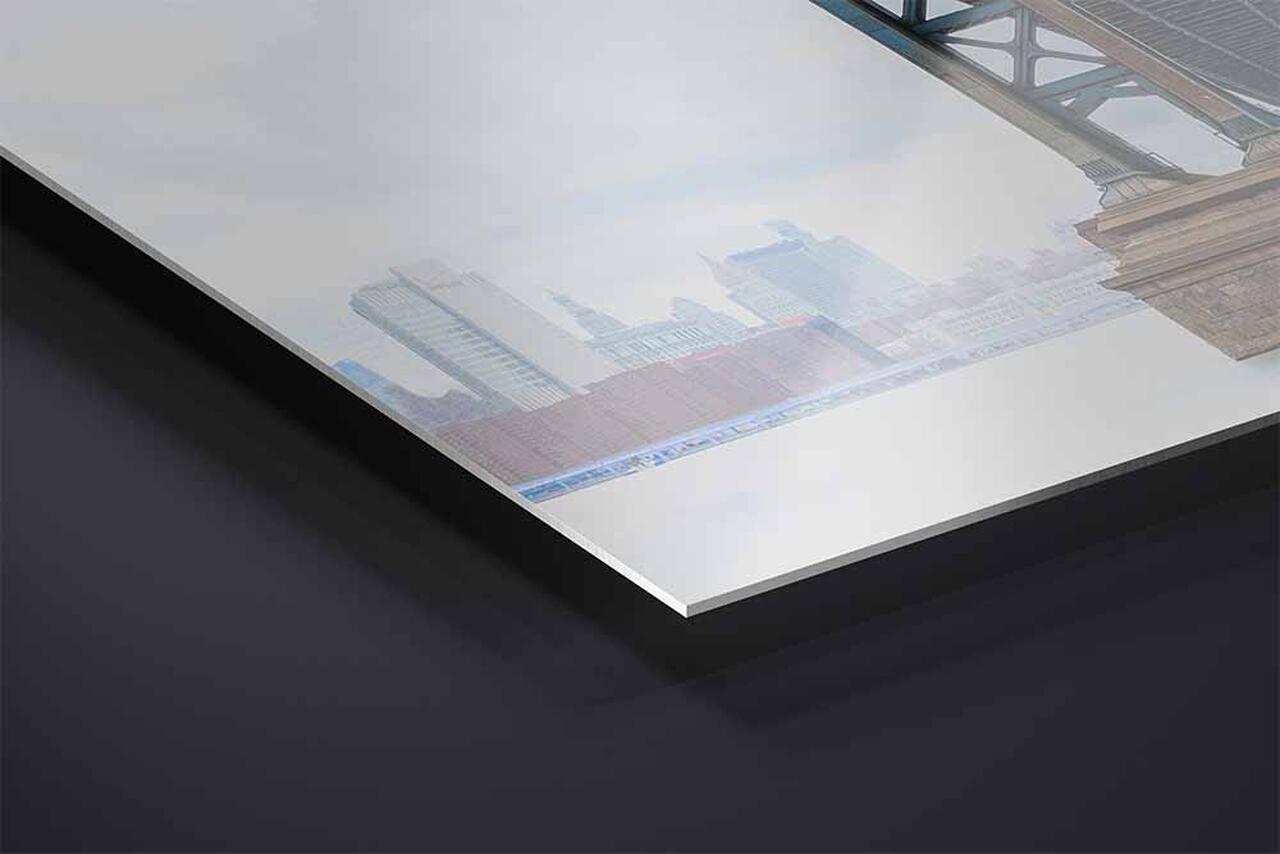
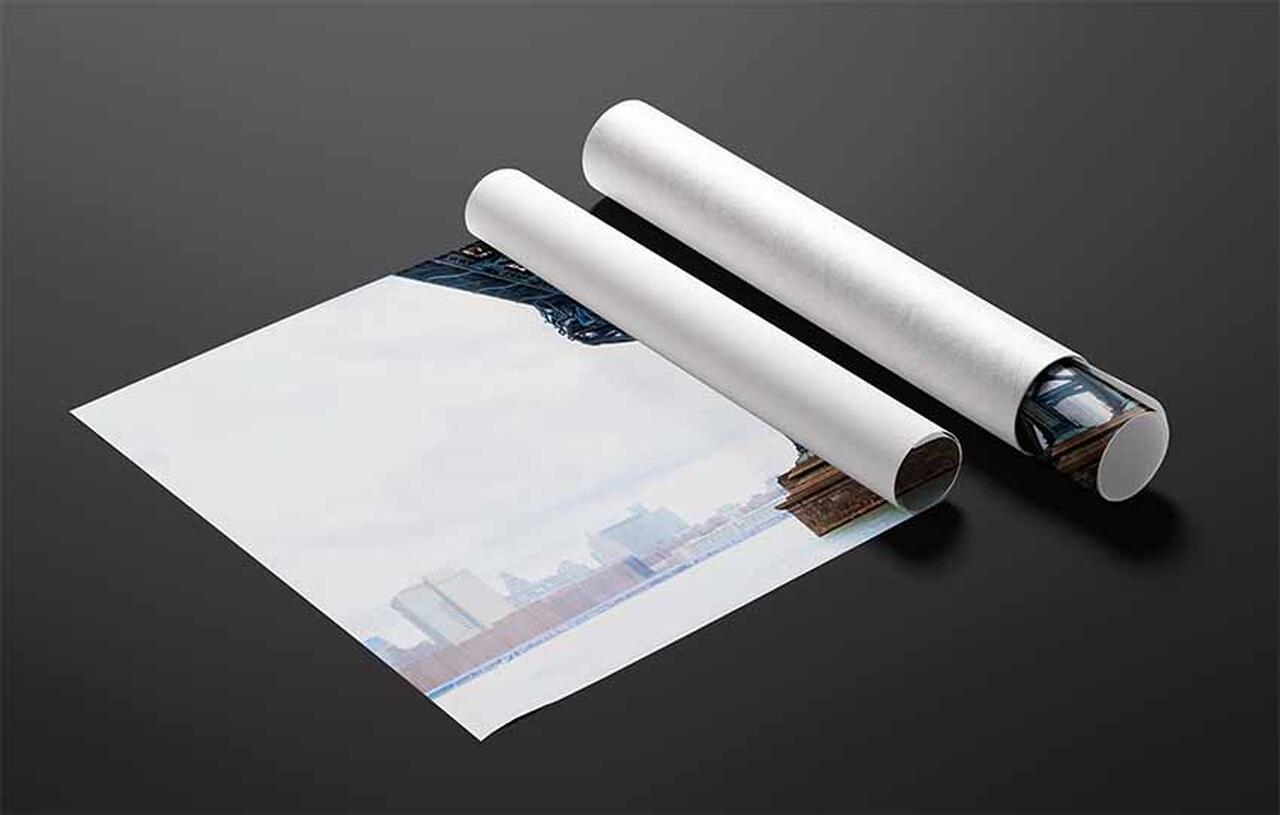
A 2:1 panoramic photograph of a Manhattan Bridge pier rising from the East River in mist, New York City, United States, available as a limited edition print in three sizes.
Artist's Story
Early summer, early morning, standing in Main Street Park at the foot of the bridge on the Brooklyn side. I had not been there before. What I wanted was the bridge as working infrastructure rather than as a view, the thing that ties Manhattan to everywhere else, seen head on across the water.
Manhattan had almost gone.
Air with water in it scatters light across the line of sight. Every drop between the camera and a distant building throws a little of the daylight around it back toward the lens, and that scattered light lands on top of the building's own image, adding brightness that carries no detail. Contrast falls, colour goes, and the further away a thing is the more of this veil sits in front of it.
The measurement is startling. Across the parts of this frame where Manhattan stands, the brightness runs between a hundred and ninety-three and a hundred and ninety-seven out of two hundred and fifty-five. The brightest passage anywhere in the picture reads two hundred and five. The mist had lifted an entire city to within about ten points of the sky above it, which is why the skyline sits in the frame as a faint pattern rather than as buildings.
The pier is untouched, because it was close. Out of the Mist is a bridge to a city the air had taken away: a few hundred feet of steel and granite holding its rust and its stone courses, and at the edges of the frame a pale pattern where Manhattan should be.
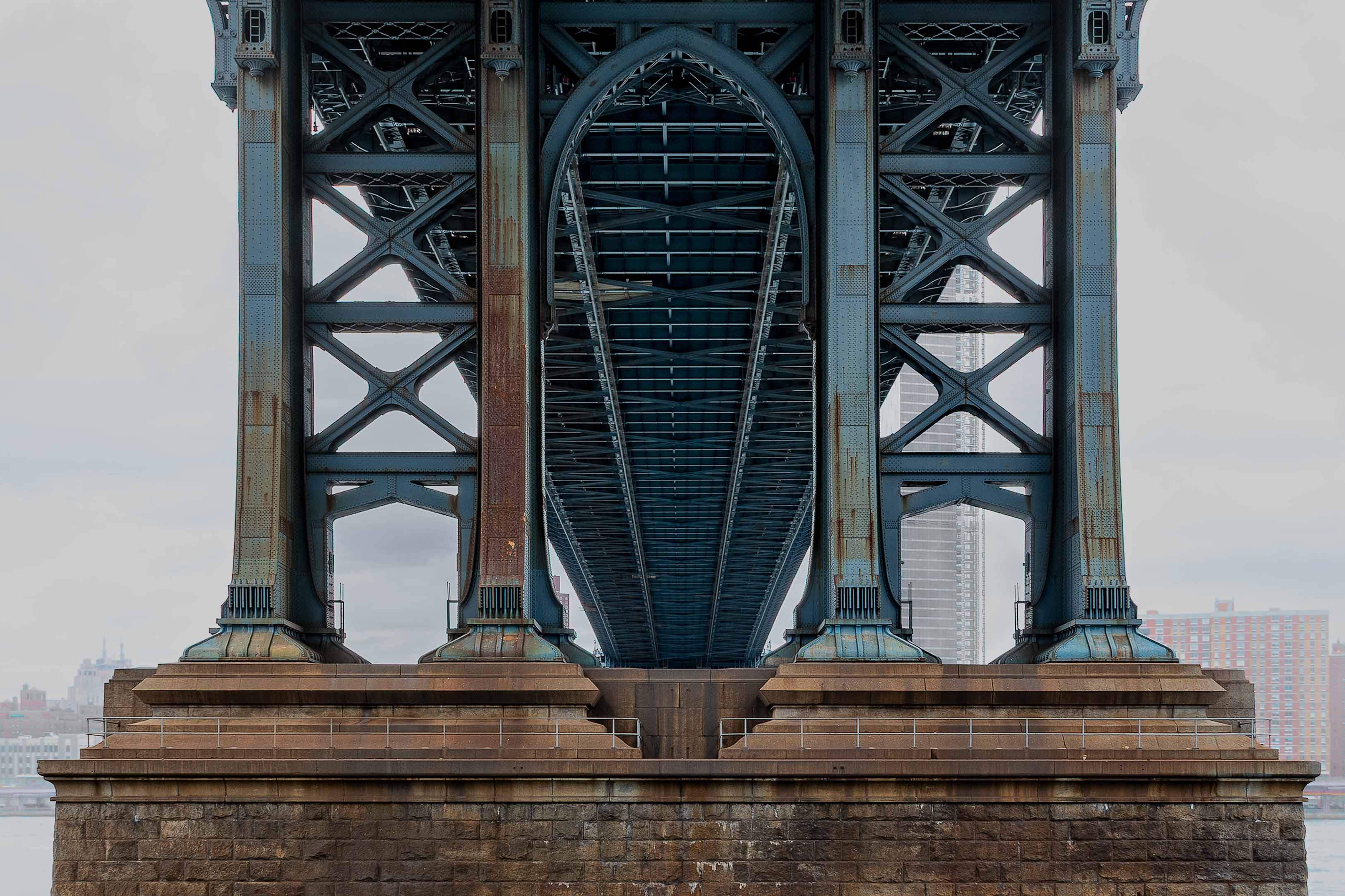
This crop is about 35 percent of the frame width, roughly 28 inches across on the 80 inch print. The cross-bracing separates member by member with the rivet lines along every flange, and behind it the inner arch resolves with the deck plating and the walkway structure visible through it. Down the columns the rust runs read as separate streaks with sound paint between them, and the capitals show their fluting where the steel sits onto the granite. In the pier the courses separate with their joints, and the handrails along the top resolve post by post. Click to view at full size.
About This Photograph
A river pier of the Manhattan Bridge, photographed in heavy mist from Main Street Park on the Brooklyn shore on an early summer morning, looking across the East River toward Manhattan. Single frame. The bridge opened in 1909 and its towers stand on masonry piers founded in the riverbed.
The symmetry in this photograph belongs to the structure rather than to the composition. Folded against its own mirror image the frame correlates at ninety-three hundredths, which is close to exact. A suspension bridge tower delivers its entire load straight down its own centreline, and the pier beneath has to spread that load evenly onto whatever it is founded on. Asymmetry in the pier would mean uneven bearing, and uneven bearing on a suspension bridge shows up as cable geometry going out of true. The pier is a mirror because it has to be.
Out of the Mist
Steve Austinhttps://www.steveaustinphotography.com/
Location
Main Street Park, Brooklyn, New York, United States
Subject
Manhattan Bridge · East River · Manhattan skyline in mist
Capture
Single frame, early morning
Format
Photograph · horizontal panorama, 2:1
Sizes
40 × 20 in · 60 × 30 in · 80 × 40 in
Print Media
TruLife Acrylic · ChromaLuxe Metal · Baryta paper
Edition
Limited, 25 / 50 / 100 by presentation
What it Does in a Room
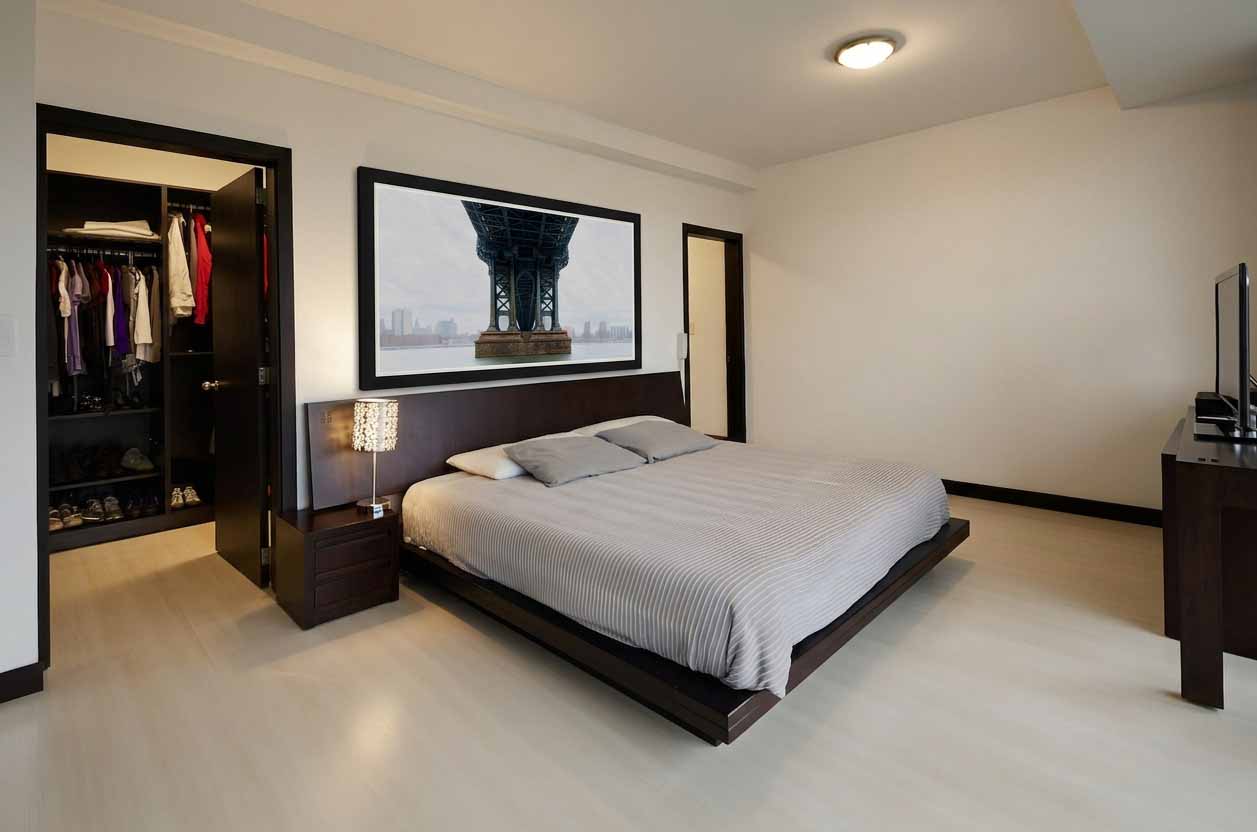
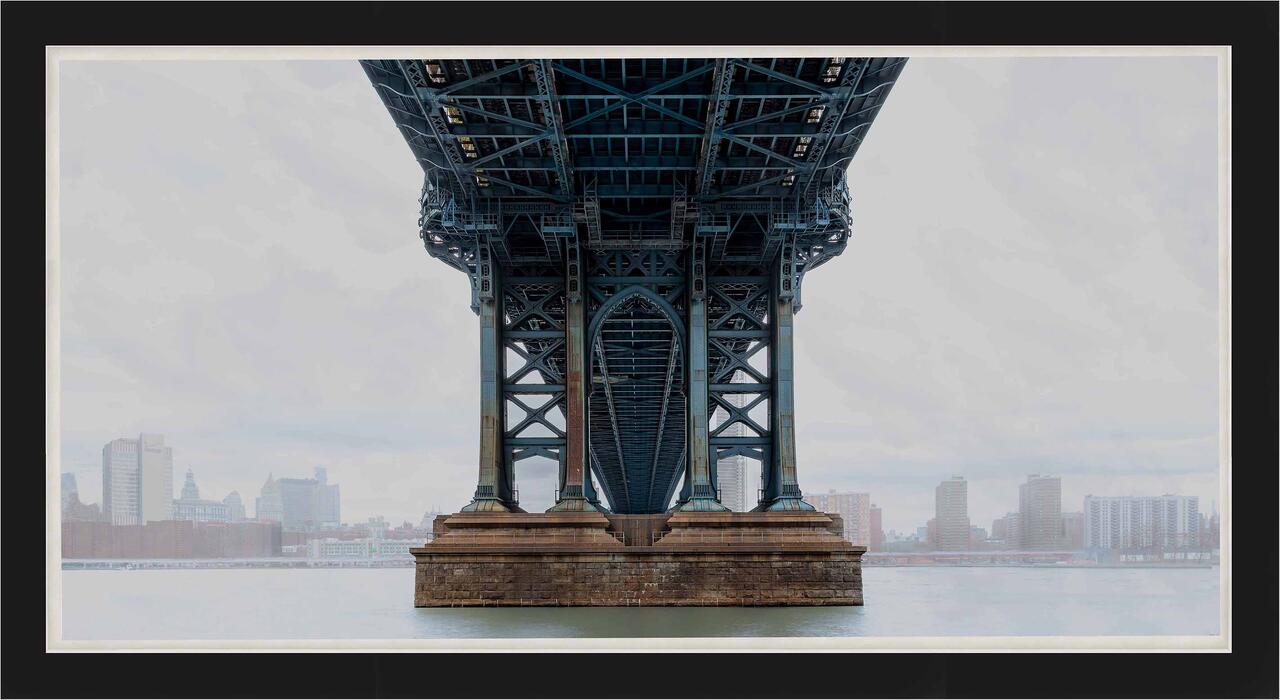
This photograph has no dark edge of its own. Its perimeter averages a hundred and seventy-one out of two hundred and fifty-five, and on three sides, left, right and bottom, it runs brighter still, in the high one-nineties. Nothing in the picture is clipped to white, but nothing anywhere near the border is dark either. The practical consequence is that the print will bleed into a pale wall: hung on white or light plaster it has no boundary and the image appears to dissolve outward at three of its four edges. So the containment has to come from the frame rather than from the print, which is unusual here. On most of this work the moulding finishes something the photograph has already resolved. On this one it does the resolving.
It is very nearly a mirror, and that demands a symmetrical hang. Folded down its own vertical centre the frame correlates with itself at ninety-three hundredths. Nothing else in this collection comes close to that, and it changes the placement rules completely. A near-symmetrical image hung off-centre, or with a console pushed to one side beneath it, or on a wall where the openings sit unevenly, reads as a mistake rather than as a choice, because the eye has an exact axis inside the picture to measure the room against. Hang it dead centre on its wall, and centre whatever sits below it. If the room offers a natural axis, a fireplace, a doorway, a bed, use it. This is the one piece here that wants that arrangement.
And nothing in it says when it was made. There are no vehicles, no people, no signage, no lit windows, no aerials, nothing with a shape that belongs to a particular decade. The skyline behind is too soft to identify and the pier has looked more or less like this since 1909. Every other city photograph in this collection dates itself somewhere, in a car, a sign, a screen, a tower that went up in a known year. This one does not, and that has a practical effect on a wall: a room changes around a picture over twenty years, and an image with nothing contemporary in it has nothing to go out of date against.
Not sure which size the room calls for, or want dimensions not listed here? Sizes beyond 80 × 40 are available on request and ship crated by freight. That conversation is welcome before an order is placed. Start that conversation and I will answer within one business day.
Out of the Mist, limited edition printSteve Austin112513400USD12https://schema.org/InStock
Questions about this photograph
How small is too small for a photograph this wide?
At the Intimate size the picture is forty inches across and twenty tall, and the form holds completely. A dark symmetrical object against a pale field is about as robust a shape as a photograph can have. What goes is the steel. The cross-bracing closes into a flat pattern, the lattice under the deck becomes a dark band, and the rust running down the columns merges into general staining. The granite courses in the pier stop being courses. Since what the picture offers at close range is the difference between a structure the air left alone and a city it removed, losing the structure's detail costs half of that. The Collected at sixty by thirty returns the bracing. If you are weighing a size against a specific wall, choosing the right print size covers the measurements and the viewing distances in more detail.
What changes at the largest size?
At eighty by forty, working down the frame: under the deck the lattice girders separate into individual diagonals with the plate edges and rivet lines along them. In the tower legs the cross-bracing pulls apart member by member. Behind them the inner arch resolves, with the ribs and the walkway structure visible through it. Down the columns the rust runs read as separate streaks rather than as tone. In the pier the granite courses separate with their joints, and the capitals at the tops of the columns show their fluting where the steel sits down onto the stone. Along the top of the pier the handrails resolve into individual posts, which is the only thing in the photograph that gives the structure a human scale. At the far left and right a few of the nearer Manhattan buildings begin to pull out of the haze as facades rather than as pattern. Why scale matters covers what happens perceptually when a photograph reaches the size where the eye has to cross it.
What kind of room does this photograph suit?
A wall with a centre line. Above a fireplace, a console, a bed, a sofa, anywhere the room already has an axis for the picture to sit on. Hang it dead centre at about fifty-seven inches. It is also one of the few pieces here that holds up in a bright room, since eighty percent of the frame is above luminance sixty and nothing in it is clipped. On materials it wants cool neutrals and matte surfaces, grey plaster and pale stone. Three things to avoid. Do not hang it off-centre or with anything asymmetrical beneath it, for the reason above. Do not hang it on a white or very pale wall unless the frame is dark, since the print has no boundary of its own on three sides. And use neutral bulbs, because the picture sits within six points of neutral and a warm lamp is enough to tint the whole thing. When your mind needs to rest takes the question further.
Every work ships insured and arrives with a signed certificate of authenticity.
If a piece is damaged in transit, the choice of replacement is always yours, and your edition number stays with you.
Production time runs 2 to 3 weeks for metal, 3 to 4 weeks for acrylic and paper, and 5 to 6 weeks for framed work.
Each print is made to order and takes its place in a numbered edition, so sales are final. Before you choose, I am glad to help: send a photo of your wall and I will show you this work in your room at true scale, at no charge. Start a conversation
Collector's Choice · TruLife ® Acrylic in Italian Frame
Collector Edition of 25· Lumachrome TruLife Acrylic · Handcrafted Italian Frame
TruLife acrylic in a handcrafted Italian frame with a linen liner chosen for the image. Frame series, finish, and liner are settled with you after the order, and production begins from there. The frame and liner add about fourteen inches to the finished dimensions, worth allowing for when planning placement.
Signature Acrylic Edition of 50· Lumachrome TruLife · Gallery Float Mount
Face-mounted to TruLife acrylic and floated approximately one inch from the wall, with no frame to mediate between the image and the room. UV-resistant, anti-reflective, and scratch-resistant, with a lifetime guarantee against fading.
Signature Metal Edition of 50· ChromaLuxe Print · Gallery Float Mount
Color infused into the aluminum panel itself, floated from the wall on a concealed system. Where acrylic produces luminosity, metal produces clarity. Exceptional fade resistance with no glazing or coating required.
Fine Art Edition of 100· Hahnemühle Baryta Fine Art Paper
Printed without acrylic, so light meets the paper surface directly. Highlights stay luminous, shadows keep their nuance, and the surface has a tactile quality the other presentations approach differently. The understated choice, and the traditional one.
Complimentary shipping within the continental United States. International collector shipping available upon request.
Still deciding
Designing for Stillness
A guide to choosing art for restorative spaces
How to tell whether an image will still hold you in a year, how scale changes what a photograph does in a room, and how to match a piece to the work a room actually performs. It cites the research it draws on, and it is equally clear about where that research stops. About ten minutes to read.