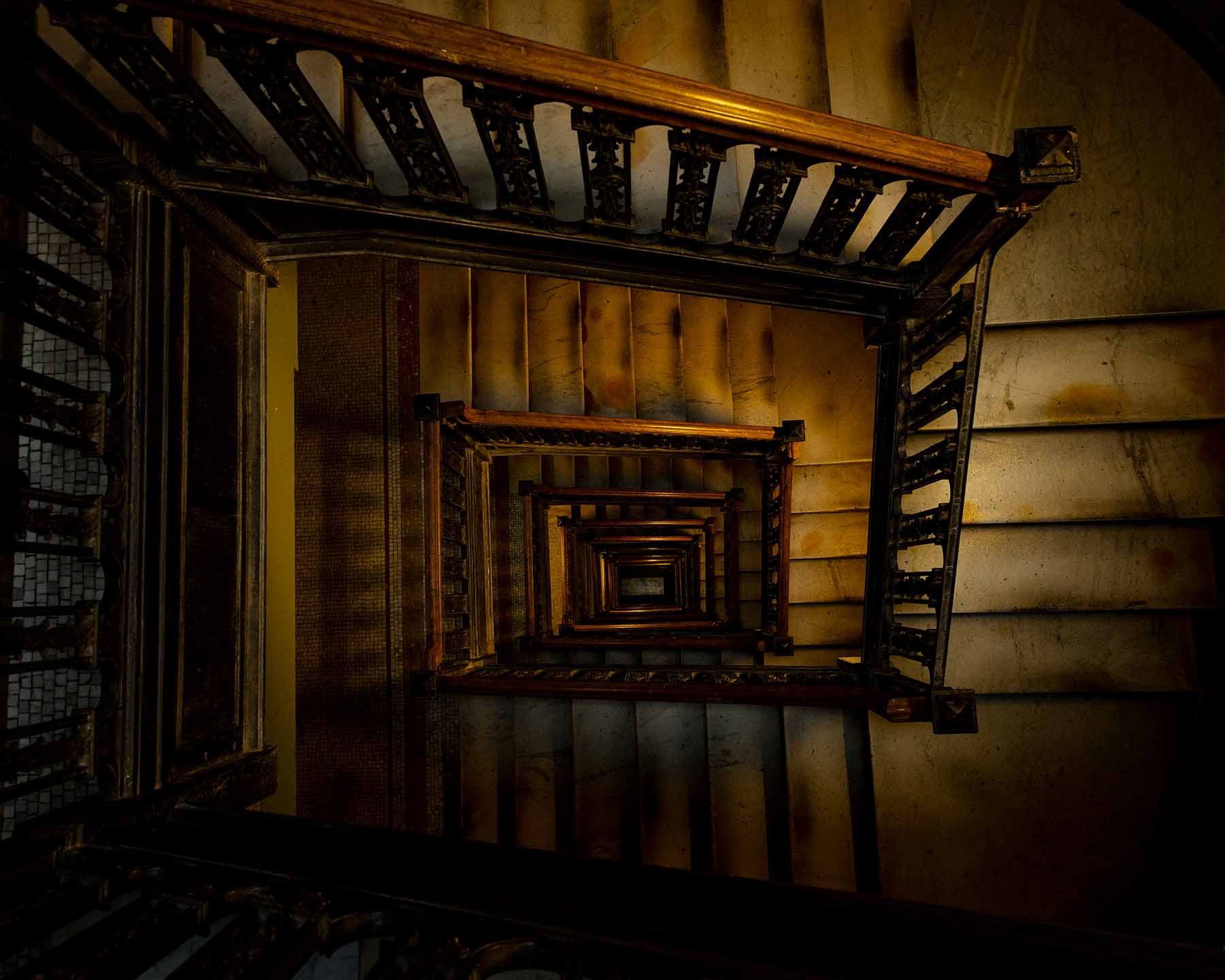
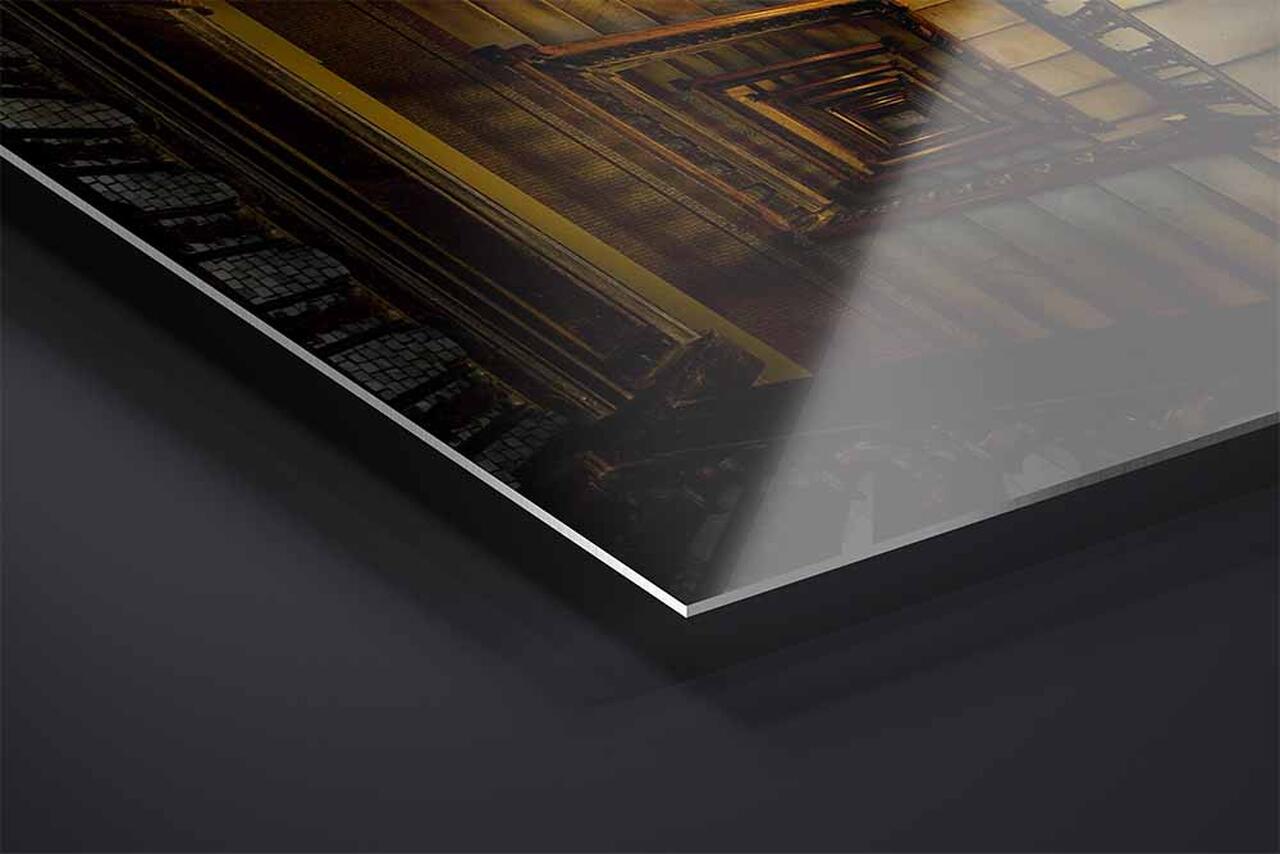
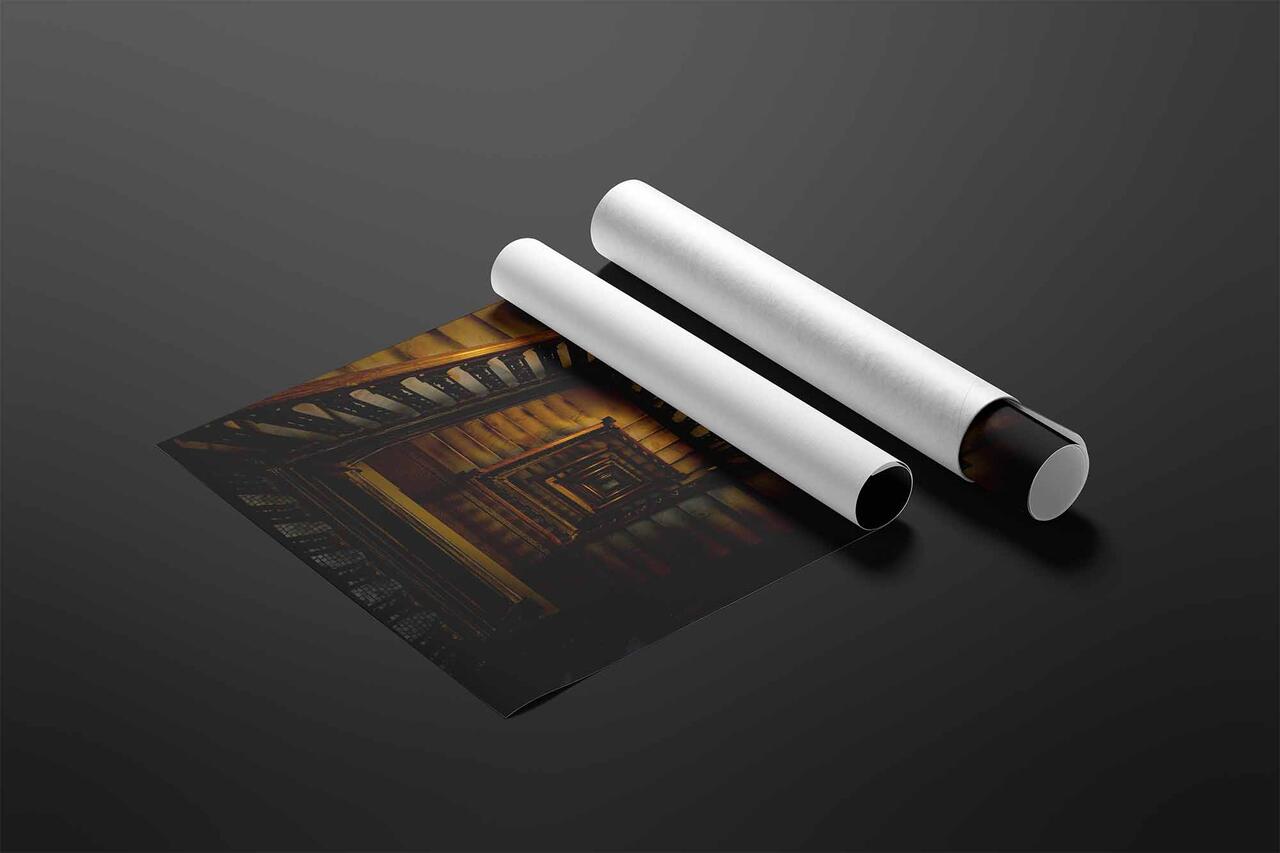
A 5:4 photograph of an old stairwell with ornamented balusters seen from above down its open well, New York City, United States, available as a limited edition print in four sizes.
Artist's Story
I was walking past and saw the stairwell through an open door, so I went in and climbed to the top. Summer, early evening. I leaned out over the rail until the well ran straight down the middle of the frame. I never did find out what the building was.
The treads are worn hollow.
Stone does not wear from feet. It wears from grit. Everybody coming in off a New York pavement carries a little of it on their soles, and every step grinds a few particles of quartz and sand across the surface. One passage removes nothing anyone could measure. A thousand a day for a century removes enough to dish the middle of every tread, and the hollow sits deepest exactly where people put their feet, which is never quite the centre of the step.
So the wear is a count of people. A stair nobody climbs stays sharp for as long as the building stands, however old it gets. These ones have been used.
Quiet Footsteps is a building I cannot name, photographed down a stair that has been keeping the tally the whole time.
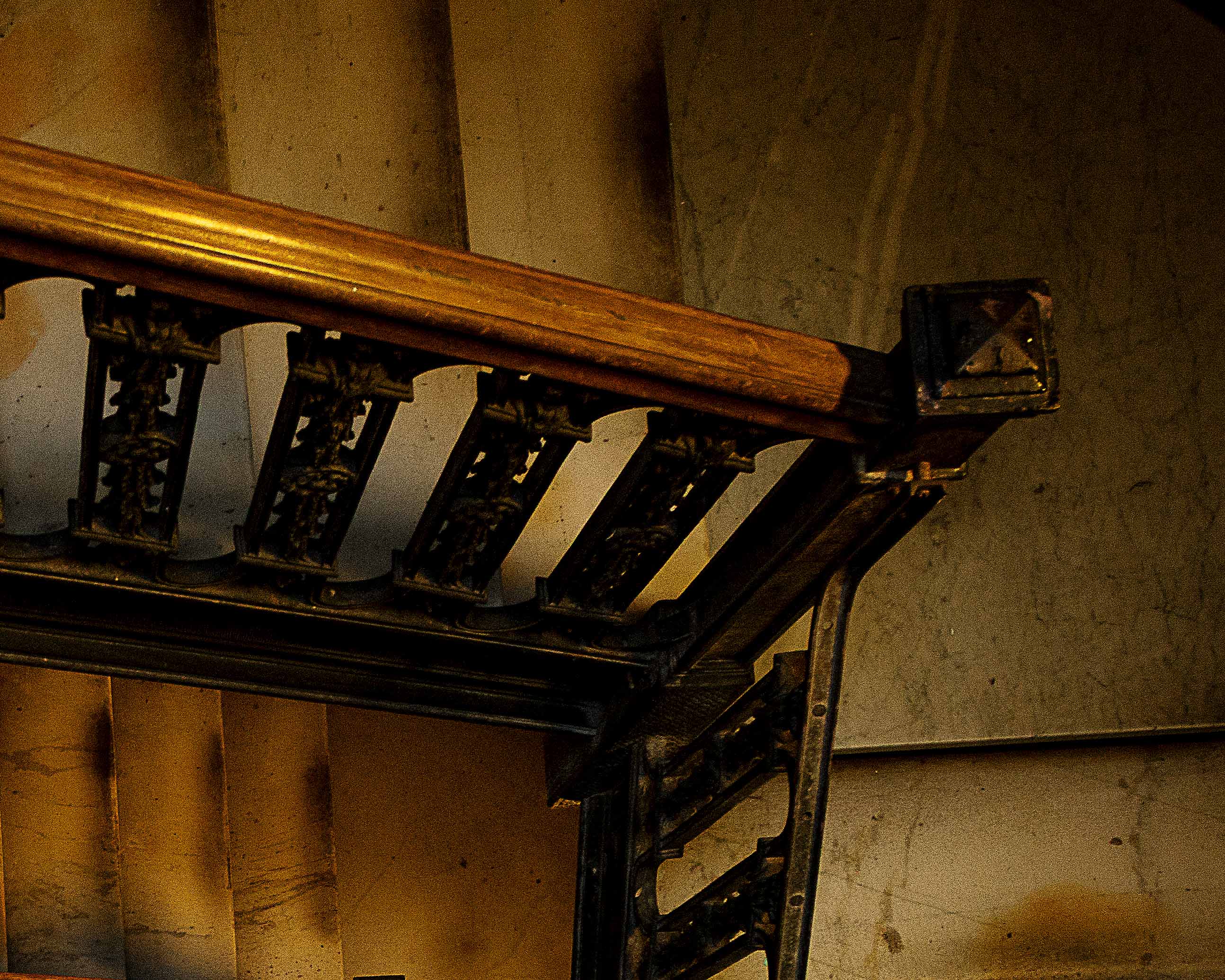
This crop is 64 percent of the frame width, about 32 inches across on the 50 inch print. The cast panels between the balusters resolve into separate leaves and scrolls, repeating identically along the run, and the handrail shows its grain and the polish worn into its upper surface. Below it the stone treads carry their staining and their wear, and the wall behind reveals its veining. Click to view at full size.
About This Photograph
An open stairwell in an older New York City building, photographed from the top floor looking down the well on a summer evening. Single frame. The building is not identified here: it was noticed in passing from the street and entered on the spot.
A stair like this one is a chimney. An open well running the height of a building carries smoke and fire upward as efficiently as it carries people, and a fire at the bottom can fill every floor above it in minutes. Building codes turned steadily against the arrangement across the twentieth century, and interior stairs above a few storeys are now required to sit inside fire-resisting enclosures with self-closing doors. Which is why a stair like this is always old. Nobody has been permitted to build one for a long time.
Quiet Footsteps
Steve Austinhttps://www.steveaustinphotography.com/
Location
New York City, United States
Subject
stairwell · open well · architectural interior
Capture
Single frame, early morning
Format
Horizontal · 5:4
Sizes
20 × 16 in · 30 × 24 in · 40 × 32 in · 50 × 40 in
Print Media
TruLife Acrylic · ChromaLuxe Metal · Baryta paper
Edition
Limited, 25 / 50 / 100 by presentation
What it Does in a Room
The picture is already a series of frames, and yours becomes the last one. Looking down the well you see five or six nested rectangles, each a storey smaller than the one before it, each rotated a few degrees off the one above. Hang that inside a rectangular moulding and the moulding joins the sequence rather than ending it. That is an argument for a plain, quiet profile and against anything decorative, because a frame with its own character reads as the outermost step in a series it was never meant to be part of. It is also an argument for a wide face over a narrow one: the outermost rectangle should be clearly the largest, not a close second to the one inside it.
There is not a single true horizontal or vertical anywhere in it. Every line in the photograph is a perspective line running off toward the centre, tilted by a few degrees or by thirty. That means the frame's own edges are the only square lines in view, and they become conspicuous in a way they would not be on a landscape with a horizon. It also means the piece has to hang dead level. On most photographs half a degree of tilt goes unnoticed because the picture has its own reference and the eye uses that. Here there is nothing inside the frame to check the frame against, so any error reads as the wall being wrong rather than the picture.
In this photograph colour and light are the same thing. Where there is illumination the frame runs thirty to fifty points warm on the red-blue axis, and where the light stops the colour stops with it: the bottom strip of the picture measures two points from neutral and sixty-two percent of the frame sits at or below twenty-five out of two hundred and fifty-five. That containment is the whole effect, a pocket of amber inside a black shell. Warm light in the room undoes it. A warm bulb washes the same amber across the print's dark regions and out onto the wall beyond it, and the pocket stops being a pocket. Neutral light keeps the edge where the photograph put it.
Not sure which size the room calls for, or want dimensions not listed here? Sizes beyond 50 × 40 are available on request and ship crated by freight. That conversation is welcome before an order is placed. Start that conversation and I will answer within one business day.
How small is too small for a photograph like this?
At the Intimate size the picture is twenty inches across and sixteen tall, and the nested rectangles hold, because they are large simple shapes against dark. What goes is everything that makes it a real building rather than a diagram. The foliate ornament in the baluster panels flattens into a dark band. The mosaic tile on the left wall closes into a flat surface. And the worn hollows in the treads disappear entirely, which matters more here than anywhere, because that wear is what the page is about. The Collected at thirty by twenty-four returns the ornament. The Expansive at forty by thirty-two is where the treads start to show their dish. If you are weighing a size against a specific wall, choosing the right print size covers the measurements and the viewing distances in more detail.
What changes at the largest size?
At fifty by forty, working inward: the foliate panels between the balusters resolve into separate leaves and scrolls, repeating identically down every flight. The handrail shows its grain and the polish worn into its upper surface by a century of hands. On the treads the hollows become visible as hollows, shallow dishes catching the light differently from the sharp stone at the edges. The newel caps show their mouldings. On the left the mosaic breaks into individual tesserae, and on the right the stone wall reveals its veining and the water staining running down it. At the bottom of the well the innermost rectangle stops being a smudge and becomes a floor. Why scale matters covers what happens perceptually when a photograph reaches the size where the eye has to cross it.
What kind of room does this photograph suit?
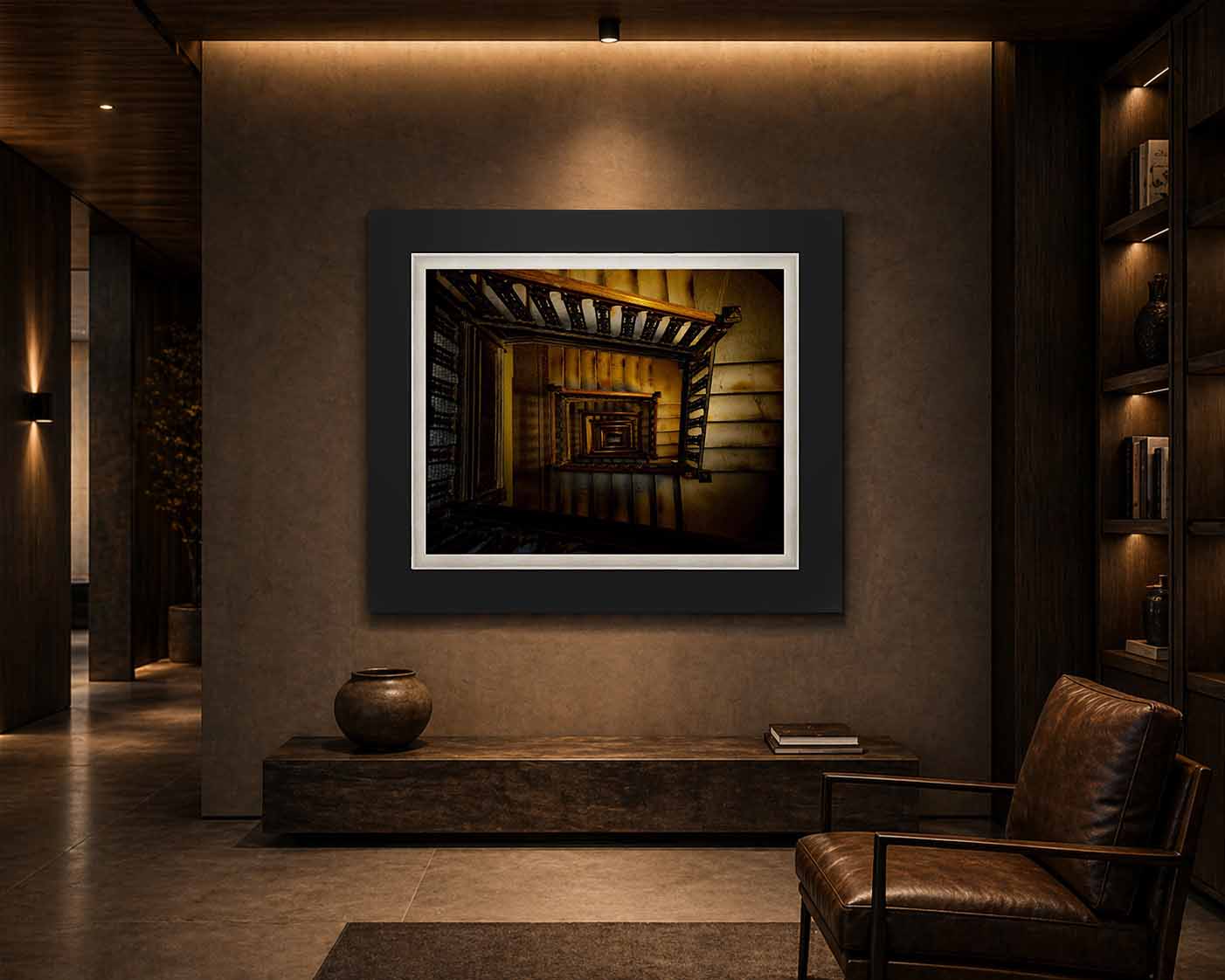
A dark room used in the evening. A study, a den, a library, a lower level, a windowless hall. Hang it at standard height with the centre at about fifty-seven inches, and hang it with a level rather than by eye. On materials it wants cool neutrals and matte surfaces, charcoal plaster and dark grey stone, so the warmth stays inside the frame. Three things to avoid. Use neutral bulbs rather than warm ones, for the reason above. Keep any run of rectangles out of the same view, including panelled doors, gridded joinery, a row of frames and open shelving, since the picture already contains a nested series and a second one competes. And do not hang it in a stairwell or beside a real stair, because the photograph becomes a label for the room rather than a picture in it. When your mind needs to rest takes the question further.
Every work ships insured and arrives with a signed certificate of authenticity.
If a piece is damaged in transit, the choice of replacement is always yours, and your edition number stays with you.
Production time runs 2 to 3 weeks for metal, 3 to 4 weeks for acrylic and paper, and 5 to 6 weeks for framed work.
Each print is made to order and takes its place in a numbered edition, so sales are final. Before you choose, I am glad to help: send a photo of your wall and I will show you this work in your room at true scale, at no charge. Start a conversation
Collector's Choice · TruLife ® Acrylic in Italian Frame
Collector Edition of 25· Lumachrome TruLife Acrylic · Handcrafted Italian Frame
TruLife acrylic in a handcrafted Italian frame with a linen liner chosen for the image. Frame series, finish, and liner are settled with you after the order, and production begins from there. The frame and liner add about fourteen inches to the finished dimensions, worth allowing for when planning placement.
Signature Acrylic Edition of 50· Lumachrome TruLife · Gallery Float Mount
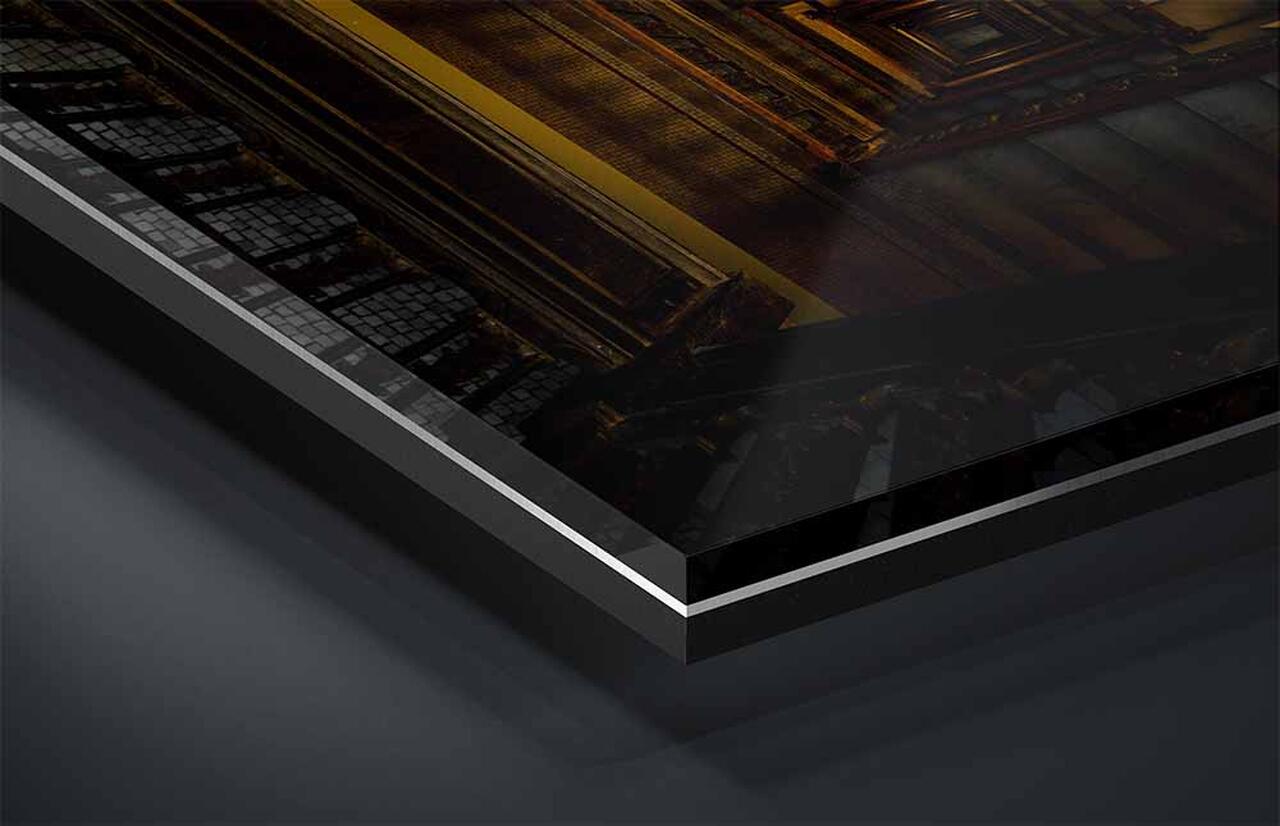
Face-mounted to TruLife acrylic and floated approximately one inch from the wall, with no frame to mediate between the image and the room. UV-resistant, anti-reflective, and scratch-resistant, with a lifetime guarantee against fading.
Signature Metal Edition of 50· ChromaLuxe Print · Gallery Float Mount
Color infused into the aluminum panel itself, floated from the wall on a concealed system. Where acrylic produces luminosity, metal produces clarity. Exceptional fade resistance with no glazing or coating required.
Fine Art Edition of 100· Hahnemühle Baryta Fine Art Paper
Printed without acrylic, so light meets the paper surface directly. Highlights stay luminous, shadows keep their nuance, and the surface has a tactile quality the other presentations approach differently. The understated choice, and the traditional one.
Complimentary shipping within the continental United States. International collector shipping available upon request.
Still deciding
Designing for Stillness
A guide to choosing art for restorative spaces
How to tell whether an image will still hold you in a year, how scale changes what a photograph does in a room, and how to match a piece to the work a room actually performs. It cites the research it draws on, and it is equally clear about where that research stops. About ten minutes to read.