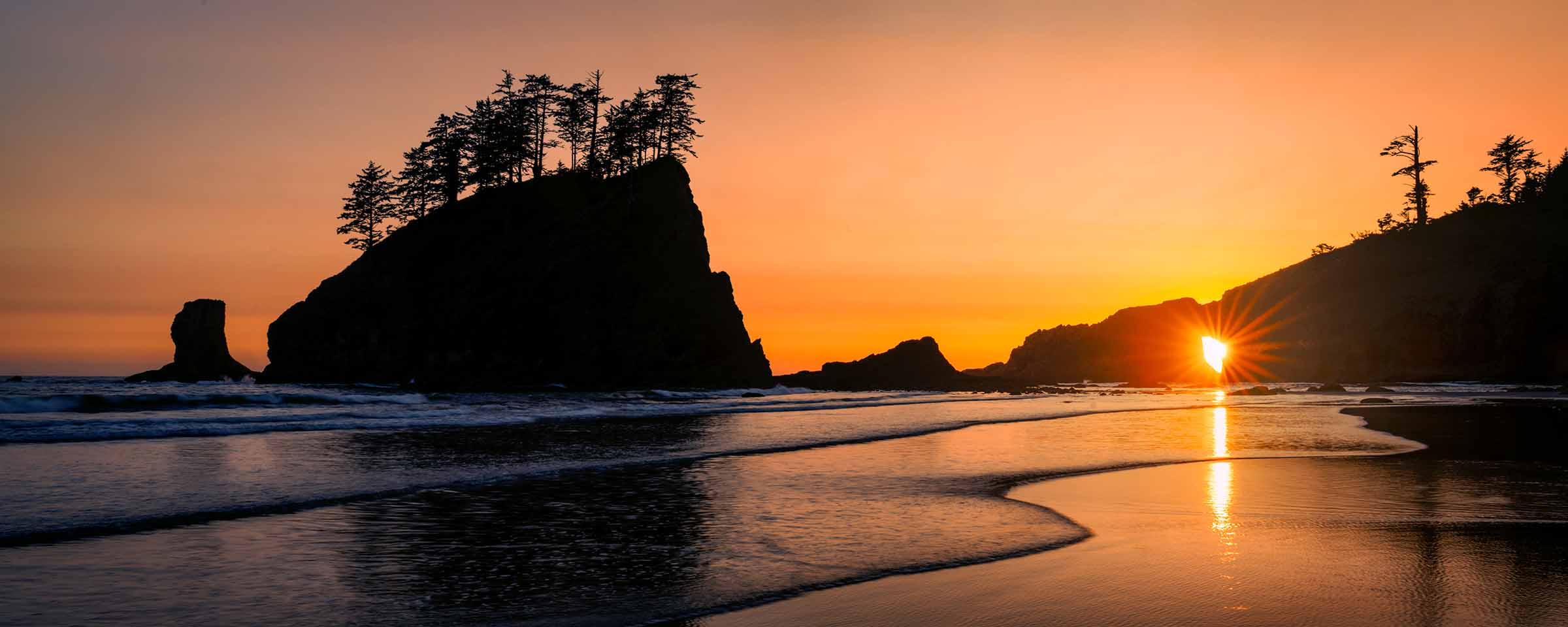
A 5:2 panoramic photograph of a sea stack at sunset, Second Beach, Olympic National Park, available as a limited edition print in three sizes and four presentations.
Artist's Story
I chased this photograph for six years.
Second Beach at La Push sits on the Olympic coast, reached by a short walk down through old growth forest before the trees open onto sand. What makes it worth the drive is the rock. Sea stacks stand offshore in a loose line, and one of them carries an opening worn straight through it. For a narrow window each summer, the setting sun lines up behind that opening. The alignment shifts a little every year, the window is only a few minutes long, and the Washington coast in August is not reliably clear.
Five times I made the trip and five times something was wrong. Cloud that never lifted. Wildfire smoke that turned the sun the wrong color. And once, entirely my own error, the sun going down well off the mark I had predicted. Each drive is most of a day. Each attempt is one chance.
On the sixth, everything held. The sky was clear, the tide had pulled back far enough to leave the sand wet and mirroring, and the sun found the opening and poured through it. I remember understanding that I had a few minutes and that arguing with the moment would waste them.
What I did not expect was how quiet it felt. After six years of wanting something, the thing itself arrived without any drama at all. The light came across the water, the waves kept their own unhurried time, and the coastline seemed to exhale. That is the part I keep returning to. Nature does not demand your attention. It simply makes it possible to give.
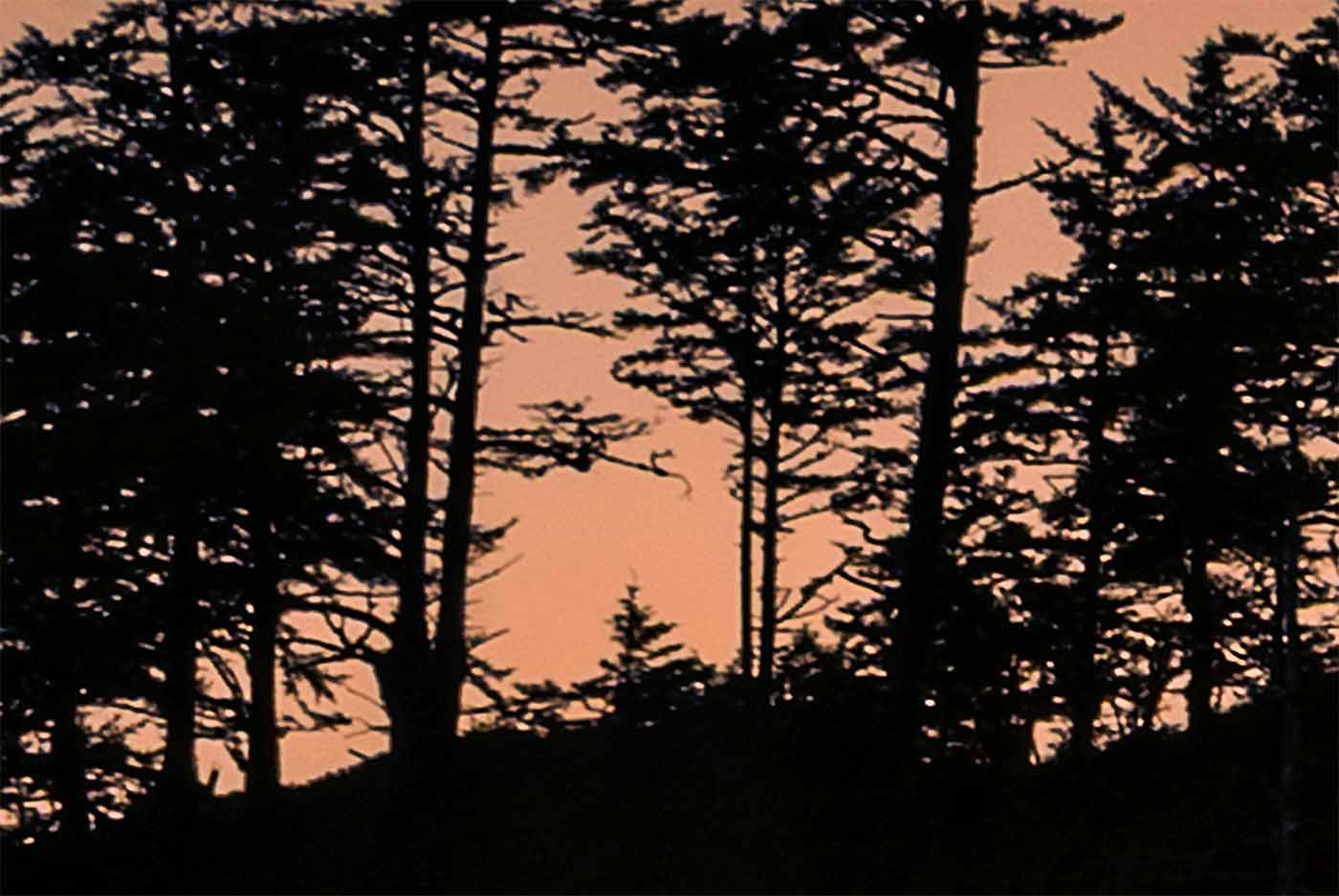
Detail at full resolution, roughly one twelfth of the frame width. At the Intimate size these trees read as a fringe along the ridge. At Statement size each one separates, down to the dead limbs and the gaps of sky between the needles.
About This Photograph
Second Beach lies within Olympic National Park on the Washington coast, reached by a short trail from La Push, the main community of the Quileute Nation. The beach runs between Quateata and its arch at the north end and Teahwhit Head to the south, with the Quillayute Needles standing offshore. The rock throughout this stretch is marine sedimentary stone, thickly bedded and severely deformed by faulting, which is why the formations here erode into caves, arches, and towers rather than into smooth cliffs. The offshore stacks have been federally protected since 1907, when the Quillayute Needles refuge was established to safeguard roughly eight hundred islands, rocks, and reefs along this coast. The formations erode in sequence, from cave to arch to free-standing tower, so the opening photographed here is not a permanent feature but a stage the rock is passing through.
XXXXX
Steve Austinhttps://www.steveaustinphotography.com/
Location
Second Beach, Olympic National Park, Washington
Subject
Sea stack at sunset
Capture
Single exposure at sunset
Format
Photograph · horizontal panorama, 5:2
Sizes
40 × 16 in · 60 × 24 in · 80 × 32 in
Print Media
TruLife Acrylic · ChromaLuxe Metal · Baryta paper
Edition
Limited, 25 / 50 / 100 by presentation
What it Does in a Room
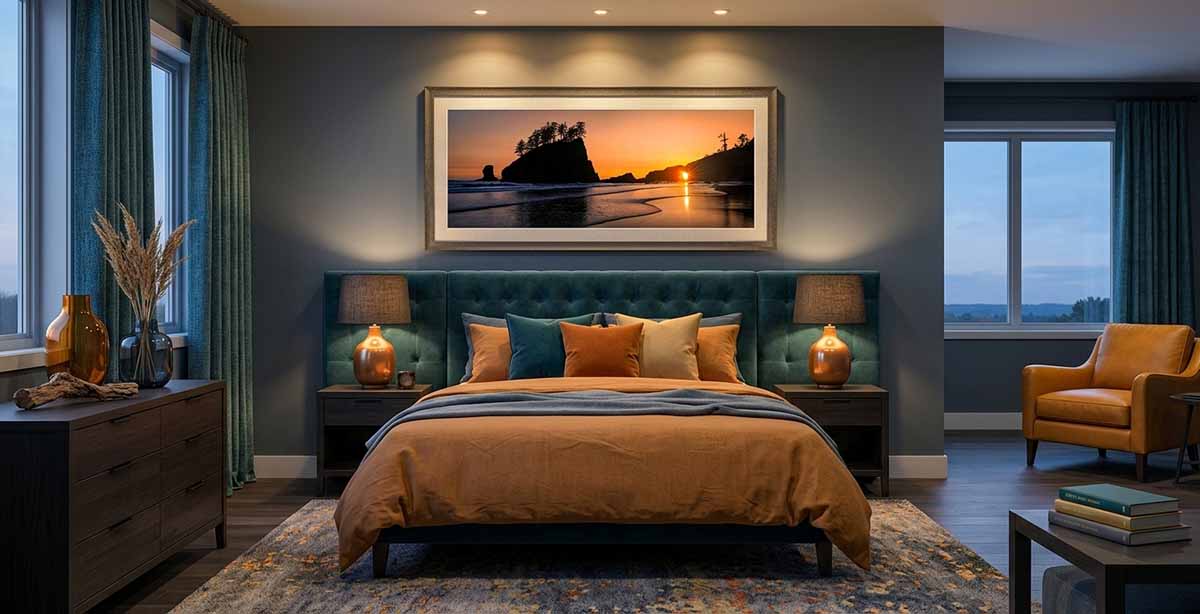
A photograph this wide does not behave like a picture on a wall. It behaves like an opening in one.
Human vision is much wider than it is tall. What you actually take in is a horizontal band, and a panoramic print is one of the few objects in a room shaped the way seeing is shaped. When the horizon inside the frame sits near the height of your own, the eye stops working the edges and settles into the image the way it settles into a view. At two to five the proportion is slightly less severe than a true three to one, which matters more than the numbers suggest. There is enough height for sky above the horizon and ground below it, so the image reads as a window rather than a slot. Open across, but with enough vertical space that the place inside the frame feels like somewhere you could stand.
Here the horizon runs low and unbroken except for the sea stack, and the wet sand carries the light forward to the bottom edge of the frame. The eye enters at the near shoreline and travels out to the sun. That path is what the width is for.
Not sure which size the room calls for, or want dimensions not listed here? Sizes beyond 80 × 32 are available on request and ship crated by freight. That conversation is welcome before an order is placed. Start that conversation and I will answer within one business day.
How small is too small for a photograph this wide?
At two to five, the Intimate size is sixteen inches tall and forty inches across. That is a gentler proportion than a true three to one, so it holds together better in a smaller space, but it is still a wide piece and it still asks for a wall that can give it room. On most walls the Intimate reads as a horizontal accent rather than a focal point, which suits a hallway, a stairwell landing, or a space above a low console. The Collected and Statement sizes are where the width does the real work. If you are weighing a size against a specific wall, choosing the right print size covers the measurements and the viewing distances in more detail.
What changes at the largest size?
The foreground is where this one changes. At sixteen inches tall the desert floor is a band of green texture and the saguaros are shapes. At thirty two you can count the ribs on the near one, see the spines catch the last light along its edge, and follow the ground back through the creosote and brittlebush to where the slope begins to climb. The cliff face does the same thing. What reads at the small size as a wall of warm rock resolves into individual columns and the gullies between them, each one lit differently depending on how it faces the light. That matters here more than on most photographs, because the argument the image makes is that nothing is hidden. At the largest size that stops being a claim about the mountain and becomes something the print demonstrates about itself. Why scale matters covers what happens perceptually when a landscape reaches the size where the eye has to travel across it.
What kind of room does this photograph suit?
This is a warm image almost end to end. Orange and gold through the sky, the same range reflected back off the wet sand, and everything else in silhouette. There is no cool note anywhere in it, which makes it easier to place than most photographs with this much color, because there is only one direction to match. It agrees immediately with wood, leather, brass, and warm plaster. Against cool gray or blue it will read as the warm element in the room, which can work well if that is what the space is missing, but it will not disappear into that palette. The value structure is dark, with the rock and trees carrying real weight, so this is not a photograph that brightens a dim room. In a bright space the gold comes fully alive and the silhouettes hold. The one thing it asks for is viewing distance. The frame runs deep, from the near shoreline out past the stack to the sun, and that depth only opens up when the viewer can take in the full width at once. A wall you pass within three feet of will show you the near half. A wall you see from across a room will show you all of it.
Every work ships insured and arrives with a signed certificate of authenticity.
If a piece is damaged in transit, the choice of replacement is always yours, and your edition number stays with you.
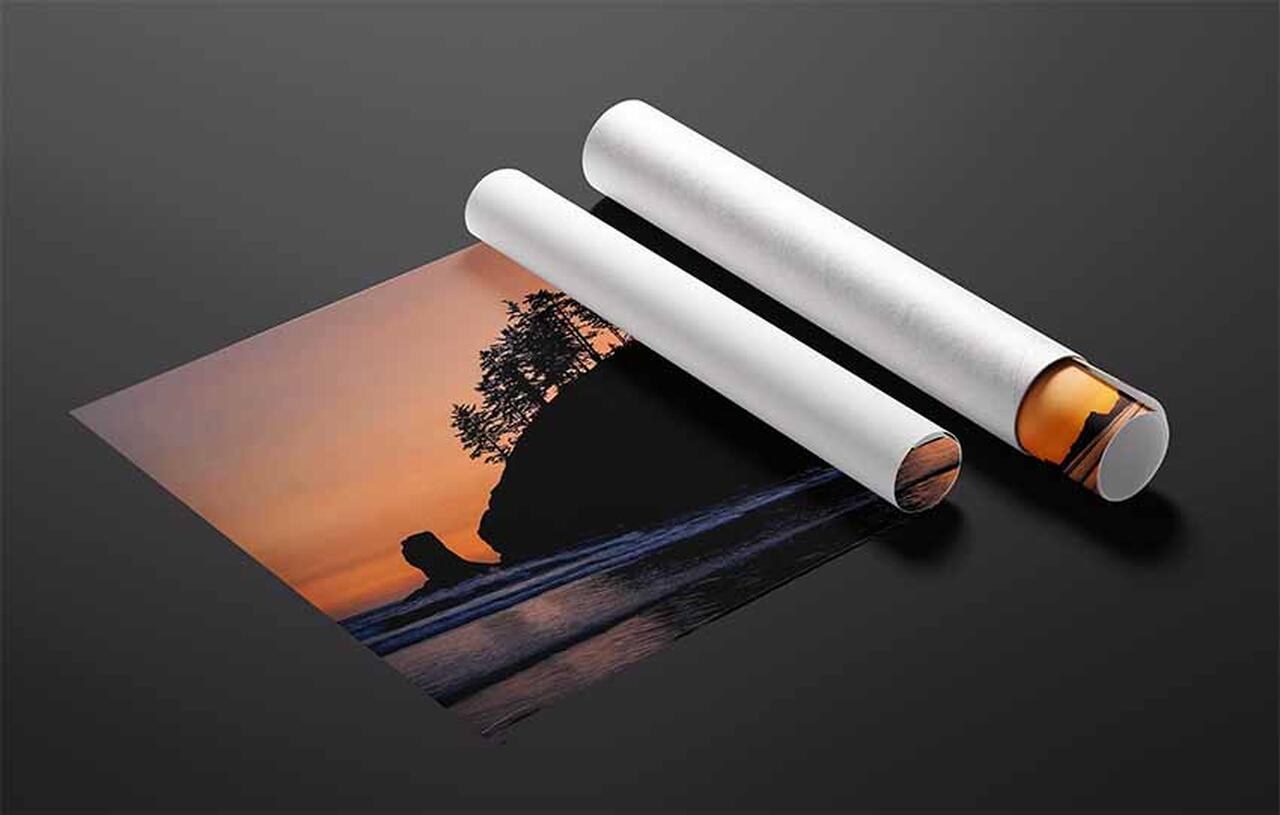
Production time runs 2 to 3 weeks for metal, 3 to 4 weeks for acrylic and paper, and 5 to 6 weeks for framed work.
Each print is made to order and takes its place in a numbered edition, so sales are final. Before you choose, I am glad to help: send a photo of your wall and I will show you this work in your room at true scale, at no charge. Start a conversation
Collector's Choice · TruLife ® Acrylic in Italian Frame
Collector Edition of 25· Lumachrome TruLife Acrylic · Handcrafted Italian Frame
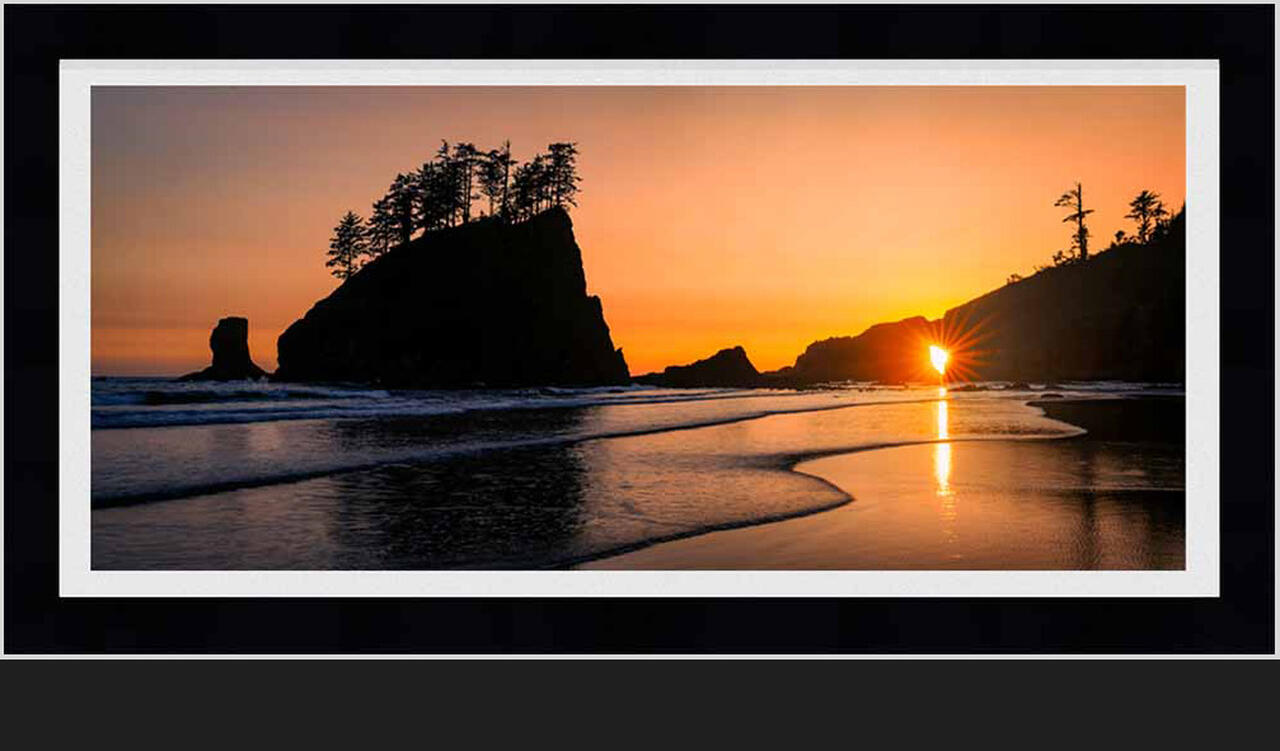
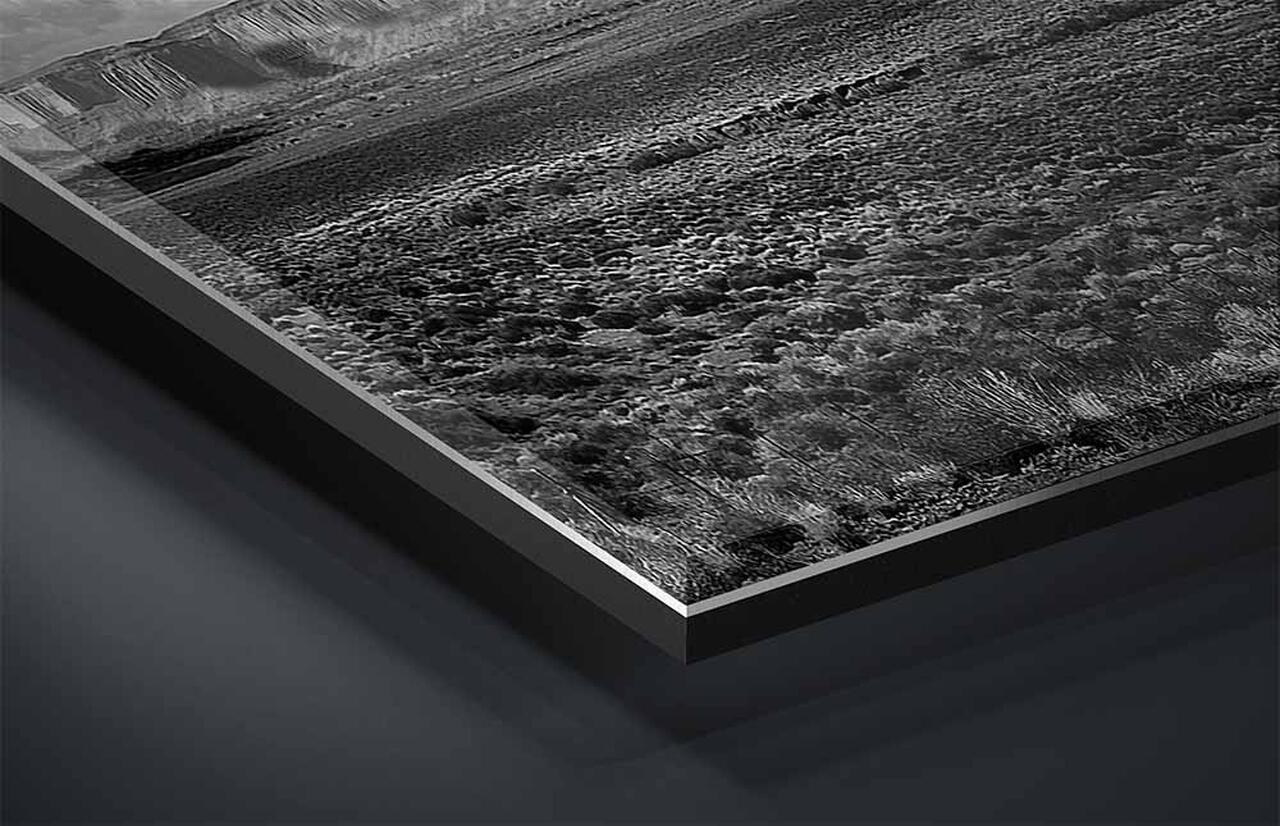
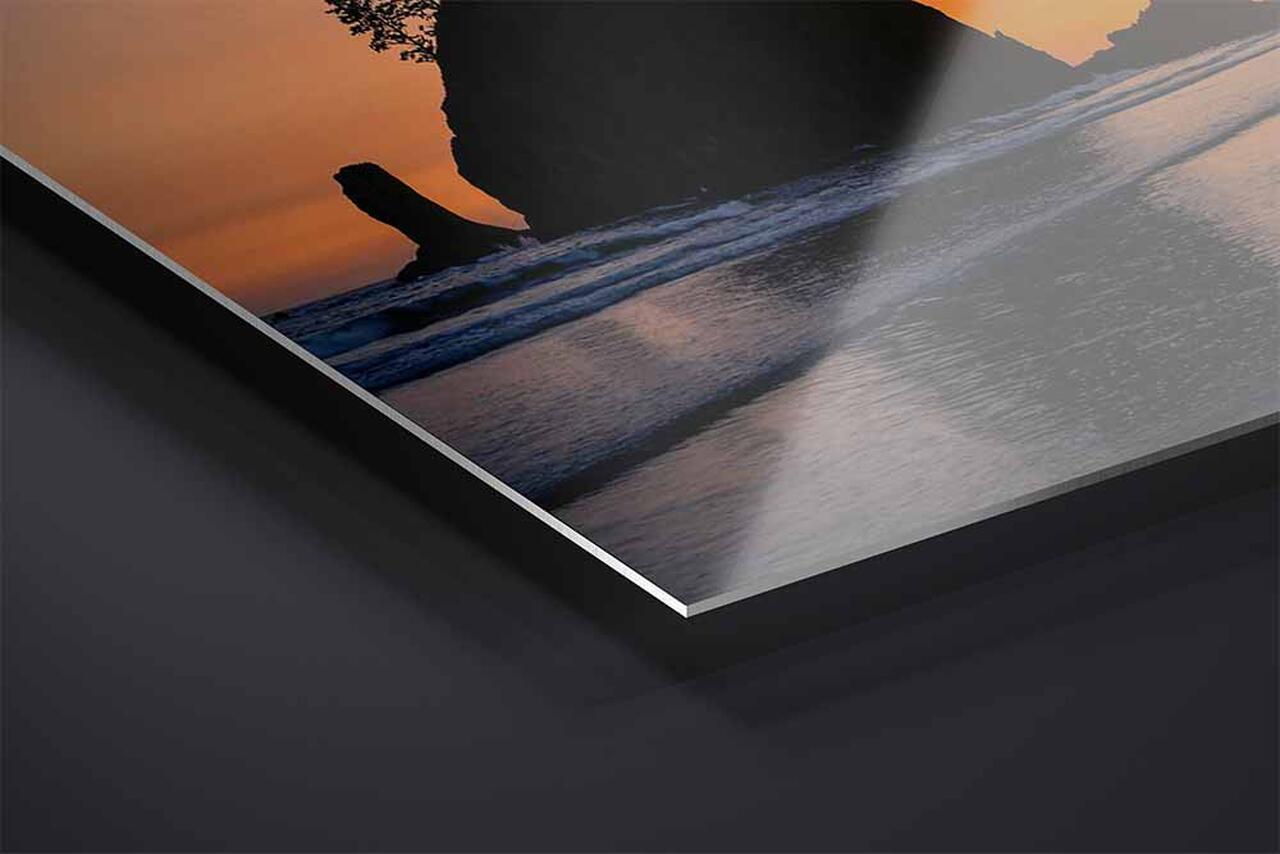
TruLife acrylic in a handcrafted Italian frame with a linen liner chosen for the image. Frame series, finish, and liner are settled with you after the order, and production begins from there. The frame and liner add about fourteen inches to the finished dimensions, worth allowing for when planning placement.
Signature Acrylic Edition of 50· Lumachrome TruLife · Gallery Float Mount
Face-mounted to TruLife acrylic and floated approximately one inch from the wall, with no frame to mediate between the image and the room. UV-resistant, anti-reflective, and scratch-resistant, with a lifetime guarantee against fading.
Signature Metal Edition of 50· ChromaLuxe Print · Gallery Float Mount
Color infused into the aluminum panel itself, floated from the wall on a concealed system. Where acrylic produces luminosity, metal produces clarity. Exceptional fade resistance with no glazing or coating required.
Fine Art Edition of 100· Hahnemühle Baryta Fine Art Paper
Printed without acrylic, so light meets the paper surface directly. Highlights stay luminous, shadows keep their nuance, and the surface has a tactile quality the other presentations approach differently. The understated choice, and the traditional one.
Complimentary shipping within the continental United States. International collector shipping available upon request.
Still deciding
Designing for Stillness
A guide to choosing art for restorative spaces
How to tell whether an image will still hold you in a year, how scale changes what a photograph does in a room, and how to match a piece to the work a room actually performs. It cites the research it draws on, and it is equally clear about where that research stops. About ten minutes to read.