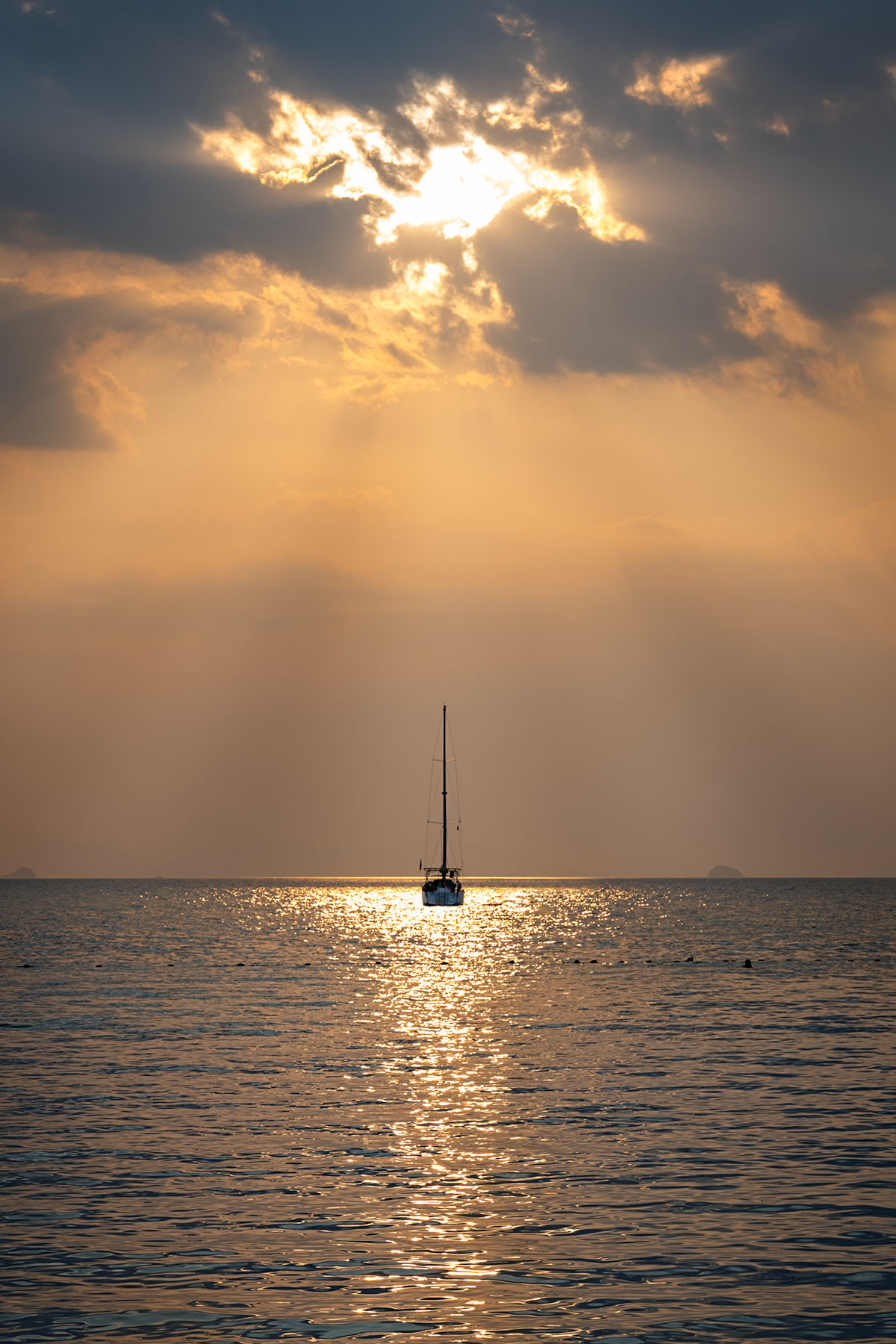
A 2:3 vertical photograph of a sailboat at anchor under a sunset sky at Railay Beach, Thailand, available as a limited edition print in four sizes.
Artist's Story
At Railay Beach, on the Andaman coast of southern Thailand, the clouds broke late in the day and let the light down to the water in long golden shafts. They look like they spread from a point. They do not. Sunlight arrives in parallel lines and perspective does the rest.
In Korean, a 받침 is the final consonant that closes a syllable, the character that sits beneath and holds what falls into it, completing the sound by receiving it. Without it the syllable stays open, unresolved, still waiting.
I was on the sand as the sun dropped toward the sea and the sky opened. At the place where the light reached the water, a single sailboat sat anchored and still, its mast rising into what was coming down.
It was not moving toward the light. It was there when the light arrived.
받침 (The Receiving) is the boat, the shafts, and the gap in the cloud they came through. A bird crosses low on the right. Limestone islands sit faint on the horizon. Everything in the frame was already in place.
The boat at about a tenth of the frame width. On a sixty inch print this section runs roughly six inches across. The forestay and shrouds separate into individual lines, the spreaders cross them, and the stern resolves into rail and fittings. Click to view at full size.
About This Photograph
From the sand at Railay Beach, on the Andaman coast of Krabi Province in southern Thailand, looking west at sunset. This is a single frame image. The frame holds one sailboat anchored offshore in silhouette, the low sun breaking through a bank of cloud, and small limestone islands faint on the horizon.
The boat sits just under half the frame width and about two thirds of the way down. The sun sits almost directly above it, on the same vertical line to within a percent, and the mast points at the gap in the cloud.
Railay is a limestone peninsula cut off from road access by its cliffs and reached only by boat. Its west-facing beach is known for open-water sunsets.
The Receiving
Steve Austinhttps://www.steveaustinphotography.com/
Location
Railay Beach, Krabi Province, Thailand
Subject
Sailboat at anchor · Andaman Sea · sunset
Capture
Single frame into the sun
Format
Photograph · vertical, 2:3
Sizes
16 × 24 in · 24 × 36 in · 32 × 48 in · 40 × 60 in
Print Media
TruLife Acrylic · ChromaLuxe Metal · Baryta paper
Edition
Limited, 25 / 50 / 100 by presentation
What it Does in a Room
This photograph contains a light source, and that is unusual enough to change how it behaves. The sun reaches pure white and the cloud around it runs close behind, so the eye reads that passage as emitting rather than reflecting. In a dim room the panel becomes the brightest thing present and the space organizes around it the way it would around a lamp. The effect is strongest in the evening, which is also when the picture's own light makes the most sense.
The proportion does something a horizontal cannot. A tall panel pulls the eye upward and takes the ceiling with it, so a room reads higher with this on the wall than without. It also fits where wide work cannot go. The stretch between two windows, the wall beside a door, the narrow face at the end of a hall, the turn of a stair. Those are the walls most collections leave empty because nothing is shaped for them.
The internal order helps it hang. The sun and the boat sit on the same vertical line, so the picture has a spine running top to bottom through its center. Hung on a wall with any vertical of its own, a door frame, a window mullion, the edge of a cabinet run, that spine gives the eye something to line the panel up against, and the whole arrangement settles.
Not sure which size the room calls for, or want dimensions not listed here? Sizes beyond 40 × 60 are available on request and ship crated by freight. That conversation is welcome before an order is placed. Start that conversation and I will answer within one business day.
The Receiving, limited edition printSteve Austin65011000USD15https://schema.org/InStock
Questions about this photograph
How small is too small for a photograph this tall?
At two to three, the Intimate size is sixteen inches across and twenty-four tall. The sky survives that easily, because the shafts and the break in the cloud are large soft shapes and they read from across a room. The boat does not. It occupies a small part of the frame, so at sixteen by twenty-four the hull is about an inch across and the mast a fine dark line, and the picture becomes a sky with a mark under it. That is a real photograph and it suits a narrow wall or a space beside a door. The Collected at twenty-four by thirty-six is where the rigging starts to separate from the mast and the boat becomes a boat again. If you are weighing a size against a specific wall, choosing the right print size covers the measurements and the viewing distances in more detail.
What changes at the largest size?
At the Expansive size, forty by sixty, the panel stands five feet tall and the boat resolves into equipment. The forestay and the shrouds separate from the mast as individual lines, the boom shows against the hull, and the shape at the stern becomes legible as fittings rather than a smudge. The bird crossing low on the right sharpens from a dark speck into a bird with a wingspan. The foreground water changes at the same size, from a field of glitter into ripples running at a readable angle. What changes beyond detail is where the picture sits relative to you. At five feet, the sun is above your eye line and the near water is below it, so you look up into the light and down into the sea instead of taking both in at once. Why scale matters covers what happens perceptually when a landscape reaches the size where the eye has to travel across it.
What kind of room does this photograph suit?
Rooms with tall narrow walls, and rooms used in the evening. The picture runs warm throughout, from amber in the cloud to bronze on the water, so it belongs with bone, cream, warm plaster, and unpainted wood, and it will lift a room that leans cool without turning it. Because the proportion is vertical it goes where horizontals cannot: an entry, a stair landing, the wall beside a door, the gap between two windows, the end of a hall. Those are walls people pass close to, and at close range the water in the lower third gives the eye somewhere to stay after the sky has done its work. It also holds a room on its own rather than needing a pair, since the spine running from the sun down through the mast already gives it a center. Designing calm spaces takes the question further.
Every work ships insured and arrives with a signed certificate of authenticity.
If a piece is damaged in transit, the choice of replacement is always yours, and your edition number stays with you.
Production time runs 2 to 3 weeks for metal, 3 to 4 weeks for acrylic and paper, and 5 to 6 weeks for framed work.
Collector's Choice · TruLife ® Acrylic in Italian Frame
Collector Edition of 25· Lumachrome TruLife Acrylic · Handcrafted Italian Frame
TruLife acrylic in a handcrafted Italian frame with a linen liner chosen for the image. Frame series, finish, and liner are settled with you after the order, and production begins from there. The frame and liner add about fourteen inches to the finished dimensions, worth allowing for when planning placement.
Signature Edition · TruLife ® Acrylic, Float Mount
Signature Edition of 50· Lumachrome TruLife Acrylic · Gallery Float Mount
Face-mounted to TruLife acrylic and floated approximately one inch from the wall, with no frame to mediate between the image and the room. UV-resistant, anti-reflective, and scratch-resistant, with a lifetime guarantee against fading.
Signature Edition of 50· ChromaLuxe Metal Print · Gallery Float Mount
Color infused into the aluminum panel itself, floated from the wall on a concealed system. Where acrylic produces luminosity, metal produces clarity. Exceptional fade resistance with no glazing or coating required.
Fine Art Edition of 100· Hahnemühle Baryta Fine Art Paper
Printed without acrylic, so light meets the paper surface directly. Highlights stay luminous, shadows keep their nuance, and the surface has a tactile quality the other presentations approach differently. The understated choice, and the traditional one.
Complimentary shipping within the continental United States. International collector shipping available upon request.
Still deciding
Designing for Stillness
A guide to choosing art for restorative spaces
How to tell whether an image will still hold you in a year, how scale changes what a photograph does in a room, and how to match a piece to the work a room actually performs. It cites the research it draws on, and it is equally clear about where that research stops. About ten minutes to read.