Jedediah Smith Redwoods, Crescent City, California
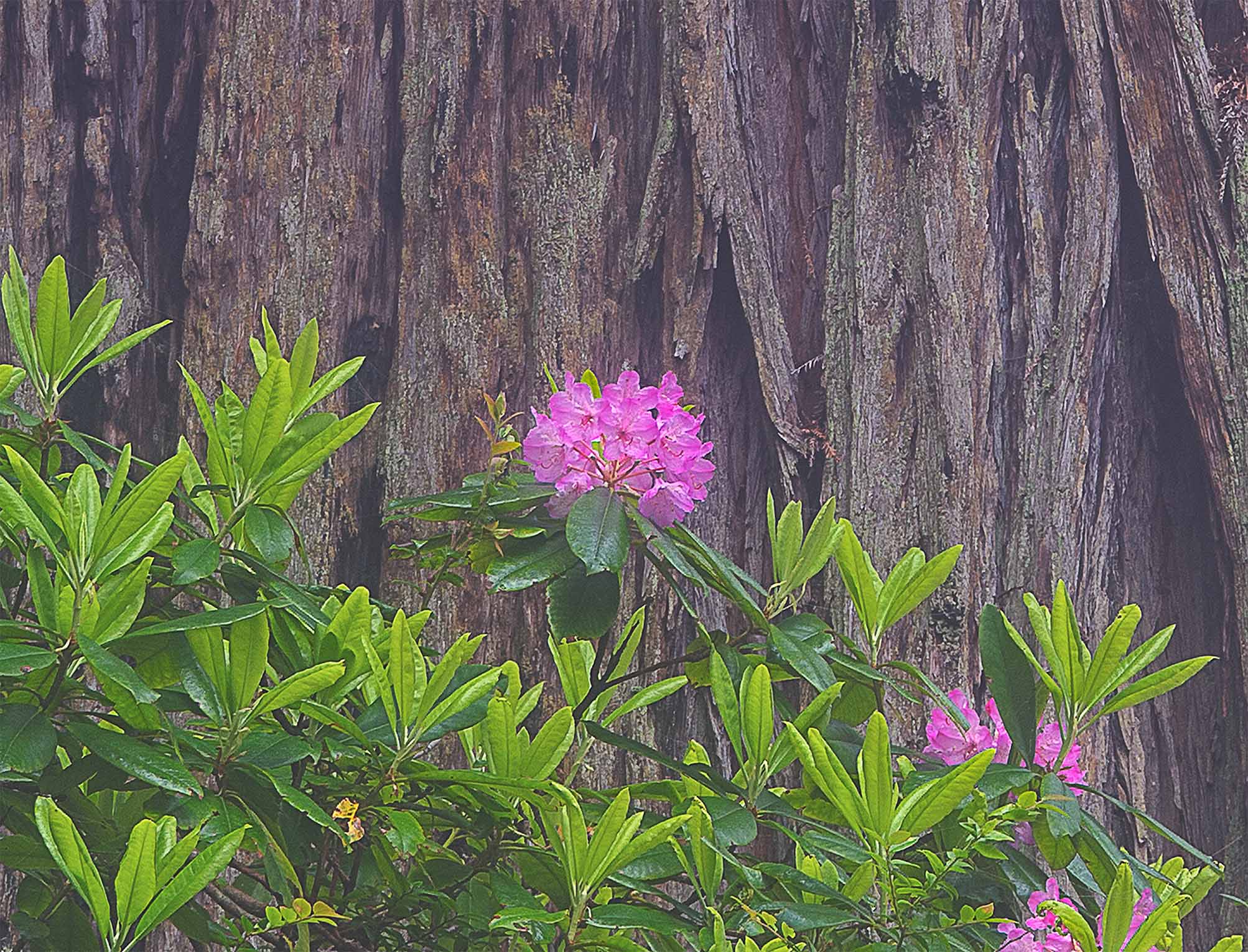
A 1:2 panoramic photograph of Pacific rhododendron in bloom at the base of a coast redwood, Jedediah Smith Redwoods, California, available as a limited edition print in three sizes and four presentations.
Artist's Story
In Jedediah Smith Redwoods, on the far northern California coast, almost no rain falls from June through October, and the trees do not much mind. Their canopies comb fog out of the marine air, it condenses, and it falls as drip. Something like a third of what a mature redwood drinks in the dry season arrives that way, harvested out of the air by the tree itself.
I come at the start of summer for the two or three weeks the wild rhododendrons are open, which is a narrow window and easy to miss from either direction. That morning the fog was in and the forest was entirely still.
What I framed as a composition, pink against dark bark, small against enormous, is not really a composition. It is plumbing. Understory plants here draw most of their summer water from fog the redwoods pulled down, which means the rhododendron in this photograph is drinking what the tree behind it collected. The relationship I was responding to aesthetically was already running as hydrology, quietly, for centuries before anyone turned up to find it beautiful.
Beauty in the Forest is that arrangement, which I noticed for the wrong reason and would not have found any other way.
Detail at full resolution, roughly one fifth of the frame width. At the Intimate size the bark reads as a pattern of stripes. At Statement size it becomes a surface, and the flowers hold their individual petals. Click to view at full size.
About This Photograph
Jedediah Smith Redwoods State Park lies in Del Norte County near Crescent City, on the far northern California coast, and protects roughly 10,400 acres of old-growth forest along the Smith River. It is one of four units managed jointly as Redwood National and State Parks, which together preserve about 45 percent of the remaining old-growth coast redwood on earth.
The tree is a coast redwood, Sequoia sempervirens, the tallest species alive, with verified individuals above 380 feet. The flowering shrub at its base is Pacific rhododendron, Rhododendron macrophyllum, which blooms for a short stretch in late spring and is gone within weeks.
The photograph is a single frame made in fog in late spring, from the forest floor.
Beauty in the Forest
Steve Austinhttps://www.steveaustinphotography.com/
Location
Jedediah Smith Redwoods, Crescent City, California
Subject
Pacific rhododendron · coast redwood · fog
Capture
Single frame in fog, late spring
Format
Photograph · horizontal panorama, 1:2
Sizes
20 × 40 in · 30 × 60 in · 40 × 80 in
Media
TruLife Acrylic · ChromaLuxe Metal · Baryta paper
Edition
Limited, 25 / 50 / 100 by presentation
What it Does in a Room
A photograph this wide does not behave like a picture on a wall. It behaves like an opening in one.
Human vision is much wider than it is tall. What you actually take in is a horizontal band, and a panoramic print is one of the few objects in a room shaped the way seeing is shaped. At one to two the frame is wide without being extreme, which changes what it asks of a room. There is real height here, enough for sky above and water or ground below, so the image reads as a window rather than as a band running across the wall. It is the most forgiving of the panoramic proportions. It will hang above a sofa or a console without demanding the entire wall, and it holds together in a space where a longer frame would look stretched.
Here the width is doing something specific. The redwood trunk fills the upper half of the frame and runs off both edges, so there is no way to see the whole tree and no attempt to show it. What you get instead is a section of something too large to fit, with the rhododendron in front of it at a scale you can actually take in. The eye moves along the flowers, finds the bark behind them, and cannot resolve how far up it goes. That is the photograph's argument, and it only works at width. A narrower frame would show a tree. This one shows that the tree does not end.
The plumbing explains the arrangement. It does not explain why I stopped walking. I wrote about where that response comes from in Why We Are Wired to Need the Natural World.
Collected size, 30 × 60 inches, shown above.
Scale
Statement · 40 × 80 in
Collected · 30 × 60 in
Intimate · 20 × 40 in
84 in · typical three-seat sofa
All three sizes shown to scale, sharing a common center line.
Not sure which size the room calls for, or want dimensions not listed here? That conversation is welcome before an order is placed. Start that conversation and I will answer within one business day.
Sizes beyond 40 × 80 are available on request and ship crated by freight.
<Beauty in the Forest, limited edition printSteve Austin112513400USD12https://schema.org/InStock
Questions about this photograph
How small is too small for a photograph this wide?
At one to two, the Intimate size is forty inches across and twenty inches tall. That is a comfortable proportion, wide enough to read as a panorama but with enough height that it still behaves like a picture rather than a band. Of the panoramic families this is the one that holds up best at its smallest size, and a twenty by forty print will anchor a modest wall on its own. Where it starts to feel small is on a large open wall or above a full-length sofa, where the surrounding space overwhelms it. The Collected and Statement sizes are where the width does the work. If you are weighing a size against a specific wall, choosing the right print size covers the measurements and the viewing distances in more detail.
What changes at the largest size?
The bark is the whole question. Coast redwood bark is deeply furrowed, and in this frame it fills the upper half with vertical channels running the full height of the picture, some of them wide enough to put a hand into. At twenty inches tall that reads as a texture, a pattern of light and dark stripes. At forty inches tall it stops being a pattern and becomes a surface. You can see how deep the furrows go, where the fibrous strands separate and hang, and where the bark has been scarred and grown over. That difference matters more here than it would in most photographs, because the entire argument of the image is that the tree is too large to take in, and a small print flattens the bark into decoration. The rhododendron leaves do the same thing at a smaller scale, going from a green mass to individual leaves with visible veining and water on their surfaces. Why scale matters covers what happens perceptually when a landscape reaches the size where the eye has to travel across it.
What kind of room does this photograph suit?
This is a green and brown image with one small bright note. The redwood bark runs warm reddish brown across the upper half, the foliage is a deep saturated green below it, and the fog behind reads as a cool blue-gray. Against all of that, the rhododendron blooms are a single saturated pink, and they are the only chromatic event in the frame. That structure makes the image easier to place than it might sound. The greens and browns are close to neutral in how they behave on a wall, and they sit comfortably against wood, plaster, limestone, jute, and linen. Warm wood in particular picks up the bark directly.
What it will not do is share a wall with another strong color. The pink is small and it is the whole point, so anything else saturated in the room competes with it and wins on size. Green upholstery is the specific case to avoid, since the foliage occupies a third of the frame and would flatten against it.
The value structure is dark and the contrast is low, with no true black anywhere and no bright passage except the flowers. That means it holds together well in a softly lit room and does not need direct light, but it will not carry a genuinely dark space either. It is a photograph for a room with reasonable ambient light and quiet surfaces, which is why it works as well in a lobby or a reception area as it does in a house.
Every work ships insured and arrives with a signed certificate of authenticity.
If a piece is damaged in transit, the choice of replacement is always yours, and your edition number stays with you.
Production time runs 2 to 3 weeks for metal, 3 to 4 weeks for acrylic and paper, and 5 to 6 weeks for framed work.
Collector's Choice · TruLife ® Acrylic in Italian Frame
Collector Edition of 25· Lumachrome TruLife Acrylic · Handcrafted Italian Frame
TruLife acrylic in a handcrafted Italian frame with a linen liner chosen for the image. Frame series, finish, and liner are settled with you after the order, and production begins from there. The frame and liner add about fourteen inches to the finished dimensions, worth allowing for when planning placement.
Signature Edition · TruLife ® Acrylic, Float Mount
Signature Edition of 50· Lumachrome TruLife Acrylic · Gallery Float Mount
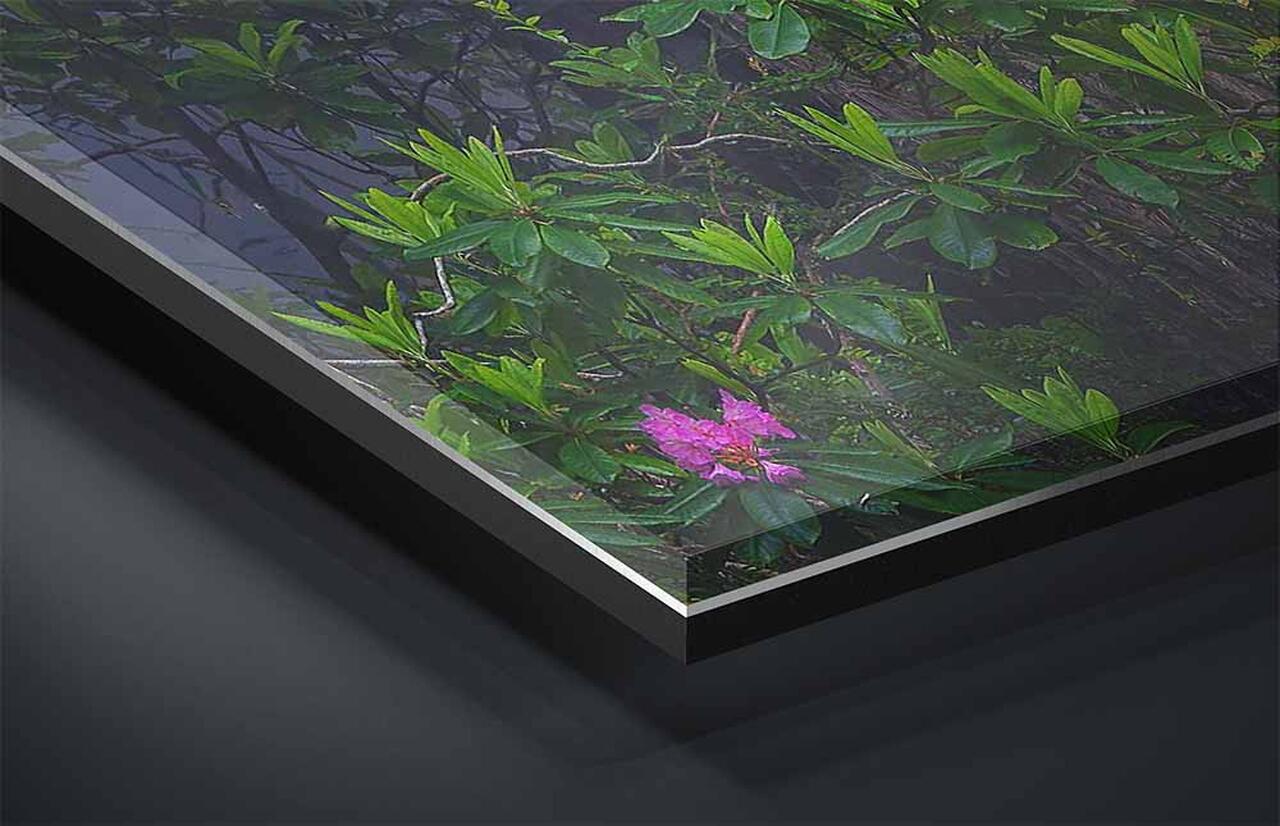
Face-mounted to TruLife acrylic and floated approximately one inch from the wall, with no frame to mediate between the image and the room. UV-resistant, anti-reflective, and scratch-resistant, with a lifetime guarantee against fading.
Signature Edition of 50· ChromaLuxe Metal Print · Gallery Float Mount
Color infused into the aluminum panel itself, floated from the wall on a concealed system. Where acrylic produces luminosity, metal produces clarity. Exceptional fade resistance with no glazing or coating required.
Fine Art Edition of 100· Hahnemühle Baryta Fine Art Paper
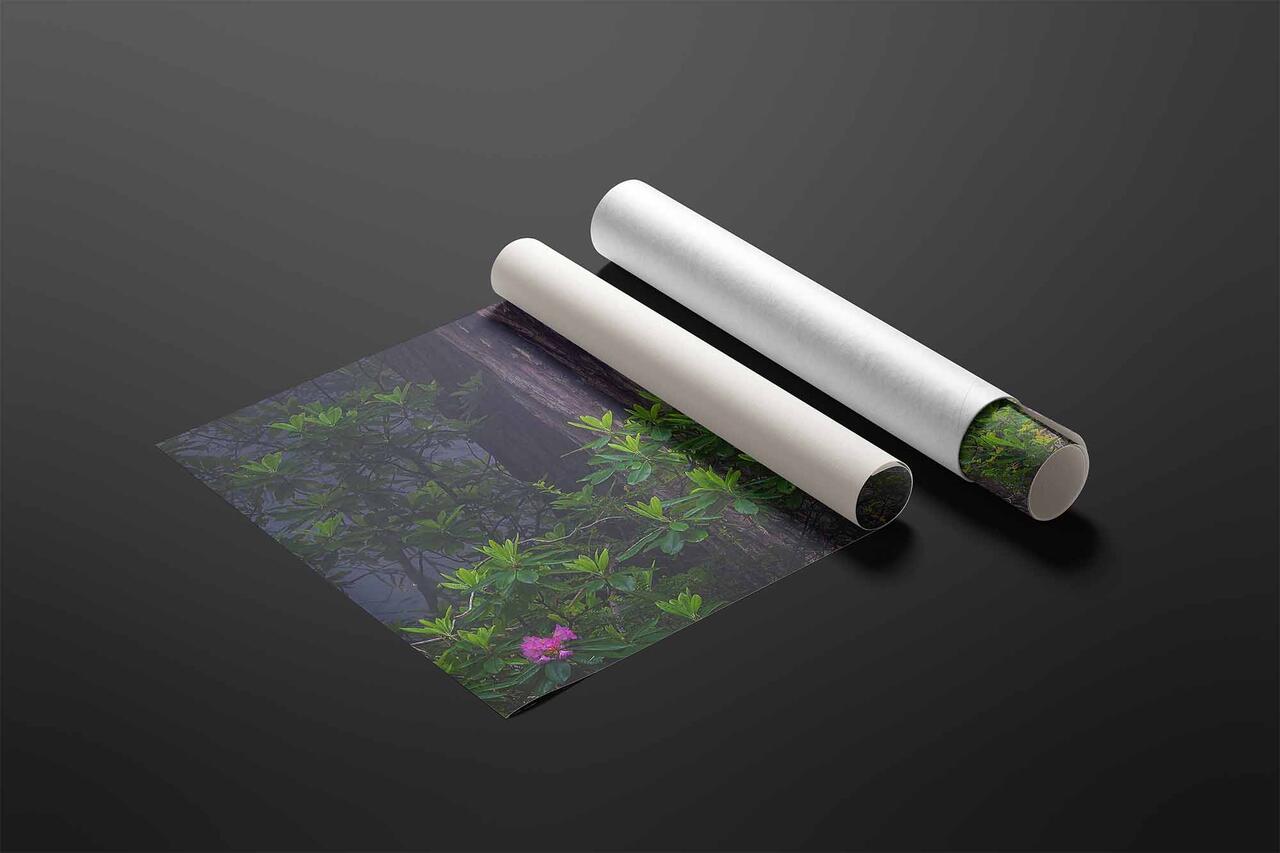
Printed without acrylic, so light meets the paper surface directly. Highlights stay luminous, shadows keep their nuance, and the surface has a tactile quality the other presentations approach differently. The understated choice, and the traditional one.
Complimentary shipping within the continental United States. International collector shipping available upon request.
Still deciding
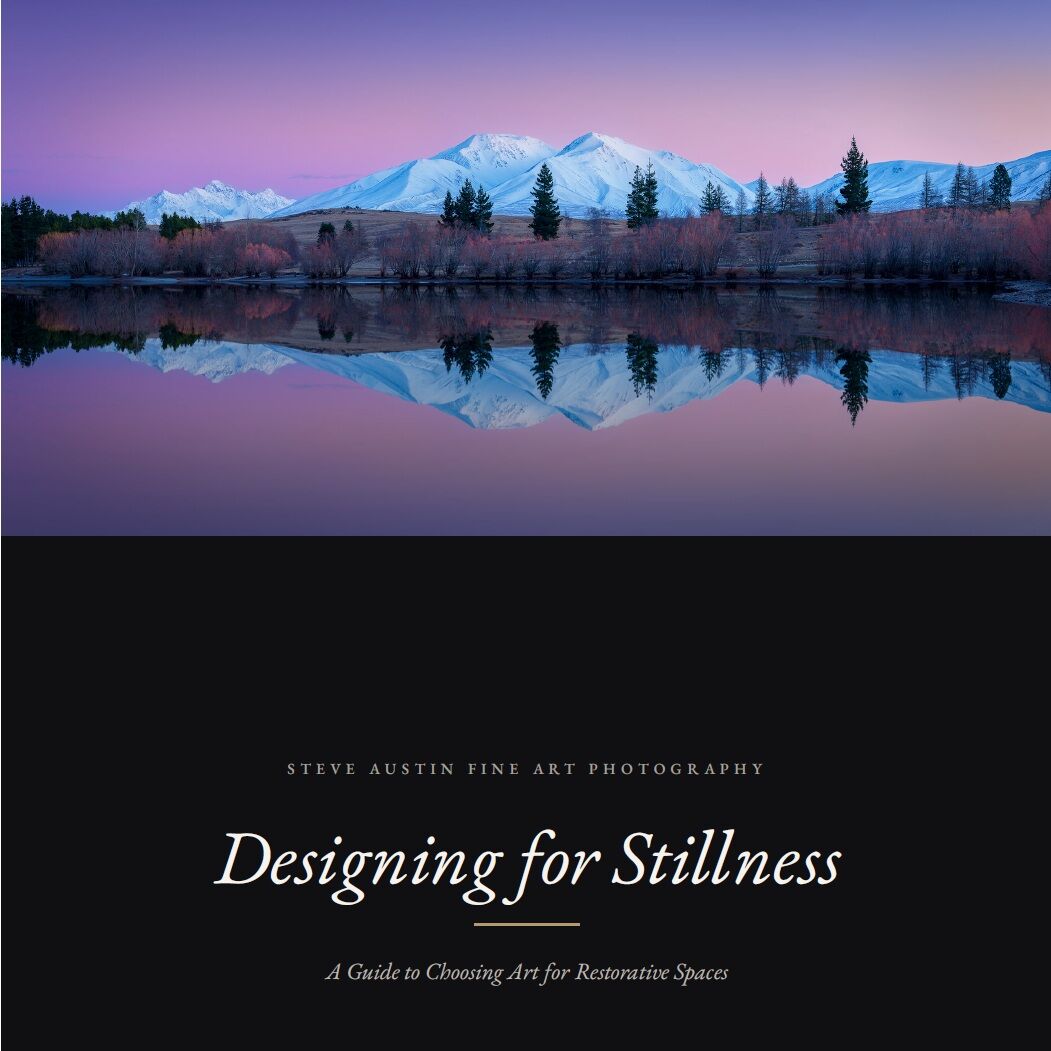
Designing for Stillness
A guide to choosing art for restorative spaces
How to tell whether an image will still hold you in a year, how scale changes what a photograph does in a room, and how to match a piece to the work a room actually performs. It cites the research it draws on, and it is equally clear about where that research stops. About ten minutes to read.