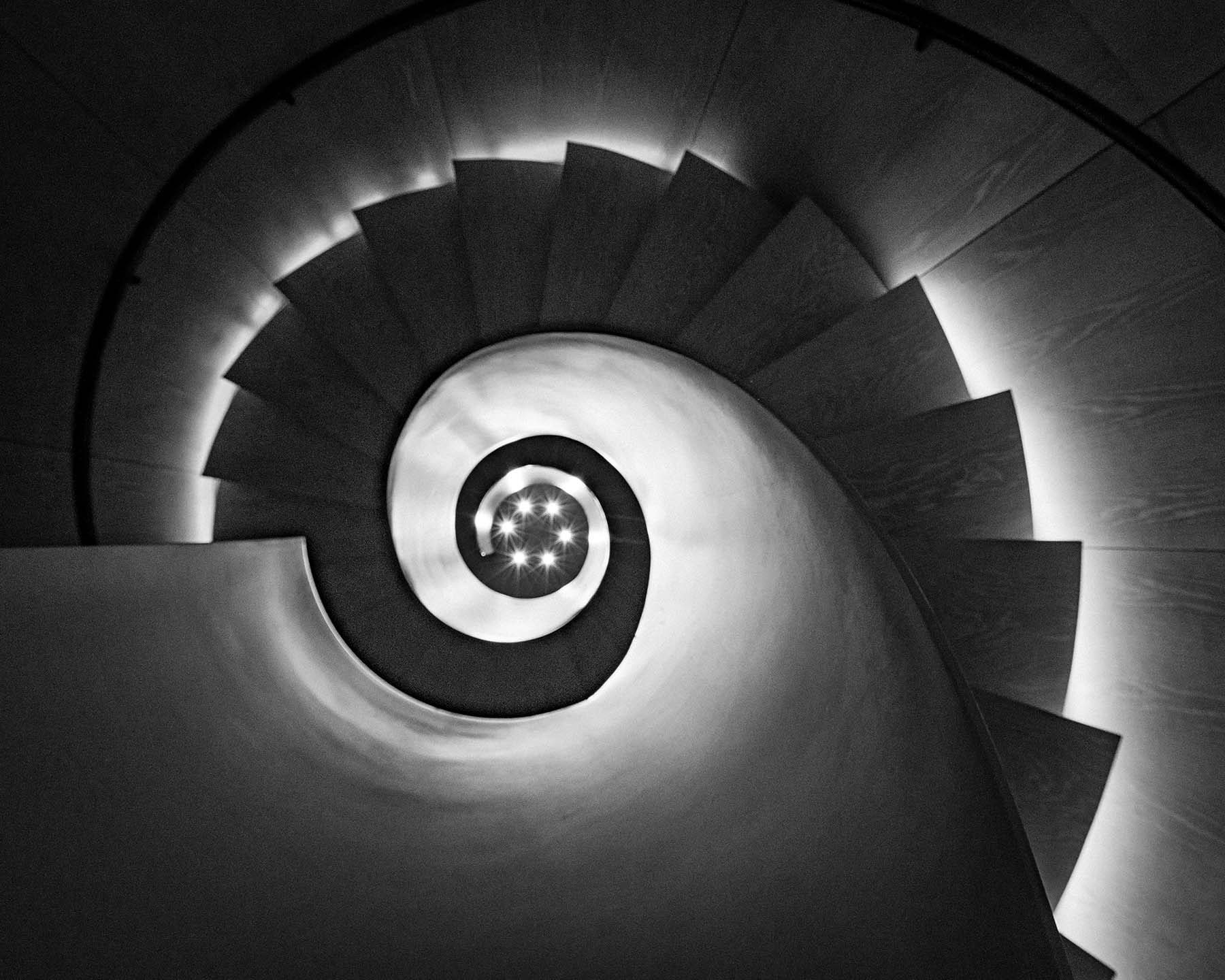
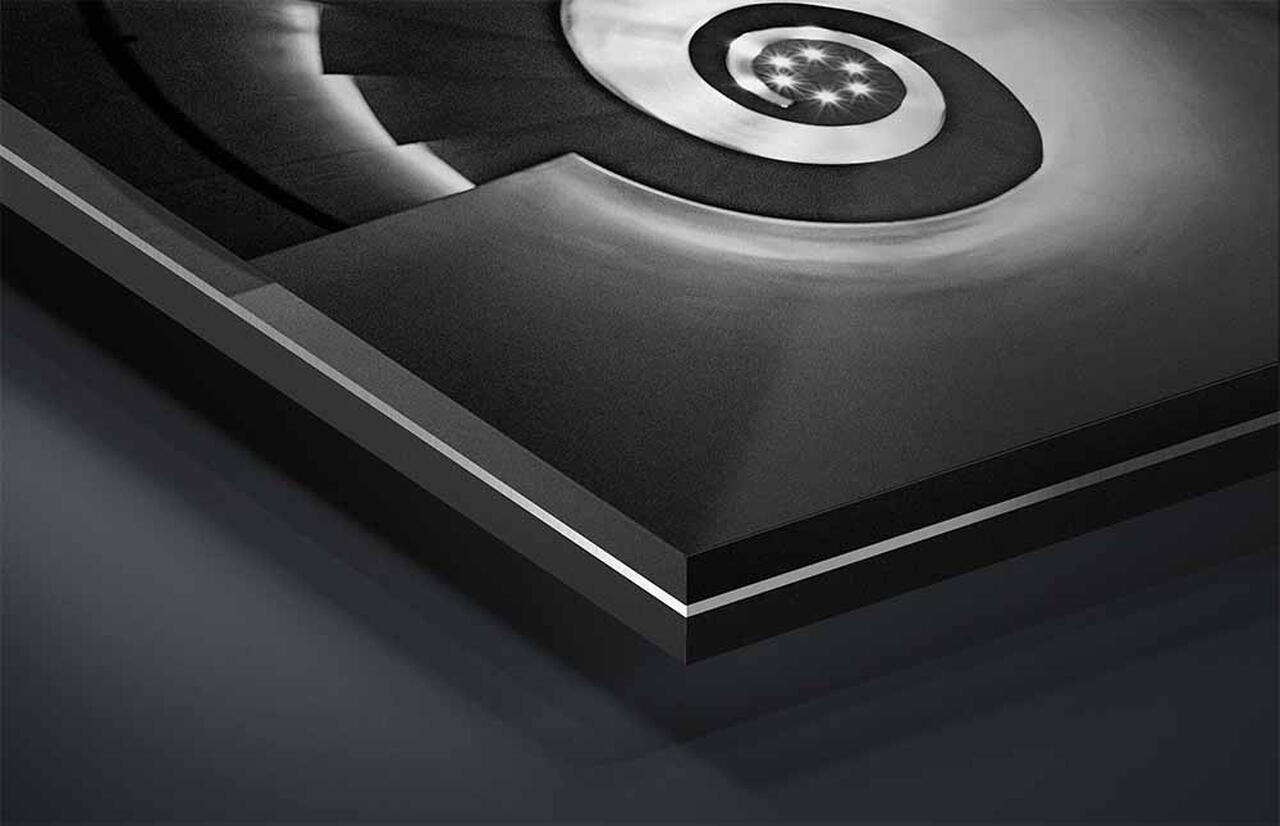
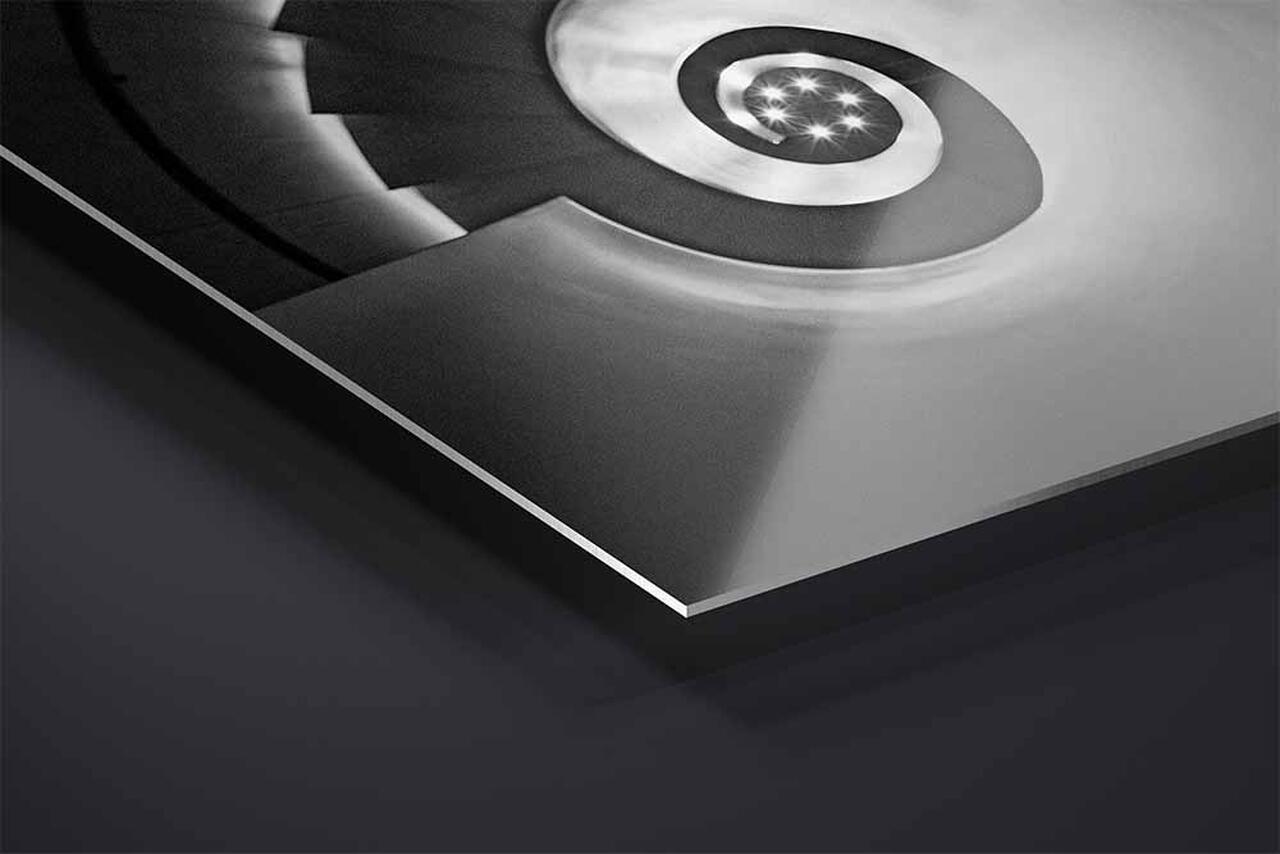
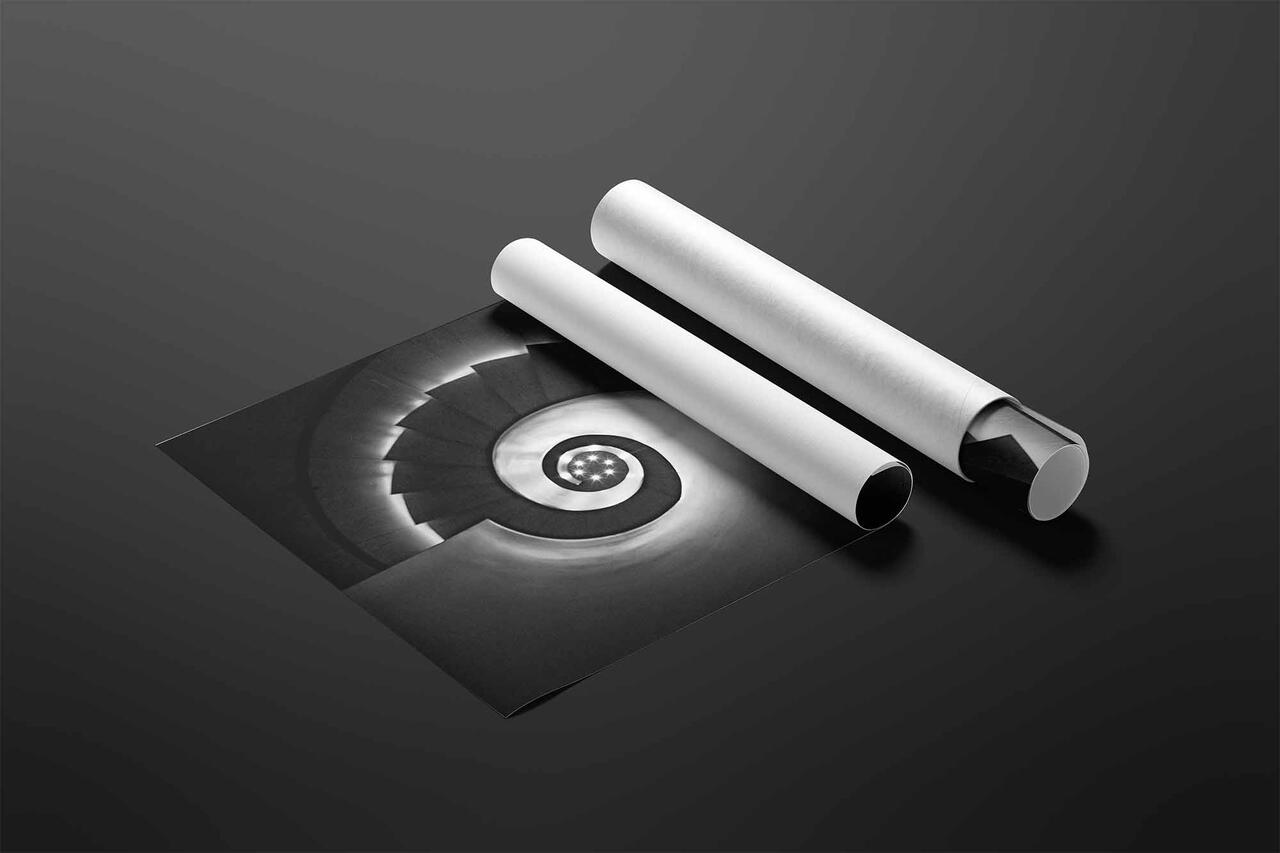
A 5:4 photograph of a helical staircase seen from above in black and white, New York City, United States, available as a limited edition print in four sizes.
Artist's Story
I had heard about this stairwell and went to see it, on a summer evening in New York. It is in a hotel, or something close to one, and I never did establish the name of the building. I stood at the top and leaned out over the rail until the center of the well sat in the middle of the frame.
Photographed that way it looks like a shell. A nautilus, coiling tighter as it goes in.
It is not coiling. A spiral is a flat curve whose radius changes as it turns. A staircase is a helix, which holds a constant radius and travels along an axis while it turns, and every tread on this stair stands exactly as far from the center as every other one. What makes it appear to tighten is distance. Each turn is further from the lens than the turn above it, and things further away are smaller. Point a camera straight down the axis of a helix and it lands on the sensor as a spiral.
So the shell was made by where I was standing. The builder made a cylinder. Step three feet to one side and the whole thing unwinds into a stack of identical circles.
The entire time I was leaning over that rail I could hear people on the stairs and never saw one of them. Descent is a cylinder photographed from the single position that turns it into a shell, with everyone who was using it just out of frame.
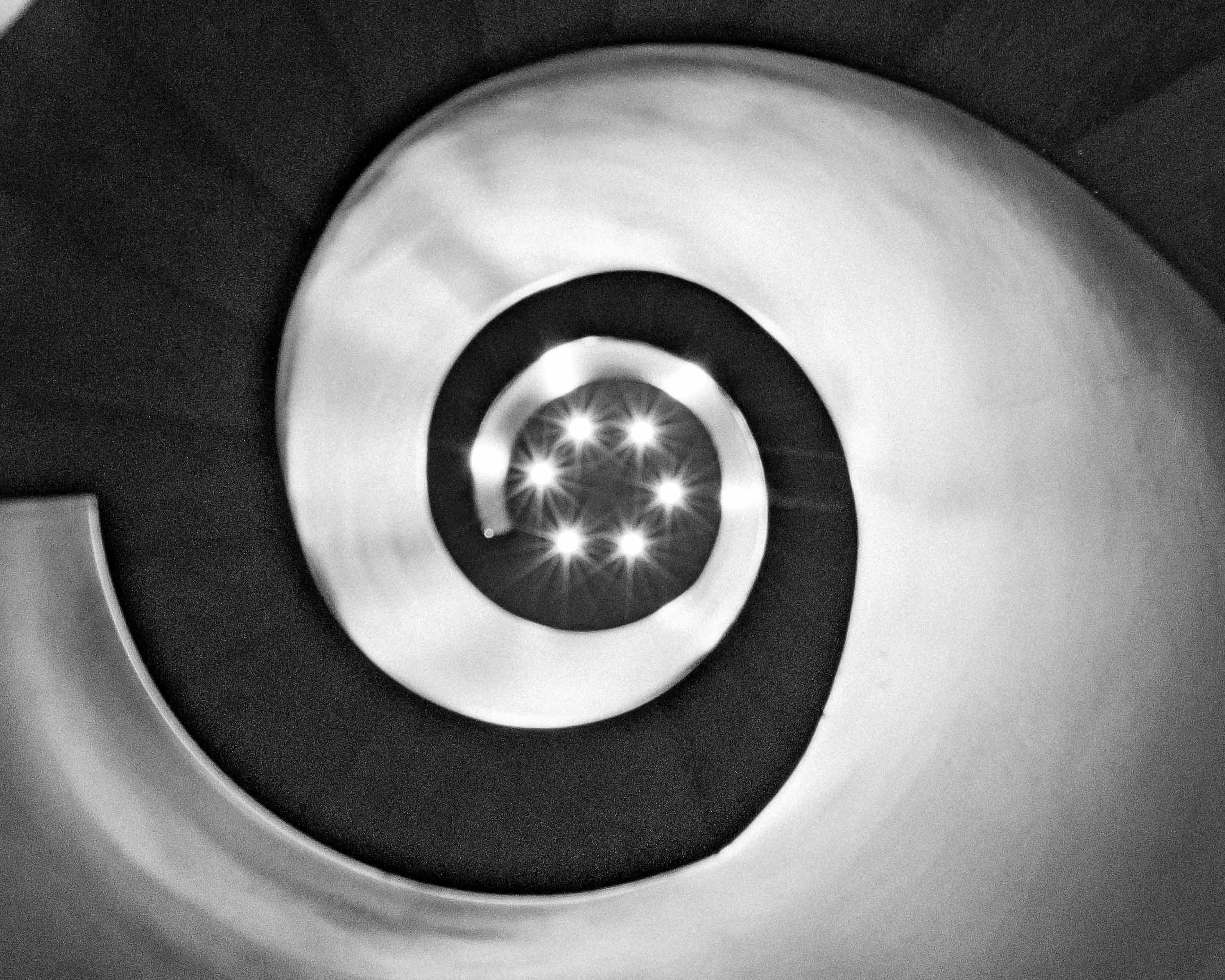
This crop is 38 percent of the frame width, about 19 inches across on the 50 inch print. At the centre the cluster resolves into individual fittings, each throwing its own starburst, and the polished surface beneath them returns a second ring of the same lights inside the first. Around them the tread nosings separate one from the next instead of reading as a single scalloped line, and across the soffit the surface picks up its own texture. Click to view at full size.
About This Photograph
A helical staircase in New York City, photographed from the top of the stairwell looking straight down its axis on a summer evening. Single frame, rendered in black and white. The building is a hotel or a comparable hospitality space and is not identified here.
A stair is built this way because it does more with less floor than any other arrangement. A straight flight needs a run and a landing and a second run. This one pivots every tread around one point, so a full storey of climb occupies little more than the diameter of the well. The cost is paid in the treads: each is wide at the outside and pinched toward the middle, which leaves exactly one radius at which the going is comfortable to walk. Everyone using the stair converges on the same line.
Descent
Steve Austinhttps://www.steveaustinphotography.com/
Every other photograph in this collection is read across or up or down. This one is read inward. The brightness climbs from thirty-two at the perimeter to more than a hundred through the middle of the frame, and the geometry funnels toward a point, so the eye arrives at the center and has nowhere else to go. That is unusual and it has a practical effect: the piece holds a viewer longer per square inch than anything else here, because there is no exit from it. It also means it wants less wall around it than its dimensions suggest. A landscape needs room on either side to finish its own movement. This one finishes in the middle.
It looks symmetrical and it is not. Turn the picture a hundred and eighty degrees and it correlates with itself at only two tenths, which is close to no relationship at all. A rose window or a mandala would score near the top of that scale, because a radial pattern repeats as it turns. A spiral never repeats, which is the whole difference between ornament and motion, and it is why this reads as something happening rather than something arranged. Practically, that means it does not belong in a symmetrical hang. Put it as one of a matched pair, or centered above a console between two lamps, and the arrangement claims a balance the picture itself refuses.
It is also the hardest thing here to print well, because it is made of two kinds of mark at once. The curved soffit under the stair is one long smooth gradient running most of the width of the frame, which is where banding shows if it is going to. The treads are hard geometric edges cutting across that gradient at every angle, which is where aliasing and oversharpening show. Most photographs risk one failure or the other. This one carries both in the same square inch, and the presentation choice matters more here than on anything else in the collection.
Not sure which size the room calls for, or want dimensions not listed here? Sizes beyond 50 × 40 are available on request and ship crated by freight. That conversation is welcome before an order is placed. Start that conversation and I will answer within one business day.
How small is too small for a photograph like this?
At the Intimate size the picture is twenty inches across and sixteen tall, and the shape survives completely. A spiral is a large simple form and reduction does not touch it. What goes is the destination. The cluster of small lights at the center of the well is the thing the whole composition points at, and at this size those lights merge into a single bright smudge, so the eye arrives at a blur instead of at an object. The tread nosings also merge, so the stair stops reading as separate steps. The Collected at thirty by twenty-four separates the lights again. If you are weighing a size against a specific wall, choosing the right print size covers the measurements and the viewing distances in more detail.
What changes at the largest size?
At fifty by forty, working inward from the edges: the topmost turn shows the balustrade edge and the floor beyond it. The handrail becomes a continuous element with its brackets visible where it meets the wall. Across the soffit the surface picks up its own texture, the fine variation in the plaster and the faint marks left in it. Behind the treads the concealed lighting resolves into separate runs, each with its own falloff up the wall above it. The tread nosings separate one from the next instead of reading as a single scalloped line. And at the center the cluster of lights resolves into individual fittings, each with its own starburst, doubled by the polished surface beneath them into a second ring inside the first. Why scale matters covers what happens perceptually when a photograph reaches the size where the eye has to cross it.
What kind of room does this photograph suit?
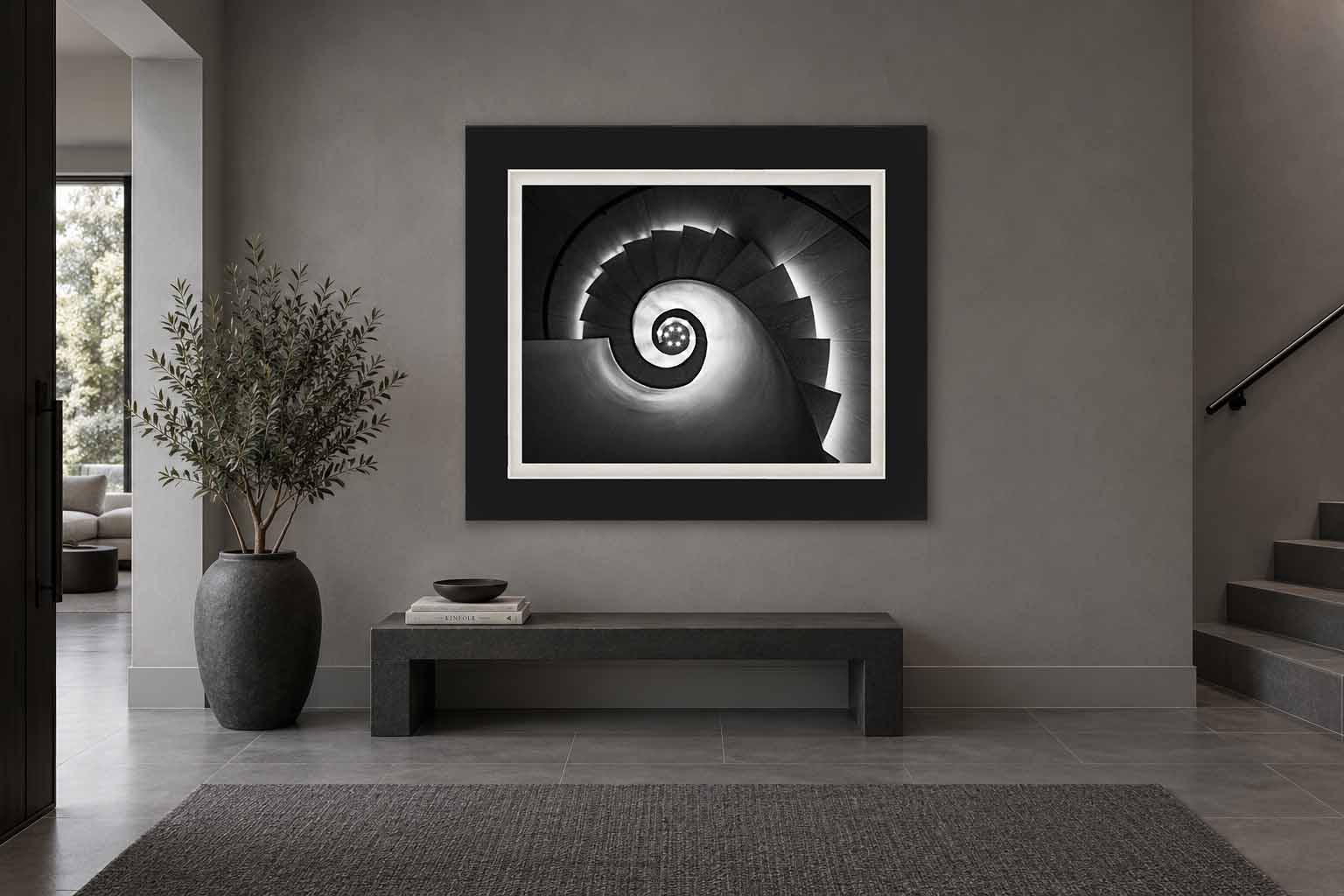
A wall you meet square on. A study, a hall, a dining room, a landing, anywhere a viewer stands in front of it rather than passing at an angle, since the whole picture is built around a single point and looking at it obliquely pulls that point off axis. Hang it at standard height with the center at about fifty-seven inches. On materials it carries no color at all and will live with any palette, though cool neutrals and matte surfaces suit it best. Three things to avoid. Do not hang it in a symmetrical arrangement or as one of a pair, for the reason above. Keep it away from any real curve nearby, an arched opening, a round mirror, a curved stair, since a second spiral in the same view divides the attention this one is designed to gather. And avoid strong directional light on the wall, because the long smooth gradient across the soffit will show any unevenness in it as a band. When your mind needs to rest takes the question further.
Every work ships insured and arrives with a signed certificate of authenticity.
If a piece is damaged in transit, the choice of replacement is always yours, and your edition number stays with you.
Production time runs 2 to 3 weeks for metal, 3 to 4 weeks for acrylic and paper, and 5 to 6 weeks for framed work.
Each print is made to order and takes its place in a numbered edition, so sales are final. Before you choose, I am glad to help: send a photo of your wall and I will show you this work in your room at true scale, at no charge. Start a conversation
Collector's Choice · TruLife ® Acrylic in Italian Frame
Collector Edition of 25· Lumachrome TruLife Acrylic · Handcrafted Italian Frame
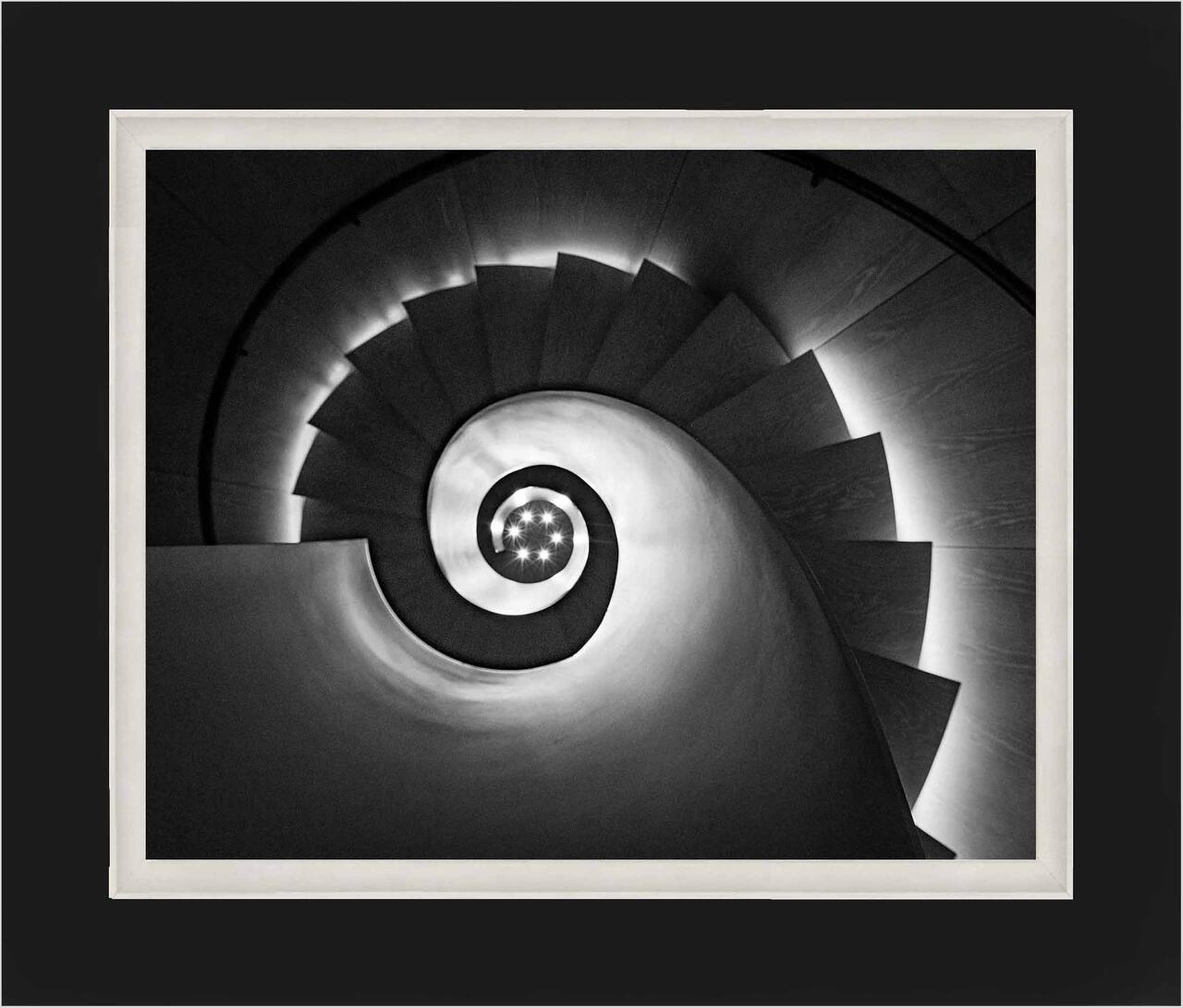
TruLife acrylic in a handcrafted Italian frame with a linen liner chosen for the image. Frame series, finish, and liner are settled with you after the order, and production begins from there. The frame and liner add about fourteen inches to the finished dimensions, worth allowing for when planning placement.
Signature Acrylic Edition of 50· Lumachrome TruLife · Gallery Float Mount
Face-mounted to TruLife acrylic and floated approximately one inch from the wall, with no frame to mediate between the image and the room. UV-resistant, anti-reflective, and scratch-resistant, with a lifetime guarantee against fading.
Signature Metal Edition of 50· ChromaLuxe Print · Gallery Float Mount
Color infused into the aluminum panel itself, floated from the wall on a concealed system. Where acrylic produces luminosity, metal produces clarity. Exceptional fade resistance with no glazing or coating required.
Fine Art Edition of 100· Hahnemühle Baryta Fine Art Paper
Printed without acrylic, so light meets the paper surface directly. Highlights stay luminous, shadows keep their nuance, and the surface has a tactile quality the other presentations approach differently. The understated choice, and the traditional one.
Complimentary shipping within the continental United States. International collector shipping available upon request.
Still deciding
Designing for Stillness
A guide to choosing art for restorative spaces
How to tell whether an image will still hold you in a year, how scale changes what a photograph does in a room, and how to match a piece to the work a room actually performs. It cites the research it draws on, and it is equally clear about where that research stops. About ten minutes to read.