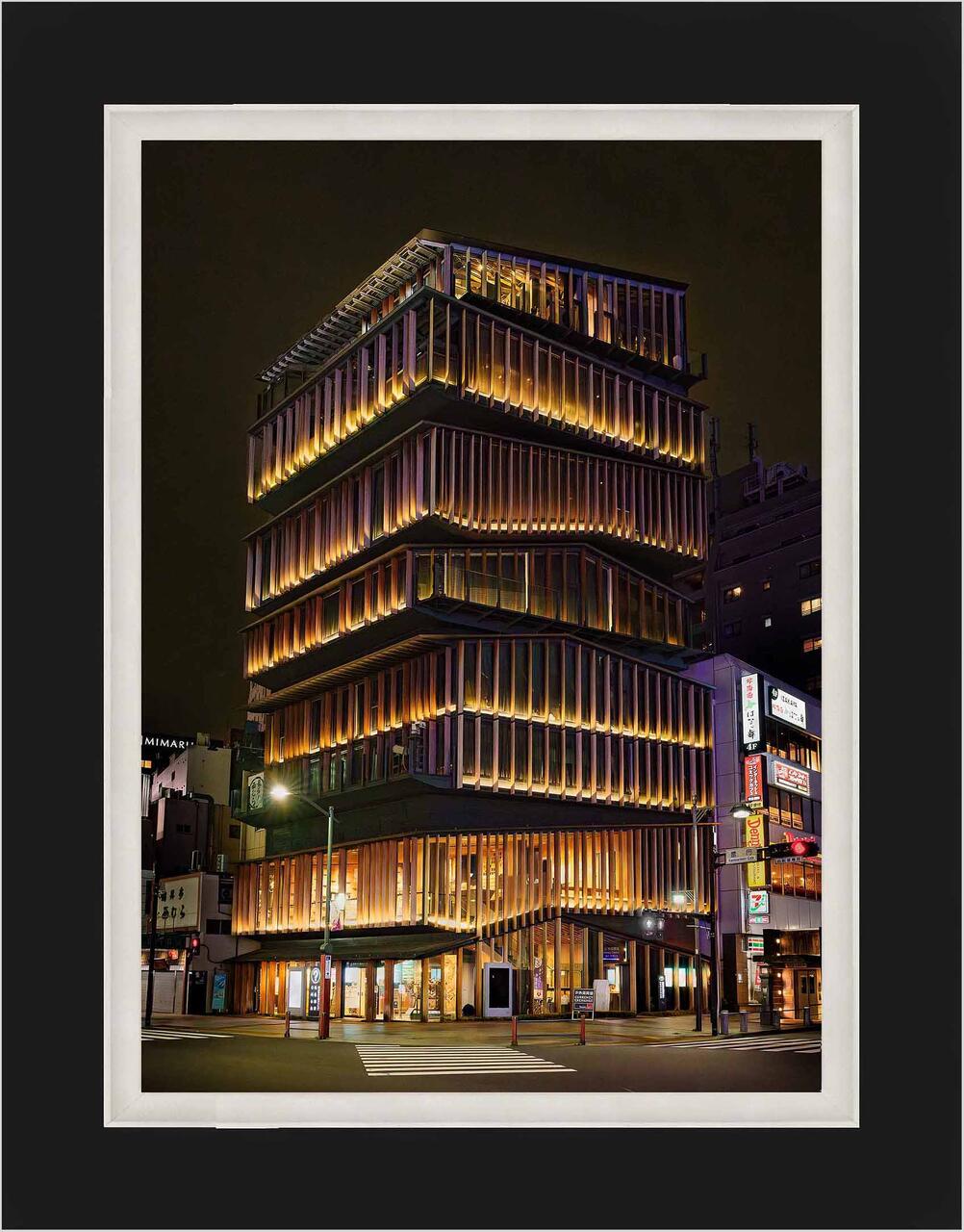
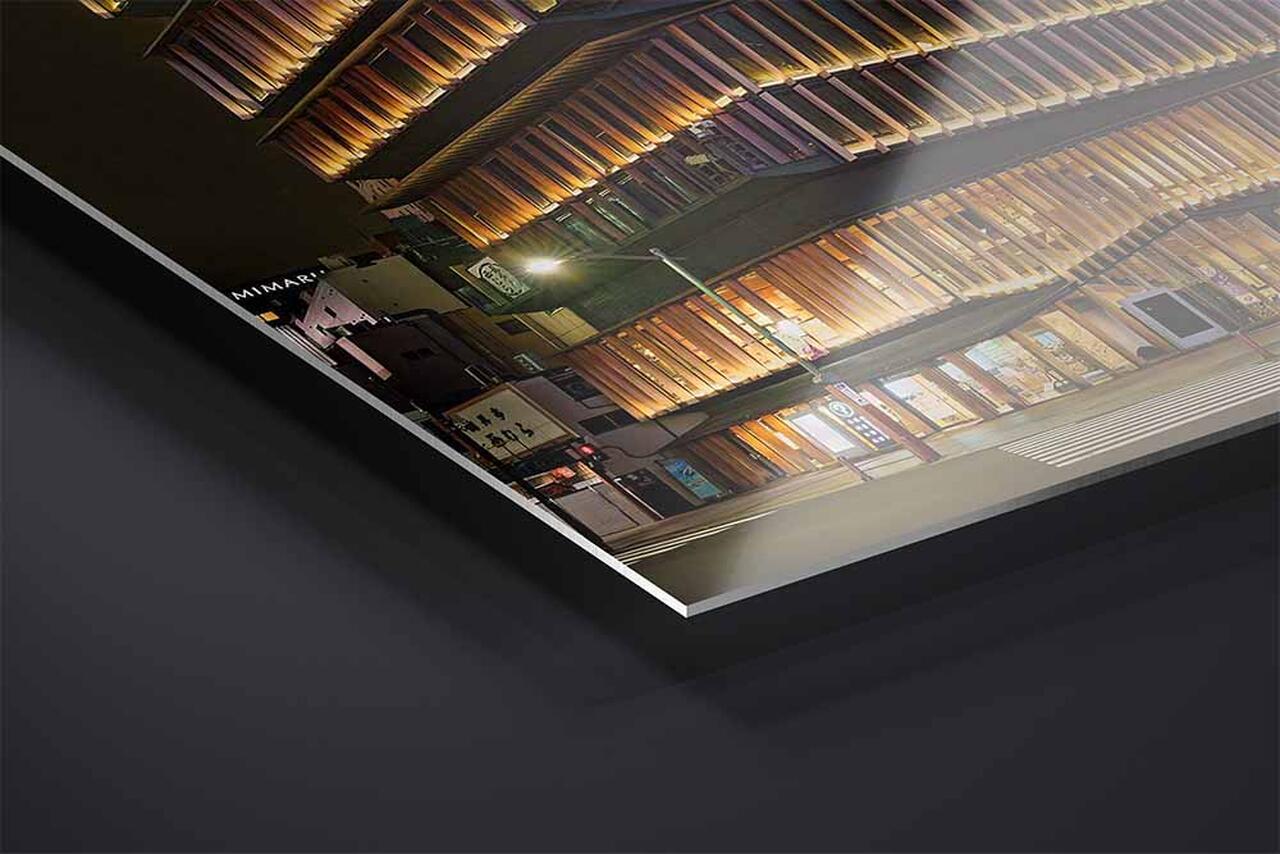
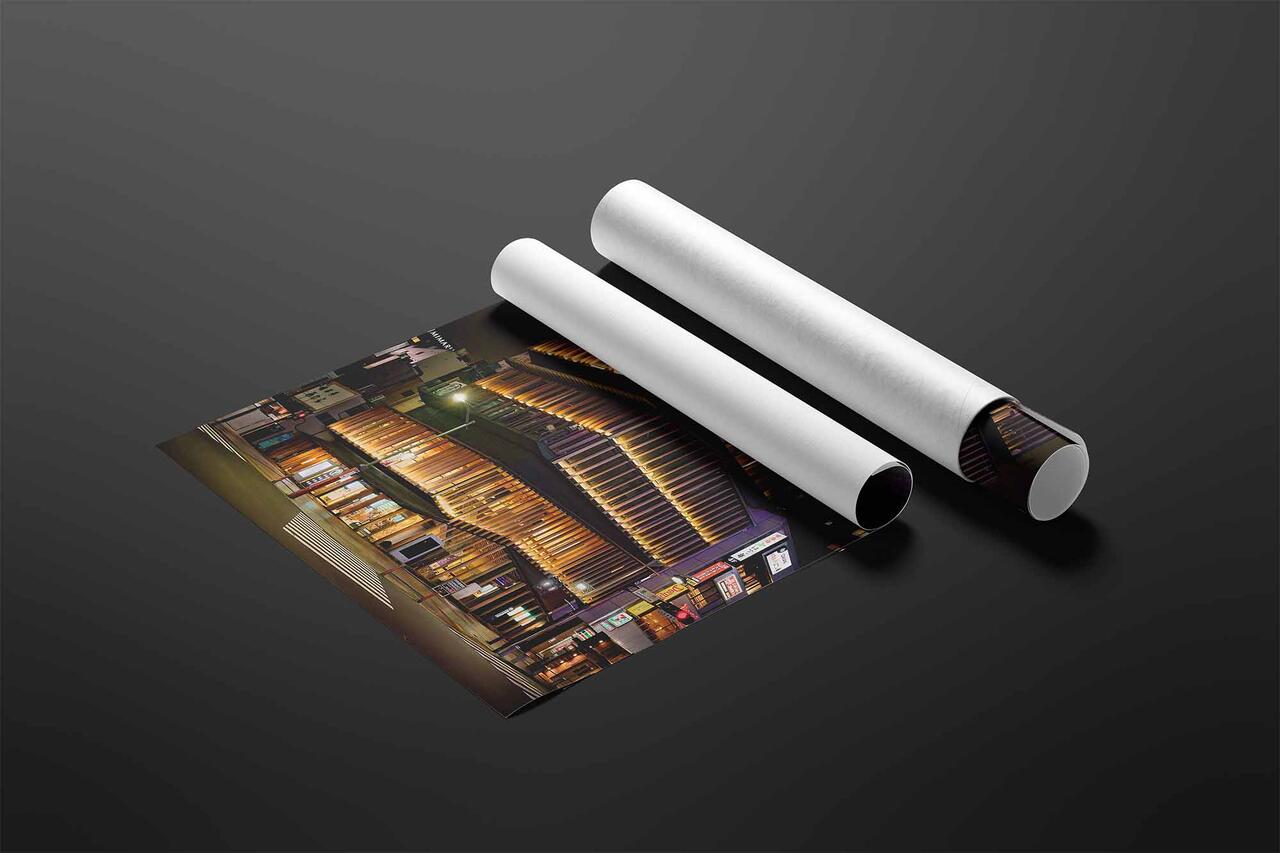
A 2:3 vertical photograph of Kengo Kuma's cedar-clad Culture Tourist Information Center lit at night, Asakusa, Tokyo, Japan, available as a limited edition print in four sizes.
Artist's Story
I photographed this from the street corner opposite, well after dusk, once the whole thing had come alight. An hour or so earlier I had been standing on top of it, making Between Towers and Time from the terrace on its eighth floor.
It is not one building. Kengo Kuma stacked seven volumes on top of one another, each with its own sloping roof, and those roofs divide the interior into eight floors. Every stepped edge in this frame is the eave of a separate house.
The roofs are not stacked square, either. Each one is pitched at its own angle, and they lean toward Kaminarimon, the temple gate directly across the street. The building was also meant to be taller. The design came in at 41.3 meters and the city assembly cut it to 38.9, on the grounds that it would sit badly against everything around it. So it is a tower that was made shorter out of deference to a gate, wearing a stack of pitched roofs that all turn to face it.
The crossing in the foreground is empty, and it was not. That corner is one of the busiest in Tokyo. This photograph is fifteen frames layered together, with only the parts of each frame that happened to be clear of people used to build the final image. Everything in it is real and the emptiness is assembled.
After Dusk is seven houses in a stack, lit from the inside, photographed from the pavement opposite about an hour after I came down off the top of them.
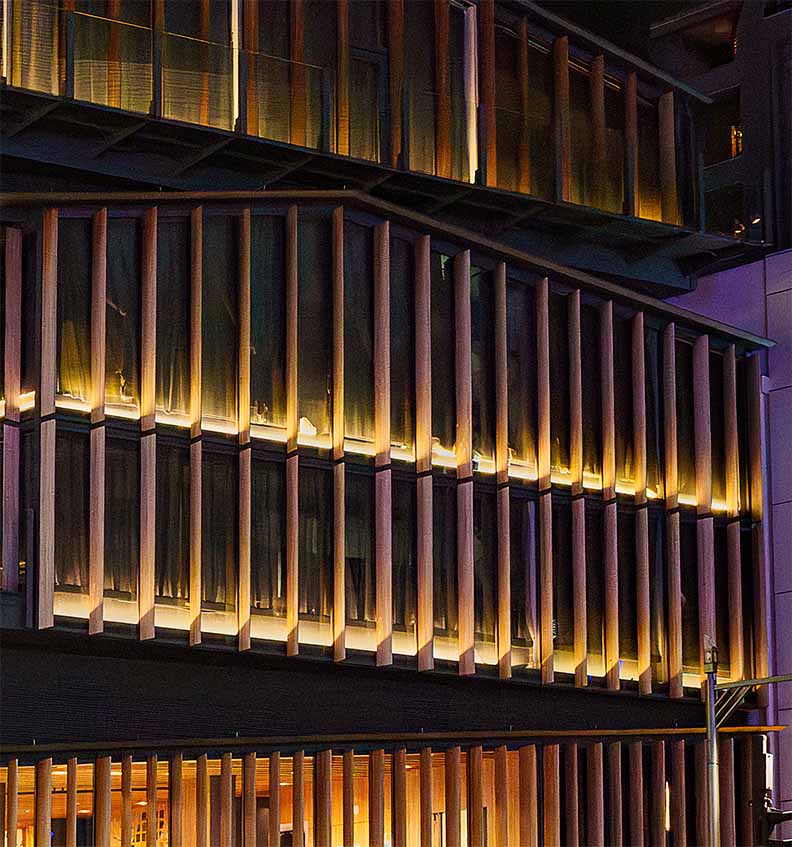
This crop is 58 percent of the frame width, about 23 inches across on the 40 inch print. The cedar louvers separate one from the next with the interior glow standing between them, and they are not parallel: each is set at a slightly different angle, which is why the bands of light widen and narrow across the face. Behind the glass the ceilings and partitions resolve, and beneath the eave above, the steel framing carrying the overhang is visible. Click to view at full size.
About This Photograph
The Asakusa Culture Tourist Information Center, across the street from the Kaminarimon gate in Asakusa, Tokyo. Designed by Kengo Kuma and opened in April 2012 on a corner plot of 326 square meters. Fifteen frames stacked, made after dusk once the interior was fully lit.
The wedge-shaped voids between the stacked volumes are not wasted. Where one house's sloping roof meets the flat floor of the house above it, the gap left over holds the building's mechanical plant, the air handling and services a building this size needs and normally hides in a basement or on a roof. On a plot this small there is room for neither. The stepped profile that gives the building its shape is also where its machinery lives.
After Dusk
Steve Austinhttps://www.steveaustinphotography.com/
Location
Asakusa, Tokyo, Japan
Subject
Kengo Kuma · cedar louvers · Asakusa at night
Capture
Fifteen frames stacked, night
Format
Photograph · vertical, 2:3
Sizes
16 × 24 in · 24 × 36 in · 32 × 48 in · 40 × 60 in
Print Media
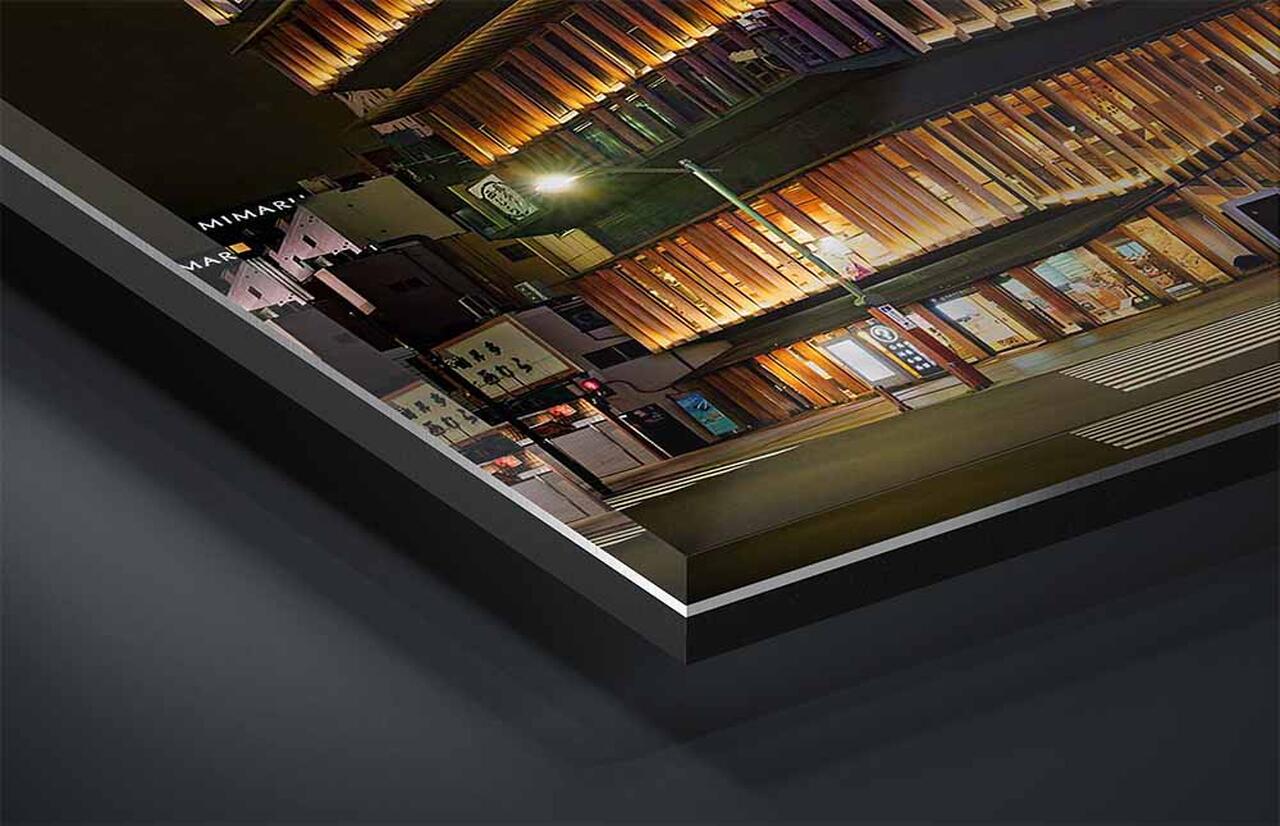
TruLife Acrylic · ChromaLuxe Metal · Baryta paper
Edition
Limited, 25 / 50 / 100 by presentation
What it Does in a Room
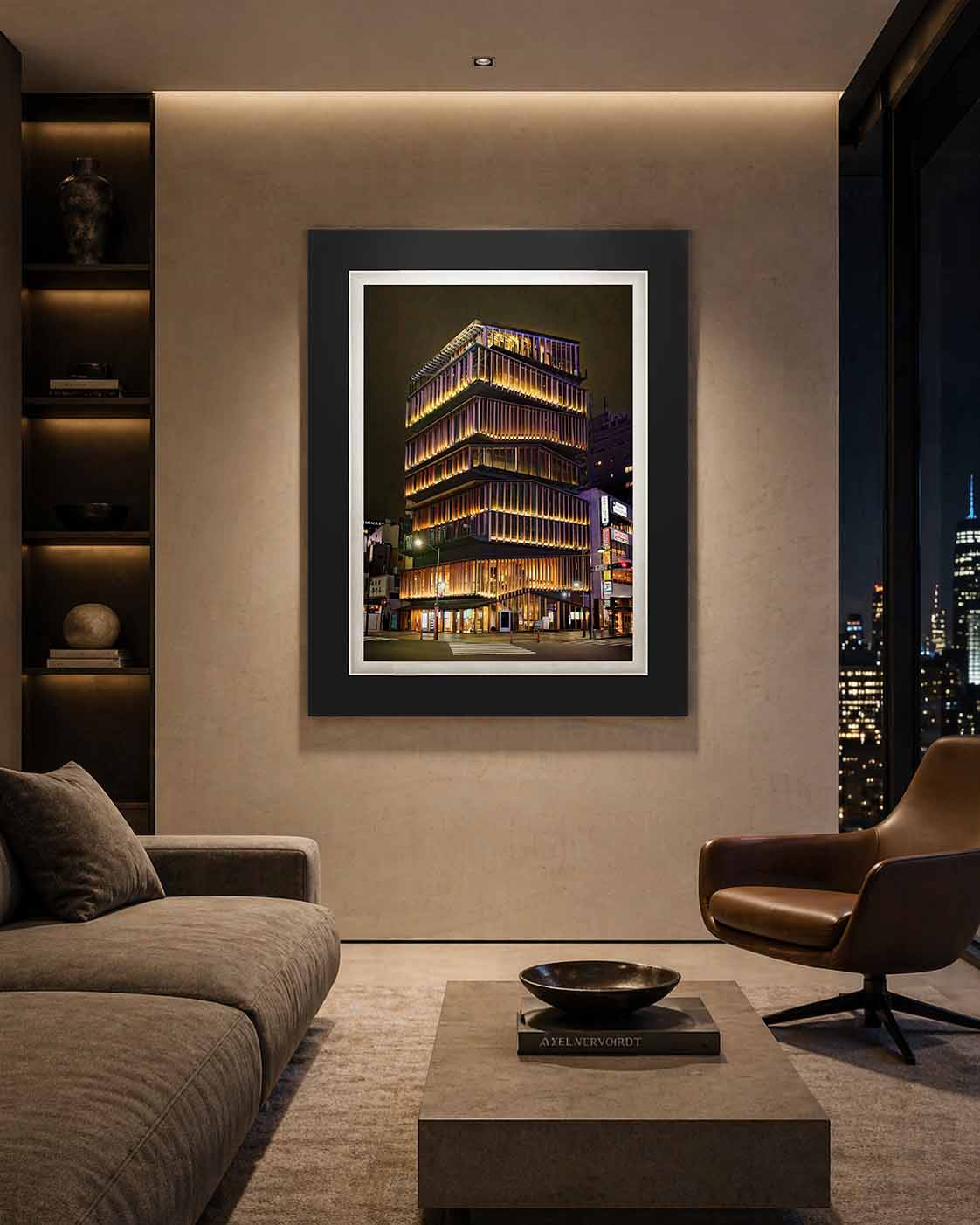
The light in this picture is at the bottom and the dark is at the top, which is the reverse of nearly everything else. Read in horizontal strips from the top down, the brightness runs twenty-five, thirty-nine, forty-four, forty-two, forty-one, forty-one, sixty-seven, seventy-three, eighty-seven, seventy-seven. The sky is the darkest thing in the frame and the street is the brightest. Two consequences follow. The picture's visual weight sits low, so it reads as planted rather than as top-heavy, and it will tolerate a higher hang than a vertical usually does. And the top tenth is doing very little: on a forty by sixty print that is six inches of near-blank at the head of the panel, which means the piece occupies less wall than its dimensions suggest.
Its surface is several hundred vertical lines. The cedar louvers wrap every floor of the building, evenly spaced, running top to bottom, and they are the dominant texture across most of the frame. That establishes a rhythm at a very fine pitch, and anything nearby with vertical repetition joins it: reeded or fluted joinery, a slatted screen, a run of balusters, a bookcase read end-on, even a closely striped textile. Where a landscape has one horizon that a shelf might echo, this has hundreds of lines, and the eye counts a neighbouring set as part of the same system. A plain wall is not a preference here so much as a requirement.
It is also the only photograph in this collection whose subject was drawn by someone. Everything else here is landscape, or a structure that was built for use and then weathered, or a ruin. This is a designed object, recently made, by a named architect, and people look at designed objects differently: they assess them. A viewer in front of a canyon does not decide whether they approve of it. A viewer in front of a building does, almost involuntarily. That makes this a piece that starts conversations rather than ending them, and it belongs in a room where that is welcome: somewhere people sit and talk rather than somewhere they pass through.
Not sure which size the room calls for, or want dimensions not listed here? Sizes beyond 40 × 60 are available on request and ship crated by freight. That conversation is welcome before an order is placed. Start that conversation and I will answer within one business day.
After Dusk, limited edition printSteve Austin65011000USD15https://schema.org/InStock
Questions about this photograph
How small is too small for a photograph like this?
At the Intimate size the picture is sixteen inches across and twenty-four tall, and the stepped shape holds, along with the bands of amber light between the floors. What goes is the cladding. The cedar louvers merge into a continuous warm surface, and once they do the building stops being made of wood and becomes a lit mass. That matters here more than usual, because the louvers are the reason the building looks the way it does. The signage on the neighbouring shops also goes, and with it the evidence that this is a specific street corner. The Collected at twenty-four by thirty-six separates the louvers again. If you are weighing a size against a specific wall, choosing the right print size covers the measurements and the viewing distances in more detail.
What changes at the largest size?
At forty by sixty, working down the frame: on the top floor the individual louvers separate with the glow standing between them, and behind the glass the ceiling structure and the furniture of the terrace lounge become legible. Through the middle floors the interiors resolve, with stairs, partitions and light fittings visible behind the cladding. The steel framing carrying the overhangs shows beneath each stepped eave. At street level the ground floor windows show their display cases and signage, and the currency exchange board becomes readable. On the right the neighbouring shopfronts resolve into individual characters, and the Kaminarimon Gate street sign reads. Across the foreground the crossing stripes and the road markings come up as painted edges. Why scale matters covers what happens perceptually when a photograph reaches the size where the eye has to cross it.
What kind of room does this photograph suit?
A dark room where people sit. A study, a den, a dining room, a library, a lower level. Hang it with the center at about fifty-four inches, lower than standard, so the lit street at the base of the picture sits near eye level. On materials it wants cool and neutral company, charcoal plaster, gray stone, blackened steel, so that the amber inside the building is the only warm thing in view. Three things to avoid. Keep fluted, reeded, slatted and closely striped surfaces out of the same view, for the reason above. Do not use warm bulbs, since a warm lamp spreads the building's own color across the whole print and the glow stops being contained. And do not hang it in a bright room, because a third of the frame is near black and the picture depends on that contrast. When your mind needs to rest takes the question further.
Every work ships insured and arrives with a signed certificate of authenticity.
If a piece is damaged in transit, the choice of replacement is always yours, and your edition number stays with you.
Production time runs 2 to 3 weeks for metal, 3 to 4 weeks for acrylic and paper, and 5 to 6 weeks for framed work.
Each print is made to order and takes its place in a numbered edition, so sales are final. Before you choose, I am glad to help: send a photo of your wall and I will show you this work in your room at true scale, at no charge. Start a conversation
Collector's Choice · TruLife ® Acrylic in Italian Frame
Collector Edition of 25· Lumachrome TruLife Acrylic · Handcrafted Italian Frame
TruLife acrylic in a handcrafted Italian frame with a linen liner chosen for the image. Frame series, finish, and liner are settled with you after the order, and production begins from there. The frame and liner add about fourteen inches to the finished dimensions, worth allowing for when planning placement.
Signature Acrylic Edition of 50· Lumachrome TruLife · Gallery Float Mount
Face-mounted to TruLife acrylic and floated approximately one inch from the wall, with no frame to mediate between the image and the room. UV-resistant, anti-reflective, and scratch-resistant, with a lifetime guarantee against fading.
Signature Metal Edition of 50· ChromaLuxe Print · Gallery Float Mount
Color infused into the aluminum panel itself, floated from the wall on a concealed system. Where acrylic produces luminosity, metal produces clarity. Exceptional fade resistance with no glazing or coating required.
Fine Art Edition of 100· Hahnemühle Baryta Fine Art Paper
Printed without acrylic, so light meets the paper surface directly. Highlights stay luminous, shadows keep their nuance, and the surface has a tactile quality the other presentations approach differently. The understated choice, and the traditional one.
Complimentary shipping within the continental United States. International collector shipping available upon request.
Still deciding
Designing for Stillness
A guide to choosing art for restorative spaces
How to tell whether an image will still hold you in a year, how scale changes what a photograph does in a room, and how to match a piece to the work a room actually performs. It cites the research it draws on, and it is equally clear about where that research stops. About ten minutes to read.