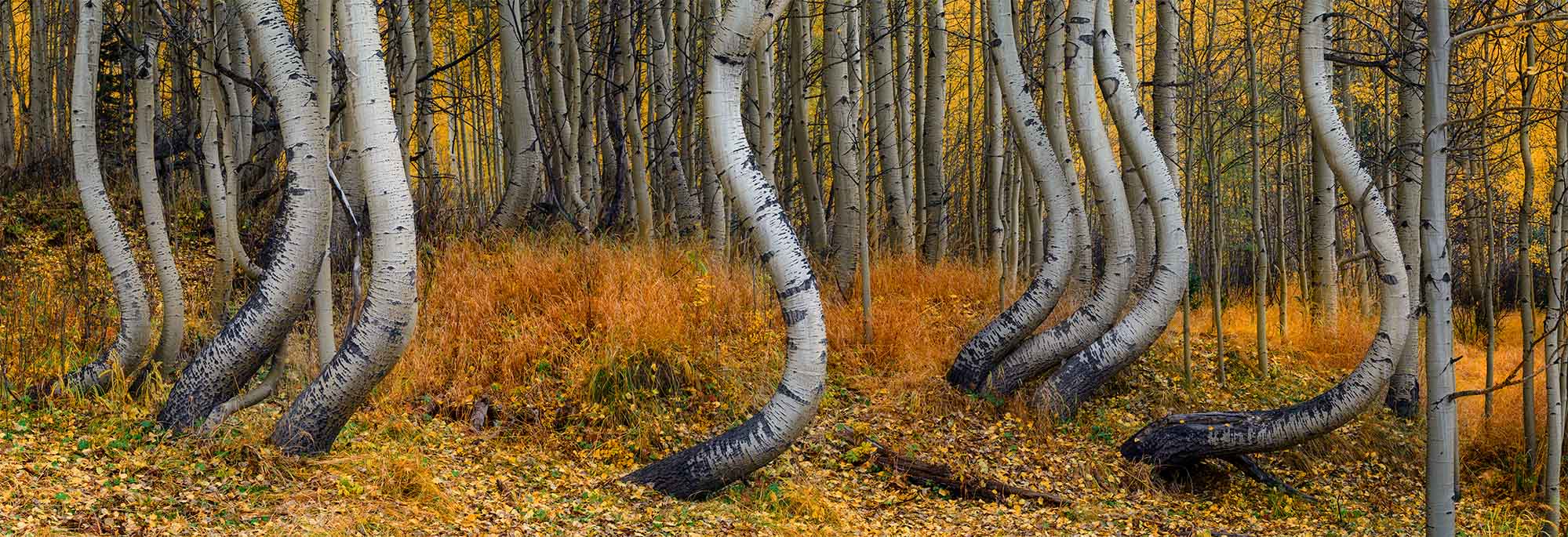
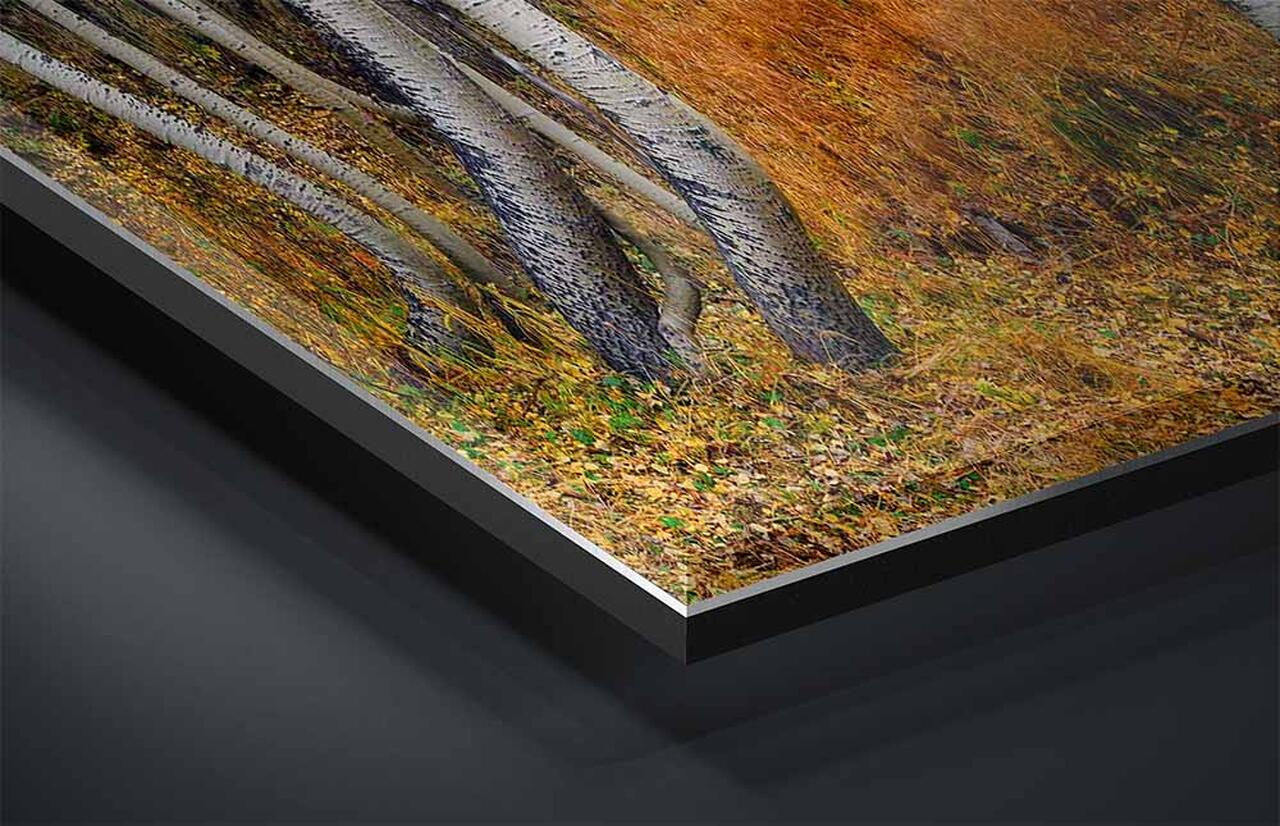
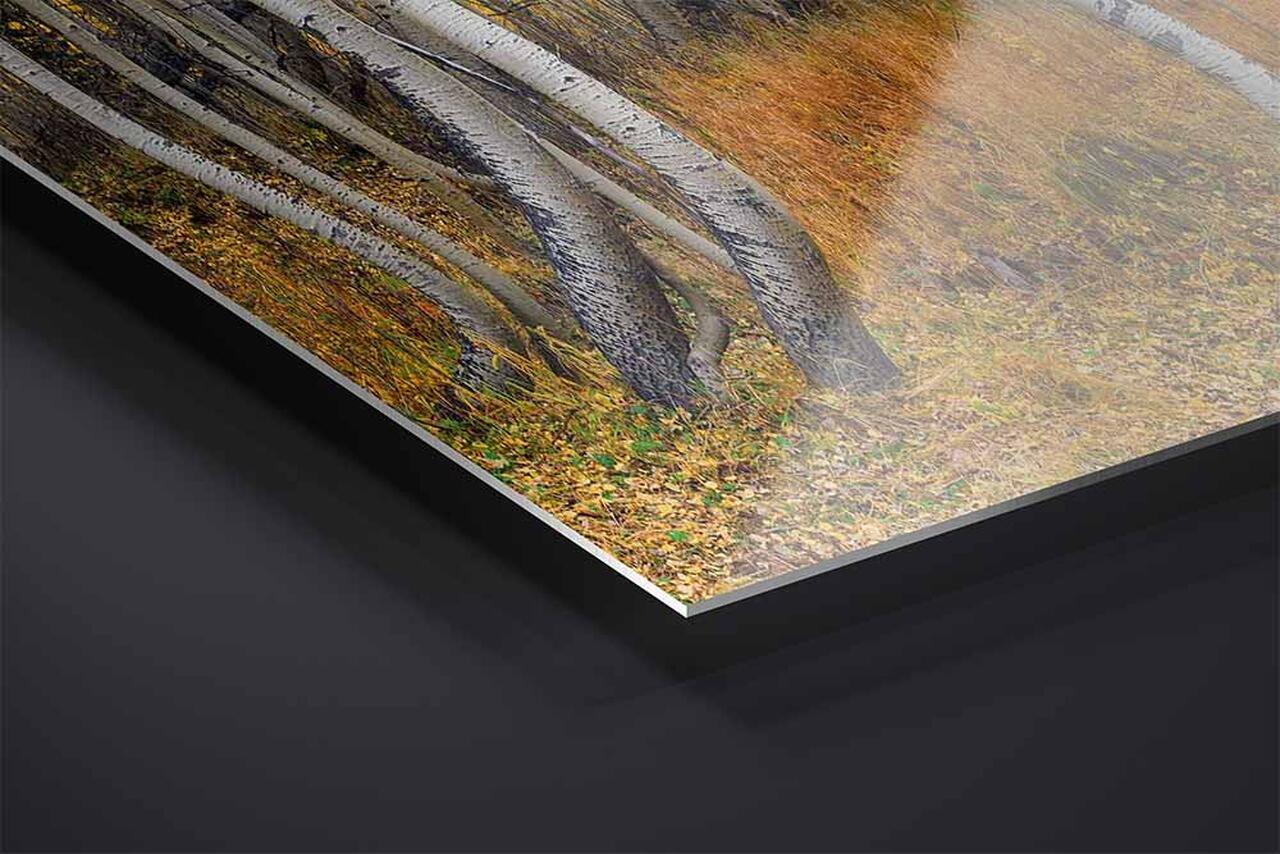
A 3:1 panoramic photograph of curved aspen trunks in an autumn grove near Telluride, Colorado, available as a limited edition print in three sizes.
Artist's Story
Near Telluride, in the western San Juan Mountains of southwestern Colorado, a stand of aspens comes out of the ground all bending the same way, each trunk sweeping low before turning back toward vertical.
The shape has a name, pistol butt, and a cause. As saplings these stems were pushed downhill, season after season, by creeping soil and by the weight of a snowpack settling and moving on a slope. Anything under about eight feet gets buried and bent. What the tree does in response is not to straighten but to grow crooked in a corrective direction: it lays down thicker rings on the downhill side, year on year, which slowly rotates the trunk back toward upright. Once the roots are deep enough that the ground can no longer push it, the growth evens out and the trunk goes straight from there.
So the curve records a period, not an injury. It marks the years between when the pushing started and when the tree got strong enough to stop being moved, held in the wood for the rest of its life.
Look along the line of them and you can see one or two that overshot. There is a faint S in a few of these trunks, which is what it looks like when the correction ran a little past vertical before settling.
I stopped here in the middle of the morning, with the sun full on the canopy and the leaves lit through, and built the frame from a series of overlapping exposures so the whole stand would hold together at size.
The thing I keep coming back to is that these are almost certainly not separate trees. Aspens spread by root, and a grove like this is usually one organism sending up stems, all of them genetically the same. Which means the ground pushed on one plant a hundred times over, in a hundred different places, and it worked out the same answer at every one of them.
In Rhythm is that shared curve, standing in a row.
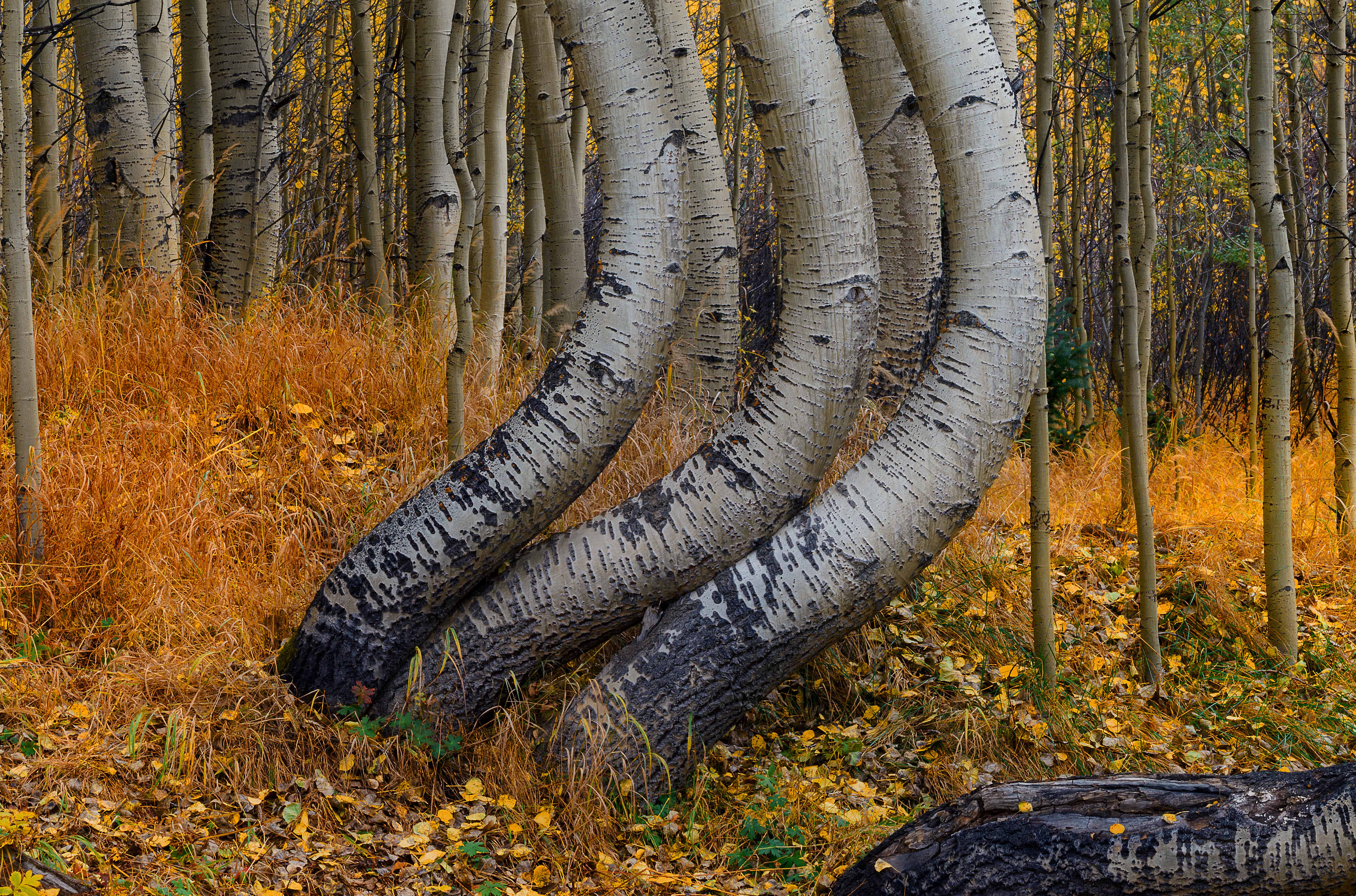
Three curved trunks at about a third of the frame width. The horizontal lenticel scoring appears across every trunk and the dark scars resolve as healed wounds with raised edges and their own texture. On the outside of each bend the bark is stretched and creased, and at the base it thickens into a dark corky rind. Behind them the stand opens into distinct ranks of trunks at different distances, and on the ground the fallen leaves separate into individual leaves with their own edges and stems. Click to view at full size.
About This Photograph
An aspen grove near Telluride, in San Miguel County on the western flank of the San Juan Mountains, southwestern Colorado, photographed in autumn in midmorning sun. This is a stitched panorama built from several overlapping frames to produce a high-resolution file. Aspen color in this part of the San Juans typically peaks from mid-September into early October.
The species is quaking aspen, Populus tremuloides. The basal curve in these trunks is known as pistol butting, and two causes are documented for it. The Forest Service attributes the form in western aspen specifically to snowpack creeping downhill across stems too short to resist it; geologists more often attribute pistol butting in general to soil creep, the slow downslope movement of the ground itself. On a snowy mountain slope both are acting.
Measured across the frame, this is among the warmest photographs in the collection, with red running fifty-six points ahead of blue. The bottom edge is warmer still, averaging a hundred and one, which is the warmest single edge measured in any piece here.
In Rhythm
Steve Austinhttps://www.steveaustinphotography.com/
Location
Telluride, Colorado
Subject
Aspen grove · curved trunks · autumn color
Capture
Stitched panorama in morning sun
Format
Photograph · horizontal panorama, 3:1
Sizes
36 × 12 in · 60 × 20 in · 90 × 30 in
Print Media
TruLife Acrylic · ChromaLuxe Metal · Baryta paper
Edition
Limited, 25 / 50 / 100 by presentation
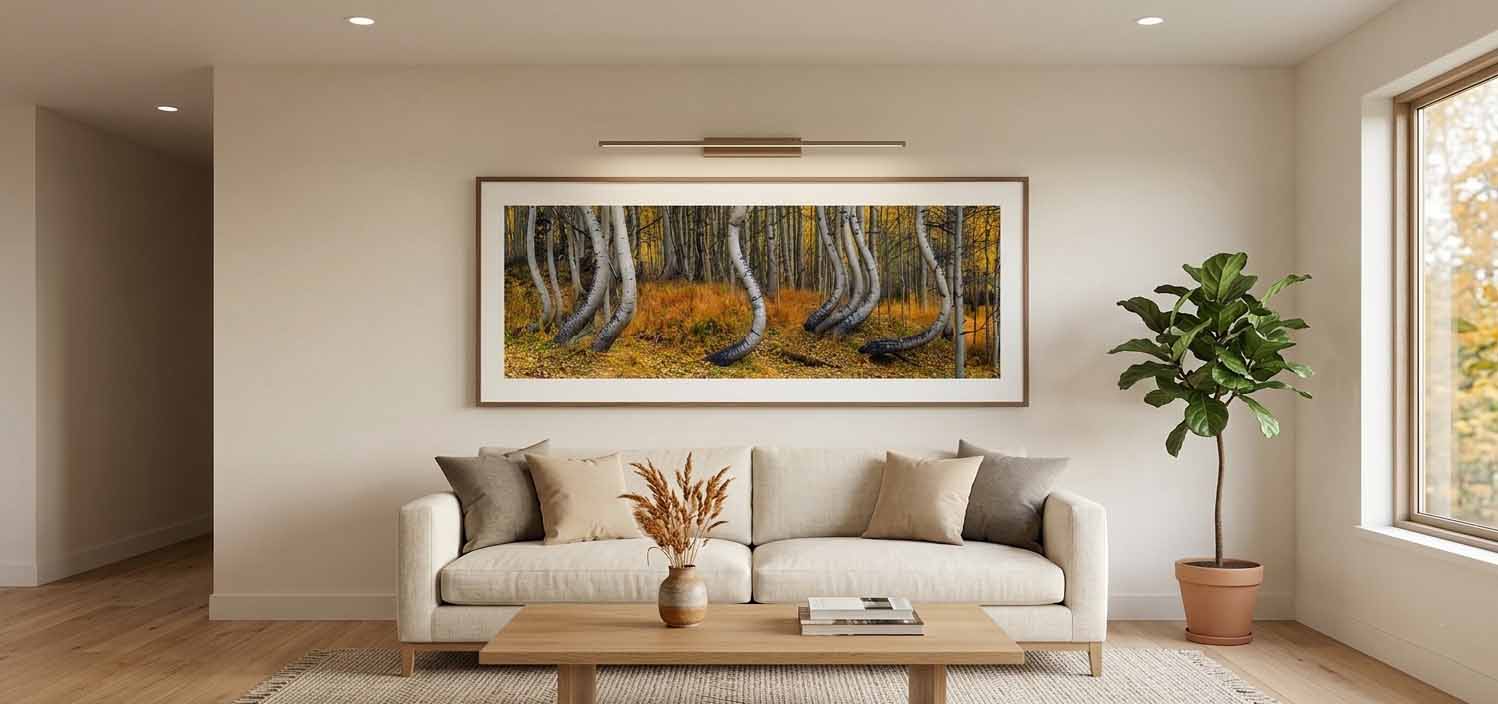
What it Does in a Room
This photograph is made of vertical marks, and it will find every vertical in a room and either agree with it or fight it. Eight or nine pale trunks stand across the frame at roughly regular intervals, and behind them a hundred more do the same thing at a smaller scale. Hung near a run of vertical joints, a fluted panel, a bank of narrow doors, or a column, the rhythm in the picture and the rhythm in the wall will read as one system and the picture stops being a picture. Hung on a plain wall it does the opposite: it supplies the only vertical measure in the room, and a broad flat surface with nothing on it is exactly what it needs.
It is also warm from edge to edge, and warmest along the bottom. Red runs fifty-six points ahead of blue across the whole frame, and along the lower edge it runs a hundred and one, which is the warmest single measurement in the collection. What that means practically is that the piece throws its warmth downward. Hung above a console, a bench, or a bed, it will make the surface beneath it read warmer than it does elsewhere in the room, and a cool gray stone or a blue-toned textile directly below it will look cooler than intended. Warm materials underneath, or none at all.
The third thing is that it is not restful in the way the rest of this collection is, and that is a feature rather than a defect. There is no open water, no sky, no distance, and nowhere for the eye to go except across the trunks and into the stand behind them. It is a photograph of being inside something rather than looking at it. That suits a room where someone is doing something, a study, a workroom, a kitchen, better than a room where someone is trying to stop.
Not sure which size the room calls for, or want dimensions not listed here? Sizes beyond 90 × 30 are available on request and ship crated by freight. That conversation is welcome before an order is placed. Start that conversation and I will answer within one business day.
In Rhythm, limited edition printSteve Austin70012900USD11https://schema.org/InStock
Questions about this photograph
How small is too small for a photograph this wide?
At the Intimate size the picture is thirty-six inches across and twelve inches tall, and the near trunks survive it easily because they are large pale shapes against a dark ground. The curve holds, which matters, since the curve is what this page is about. What goes is the stand behind them. Those hundreds of smaller trunks receding into the grove are what give the picture its depth, and at twelve inches tall they compress into a vertical grain rather than staying as separate trees, which flattens the whole space to two planes. The bark markings go at the same point, and with them the sense that these are individual stems with individual histories. The Collected at sixty by twenty is where the back of the stand opens up again. If you are weighing a size against a specific wall, choosing the right print size covers the measurements and the viewing distances in more detail.
What changes at the largest size?
The bark becomes a record. At ninety by thirty the horizontal lenticel scoring appears across every near trunk, and the dark scars resolve as healed wounds with raised edges and their own texture rather than as black marks. On the curved sections you can see the bark stretched and creased on the outside of the bend. The stand behind opens into distinct ranks of trunks at different distances, with the aspen twenty and forty and eighty feet back all separately visible. On the ground the fallen leaves separate into individual leaves with their own edges and stems, and the dry grasses become individual blades. At this size a viewer stands roughly where the camera stood, which is inside the grove rather than in front of it. Why scale matters covers what happens perceptually when a landscape reaches the size where the eye has to cross it.
What kind of room does this photograph suit?
Rooms with a long plain wall and warm materials. A study, a hallway, a kitchen, a room behind a desk or a workbench. It hangs at ordinary height and wants clear wall at both ends rather than a place in an arrangement. On surfaces, give it warm plaster, limewash, unfinished stone, or off-white, and keep cool grays and blue-toned finishes off the wall directly beneath it. Three things to avoid. Do not hang it near a run of narrow verticals, whether that is fluting, slats, doors, or spindles. Do not put it beside real birch or aspen furniture or a wood floor with strong pale grain, because a photograph of trunks above a surface made from them reads as a sample. And keep it away from a second aspen image, since two of them in a room read as a set. When your mind needs to rest takes the question further.
Every work ships insured and arrives with a signed certificate of authenticity.
If a piece is damaged in transit, the choice of replacement is always yours, and your edition number stays with you.
Production time runs 2 to 3 weeks for metal, 3 to 4 weeks for acrylic and paper, and 5 to 6 weeks for framed work.
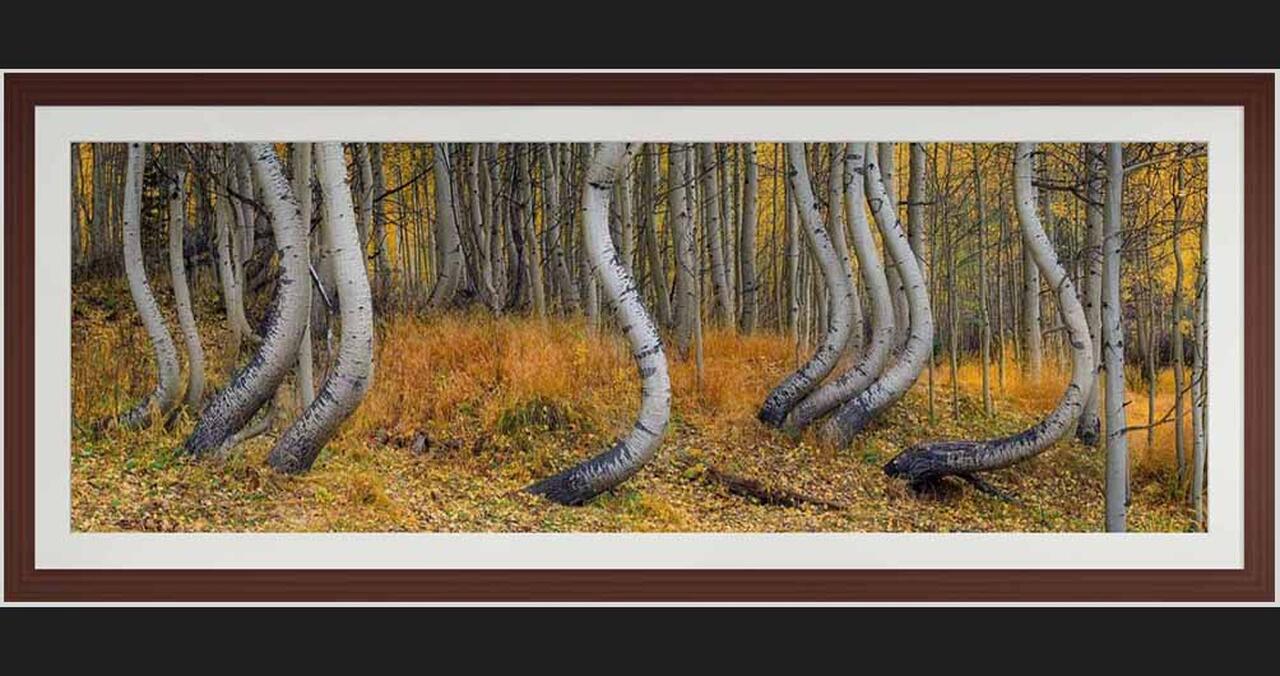
Collector's Choice · TruLife ® Acrylic in Italian Frame
Collector Edition of 25· Lumachrome TruLife Acrylic · Handcrafted Italian Frame
TruLife acrylic in a handcrafted Italian frame with a linen liner chosen for the image. Frame series, finish, and liner are settled with you after the order, and production begins from there. The frame and liner add about fourteen inches to the finished dimensions, worth allowing for when planning placement.
Signature Edition · TruLife ® Acrylic, Float Mount
Signature Edition of 50· Lumachrome TruLife Acrylic · Gallery Float Mount
Face-mounted to TruLife acrylic and floated approximately one inch from the wall, with no frame to mediate between the image and the room. UV-resistant, anti-reflective, and scratch-resistant, with a lifetime guarantee against fading.
Signature Edition of 50· ChromaLuxe Metal Print · Gallery Float Mount
Color infused into the aluminum panel itself, floated from the wall on a concealed system. Where acrylic produces luminosity, metal produces clarity. Exceptional fade resistance with no glazing or coating required.
Fine Art Edition of 100· Hahnemühle Baryta Fine Art Paper
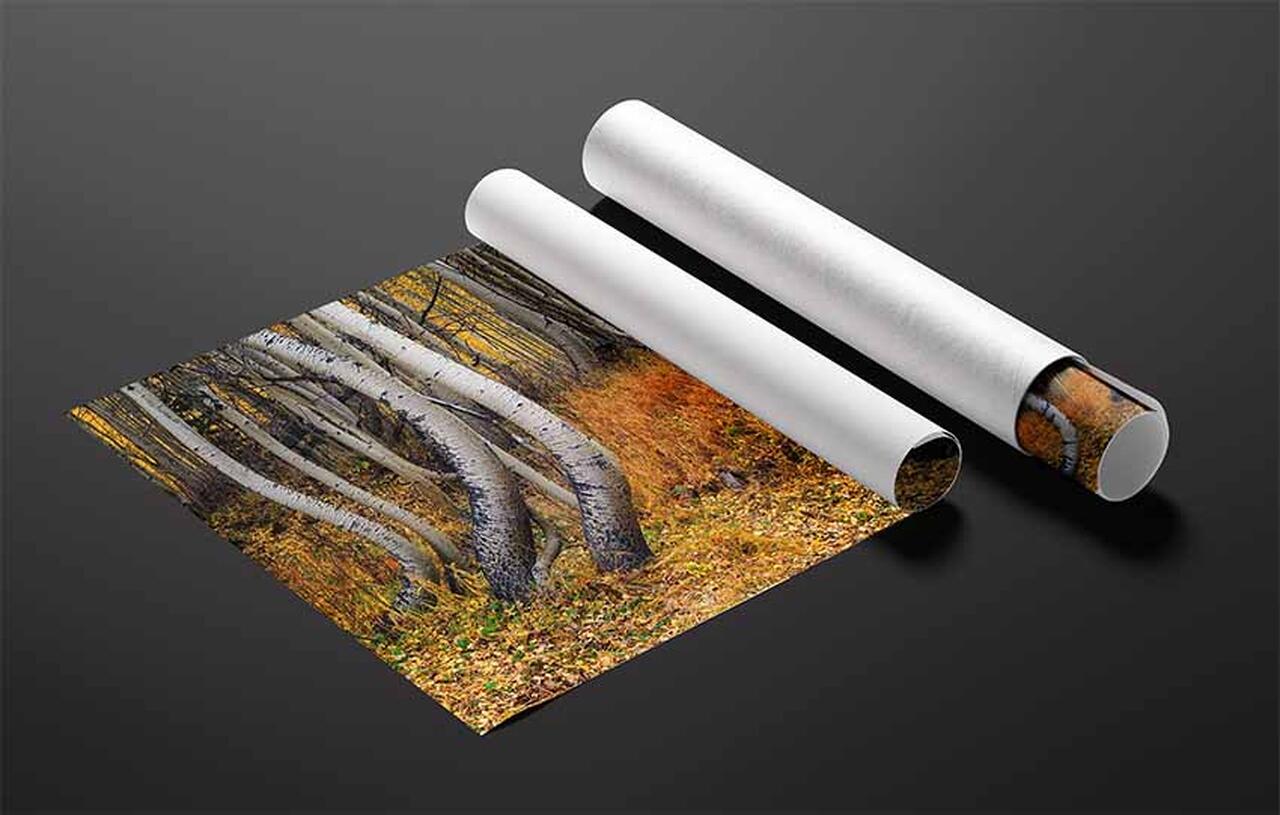
Printed without acrylic, so light meets the paper surface directly. Highlights stay luminous, shadows keep their nuance, and the surface has a tactile quality the other presentations approach differently. The understated choice, and the traditional one.
Complimentary shipping within the continental United States. International collector shipping available upon request.
Still deciding
Designing for Stillness
A guide to choosing art for restorative spaces
How to tell whether an image will still hold you in a year, how scale changes what a photograph does in a room, and how to match a piece to the work a room actually performs. It cites the research it draws on, and it is equally clear about where that research stops. About ten minutes to read.