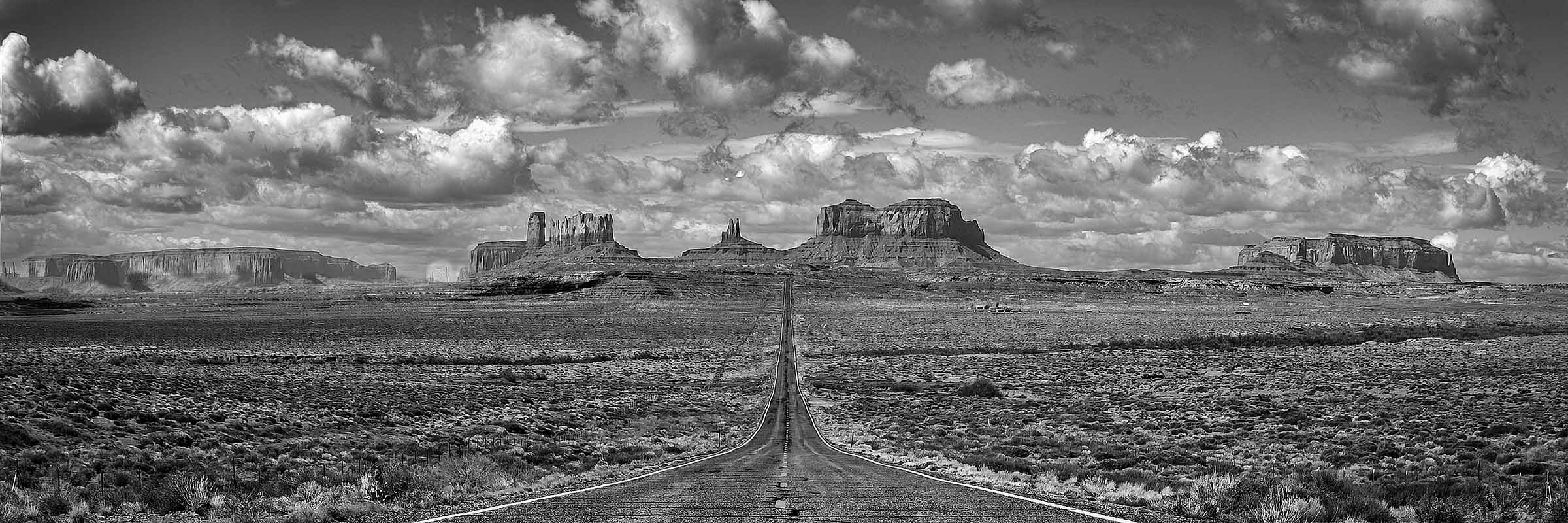
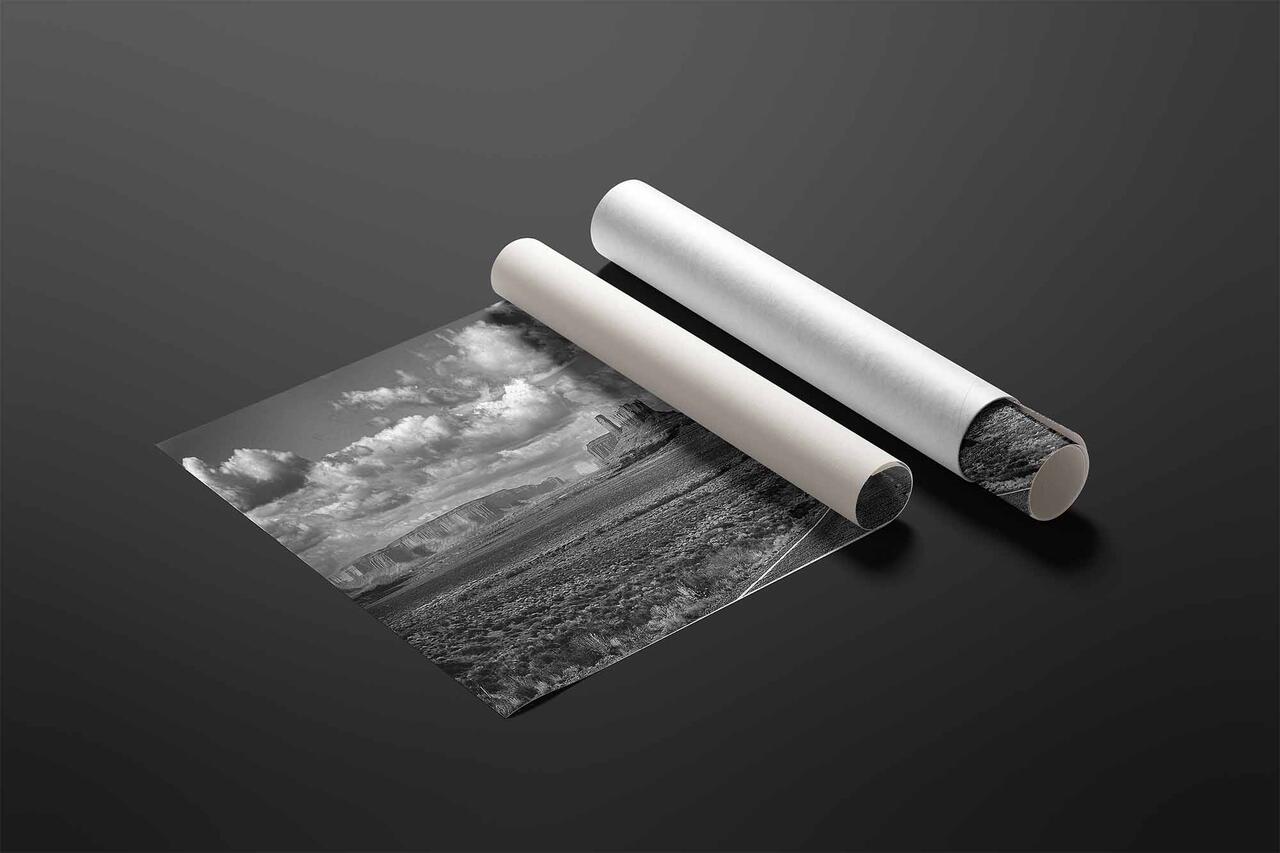
A 3:1 panoramic photograph of a desert highway running toward the buttes of Monument Valley from US 163 in Utah, available as a limited edition print in three sizes.
Artist's Story
US 163 runs at Monument Valley in a straight line for miles. This is from mile marker 13, on the Utah side, north of the valley, where the road drops and then lifts and the whole thing is in front of you at once.
I felt small standing there, which is what everyone says about this place, and I want to say what the smallness actually is.
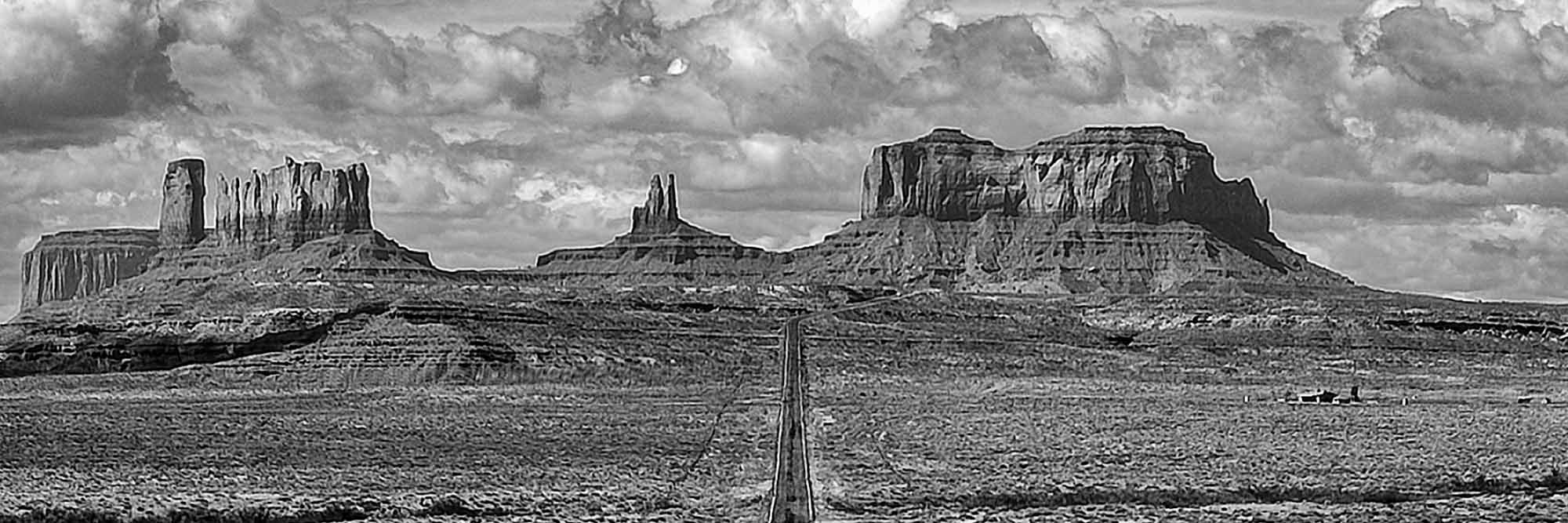
These are not mountains. Nothing was pushed up here. The rock is layered, and the layers are not equally tough. Under most of these formations sits Organ Rock Shale, which is soft, and above it sits De Chelly Sandstone, which is hard, and on the biggest ones a cap of Shinarump Conglomerate sits above that. Water and wind take the soft rock out from under the hard rock. The hard rock holds until it is undercut past the point where it can hold, and then it comes down, and what is left stands there while the process starts again on its edges.
So these are not things that rose. They are what has not gone yet.
Look along the flat tops in this frame, left to right, and they sit at close to a common level. That level is where the ground used to be. All of it, continuous, from the mesa on the left to the mesa on the right, and everything in between at that height. The tallest of these stand about a thousand feet over the valley floor, so the ground under my tripod was roughly a thousand feet below the old surface of the country.
Mile marker 13 is thirteen miles from somewhere. That is the measurement a road can give you. The other measurement here is vertical, and it is the distance between the ground and those flat tops, which is how much country used to be overhead.
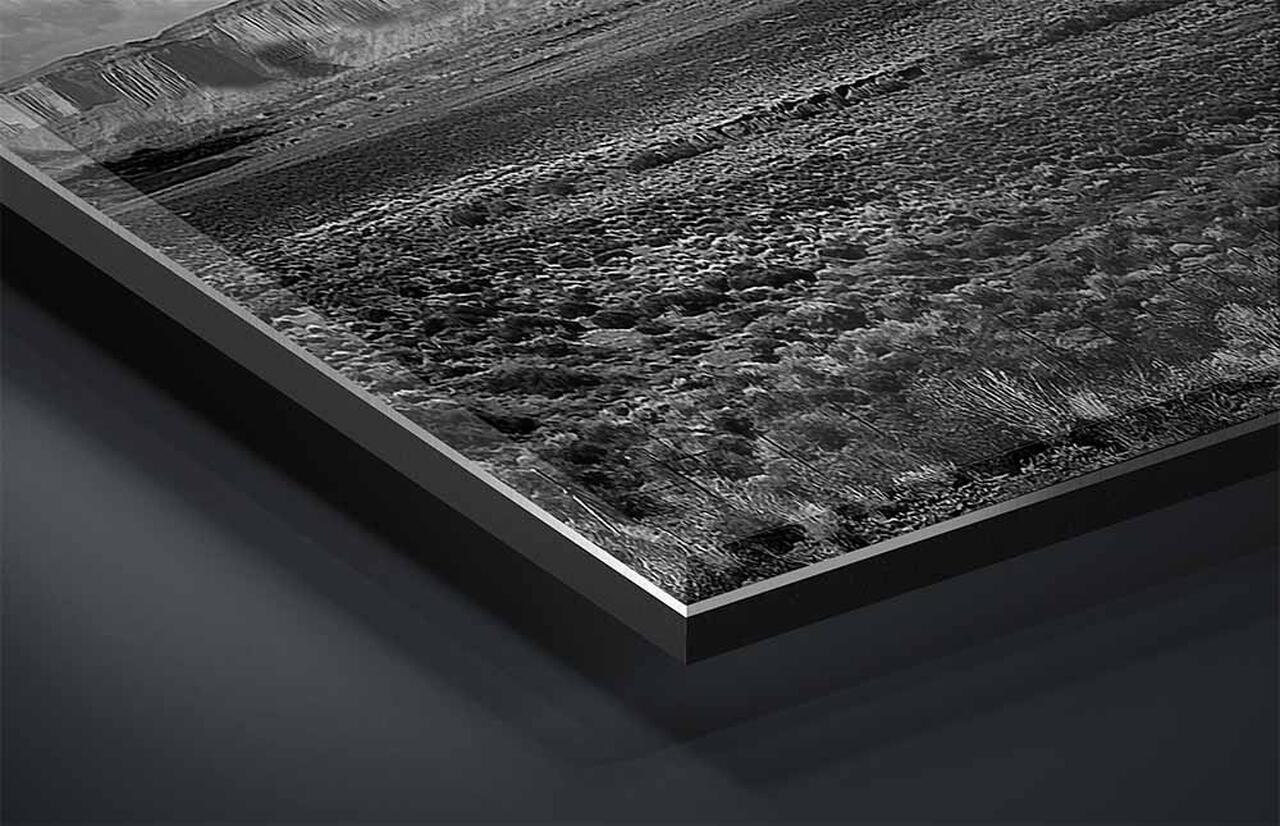
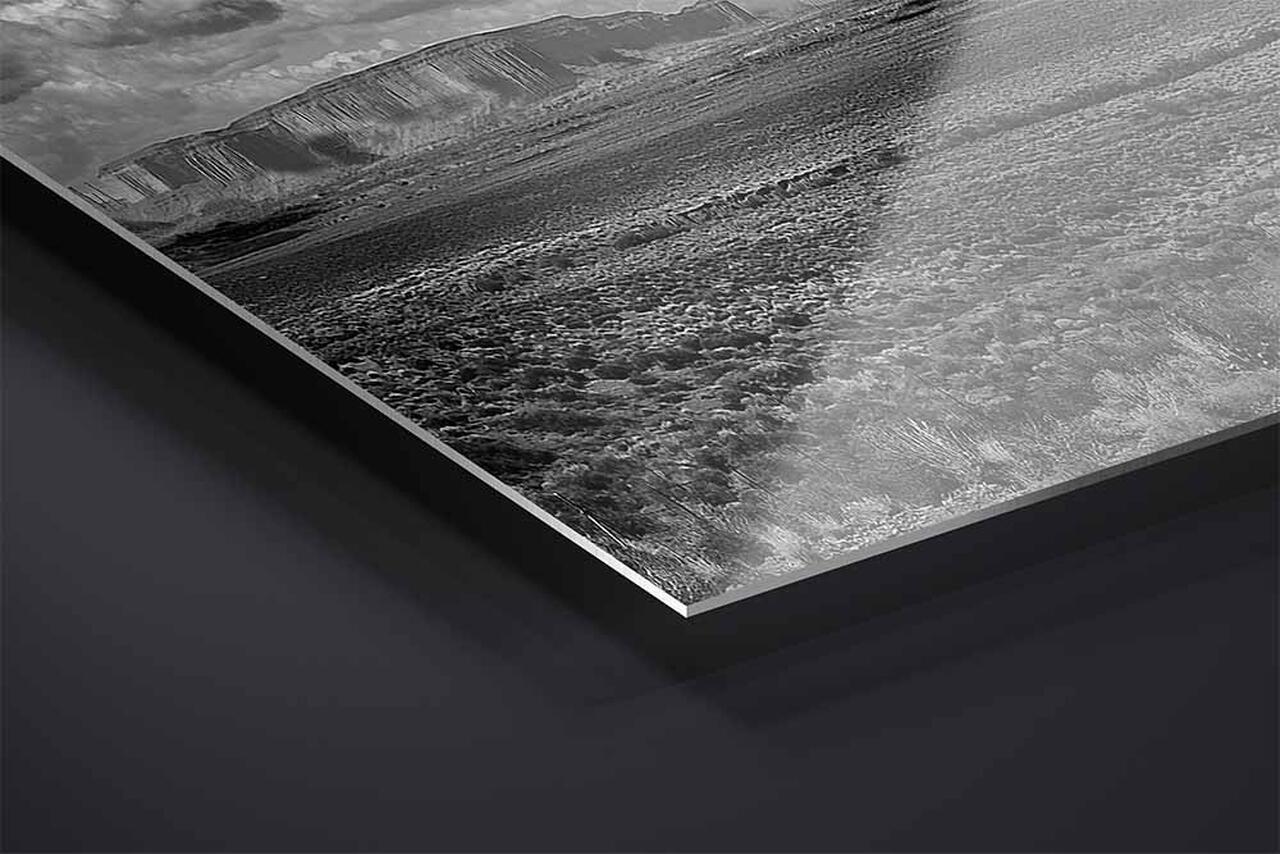
The buttes at about a third of the frame width. The horizontal strata separate into distinct bands, the sloped base of each formation reads as a separate layer from the sheer face above it, the flat tops resolve as edges, and the desert between them breaks into individual clumps of scrub. Click to view at full size.
About This Photograph
US 163 at mile marker 13, San Juan County, Utah, looking south toward Monument Valley on the Arizona line. This is a single frame image. The formations stand on Navajo Nation land within Tsé Biiʼ Ndzisgaii, the Monument Valley Navajo Tribal Park.
This is a black and white photograph and the conversion is neutral, with no toning of any kind. What the conversion adds is a black point. In the color version almost nothing in the frame reached true black. Here about one and three quarter percent of the picture does, and nine tenths of that sits in the foreground, in the gaps between the scrub and in the shadow under the near edge of the road. That black is what gives the desert its weight, and it is why the ground reads as something you could stand on rather than as a pale field the buttes happen to sit behind.
The road is the only cue to distance in the frame. There is nothing here of familiar size, so the buttes read as far away rather than as small entirely because of how fast the road converges.
Mile Marker 13
Steve Austinhttps://www.steveaustinphotography.com/
Location
US 163, Monument Valley, Utah
Subject
Desert highway · sandstone buttes · high desert sky
Capture
Single frame in midday light
Format
Photograph · horizontal panorama, 3:1
Sizes
36 × 12 in · 60 × 20 in · 90 × 30 in
Print Media
TruLife Acrylic · ChromaLuxe Metal · Baryta paper
Edition
Limited, 25 / 50 / 100 by presentation
What it Does in a Room
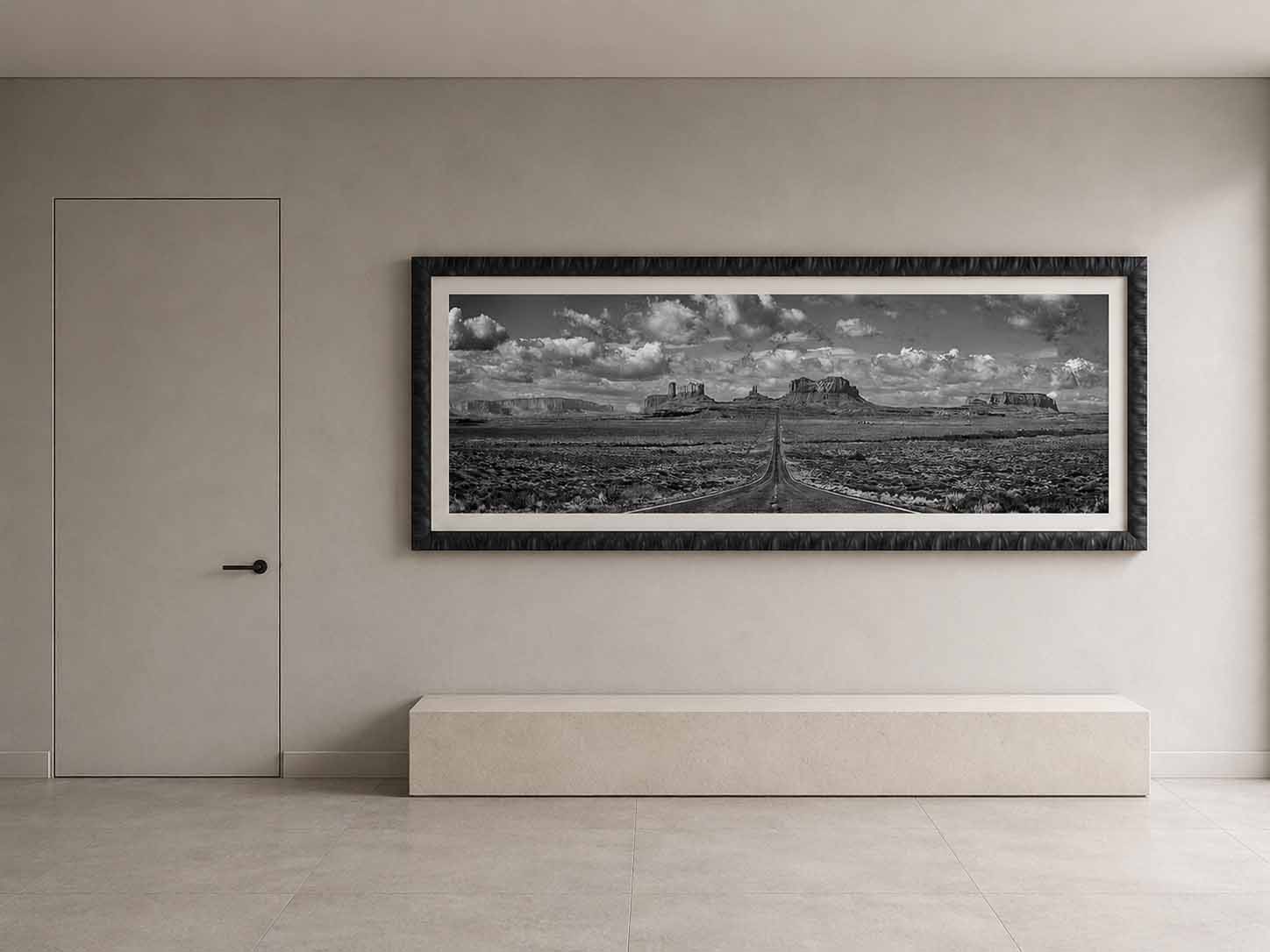
Three to one is a different object on a wall than two to one is. At eight feet wide and thirty-two inches tall this is closer in proportion to a transom or a long window than to a picture, and it behaves like one. It reads as an opening rather than as a framed object, and it does that best above something long and low, where the horizontal it establishes agrees with the furniture instead of floating over it. On a tall narrow wall it will look stranded. Give it length.
Being black and white makes it the one piece in the collection that cannot argue with a room. Every color photograph brings a palette with it, and a palette either agrees with what is already on the walls and the floor or it does not. This one brings none. It will hang against a green wall, a warm oak floor, a rust-colored sofa, or a room with nothing in it at all, and in each case it is doing the same thing, because none of those materials has anything to disagree with. That is worth knowing if the piece is going somewhere already committed to a scheme, or somewhere the scheme is likely to change.
The third thing is direction. Everything in the frame converges on a point at the center, and a picture with a vanishing point pulls a viewer toward the wall it hangs on rather than holding them where they stand. That makes it well suited to the far end of a room, a corridor, or a wall you approach rather than pass, because the convergence gets stronger as you get closer and the piece rewards being walked toward.
Not sure which size the room calls for, or want dimensions not listed here? Sizes beyond 90 × 30 are available on request and ship crated by freight. That conversation is welcome before an order is placed. Start that conversation and I will answer within one business day.
Finding the Way, limited edition printSteve Austin70012900USD11https://schema.org/InStock
Questions about this photograph
How small is too small for a photograph this wide?
Three to one punishes small sizes more than two to one does, because the height falls away twice as fast as the width. At the smallest size the picture is 32 inches across and 12 inches tall. What goes first at that height is the ground. The desert between the road and the buttes is the part of this frame carrying the most detail, in scrub and drainage and the texture of open country, and it occupies a band that gets very shallow when the picture is short. The sky survives, the buttes survive as shapes, and the middle compresses. The road survives at any size, since a converging line is legible when almost nothing else is. If you are weighing a size against a specific wall, choosing the right print size covers the measurements and the viewing distances in more detail.
What changes at the largest size?
The buttes stop being silhouettes. At the largest size the horizontal banding in the sandstone becomes visible as separate strata, the slope at the base of each formation separates from the sheer face above it, and the debris fallen from those faces reads as broken rock rather than as shading. The flat tops resolve as edges. Across the foreground the desert separates into individual clumps of scrub with bare ground between them, the shallow drainages that cross it become visible as channels, and the fence line running along the left side reads as posts. On the road the painted center line resolves into separate dashes, and following those dashes toward the vanishing point is how the distance in this picture becomes a quantity rather than an impression. Where attention leads covers what a receding line does to a viewer's attention.
What kind of room does this photograph suit?
Rooms with a long wall, and beyond that it is unusually forgiving. Because there is no color in it, there is no room it can clash with, so the usual question of whether a piece suits the palette does not arise here. What it does need is length and a low hang. The horizon sits low in the frame and the picture reads correctly when that horizon lands at or slightly below eye level, which puts it lower on the wall than most pieces go. Above a long console, a credenza, or a run of low cabinets is where the proportion does its best work. It is one of the few pieces in the collection that suits a corridor, where the length is available and the convergence has room to work on someone walking toward it. When your mind needs to rest takes the question further.
Every work ships insured and arrives with a signed certificate of authenticity.
If a piece is damaged in transit, the choice of replacement is always yours, and your edition number stays with you.
Production time runs 2 to 3 weeks for metal, 3 to 4 weeks for acrylic and paper, and 5 to 6 weeks for framed work.
Each print is made to order and takes its place in a numbered edition, so sales are final. Before you choose, I am glad to help: send a photo of your wall and I will show you this work in your room at true scale, at no charge. Start a conversation
Collector's Choice · TruLife ® Acrylic in Italian Frame
Collector Edition of 25· Lumachrome TruLife Acrylic · Handcrafted Italian Frame
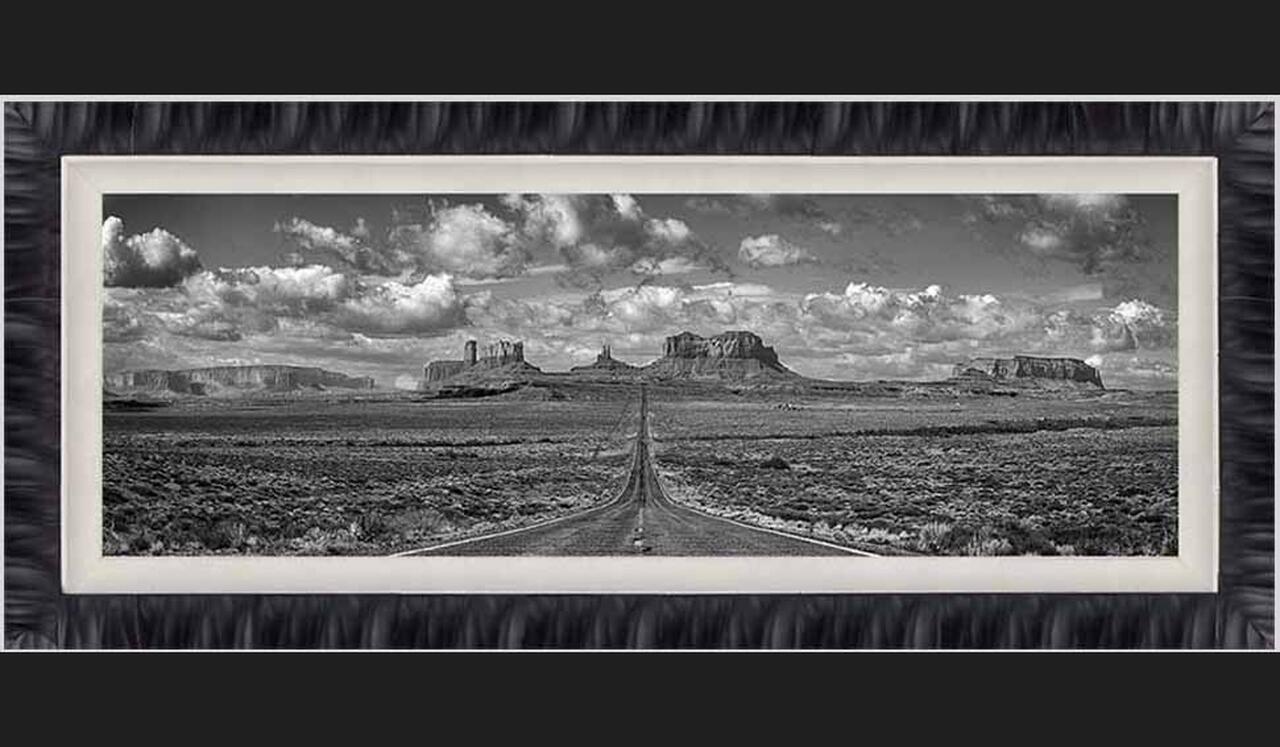
TruLife acrylic in a handcrafted Italian frame with a linen liner chosen for the image. Frame series, finish, and liner are settled with you after the order, and production begins from there. The frame and liner add about fourteen inches to the finished dimensions, worth allowing for when planning placement.
Signature Acrylic Edition of 50· Lumachrome TruLife · Gallery Float Mount
Face-mounted to TruLife acrylic and floated approximately one inch from the wall, with no frame to mediate between the image and the room. UV-resistant, anti-reflective, and scratch-resistant, with a lifetime guarantee against fading.
Signature Metal Edition of 50· ChromaLuxe Print · Gallery Float Mount
Color infused into the aluminum panel itself, floated from the wall on a concealed system. Where acrylic produces luminosity, metal produces clarity. Exceptional fade resistance with no glazing or coating required.
Fine Art Edition of 100· Hahnemühle Baryta Fine Art Paper
Printed without acrylic, so light meets the paper surface directly. Highlights stay luminous, shadows keep their nuance, and the surface has a tactile quality the other presentations approach differently. The understated choice, and the traditional one.
Complimentary shipping within the continental United States. International collector shipping available upon request.
Still deciding
Designing for Stillness
A guide to choosing art for restorative spaces
How to tell whether an image will still hold you in a year, how scale changes what a photograph does in a room, and how to match a piece to the work a room actually performs. It cites the research it draws on, and it is equally clear about where that research stops. About ten minutes to read.