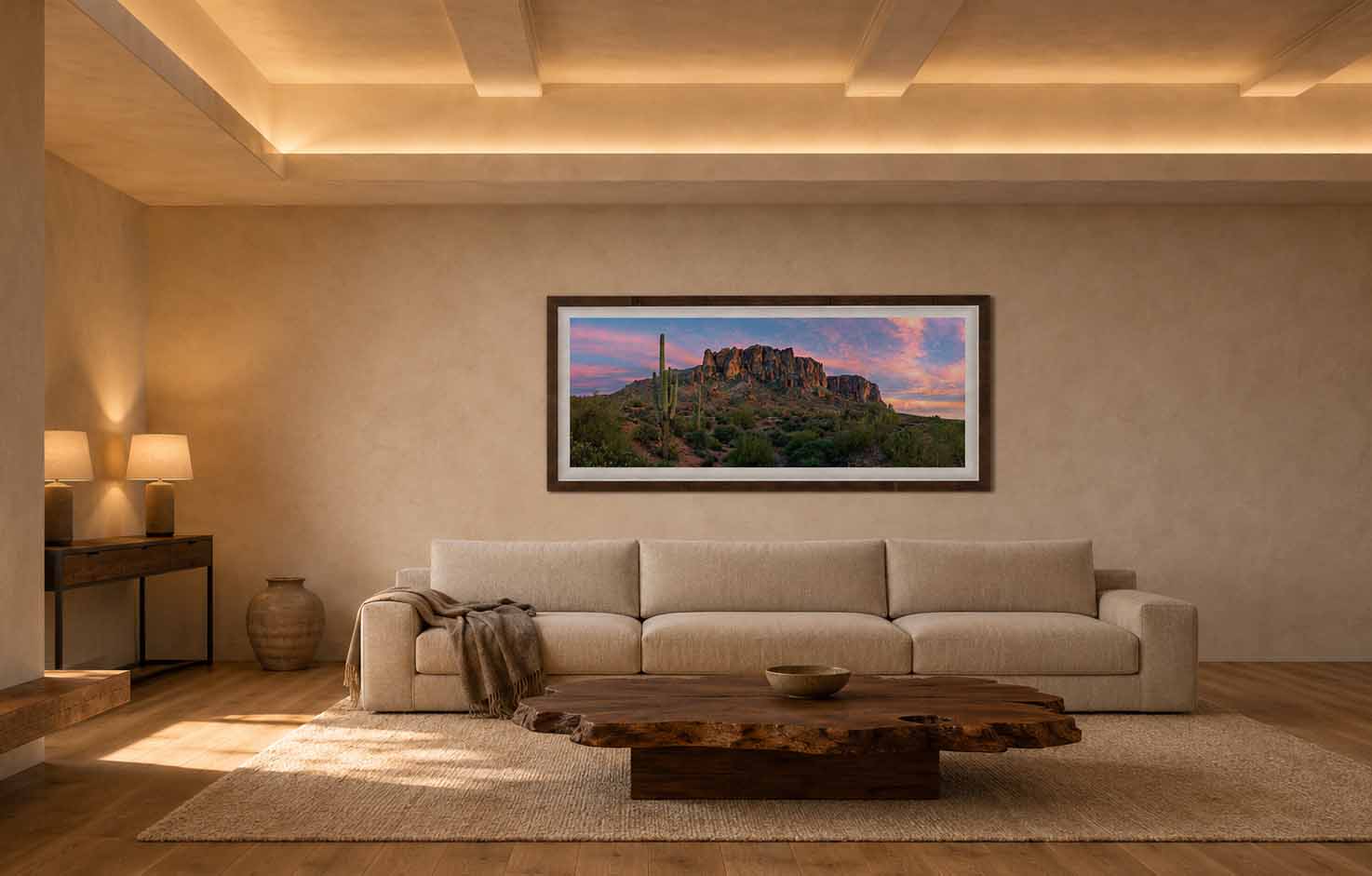
A 5:2 panoramic photograph of Superstition Mountain at sunset, Lost Dutchman State Park, Arizona, available as a limited edition print in three sizes and four presentations.
Artist's Story
From Lost Dutchman State Park, east of Phoenix, Superstition Mountain takes up the whole horizon. For more than a century people have come here convinced there is a gold mine inside it. Jacob Waltz died in Phoenix in 1891 having supposedly described where it was, and men have died on this mountain looking for it since. Geologists have been saying for a long time that the rock is wrong, that these cliffs are welded volcanic ash from calderas that collapsed between twenty nine and fifteen million years ago, and that the gold in the story does not occur in stone like this.
I live near enough to come back whenever I want, and I have, more times than I can count. On this evening the sun had already left the desert floor. The saguaros in front of me were in shade, the scrub had gone dark, and the last light was on the cliffs alone, with the sky going pink above them. The only lit thing in front of me was the mountain everyone comes here to look past.
There is a habit of mind this place exposes. We assume the valuable thing is concealed. That what stands in front of us is a surface, and the real prize is behind it, beneath it, further in. It is a useful instinct and it has cost people their lives here. Standing at the bottom in the last light, the arrangement briefly reverses. Nothing is hidden. The cliffs, the saguaros, the color coming up in the clouds are the whole of it, and there is a specific rest in not having to look past them for something better.
Mountain of Riches is that reversal. The wealth was never buried. It has been standing in the open the entire time, in plain sight of everyone who came here looking for something else.
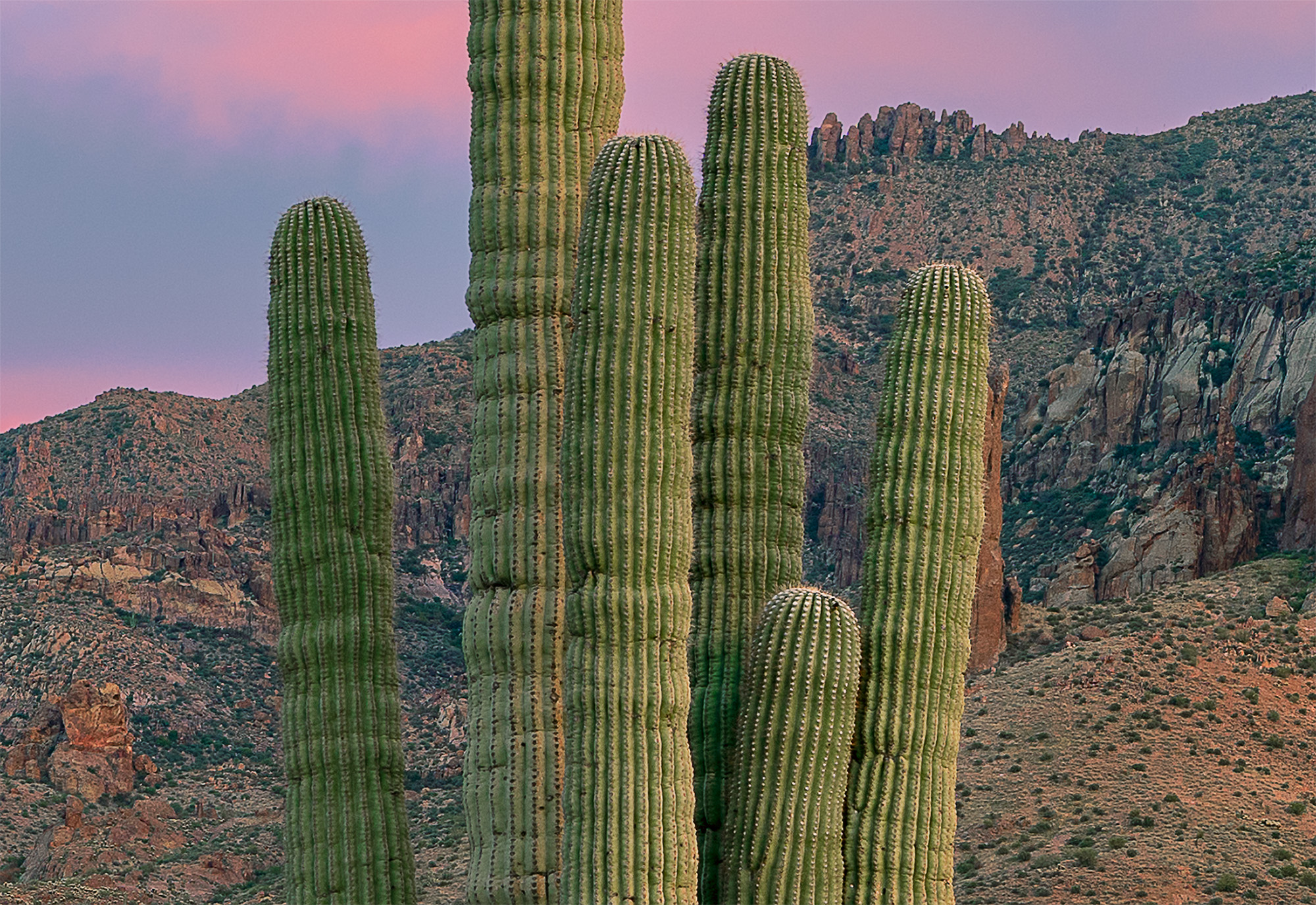
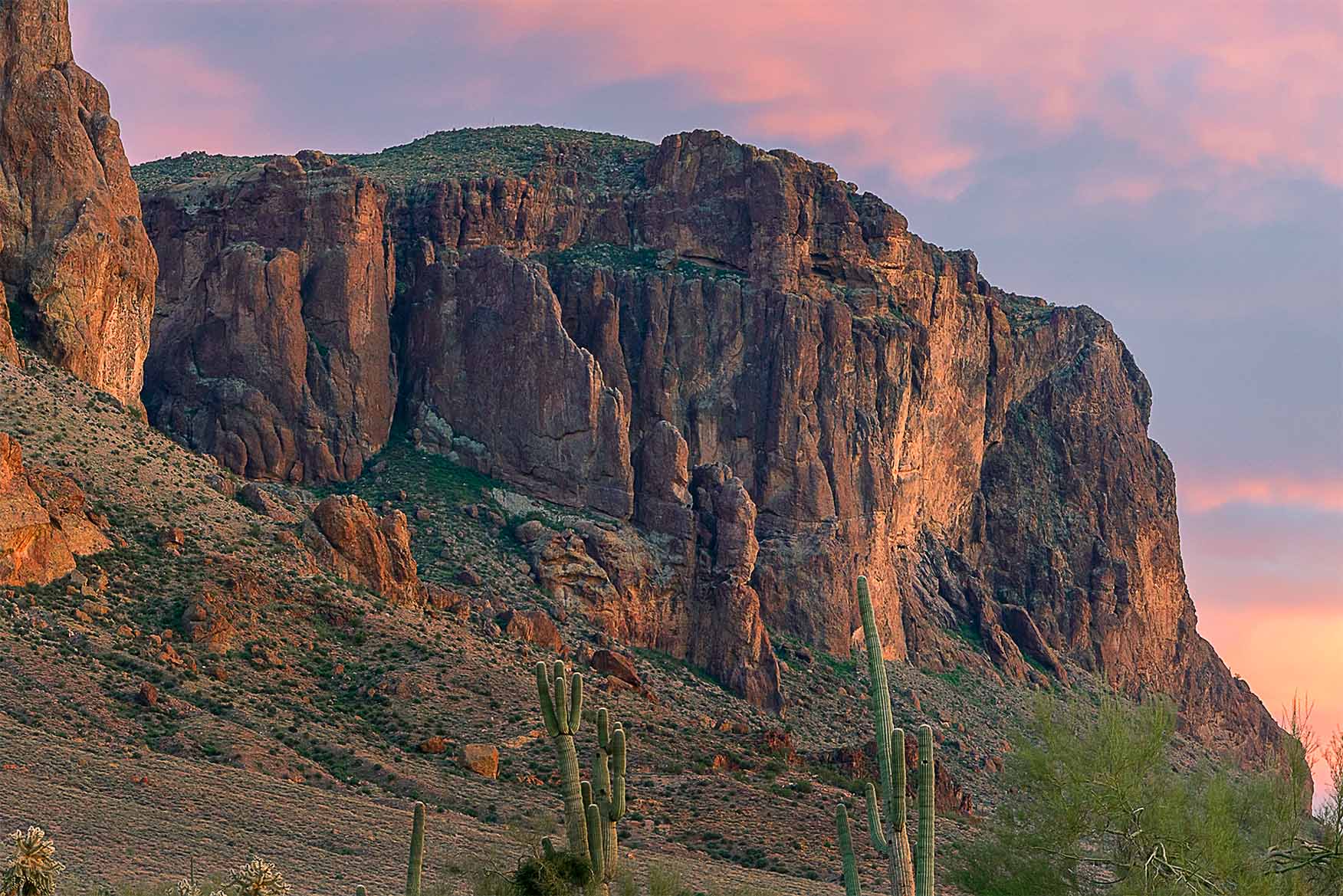
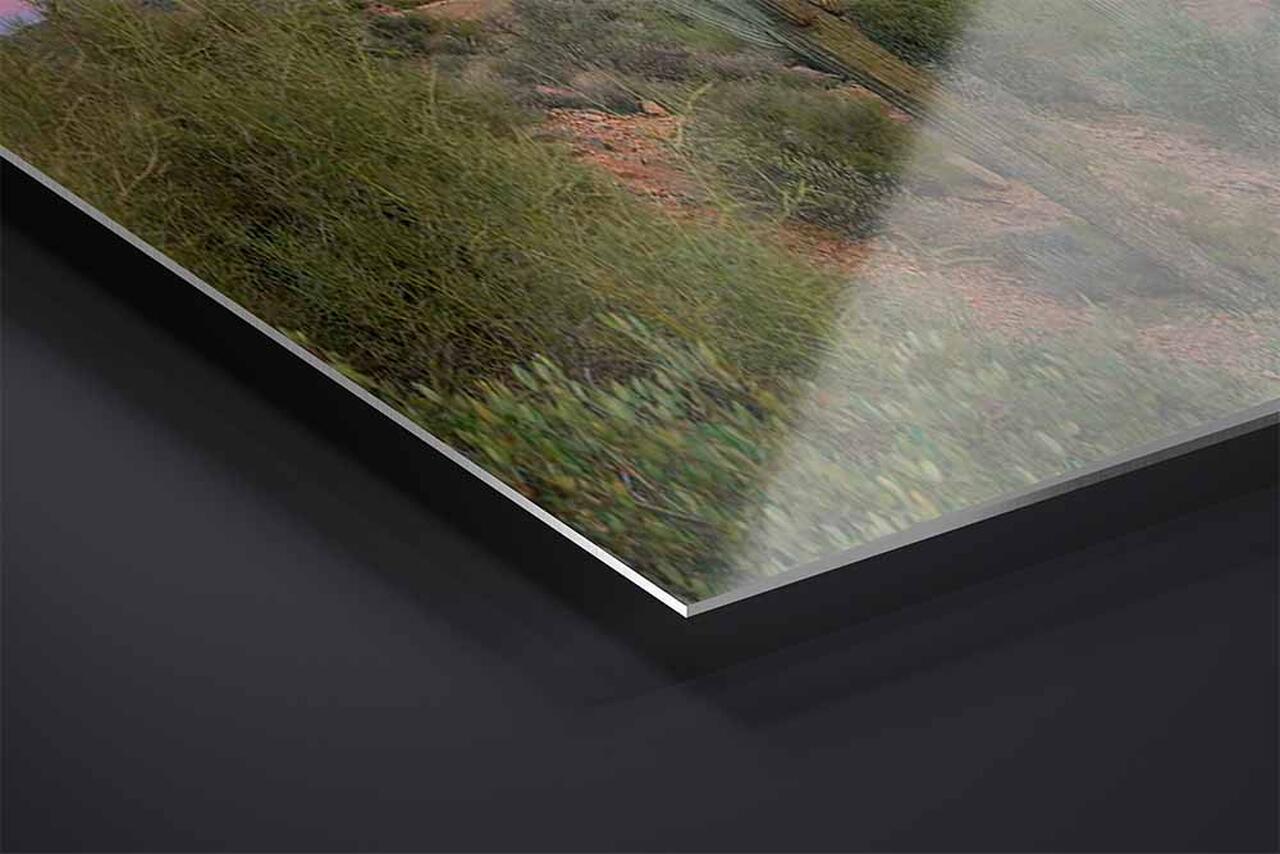
Three details, each at one tenth of the frame width, moving from the near foreground to the far shoulder of the mountain. Click any of them to view at full size.
About This Photograph
Photographed at Lost Dutchman State Park in Apache Junction, Arizona, east of Phoenix, looking west toward the southwest face of Superstition Mountain at sunset. Made in a single frame.
The subject is Superstition Mountain, the eroded surface remnant of a volcanic complex active roughly 29 to 15 million years ago and built from at least three overlapping calderas. Its cliffs are welded rhyolitic tuff and dacite, ash deposited hot enough to fuse into rock as it settled. The frame holds the cliff face in the last direct light of the day, with saguaro and desert scrub across the foreground already in shade beneath a pink and violet sky.
The mountain is the presumed site of the Lost Dutchman's Gold Mine, associated with the German immigrant Jacob Waltz, who reportedly described its location before his death in Phoenix in 1891. No verified find has ever been made, and the volcanic geology is generally considered inconsistent with the gold of the legend.
Mountain of Riches
Steve Austinhttps://www.steveaustinphotography.com/
Location
Lost Dutchman State Park, Arizona
Subject
Superstition Mountain
Capture
Single exposure at sunset
Format
Photograph · horizontal panorama, 5:2
Sizes
40 × 16 in · 60 × 24 in · 80 × 32 in
Print Media
TruLife Acrylic · ChromaLuxe Metal · Baryta paper
Edition
Limited, 25 / 50 / 100 by presentation
What it Does in a Room
Most panoramas ask the eye to travel. This one hands it a single mass and lets it stay.
The cliff line runs almost the full width of the frame at a nearly constant height, so there is no peak to arrive at and no direction the composition sends you. The saguaro left of center gives the eye somewhere to start and the lit rock gives it somewhere to rest, and between those two the photograph does not move. On a wall that reads as weight rather than motion, which is a different thing to live with than a view that draws you across it.
The palette is unusual for a desert photograph. Warm rock and cool sky occupy roughly equal halves of the frame, pink and violet above, sunlit stone and dark green scrub below, and the two do not blend. The image carries a full shadow range with real black in the foreground, but the highlights stay restrained, so it holds depth without ever going bright. Against warm walls and wood the rock agrees and the sky supplies the contrast. Against cool grays the relationship inverts and the cliffs become the warm event in the room. It works either way, which is not true of most photographs this saturated.
What it needs is distance more than width. At two and a half to one the frame is long, but the subject is a single continuous mass rather than a composition that opens outward, so it does not suffer from a wall that ends close to it the way a photograph built on depth would. What it does need is enough room to step back. The foreground scrub is dense and finely detailed, and standing too near it, the eye works the brush instead of the mountain.
Not sure which size the room calls for, or want dimensions not listed here? Sizes beyond 80 × 32 are available on request and ship crated by freight. That conversation is welcome before an order is placed. Start that conversation and I will answer within one business day.
Mountain of Riches, limited edition printSteve Austin95012100USD11https://schema.org/InStock
Questions about this photograph
How small is too small for a photograph this wide?
At two to five, the Intimate size is sixteen inches tall and forty inches across. That is a gentler proportion than a true three to one, so it holds together better in a smaller space, but it is still a wide piece and it still asks for a wall that can give it room. On most walls the Intimate reads as a horizontal accent rather than a focal point, which suits a hallway, a stairwell landing, or a space above a low console. The Collected and Statement sizes are where the width does the real work. If you are weighing a size against a specific wall, choosing the right print size covers the measurements and the viewing distances in more detail.
What changes at the largest size?
The foreground is where this one changes. At sixteen inches tall the desert floor is a band of green texture and the saguaros are shapes. At thirty two you can count the ribs on the near one, see the spines catch the last light along its edge, and follow the ground back through the creosote and brittlebush to where the slope begins to climb. The cliff face does the same thing. What reads at the small size as a wall of warm rock resolves into individual columns and the gullies between them, each one lit differently depending on how it faces the light. That matters here more than on most photographs, because the argument the image makes is that nothing is hidden. At the largest size that stops being a claim about the mountain and becomes something the print demonstrates about itself. Why scale matters covers what happens perceptually when a landscape reaches the size where the eye has to travel across it.
What kind of room does this photograph suit?
This photograph is split, and that is what makes it flexible. The lower half is warm, sunlit rock and red ground and deep green scrub, and the upper half is cool, pink and violet running toward blue at the top of the frame. Neither half dominates. Against warm wood, leather, and plaster the rock agrees and the sky supplies the contrast. Against cool gray or blue the relationship inverts and the cliffs become the warm element. Most photographs with this much color commit to one direction and can only be placed one way. This one can go either.
The value structure is worth knowing. The foreground carries real black and the highlights stay restrained, so the image holds weight without ever going bright. It will not lift a dim room. In good light the color range opens fully and the shadow detail in the scrub comes forward.
What it asks for is stepping-back room rather than wall width. The near foreground is dense and finely detailed, and a viewer standing three feet away works the brush instead of the mountain. From across a room the composition resolves into what it actually is, which is one continuous mass under a sky.
Every work ships insured and arrives with a signed certificate of authenticity.
If a piece is damaged in transit, the choice of replacement is always yours, and your edition number stays with you.
Production time runs 2 to 3 weeks for metal, 3 to 4 weeks for acrylic and paper, and 5 to 6 weeks for framed work.
Collector's Choice · TruLife ® Acrylic in Italian Frame
Collector Edition of 25· Lumachrome TruLife Acrylic · Handcrafted Italian Frame
TruLife acrylic in a handcrafted Italian frame with a linen liner chosen for the image. Frame series, finish, and liner are settled with you after the order, and production begins from there. The frame and liner add about fourteen inches to the finished dimensions, worth allowing for when planning placement.
Signature Edition · TruLife ® Acrylic, Float Mount
Signature Edition of 50· Lumachrome TruLife Acrylic · Gallery Float Mount
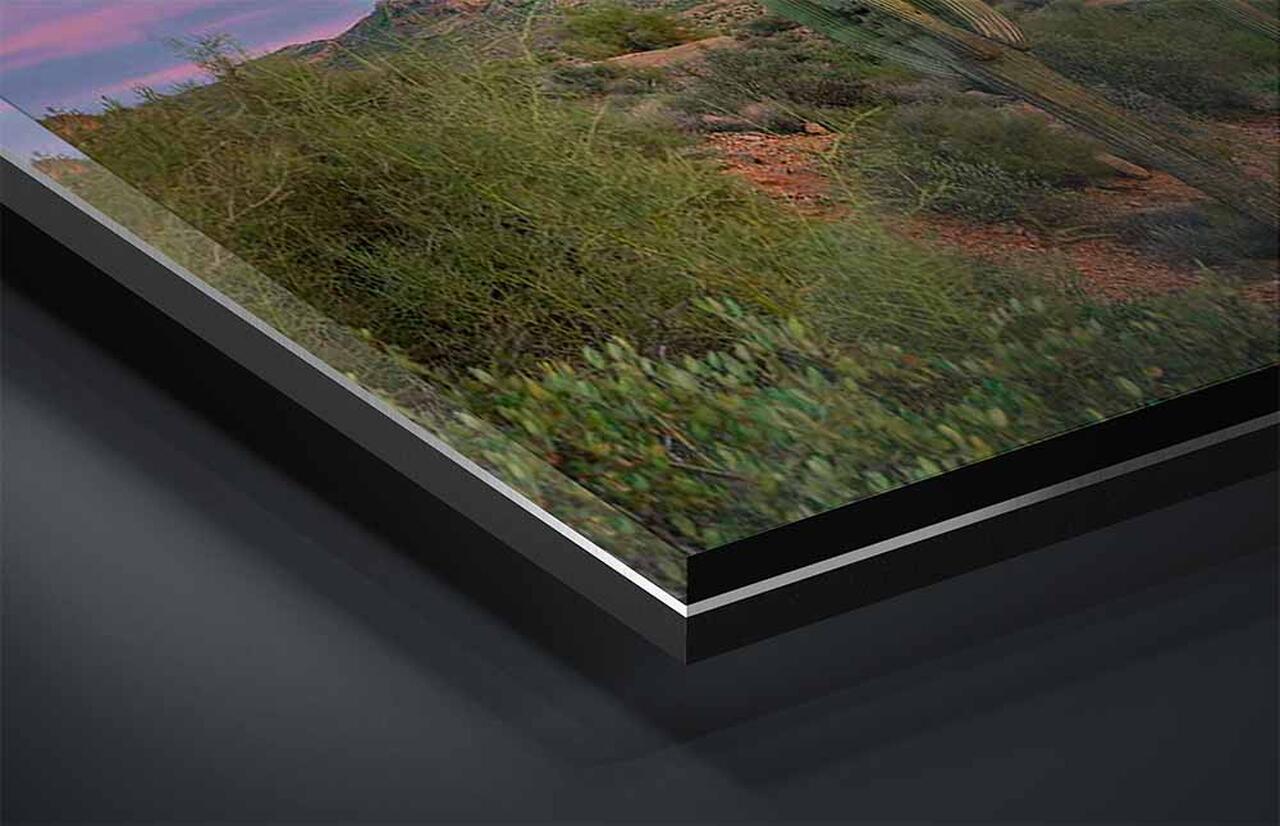
Face-mounted to TruLife acrylic and floated approximately one inch from the wall, with no frame to mediate between the image and the room. UV-resistant, anti-reflective, and scratch-resistant, with a lifetime guarantee against fading.
Signature Edition of 50· ChromaLuxe Metal Print · Gallery Float Mount
Color infused into the aluminum panel itself, floated from the wall on a concealed system. Where acrylic produces luminosity, metal produces clarity. Exceptional fade resistance with no glazing or coating required.
Fine Art Edition of 100· Hahnemühle Baryta Fine Art Paper
Printed without acrylic, so light meets the paper surface directly. Highlights stay luminous, shadows keep their nuance, and the surface has a tactile quality the other presentations approach differently. The understated choice, and the traditional one.
Complimentary shipping within the continental United States. International collector shipping available upon request.
Still deciding
Designing for Stillness
A guide to choosing art for restorative spaces
How to tell whether an image will still hold you in a year, how scale changes what a photograph does in a room, and how to match a piece to the work a room actually performs. It cites the research it draws on, and it is equally clear about where that research stops. About ten minutes to read.