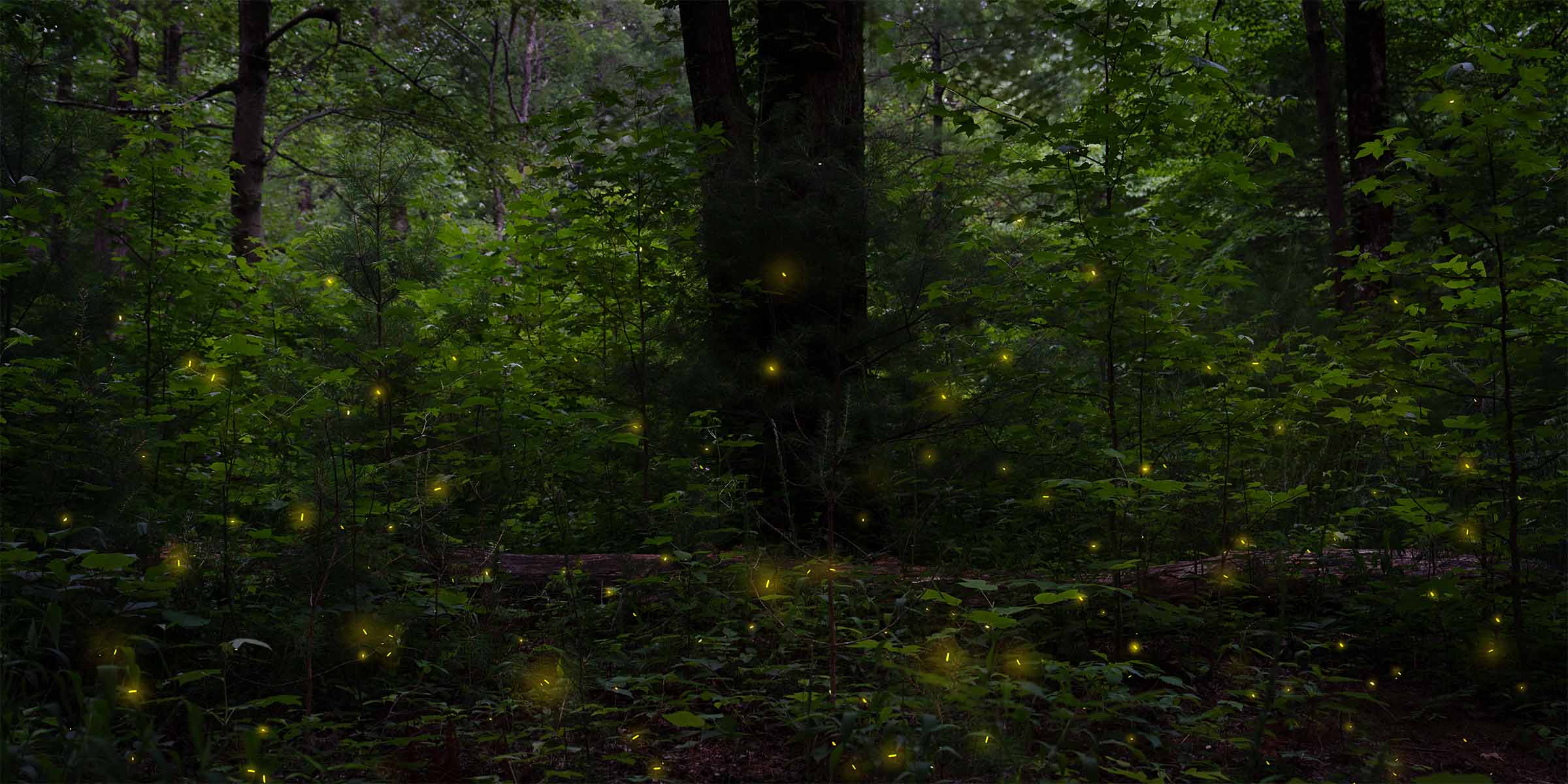
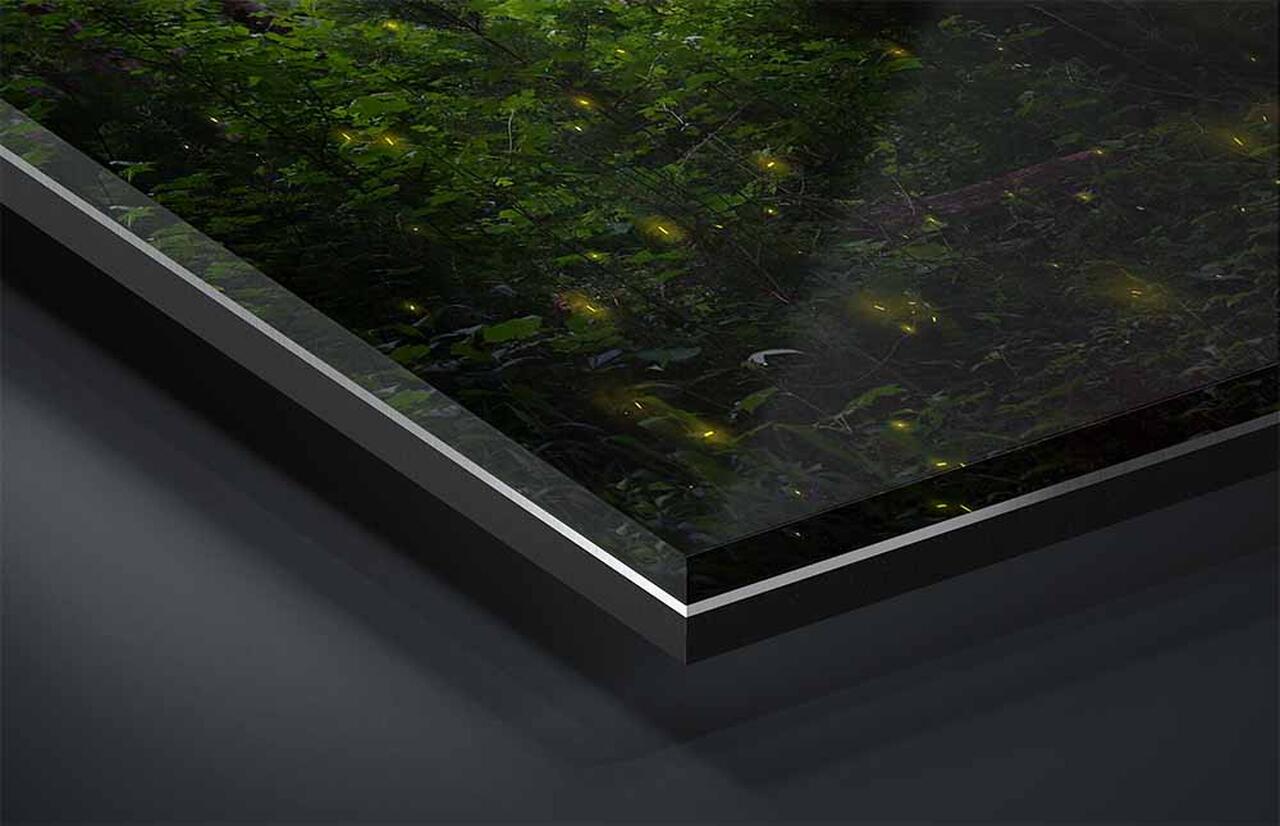
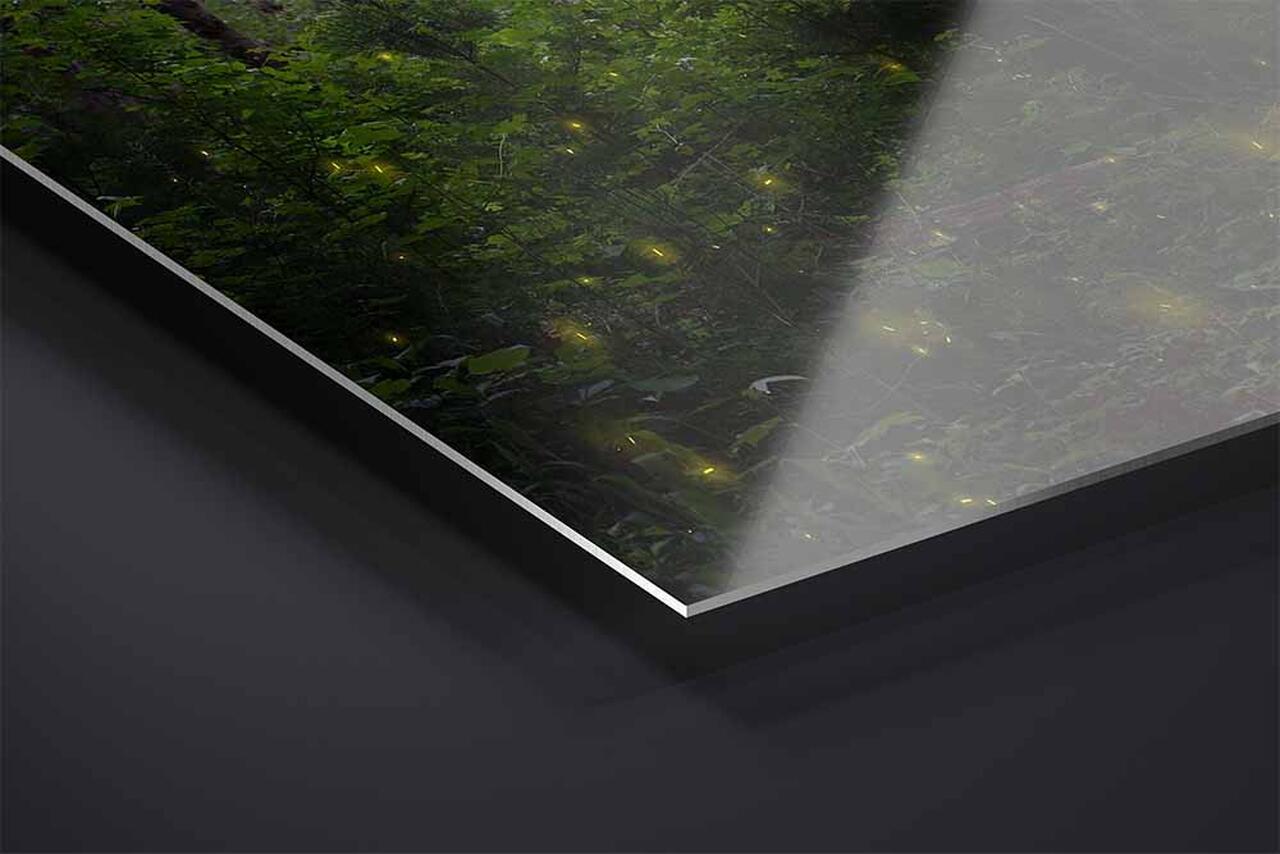
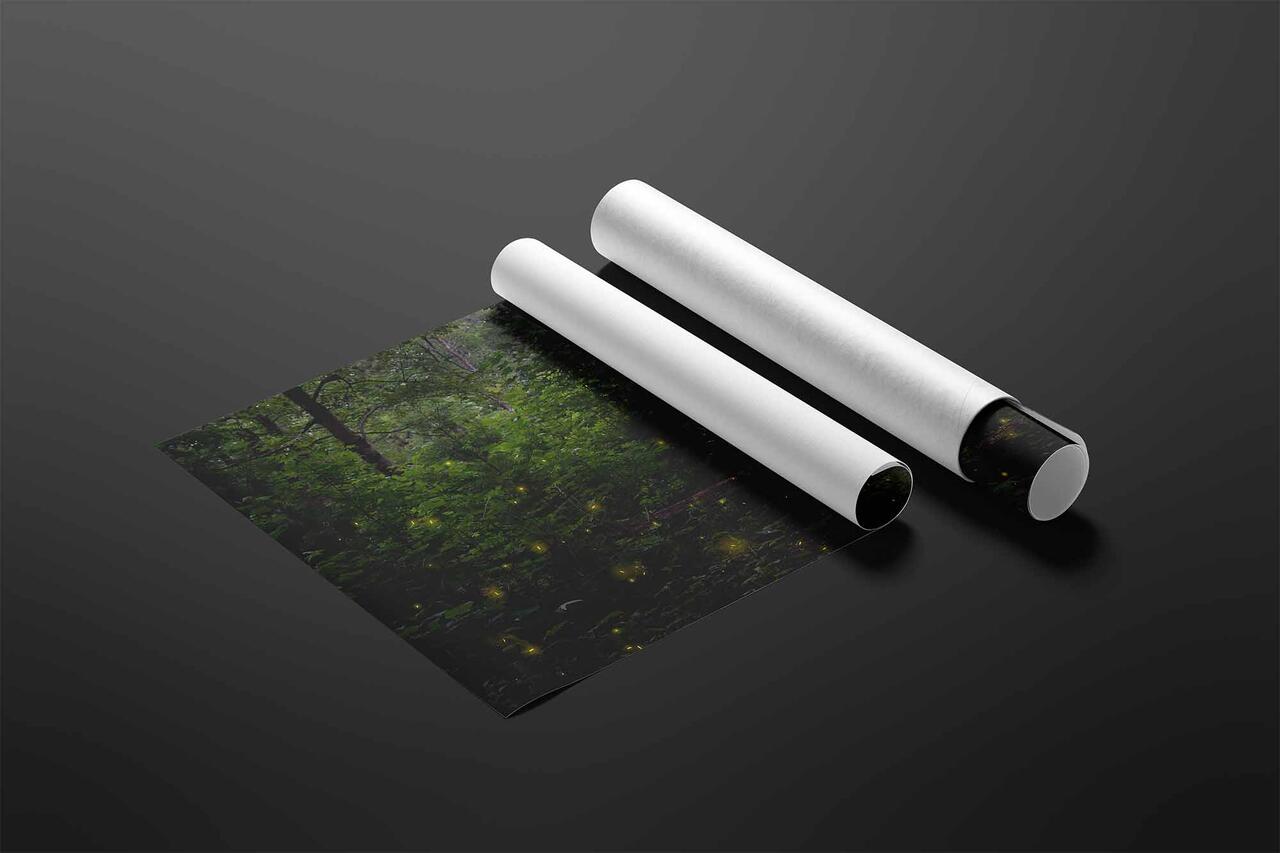
A 2:1 panoramic photograph of fireflies in a summer forest at dusk, Great Smoky Mountains National Park, Tennessee, United States, available as a limited edition print in three sizes.
Artist's Story
I stood in a forest in Tennessee for about an hour one evening in early summer, while the fireflies came up out of the undergrowth and the last light went out of the sky behind them.
A firefly makes light by a route almost nothing else uses. The reaction is chemical. A compound called luciferin is oxidized by an enzyme called luciferase, with oxygen and ATP, and the molecule left over comes out of the reaction in an excited state and sheds the surplus as a photon. The emission peaks near five hundred and sixty nanometers, which is the yellow-green in this frame, and it holds that wavelength whether the insect is in a Tennessee forest or a laboratory flask.
The part worth reporting is the temperature. A filament bulb makes light by getting hot, and tungsten has to reach something close to three thousand Kelvin before it glows usefully, with most of the energy leaving as heat instead. A firefly is at the temperature of the air around it. The photons come off a chemical reaction rather than off a hot surface, so there is nothing to feel. Roughly forty percent of the reaction's energy leaves as visible light. An older measurement put that figure near a hundred percent and it still circulates, but it has been revised down.
This photograph is assembled, and I would rather say so. Thirty frames across that hour, ten of them good enough to keep, stacked so that flashes separated by many minutes appear together. The foliage came from a separate frame made at blue hour, while there was still enough light to render a leaf. No single instant in that forest looked like this. Every firefly in it was there.
Nature's Luminous Dance is an hour of a forest, and the part of it that glows covers about one seventh of one percent of the frame.
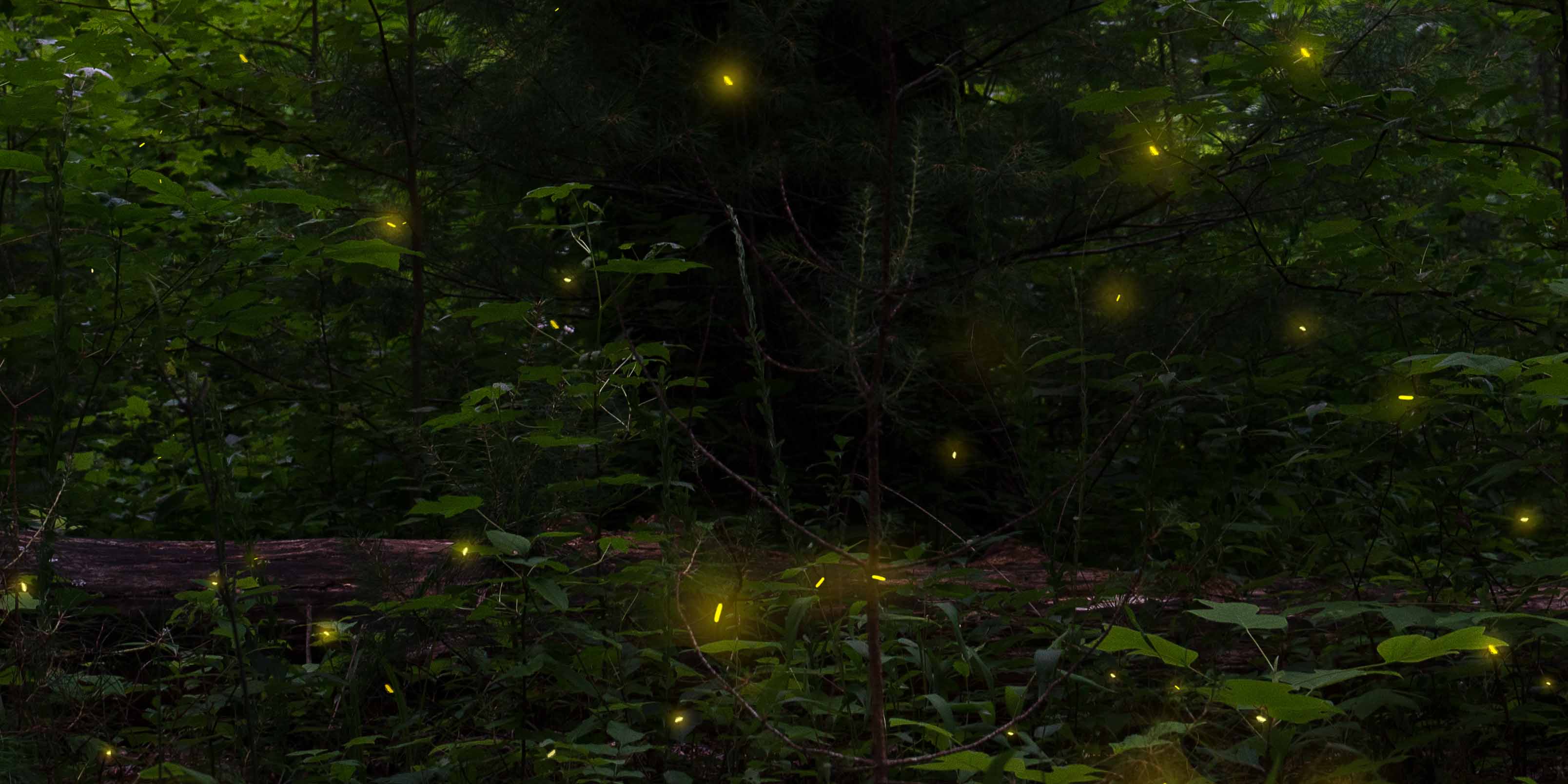
This crop is 28 percent of the frame width, about 22 inches across on the 80 inch print. The fireflies have stopped being dots. Some are compact points and some are short streaks where the insect moved, and each carries a soft halo where its light fell on the nearest leaves. The fallen log reads as a log, the leaf litter separates across the floor beneath it, and small pale wildflowers stand in the undergrowth at left. Click to view at full size.
About This Photograph
Great Smoky Mountains National Park, Tennessee, in early summer. Ten exposures selected from thirty made across an hour and stacked so that flashes separated in time appear at once, with a separate blue hour frame supplying the foliage.
The flash is a signal rather than a byproduct. Each species runs its own pattern, differing in the duration of the flash, the interval between flashes, and the path the insect flies while producing them. Males patrol and broadcast, females answer from the vegetation, and the pattern is how each recognizes its own kind in a forest holding several species at once.
Measured across the frame, no forty-pixel block anywhere reaches above ninety-two out of two hundred and fifty-five, while individual points reach two hundred and fifty-five. Over half the picture sits at or below twenty-five.
Nature's Luminous Dance
Steve Austinhttps://www.steveaustinphotography.com/
Location
Great Smoky Mountains National Park, Tennessee, United States
Subject
fireflies · summer forest · bioluminescence
Capture
Stacked exposure, ten frames with blue hour blend
Format
Photograph · horizontal panorama, 2:1
Sizes
40 × 20 in · 60 × 30 in · 80 × 40 in
Print Media
TruLife Acrylic · ChromaLuxe Metal · Baryta paper
Edition
Limited, 25 / 50 / 100 by presentation
What it Does in a Room
Room light damages this photograph from one end only, and that is unusual enough to be worth understanding. The fireflies are already at the top of the scale, two hundred and fifty-five out of two hundred and fifty-five. They cannot get any brighter. The forest around them sits at a mean of thirty. Ambient light falling on the print raises the forest and leaves the fireflies where they are, so every additional lamp in the room closes the gap between the two from below. The points do not dim. The darkness they depend on lifts toward them. In a bright room the flashes stop reading as light sources and start reading as pale marks on a gray field, and the picture loses the one thing it is about.
It also has almost nothing in the middle of its range. The picture is built from a dark forest and a scatter of maximum-brightness points, and the territory between ninety and two hundred and fifty is nearly empty. That matters for the presentation rather than the frame. A reflection landing on a glossy surface arrives as a midtone, somewhere in the range this picture never occupies, and it therefore reads as something that does not belong rather than merging into the image the way a reflection does on a photograph with a full tonal range. Under acrylic or glass, every reflection here will announce itself. A matte surface removes the problem entirely and costs this file less than it would cost a brighter one.
It is a field rather than a composition. The fireflies are spread across the whole frame at roughly even density, with no cluster the eye is meant to find and no arrangement it is meant to follow. That has a practical benefit most photographs do not offer. There is no wrong lateral position to stand in, and nothing is lost if the piece is partly occluded at one end. A sofa back crossing its lower edge, a doorway crowding one side, a lamp interrupting a corner: none of it removes a subject, because the subject is distributed. On a wall where a composed picture would have to be centered and given clearance, this one can be fitted around what is already in the room.
Not sure which size the room calls for, or want dimensions not listed here? Sizes beyond 80 × 40 are available on request and ship crated by freight. That conversation is welcome before an order is placed. Start that conversation and I will answer within one business day.
How small is too small for a photograph this wide?
This photograph reduces in the opposite direction from most. At the Intimate size, forty inches across and twenty tall, the fireflies hold perfectly well, because they sit at maximum brightness against near black and that is the last thing any reduction takes. What goes is the forest. The leaves lose their edges and become a dark green field, the trunk stops separating from the shade behind it, and the fallen log across the middle disappears into the floor. What you are left with is points of light on darkness, which is attractive and which is also a different photograph, one that could have been made anywhere. The forest is what places it. The Collected at sixty by thirty brings the leaves back as leaves. If you are weighing a size against a specific wall, choosing the right print size covers the measurements and the viewing distances in more detail.
What changes at the largest size?
At eighty by forty, working down the frame: the canopy across the top separates into layers, with the far trees standing behind the near ones instead of merging with them. The large trunk through the center picks up bark texture and separates cleanly from the dark behind it. The pine seedlings on the left resolve into individual needles. The fireflies themselves stop being dots and become shapes, some compact points and some short streaks where the insect moved during the exposure, each with its own soft halo where the light fell on the leaves nearest it. The fallen log across the middle right reads as a log, with its broken end visible. Across the forest floor the leaf litter separates into individual leaves. Why scale matters covers what happens perceptually when a photograph reaches the size where the eye has to cross it.
What kind of room does this photograph suit?
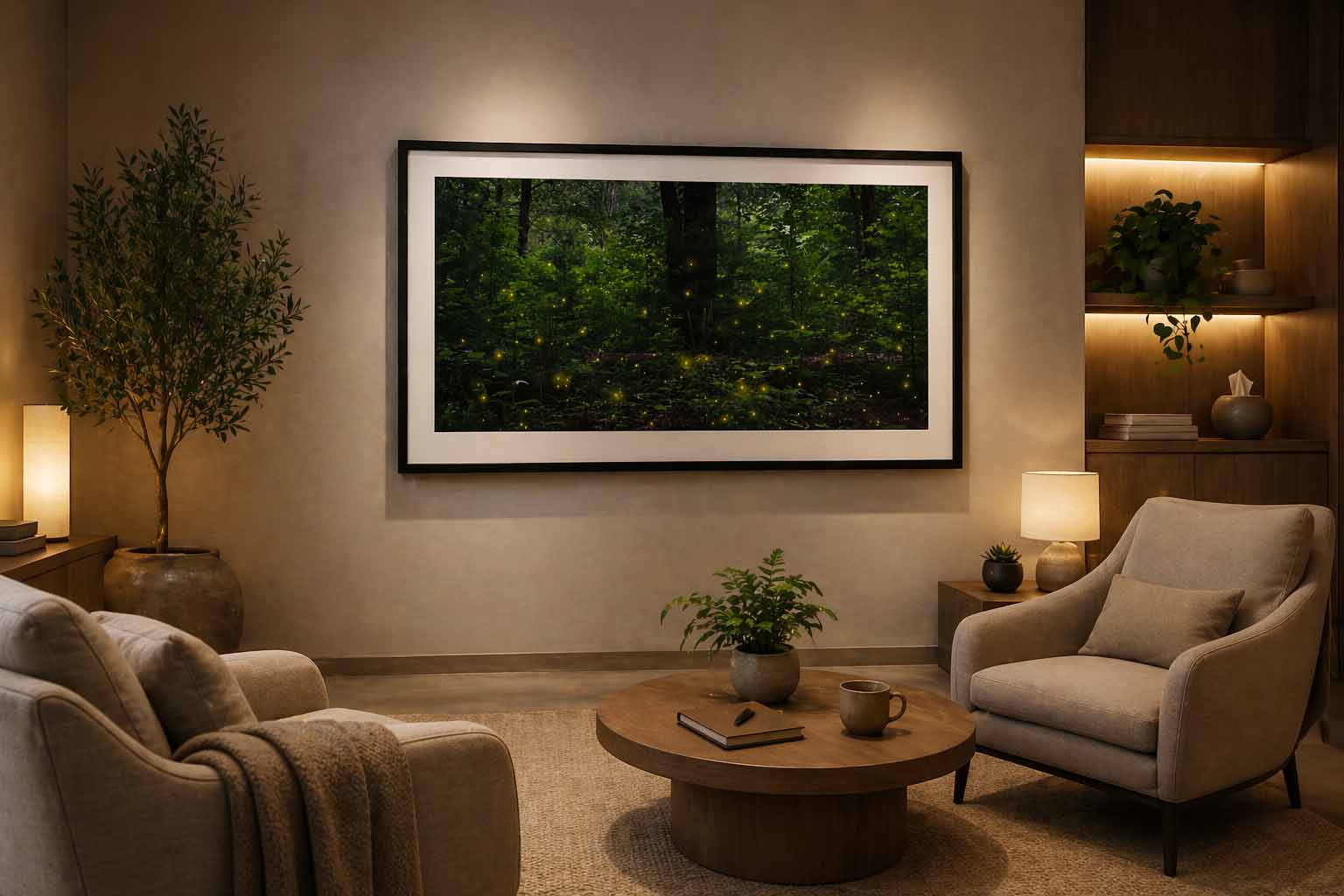
Rooms used in the evening. A den, a media room, a bedroom, a study, a lower level. Hang it at standard height with the center at about fifty-seven inches. On materials it wants dark and matte throughout: charcoal plaster, deep gray, dark stained timber, and nothing polished nearby. Three things to avoid. Use neutral bulbs rather than warm ones, because a warm lamp pushes the green foliage toward yellow and the fireflies are yellow, so the two stop reading as different kinds of thing. Do not hang it in a line with brighter work, since the eye adapts to the brightest thing in view and beside a luminous piece this one reads as a dark rectangle. And keep it off a textured or patterned wall, because the forest is already dense fine detail and a busy surface behind it will compete at the same scale. When your mind needs to rest takes the question further.
Every work ships insured and arrives with a signed certificate of authenticity.
If a piece is damaged in transit, the choice of replacement is always yours, and your edition number stays with you.
Production time runs 2 to 3 weeks for metal, 3 to 4 weeks for acrylic and paper, and 5 to 6 weeks for framed work.
Each print is made to order and takes its place in a numbered edition, so sales are final. Before you choose, I am glad to help: send a photo of your wall and I will show you this work in your room at true scale, at no charge. Start a conversation
Collector's Choice · TruLife ® Acrylic in Italian Frame
Collector Edition of 25· Lumachrome TruLife Acrylic · Handcrafted Italian Frame
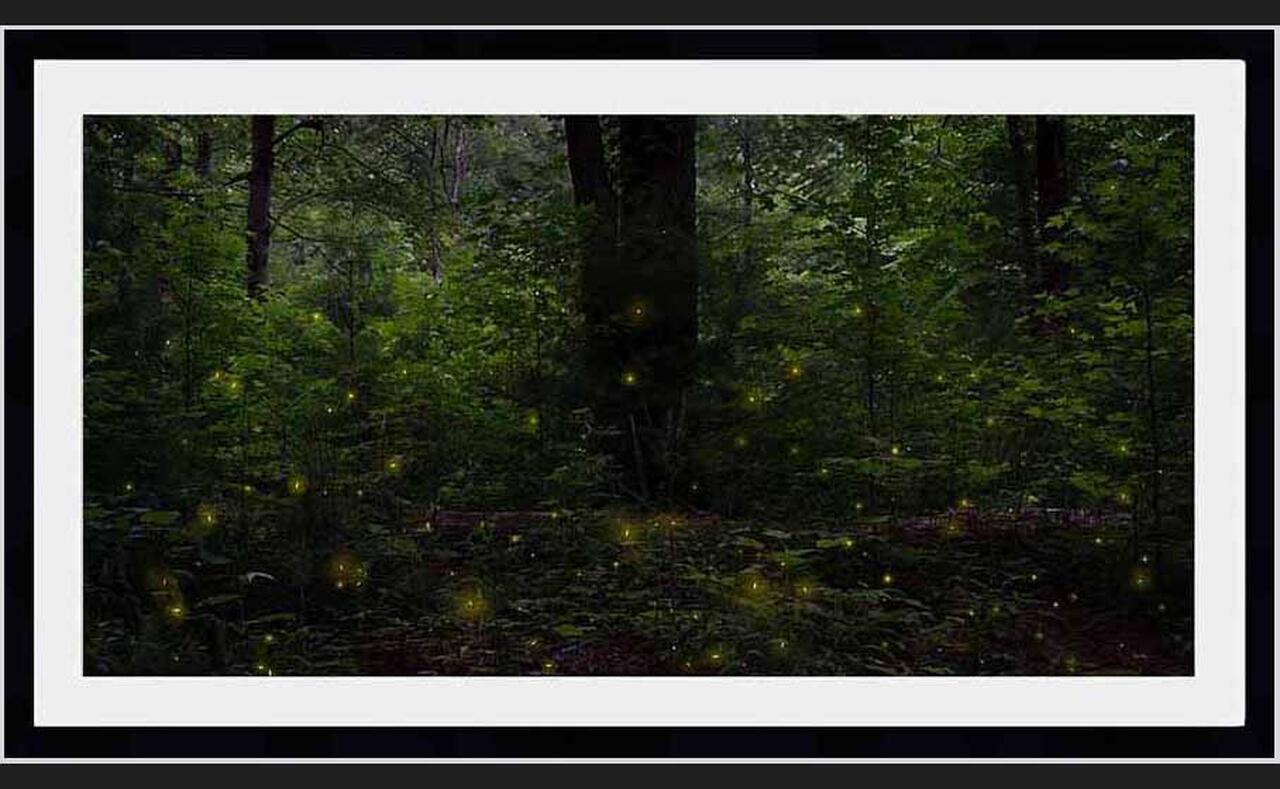
TruLife acrylic in a handcrafted Italian frame with a linen liner chosen for the image. Frame series, finish, and liner are settled with you after the order, and production begins from there. The frame and liner add about fourteen inches to the finished dimensions, worth allowing for when planning placement.
Signature Acrylic Edition of 50· Lumachrome TruLife · Gallery Float Mount
Face-mounted to TruLife acrylic and floated approximately one inch from the wall, with no frame to mediate between the image and the room. UV-resistant, anti-reflective, and scratch-resistant, with a lifetime guarantee against fading.
Signature Metal Edition of 50· ChromaLuxe Print · Gallery Float Mount
Color infused into the aluminum panel itself, floated from the wall on a concealed system. Where acrylic produces luminosity, metal produces clarity. Exceptional fade resistance with no glazing or coating required.
Fine Art Edition of 100· Hahnemühle Baryta Fine Art Paper
Printed without acrylic, so light meets the paper surface directly. Highlights stay luminous, shadows keep their nuance, and the surface has a tactile quality the other presentations approach differently. The understated choice, and the traditional one.
Complimentary shipping within the continental United States. International collector shipping available upon request.
Still deciding
Designing for Stillness
A guide to choosing art for restorative spaces
How to tell whether an image will still hold you in a year, how scale changes what a photograph does in a room, and how to match a piece to the work a room actually performs. It cites the research it draws on, and it is equally clear about where that research stops. About ten minutes to read.