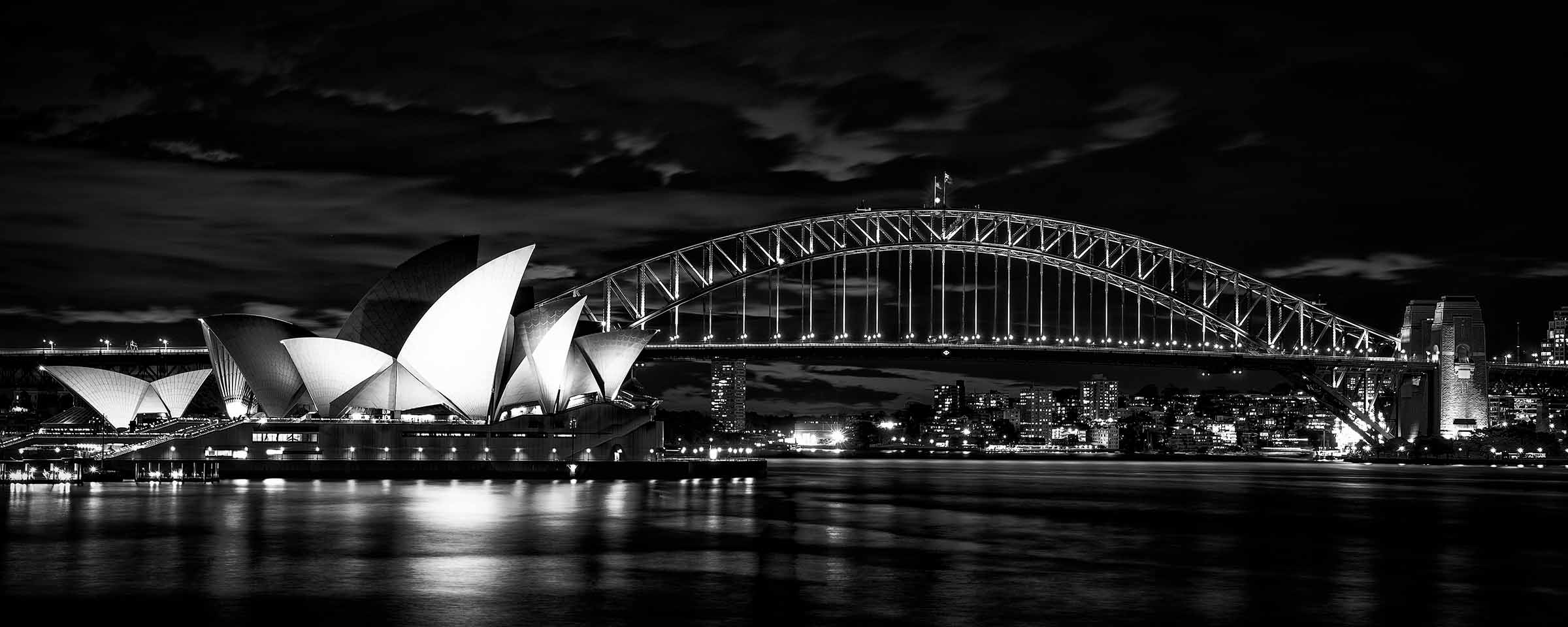
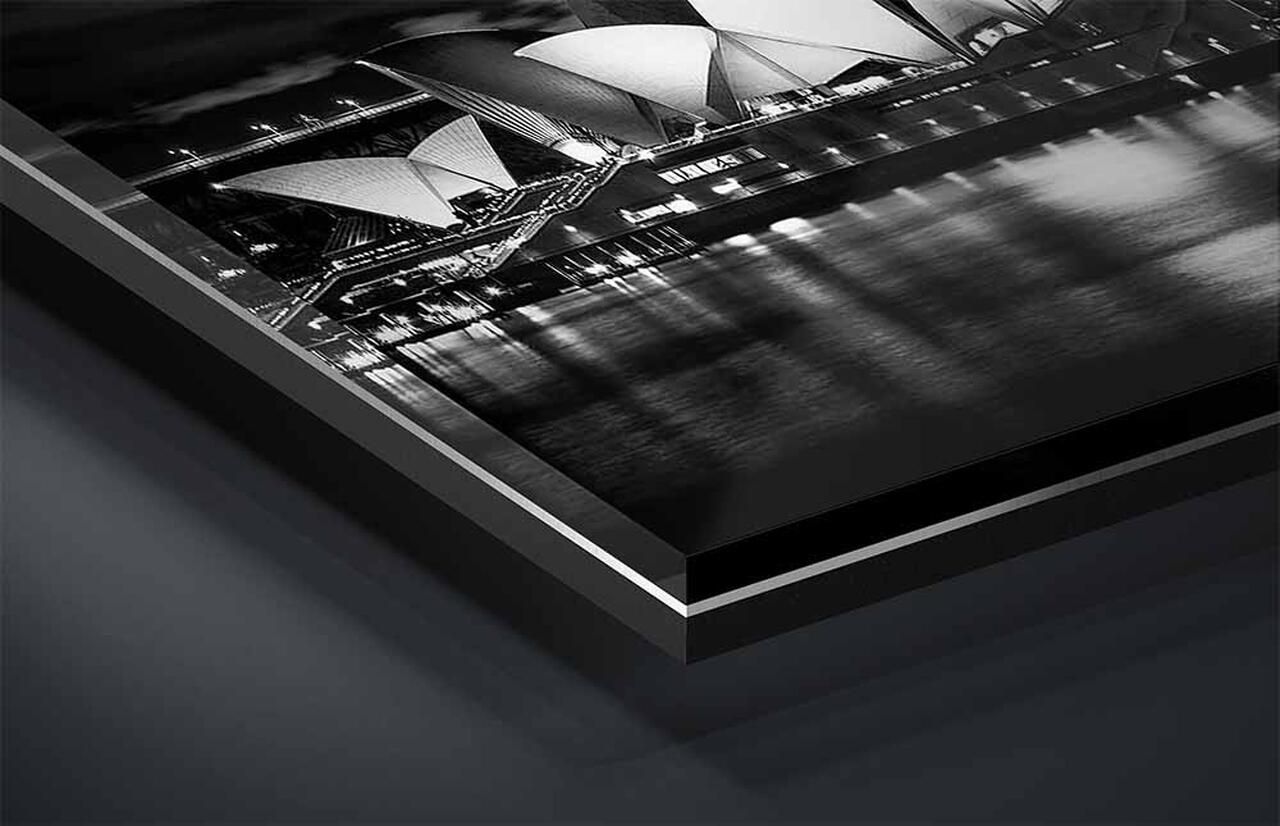
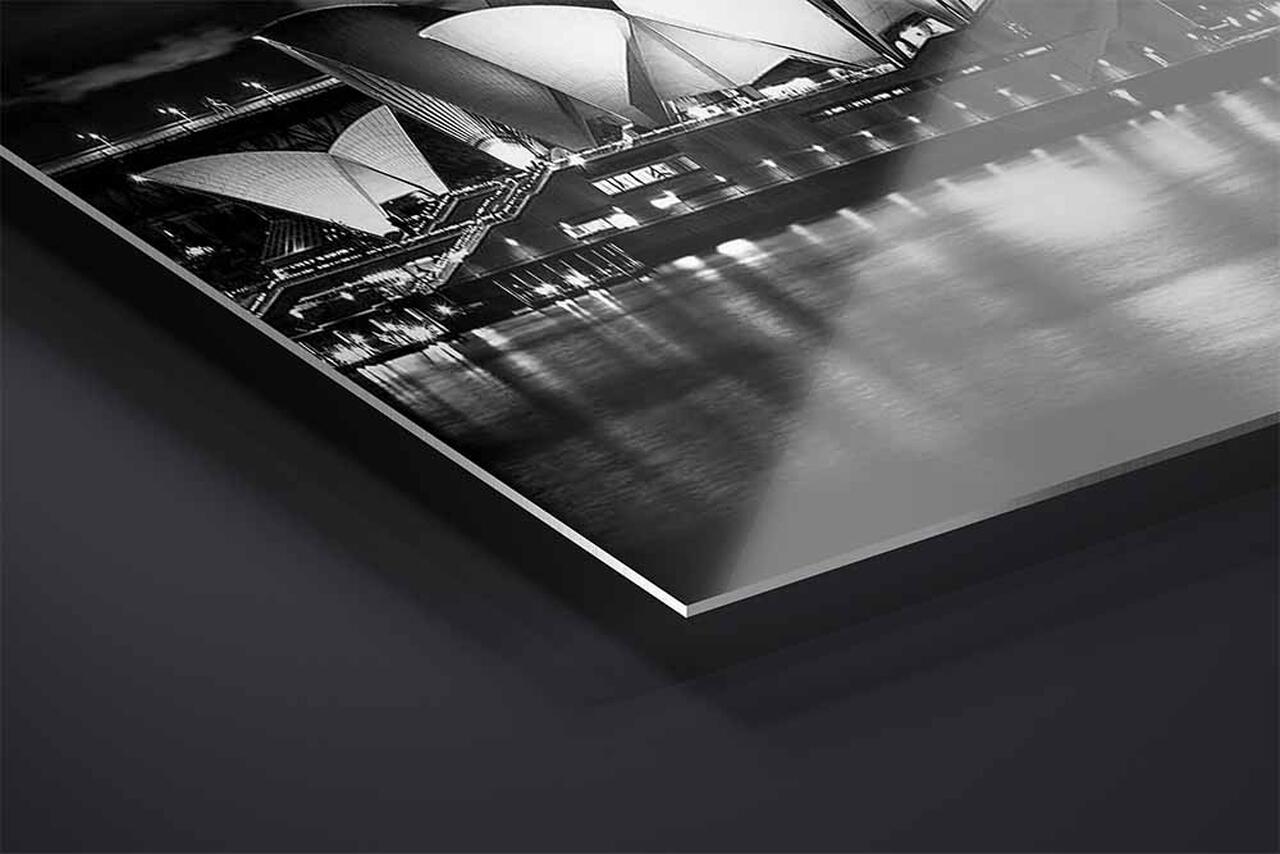
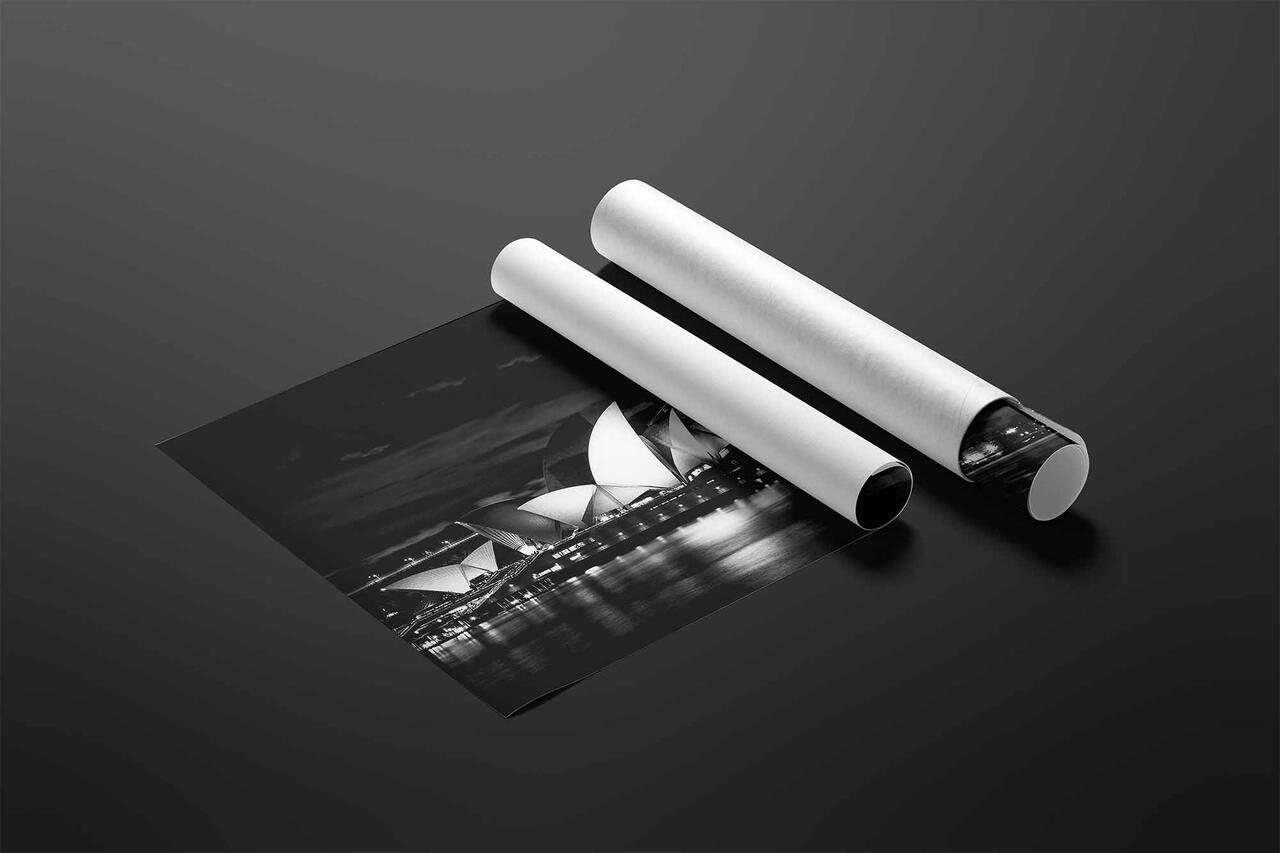
A 5:2 panoramic black and white photograph of the Sydney Opera House and Harbour Bridge at night, reflected in Sydney Harbour, Australia, available as a limited edition print in three sizes.
Artist's Story
I set up at Mrs Macquarie's Point and waited for the light to go and the boats to clear the harbor. It was a long exposure once it was properly dark, long enough that the water stopped being water and became a surface.
The sails read as white in this photograph, and white is the one thing they are not.
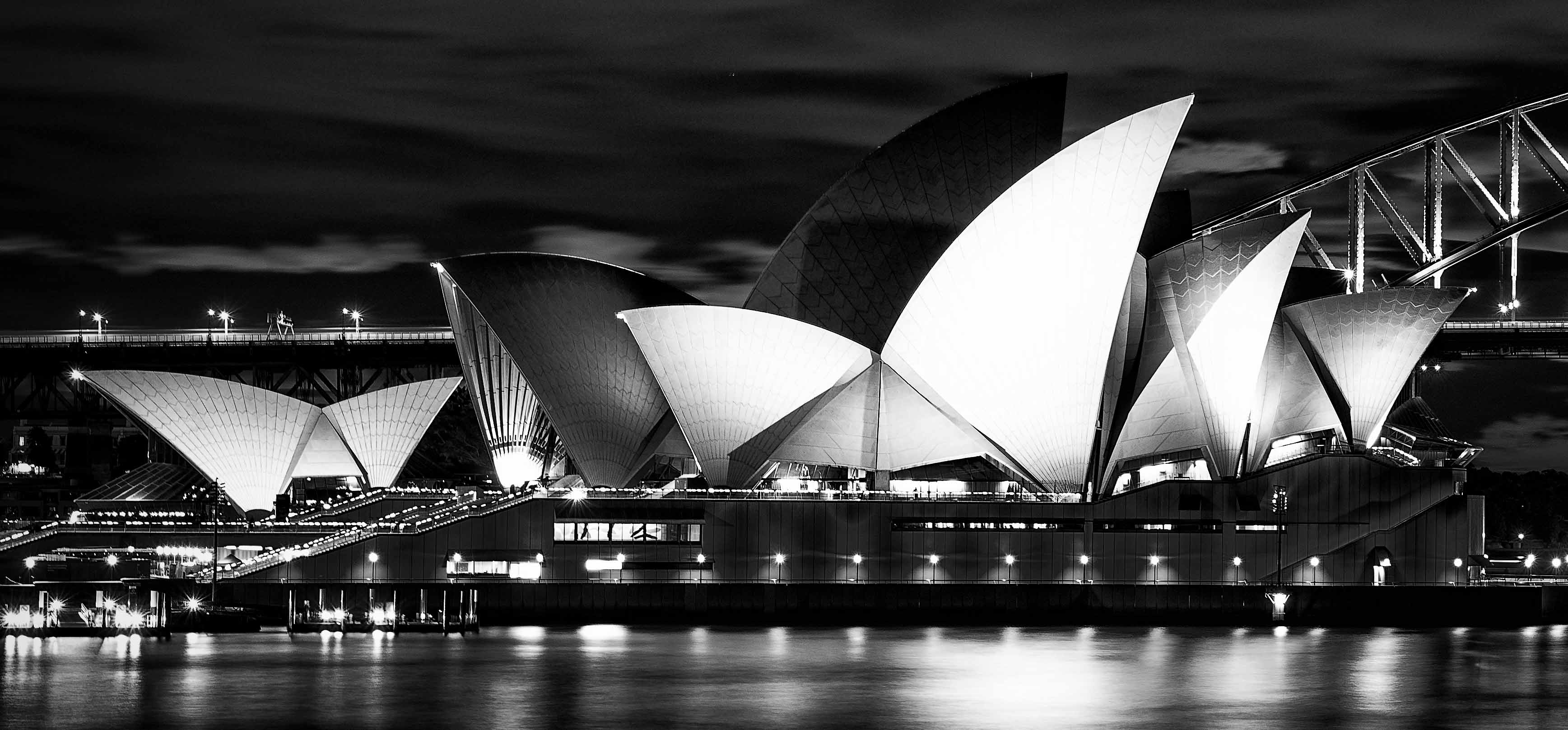
There are 1,056,006 tiles on that roof, in two kinds. One is a glossy white and the other is a matte cream, and they are laid in a chevron pattern across every panel. Utzon spent three years getting the tile right, working with a Swedish firm that until then had been supplying stoneware to paper mills. The result is a surface that is not one color and is not flat.
That is why the roof holds its shape under floodlight instead of turning into a white shape with no information in it. The glossy tiles return a hard specular point and the matte ones return a soft diffuse spread, so every panel is producing two different kinds of reflection at once, and the curve stays legible because the two do not fall off at the same rate across it.
In this frame the sails are the brightest thing by a wide margin, and about eight tenths of one percent of the picture is pure white. Nearly seventy percent of it is at or near black.
Nightfall at the Opera is a building that has been designed, down to a tile 120 millimeters square, to be looked at in exactly this light.
The sails at about a third of the frame width. The chevron tiling registers across every panel as a fine ribbed pattern rather than a smooth surface, and the seams between the precast panels run as lines following the curve. Along the podium the lamps separate into individual points with dark between them, the lit interiors resolve as rooms with windows, and on the water each light returns as its own column drawn out by the long exposure. Behind the sails the steel lattice of the bridge separates into individual members. Click to view at full size.
About This Photograph
Photographed in 2018 from Mrs Macquarie's Point in the Royal Botanic Garden, Sydney, Australia, looking west across Farm Cove. The Sydney Opera House, designed by Jørn Utzon, opened in 1973. The steel arch of the Sydney Harbour Bridge behind it opened in 1932. Made at night on a long exposure and rendered in black and white.
The roofs are usually called shells, which is a description of how they look rather than how they work. They are precast concrete panels carried on precast concrete ribs, and the curve of every one of them is taken from the surface of a single sphere. That decision is what made them possible to build, because identical curvature meant the panels could be cast from a small number of moulds instead of individually.
This is the darkest photograph in the collection by a wide margin. Its average brightness is thirty-three out of two hundred and fifty-five and its median is eleven, which means half the frame is nearly black. It is also the only one with real clipping at both ends, so the picture holds a true black and a true white at the same time.
Nightfall at the Opera
Steve Austinhttps://www.steveaustinphotography.com/
Location
Sydney Harbour, Sydney, Australia
Subject
Sydney Opera House · Harbour Bridge · night harbor
Capture
Single frame, long exposure at night
Format
Photograph · horizontal panorama, 5:2
Sizes
40 × 16 in · 60 × 24 in · 80 × 32 in
Print Media
TruLife Acrylic · ChromaLuxe Metal · Baryta paper
Edition
Limited, 25 / 50 / 100 by presentation
What it Does in a Room
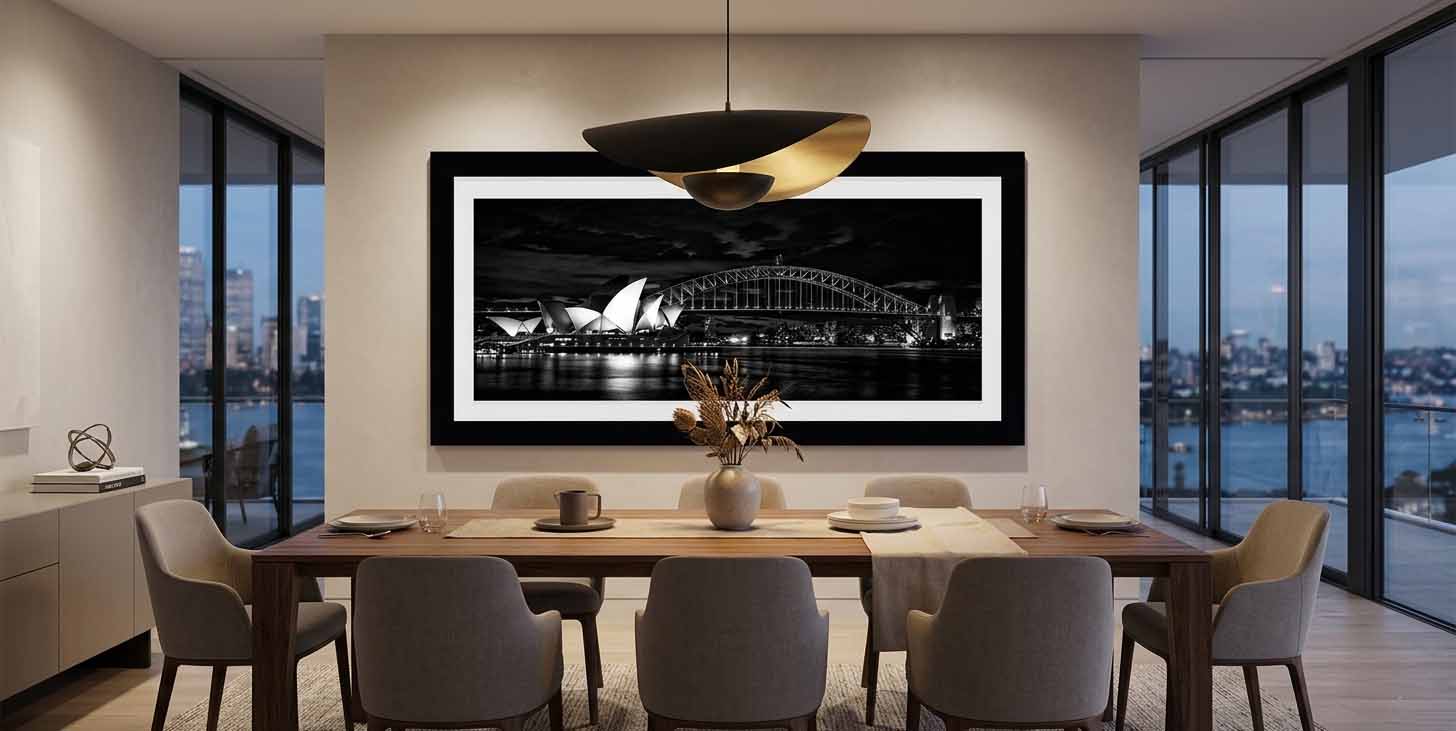
This is the one piece in the collection that wants a dark wall. Every other photograph here needs a ground lighter than itself, and the usual advice is to give a dark picture a pale surround so it reads as a picture rather than as a shadow. This one is dark enough that the advice inverts. Nearly seventy percent of the frame is at or near black, so on a white wall the panel reads as a hole cut in the plaster. On a charcoal or deep gray wall the blacks in the photograph and the wall behind it settle into the same register, the boundary between them stops being the loudest thing present, and what is left is the lit building appearing to hang in the dark. It is a genuinely different piece in a dark room, and better.
It has two subjects rather than one, and they are placed apart. The sails occupy the left third and the arch of the bridge occupies the right two thirds, with the darkest passage in the picture sitting between them. Nothing connects them across that gap, so the eye crosses back and forth rather than settling, and the picture keeps moving in a way a single-subject image does not. That is worth knowing when choosing a wall, because the piece needs to be seen whole. On a wall where it can only be taken in from an angle, or partly obscured by furniture at one end, one of the two subjects is lost and the traverse stops.
The third thing is that this is the only photograph in the collection whose subject has a size everyone already knows. Nobody standing in front of a landscape can say how large the hill is, so a bigger print simply shows more detail. Here the viewer knows roughly how big the Opera House is, so enlarging the print does not make the building bigger, it moves the viewer closer to it. At the largest size the effect is of standing at the water's edge; at the smallest it is of seeing the harbor from a hill. Choosing a size on this piece is choosing a vantage point.
Not sure which size the room calls for, or want dimensions not listed here? Sizes beyond 80 × 32 are available on request and ship crated by freight. That conversation is welcome before an order is placed. Start that conversation and I will answer within one business day.
The Spire, limited edition printSteve Austin95012100USD11https://schema.org/InStock
Questions about this photograph
How small is too small for a photograph this wide?
At the Intimate size the picture is forty inches across and sixteen inches tall. A night photograph is more forgiving at small sizes than a daylight one, because most of the frame carries no detail to lose. The two silhouettes hold, the reflections on the water hold, and the picture reads from across a room. What goes first is the bridge. Its arch is drawn out of steel lattice and a line of lights along the deck, and both are fine structures that collapse into a solid line when the print is short. The sails hold their shape longer, since they are large simple curves, but the chevron tiling and the seams between panels go early. The Collected at sixty by twenty-four is where the lattice separates and the bridge stops being a drawn arch and becomes a built one. If you are weighing a size against a specific wall, choosing the right print size covers the measurements and the viewing distances in more detail.
What changes at the largest size?
The buildings become built things. At the largest size the seams between the precast panels appear across the sails as fine lines running with the curve, and the tiling itself begins to register as a texture rather than as a smooth surface. On the bridge every member of the steel lattice separates from its neighbor, the hangers drop as individual vertical lines, and the string of lights along the deck resolves into separate lamps with dark between them. Behind and below, the lit windows of the buildings on the far shore become individual squares rather than a glow, and the reflections on the water separate into distinct columns of light with the long-exposure smear visible in each one. The flag on the bridge becomes a flag. Why scale matters covers what happens perceptually when a photograph reaches the size where the eye has to cross it.
What kind of room does this photograph suit?
Rooms that are dark, and rooms used after dark. A media room, a study, a bar, a windowless corridor, or any room with deep-toned walls will suit it, and it is the one piece here that gains rather than loses in a room with the lights down. Charcoal plaster, dark stone, and deep painted walls all work; white plaster is the one surface to avoid. Hang it where it can be seen whole and from straight on, with clear wall at both ends. Two things to keep away from it. Do not pair it with another city photograph, because two skylines in a room read as a travel set rather than as two pictures. And keep it off a wall that gets direct daylight, since a picture this dark shows every reflection in its glazing and daylight will put the room back into the surface. When your mind needs to rest takes the question further.
Every work ships insured and arrives with a signed certificate of authenticity.
If a piece is damaged in transit, the choice of replacement is always yours, and your edition number stays with you.
Production time runs 2 to 3 weeks for metal, 3 to 4 weeks for acrylic and paper, and 5 to 6 weeks for framed work.
Collector's Choice · TruLife ® Acrylic in Italian Frame
Collector Edition of 25· Lumachrome TruLife Acrylic · Handcrafted Italian Frame
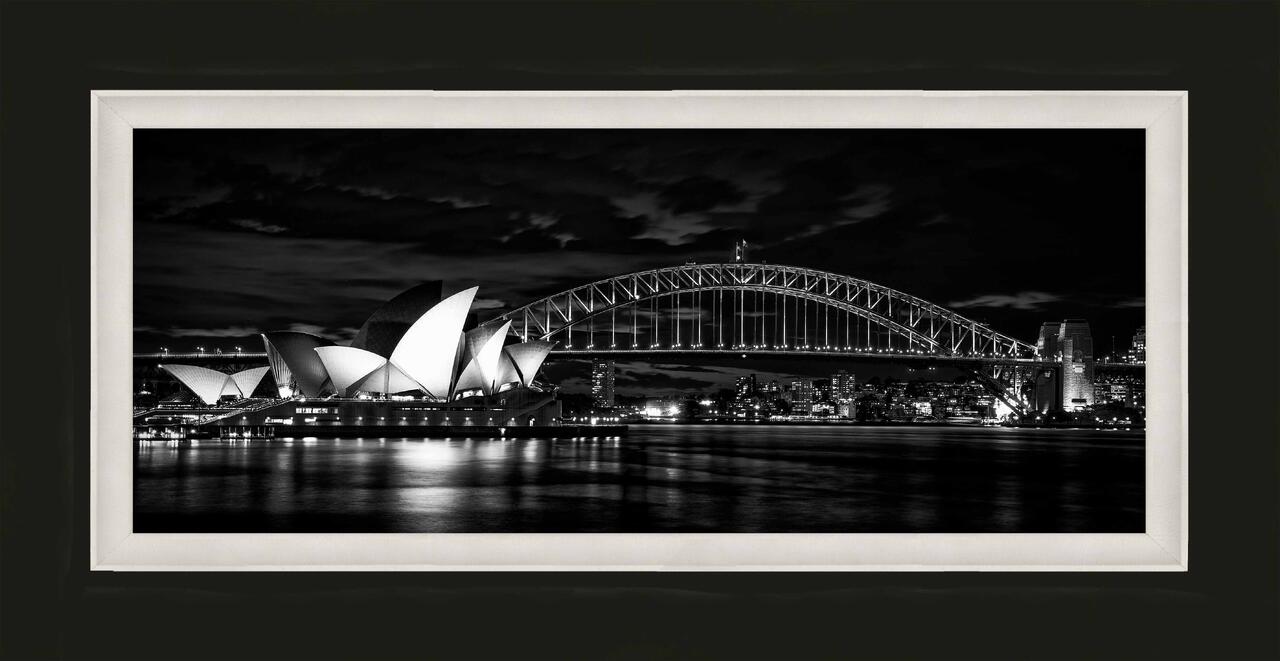
TruLife acrylic in a handcrafted Italian frame with a linen liner chosen for the image. Frame series, finish, and liner are settled with you after the order, and production begins from there. The frame and liner add about fourteen inches to the finished dimensions, worth allowing for when planning placement.
Signature Edition · TruLife ® Acrylic, Float Mount
Signature Edition of 50· Lumachrome TruLife Acrylic · Gallery Float Mount
Face-mounted to TruLife acrylic and floated approximately one inch from the wall, with no frame to mediate between the image and the room. UV-resistant, anti-reflective, and scratch-resistant, with a lifetime guarantee against fading.
Signature Edition of 50· ChromaLuxe Metal Print · Gallery Float Mount
Color infused into the aluminum panel itself, floated from the wall on a concealed system. Where acrylic produces luminosity, metal produces clarity. Exceptional fade resistance with no glazing or coating required.
Fine Art Edition of 100· Hahnemühle Baryta Fine Art Paper
Printed without acrylic, so light meets the paper surface directly. Highlights stay luminous, shadows keep their nuance, and the surface has a tactile quality the other presentations approach differently. The understated choice, and the traditional one.
Complimentary shipping within the continental United States. International collector shipping available upon request.
Still deciding
Designing for Stillness
A guide to choosing art for restorative spaces
How to tell whether an image will still hold you in a year, how scale changes what a photograph does in a room, and how to match a piece to the work a room actually performs. It cites the research it draws on, and it is equally clear about where that research stops. About ten minutes to read.