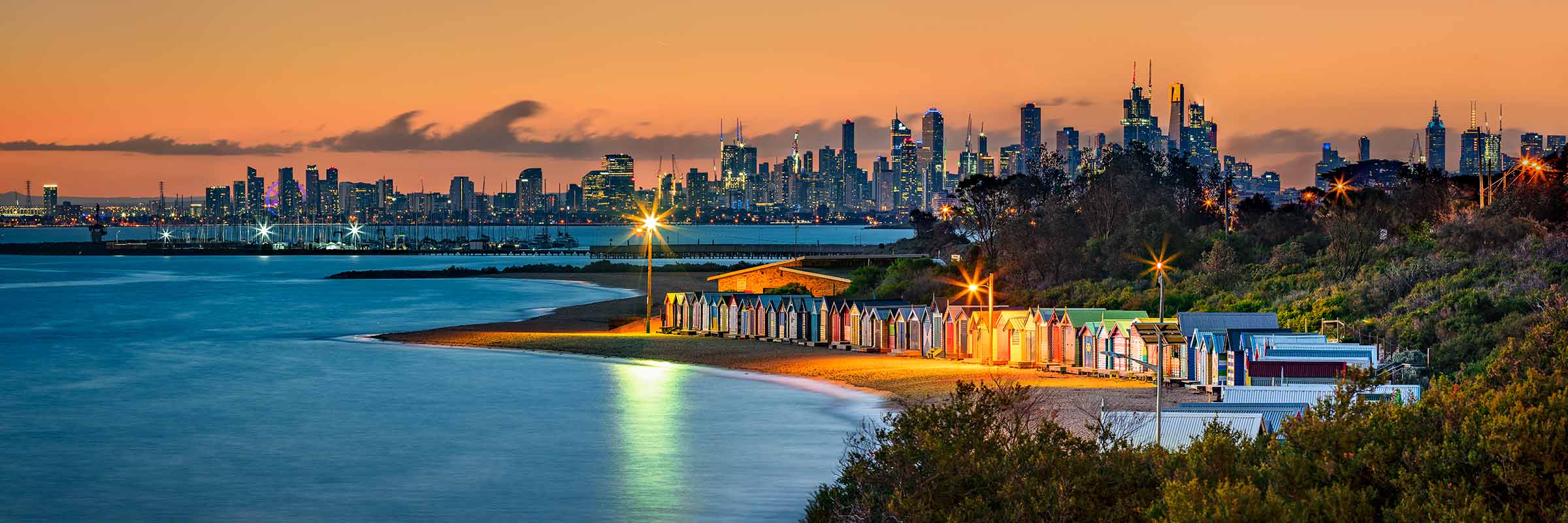
A 3:1 panoramic photograph of the Brighton bathing boxes at dusk with the Melbourne skyline beyond, in Victoria, Australia, available as a limited edition print in three sizes.
Artist's Story
At Dendy Street Beach in Brighton, about thirteen kilometers south of the center of Melbourne, a row of timber huts stands facing Port Phillip Bay. Eighty-two of them are the heritage boxes, built mostly between 1907 and 1933. Bayside has added more since, and the row now runs to about ninety-three.
They have no electricity and no running water. You cannot sleep in one, let it, or run anything out of it. They change hands for more than four hundred thousand dollars, and what you get for that is not the box.
You get a licence. The land belongs to the City of Bayside and the licence lets you keep a box on it. There is no title and no stamp duty, and you have to be a Bayside ratepayer before you are allowed to buy one at all. So four hundred thousand dollars buys permission to have a shed on a beach you do not own, in which you may not sleep, wire, plumb, or trade.
I set up on the rise where the road runs along the top of the beach, and waited for the city to come on behind them.
In 1983 a coastal committee decided to clear some two thousand buildings off the shore of Port Phillip Bay, and the bathing boxes were on the list. The owners fought it. By 1985 the boxes were recommended for retention, and in 2000 they were heritage listed. So the protection is recent, and it was argued for by the people who use them.
There is a category of thing our economy has almost no language for, which is a place that exists only in order to be a place. The boxes do nothing. They hold a deckchair, some towels, a bucket. What that money buys is somewhere to sit and look at water with nothing expected of you in return.
Nothing Asked is that row at the close of a day. Eighty-two small rooms that had to be defended on the grounds that they are for nothing.
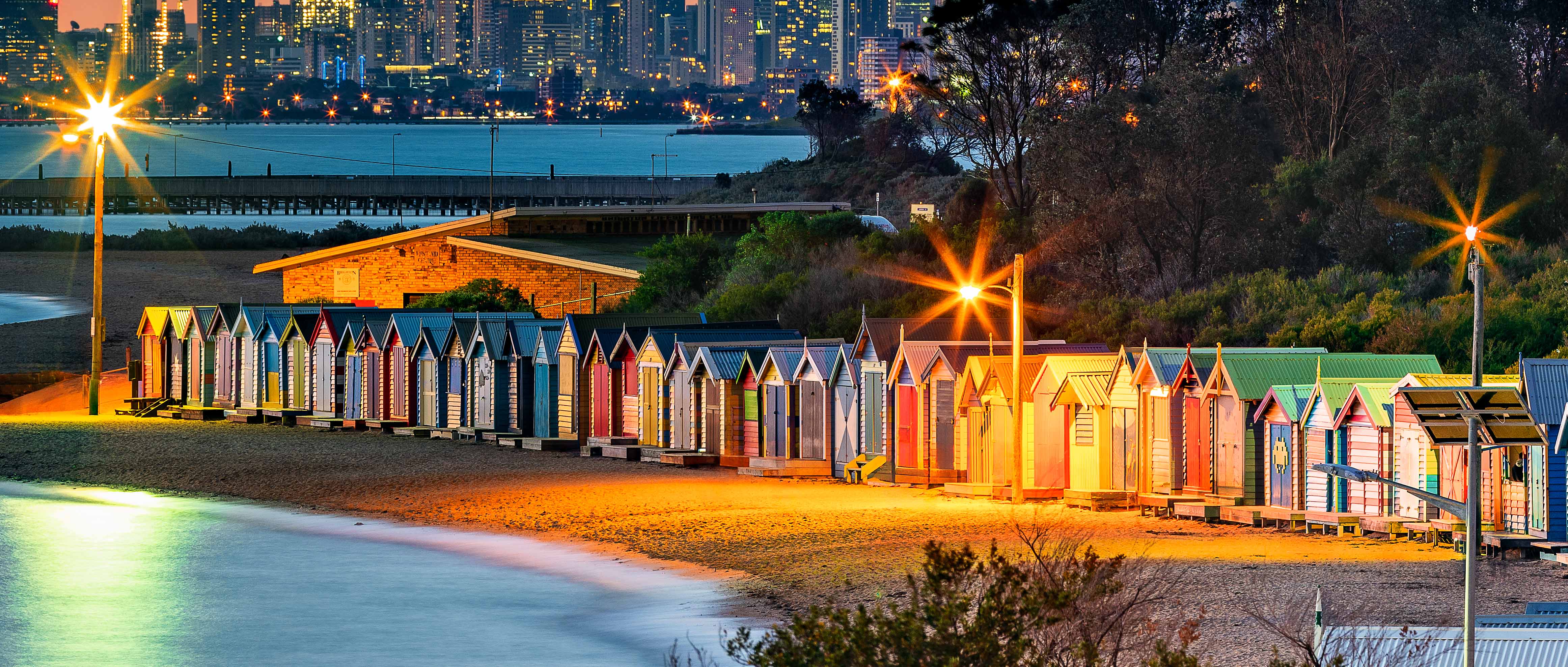
The row at about a third of the frame width. Each hut separates from its neighbors, the pitched roofline of each one reads as its own shape, and the painted schemes resolve into stripes, panels, and blocks that differ down the whole row. The corrugation of the iron roofs registers as a texture and the timber steps at the front of each box become individual boards. Behind them the skyline separates into distinct towers with lit floors visible as rows of windows, and along the water the lamps resolve into their diffraction spikes. Click to view at full size.
About This Photograph
Dendy Street Beach in Brighton, City of Bayside, about thirteen kilometers south of central Melbourne, Victoria, Australia, at dusk with the Melbourne skyline beyond. This is a single frame image. The boxes are timber framed with weatherboard sides and corrugated iron roofs, uniform in scale and construction, and individually painted by their licence holders.
The first bathing boxes appeared along the Brighton coastline in the 1860s. Most of those at Dendy Street were built between 1907 and 1933, and in 1934 boxes from other beaches were moved here and set at the top of the beach rather than at the high water mark, where they had stood before.
The top of this frame and the bottom of it are two different photographs by measurement. Along the upper edge red runs a hundred and nineteen points ahead of blue; along the lower edge blue leads by twenty-three. That hundred and forty point swing across the height of the picture is the largest in the collection, and it is the difference between a sky at sunset and water at dusk.
Nothing Asked
Steve Austinhttps://www.steveaustinphotography.com/
Location
Brighton, Melbourne, Australia
Subject
Brighton bathing boxes · Melbourne skyline · dusk
Capture
Single frame at dusk
Format
Photograph · horizontal panorama, 3:1
Sizes
36 × 12 in · 60 × 20 in · 90 × 30 in
Print Media
TruLife Acrylic · ChromaLuxe Metal · Baryta paper
Edition
Limited, 25 / 50 / 100 by presentation
What it Does in a Room
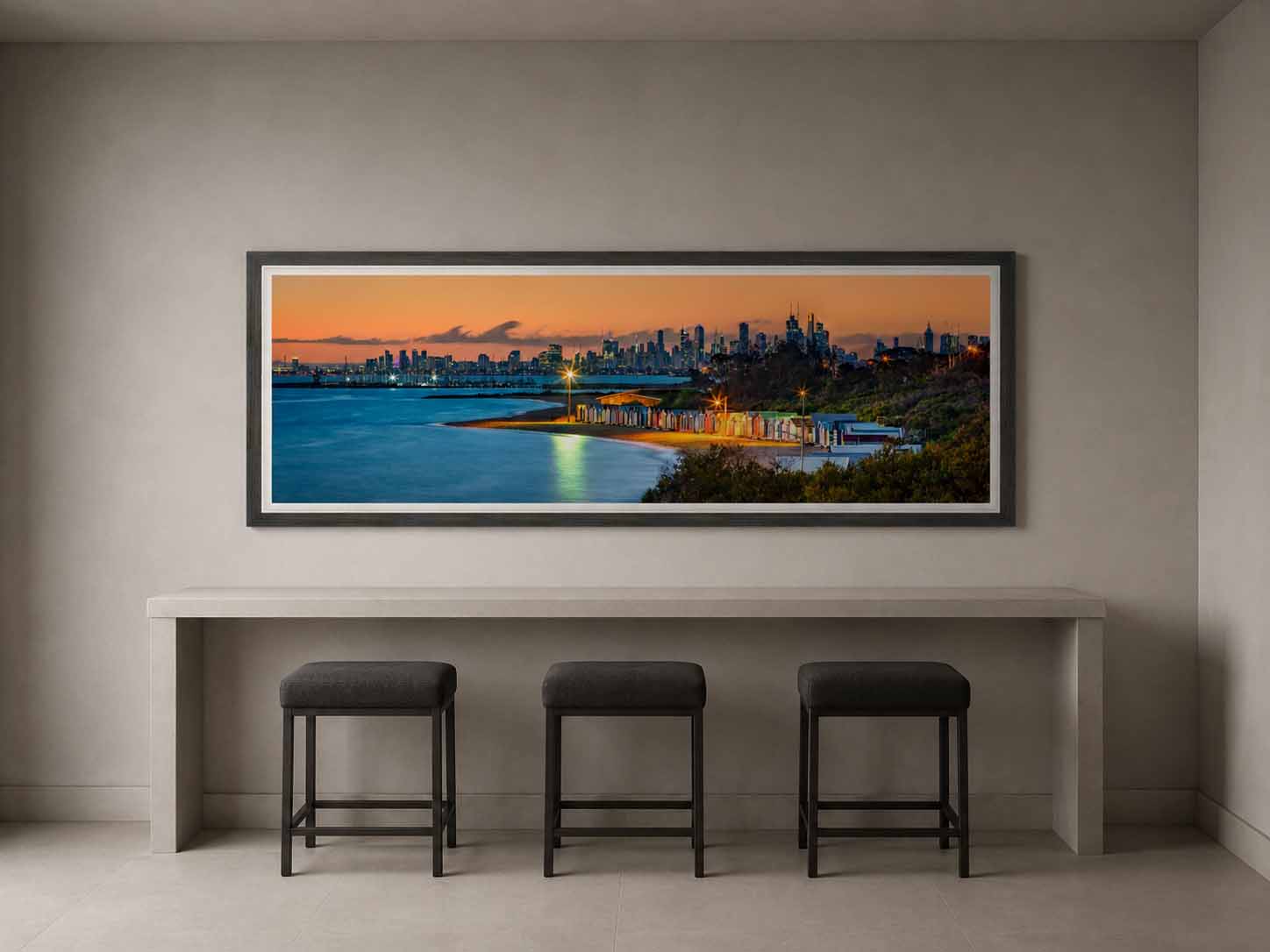
This photograph has a direction, and it should be hung with that in mind. Open water and empty sand fill the left half; the boxes, the vegetation, and the density of the city gather to the right. The shoreline runs as a long curve between them. A picture built that way is not symmetrical and does not want to be centered on a wall as though it were. It finishes best with the open side facing the open part of the room and the dense side toward a corner, a return, or a doorway, so the composition arrives somewhere instead of running off the edge. Hung the other way around it feels subtly wrong in a way most people notice without being able to say why.
It is also the only piece here whose light is artificial. Street lamps, lit windows, the glow along the front of the boxes, the reflection running down the wet sand: all of it comes from things somebody switched on. That matters more on a wall than it sounds, because a photograph lit by lamps sits comfortably in a room lit by lamps. A daylight landscape hung in an evening room always reads as a window onto a different hour. This one agrees with the room it is in after dark, and it is one of the few pieces in the collection that looks more at home at ten at night than at ten in the morning.
The third thing is that it has more in it than anything else here. Water, sand, eighty-odd painted huts, scrub, a pier, a city, and a sky, with no single focal point among them and no obvious place the composition wants the eye to stop. That makes it a poor choice for a corridor, where a picture gets four seconds and needs to deliver in one, and a good one for a room where people sit for an hour. It keeps giving up new things for a long time, and most of them are small.
Not sure which size the room calls for, or want dimensions not listed here? Sizes beyond 90 × 30 are available on request and ship crated by freight. That conversation is welcome before an order is placed. Start that conversation and I will answer within one business day.
How small is too small for a photograph this wide?
At the Intimate size the picture is thirty-six inches across and twelve inches tall, and this is a photograph that punishes that. The row of boxes occupies about a third of the width and contains upwards of forty visible huts, so at thirty-six inches each one is roughly a quarter of an inch across on the print. At that size they are a band of colored marks rather than a row of small buildings, and the doors, the gable ends, and the individual paint schemes are gone. The skyline goes the same way, from a city of separate towers into a serrated line. The sky, the bay, and the curve of the shore all survive at any size, so what you have at thirty-six inches is a handsome evening bay scene with a colored stripe in it. The Collected at sixty by twenty is the smallest size at which the boxes are buildings. If you are weighing a size against a specific wall, choosing the right print size covers the measurements and the viewing distances in more detail.
What changes at the largest size?
The boxes become individual. At ninety by thirty each hut separates from its neighbors with a visible gap between them, the pitched roofline of each one reads as its own shape, and the painted schemes resolve into stripes, panels, and blocks that differ from box to box down the whole row. The corrugation of the iron roofs registers as a texture. Behind them the skyline separates into distinct towers with lit floors visible as rows of individual windows, and the cranes among them read as cranes. Along the water the lamps resolve into their diffraction spikes and the long reflection down the wet sand shows the ripple that produced it. In the foreground the scrub on the right separates into individual plants rather than a dark mass. Why scale matters covers what happens perceptually when a photograph reaches the size where the eye has to cross it.
What kind of room does this photograph suit?
Rooms people stay in. A sitting room, a bar, a study, a dining room, anywhere a person is in a chair rather than passing through. It hangs at ordinary height and the warm band across the top wants to sit above eye level, which a standard hang gives it. On materials it is accommodating, since it carries an orange sky, a blue bay, and a full spectrum along the row of boxes, so almost any palette finds something to agree with. Two things to avoid. Do not hang it where the wall behind it is strongly colored, because the boxes are already carrying every color and a fourth or fifth one on the wall turns the row into noise. And give it a wall with space to its left, since the composition opens that way and needs somewhere to open into. When your mind needs to rest takes the question further.
Every work ships insured and arrives with a signed certificate of authenticity.
If a piece is damaged in transit, the choice of replacement is always yours, and your edition number stays with you.
Production time runs 2 to 3 weeks for metal, 3 to 4 weeks for acrylic and paper, and 5 to 6 weeks for framed work.
Each print is made to order and takes its place in a numbered edition, so sales are final. Before you choose, I am glad to help: send a photo of your wall and I will show you this work in your room at true scale, at no charge. Start a conversation
Collector's Choice · TruLife ® Acrylic in Italian Frame
Collector Edition of 25· Lumachrome TruLife Acrylic · Handcrafted Italian Frame
TruLife acrylic in a handcrafted Italian frame with a linen liner chosen for the image. Frame series, finish, and liner are settled with you after the order, and production begins from there. The frame and liner add about fourteen inches to the finished dimensions, worth allowing for when planning placement.
Signature Acrylic Edition of 50· Lumachrome TruLife · Gallery Float Mount
Face-mounted to TruLife acrylic and floated approximately one inch from the wall, with no frame to mediate between the image and the room. UV-resistant, anti-reflective, and scratch-resistant, with a lifetime guarantee against fading.
Signature Metal Edition of 50· ChromaLuxe Print · Gallery Float Mount
Color infused into the aluminum panel itself, floated from the wall on a concealed system. Where acrylic produces luminosity, metal produces clarity. Exceptional fade resistance with no glazing or coating required.
Fine Art Edition of 100· Hahnemühle Baryta Fine Art Paper
Printed without acrylic, so light meets the paper surface directly. Highlights stay luminous, shadows keep their nuance, and the surface has a tactile quality the other presentations approach differently. The understated choice, and the traditional one.
Complimentary shipping within the continental United States. International collector shipping available upon request.
Still deciding
Designing for Stillness
A guide to choosing art for restorative spaces
How to tell whether an image will still hold you in a year, how scale changes what a photograph does in a room, and how to match a piece to the work a room actually performs. It cites the research it draws on, and it is equally clear about where that research stops. About ten minutes to read.