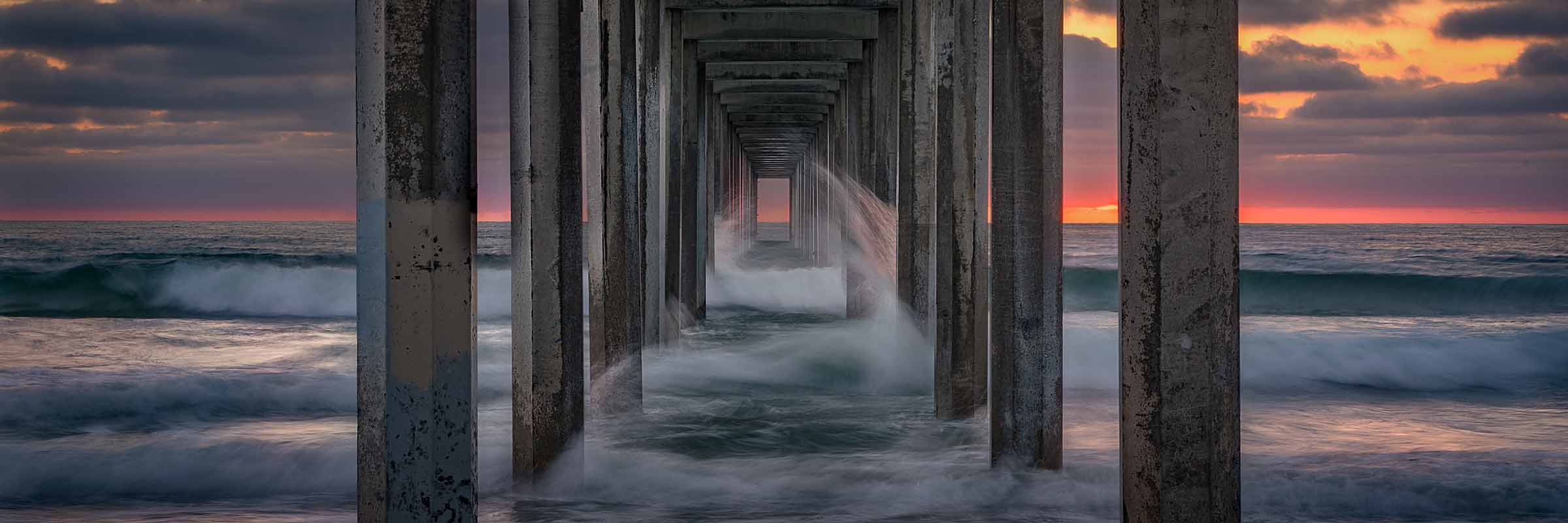
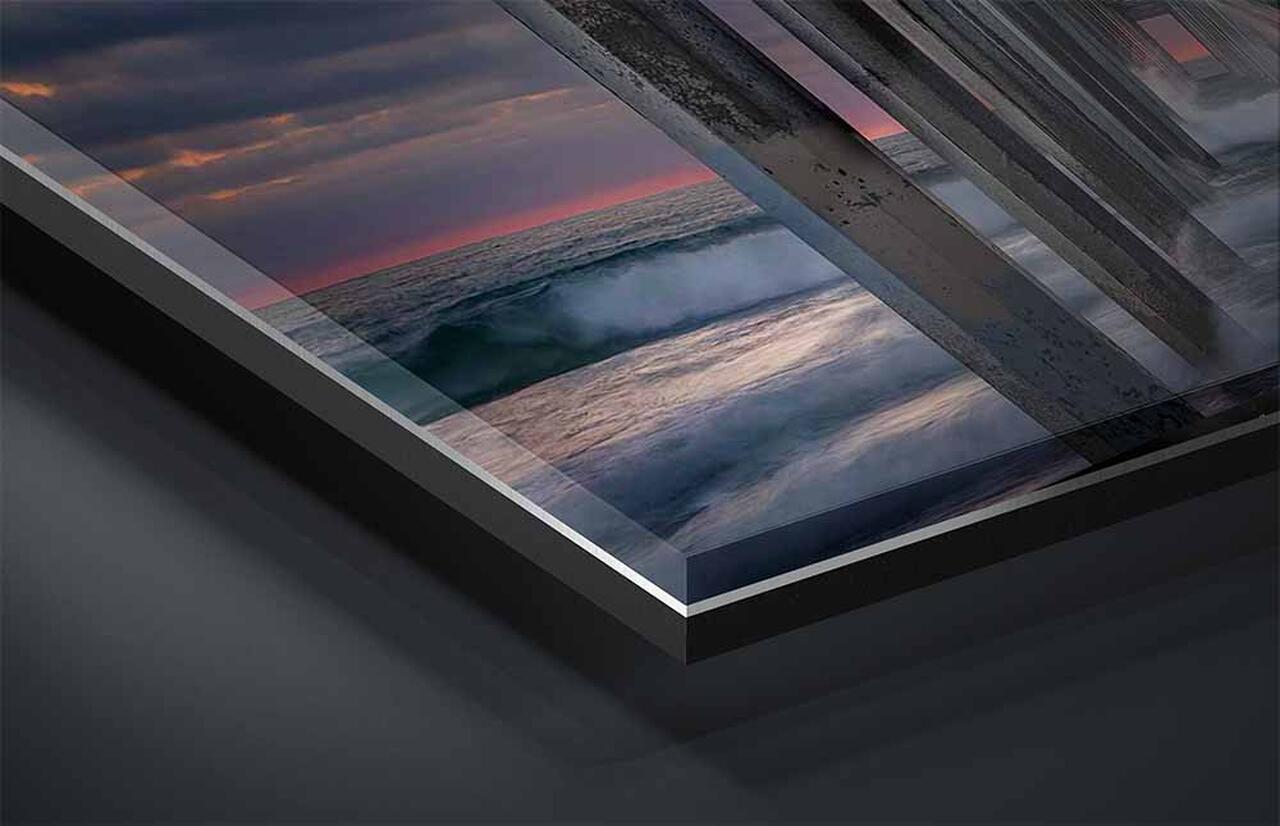
A 3:1 panoramic photograph of waves breaking against the pilings beneath Scripps Pier at sunset in La Jolla, California, available as a limited edition print in three sizes.
Artist's Story
I was standing in the water under the Scripps pier, further in than was sensible, with the sun about to touch the sea somewhere off to the right.
What I was there for was the spray. A wave runs in, hits a pile, and stops. The water behind it is still moving, and it has to go somewhere, so it goes up. For about a second there is a plume of it standing in the air between the columns, and then it is gone and the next wave is coming.
A pier deck is a roof. Nothing from overhead gets into the space underneath it, so at that hour the only light down there is arriving almost horizontally, in under the deck from a sun sitting on the water. Everything in that space is lit from the side or not at all.
Seawater in bulk absorbs light. A wave is a dark object, and it stays dark no matter what is shining on it. Break the same water into droplets and its surface area goes up enormously, and each droplet refracts and scatters instead of swallowing. So a plume of spray, made of exactly the water that was dark a half second earlier, becomes something that can carry light.
That is what happened in front of me for about an hour. The wave arrived dark, hit the pile, went into the air, lit up orange, and fell back dark. I measured it afterward. In this frame the plume runs fifteen to twenty points warmer than the water it came out of, and brighter besides. The pile standing next to it is the darkest thing in the picture, because a concrete column in flat light catches the sun on one edge only.
The pier will be there for decades and the sun does this on every clear evening. The thing in this photograph lasted about a second.
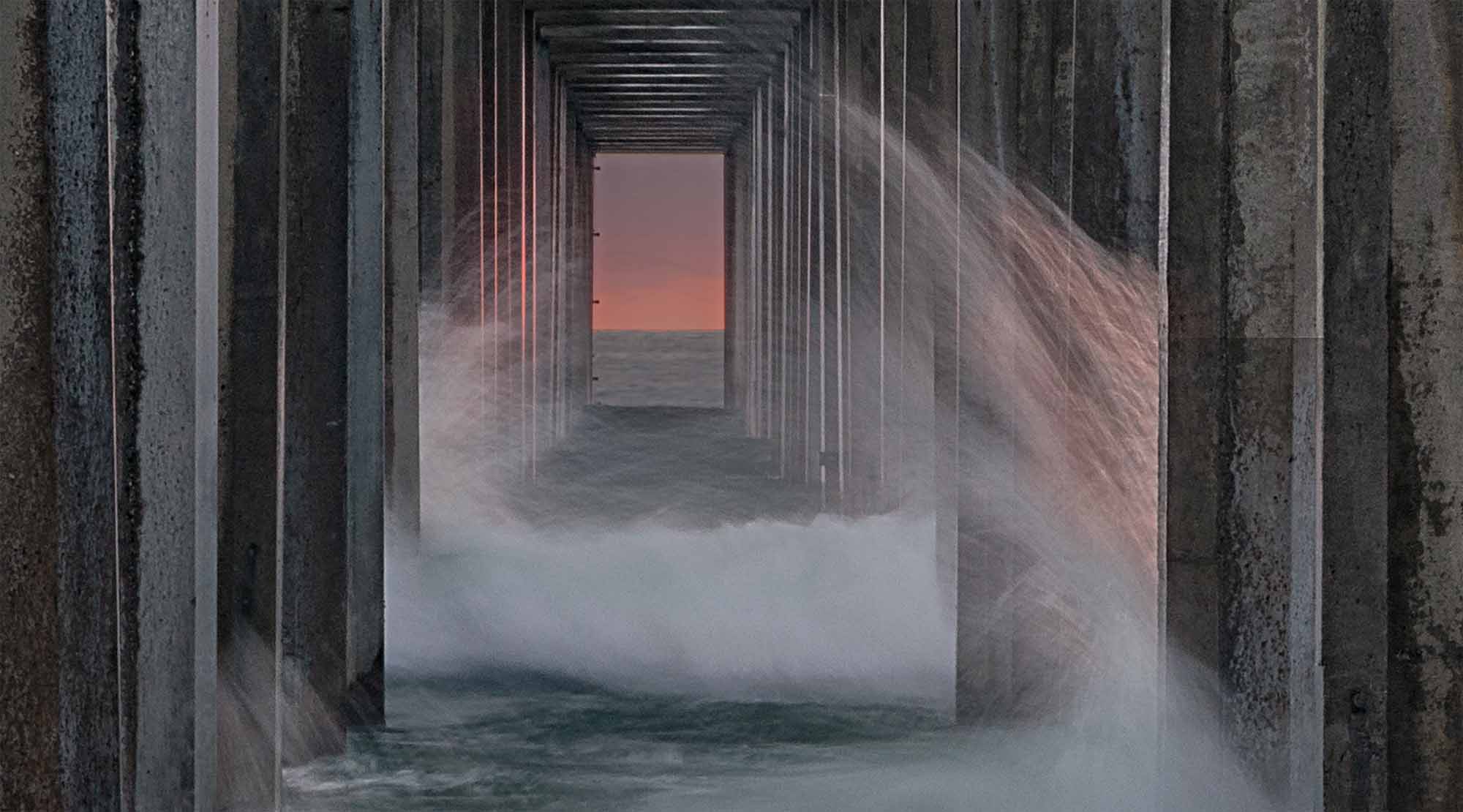
The spray and the near piles at about a third of the frame width. On a ninety inch print this section runs roughly thirty inches across. The plume separates into individual streaks with dark between them, so the direction it is traveling becomes readable. On the piles the surface comes clear: the pour lines, the blotchy loss where the concrete face has come away, and the bolt heads set into the beams overhead. Down the corridor the bays resolve one behind another to the opening at the end, where the sea and the last of the sunset show through. Click to view at full size.
About This Photograph
Beneath the Scripps pier at La Jolla, San Diego County, California, at sunset, looking seaward along the line of piles. This is a single frame image, made with a shutter long enough that the moving water veils and the plume registers as a shape rather than as separate droplets.
All the color in this photograph is in a band across the top. The sky and the open sea beyond the piles measure about forty points toward red; everything below and between the columns measures cool or neutral, and the picture as a whole comes out within a fraction of a point of neutral. The warm light is present in only one horizontal strip and everything else is a version of gray.
The piles carry a darker band around them near the waterline. That band is not staining. It marks the zone that is wet and dry in turn as the tide moves, and the height of it is a record of the tidal range at this spot.
Passage
Steve Austinhttps://www.steveaustinphotography.com/
Location
Scripps Pier, La Jolla, California
Subject
Breaking surf · pier pilings · sunset light
Capture
Single frame at sunset
Format
Photograph · horizontal panorama, 3:1
Sizes
36 × 12 in · 60 × 20 in · 90 × 30 in
Print Media
TruLife Acrylic · ChromaLuxe Metal · Baryta paper
Edition
Limited, 25 / 50 / 100 by presentation
What it Does in a Room
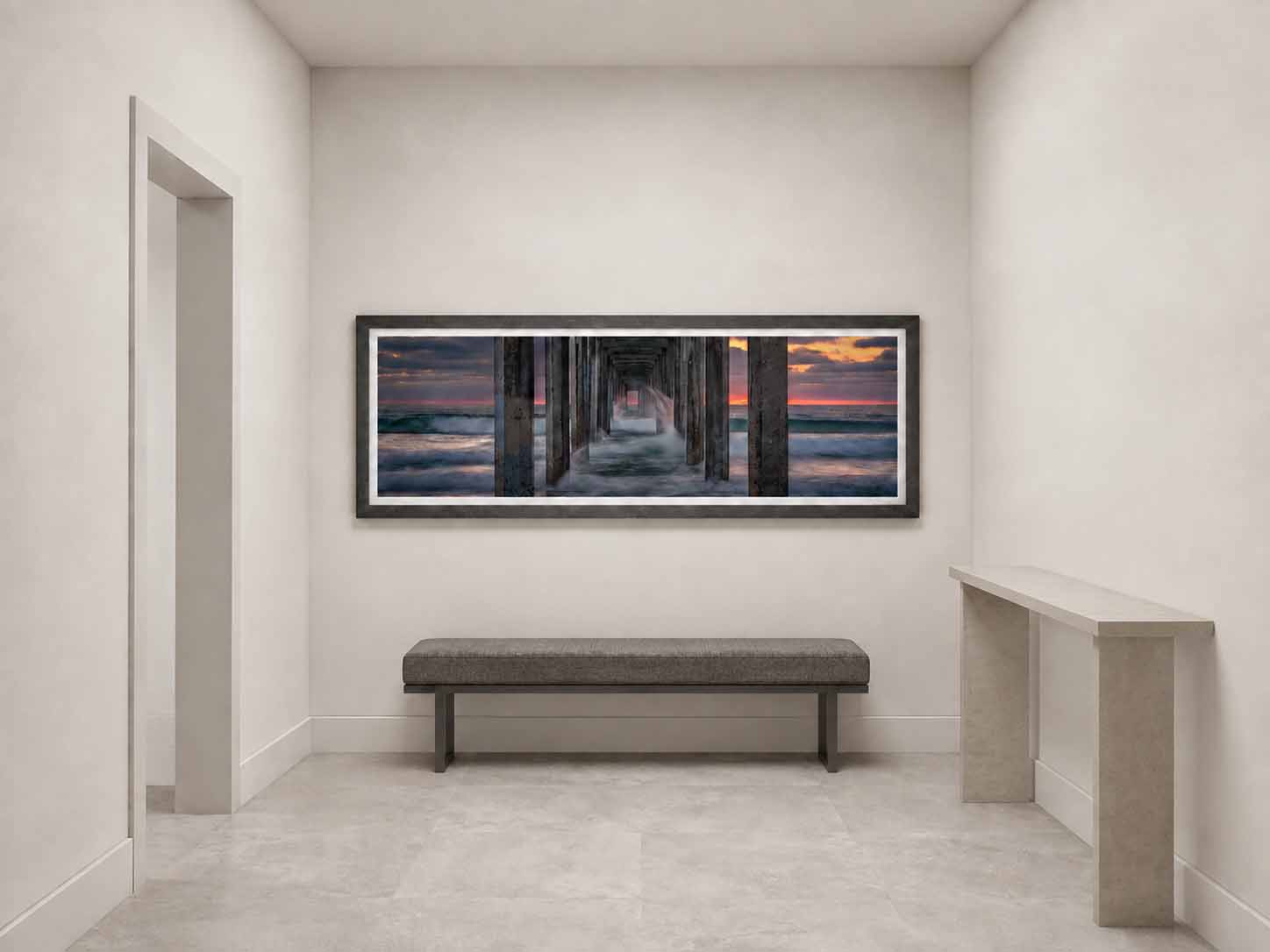
Everything in this frame converges on a single point, and a picture built that way does something to a room that a picture without one cannot. Parallel lines that meet on the page read as depth, and the eye follows them to where they meet whether or not it means to. On a wall that means the piece pulls a viewer toward it rather than holding them where they stand, and the effect strengthens as they get closer, because the convergence steepens with proximity. That makes it well suited to the end of a corridor, the far wall of a long room, or anywhere a person walks toward rather than past.
It is also a dark photograph, and darker than anything else in this collection. Its average brightness is well below the middle of the range, and the border of the picture is darker still. A dark piece behaves like an opening in a wall rather than an object on one, and it needs the wall around it to be lighter than it is or it stops reading as a picture and starts reading as a shadow. Pale plaster, white, or light stone give it what it needs. It also does better with even ambient light than with a spotlight, because a directed beam on a dark surface finds the sheen before it finds the image.
The third thing is where the color lives. Every warm tone in this photograph is in a band across the top, and the rest is gray. Measured across the frame the whole picture is within a fraction of a point of neutral, so it will not push a room warm or cool, and the orange it does contain is concentrated in a strip about a fifth of the height. A room picks that strip up as an accent rather than as a palette, which is why the piece sits comfortably against materials it has no color in common with.
Not sure which size the room calls for, or want dimensions not listed here? Sizes beyond 90 × 30 are available on request and ship crated by freight. That conversation is welcome before an order is placed. Start that conversation and I will answer within one business day.
How small is too small for a photograph this wide?
At the Intimate size the picture is thirty-six inches across and twelve inches tall, and the convergence survives that better than the subject does. Lines meeting at a point are legible at any size, so the corridor still pulls, and the bright aperture at the end of it still reads. What goes is the spray. At twelve inches tall the plume between the columns becomes a pale shape rather than a mass of lit water with structure inside it, and the difference between the lit droplets and the dark wave they came from flattens into a single value. The picture works as a graphic of a corridor; it stops being a photograph of an event. The Collected at sixty by twenty is where the plume becomes water again. If you are weighing a size against a specific wall, choosing the right print size covers the measurements and the viewing distances in more detail.
What changes at the largest size?
The spray becomes water in the air. At ninety by thirty the plume separates into streaks and threads with dark between them, so you can see it as a body of moving droplets with direction and speed rather than as a lit cloud, and the edge where it stops being spray and starts being wave becomes findable. On the piles the surface comes clear: the pour lines, the blotchy loss where the concrete face has come away, the pale rectangle of a patch on the near column, and the darker tidal band running around each one. Down the corridor the columns resolve one behind another for six or seven bays before they merge, which is what makes the depth measurable rather than implied. At the far end the aperture becomes a distinct opening with sea and sky visible through it. Why scale matters covers what happens perceptually when a landscape reaches the size where the eye has to cross it.
What kind of room does this photograph suit?
Rooms with a light wall and some distance in front of the piece. Because the photograph is dark it wants a pale ground behind it, and because it converges it wants somewhere a person can approach it from. A hallway, a stairwell landing, the far end of an open plan, or a wall you see from another room all suit it. It hangs at ordinary height, since the vanishing point sits a little above the middle of the frame and lands near eye level on a standard hang. The thing to avoid is a wall with a lot of competing structure on it, shelving, panel joints, or a run of doors, because the photograph is already made of repeated verticals and a second set nearby confuses which ones are the picture. When your mind needs to rest takes the question further.
Every work ships insured and arrives with a signed certificate of authenticity.
If a piece is damaged in transit, the choice of replacement is always yours, and your edition number stays with you.
Production time runs 2 to 3 weeks for metal, 3 to 4 weeks for acrylic and paper, and 5 to 6 weeks for framed work.
Collector's Choice · TruLife ® Acrylic in Italian Frame
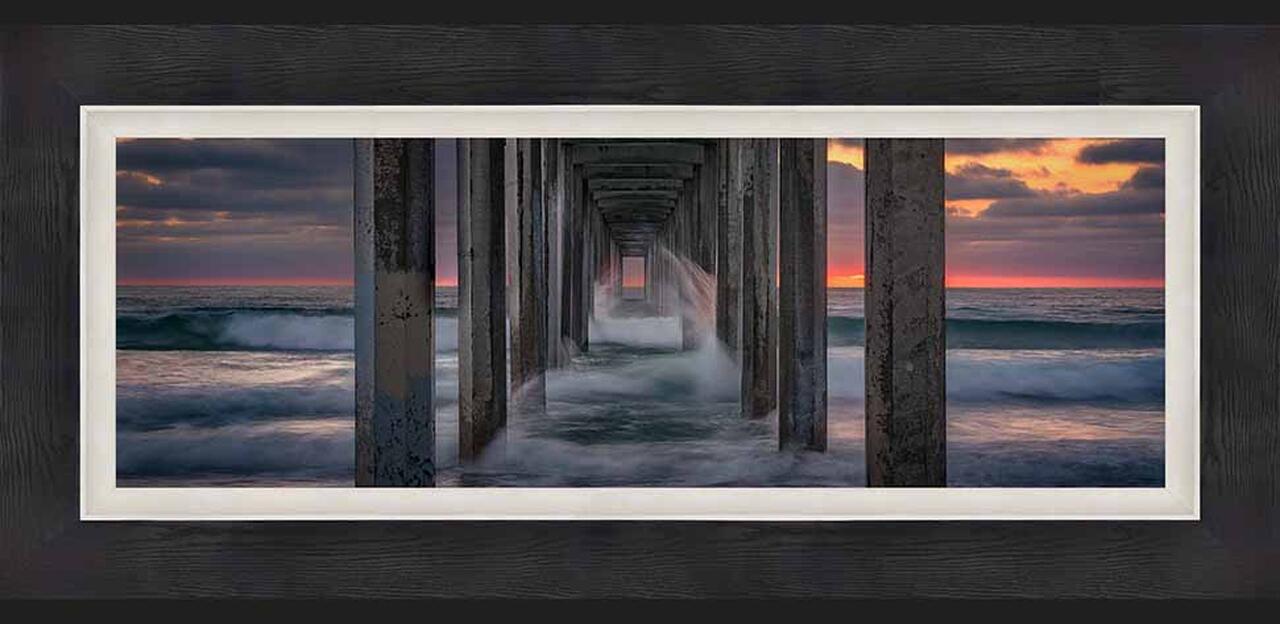
Collector Edition of 25· Lumachrome TruLife Acrylic · Handcrafted Italian Frame
TruLife acrylic in a handcrafted Italian frame with a linen liner chosen for the image. Frame series, finish, and liner are settled with you after the order, and production begins from there. The frame and liner add about fourteen inches to the finished dimensions, worth allowing for when planning placement.
Signature Edition · TruLife ® Acrylic, Float Mount
Signature Edition of 50· Lumachrome TruLife Acrylic · Gallery Float Mount
Face-mounted to TruLife acrylic and floated approximately one inch from the wall, with no frame to mediate between the image and the room. UV-resistant, anti-reflective, and scratch-resistant, with a lifetime guarantee against fading.
Signature Edition of 50· ChromaLuxe Metal Print · Gallery Float Mount
Color infused into the aluminum panel itself, floated from the wall on a concealed system. Where acrylic produces luminosity, metal produces clarity. Exceptional fade resistance with no glazing or coating required.
Fine Art Edition of 100· Hahnemühle Baryta Fine Art Paper
Printed without acrylic, so light meets the paper surface directly. Highlights stay luminous, shadows keep their nuance, and the surface has a tactile quality the other presentations approach differently. The understated choice, and the traditional one.
Complimentary shipping within the continental United States. International collector shipping available upon request.
Still deciding
Designing for Stillness
A guide to choosing art for restorative spaces
How to tell whether an image will still hold you in a year, how scale changes what a photograph does in a room, and how to match a piece to the work a room actually performs. It cites the research it draws on, and it is equally clear about where that research stops. About ten minutes to read.