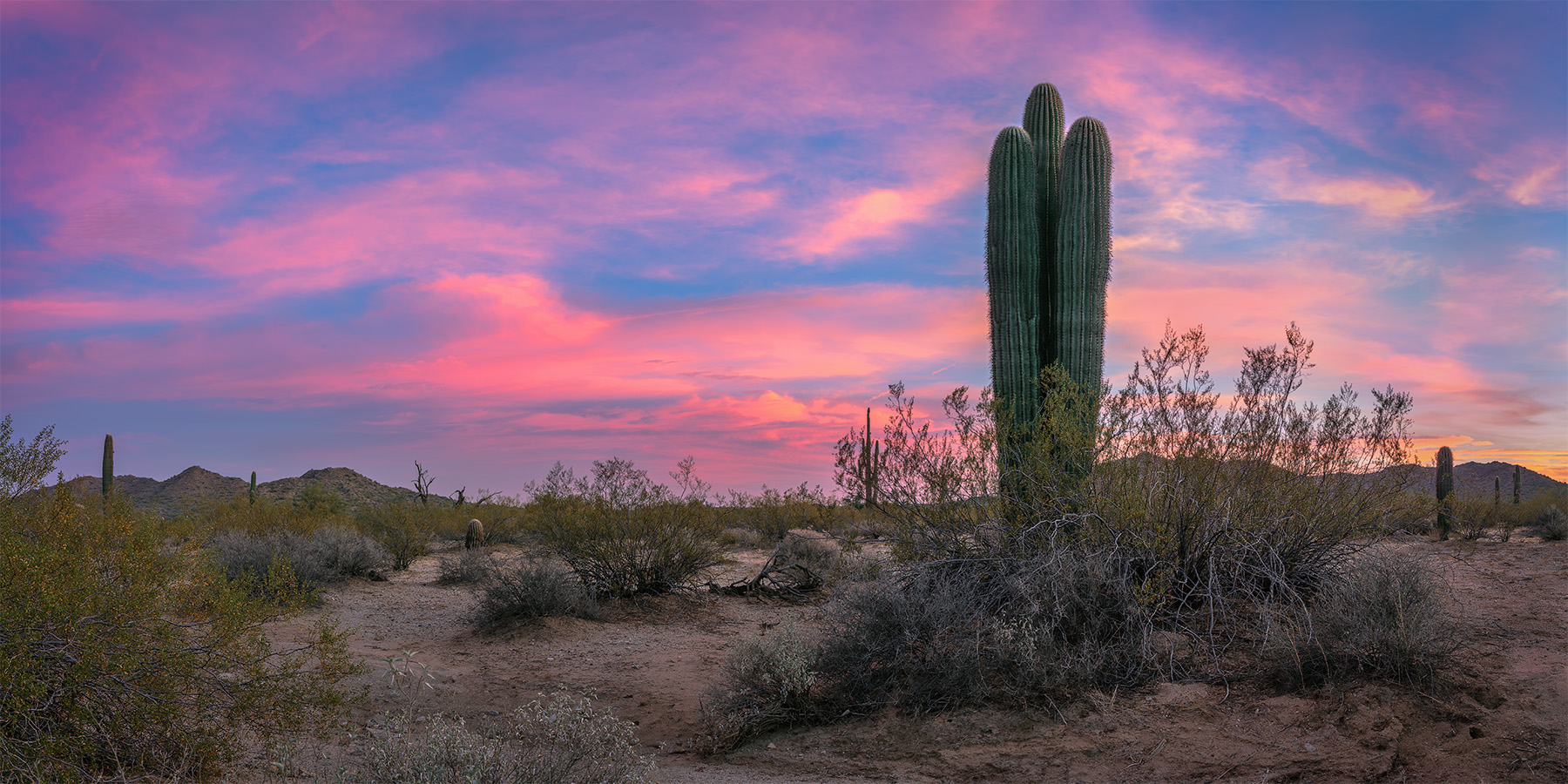
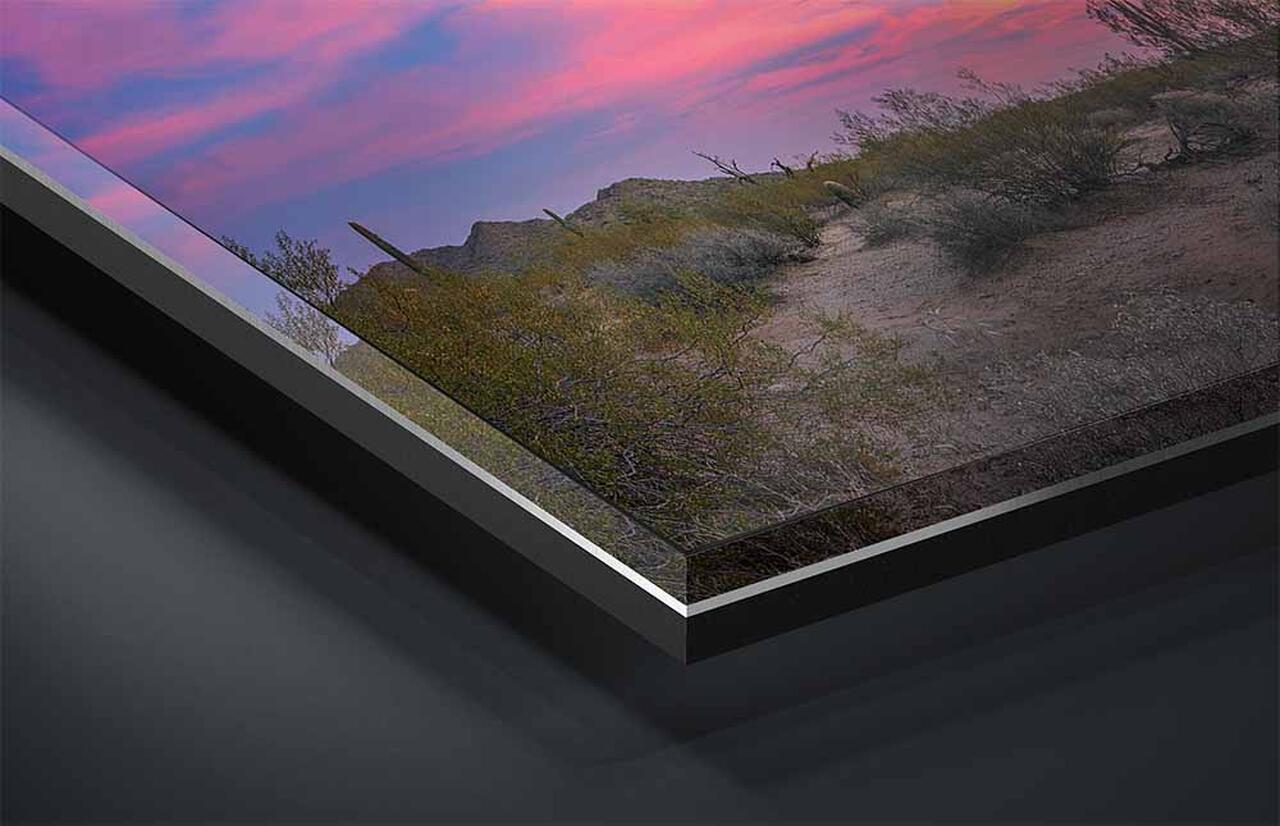
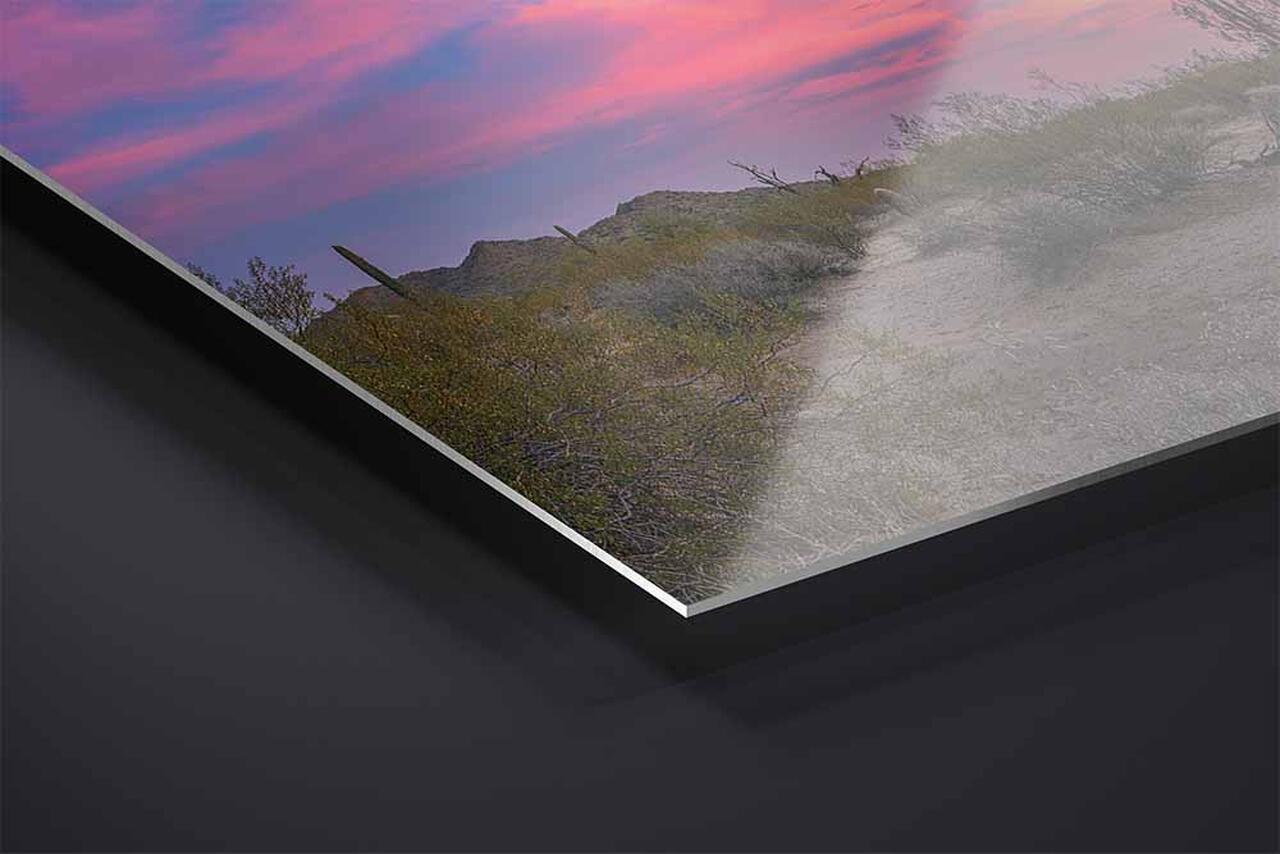
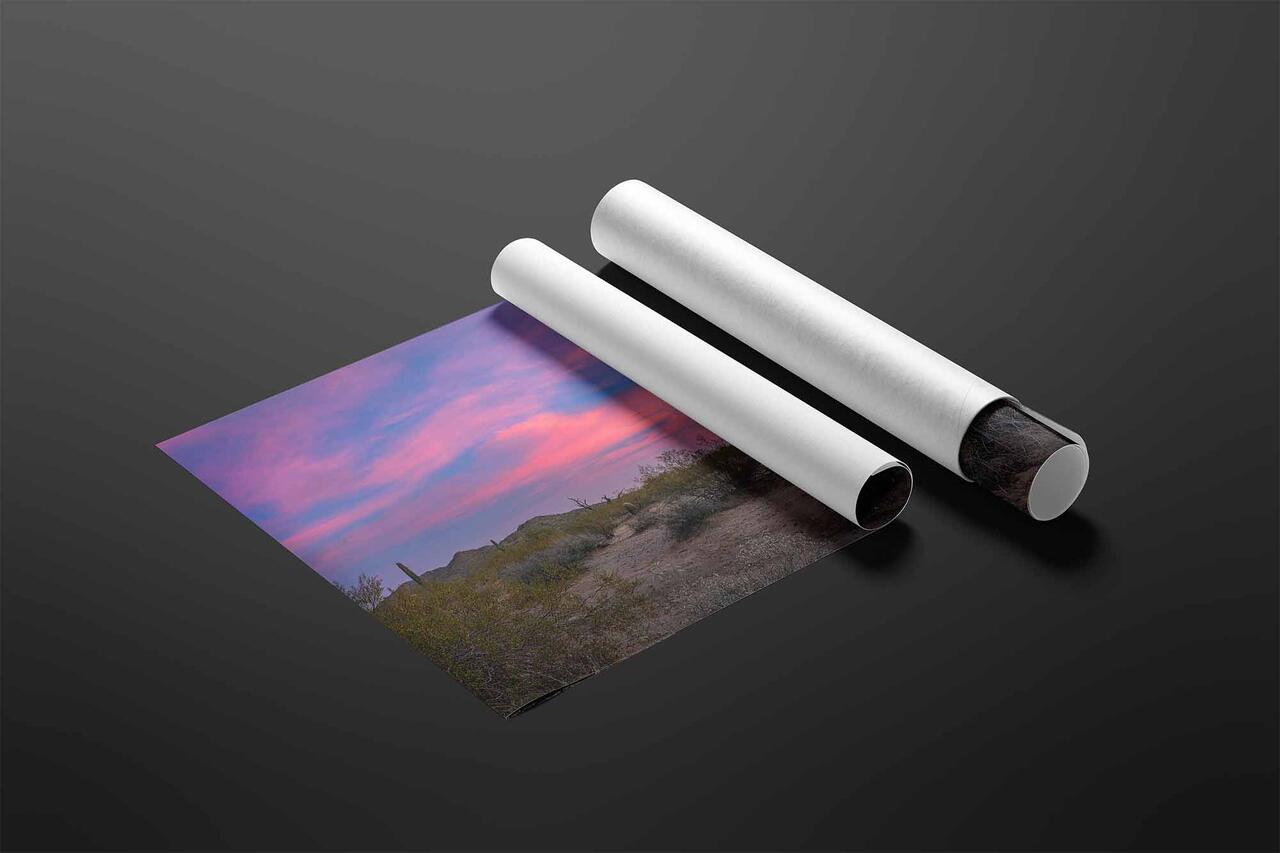
A 2:1 panoramic photograph of a saguaro beneath a pink dusk sky, San Tan Mountain Regional Park, Arizona, United States, available as a limited edition print in three sizes.
Artist's Story
I went out into San Tan Mountain Regional Park at dusk looking for saguaros, and found one standing in a thicket with two arms rising beside the trunk. The woody growth around its feet is the part of the picture that explains the rest of it.
A saguaro that size did not start out in the open.
The seed is roughly the size of a pinhead, and a seedling spends its first years shorter than a thumb. On bare desert ground at that size it cooks in summer, freezes in winter, and is easy for anything that eats plants to find. What gets one through is shelter. Seedlings survive under the canopy of a palo verde, a mesquite, or an ironwood, which moderates the ground temperature and keeps them out of sight. Birds perch in those same trees and drop seeds beneath them, so the seed lands exactly where the shelter already is. Decades on, the saguaro is drawing water from the same ground as the tree that raised it, and usually outlasts it.
The arms come much later. A saguaro puts out none at all for the first several decades of its life, and this one carries two, which places it deep into a lifespan that runs well past a century. It was standing here before the park was a park.
Pastel Horizons is a sky with no white in it anywhere. Not one pixel in this frame reaches it, and the brightest thing in the picture is a cloud at a hundred and seventy-eight out of two hundred and fifty-five.
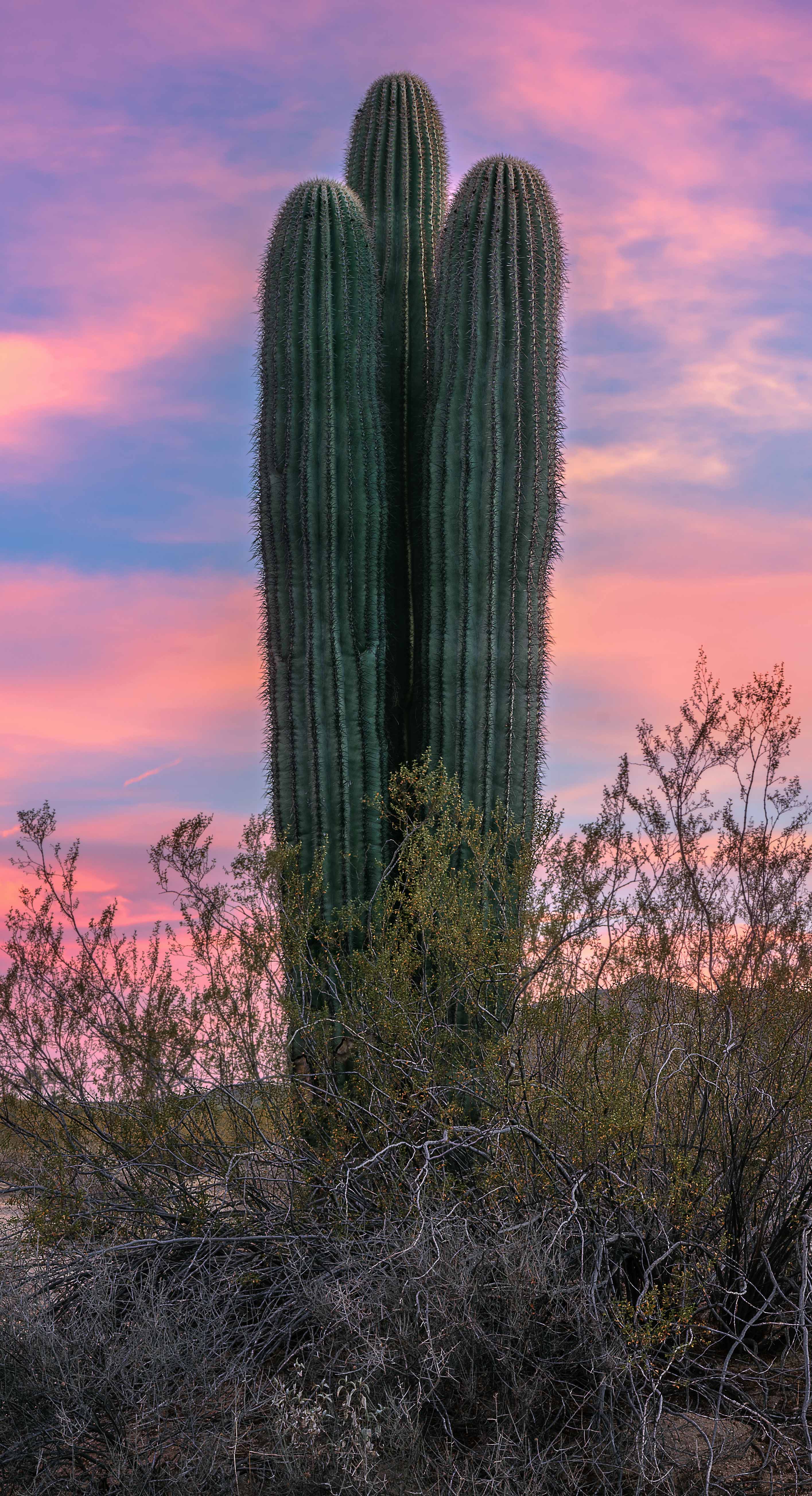
This crop is 22 percent of the frame width, about 18 inches across on the 80 inch print. The ribs read as continuous vertical pleats running the full height, and the spine clusters stand out along the ridge of each pleat. The shrubs at the base break into individual twigs with sky visible between them, and the dead wood tangled through the bottom of the frame separates from the living growth around it. Click to view at full size.
About This Photograph
San Tan Mountain Regional Park, in the Sonoran Desert southeast of Phoenix, Arizona. Three frames stitched into a single panorama, made at dusk. The saguaro grows wild in the Sonoran Desert and nowhere else, which makes it a marker of a specific few hundred miles rather than of deserts in general.
The color here is in the sky and not on the ground, which is a matter of what the light can still reach. With the sun below the local horizon, direct sunlight continues to land on the undersides of clouds high enough to see over it while everything at ground level has already passed into shadow. The clouds return that light downward, and the desert receives it as ambient rather than direct.
Measured across the frame, not one pixel reaches pure white and near-white occupies less than a hundredth of one percent. The brightest sustained passage is a hundred and seventy-eight out of two hundred and fifty-five.
Pastel Horizons
Steve Austinhttps://www.steveaustinphotography.com/
Location
San Tan Mountain Regional Park, Arizona, United States
Subject
saguaro cactus · Sonoran Desert · dusk sky
Capture
Three-frame stitched panorama, dusk
Format
Photograph · horizontal panorama, 2:1
Sizes
40 × 20 in · 60 × 30 in · 80 × 40 in
Print Media
TruLife Acrylic · ChromaLuxe Metal · Baryta paper
Edition
Limited, 25 / 50 / 100 by presentation
What it Does in a Room
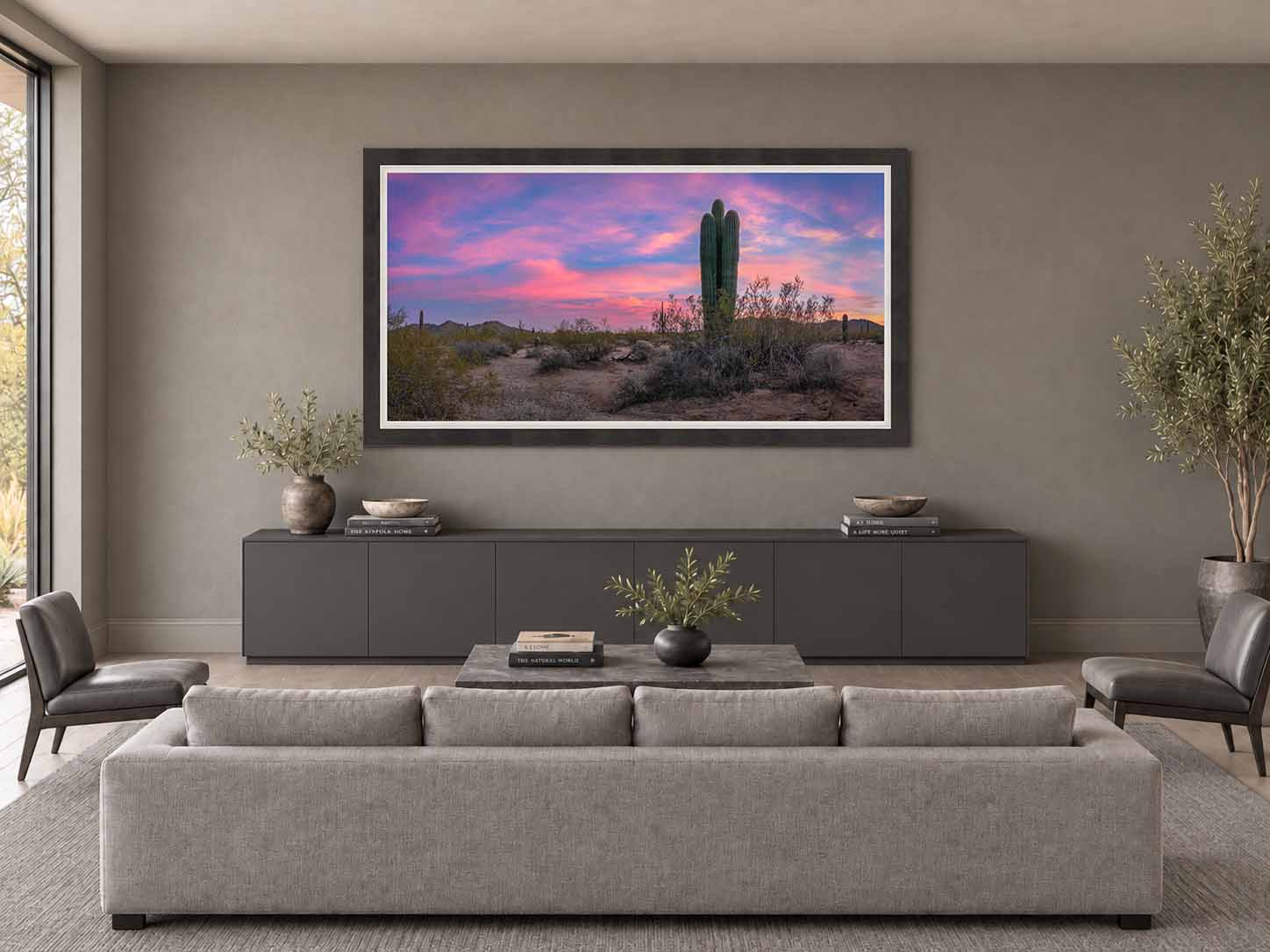
This photograph has no highlights and almost no shadows. Nothing in it reaches white, only four percent of the frame sits near black, and the entire picture lives between about forty and a hundred and seventy-eight out of two hundred and fifty-five. That narrow range has one practical consequence: on a mid-toned wall the print has no boundary of its own. Its perimeter averages ninety-two, so a mid-gray or greige wall sits inside the picture's own tonal life along all four edges and the image simply fades into the plaster. The frame is doing more work on this one than on anything else here, and it is the only thing telling the eye where the photograph stops.
Its weight sits right of center and stays there. The saguaro is the only strong vertical in a picture built from horizontals, and it is the only green in a frame otherwise made of pink, blue, and tan. Two kinds of contrast landing in the same place makes a fixed focal point, at roughly two thirds of the way across. The eye goes there first from any distance and returns there. That means the print reads as leaning right, and it should be hung either dead center on its wall, where the imbalance becomes deliberate, or with slightly more open wall to its right than its left to answer it. Hanging it off center to the right compounds the effect and the piece looks as though it is sliding off the wall.
It also has no dark reference inside itself, which makes it borrow one from the room. The eye judges brightness against whatever is available, and with nothing in the frame darker than about forty, the wall becomes the comparison. Against a charcoal wall this print reads as luminous, considerably brighter than its measurements say it is. Against a pale wall the same print reads as muted and slightly gray. Nothing about the object changes. Both are the same ink under the same light, and the wall is deciding which one you see.
Not sure which size the room calls for, or want dimensions not listed here? Sizes beyond 80 × 40 are available on request and ship crated by freight. That conversation is welcome before an order is placed. Start that conversation and I will answer within one business day.
How small is too small for a photograph this wide?
At the Intimate size the picture is forty inches across and twenty tall, and the large elements hold. The saguaro holds, because it is a tall dark vertical against a bright sky and that is the easiest kind of shape to keep. The cloud bands hold, since they are broad and soft. The mountain profile along the horizon holds as an outline. What goes is everything small, and there is a lot of it here. The scattered distant saguaros along the horizon disappear entirely at this size, which matters because they are what tells you this is a populated desert rather than an empty one. The branch structure of the shrubs merges into gray mass, and the desert floor flattens into a single tone. The Collected at sixty by thirty brings the distant saguaros back and the shrubs start to separate into branches. If you are weighing a size against a specific wall, choosing the right print size covers the measurements and the viewing distances in more detail.
What changes at the largest size?
At eighty by forty, working down the frame: the cloud across the top separates into distinct streaks with edges rather than reading as a wash, and the fine high filaments through the upper left hold their shape against the blue behind them. The mountain ridges at both edges resolve into individual summits and the shadowed folds between them. Along the horizon the distant saguaros become countable, standing separately rather than reading as marks. The trunk and both arms show their ribs as continuous vertical pleats down the full height, and the spine clusters become visible along the ridges of those pleats. The shrubs break apart into individual twigs with sky between them. On the desert floor the loose stones separate from the sand they are sitting in. Why scale matters covers what happens perceptually when a photograph reaches the size where the eye has to cross it.
What kind of room does this photograph suit?
A long wall, and a room where the width is available. A living room, a dining room, a corridor, a bedroom above a low headboard. Hang it centered on its wall at standard height, with the center at about fifty-seven inches. On materials it is one of the least demanding pieces here, since it carries both a warm half and a cool half and will not argue with either a warm or a cool scheme. Three things to avoid. Do not hang it where a strong horizontal cuts across the wall nearby, since the picture's own horizon runs the full width and a shelf or rail at a different height will read as a second one. Do not hang it above a strongly patterned surface, since the desert floor is already fine texture and the two will fight at the same scale. And avoid warm accent lighting aimed at the wall, which will take the blue out of the upper sky and leave the whole frame reading pink. When your mind needs to rest takes the question further.
Every work ships insured and arrives with a signed certificate of authenticity.
If a piece is damaged in transit, the choice of replacement is always yours, and your edition number stays with you.
Production time runs 2 to 3 weeks for metal, 3 to 4 weeks for acrylic and paper, and 5 to 6 weeks for framed work.
Each print is made to order and takes its place in a numbered edition, so sales are final. Before you choose, I am glad to help: send a photo of your wall and I will show you this work in your room at true scale, at no charge. Start a conversation
Collector's Choice · TruLife ® Acrylic in Italian Frame
Collector Edition of 25· Lumachrome TruLife Acrylic · Handcrafted Italian Frame
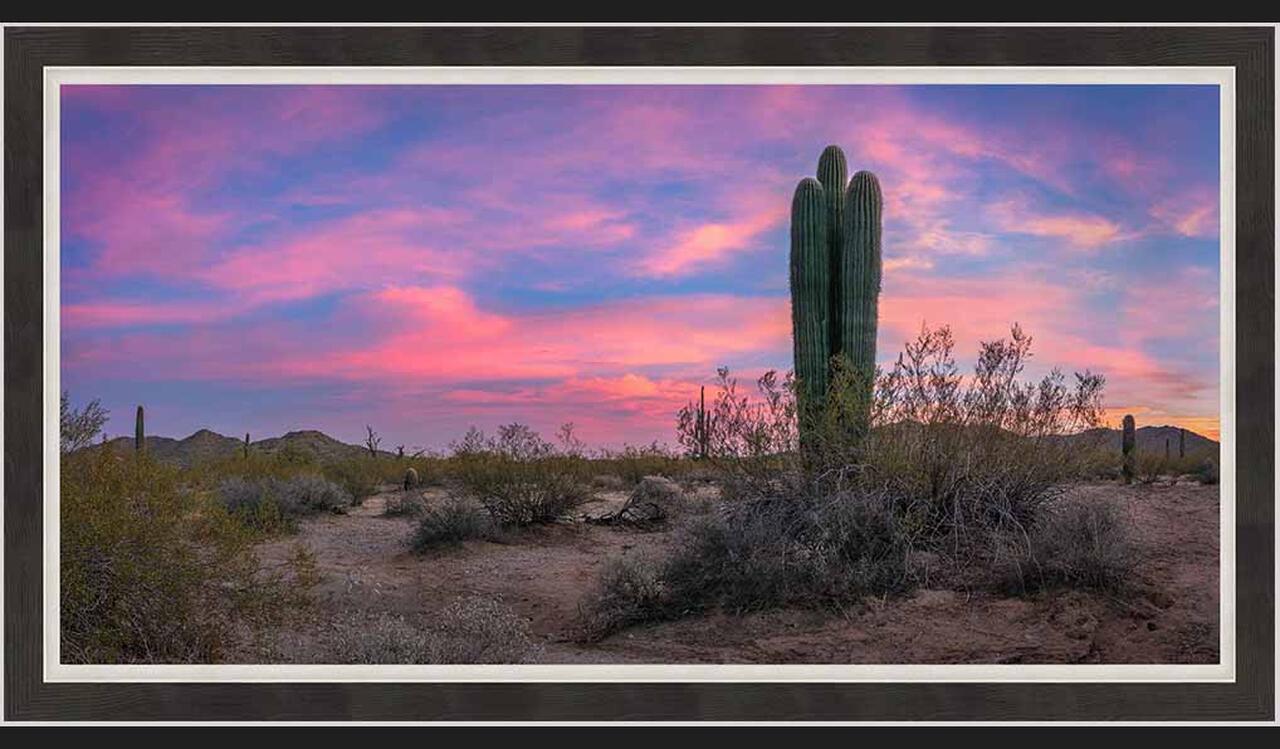
TruLife acrylic in a handcrafted Italian frame with a linen liner chosen for the image. Frame series, finish, and liner are settled with you after the order, and production begins from there. The frame and liner add about fourteen inches to the finished dimensions, worth allowing for when planning placement.
Signature Acrylic Edition of 50· Lumachrome TruLife · Gallery Float Mount
Face-mounted to TruLife acrylic and floated approximately one inch from the wall, with no frame to mediate between the image and the room. UV-resistant, anti-reflective, and scratch-resistant, with a lifetime guarantee against fading.
Signature Metal Edition of 50· ChromaLuxe Print · Gallery Float Mount
Color infused into the aluminum panel itself, floated from the wall on a concealed system. Where acrylic produces luminosity, metal produces clarity. Exceptional fade resistance with no glazing or coating required.
Fine Art Edition of 100· Hahnemühle Baryta Fine Art Paper
Printed without acrylic, so light meets the paper surface directly. Highlights stay luminous, shadows keep their nuance, and the surface has a tactile quality the other presentations approach differently. The understated choice, and the traditional one.
Complimentary shipping within the continental United States. International collector shipping available upon request.
Still deciding
Designing for Stillness
A guide to choosing art for restorative spaces
How to tell whether an image will still hold you in a year, how scale changes what a photograph does in a room, and how to match a piece to the work a room actually performs. It cites the research it draws on, and it is equally clear about where that research stops. About ten minutes to read.