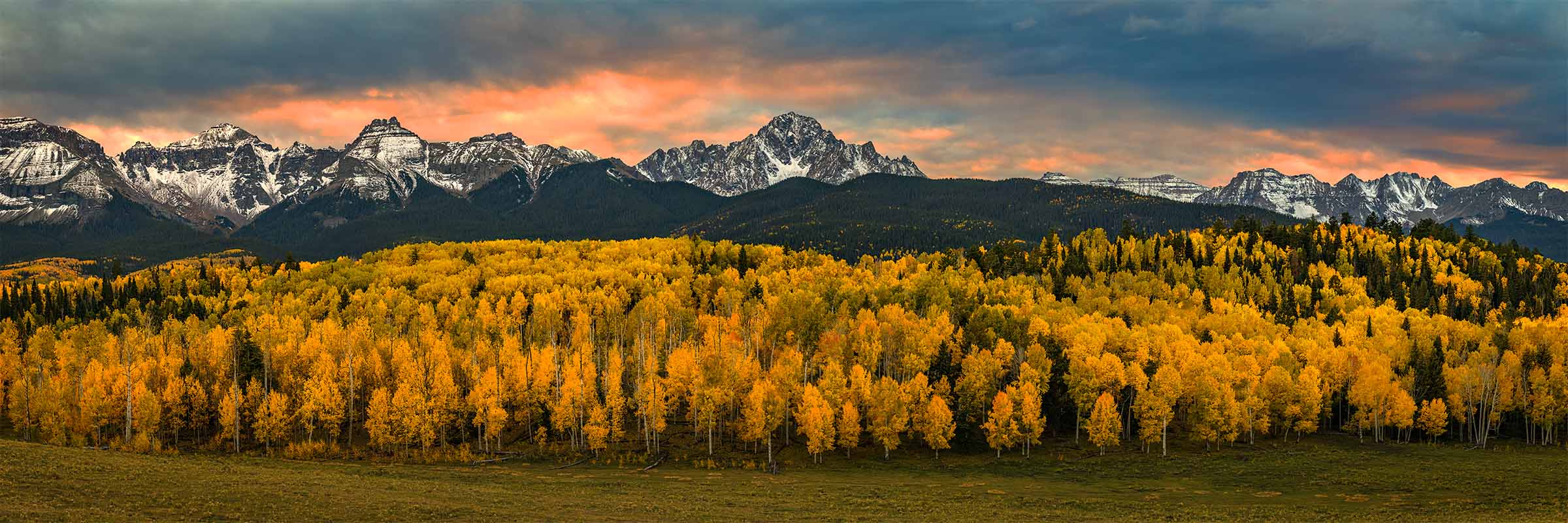
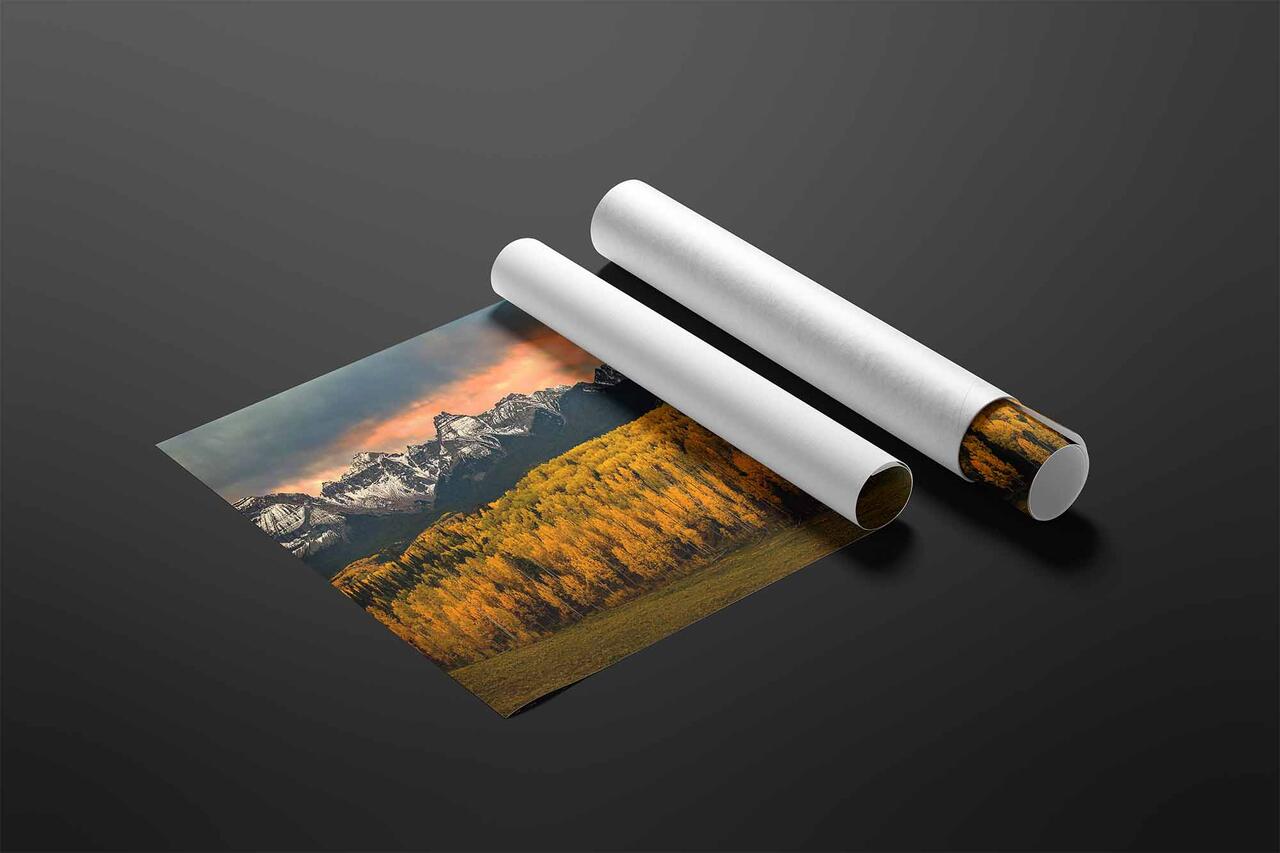
A 3:1 panoramic photograph of golden aspen below Mount Sneffels at sunrise near Ridgway, Colorado, available as a limited edition print in three sizes.
Artist's Story
This is from outside Ridgway, in southwest Colorado, looking across at Mount Sneffels with the light going off the peaks and a band of aspen holding the last of it below.
Look along that band and it is not one color. There is a deep orange-gold on the left, a paler lemon through the middle, a warmer patch to the right, and here and there a section still holding green. The boundaries between them are sharp. One color stops and the next one starts, and the line between them does not follow a ridge or a drainage or anything in the ground.
Aspens mostly do not grow from seed. A stem sends roots out sideways, and those roots push up new stems, and every one of them carries the same genetics as the first. What looks like a stand of a thousand trees is usually a much smaller number of organisms, each one made of hundreds of stems sharing a single root system.
Genetically identical stems respond to the same cue at the same time. So a clone turns as a unit, all of it at once, and the clone next to it turns on its own schedule, sometimes a week or two later. That is what the sharp lines across this hillside are. Each patch of one color is one individual.
It is a strange thing to know while you are looking at it. The scale of the thing in front of you is right, and the count is wrong by a factor of several hundred.
Quiet Autumn at Sneffels is a hillside of trees that is not a hillside of trees. It is a small number of organisms, each on its own schedule, photographed in the week those schedules happened to overlap.
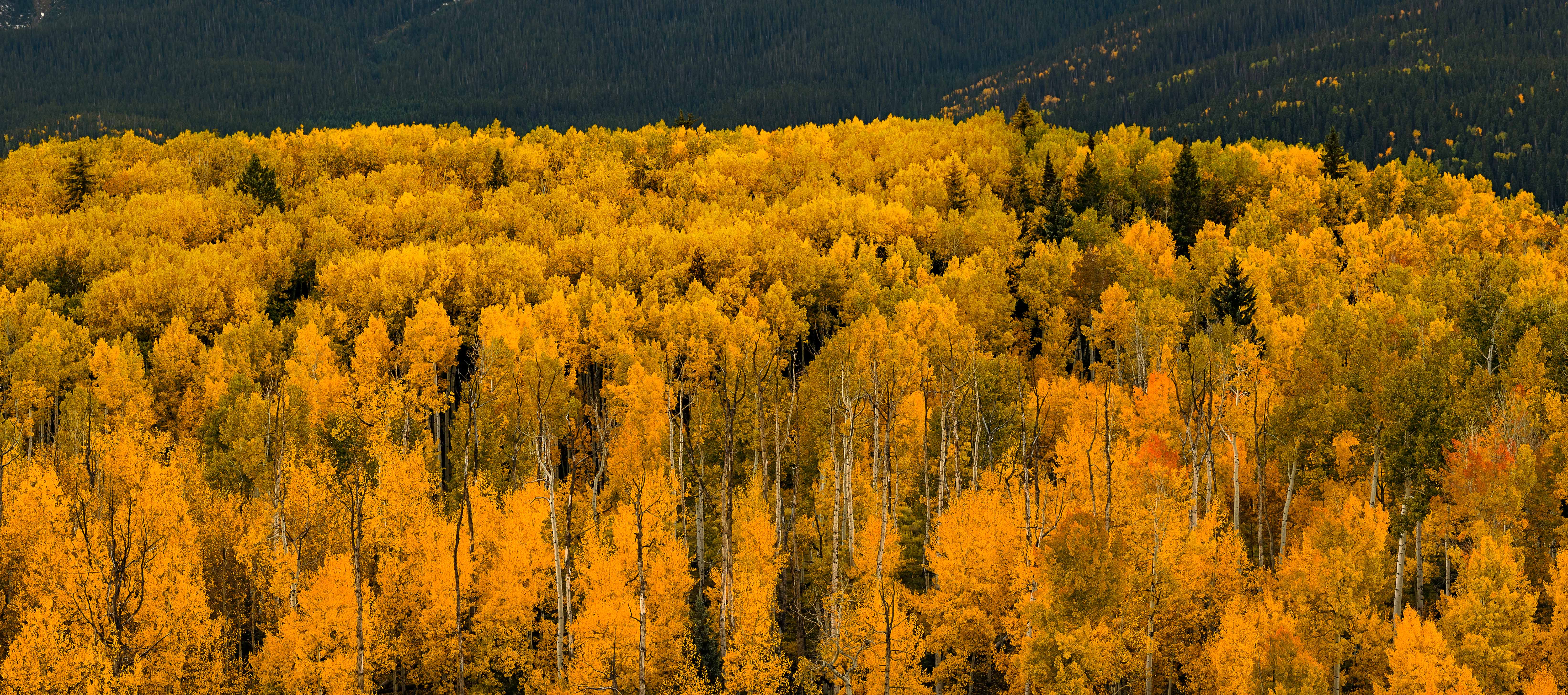
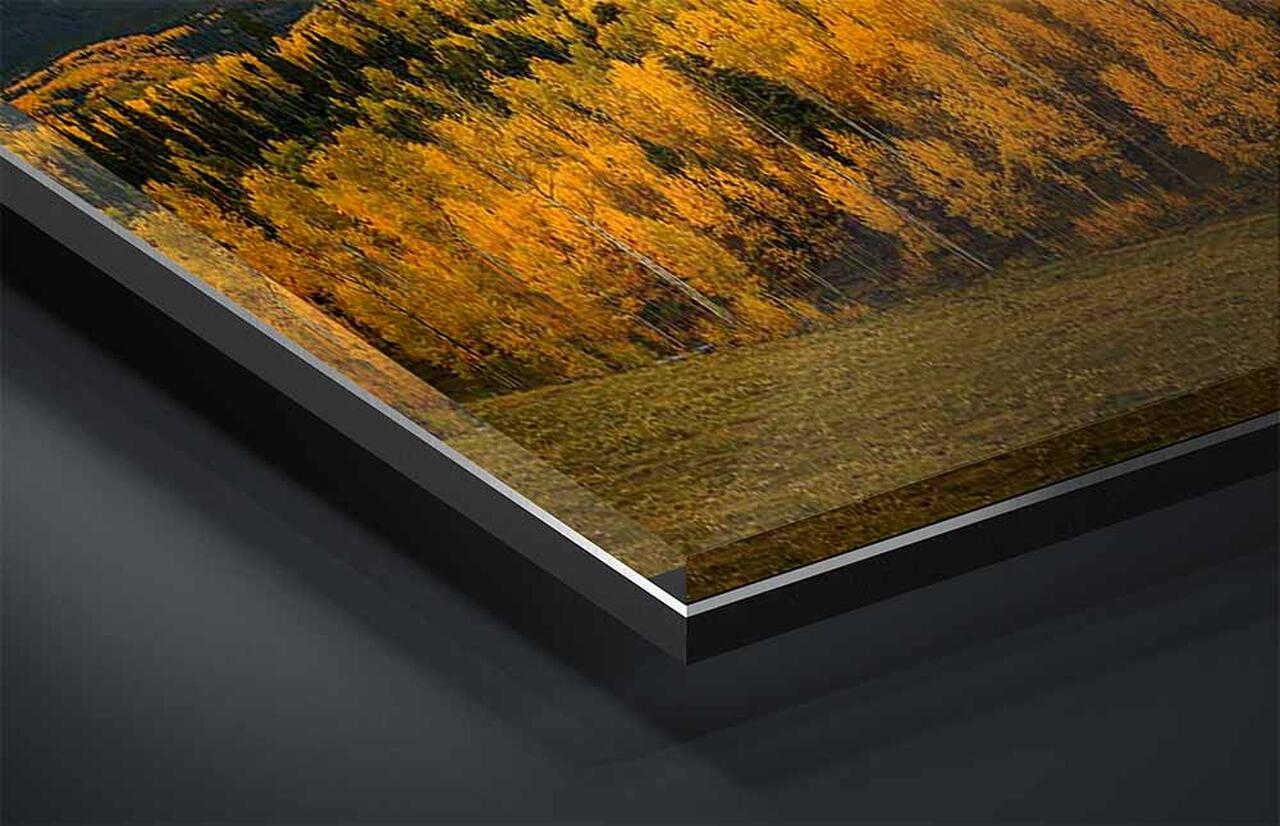
A section of the aspen band at about a third of the frame width. On a ninety inch print this runs roughly thirty inches across. Individual crowns separate from one another with sky and shadow between them, and the pale trunks come clear in the lower part of the band as separate vertical lines. Several shades sit side by side here, a deep orange, a lighter gold, and a section still holding green, and where they meet the boundary is a hard edge rather than a gradient. The dark conifers growing through the stand read as individual trees with their own shape. Click to view at full size.
About This Photograph
Near Ridgway, Ouray County, Colorado, looking southwest toward Mount Sneffels and the Sneffels Range in the San Juan Mountains. This is a single frame image, made at sunrise with the last light on the cloud and the peaks already in shadow.
The gold in those leaves was there all summer. A green leaf is green because chlorophyll absorbs red and blue light and returns green, and the yellow pigments sit in the same leaf the whole time, masked by it. When the tree stops maintaining chlorophyll in autumn, what was underneath becomes visible. Those pigments absorb blue almost completely, and it shows in the file: across the aspen band the blue channel averages eleven out of two hundred and fifty-five.
The picture divides into four horizontal bands, each with its own temperature. The cloud measures slightly cool, the peaks warm, the dark conifer ridge warmer, and the aspen band warmest by a wide margin. There is a hundred and ten point swing from the top edge of the frame to the bottom.
Quiet Autumn at Sneffels
Steve Austinhttps://www.steveaustinphotography.com/
Location
Mount Sneffels, Ridgway, Colorado
Subject
Golden aspen · San Juan Mountains · autumn sunrise
Capture
Single frame at sunrise
Format
Photograph · horizontal panorama, 3:1
Sizes
36 × 12 in · 60 × 20 in · 90 × 30 in
Print Media
TruLife Acrylic · ChromaLuxe Metal · Baryta paper
Edition
Limited, 25 / 50 / 100 by presentation
What it Does in a Room
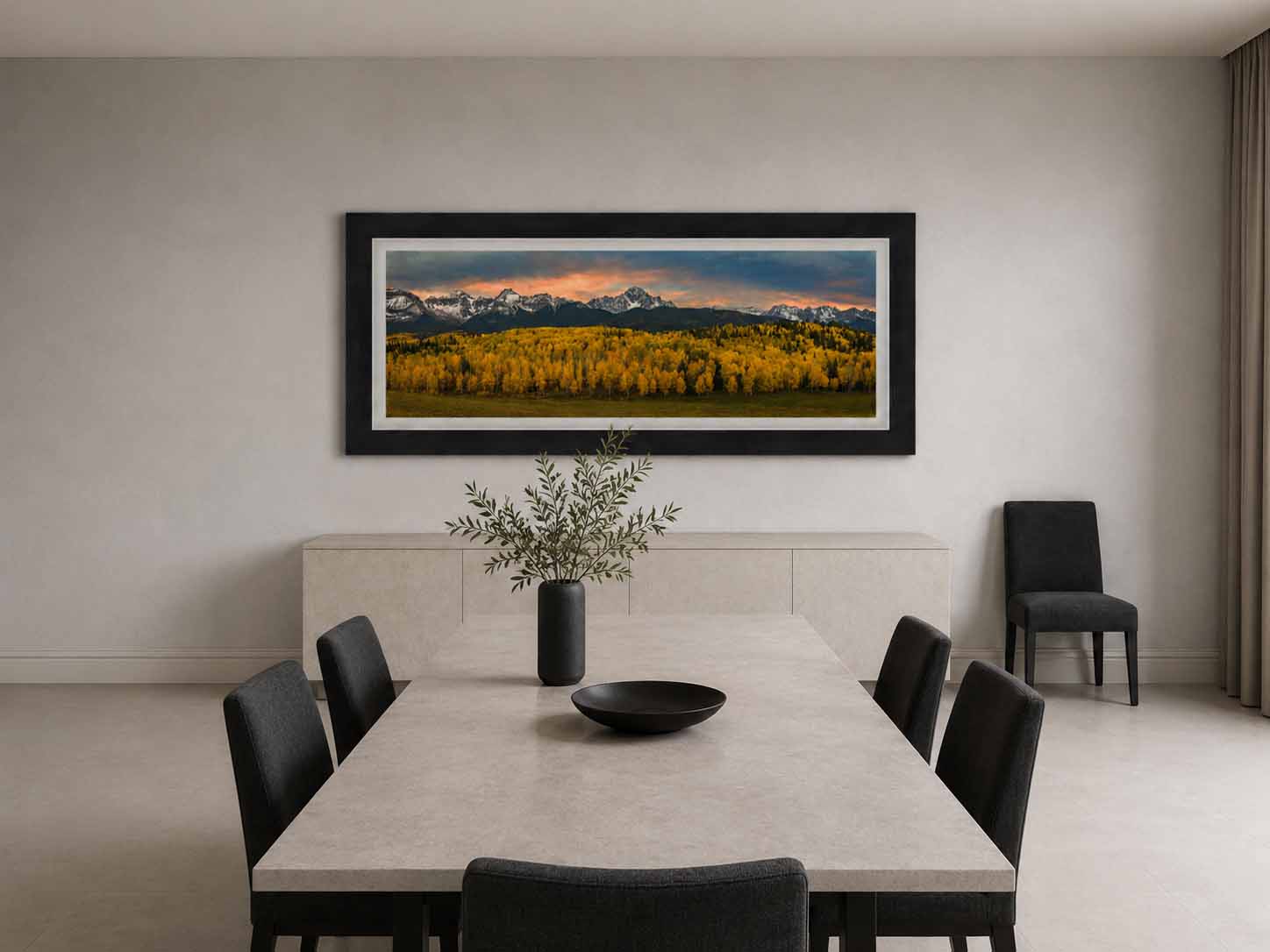
This photograph is stacked in horizontal bands, and a picture built that way behaves like architecture on a wall. Cloud, peaks, dark ridge, gold, meadow: five layers in a fixed order, each running the full width, with no diagonal anywhere and nothing crossing from one band into the next. That gives it a stability that a composition with a subject in it does not have. It settles above a long horizontal, a credenza, a headboard, a run of cabinets, because the bands agree with the furniture instead of arguing with it, and it will look wrong on a wall with strong verticals nearby.
Its color is unevenly distributed in a way that matters for placement. The bottom two thirds of the frame is intensely warm and the top third is cool, with a hundred and ten point difference between the top edge and the bottom. Hung at standard height, the warm mass sits at and below eye level and the cool sits above it, which is the arrangement that reads as correct, because it is how the world is built. Hung too high, the warm band lifts above eye level and the picture starts to feel top-heavy in a way that is hard to name and easy to see.
It is also a piece with a light source in it. The bright cloud across the upper third is the brightest thing in the frame and it reads as illumination rather than as an object, which means the photograph appears to give light to the wall around it. Practically that makes it a good choice for a wall that is otherwise dim, and a poor one directly opposite a window, where real daylight competes with the pictured light and the picture comes off second.
Not sure which size the room calls for, or want dimensions not listed here? Sizes beyond 90 × 30 are available on request and ship crated by freight. That conversation is welcome before an order is placed. Start that conversation and I will answer within one business day.
Quiet Autumn at Sneffels, limited edition printSteve Austin70012900USD11https://schema.org/InStock
Questions about this photograph
How small is too small for a photograph this wide?
At the Intimate size the picture is thirty-six inches across and twelve inches tall, and the band structure survives it completely. Five stacked layers read from any distance, and the color, which is the loudest thing here, does not care about size at all. What goes is the aspen. At twelve inches tall that band is about four and a half inches deep on the print, so the individual crowns merge into a continuous field and the boundaries between the color patches soften from hard lines into gradients. That takes with it the one thing this photograph is actually about, since those boundaries are where one organism ends and the next begins. The peaks also lose their snow detail and become a serrated dark shape. The Collected at sixty by twenty is where the patch edges sharpen again. If you are weighing a size against a specific wall, choosing the right print size covers the measurements and the viewing distances in more detail.
What changes at the largest size?
The forest becomes trees. At ninety by thirty individual aspen crowns separate from one another with sky and shadow visible between them, and the pale trunks come clear in the lower part of the band as separate vertical lines. The boundaries between the color patches resolve into hard edges you can trace, and along several of them you can see one crown in full orange standing directly beside one still holding green. Among the gold, the dark conifers that grow through the stand read as individual trees with their own shape rather than as dark blotches. On the range the snow separates into fields and couloirs, the rock faces beneath show their layering, and the serrated ridgeline to the right of Sneffels resolves into a line of separate spires. Why scale matters covers what happens perceptually when a landscape reaches the size where the eye has to cross it.
What kind of room does this photograph suit?
Rooms with a long horizontal to sit above and a wall that is not fighting for attention. Above a credenza, a headboard, a run of low cabinets, or a sideboard is where the proportion and the band structure both work. On materials, keep the room quiet: plaster, stone, and off-white give the color somewhere to land, and a room that already has a warm scheme will absorb the piece rather than show it. Two things to avoid. Do not hang it beside another autumn or mountain image, since the subject is common enough that two of them in a room read as a theme. And keep strong verticals away from it, no fluted panels, no columns, no tall narrow cabinets, because the composition is entirely horizontal and a vertical nearby cuts across every band at once. When your mind needs to rest takes the question further.
Every work ships insured and arrives with a signed certificate of authenticity.
If a piece is damaged in transit, the choice of replacement is always yours, and your edition number stays with you.
Production time runs 2 to 3 weeks for metal, 3 to 4 weeks for acrylic and paper, and 5 to 6 weeks for framed work.
Each print is made to order and takes its place in a numbered edition, so sales are final. Before you choose, I am glad to help: send a photo of your wall and I will show you this work in your room at true scale, at no charge. Start a conversation
Collector's Choice · TruLife ® Acrylic in Italian Frame
Collector Edition of 25· Lumachrome TruLife Acrylic · Handcrafted Italian Frame
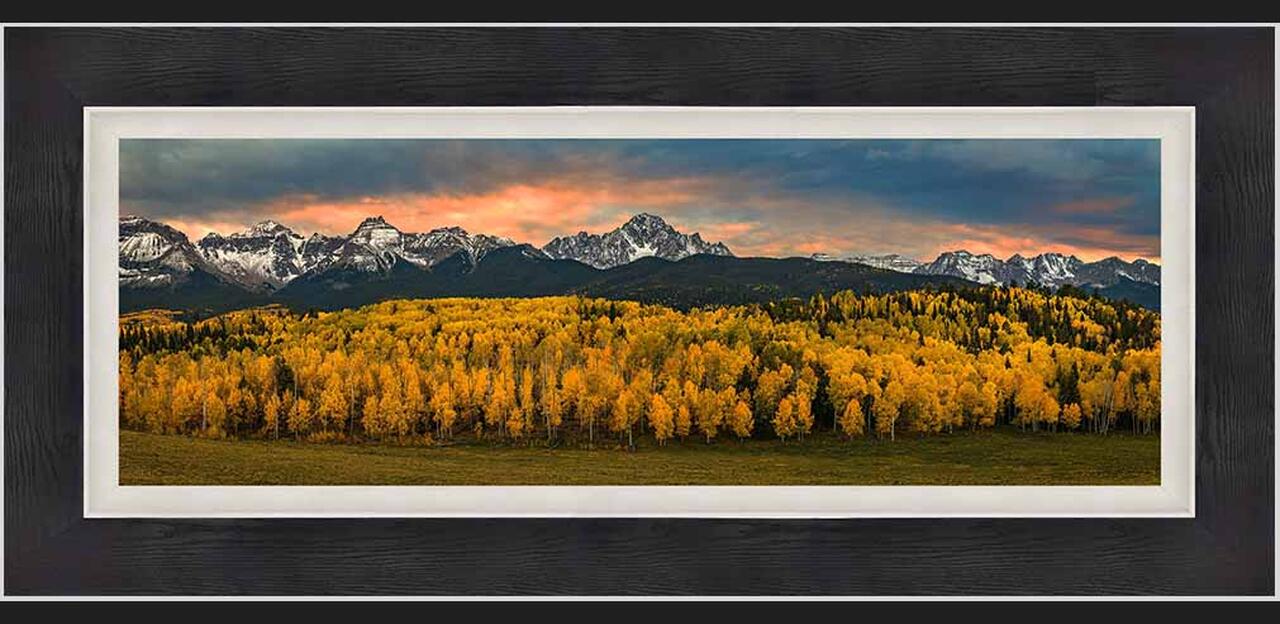
TruLife acrylic in a handcrafted Italian frame with a linen liner chosen for the image. Frame series, finish, and liner are settled with you after the order, and production begins from there. The frame and liner add about fourteen inches to the finished dimensions, worth allowing for when planning placement.
Signature Acrylic Edition of 50· Lumachrome TruLife · Gallery Float Mount
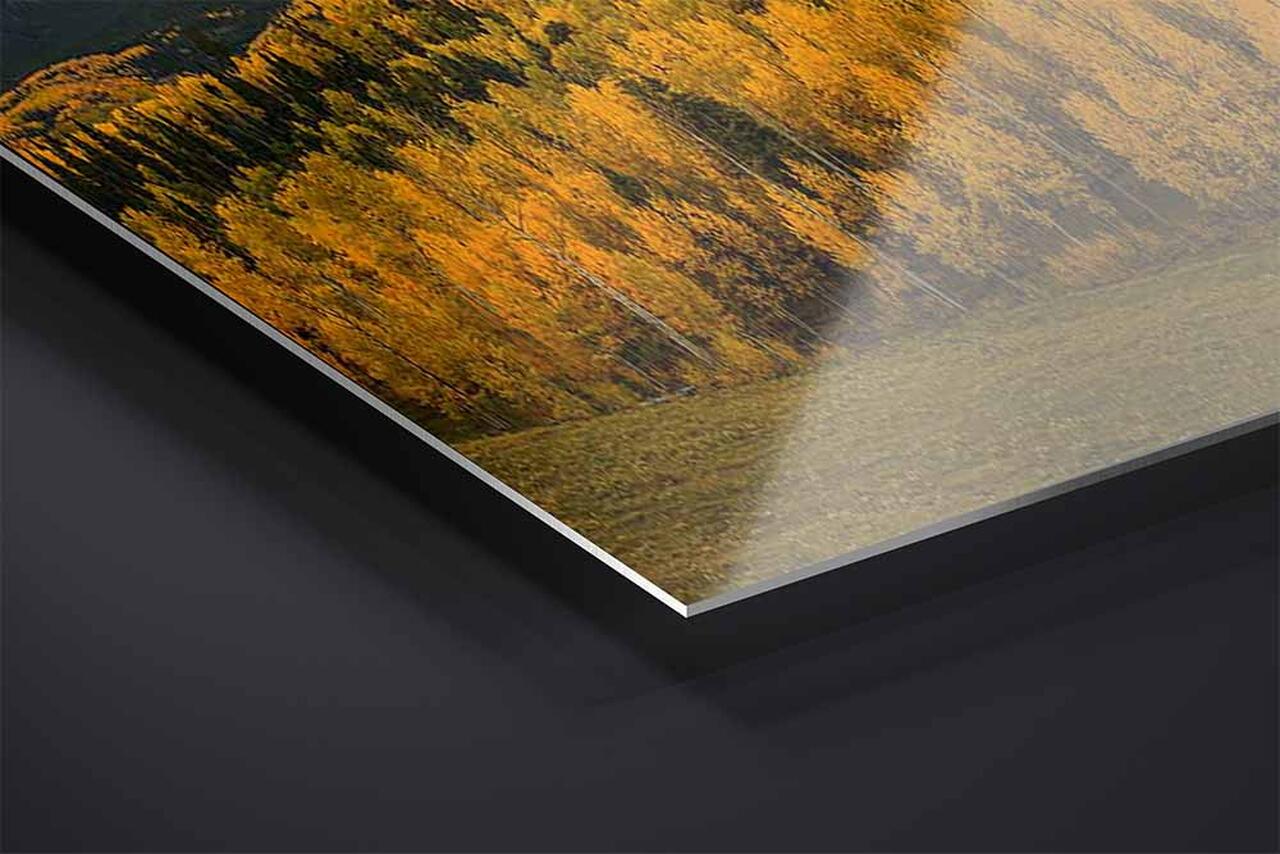
Face-mounted to TruLife acrylic and floated approximately one inch from the wall, with no frame to mediate between the image and the room. UV-resistant, anti-reflective, and scratch-resistant, with a lifetime guarantee against fading.
Signature Metal Edition of 50· ChromaLuxe Print · Gallery Float Mount
Color infused into the aluminum panel itself, floated from the wall on a concealed system. Where acrylic produces luminosity, metal produces clarity. Exceptional fade resistance with no glazing or coating required.
Fine Art Edition of 100· Hahnemühle Baryta Fine Art Paper
Printed without acrylic, so light meets the paper surface directly. Highlights stay luminous, shadows keep their nuance, and the surface has a tactile quality the other presentations approach differently. The understated choice, and the traditional one.
Complimentary shipping within the continental United States. International collector shipping available upon request.
Still deciding
Designing for Stillness
A guide to choosing art for restorative spaces
How to tell whether an image will still hold you in a year, how scale changes what a photograph does in a room, and how to match a piece to the work a room actually performs. It cites the research it draws on, and it is equally clear about where that research stops. About ten minutes to read.