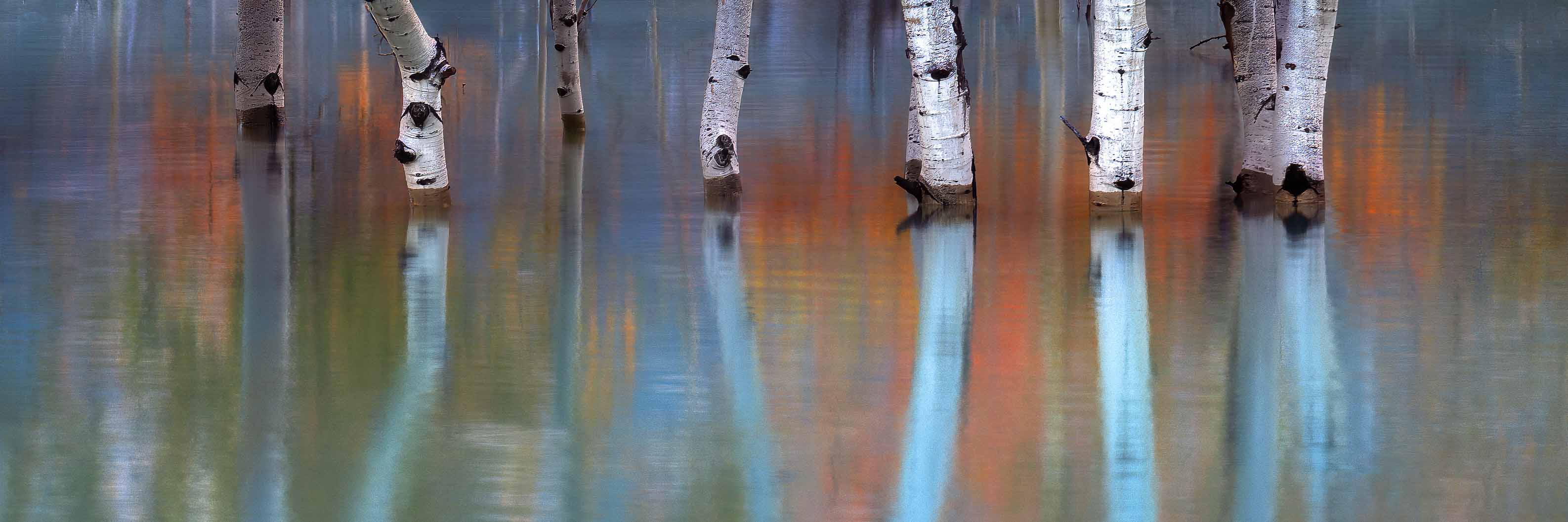
A 3:1 panoramic photograph of aspen trunks standing in still water with autumn color reflected around them, in Alberta, Canada, available as a limited edition print in three sizes.
Artist's Story
This is somewhere east of Banff, in Alberta. I did not write down where, and I have not managed to work it out since.
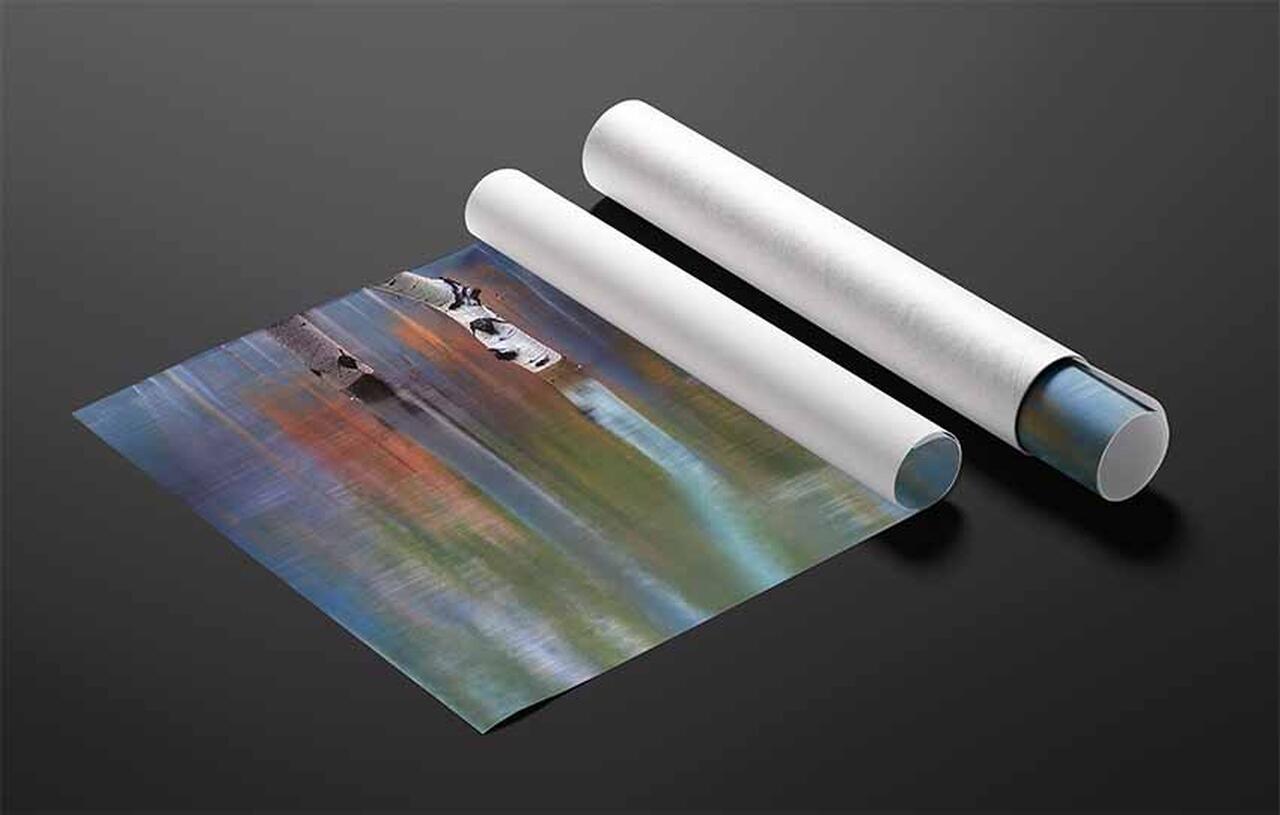
There is no landscape in this photograph. The top edge is water and the bottom edge is water and everything between them is water, and the only solid things in the frame are seven aspen trunks passing down through the surface.
So all the color here is a report on something outside the picture. The orange is aspen in October, standing on a shore that is not in the frame. The blue-gray is sky, which is also not in the frame. Almost the entire photograph is a description of things you cannot see in it.
The surface was moving very slightly. Enough to stretch a reflection downward without breaking it, which is why the color arrives as vertical bands instead of as recognizable trees. A dead flat surface would have handed me a copy of the far shore, legible and a bit dull. A rough one would have handed me nothing. This was the narrow condition in between, and it lasted about ten minutes.
I assumed the water had taken something out of the color. It had not. Measured afterward, the part of the frame above the waterline averages twenty-four percent saturation and the part below it averages twenty-three, which is the same number, and the lower half runs about twenty points brighter than the upper.
What remains in the water is a shoreline in autumn. The trunks are the only part of this picture standing where they appear to stand.
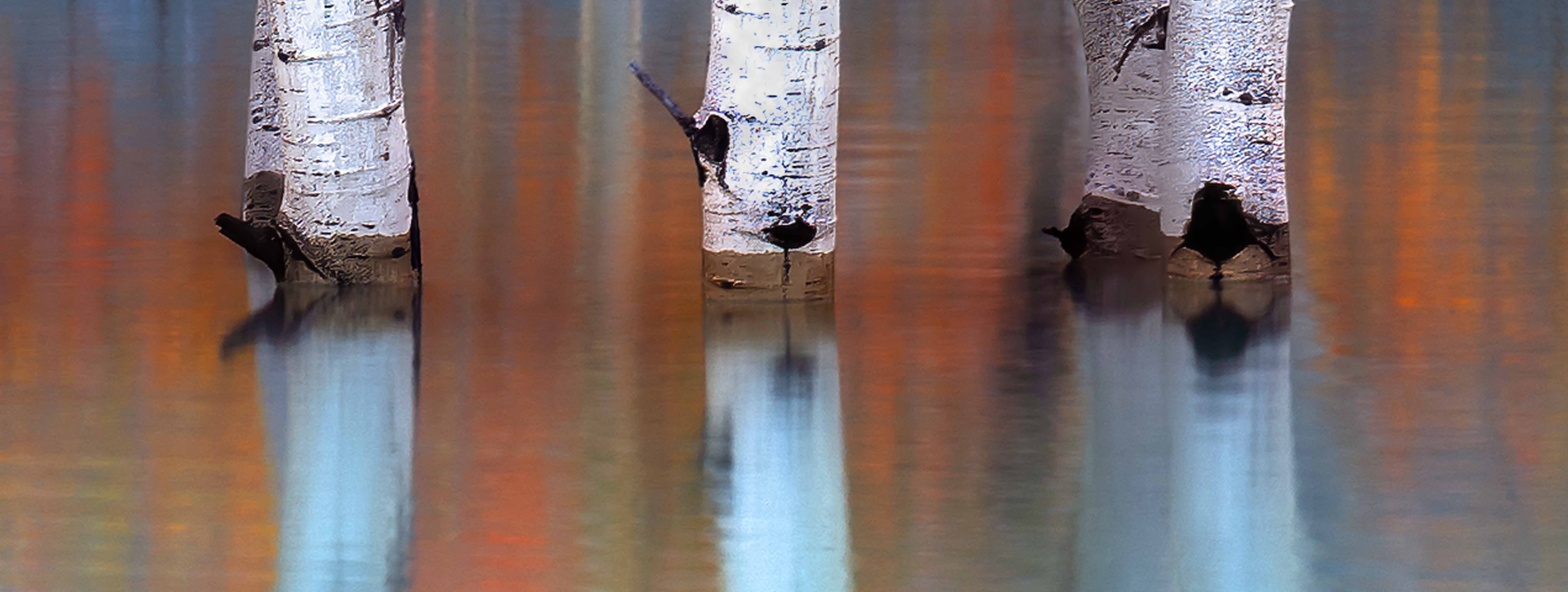
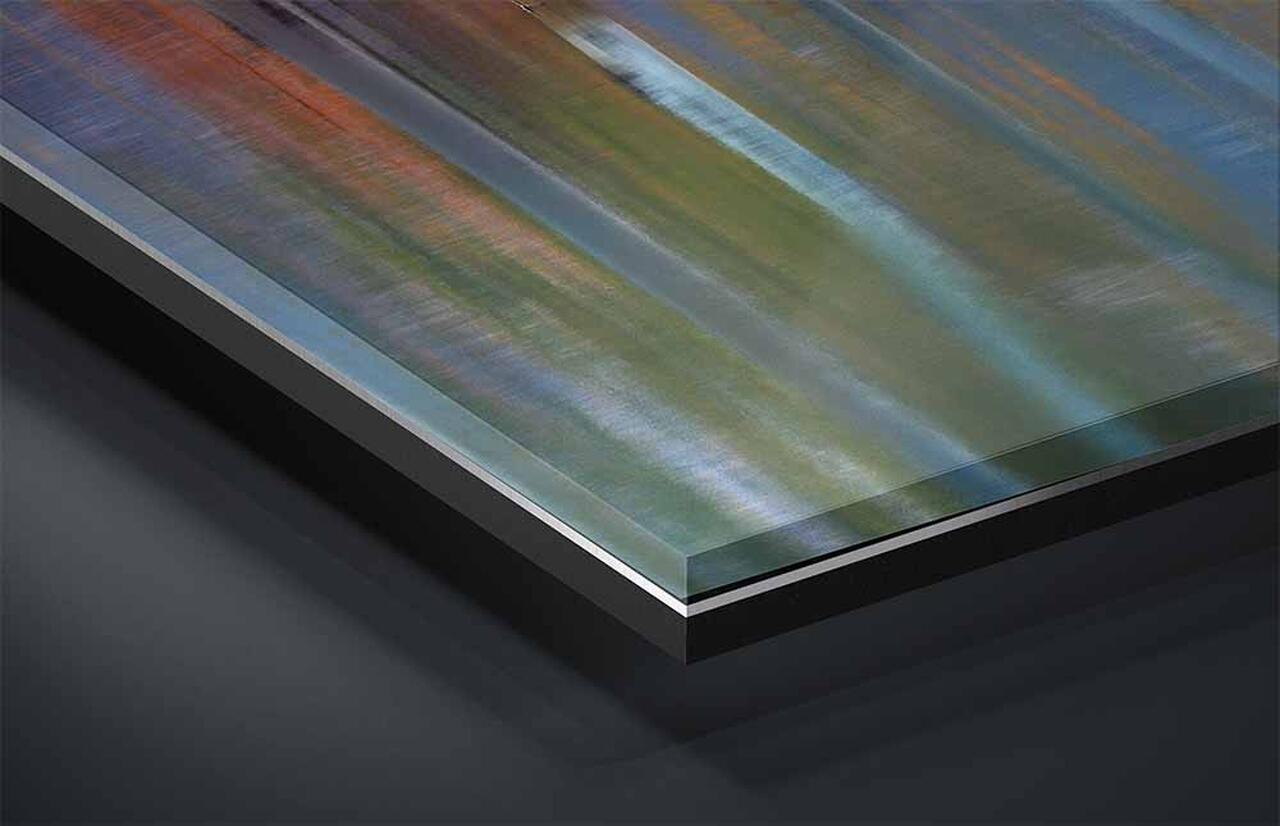
Three trunks and the waterline at about a third of the frame width. On a ninety inch print this section runs roughly thirty inches across. The bark resolves into its horizontal lenticel scoring and the dark knots come clear as healed wounds with texture in them. Where each trunk enters the water a small shadow appears beneath it, which is what tells you the surface is against the wood rather than behind it. Below the waterline the reflected bands separate into layers at different distances, and the faint horizontal ripple lines crossing the vertical smear record how much the surface was moving. Click to view at full size.
About This Photograph
A stand of aspen in standing water, in Alberta, Canada, east of Banff National Park. This is a single frame image. The exact location was not recorded and I have not been able to identify it since.
Aspen bark is unusual in that it photosynthesizes. Beneath the pale outer surface there is a layer of chlorophyll, so the trunk continues working through winter after the leaves have gone. That layer is why the bark carries a faint green under its white, and the whiteness itself is why a stand of aspen is the brightest thing in a northern forest.
Measured across the frame, this photograph has almost nothing at either end of the range: four thousandths of one percent reaches pure black and three hundredths of one percent reaches pure white. Everything else sits in the middle, which is why the picture reads as soft rather than as low in contrast.
Reflections That Remain
Steve Austinhttps://www.steveaustinphotography.com/
Location
Alberta, Canada
Subject
Aspen trunks · still water · autumn reflection
Capture
Single frame in autumn
Format
Photograph · horizontal panorama, 3:1
Sizes
36 × 12 in · 60 × 20 in · 90 × 30 in
Print Media
TruLife Acrylic · ChromaLuxe Metal · Baryta paper
Edition
Limited, 25 / 50 / 100 by presentation
What it Does in a Room
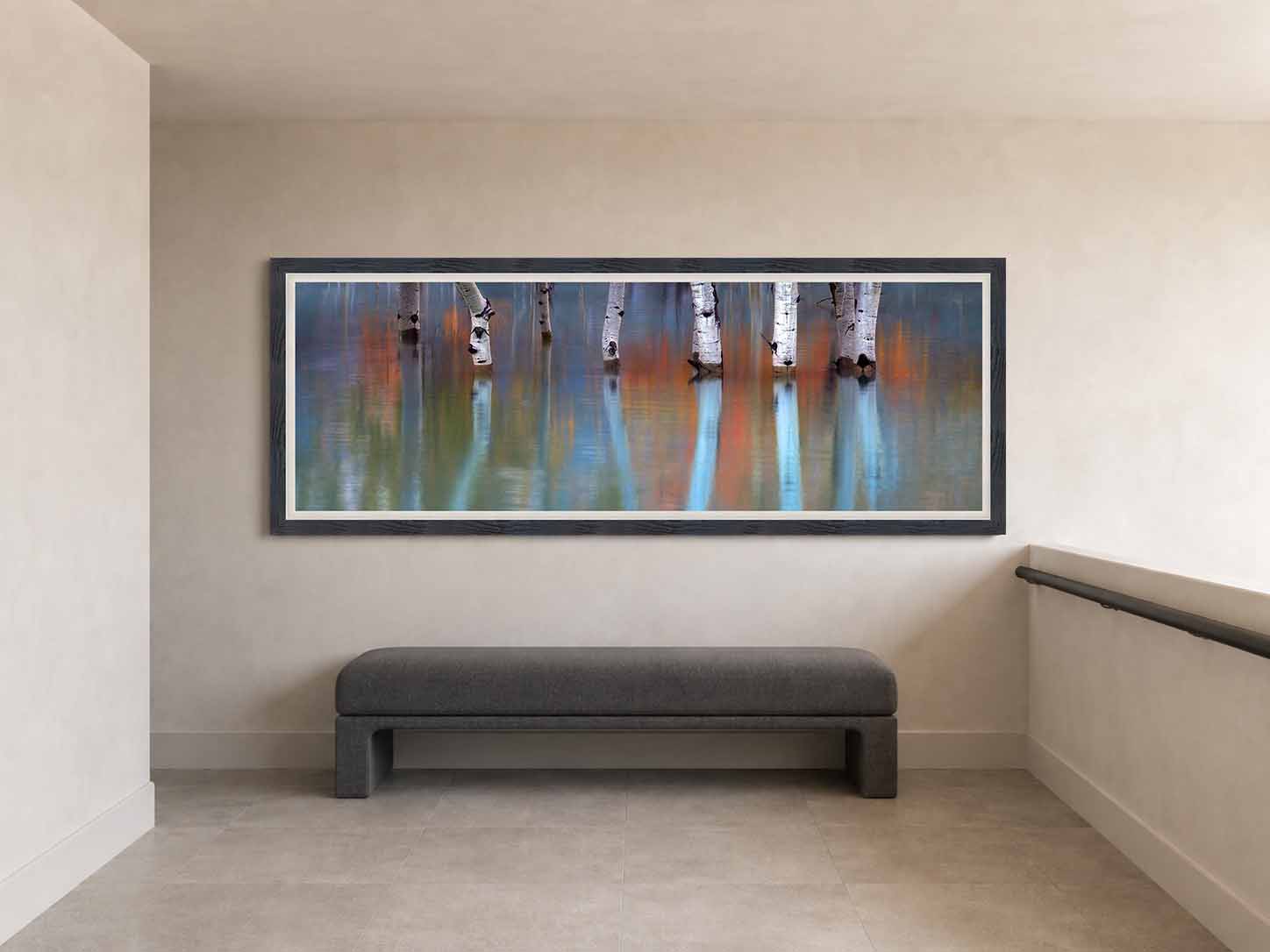
This photograph has no horizon, and that is more consequential on a wall than it sounds. Almost every landscape carries an implied eye level, and the room has to agree with it: hang a picture with a low horizon too high and the viewer is looking down at a scene they should be standing in. There is nothing here to disagree with. No sky, no shore, no ground, no line anywhere that says where the viewer is meant to be. The piece is correct at any height, which makes it one of the few things in this collection that can go above a stair, over a door, high on a tall wall, or low behind a piece of furniture without reading as misplaced.
It becomes two different pictures at two distances. From across a room it is a field of vertical color, orange and blue-gray and pale green in soft bands, and it reads as an abstract. From close up the trunks resolve as trees with knots and scars and a shadow where each one enters the water, and the bands resolve as a shoreline. Most photographs simply get more detailed as you approach. This one changes what it is a picture of, which means it does not become familiar in the way a single-reading image does.
The color is also distributed rather than located. There is no focal point, no bright object, and no place the composition wants you to look, and the same bands of color run the full width from one edge to the other. Practically that means the piece tolerates being seen badly. On a stair, down a corridor, or on a wall you only ever catch at an angle, a photograph with a single subject loses its subject. This one has nothing to lose, and a partial or oblique view of it still delivers what it has.
Not sure which size the room calls for, or want dimensions not listed here? Sizes beyond 90 × 30 are available on request and ship crated by freight. That conversation is welcome before an order is placed. Start that conversation and I will answer within one business day.
Reflections That Remain, limited edition printSteve Austin70012900USD11https://schema.org/InStock
Questions about this photograph
How small is too small for a photograph this wide?
At the Intimate size the picture is thirty-six inches across and twelve inches tall. The color bands survive that, since a soft vertical stripe is legible at almost any scale, and the picture still works as an abstract from across a room. What goes is the trunks. At twelve inches tall each one is about an inch and a half wide on the print, so the knots, the dark scars, and the small shadow where the trunk meets the surface all disappear, and the trunks become pale vertical marks among the other vertical marks. That removes the only part of the photograph that is a solid object, and with it the reason the color bands are where they are. The Collected at sixty by twenty is where the trunks separate from the reflection again. If you are weighing a size against a specific wall, choosing the right print size covers the measurements and the viewing distances in more detail.
What changes at the largest size?
The trunks become trees. At ninety by thirty the bark resolves into its horizontal lenticel scoring and the dark knots come clear as raised, healed wounds with texture in them rather than as black marks. Where each trunk enters the water a small shadow and a slight distortion of the surface appear, which is what tells you the water is against the wood rather than behind it. Down in the reflection the bands separate into layers at different distances, so the orange stops being one color and becomes several, and in the lower third you can see the faint horizontal ripple lines crossing the vertical smear, which is the record of how much the surface was actually moving. At this size the trunks are close to life size, which puts the viewer where the camera was. Why scale matters covers what happens perceptually when a landscape reaches the size where the eye has to cross it.
What kind of room does this photograph suit?
Stairwells, landings, corridors, and any wall that is awkward for other reasons. It is the piece to reach for when a wall is too high, too narrow at the top, or only ever seen in passing. On materials it is forgiving, since it contains a cool gray, a warm orange, and a pale green and finds a partner in most palettes. Two things to avoid. Do not hang it beside a window with a view of trees, because the reflection in the picture and the real trees outside compete and the picture loses. And give it a wall without strong verticals nearby, no fluting, no slats, no narrow door runs, since the whole photograph is already vertical bands and a second set nearby reads as continuous with it. When your mind needs to rest takes the question further.
Every work ships insured and arrives with a signed certificate of authenticity.
If a piece is damaged in transit, the choice of replacement is always yours, and your edition number stays with you.
Production time runs 2 to 3 weeks for metal, 3 to 4 weeks for acrylic and paper, and 5 to 6 weeks for framed work.
Collector's Choice · TruLife ® Acrylic in Italian Frame
Collector Edition of 25· Lumachrome TruLife Acrylic · Handcrafted Italian Frame
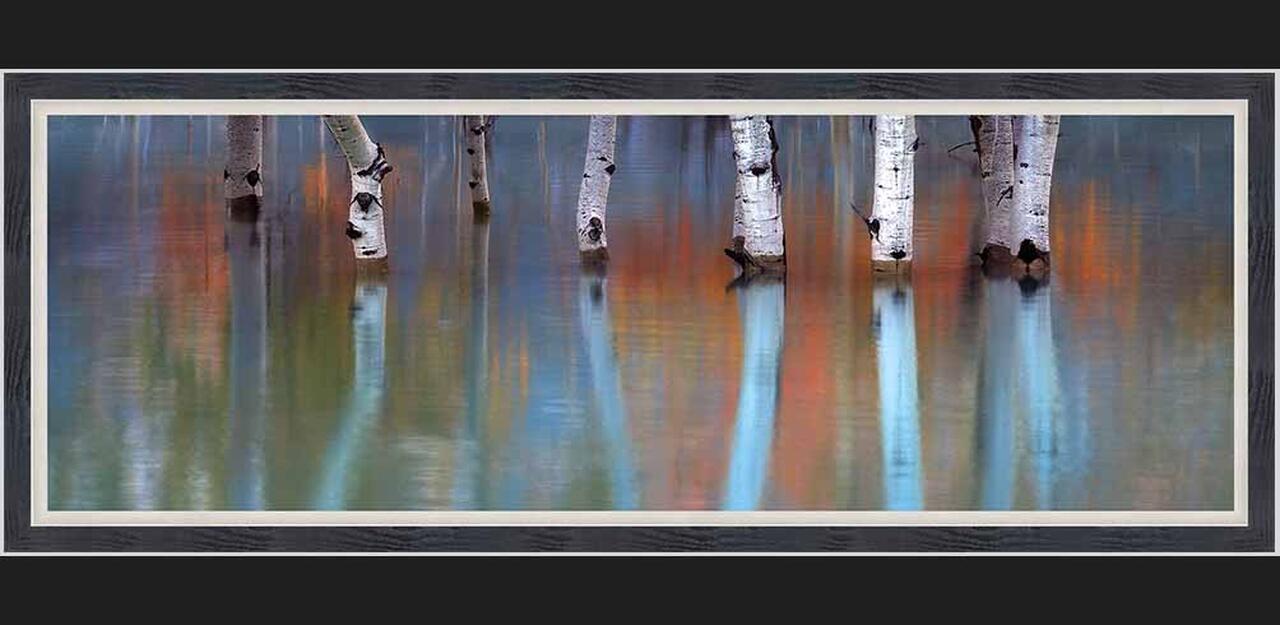
TruLife acrylic in a handcrafted Italian frame with a linen liner chosen for the image. Frame series, finish, and liner are settled with you after the order, and production begins from there. The frame and liner add about fourteen inches to the finished dimensions, worth allowing for when planning placement.
Signature Edition · TruLife ® Acrylic, Float Mount
Signature Edition of 50· Lumachrome TruLife Acrylic · Gallery Float Mount
Face-mounted to TruLife acrylic and floated approximately one inch from the wall, with no frame to mediate between the image and the room. UV-resistant, anti-reflective, and scratch-resistant, with a lifetime guarantee against fading.
Signature Edition of 50· ChromaLuxe Metal Print · Gallery Float Mount
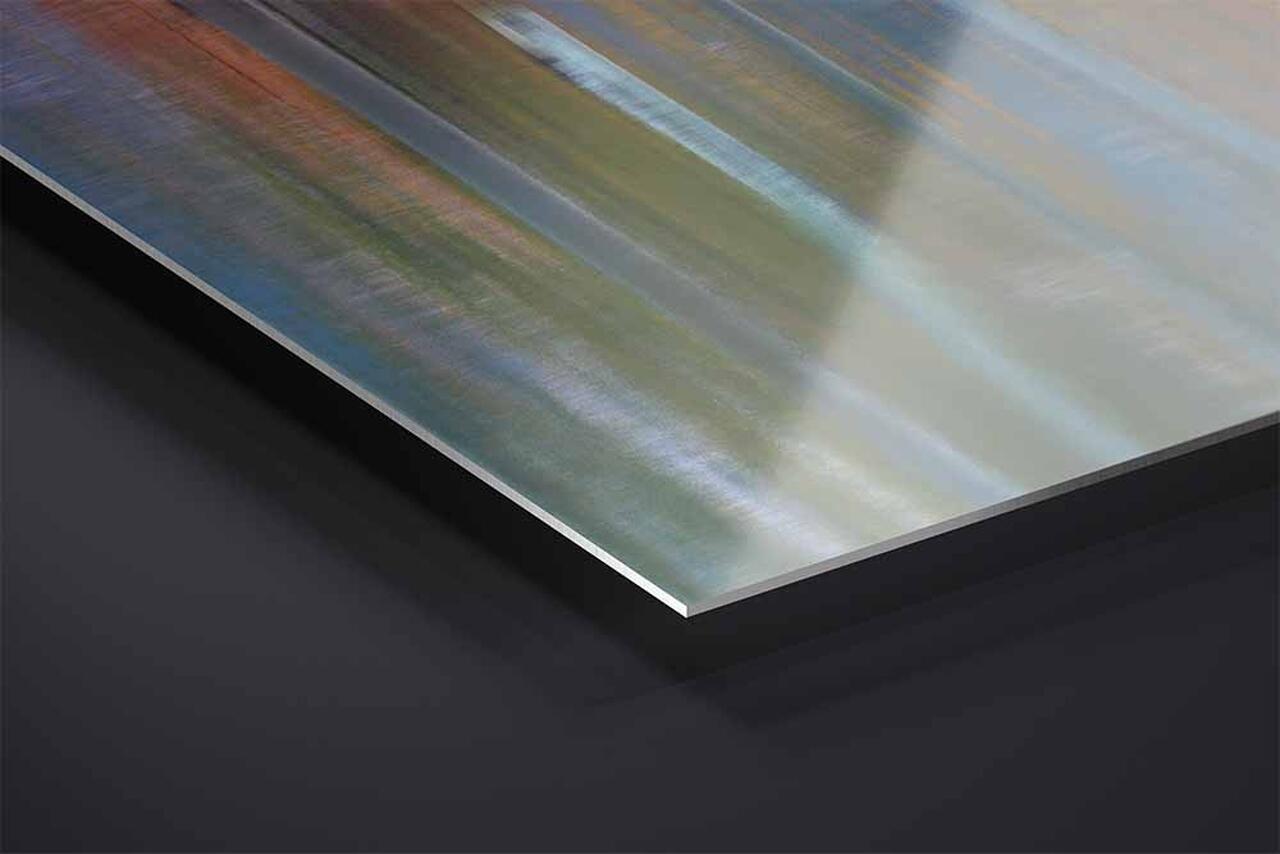
Color infused into the aluminum panel itself, floated from the wall on a concealed system. Where acrylic produces luminosity, metal produces clarity. Exceptional fade resistance with no glazing or coating required.
Fine Art Edition of 100· Hahnemühle Baryta Fine Art Paper
Printed without acrylic, so light meets the paper surface directly. Highlights stay luminous, shadows keep their nuance, and the surface has a tactile quality the other presentations approach differently. The understated choice, and the traditional one.
Complimentary shipping within the continental United States. International collector shipping available upon request.
Still deciding
Designing for Stillness
A guide to choosing art for restorative spaces
How to tell whether an image will still hold you in a year, how scale changes what a photograph does in a room, and how to match a piece to the work a room actually performs. It cites the research it draws on, and it is equally clear about where that research stops. About ten minutes to read.