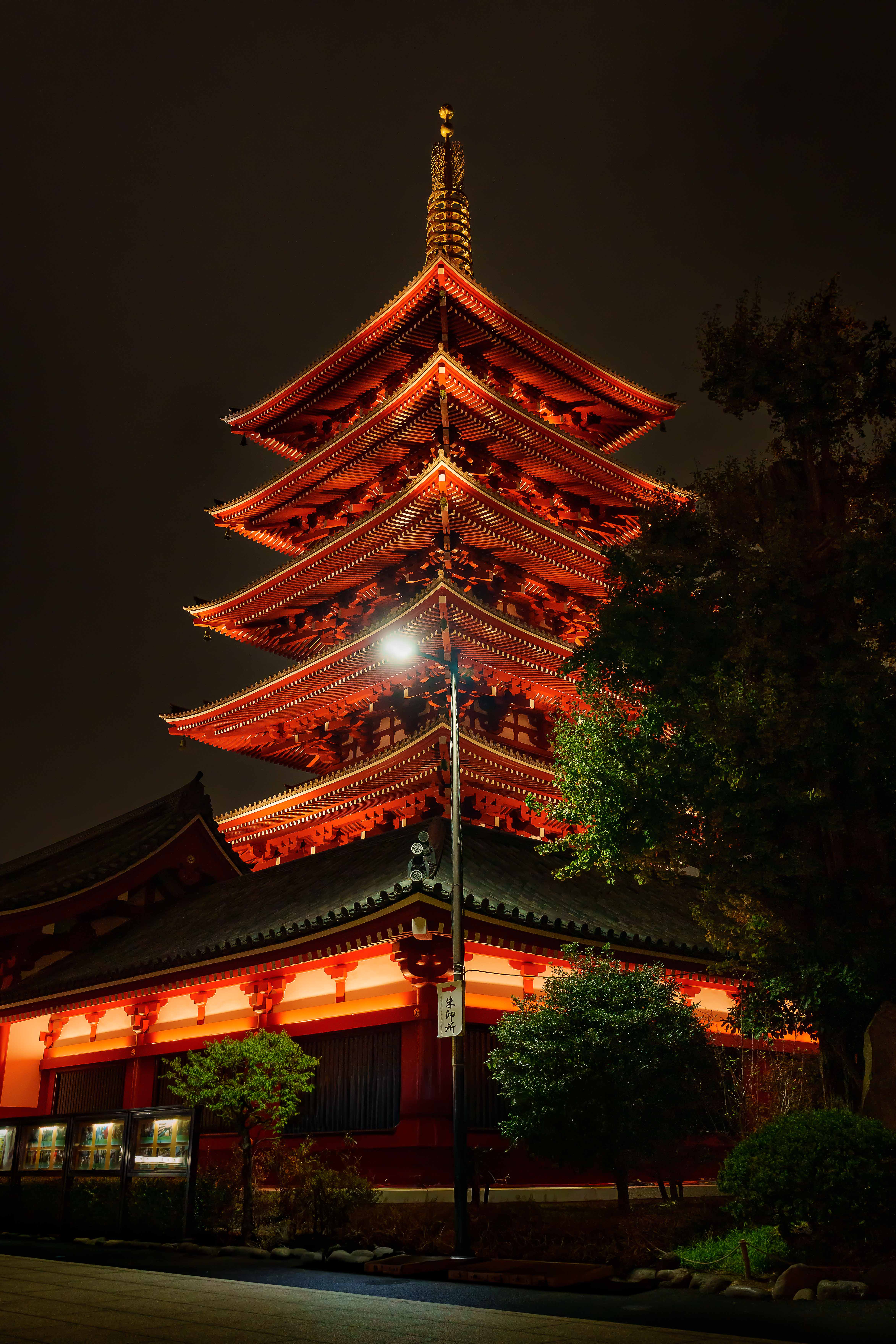
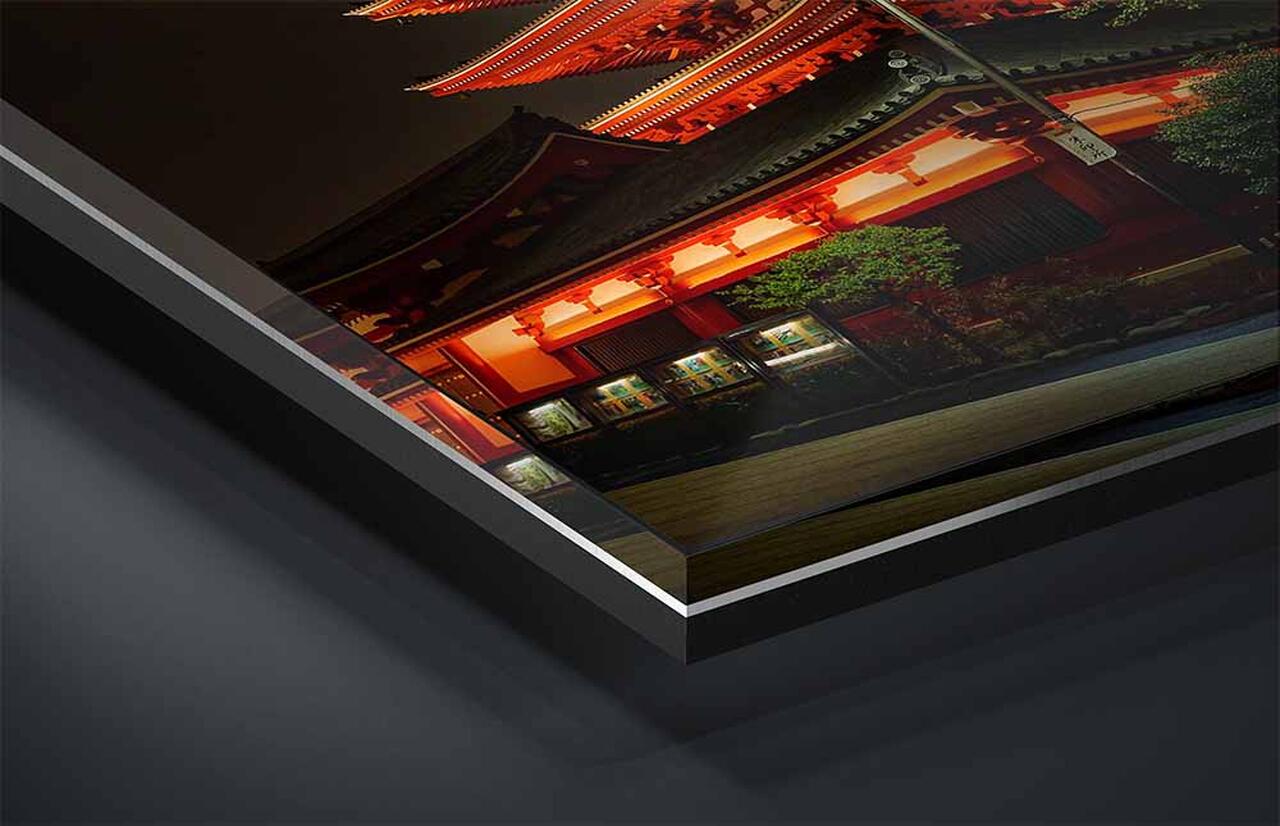
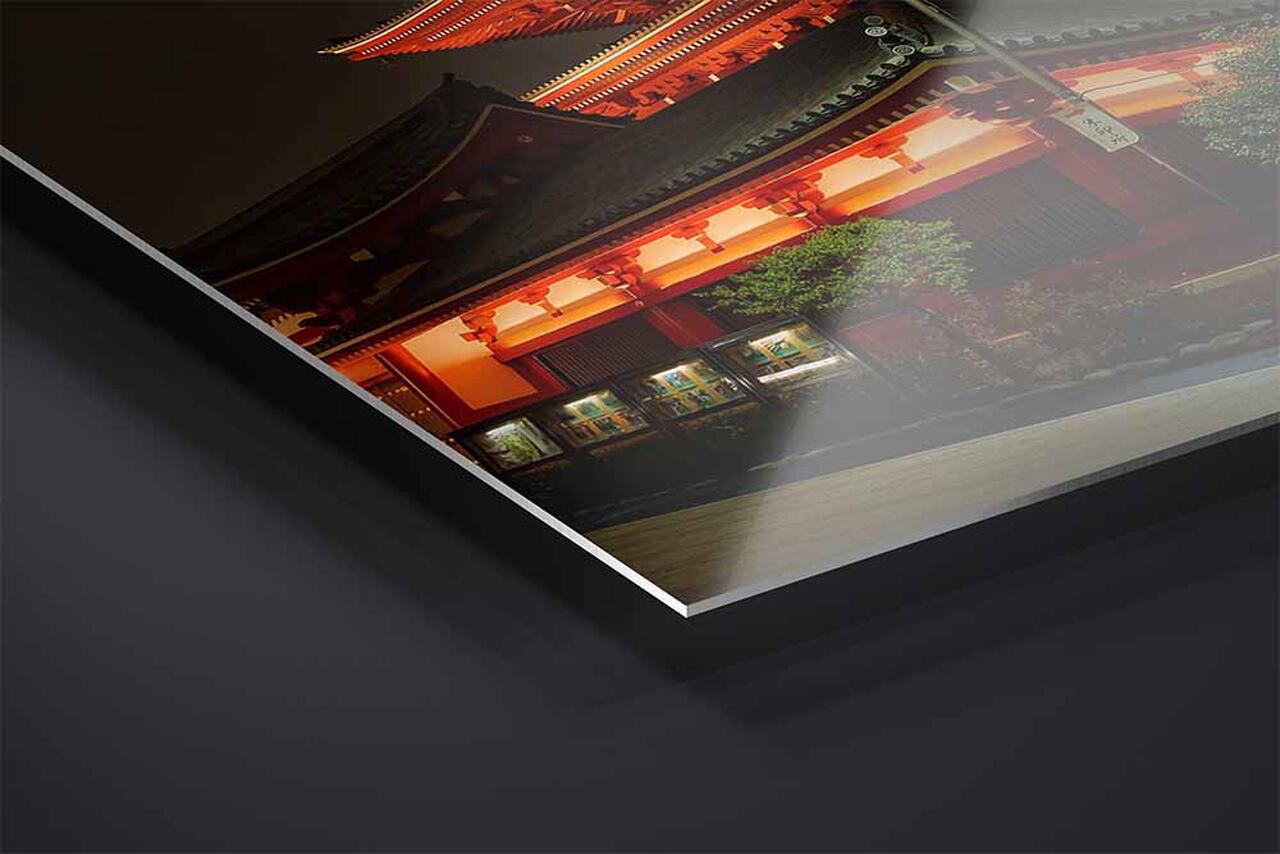
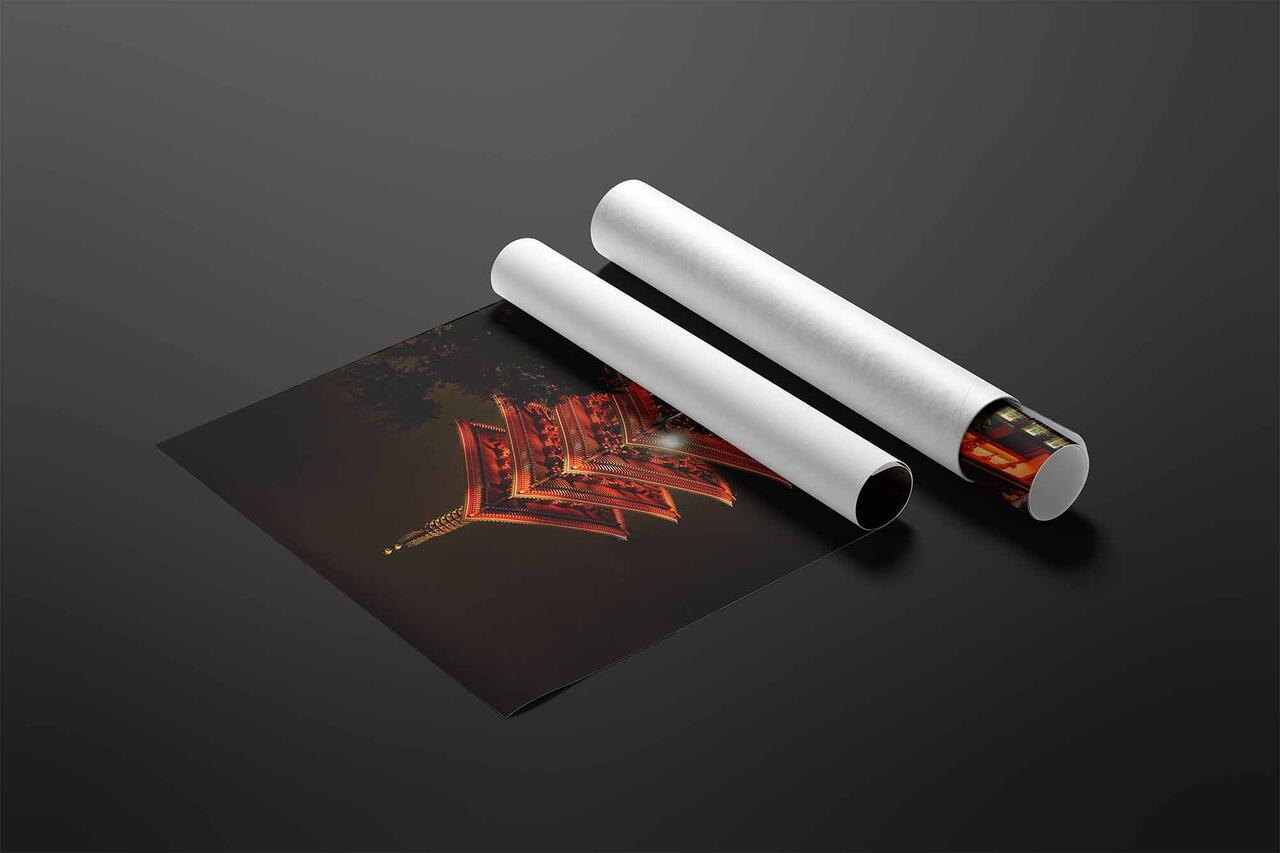
A 2:3 vertical photograph of the vermilion five-storied pagoda at Sensō-ji lit at night, Asakusa, Tokyo, Japan, available as a limited edition print in four sizes.
Artist's Story
I went to Asakusa in the evening to photograph the temples under their lights, having never been before, and set up on the concrete path beside the main hall at around nine o'clock.
The thing worth knowing about a five-storied pagoda is that it does not really hold together.
In the traditional construction the five stories are stacked rather than fastened into one rigid frame, and a central pillar called the shinbashira runs up through the middle without carrying any of them. When the ground moves, the stories shift against one another out of step, and the free pillar swings against that motion and cancels it. The building absorbs an earthquake by coming loose rather than by resisting. Japan sits on one of the most active seismic zones on the planet and has lost pagodas to fire and to lightning over the centuries, but almost never to shaking.
This one does none of that. A pagoda has stood on these grounds since 942 and Tokugawa Iemitsu rebuilt it in 1648, but that building burned in the Tokyo air raid of March 1945, and what I was standing under went up in 1973 in steel and reinforced concrete. It gets its earthquake resistance from modern engineering instead.
Two kilometers away, and visible from these grounds in daylight, Tokyo Skytree went the other direction. Its engineers hung a three hundred and seventy-five meter column down the center of the tower, connected to nothing, to swing against the building and cancel its sway. They called it a shinbashira.
Sacred Temple is a concrete pagoda that gave up the old solution, photographed from a path a few minutes' walk from a tower that borrowed it back.
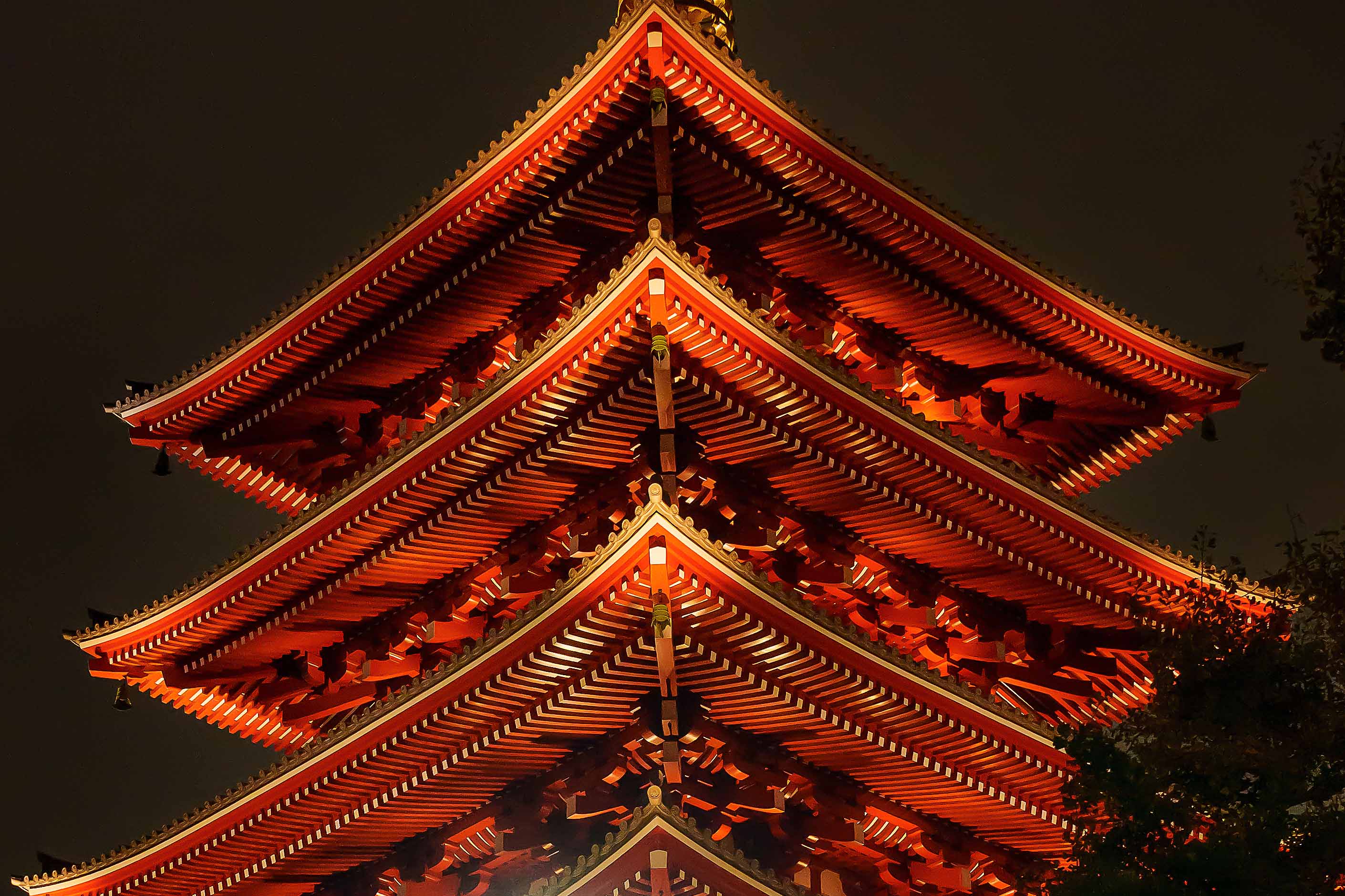
This crop is 50 percent of the frame width, about 20 inches across on the 40 inch print. The bracket complexes carrying each overhang separate into individual arms, layer above layer, and the shadows they throw on one another read as depth. Along every eave the rafter ends run in countable rows, and at the corners the small bells hang clear of the timber. Click to view at full size.
About This Photograph
The five-storied pagoda at Sensō-ji, in Asakusa, Tokyo. Single frame at night. A pagoda has stood on these grounds since 942 and was rebuilt by Tokugawa Iemitsu in 1648, but that building burned in the Tokyo air raid of March 1945. What stands here now went up in 1973, in steel frame and reinforced concrete.
The deep upward curve of the eaves is working rather than decorating. Each one projects far enough to keep rain off the walls below it, and the upward sweep throws water clear of the structure instead of letting it run back down the face. The same overhang admits low winter sun beneath it while cutting out high summer sun, so the building shades itself in one season and warms itself in the other.
Sacred Temple
Steve Austinhttps://www.steveaustinphotography.com/
Location
Sensō-ji, Asakusa, Tokyo, Japan
Subject
Sensō-ji · five-storied pagoda · Asakusa at night
Capture
Single frame, night
Format
Photograph · vertical, 2:3
Sizes
16 × 24 in · 24 × 36 in · 32 × 48 in · 40 × 60 in
Print Media
TruLife Acrylic · ChromaLuxe Metal · Baryta paper
Edition
Limited, 25 / 50 / 100 by presentation
What it Does in a Room
The light in this photograph comes from below, and every room you might hang it in is lit from above. The pagoda is uplit, so the undersides of the eaves are the brightest surfaces in the frame and the upper faces are dark, which is the reverse of how the eye expects a solid object to be lit. Hang it in a room with normal overhead light and the print's internal lighting direction contradicts the room's. That contradiction is not a fault, and it is a large part of why the building reads as staged and ceremonial rather than as a thing seen in passing. It is worth knowing because it means the piece will never blend into a room the way a daylit photograph does. It stays an object with its own conditions.
It has two states and almost nothing between them. Two thirds of the frame sits at or below twenty-five out of two hundred and fifty-five, and the lit structure covers under a tenth, at very high saturation. There is no substantial middle. That makes it unusually robust in one way and fragile in another. Robust, because there are no delicate mid-tones for poor light to flatten, so the picture survives a badly lit wall better than a photograph built on gradual transitions. Fragile, because the vermilion is doing all the work alone, and anything that reduces its saturation, a warm bulb, a strong ambient lift, a glossy surface catching the room, takes away the only thing the picture has.
And the eaves are a series. Five of them, stacked, parallel, evenly spaced, each one a bright horizontal against the dark. Nothing else in this collection contains repeated architectural geometry, and that changes what the picture does to the wall around it. A landscape's horizon is one line, and a shelf near it reads as a second line. Here the picture already establishes a rhythm, and any horizontal introduced nearby at a comparable spacing joins the sequence rather than sitting beside it. A run of shelves, a stair stringer, a picture rail, the top of a cabinet: the eye adds them to the count. Give it a plain wall and the series stays inside the frame where it belongs.
Not sure which size the room calls for, or want dimensions not listed here? Sizes beyond 40 × 60 are available on request and ship crated by freight. That conversation is welcome before an order is placed. Start that conversation and I will answer within one business day.
How small is too small for a photograph like this?
At the Intimate size the picture is sixteen inches across and twenty-four tall, and the shape holds easily. Five bright tiers against black is about as reduction-resistant as a subject gets. What goes is the carpentry. Under every eave sits a dense field of bracket work, the stacked arms that carry the overhang, and at this size it merges into a warm blur. That blur is most of what the photograph is actually made of. The finial at the top loses its stacked rings and becomes a spike. The Collected at twenty-four by thirty-six brings the brackets back as separate members. The Expansive at thirty-two by forty-eight is where the roof tiles begin to count. If you are weighing a size against a specific wall, choosing the right print size covers the measurements and the viewing distances in more detail.
What changes at the largest size?
At forty by sixty, working down the frame: the gilded finial resolves into its separate stacked rings with the sky visible between them. Beneath each eave the bracket complexes separate into individual arms, layer over layer, and the shadows they throw on one another become legible. Along every eave edge the roof tiles become countable, and at the corners the small bells hang clear of the timber. On the hall below, the painted beam running above the doors shows its carved ornament and the grain of the boards beneath it. At the lower left the noticeboard resolves into separate posted panels. And where the lamp reaches the tree, individual leaves separate from the mass. Why scale matters covers what happens perceptually when a photograph reaches the size where the eye has to cross it.
What kind of room does this photograph suit?
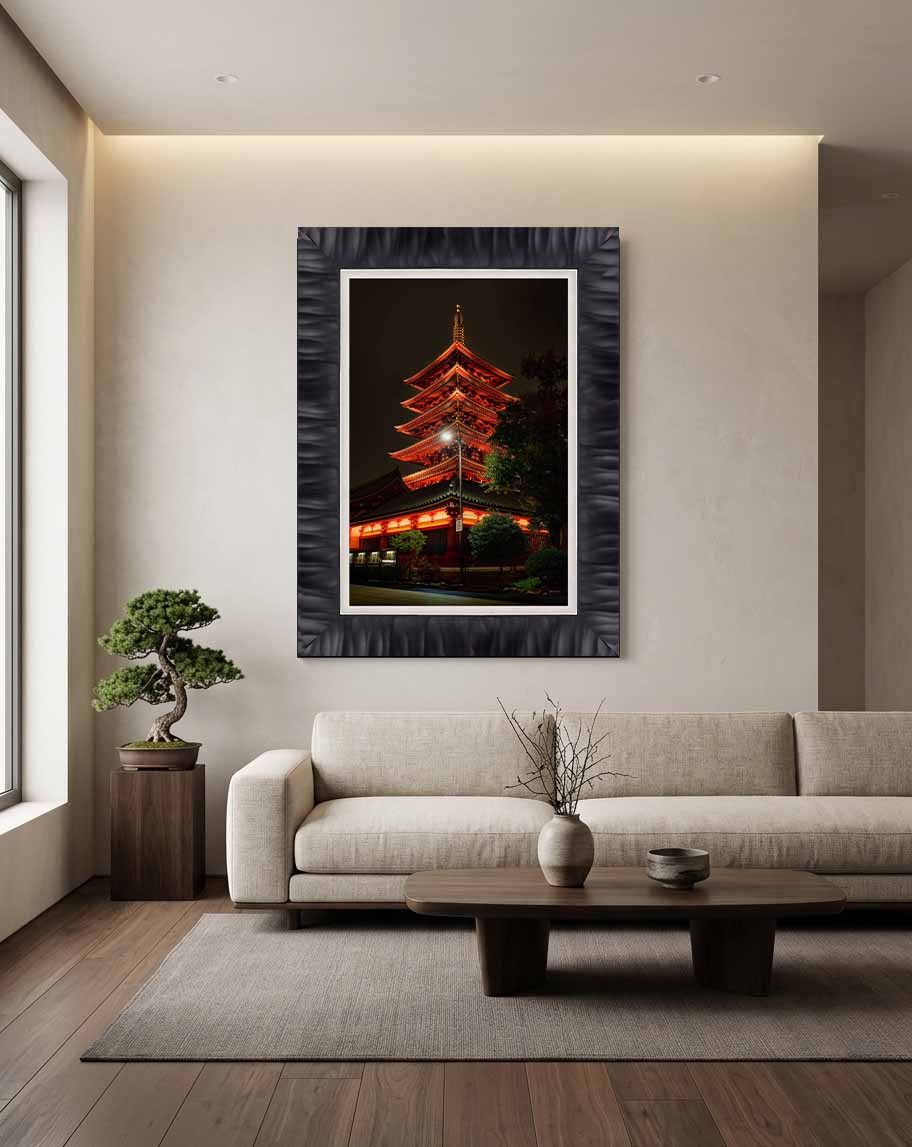
A dark room and a plain wall. A study, an entry, a stair, a dining room used in the evening, a hall. Hang it with the center at about sixty inches, higher than standard, since the subject sits in the upper half of the frame. On materials it wants charcoal and deep neutrals, matte throughout, and it is one of the few pieces here that will take dark timber without argument. Three things to avoid. Keep shelving, rails, and any run of repeated horizontals out of the same view for the reason above. Do not use uplighting anywhere in the room, because the picture is already lit from below and a second uplit surface competes with the effect the photograph depends on. And do not hang it on a warm-toned wall, since the vermilion is the only color in the frame and a warm surround dilutes the one thing it has. When your mind needs to rest takes the question further.
Every work ships insured and arrives with a signed certificate of authenticity.
If a piece is damaged in transit, the choice of replacement is always yours, and your edition number stays with you.
Production time runs 2 to 3 weeks for metal, 3 to 4 weeks for acrylic and paper, and 5 to 6 weeks for framed work.
Each print is made to order and takes its place in a numbered edition, so sales are final. Before you choose, I am glad to help: send a photo of your wall and I will show you this work in your room at true scale, at no charge. Start a conversation
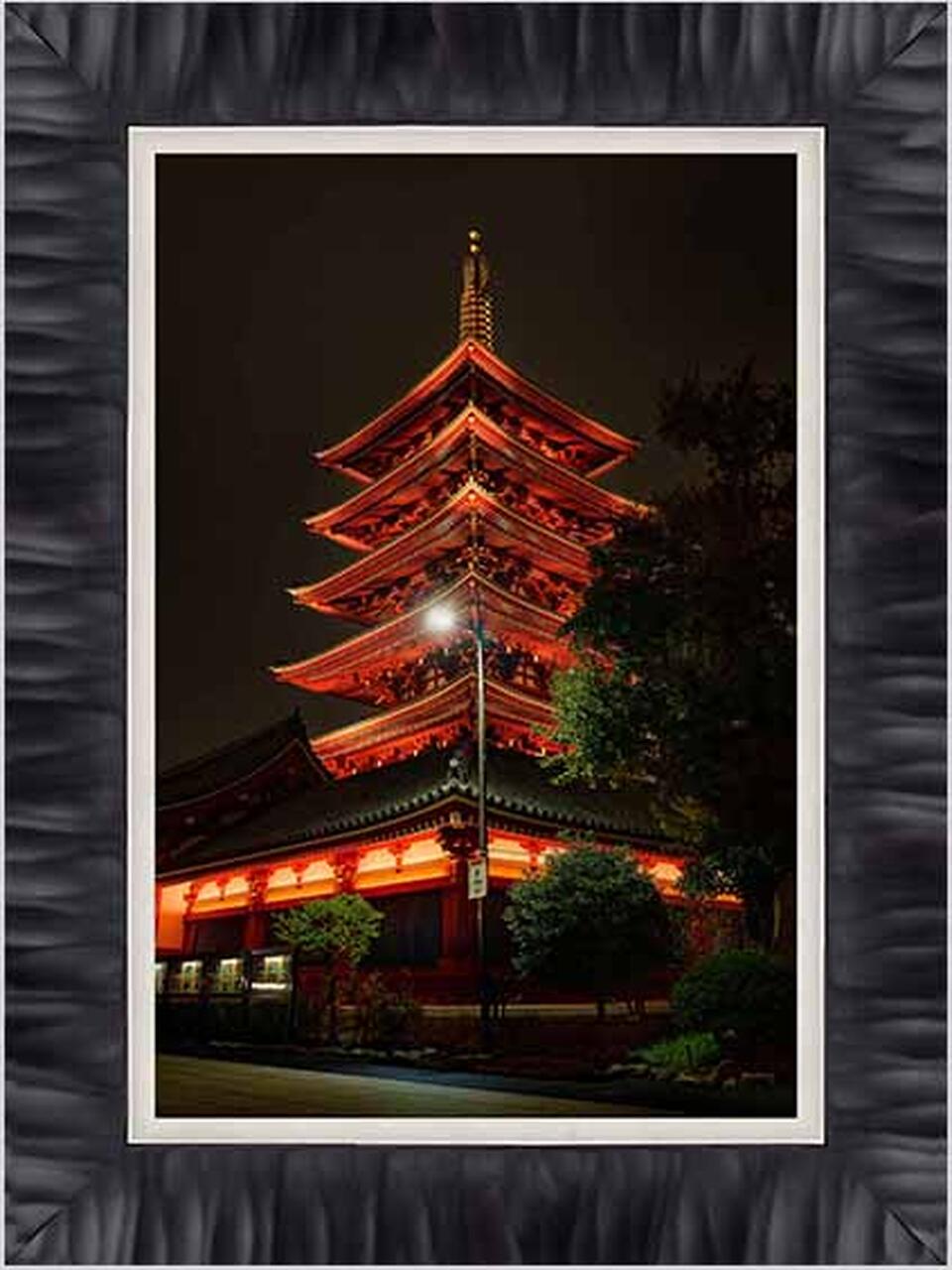
Collector's Choice · TruLife ® Acrylic in Italian Frame
Collector Edition of 25· Lumachrome TruLife Acrylic · Handcrafted Italian Frame
TruLife acrylic in a handcrafted Italian frame with a linen liner chosen for the image. Frame series, finish, and liner are settled with you after the order, and production begins from there. The frame and liner add about fourteen inches to the finished dimensions, worth allowing for when planning placement.
Signature Acrylic Edition of 50· Lumachrome TruLife · Gallery Float Mount
Face-mounted to TruLife acrylic and floated approximately one inch from the wall, with no frame to mediate between the image and the room. UV-resistant, anti-reflective, and scratch-resistant, with a lifetime guarantee against fading.
Signature Metal Edition of 50· ChromaLuxe Print · Gallery Float Mount
Color infused into the aluminum panel itself, floated from the wall on a concealed system. Where acrylic produces luminosity, metal produces clarity. Exceptional fade resistance with no glazing or coating required.
Fine Art Edition of 100· Hahnemühle Baryta Fine Art Paper
Printed without acrylic, so light meets the paper surface directly. Highlights stay luminous, shadows keep their nuance, and the surface has a tactile quality the other presentations approach differently. The understated choice, and the traditional one.
Complimentary shipping within the continental United States. International collector shipping available upon request.
Still deciding
Designing for Stillness
A guide to choosing art for restorative spaces
How to tell whether an image will still hold you in a year, how scale changes what a photograph does in a room, and how to match a piece to the work a room actually performs. It cites the research it draws on, and it is equally clear about where that research stops. About ten minutes to read.