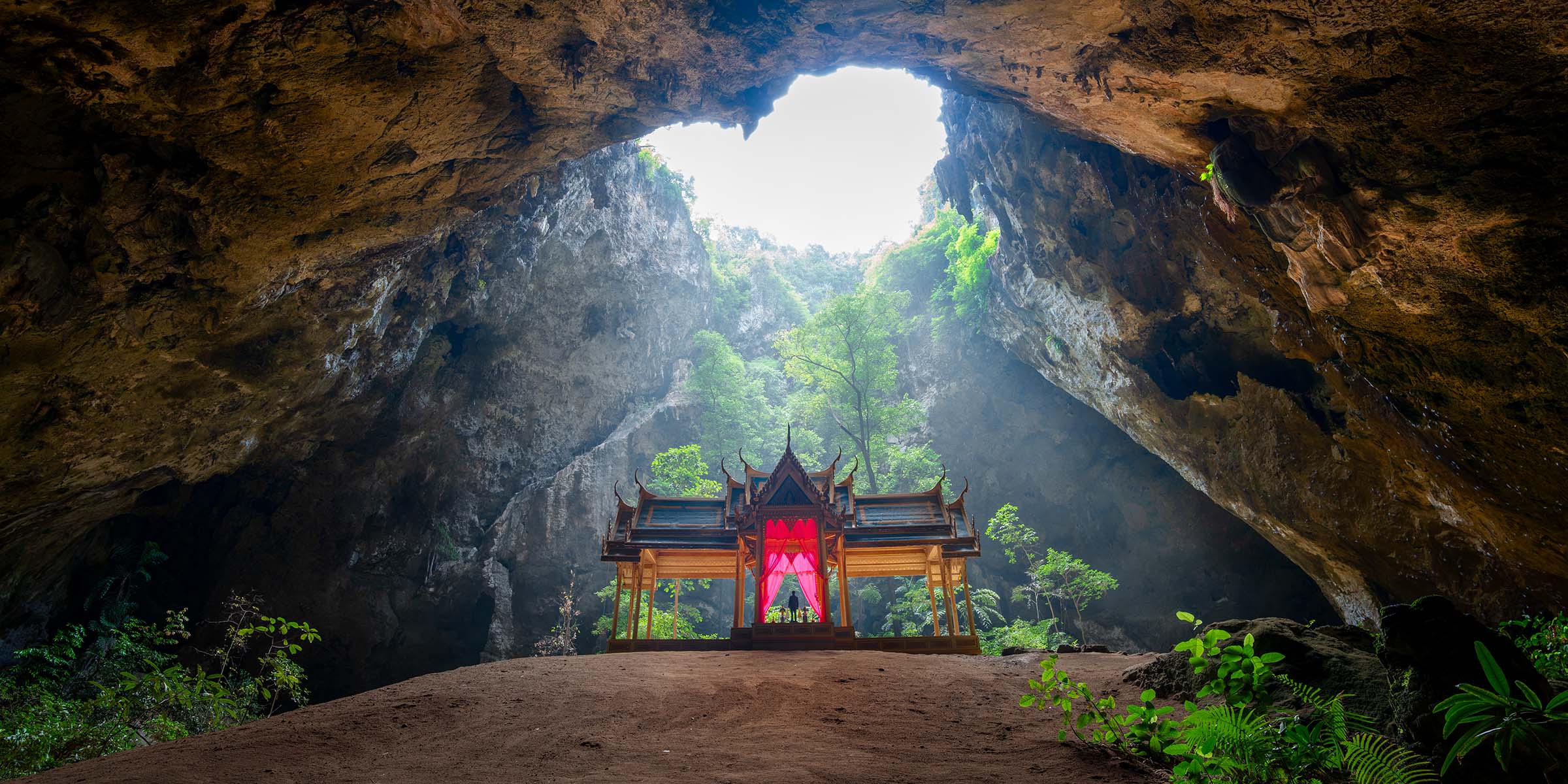
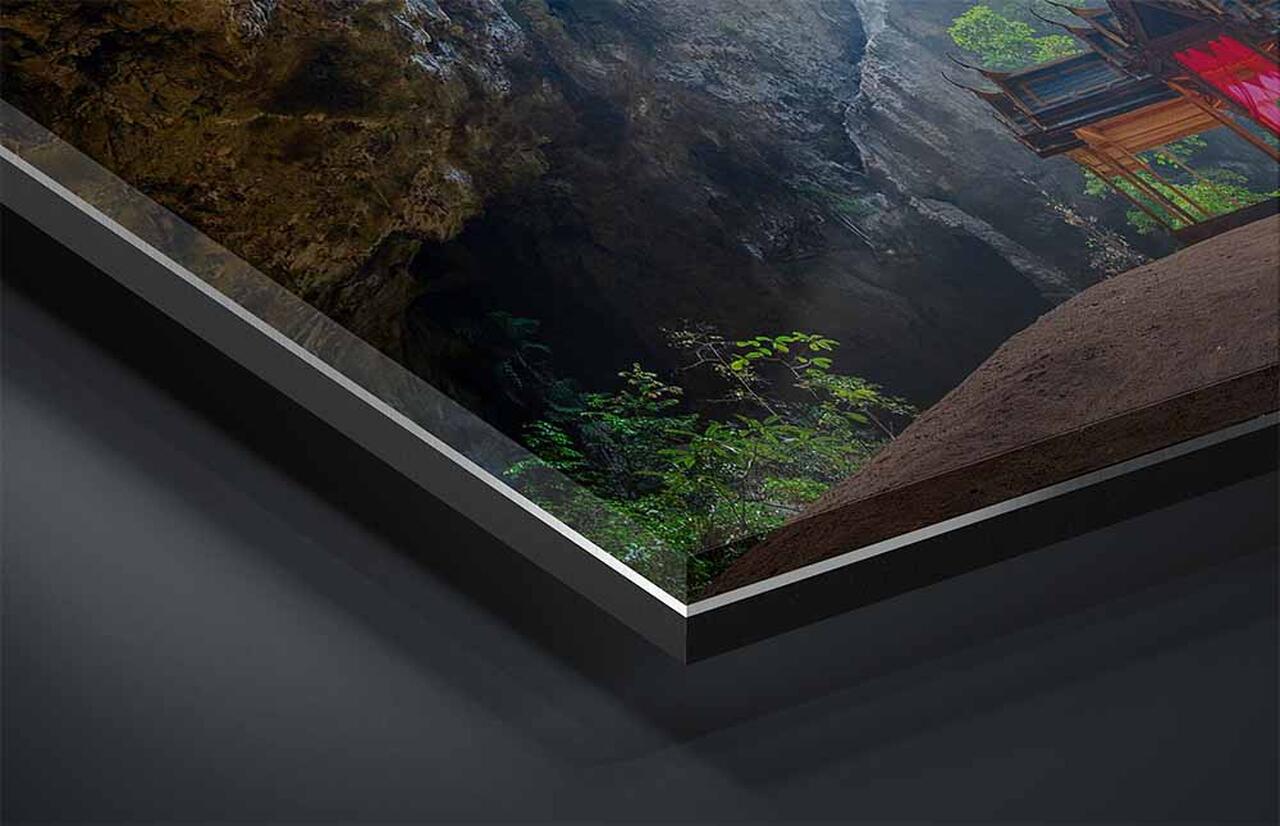
A 2:1 panoramic photograph of the royal pavilion in Phraya Nakhon Cave, Thailand, available as a limited edition print in three sizes.
Artist's Story
I made this climb several times before I got the picture. It is a four hundred and thirty meter haul of steep uneven steps up from the beach, in heat, and the cave at the top has a hole in its roof.
The building under the hole is Kuha Karuhas, put up in 1890 for a visit by King Rama V. It is not a temple. It is a royal pavilion, and it stands where it stands on purpose, because the sun comes through the collapse and lands on it between about ten and half past eleven in the morning, and best from November through March. Outside that window the beam misses. My earlier trips were not unlucky. They were the wrong hour.
This one was the right hour. There is a man standing in the doorway of the pavilion, and he is the only thing in the frame that tells you how large the cave is.
The roof came down a long time ago and enough daylight reaches the floor through the two openings that a forest grows in here. The trees behind the pavilion are underground. So is the grass, and the ferns along the edges.
The Light Gets In is the hole, the pavilion beneath it, the man in the doorway, and a forest growing inside a mountain because a ceiling failed.
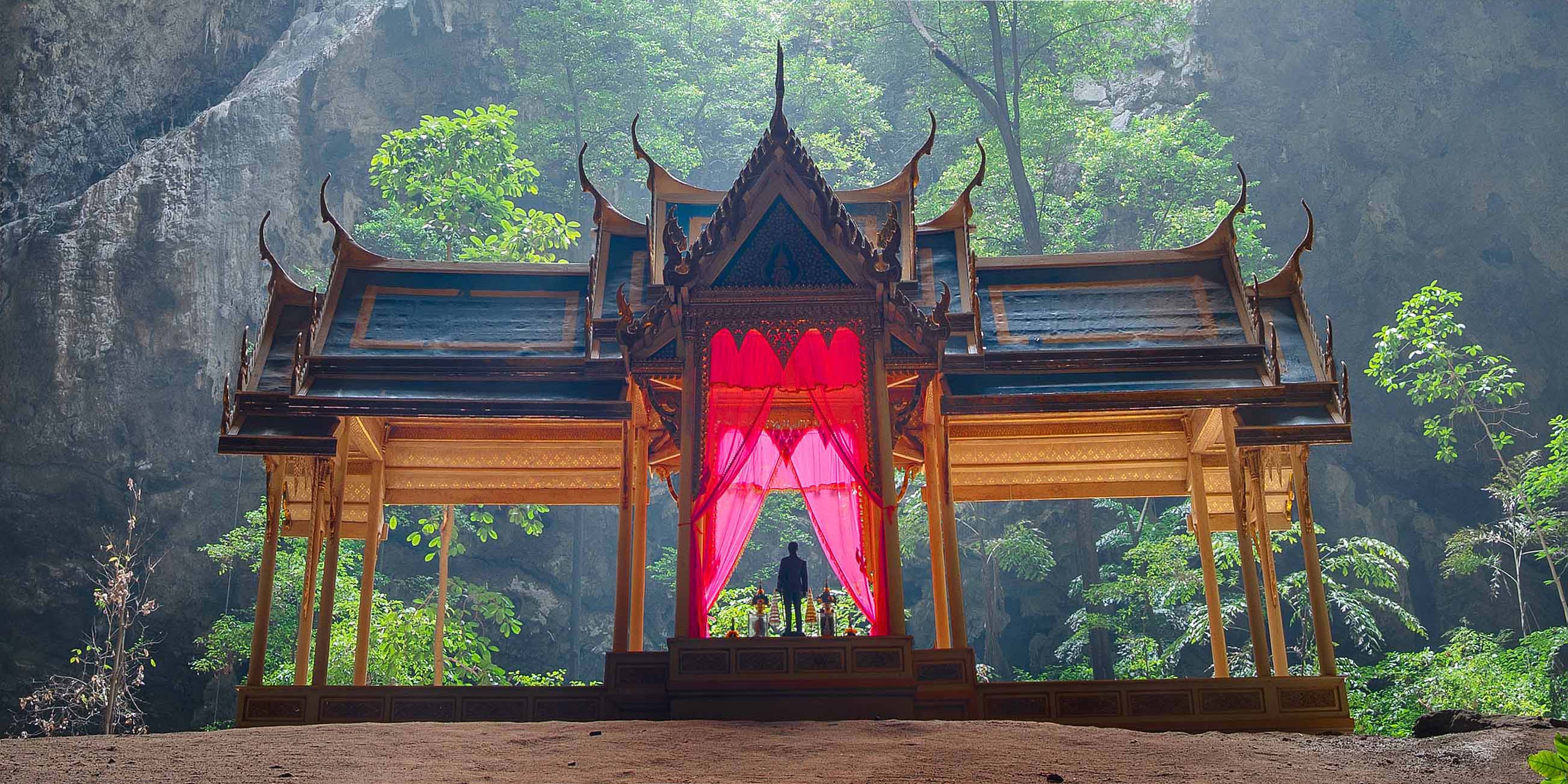
The pavilion at about a third of the frame width. On an eighty inch print this section runs roughly twenty-seven inches across. The roof tiers separate, the carved finials stand clear against the trees, the gilding on the columns reads as applied metal, and the red hanging resolves into folded cloth with light coming through it. Click to view at full size.
About This Photograph
In Phraya Nakhon Cave, in Khao Sam Roi Yot National Park, Prachuap Khiri Khan Province, Thailand, in mid-morning. This is a single frame image. The frame looks from inside the outer chamber toward the second, where the Kuha Karuhas pavilion stands on the cave floor beneath a collapsed section of roof, with a figure in its doorway.
The pavilion is a royal sala rather than a temple, built in 1890 for the visit of King Rama V, and it appears on the provincial seal. The cave has two chambers and both roofs have collapsed, which is why trees and undergrowth are able to grow on the floor.
The cave takes its name from Phraya Nakhon, who is said to have sheltered here from a storm. It is reached by boat to Laem Sala Beach or on foot over the headland, then a four hundred and thirty meter climb of steep uneven steps.
The Light Gets In
Steve Austinhttps://www.steveaustinphotography.com/
The picture frames itself. All four edges of this photograph are cave rock in deep shadow, running as low as five on a scale to two hundred and fifty-five, while the opening at the center reaches two hundred and forty-three. That is the widest span of any file in the collection, and it means the panel does not read as a rectangle of image sitting on a wall. It reads as a hole in the wall, because its own boundary is darker than almost any moulding you could put around it.
That structure repeats going in. The cave mouth is the first opening, the collapsed roof beyond it is the second, the pavilion doorway is the third, and the man standing in it is the fourth thing you notice. Four apertures nested inside each other, each smaller and brighter than the one before. On a wall that produces a long, staged approach rather than an immediate impression: you see a dark shape, then a bright hole, then a building, then a person, and each step takes a moment.
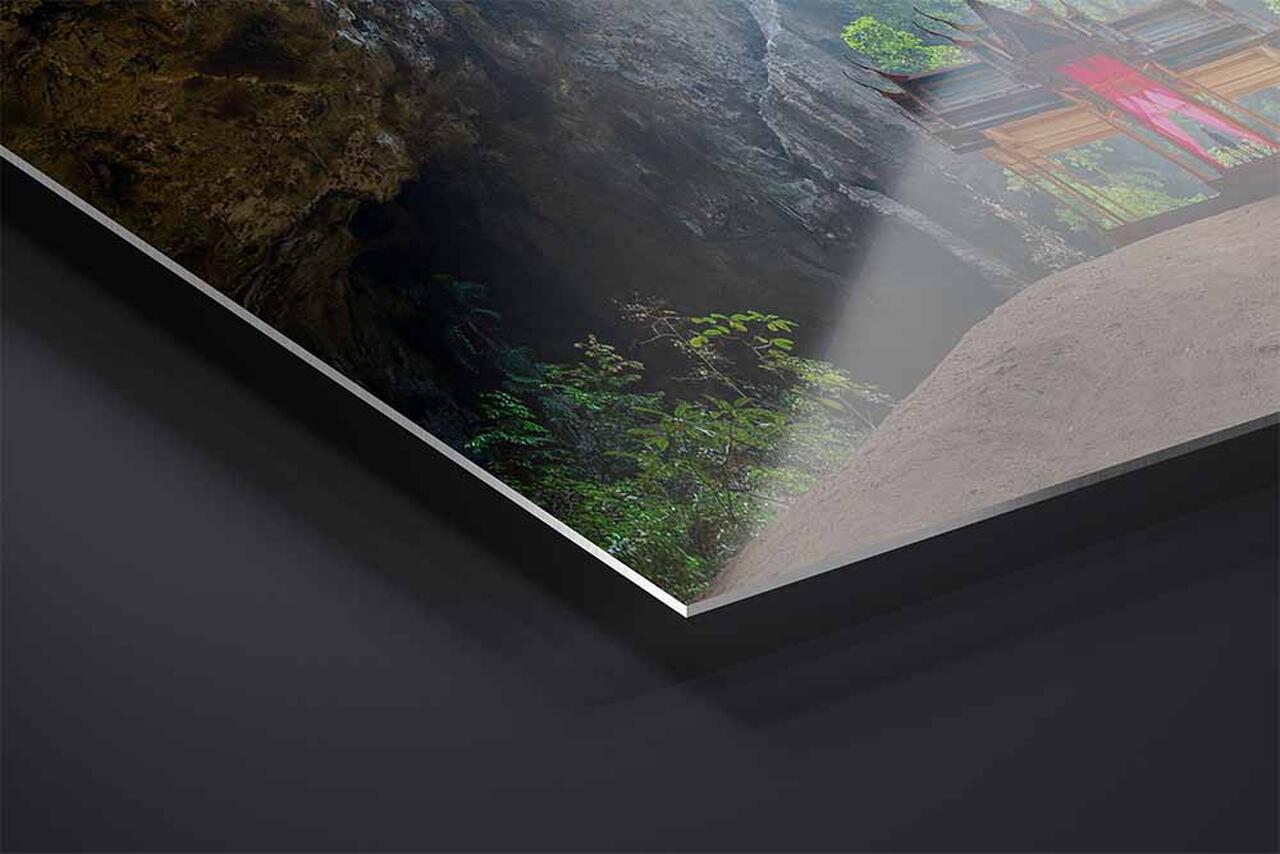
This is also the one photograph in the collection where the presentation choice changes the picture. Two percent of the frame sits at pure black and the range runs the full scale, so the medium has to hold both ends. On acrylic the shadows stay deep and the opening stays luminous, which is what the picture is built on. On paper the blacks lift and the cave becomes gray, which is a softer and more atmospheric object and a legitimate one, but a different photograph. Worth seeing both before deciding.
Not sure which size the room calls for, or want dimensions not listed here? Sizes beyond 80 × 40 are available on request and ship crated by freight. That conversation is welcome before an order is placed. Start that conversation and I will answer within one business day.
The Light Gets In, limited edition printSteve Austin112513400USD12https://schema.org/InStock
Questions about this photograph
How small is too small for a photograph this wide?
At two to one, the Intimate size is forty inches across and twenty inches tall. That is a comfortable panoramic proportion and the composition survives it, because the structure is a dark surround with a bright opening and that reads from any distance at all. What goes at that size is everything inside the opening. At forty by twenty the pavilion is about four inches wide, so its tiered roofs merge into one shape, the gilding flattens to a warm tone, and the man in the doorway becomes a mark rather than a person. The cave keeps its scale and loses its subject. That is a real photograph and a graphic one, and it suits a wall seen from six or eight feet. The Collected at sixty by thirty is where the pavilion becomes a building again and the figure becomes a figure. If you are weighing a size against a specific wall, choosing the right print size covers the measurements and the viewing distances in more detail.
What changes at the largest size?
The pavilion becomes architecture. At the Statement size, eighty by forty, it stands about eight inches wide in the frame, enough that the tiers of the roof separate, the carved finials at each ridge come clear against the trees, and the gilding on the columns reads as applied metal rather than as color. The red hanging in the doorway resolves into folded cloth. The man in front of it becomes a man, in clothing, at a scale that finally tells you the cave is the size of a cathedral. The rock changes at the same width, the ceiling above opening into flowstone and fracture, and the trees behind the pavilion separating into individual trunks growing out of a cave floor. Why scale matters covers what happens perceptually when a landscape reaches the size where the eye has to cross it.
What kind of room does this photograph suit?
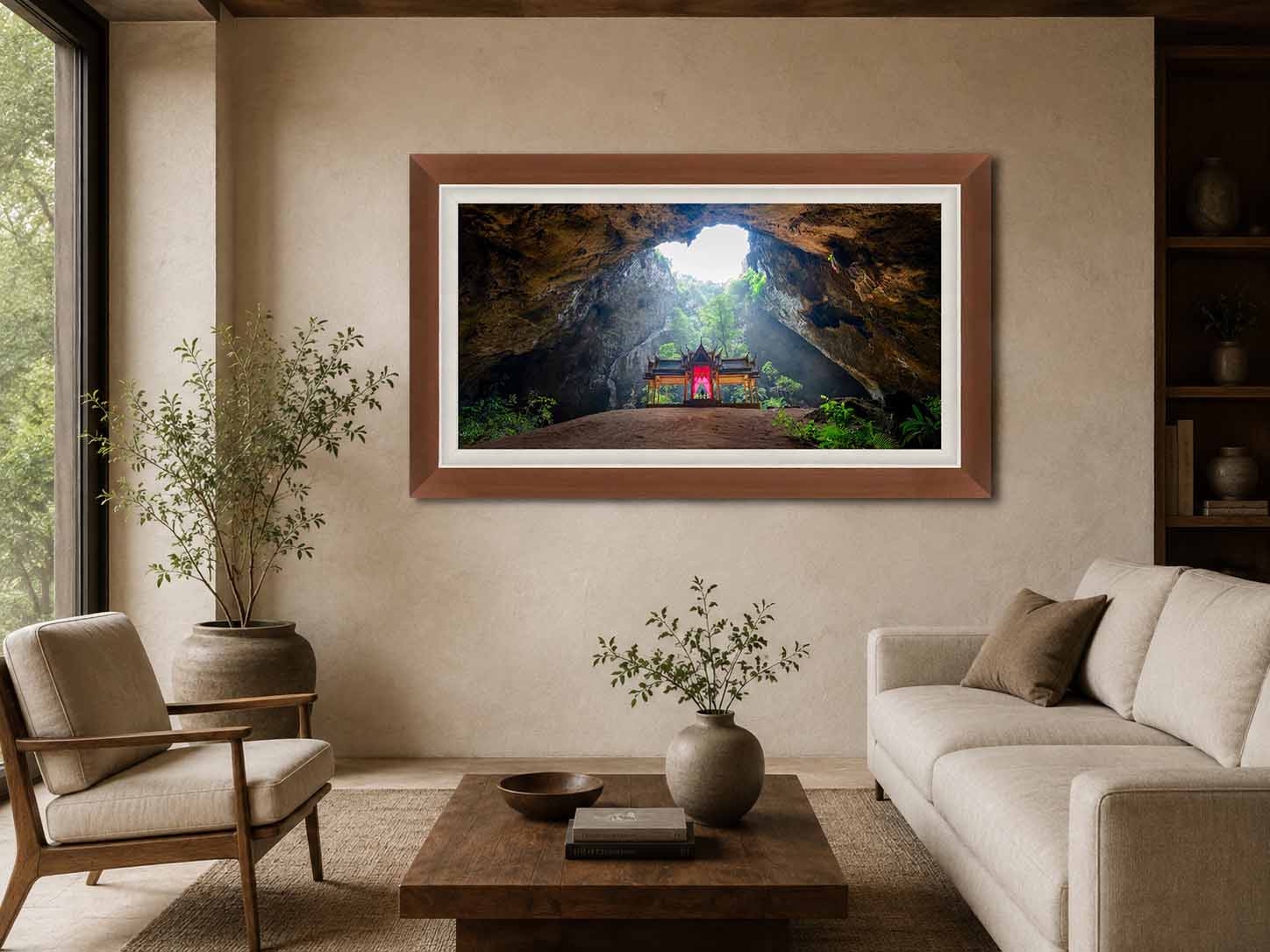
Rooms with light in them, and walls that can take something dark. This is the darkest photograph in the collection and it wants a lit wall: with a picture light or a lamp within a few feet, the cave opens up and the rock reveals its texture, while in flat overhead light it reads as a silhouette with a bright center. Both are true to the picture, but the first is the one it was made for. It belongs against warm surfaces, plaster, stone, walnut, leather, brass, because the whole frame runs warm to the edges. And because it reads as an opening rather than as an object, it does something useful on an interior wall with no window near it, where a room can use the suggestion of somewhere else. You are not buying scenery takes the question further.
Every work ships insured and arrives with a signed certificate of authenticity.
If a piece is damaged in transit, the choice of replacement is always yours, and your edition number stays with you.
Production time runs 2 to 3 weeks for metal, 3 to 4 weeks for acrylic and paper, and 5 to 6 weeks for framed work.
Collector's Choice · TruLife ® Acrylic in Italian Frame
Collector Edition of 25· Lumachrome TruLife Acrylic · Handcrafted Italian Frame
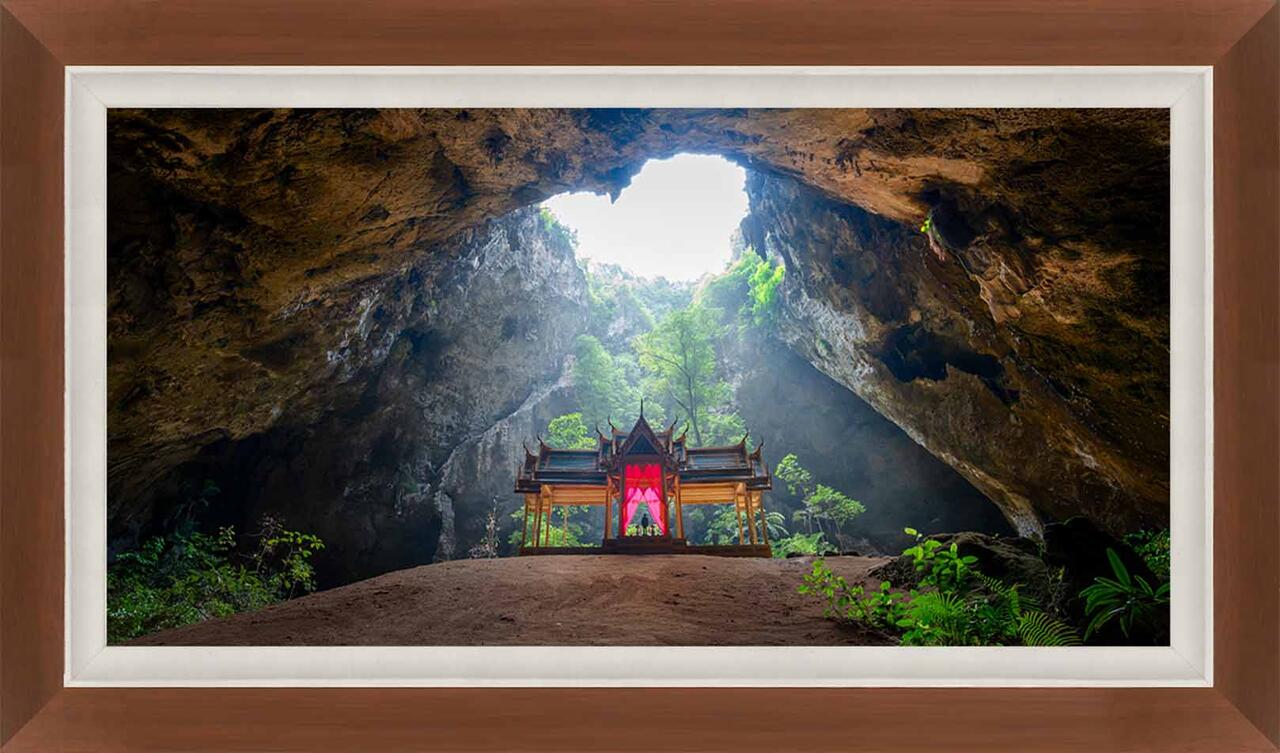
TruLife acrylic in a handcrafted Italian frame with a linen liner chosen for the image. Frame series, finish, and liner are settled with you after the order, and production begins from there. The frame and liner add about fourteen inches to the finished dimensions, worth allowing for when planning placement.
Signature Edition · TruLife ® Acrylic, Float Mount
Signature Edition of 50· Lumachrome TruLife Acrylic · Gallery Float Mount
Face-mounted to TruLife acrylic and floated approximately one inch from the wall, with no frame to mediate between the image and the room. UV-resistant, anti-reflective, and scratch-resistant, with a lifetime guarantee against fading.
Signature Edition of 50· ChromaLuxe Metal Print · Gallery Float Mount
Color infused into the aluminum panel itself, floated from the wall on a concealed system. Where acrylic produces luminosity, metal produces clarity. Exceptional fade resistance with no glazing or coating required.
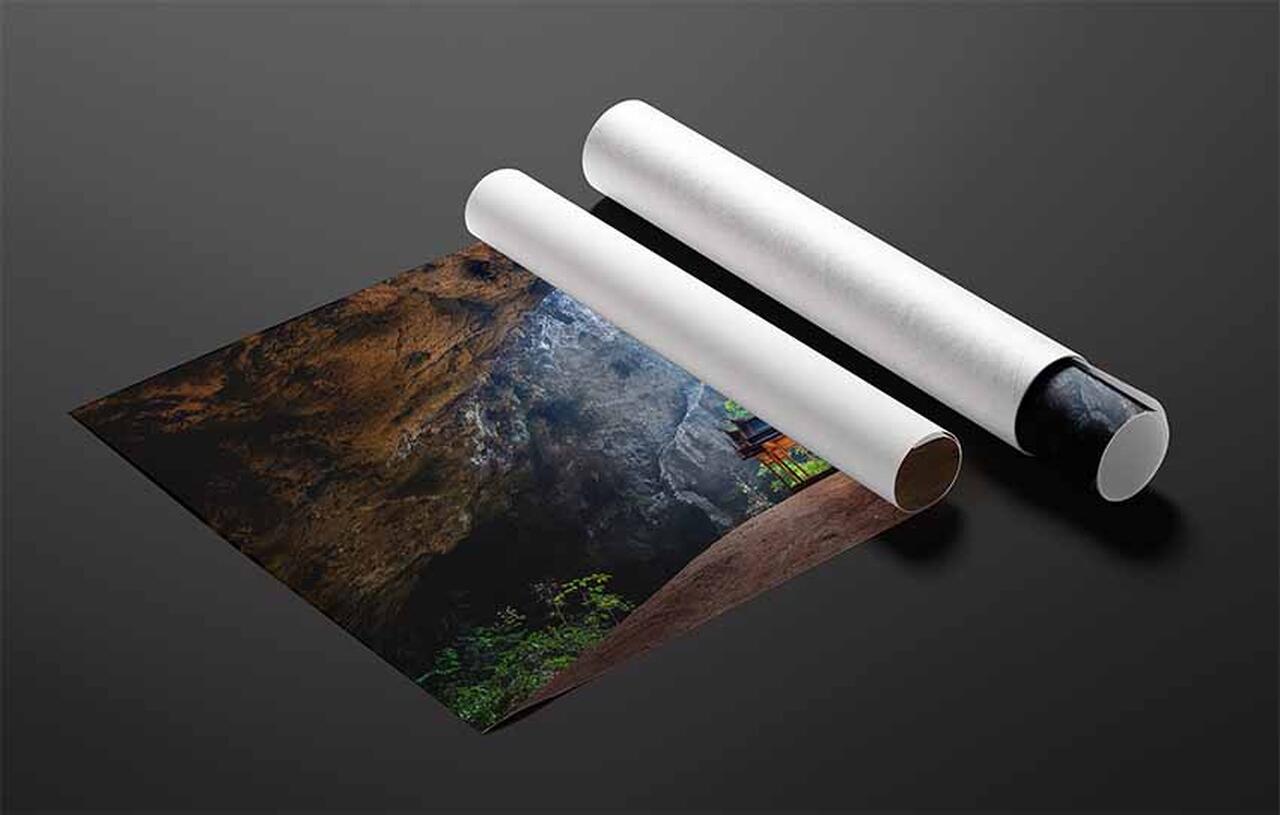
Fine Art Edition of 100· Hahnemühle Baryta Fine Art Paper
Printed without acrylic, so light meets the paper surface directly. Highlights stay luminous, shadows keep their nuance, and the surface has a tactile quality the other presentations approach differently. The understated choice, and the traditional one.
Complimentary shipping within the continental United States. International collector shipping available upon request.
Still deciding
Designing for Stillness
A guide to choosing art for restorative spaces
How to tell whether an image will still hold you in a year, how scale changes what a photograph does in a room, and how to match a piece to the work a room actually performs. It cites the research it draws on, and it is equally clear about where that research stops. About ten minutes to read.